
15 No-Headboard Bedroom Ideas That Still Look Intentional
A bed without a headboard has a reputation it doesn’t deserve. Most people assume the look is unfinished — like furniture that hasn’t arrived yet or a bedroom that hasn’t been decorated.
Done deliberately, the opposite is true. A bed without a headboard forces every other element in the room to work harder, and the result is often more interesting than a bed with a headboard anchoring the entire wall.

The difference between a bedroom that looks intentionally headboard-free and one that looks like it’s missing something almost always comes down to what happens on the wall behind the bed. These fifteen ideas cover wall treatments, textile approaches, lighting strategies, and furniture choices that make a no-headboard bed look considered rather than incomplete.
1. Install a Large Piece of Art at Headboard Height
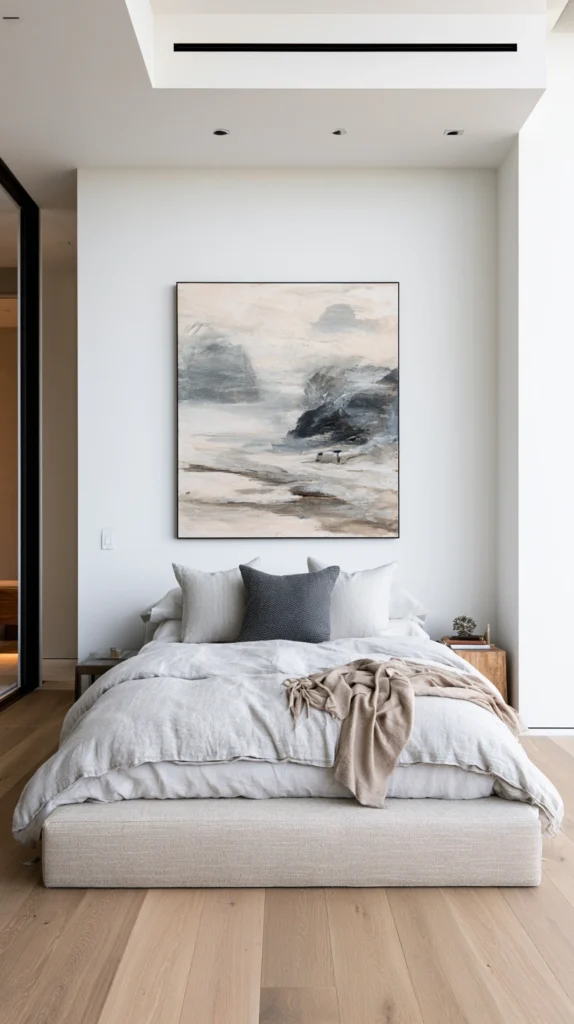
A single large-format artwork mounted at the same height and approximate width as a headboard would occupy performs the same visual function — it anchors the bed to the wall and gives the eye something to land on above the pillows.
The key is scale. A small print above a king bed looks like a forgotten accent piece. The art should be at minimum 60% of the bed width — a king bed at 76 inches wide needs art at least 45 inches across to anchor the wall properly.
Large-format art doesn’t have to be expensive. A canvas gallery wrap printed from a digital file at a print shop runs $30–$80 in sizes up to 24×36 inches. Multiple panels — a diptych or triptych hung with consistent spacing — cover a wider width for less cost per piece.
For the placement, center the artwork horizontally above the bed and hang the bottom edge approximately 4–6 inches above the top pillow line. Any higher and the connection between bed and art weakens.
Tip: Choose art with at least one horizontal element — a landscape, a horizon line, a wide abstract gesture — rather than a vertical composition. Horizontal art at headboard height reinforces the horizontal quality of the bed itself. Vertical art above a bed creates an upward pull that makes the composition feel unresolved.
Budget: $30–$100
2. Create a Gallery Wall That Functions as the Headboard Zone
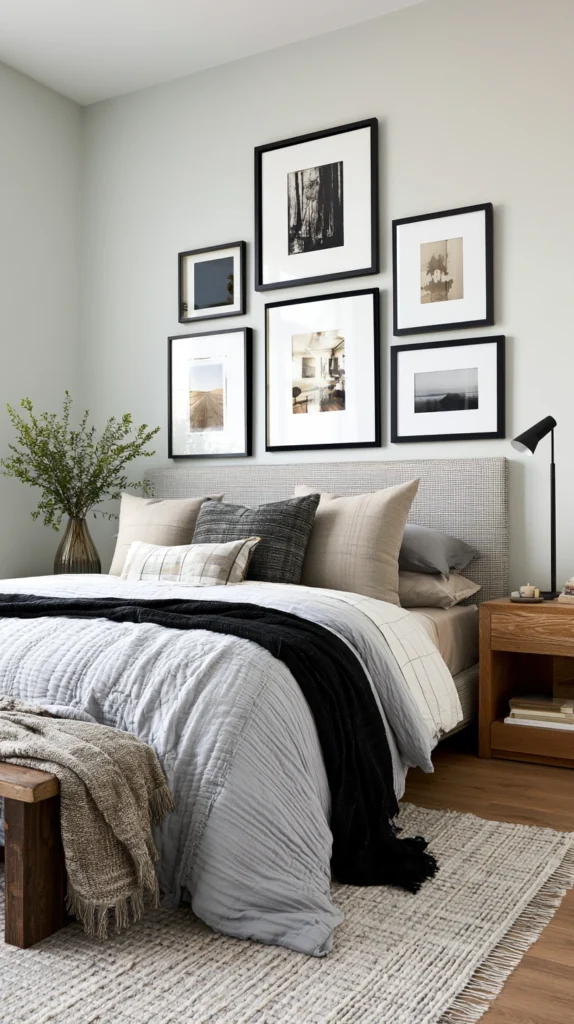
A gallery wall behind the bed — positioned within the same visual zone a headboard would occupy — creates a headboard-like mass through accumulated smaller pieces rather than a single large one.
The gallery wall approach works best when it has a defined boundary. Rather than spreading prints across the full wall from floor to ceiling, constrain the arrangement to the zone between 4 inches above the pillows and 18–24 inches above that. This contained gallery reads as a deliberate headboard-height feature rather than general wall decor.
Within that zone, mix frame sizes and orientations but keep the palette consistent. Black frames, or natural wood frames, or a single metallic finish throughout the arrangement creates the unity that makes mixed-size gallery walls read as designed rather than random.
Print files from Etsy at $3–$8 each, printed at a local print shop. Simple frames from IKEA’s RIBBA or SANNAHED lines run $5–$12 each.
Tip: Before hammering a single nail, lay the full arrangement on the floor and photograph it from above. Then tape paper templates of each frame to the wall using painter’s tape. Assess from the doorway before committing any frame to a permanent position.
Budget: $40–$100 for a complete gallery arrangement
3. Apply Wallpaper to the Bed Wall Only
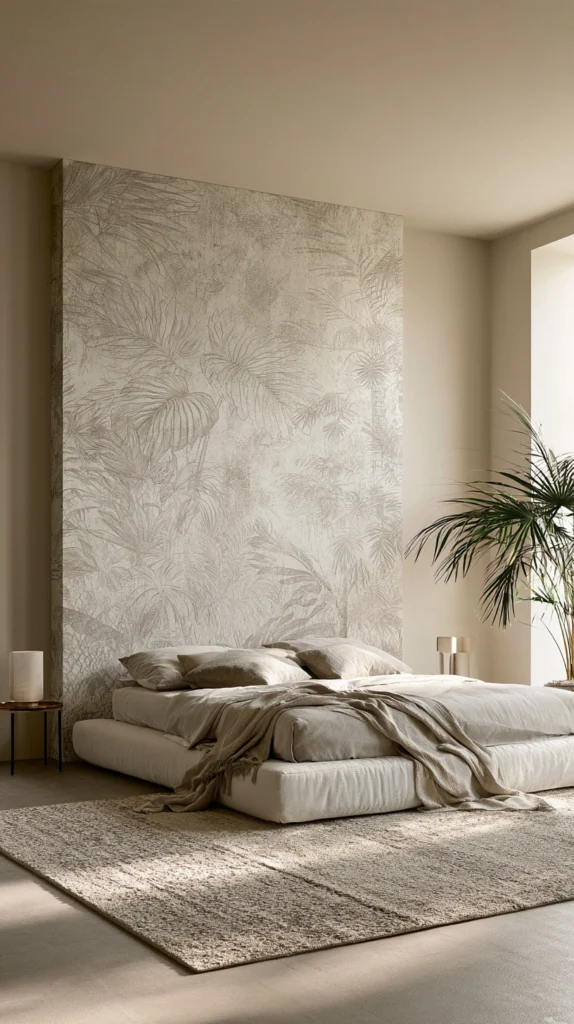
A wallpapered bed wall in an otherwise painted room does exactly what a headboard does — it marks the sleeping end of the room as architecturally different from the rest.
The wallpaper approach works particularly well in no-headboard bedrooms because it creates visual weight behind the bed without adding any object to the space. The wall becomes the headboard — not as a metaphor but as a functional design decision.
For the most headboard-like effect, apply the wallpaper only to the section of wall that a headboard would cover rather than the full wall width. Floor-to-ceiling wallpaper on the full bed wall is striking but reads as an accent wall. Wallpaper applied in a panel shape — 6–8 inches wider than the mattress on each side, from baseboard to ceiling — reads specifically as a bed feature.
Peel-and-stick options from NuWallpaper or Chasing Paper run $25–$55 per roll and remove cleanly without wall damage.
Tip: Choose a wallpaper with a vertical pattern element — vertical stripes, vertical botanical stems, or a pattern with a clear upward movement. Vertical pattern behind the bed draws the eye upward and makes the ceiling feel higher, which improves the bedroom’s spatial quality.
Budget: $25–$65
4. Mount a Wooden Ledge or Floating Shelf at Pillow Height
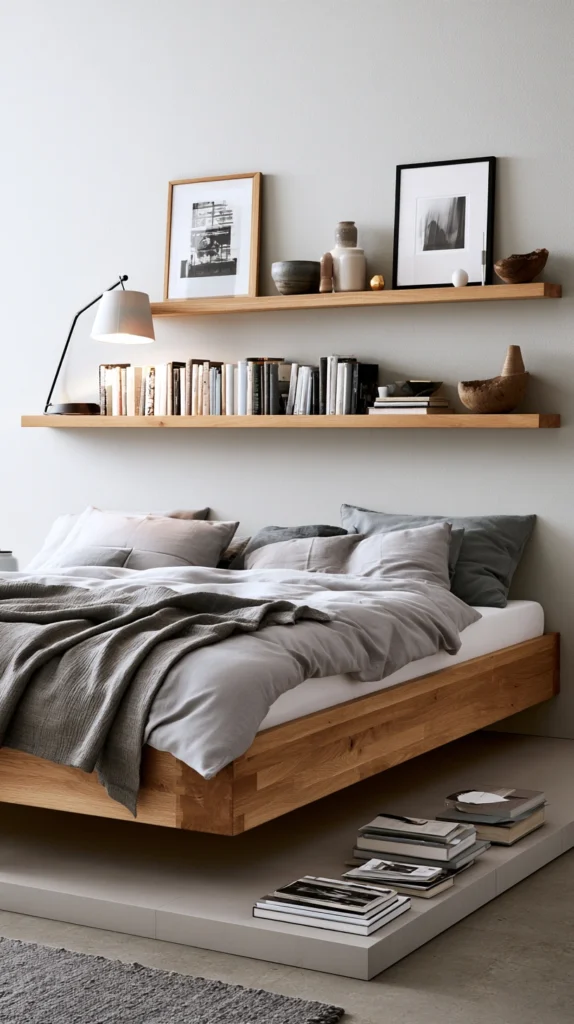
A floating shelf or wooden ledge mounted at the height where a headboard’s top edge would sit — typically 24–36 inches above the mattress — creates a practical headboard substitute that also functions as storage.
The shelf holds everything that a bedside table holds but positions it at pillow level rather than table height: a reading lamp, a water glass, a book, a small plant, a phone charger. Both sides of the bed benefit simultaneously from one continuous shelf rather than two separate tables.
For a headboard-like quality, use a shelf that spans the full bed width plus 6–8 inches on each side — the same overhang a headboard would have. A single plank of walnut, oak, or reclaimed pine at 8–10 inches deep, finished with Danish oil or clear wax, reads as warm and deliberate.
A 6-foot section of 1×10 hardwood runs $25–$50. Floating shelf brackets rated for the load run $10–$20.
Tip: Mount the shelf into wall studs rather than drywall anchors. A shelf at headboard height will hold a lamp, a glass of water, and books — more weight than most drywall anchors are reliably rated for over time. Stud mounting is the correct approach for any shelf that carries regular load.
Budget: $35–$75
5. Use a Fabric Panel or Tapestry as a Soft Headboard
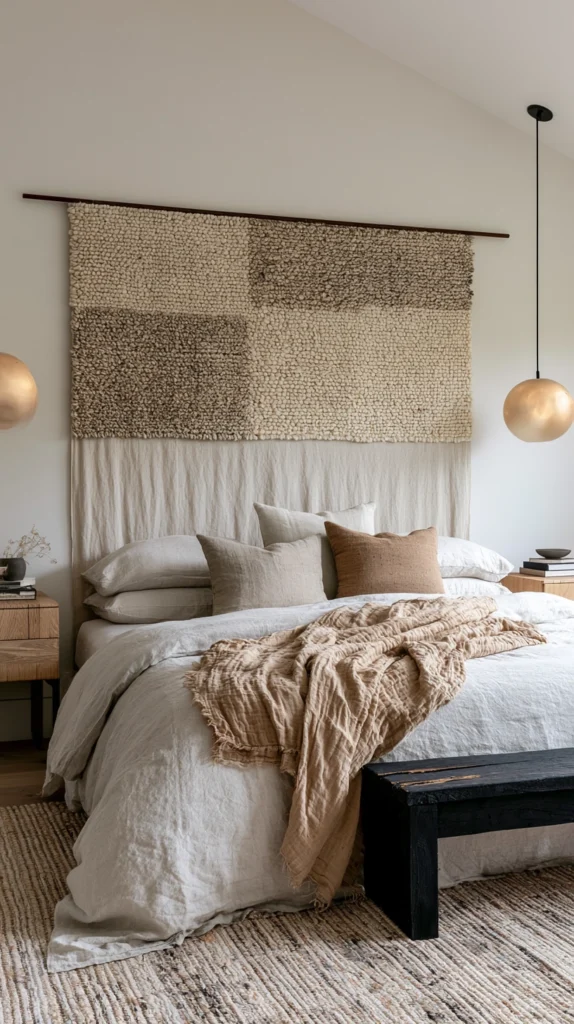
A large fabric panel, a woven tapestry, or a piece of upholstered fabric mounted directly to the wall behind the bed functions as a soft headboard — it has the warmth and texture of an upholstered headboard without the frame, the bulk, or the expense.
Tapestries in warm, textured weaves — Moroccan wool designs, macramé panels, woven cotton wall hangings — add organic warmth to the wall that flat paint and art prints don’t. They also add acoustic softness, which reduces sound reflections in a bedroom with hard surfaces.
For the most headboard-like result, choose a tapestry or fabric panel that matches or slightly exceeds the bed width and hangs from a wooden dowel or a simple brass rod at pillow-plus-20-inches height.
A large woven tapestry from Etsy or World Market runs $25–$80 depending on size and material.
Tip: Iron or steam the tapestry before hanging. Freshly unrolled woven tapestries have horizontal crease lines from packaging that are clearly visible against the wall. A quick steam removes them entirely and makes the hang look professional rather than fresh from a shipping tube.
Budget: $25–$80
6. Paint a Rectangle or Arch Behind the Bed
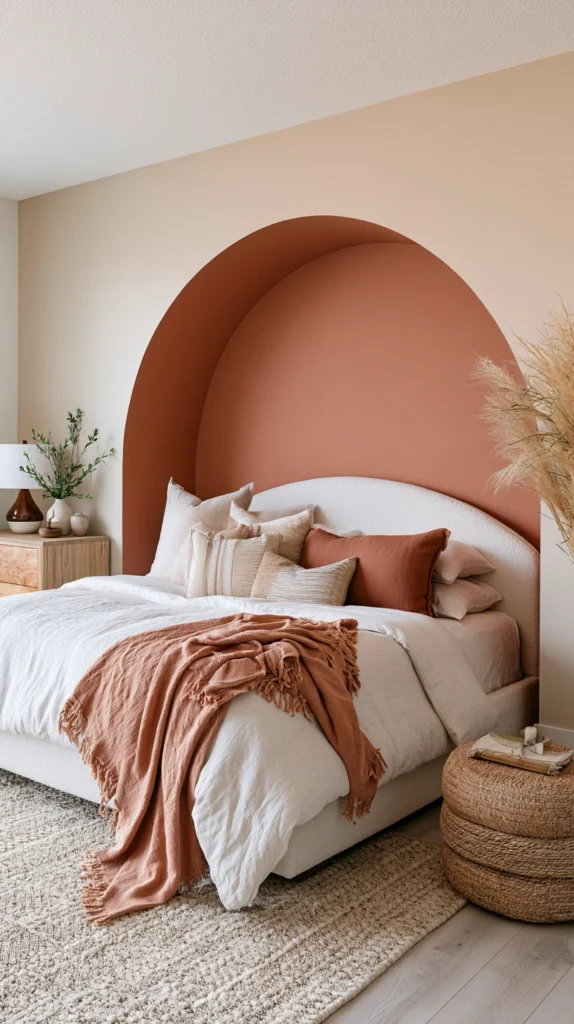
A painted shape on the wall behind the bed — a rectangle in a contrasting color at headboard dimensions, or an arch that rises above the pillow line — creates the visual effect of a headboard using only paint.
This is the cheapest and most reversible approach on the list. A rectangle painted in a color slightly darker or warmer than the surrounding wall, sized to approximate headboard dimensions (approximately mattress width plus 6 inches on each side, from baseboard to 36–48 inches above the mattress), reads as a deliberate architectural feature at minimal cost.
The arch variant — a half-circle or pointed arch shape painted in a contrasting color — is currently the most popular version of this technique. A painted arch requires only a piece of string tied to a nail at the arch center point to draw the curve accurately before painting.
Paint cost for one accent shape: $10–$20 for a sample pot of the contrasting color.
Tip: Use the same sheen throughout — paint the headboard shape in the same finish as the surrounding wall rather than switching from matte to satin. A sheen difference in the same color creates a headboard effect but reads as a patchy paint job rather than an intentional choice. A color difference in the same sheen reads as a decision.
Budget: $10–$25
7. Hang Curtains from Ceiling to Floor Behind the Bed
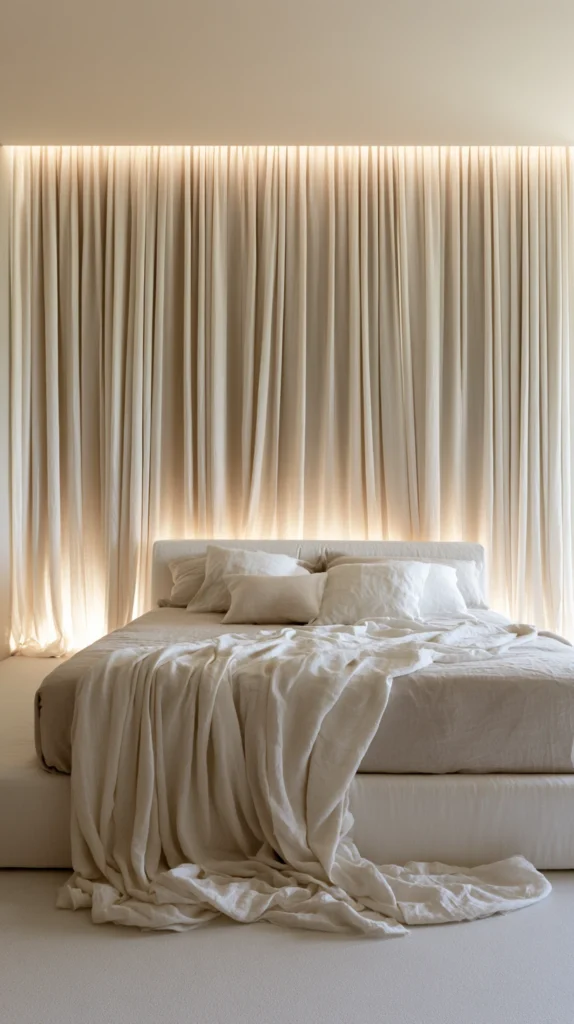
Floor-to-ceiling curtains hung from a ceiling-mounted rod behind the bed create a luxurious backdrop that references the fabric canopy beds of historical interiors without requiring any frame or structure.
The curtains don’t need to be on a track that opens and closes. They can be stationary — hung in three or four fixed panels symmetrically behind the bed, creating a draped fabric wall that frames the sleeping position on all sides.
For this treatment to look intentional rather than like a curtain in the wrong place, use at least three panels and hang them floor-to-ceiling rather than at standard window height. The full height is what creates the deliberate, architectural quality.
For a no-headboard bedroom, linen, velvet, and cotton in warm neutrals — cream, caramel, warm grey — work better than patterned or brightly colored curtains, which compete with the bedding.
Ceiling-mounted curtain tracks run $20–$50. Curtain panels at full length run $20–$45 each.
Tip: Pool the curtain fabric slightly on the floor — 2–3 inches of fabric lying on the floor at the base of each panel. This pooling effect is the detail that shifts stationary curtains from looking like window treatments placed in the wrong location to looking like a designed bed feature.
Budget: $80–$180 for three to four panels with track
8. Stack Oversized Pillows Against the Wall
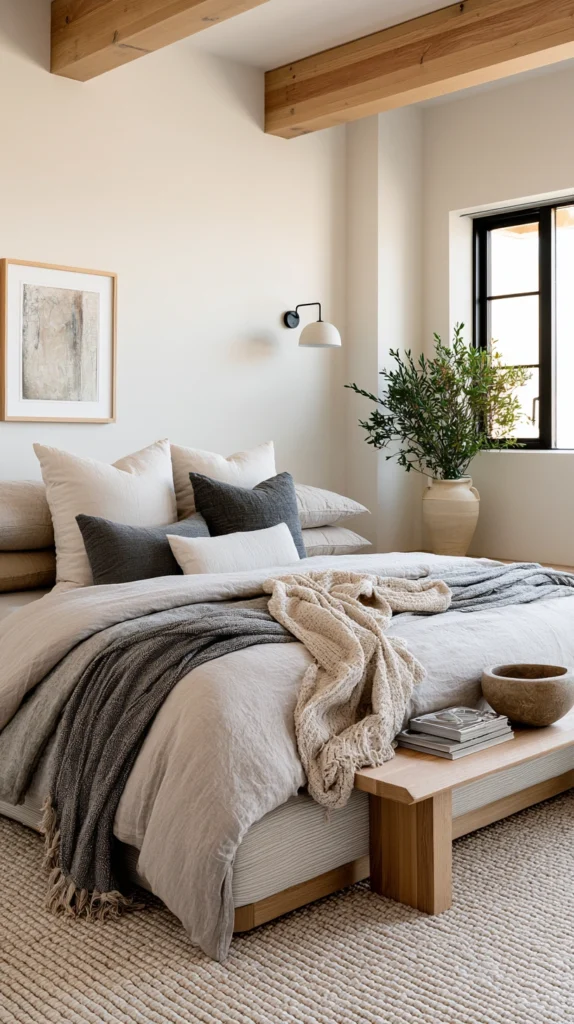
The simplest and most immediately achievable approach on this list. A row of oversized floor pillows, large throw pillows, or Euro shams stacked against the wall behind the bed creates a soft, pillow-based headboard that requires no installation and no wall treatment.
The key is scale. Standard 18×18-inch throw pillows are too small for this role — they read as sleeping pillows displaced to the wall rather than a deliberate headboard substitute. Euro shams at 26×26 inches, large floor pillows at 24×24 or larger, or a row of cylindrical bolster pillows create the visual mass that reads as intentional.
Three large Euro shams or two oversized floor cushions in coordinating textures and tones positioned against the wall create enough depth and height to function as a visual headboard from across the room.
This approach also means the headboard substitute changes as easily as changing the pillow covers — seasonal swaps, color refreshes, and aesthetic updates require no tools and no wall commitment.
Tip: Position the floor pillows or Euros in front of the sleeping pillows rather than replacing them. The sleeping pillows stay on the bed; the oversized pillows lean against the wall behind them. This prevents the arrangement from collapsing every time someone adjusts their sleeping pillows.
Budget: $30–$80 for oversized pillows or Euro shams
9. Mount a Mirror at Headboard Height
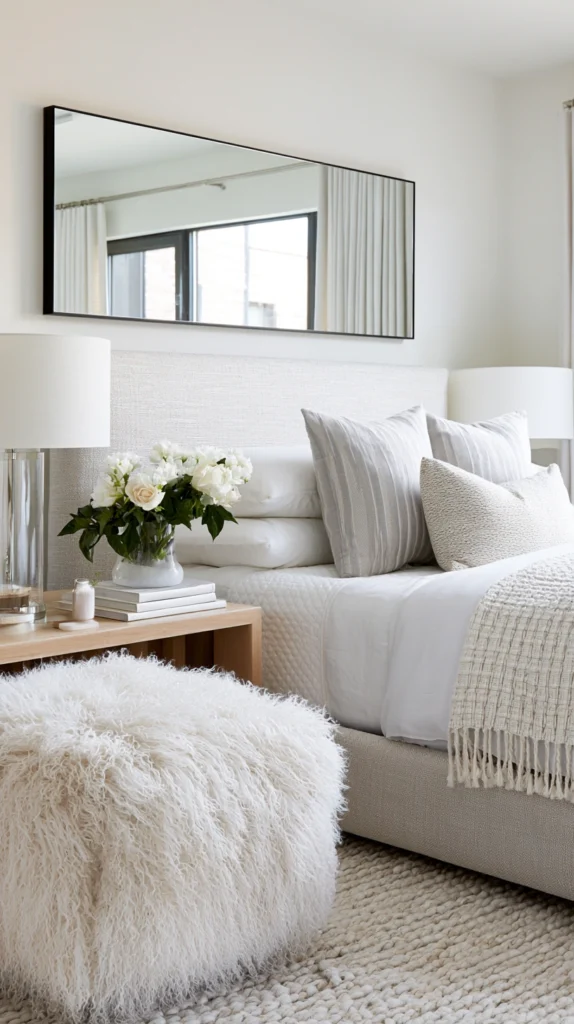
A large mirror mounted horizontally at headboard height does two things simultaneously: it fills the visual role of a headboard and it reflects light back into the bedroom, which makes the space feel larger and brighter.
The mirror should be oriented horizontally rather than vertically for this application. A horizontal mirror at 36–48 inches wide and 24–30 inches tall at headboard position reads as a considered design feature. A vertical mirror above the bed reads as a slightly unusual art choice rather than a headboard substitute.
For safety, use a mirror rated for wall mounting with appropriate hanging hardware — mirrors above a bed have specific safety requirements because of the risk of falling during sleep. Use mirror mounting clips or a French cleat system rather than a single central hook.
Horizontal mirrors in the right size range run $40–$120 from IKEA, Target, and Wayfair.
Tip: Avoid placing a mirror in a position where it reflects the sleeping occupant directly. A mirror that reflects the bed itself creates a discomfort that affects sleep quality for many people. Position it to reflect a window or the opposite wall instead — the light reflection benefit is the same regardless of the exact angle.
Budget: $40–$120
10. Create a Washi Tape or Paint Pen Pattern on the Wall
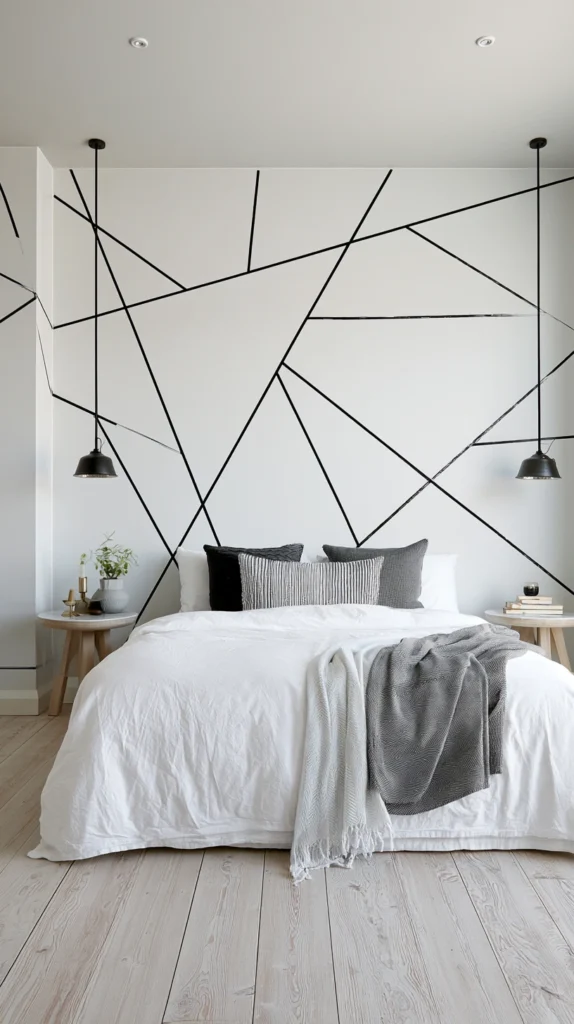
A geometric or organic pattern applied directly to the wall in washi tape or paint pen — positioned in the headboard zone behind the bed — creates a visual feature that reads as intentional from a distance and reveals its material on close inspection.
For a headboard effect, apply the pattern within a defined zone rather than across the full wall. A rectangular zone matching approximate headboard dimensions, filled with a simple geometric repeat — diamonds, chevrons, horizontal lines, or a hand-drawn vine pattern — reads as a deliberate feature from the bedroom doorway.
Washi tape in a single color or two related tones is entirely removable. A paint pen version is permanent but cost under $5 in materials.
This approach works particularly well in rented spaces where wall modification is limited. The washi tape version leaves no damage and removes completely in minutes.
Tip: Work from the center outward rather than from one side. A pattern started at the center of the zone stays symmetrical even if the tape or pen lines aren’t perfectly precise. A pattern started at one edge accumulates asymmetry visibly by the time it reaches the other side.
Budget: $5–$20
11. Use a Bookcase or Shelving Unit as a Headboard Replacement
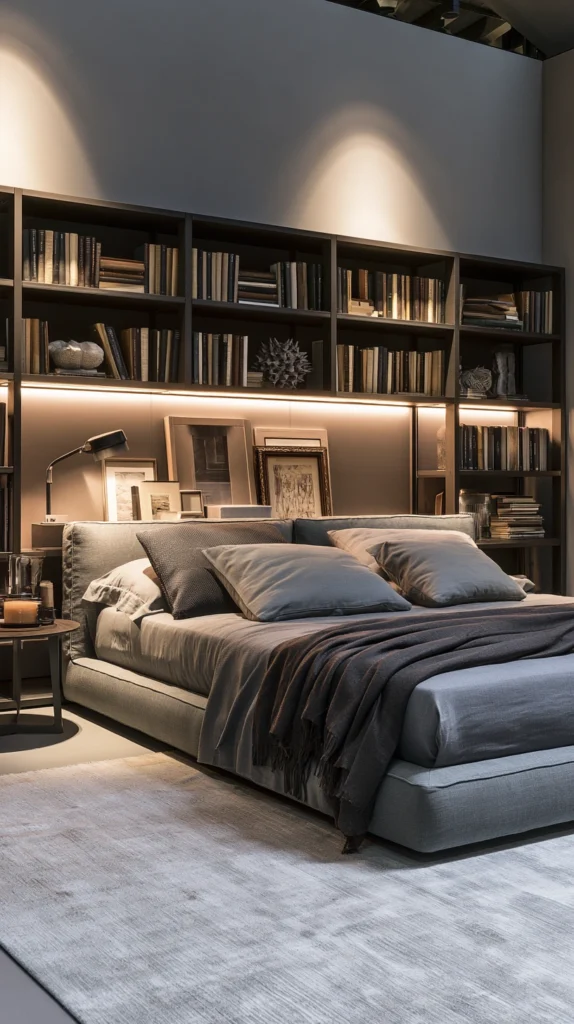
A low bookcase positioned directly behind and against the head of the bed functions as a headboard — it creates a physical barrier between the wall and the sleeping area, provides a surface at the right height for bedside essentials, and adds storage simultaneously.
For this to read as intentional rather than as furniture pushed against a bed for convenience, the bookcase should be styled rather than purely functional. Books organized by color, a plant or two, a small lamp, a few decorative objects alongside the books — the bookcase becomes a feature behind the bed rather than overflow storage.
An IKEA KALLAX in a 2×4 or 4×2 orientation at the head of a full-sized bed sits at approximately mattress height on a low platform. A taller bookcase creates a dramatic full-height backdrop with shelf space above sleeping height.
IKEA KALLAX in the right configuration runs $65–$130. A taller BILLY bookcase runs $60–$110.
Tip: Secure any tall bookcase mounted behind a bed to the wall using an anti-tip bracket. A bookcase at headboard position is not anchored by furniture in front of it the way a standard room arrangement would be — it should be wall-mounted for safety regardless of how stable it appears freestanding.
Budget: $65–$130
12. Apply a Plaster or Limewash Texture to the Bed Wall
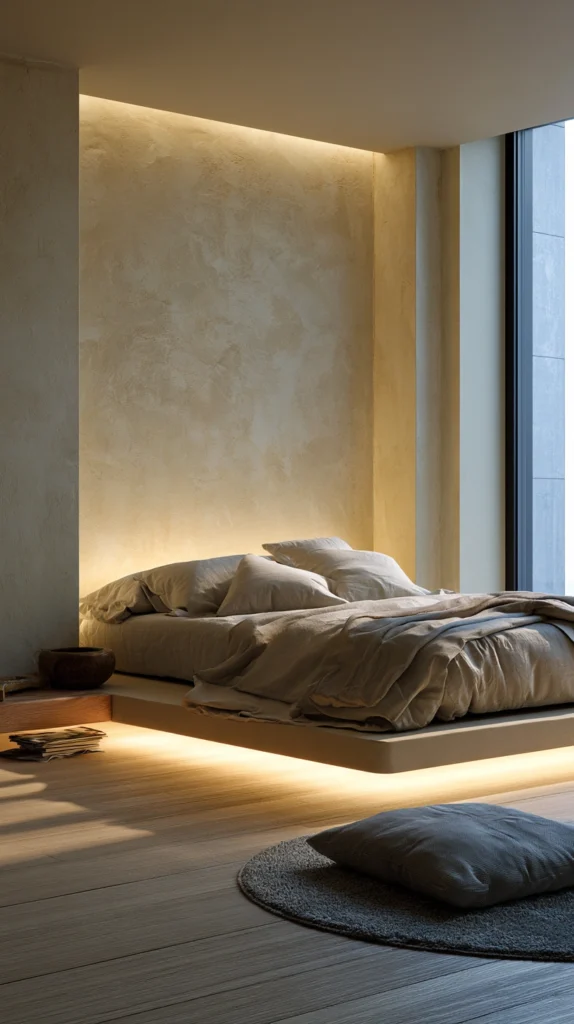
A textured wall finish behind the bed — lime wash, Venetian plaster, or a hand-applied textured paint — creates depth and visual interest on the wall that anchors the bed without requiring a headboard or any mounted object.
Limewash paint (Portola Paints and ROMAN are two accessible brands) applies with a brush in a deliberately varied, overlapping technique that creates a mottled, aged quality. In a warm tone — warm white, soft terracotta, dusty pink, aged ochre — the limewash wall behind a bed looks like a centuries-old plaster wall rather than a modern bedroom.
The material change on one wall — even in the same color family as surrounding walls — creates enough visual differentiation to make the bed wall read as a distinct feature. The texture catches light differently than flat paint, which creates a subtle shifting quality as the day’s light changes.
Portola Paints Lime Wash runs $40–$60 per gallon, which covers a standard bedroom wall.
Tip: Apply limewash in opposing directions — one pass horizontal, one diagonal, one vertical — rather than in consistent strokes. The varied application direction is what creates the layered, aged depth. Consistent stroke direction in limewash produces a flat, textured appearance rather than the dimensional quality the finish is known for.
Budget: $40–$70 for paint and supplies
13. Drape Macramé or a Woven Wall Hanging at Bed Width
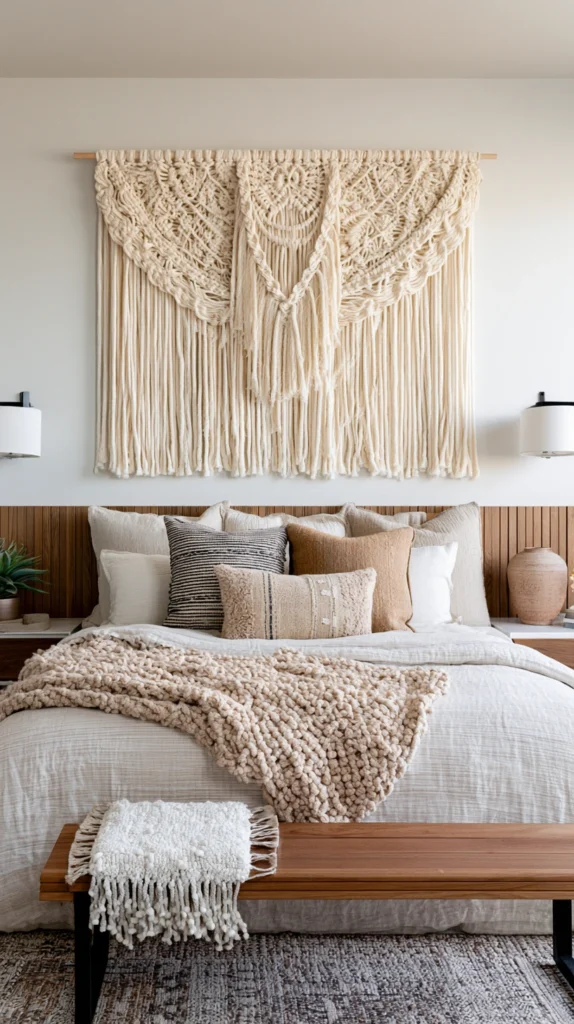
A macramé or large woven wall hanging at bed width is a softer, more bohemian version of the tapestry approach — with the key difference that macramé has three-dimensional texture that casts shadows, adds depth, and reads as a craft object rather than a fabric panel.
For a no-headboard bedroom, a macramé piece at least as wide as the mattress and 18–24 inches tall creates a visual mass behind the bed that serves the headboard function. The knotted texture adds warmth and shadow that flat tapestries don’t.
Natural macramé — undyed cotton or jute — suits warm, neutral, and boho bedroom aesthetics. Dyed macramé in a single color — dusty pink, sage green, or terracotta — suits more color-specific palettes while maintaining the textural quality.
Large macramé wall hangings from Etsy run $40–$120 depending on size and complexity. DIY versions using macramé cord and a dowel rod cost $15–$30 in materials.
Tip: Hang macramé from a wooden dowel rather than directly on nails or hooks. The dowel distributes the weight of the piece evenly, prevents the top edge from pulling into a point at the hanging location, and allows the piece to be relocated without disturbing the wall arrangement.
Budget: $40–$120 purchased, $15–$30 DIY
14. Leave the Wall Plain and Invest in Exceptional Bedding Instead
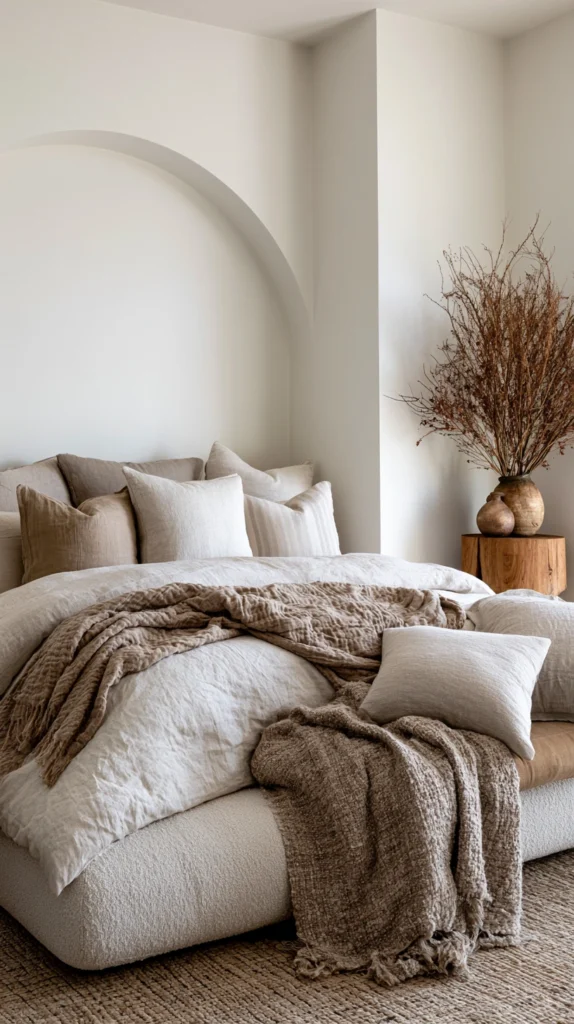
The final approach is the one that requires the most confidence and costs the most in one place while spending nothing on the wall.
A bed with no headboard, no wall treatment, and no art can look completely intentional when the bedding is exceptional enough to carry the entire visual weight of the sleeping zone.
A high-linen-content duvet cover in a warm, textured tone. Three or four pillows in coordinating but not matching cases. A throw of genuine quality — heavy cashmere, chunky merino, or textured boucle — folded at the foot. The bed itself, styled with this level of care, becomes the room’s feature. The plain wall behind it reads as a deliberate negative space — a framing device rather than a missing headboard.
This approach requires discipline. The plain wall only reads as intentional if everything else in the room is equally considered. A plain wall with average bedding reads as unfinished. A plain wall with exceptional bedding reads as confident.
Tip: Iron or steam the duvet cover before making the bed, and again after straightening it. Crisp fabric reads as deliberate in a way that wrinkled fabric doesn’t — and in a no-headboard bedroom where the bedding is doing all the visual work, the quality of the make matters more than in a bed with surrounding furniture and a headboard to share the load.
Budget: $80–$200 for genuinely exceptional bedding
15. Combine Two Approaches for a Layered Effect
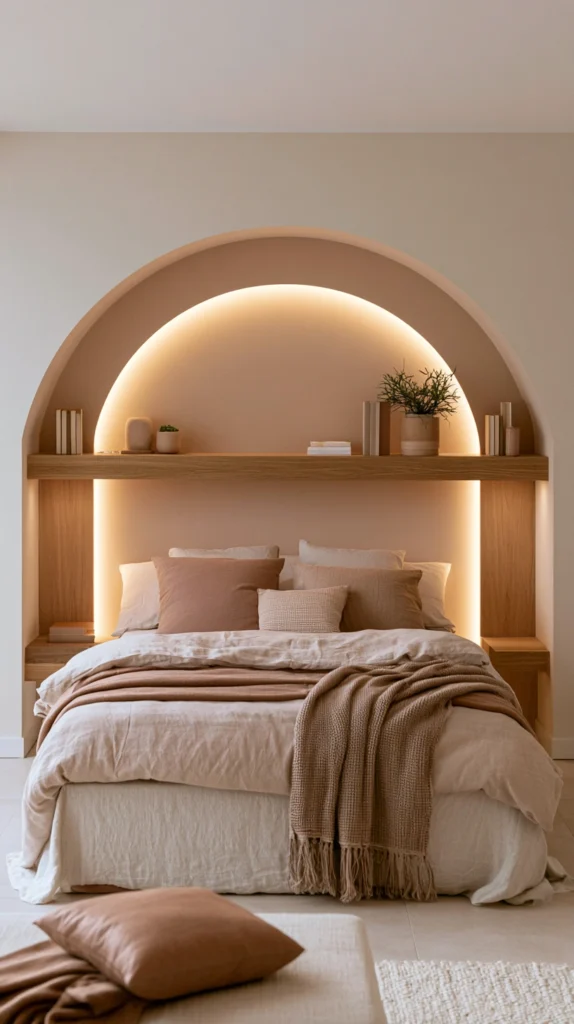
A single no-headboard treatment works. Two combined work better.
A painted arch on the wall plus a floating shelf at headboard height — the arch frames the bed from above, the shelf provides the functional layer below it. A gallery wall of prints plus curtain panels hanging alongside — the prints provide the pattern and color, the curtains add softness and frame the sleeping position. A limewashed wall behind the bed plus a large tapestry hung from a dowel in the center — texture upon texture, each adding a different quality.
The most effective combinations pair a wall treatment (paint, wallpaper, texture) with an object treatment (shelf, art, textile). Wall treatment alone can feel flat at close range; object treatment alone can feel suspended without context. Together they create the layered quality that makes a no-headboard bedroom feel fully resolved.
Tip: Choose combinations where the two elements are in the same color family but different materials. A warm white limewash wall with a cream linen curtain panel. A navy painted rectangle with a navy velvet throw pillow stack. The material contrast within the same tone creates depth without visual competition.
Budget: Varies — combine the budgets of two chosen approaches
Final Thoughts
A bed without a headboard doesn’t look unfinished. It looks unfinished only when nothing else accounts for the visual role the headboard would have played.
The wall behind the bed, the bedding on the bed, and the lighting around the bed carry that role between them when a headboard isn’t present. These fifteen approaches each address one or more of those three elements — and any one of them, done with care, produces a bedroom that reads as considered rather than incomplete.
Start with the wall. The wall treatment establishes the character of the sleeping zone before the bedding or lighting decisions are made, and it creates the context that makes every subsequent choice clearer.