
15 Chevron Wall Decor Ideas for a Bold Graphic Statement
The chevron wall was the decision the room had been waiting for without knowing it.
Not the furniture arrangement, which had been reworked three times. Not the rug, which had been right from the beginning. Not the gallery wall that lasted eight months before being taken down.
The chevron. A repeating V-pattern in two tones running floor to ceiling on a single wall, and suddenly the room had a direction — literally. The eye: following the V-shapes upward, reading the wall as active rather than passive. The room: organized around a graphic decision that required everything else to respond to it.
Chevron is one of the oldest geometric patterns in human visual culture. It appears in ancient pottery, in medieval heraldry, in Art Deco architecture, in mid-century textile design. It has survived every design era because it does something simpler patterns cannot: it moves. A horizontal stripe is static. A vertical stripe is static. A chevron moves upward, in both directions at once, and the room moves with it.
Here are 15 chevron wall decor ideas — from a single painted stripe to a full tile installation — built on that understanding.
Why Chevron Works Specifically as a Wall Statement
The directional effect
Without chevron: A flat wall in a single color. The eye: arriving at the wall and stopping. The room: its boundary visible, its edges clear, its dimensions fixed.
With chevron: The same wall. The eye: following the V-shapes upward from the baseboard to the ceiling. The room: its height amplified, its boundary active rather than passive, its dimensions feeling larger than they are.
The scale relationship
Chevron at small scale reads as texture. Chevron at medium scale reads as pattern. Chevron at large scale reads as architecture. The choice of scale determines whether the wall feels decorated or transformed.
A 2-inch chevron repeat: wallpaper territory. Subtle, layered, present at close range and absent at a distance.
A 6-inch chevron repeat: the most versatile. Visible from across the room, clear as a geometric pattern, not so large it overwhelms the space.
A 12-inch or larger chevron repeat: architectural. Bold from the doorway, graphic in photographs, demanding of the rest of the room.
The color logic
Chevron in two colors is the standard. But the relationship between those colors determines everything.
High contrast — black and white, navy and white, deep green and cream — reads as graphic and bold. The pattern: dominant. The room: organized around it.
Low contrast — warm white and cream, light grey and warm grey, two shades of the same tone — reads as textured and subtle. The pattern: present but calm. The room: warmed by the chevron without being commanded by it.
One color plus wood or tile: the pattern constructed from two different materials rather than two different paints. The contrast: material rather than chromatic.
The direction question
Pointing upward — the standard chevron orientation — amplifies ceiling height. Pointing sideways — a horizontal chevron pattern — reads as a series of nested V-shapes and widens the wall rather than heightening it. The direction: a decision before any other.
1. The Painted Chevron Accent Wall
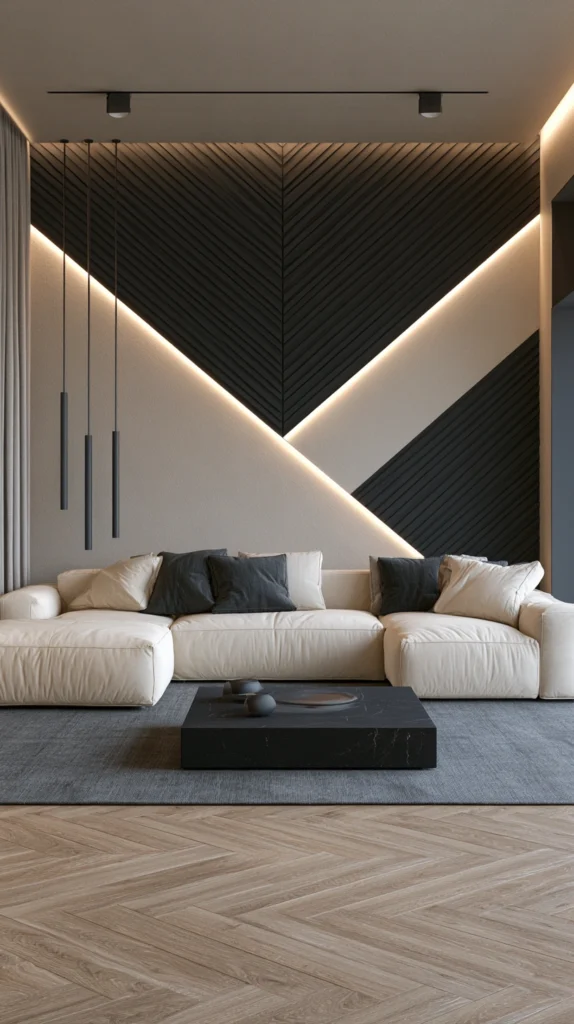
Two colors of paint — one the wall’s base color, the other the accent — applied in a repeating chevron pattern across one wall. The most accessible and most reversible version of the chevron statement.
Why paint is the right starting point
Paint costs under $50 for one wall. It can be painted over. It requires only tape, a level, a pencil, and patience — no specialist installation, no permanent modification, no second-guessing after the roller dries.
The tape method
Mark the apex of each V-shape along the wall center using a level and pencil. From each apex, draw lines descending at 45 degrees to the baseboard. The descending lines: the legs of each V. Apply painter’s tape along every line — outside the V for the base color, inside for the accent. Paint the accent color. Remove tape while paint is wet for a clean edge.
The critical step most first attempts skip: pressing the tape edge with a flat tool — a credit card, a putty knife — before painting. Unpressed tape allows paint to bleed under the edge and produces the ragged chevron that decorating forums are full of.
The scale decision
6 inches from apex to apex horizontally: the standard for a bedroom or dining room wall. 8 to 10 inches: for a living room or any wall wider than 10 feet. 4 inches: for a small bathroom or a feature wall seen primarily at close range.
The color selection
The base color: the dominant tone, present in the larger sections of the pattern. The accent: the contrast, present in the narrower bands. If uncertain: make the accent the darker color. Dark on light almost always reads better than light on dark in a painted chevron.
Cost breakdown: Base wall paint (existing): $0 Accent paint (1 quart): $15–25 Painter’s tape (2 rolls): $10–18 Total: $25–43
2. The Chevron Wallpaper Feature Wall
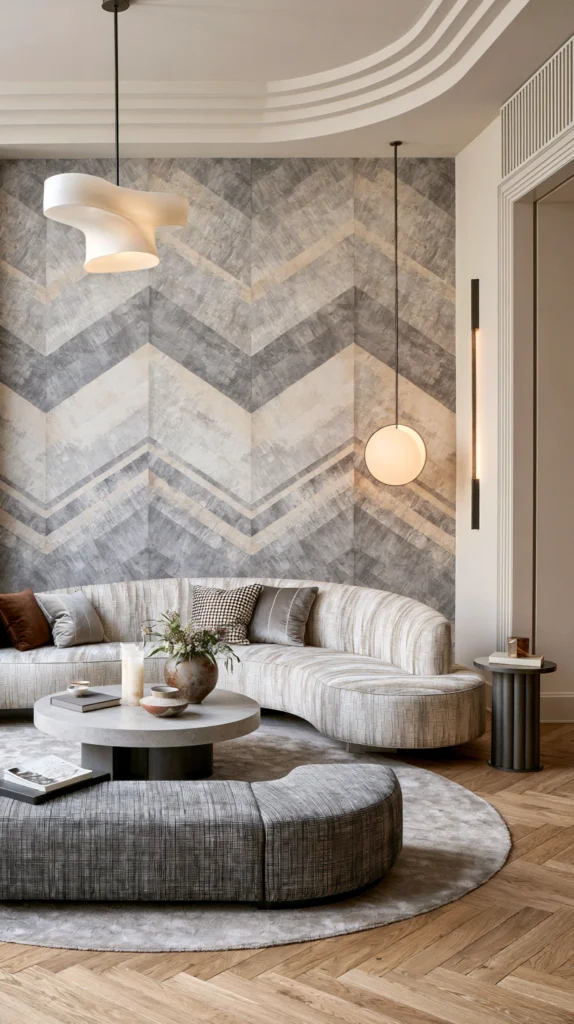
Pre-printed chevron wallpaper — on a single accent wall, behind a bed, behind a sofa, or in a narrow hallway — for a pattern at a scale and precision that paint cannot replicate.
Why wallpaper achieves what paint cannot
A printed chevron is exact. Every V-shape is identical, every line is parallel, every repeat is perfect. A painted chevron is approximate. At the scales where the difference matters — a fine 2-inch repeat, a precise geometric multicolor pattern — wallpaper is the correct medium.
The pattern scale for different rooms
A bedroom: small-repeat chevron (2 to 4 inches) in a muted palette — the pattern: background warmth rather than graphic statement. Sleep is easier without a large bold pattern in the room’s primary sightline.
A dining room: medium-repeat (5 to 8 inches) in two contrasting tones — the pattern: graphic and present, appropriate for a room used for an hour or two rather than eight hours a day.
An entryway or hallway: large-repeat (10 to 14 inches) — the pattern: dramatic for a space that is experienced in transit rather than inhabited continuously.
The peel-and-stick option
Peel-and-stick chevron wallpaper — available from NuWallpaper, RoomMates, and similar brands — applies without paste, removes without damage, and repositions during installation. For renters, for rooms in flux, and for anyone uncertain about a permanent pattern commitment: the correct choice.
The pattern match requirement
Chevron wallpaper requires a pattern match at every seam — each strip must align precisely with the next for the V-shapes to be continuous across the wall. Add 15% to yardage calculations for pattern match waste.
Cost breakdown: Peel-and-stick chevron wallpaper (one wall, approx. 56 sq ft): $45–120 Traditional paste-up chevron wallpaper: $60–180 Total: $45–180
3. The Herringbone Tile Chevron Wall
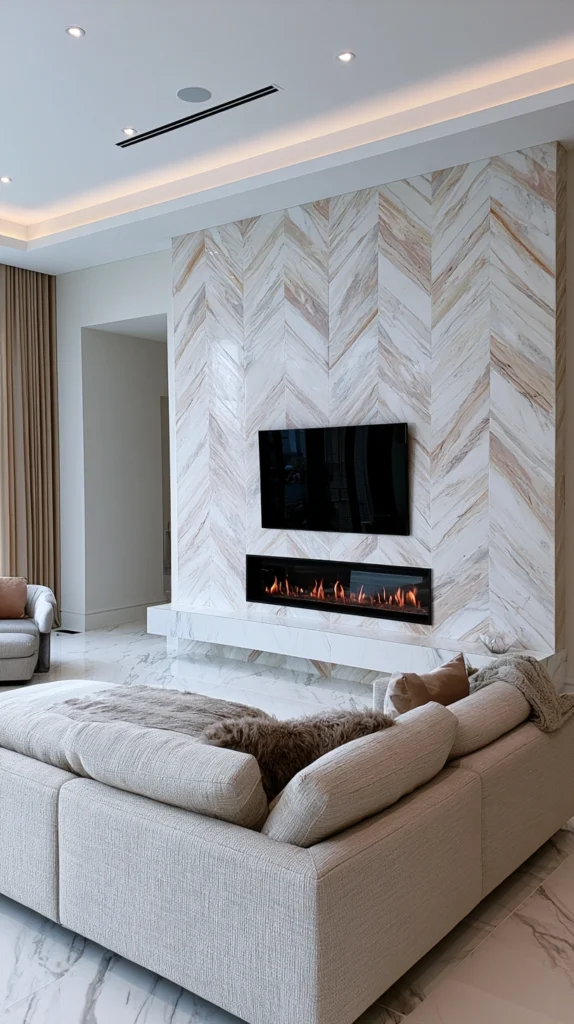
Ceramic, porcelain, or stone tile laid in a herringbone pattern — the diagonal V-shape related to but distinct from chevron — on a bathroom wall, kitchen backsplash, or fireplace surround.
The herringbone distinction
Herringbone and chevron are related but not identical. In a true chevron tile, the tile ends are cut at an angle so the V-shapes meet in a continuous point. In herringbone, the tiles are rectangular and the pattern is created by the placement alone, producing a staggered V rather than a pointed one.
For most tile applications, herringbone is more practical. Chevron requires specially cut tiles at additional cost. Herringbone uses standard rectangular tiles available at any tile supplier.
The tile choice
White subway tile (3×6 inches) in herringbone: the most widely used and most adaptable version. The pattern: present but neutral, dominating no particular color story.
Zellige tile in a warm tone — cream, terracotta, pale blue — in herringbone: the pattern amplified by the handmade variation in each tile’s surface.
Large-format tile (4×12 or 3×9) in herringbone: the V-shapes larger and more architectural. More graphic than the standard subway format.
The grout color
The grout is part of the pattern in a herringbone wall. White grout with white tile: the pattern subtle, visible primarily in the shadow lines. Dark grey or black grout with white tile: the pattern dominant, every V-shape outlined. The grout color: as important as the tile selection.
Cost breakdown: Subway tile (50 sq ft): $80–200 Zellige tile (50 sq ft): $200–500 Grout and installation materials: $40–80 Professional installation (50 sq ft): $300–600 Total (DIY): $120–280 / Total (professional): $420–880
4. The Chevron Wood Panel Wall
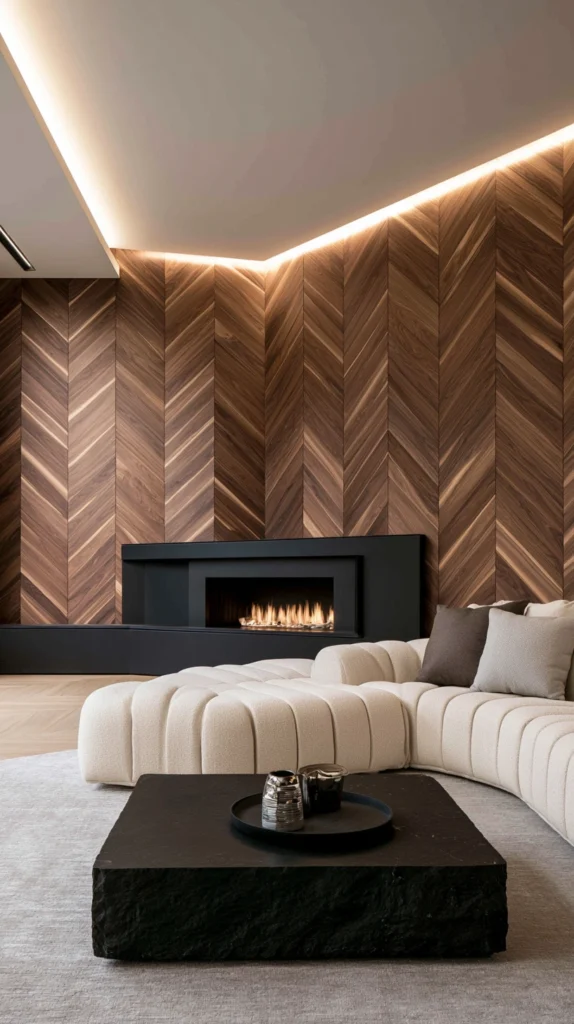
Solid wood or engineered wood strips arranged in a chevron pattern on a wall — the pattern: three-dimensional, casting shadow within its own geometry as the light across the day changes.
Why wood chevron reads differently from painted or papered versions
A painted chevron is flat. The pattern exists in color. A wood chevron is dimensional — each strip sits slightly proud of its neighbor, and the joins between strips catch and release light as the day moves. At noon, the wall reads as a pattern. At dusk, with a lamp nearby, the wall reads as a texture.
The wood species and finish
Light wood — pine, ash, or maple in a natural or whitewash finish — for a Scandinavian quality. The pattern: subtle, warm, more textured than graphic.
Dark wood — walnut or oak in a dark stain — for a more dramatic and more formally neo deco result. The dark strips against a painted wall: the pattern reading in both color and shadow.
Mixed tones — alternating light and dark wood strips — for the most explicit graphic chevron statement in wood. Two species, two tones, one pattern.
The installation method
Thin strips — 2 to 3 inches wide, 1/4 to 1/2 inch thick — cut to 45-degree angles at the ends where they meet at the V-apex. Adhered with construction adhesive and finished with small finish nails at the wall edge.
The 45-degree cut at the apex: the detail that determines whether the chevron reads as precise or as approximate. A clean mitered joint at the apex: correct. A gap or misalignment: the pattern’s primary failure mode.
Cost breakdown: Lumber (pine, 1×3, one wall): $60–120 Dark walnut strips (one wall): $150–350 Construction adhesive and finish nails: $20–35 Total: $80–385
5. The Chevron Tape Wall Art
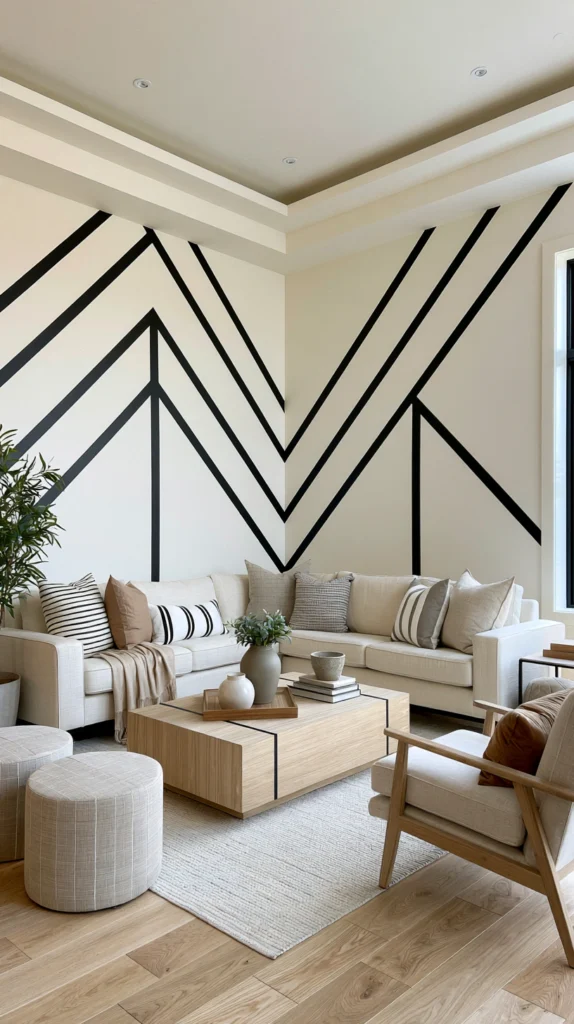
Removable washi tape or vinyl tape in two tones — applied directly to the wall in a chevron pattern — for the most temporary and most renter-friendly version of the graphic statement.
Why tape deserves serious consideration
Washi tape leaves no residue on most painted walls. It removes completely. It costs $5 to $15 per roll. And at large scale — 2-inch tape in a 12-inch chevron repeat on a full wall — it produces a graphic effect indistinguishable from paint at a distance.
The tape selection
Washi tape in a matte finish: the most authentic and most varied color selection. Available in hundreds of colors and several widths.
Vinyl wall tape in 1/2-inch or 1-inch width: better adhesion and sharper edges than washi, appropriate for walls that will be viewed at close range.
The pattern method
Mark apex points along a center vertical line at regular intervals. From each apex, apply tape diagonally downward at 45 degrees in both directions, pressing firmly with a flat tool as the tape is applied rather than after. The pressing-as-you-go technique: the difference between a tape line that stays crisp for months and one that lifts at the edges within days.
The two-tone option
Two tape colors — one for each arm of the V-shape — so the chevron reads as a two-color pattern rather than a single-color outline on a painted background. Gold tape on one arm, black tape on the other, against a white wall: the graphic statement achievable in under two hours.
Cost breakdown: Washi tape (3 rolls): $12–24 Vinyl wall tape (2 rolls): $15–30 Total: $12–30
6. The Chevron Accent Wall in Reclaimed Wood
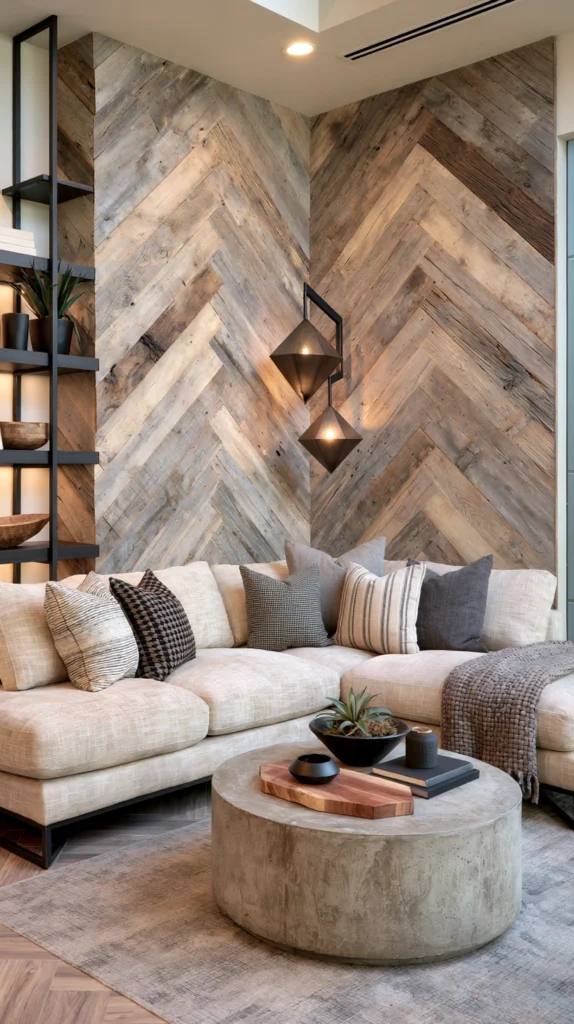
Salvaged or reclaimed wood planks — each plank carrying its own grain variation, nail holes, saw marks, and color variation — arranged in a chevron pattern for the most organic and most textured version of the wood chevron wall.
Why reclaimed wood produces a better chevron than new wood
New wood in a chevron pattern is precise and uniform. The pattern: graphic. Reclaimed wood in the same chevron pattern is imprecise and varied — each plank different from its neighbor in color, grain, and surface character. The pattern: present but warmed by the variation. The wall: looking as if it has been there for decades before the room was built around it.
The sourcing
Reclaimed barn wood, salvaged floor boards, old fence planks, pallet wood in varying widths. Mix widths within the pattern — 2-inch planks alongside 4-inch planks — for the most organic quality.
The color in a reclaimed chevron
Reclaimed wood is typically grey-brown to warm brown in tone. Against a white or cream wall: the pattern warm, the color muted. Against a dark painted wall — deep green, navy — the reclaimed wood reads as pale and almost driftwood-like, the color contrast: dramatic.
The sealing requirement
Apply two coats of a clear matte sealer to reclaimed wood used indoors. Old barn wood can harbor insects, splinters, and moisture that the sealer addresses before the wood is permanently fixed to the wall.
Cost breakdown: Reclaimed barn wood (one wall): $60–180 Pallet wood (one wall, sourced free): $0–30 in finishing materials Matte sealer: $15–30 Total: $15–210
7. The Chevron Gallery Wall Arrangement
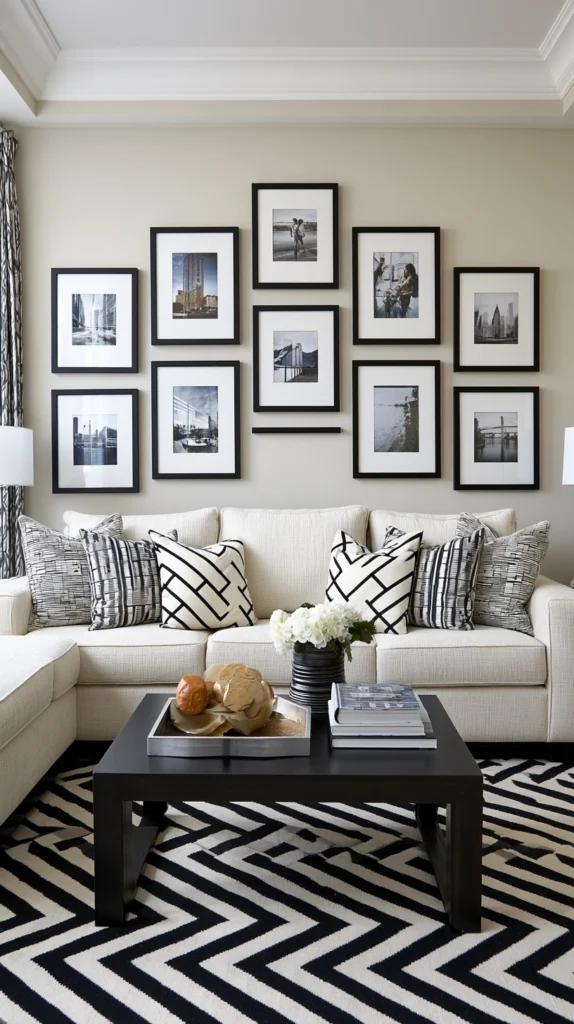
An existing collection of framed art, photographs, or prints — arranged on the wall in a chevron layout, the frames themselves forming the V-pattern rather than the wall behind them.
Why the gallery wall as chevron is underused
Most gallery walls are arranged in a loose cluster, a grid, or an organic spread. Arranging them in a chevron formation — the frames aligned along invisible chevron lines — produces a graphic result from objects that would otherwise read as a standard picture arrangement.
The arrangement method
Draw the chevron pattern lightly on the wall in pencil before hanging. The V-shapes formed by the arrangement guidelines: the invisible structure that the frames will follow. Each frame centered on the guideline rather than the frame edge aligned to it.
The frame centers: spaced 4 to 6 inches apart along each arm of the V-shape.
The frame selection
Matching frames throughout: the chevron pattern dominant, the individual images secondary. Mixed frames in a consistent finish: the arrangement read as curated. Individual frames in varied finishes and sizes: the arrangement read as personal.
For a graphic chevron statement from a gallery arrangement: matching frames, consistent size, close spacing. The pattern emerges from the arrangement rather than the frames themselves.
The paper template method
Cut paper to the exact size of each frame. Tape the templates to the wall in the chevron arrangement before making any holes. Adjust until satisfied. The templates: the most effective way to visualize a gallery arrangement before committing to wall holes.
Cost breakdown: Frames (assuming existing art, 12 frames): $60–180 Picture hooks: $8–15 Total: $68–195
8. The Chevron Floor-to-Ceiling Painted Stripe
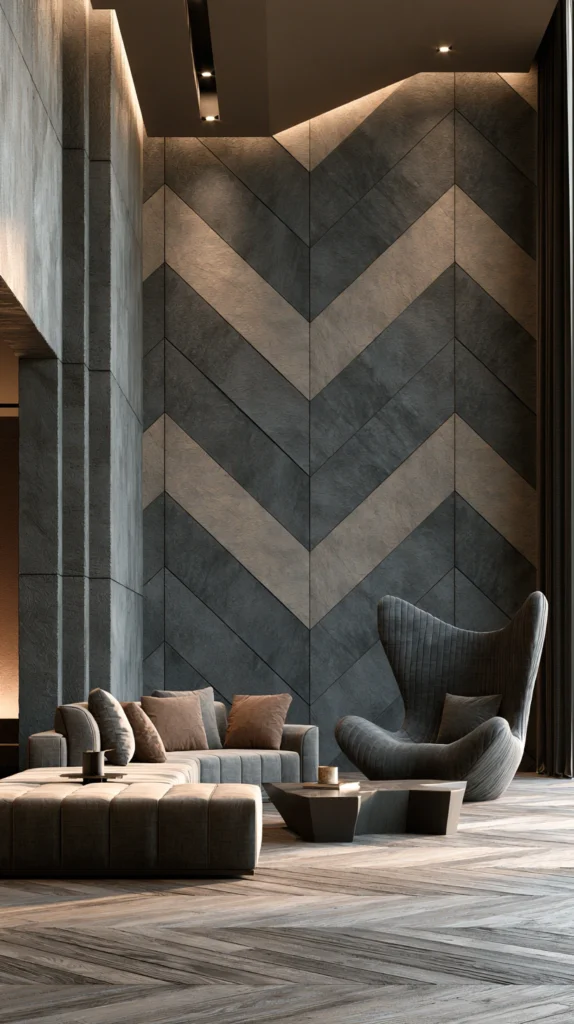
A chevron pattern that runs from baseboard to ceiling — no top or bottom edge — on a wall that is treated as a continuous pattern field rather than a surface with a pattern on it.
Why floor-to-ceiling matters
A chevron that stops at 7 feet on a 9-foot wall reads as a panel of wallpaper. A chevron that runs from baseboard to ceiling reads as an architectural decision — the wall treated as a complete surface, the pattern belonging to the room rather than placed upon it.
The ceiling line
The V-shapes continue until they meet the ceiling — some shapes complete, some cut off by the ceiling plane. The incomplete shapes at the top: not a flaw but evidence that the pattern is larger than the wall, that the wall is a window into a pattern that continues beyond it.
The baseboard treatment
Continue the pattern to the baseboard in the same way as the ceiling — the V-shapes cut off at the bottom. Or stop the pattern 3 inches above the baseboard and paint the 3-inch zone the accent color, creating a subtle horizontal band at the wall base.
The corner continuation
On an accent wall with returns — where the chevron wall meets adjacent walls at the room’s corners — the pattern can either stop at the corner (the clean version) or wrap around the corner by 4 to 6 inches (the committed version). The wrap: the detail that makes the chevron read as belonging to the room rather than applied to one face of it.
Cost breakdown: Accent paint (1 quart for a standard wall): $15–25 Painter’s tape (3 rolls for floor-to-ceiling precision): $15–24 Total: $30–49
9. The Monochrome Chevron Wall
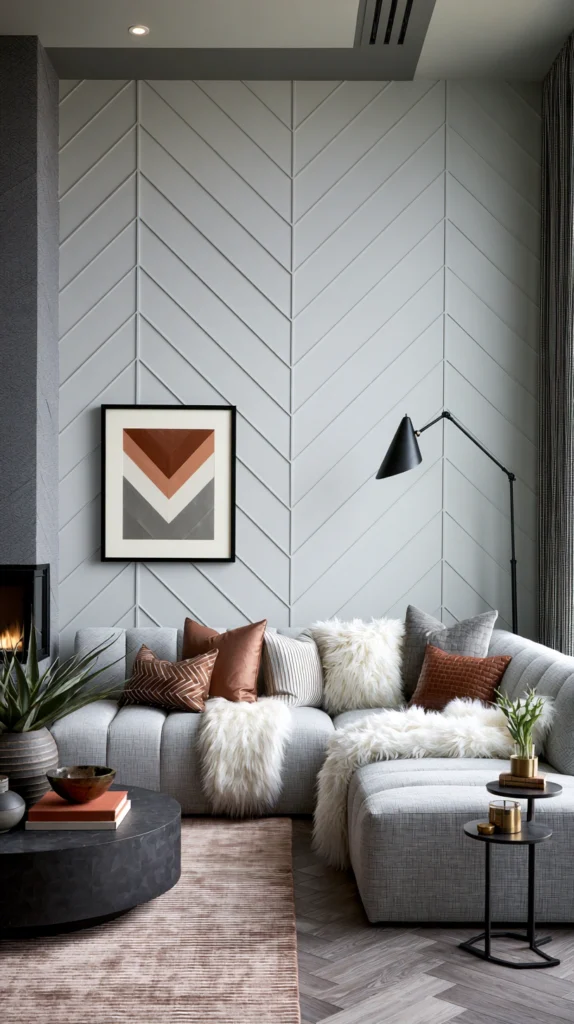
A chevron pattern in a single color — the paint applied in two slightly different finishes rather than two different colors — the pattern visible primarily in the way light catches the two surface textures differently.
Why monochrome is harder than two-color and more rewarding
A two-color chevron announces itself. A monochrome chevron is discovered — the pattern invisible from some angles and clearly present from others as the light across the day changes the finish difference’s visibility.
The finish pairing
Matte and satin in the same color: the most common version. Matte absorbs light; satin reflects it. The difference: most visible in evening lamp light and least visible in flat midday daylight. A chevron wall that reads differently at noon than at 7pm is not a wall that needs to be looked at continuously — it rewards the room’s users across the full day.
Matte and eggshell: a subtler version. The finish difference smaller, the pattern less evident except at acute viewing angles.
The color selection
White on white — matte and satin, both the same white — for a wall that reads as purely textural with no color contrast at all.
Or a mid-tone — warm grey, dusty blue, sage green — where the monochrome chevron adds pattern depth to a color that would otherwise read as a flat single-surface application.
The painting sequence
Apply the satin finish first to the entire wall. Allow to cure for 48 hours. Apply painter’s tape along the chevron lines and paint the alternate sections in matte. The satin beneath: the base. The matte over it: the pattern.
Cost breakdown: Satin paint for full wall: $25–50 Matte paint for alternate sections (1 quart): $15–25 Total: $40–75
10. The Chevron Wallpaper Behind Open Shelving
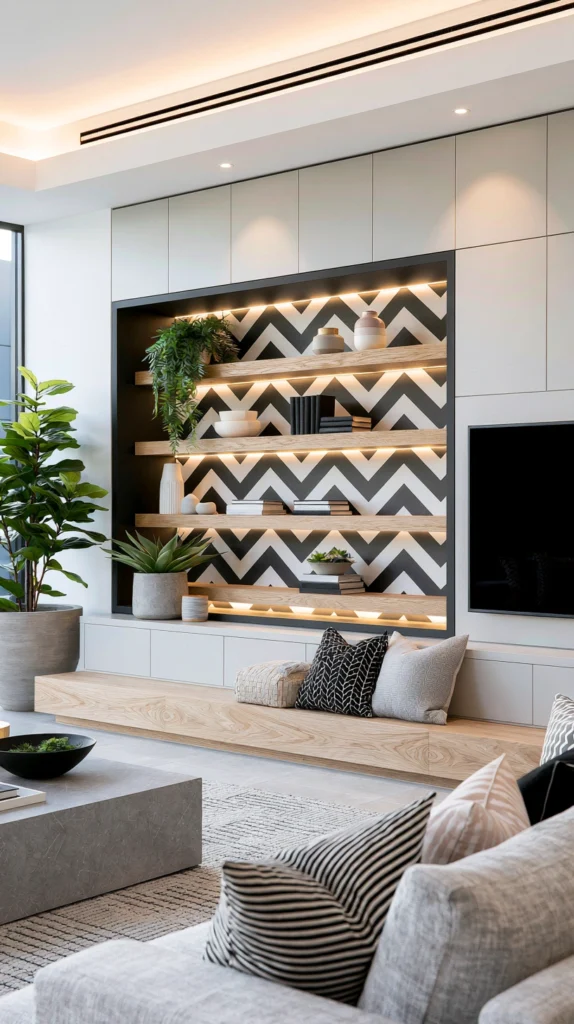
A chevron wallpaper applied to a wall section that is then partially covered by floating shelves or a shelving unit — the pattern: visible between and around the shelves, the shelves: floating in front of the graphic.
Why chevron behind shelving reads differently from chevron on an open wall
An open chevron wall is a graphic statement. Chevron partially visible behind shelving is a layer — the pattern underneath, the objects on the shelves in front, the eye moving between the two. The arrangement reads as designed rather than decorated.
The wallpaper selection for a shelved wall
A bold, large-scale chevron — 10 to 14 inches — so the pattern reads clearly between shelving and objects rather than being lost behind them.
A high-contrast color combination — dark background, light V-shapes — so the pattern is visible even when partially shadowed by the shelf overhang.
The shelving
Floating shelves with no visible bracket — the shelves appearing to extend directly from the patterned wall, with no hardware interrupting the chevron pattern visible between them.
Clear acrylic floating shelves for the maximum pattern visibility: the shelves nearly invisible, the chevron continuous behind them.
The object curation
Objects on the shelves in colors drawn from the chevron palette. If the chevron is navy and white: objects in white ceramic, natural wood, and brass. If the chevron is terracotta and cream: warm-toned ceramics, dried botanicals, amber glass. The objects and the pattern: a continuous color story.
Cost breakdown: Chevron wallpaper (one wall): $45–180 Floating shelves (3–4): $60–150 Total: $105–330
11. The Chevron Plaster or Textured Finish Wall
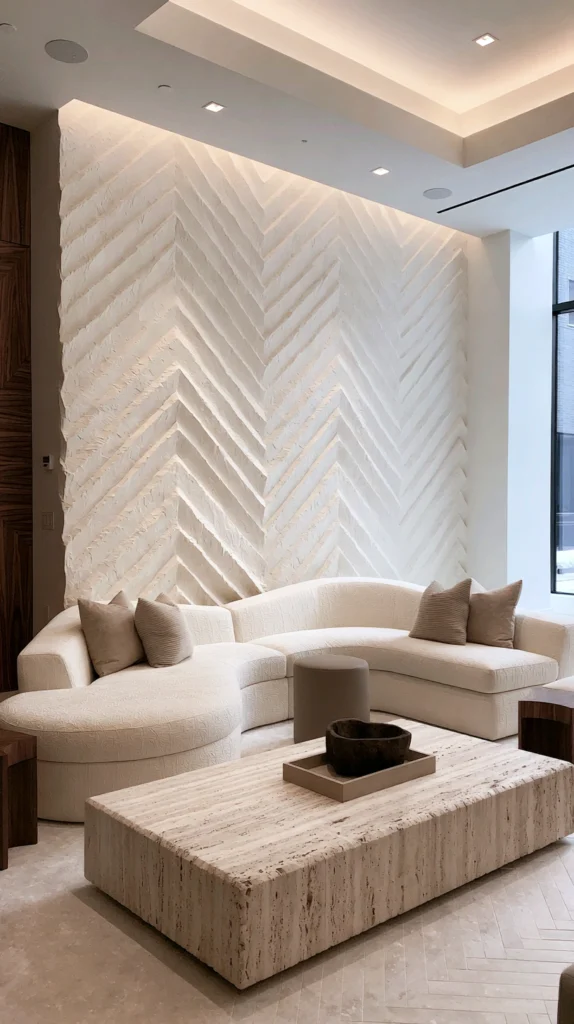
A raised chevron pattern applied to the wall using plaster, joint compound, or a textured coating — the pattern: three-dimensional, cast in the wall surface itself rather than painted or adhered.
Why a plaster chevron is a different category of statement
A painted chevron is visible. A plaster chevron is visible and tactile — present as a physical texture that can be touched, that casts shadow, that changes as light conditions change. It is also permanent in a way that paint and wallpaper are not. Removing it requires skim-coating the wall, not just repainting.
The construction method
Skim-coat joint compound applied to a masked wall in sections — the chevron lines taped, the compound applied between the tape in a 1/8 to 1/4-inch layer, the tape removed while compound is wet. Each section: smoothed within its boundaries, the chevron edge defined by the tape line.
Or a rubber texture stamp in a chevron form, pressed into wet compound across the full wall surface. The stamp: producing a repeated impression at a consistent scale and depth.
The finish
Left in the natural white of the compound: matte, chalk-like, the shadow within the pattern in grey.
Painted over in a single color once dry: the texture reads under paint as a dimensional pattern, the color unified.
Gilded in gold or brass metallic paint in alternate sections: the most formally neo deco and most commitment-requiring version.
Cost breakdown: Joint compound (one wall): $15–30 Rubber chevron stamp: $20–50 Paint over dried compound: $15–25 Total: $50–105
12. The Chevron Curtain as a Moveable Wall Statement
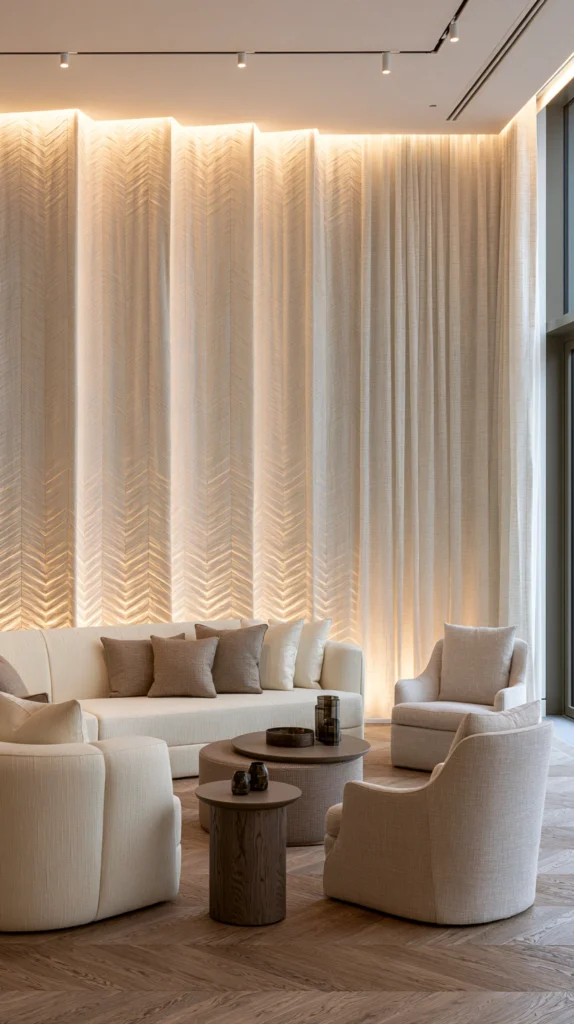
Floor-to-ceiling curtains in a chevron woven pattern — hung across a full wall rather than over a window — used as a textile wall treatment that can be opened, closed, changed, or removed.
Why curtains as wall treatment are underused
A fabric wall is acoustic — it absorbs sound rather than reflecting it. In a room with hard floors and hard furniture, floor-to-ceiling curtains on one wall reduce echo noticeably. In a bedroom, a dining room, or a home office, this acoustic quality improves the room’s usability in a way that paint and tile cannot.
The chevron textile
A woven chevron — the pattern in the fabric’s weave structure rather than printed — at a medium repeat (4 to 6 inches). The woven version: more textured and more substantial than a printed chevron. The pattern visible in the fabric’s structure as well as its color.
The hanging method
A ceiling-mounted curtain track rather than a standard window rod — the track allows the curtains to hang flush to the wall when closed, with no gap at the ceiling. The flush hang: what makes curtains on a wall read as a wall treatment rather than window dressing in the wrong place.
The color and the room
A navy and cream chevron curtain in a white room: the textile wall dominant, the pattern the room’s graphic decision. A warm rust and oatmeal chevron in a room with warm wood floors: the curtain warming the room rather than contrasting with it. A monochrome grey-on-grey chevron in a minimal room: texture without color shift, the pattern present as pattern rather than as color statement.
Cost breakdown: Woven chevron curtain panels (3–4 for a full wall): $120–350 Ceiling-mounted curtain track: $40–90 Total: $160–440
13. The Chevron in a Single-Color Two-Material Combination
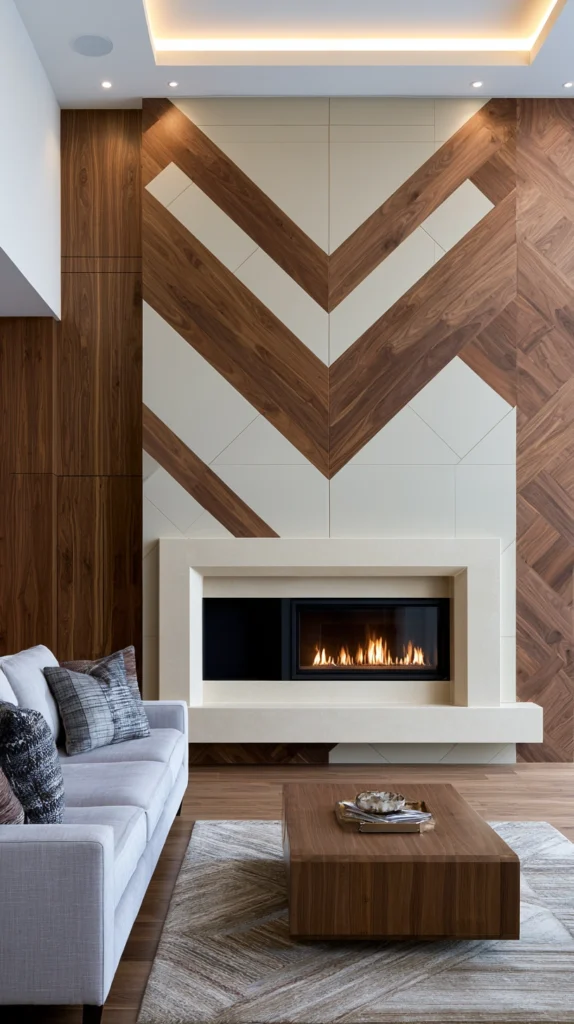
A chevron pattern where one arm of each V-shape is a different material from the other — one arm in wood, one in paint; one arm in tile, one in grout; one arm in mirror, one in wall — the contrast: material and texture rather than color.
Why material contrast produces a different result than color contrast
Color contrast chevron: two colors, the pattern clear, the reading: graphic. Material contrast chevron: two textures, the pattern present but the reading: architectural. The material version is harder to describe from a distance and more rewarding to live with at close range.
The wood-and-paint version
Thin wood strips applied in the V-shape positions, the alternate V-shapes painted in the same tone as the wood. From a distance: a near-monochrome chevron. At close range: one arm wood, one arm paint, the difference: material and tactile.
The mirror-and-wall version
Mirror tiles cut to the V-shape and adhered in alternate positions, the remaining positions left as painted wall. From a distance: a two-tone chevron with a high-contrast reflective element. At close range: mirror reflecting the room back at itself from every alternate V-shape. The wall: simultaneously a pattern and a fragmented reflection of everything in the room.
The tile-and-plaster version
In a bathroom or kitchen: tile in one arm, smooth plaster or painted surface in the other. The material difference: tactile as well as visual, the tile glossy and cool, the plaster matte and warm.
Cost breakdown varies significantly by material chosen: Wood-and-paint: $60–150 Mirror tile-and-paint: $80–200 Tile-and-plaster (professional): $200–600
14. The Large-Scale Single Chevron V
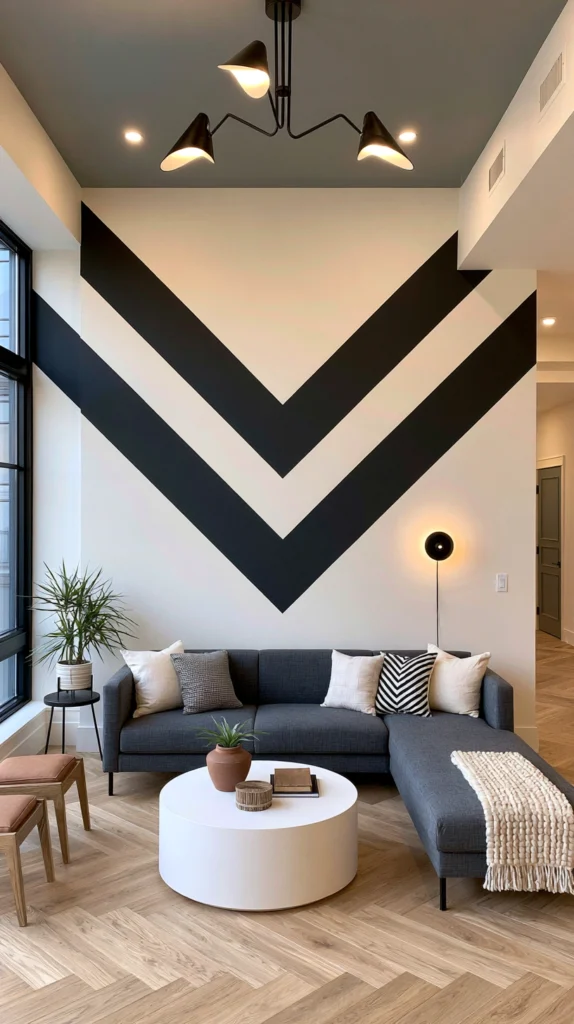
A single oversized V-shape — not a repeating pattern, but one large chevron — painted, taped, or constructed on a wall. The graphic: bold and reductive. One V, one statement.
Why a single chevron is bolder than a repeating pattern
A repeating chevron distributes the visual attention across the full wall. A single large V concentrates it. The eye goes immediately to the apex of the V and follows its arms downward. The wall: doing less, saying more.
The scale
The V-apex at the vertical center of the wall, the arms descending to the baseboards at the left and right edges. The wall width determines the arm angle — a narrow wall produces a steep V, a wide wall a shallower one. For a standard 10-foot wall: an apex at 5 feet from the floor, arms descending at approximately 25 to 30 degrees.
The color
The single V in a color that is the room’s most considered choice — not the dominant neutral but the accent. If the room is warm white with terracotta accents: a terracotta V. If navy with brass: a single brass-toned metallic V. The V: the room’s accent color concentrated into one graphic object.
The material options
Painted directly: the fastest version. Constructed from two strips of trim molding: three-dimensional, casting shadow. Applied in large-format metallic or mirror tile: the most dramatic and most permanent.
Cost breakdown: Painted single V (1 quart accent paint): $15–25 Trim molding V: $30–60 Metallic tile V: $80–200
15. The Fully Committed Chevron Room
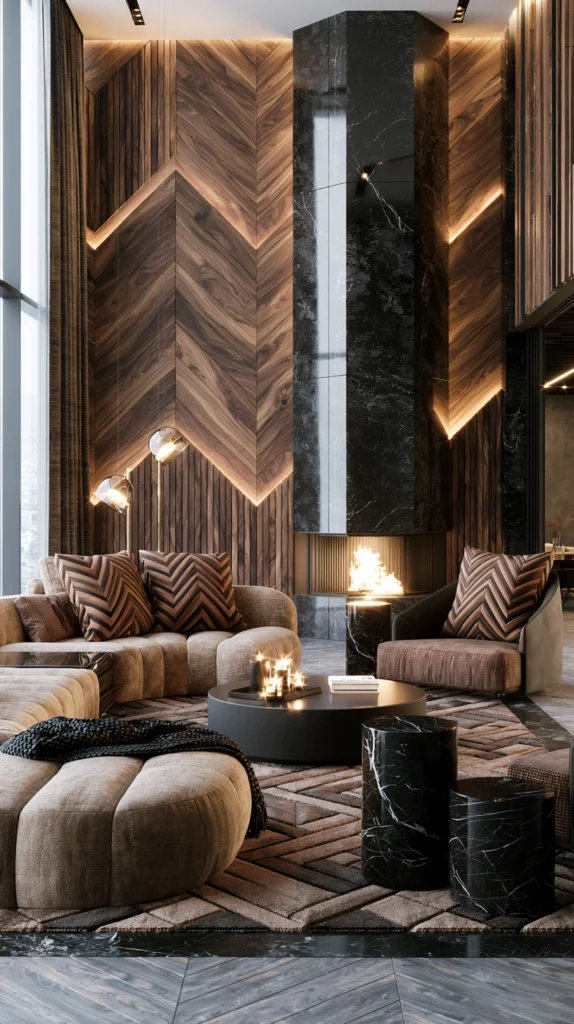
A room in which the chevron is not an accent but an organizing principle — the pattern present on the primary wall, echoed in the textiles, referenced in the furniture, and completed by the objects chosen in response to it.
What separates a chevron room from a chevron wall
A chevron accent wall: a graphic decision on one surface. A chevron room: a design language in which the pattern at the wall is the beginning of a conversation that the rug, the cushions, the curtains, and the objects continue at different scales and in different materials.
The elements of the fully committed chevron room
The primary wall
The most graphic version of the 15 ideas above — large-scale painted chevron in high contrast, full floor-to-ceiling, the base of every other decision in the room.
The rug
A chevron rug — in a smaller scale than the wall pattern, so the two readings coexist rather than compete. The wall: 8-inch repeat. The rug: 2 to 3-inch repeat. Same direction, different scale, the eye moving between the two as the day passes.
The textiles
Chevron cushions on the sofa or chairs in a third scale — smaller than the rug. The three scales of chevron: wall, floor, cushion, each reading at a different viewing distance, the pattern present everywhere and dominant nowhere.
The objects
Arrow-shaped or V-form decorative objects — a V-shaped sculptural piece, chevron-cut glass, an arrowhead geode — that reference the geometry without replicating it in pattern form.
The non-chevron elements
Every surface not carrying the pattern: plain, solid, and in a color drawn from the chevron palette. The floor (if not rugged): the base color. The ceiling: the lighter of the two chevron colors. The walls not carrying the pattern: the base tone, giving the chevron wall the contrast it needs to read boldly.
The room across conditions
Morning light: the painted chevron sharp and graphic, the light catching the tape-line precision of the V-shapes. The rug beneath: the smaller pattern warming the floor.
Afternoon: the chevron wall in even light, reading as pure geometry. The objects on the surfaces: solid and calm in response to the pattern’s activity on the wall.
Evening lamp light: the monochrome version’s finish difference becoming visible, the wall active in a different way. The chevron cushions catching the lamp light, the V-shapes casting small shadows.
The fully committed chevron room: not a room that has been decorated with a pattern but a room that was organized around one.
Cost breakdown for the complete room: Primary chevron wall (paint method): $30–75 Chevron area rug: $80–250 Chevron cushions (4): $60–140 Accent furniture in chevron palette colors: $200–800 Objects in V-form or chevron geometry: $40–120 Total: $410–1,385
Phased over two to three seasons:
Season one ($60–150): The painted chevron accent wall Warm bulbs throughout to complement the pattern
Season two ($150–400): The chevron rug Two to four chevron cushions Accent objects in the palette
Season three ($200–800): Furniture updated or chosen in response to the palette Curtains or textile wall treatment echoing the pattern The complete room assembled
The question before any chevron decision
Before choosing a wall, a method, a scale:
What is the primary intention for this pattern in this room?
If the answer is: maximum graphic impact — the high-contrast large-scale painted chevron, floor to ceiling. If the answer is: texture without boldness — the monochrome finish-difference version or the reclaimed wood chevron. If the answer is: the pattern without the permanence — the tape wall, the washi version, the peel-and-stick wallpaper. If the answer is: the fullest version of a graphic room built around this pattern — the complete chevron room, assembled over time.
The design follows the scale of commitment available. Every chevron idea on this list is the same fundamental decision — the V-shape, moving upward — at a different material, cost, and level of permanence.
The single taped chevron on a rental wall: already more than an empty surface. The complete room, built with intention: a graphic environment that changes how every other object in it is seen.
That change in seeing: the whole point of the pattern.