
13 Brass Pendant Light Ideas for a Dramatic Dining Room
The pendant light was the last thing we changed and the thing that made every earlier decision finally make sense.
The table had been right for two years. The chairs had been right. The rug, the wall color, the art — all resolved, all considered, all sitting in an arrangement that photographed well and felt incomplete every time dinner was served.
Then the pendant. Unlacquered brass, wide dome, hung lower than the electrician initially recommended. And the room: finished. Not because the light was beautiful — though it was — but because it changed what happened at the table. The warm amber pool it cast over the dinner plates, the glasses, the faces of the people sitting there. The ceiling above: dark and retreating. The table below: warm and present.
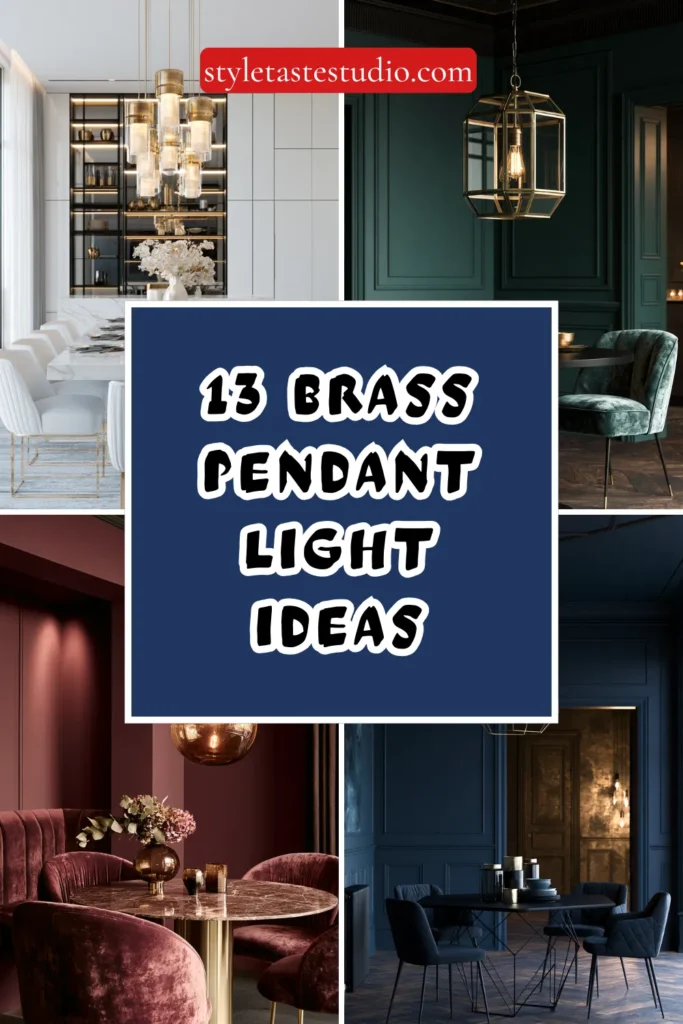
A brass pendant light over a dining table does not merely illuminate the room. It defines the table as the room’s purpose. Everything outside its reach: context. Everything inside it: the reason the room exists.
Here are 13 brass pendant light ideas for a dramatic dining room — from a single dome over a small table to a full chandelier installation — built on that understanding.
Why Brass Pendants Work Specifically Over a Dining Table
The color temperature effect
Without a brass pendant: A dining room lit from a ceiling fixture at standard height. The light: even, distributed, without a center. The table: one surface among others. The room: a room with a table in it.
With a brass pendant hung low over the table: The light: concentrated, warm, directed downward onto the place settings. The table: the reason the light exists. The room: organized around the thing it was built for.
The reflection advantage
Brass reflects light with a warm amber cast. A brass dome pendant reflects the bulb’s light outward and downward through a filter of its own warm tone — the light reaching the table is not just warm white but brass-warmed white. No other material adds this second layer of warmth to the light it distributes.
The hanging height difference
Standard pendant height: 30 to 36 inches above the table surface. Dramatic pendant height: 26 to 30 inches. The lower position increases the light’s concentration, reduces its spill into the ceiling zone, and makes the pendant visible as a sculptural object from a seated position at the table. The difference of 4 to 6 inches: significant.
The unlacquered argument
Lacquered brass pendants stay bright. Unlacquered brass pendants develop a patina — a deeper, more complex warm amber — over months and years of heat exposure from the bulb above. In a dining room, where the pendant is used for hours daily, the patina develops faster than elsewhere. The result: a pendant that improves with use rather than requiring maintenance to stay static.
The four pendant configurations for a dining room
Before choosing any design:
Single pendant — one light source centered over the table. The most minimal and most graphic version. Works at every table size when the pendant diameter is scaled correctly.
Linear multi-pendant — two or three pendants hung from a single bar or at equal intervals along the table length. For long rectangular tables where a single pendant creates unlit ends.
Cluster pendant — multiple pendants hung at varied heights from a single canopy. More organic and sculptural than a linear arrangement.
Chandelier — a single multi-arm brass fixture with individual bulbs or shades. The most formal and most fully neo deco version.
1. The Wide Brass Dome
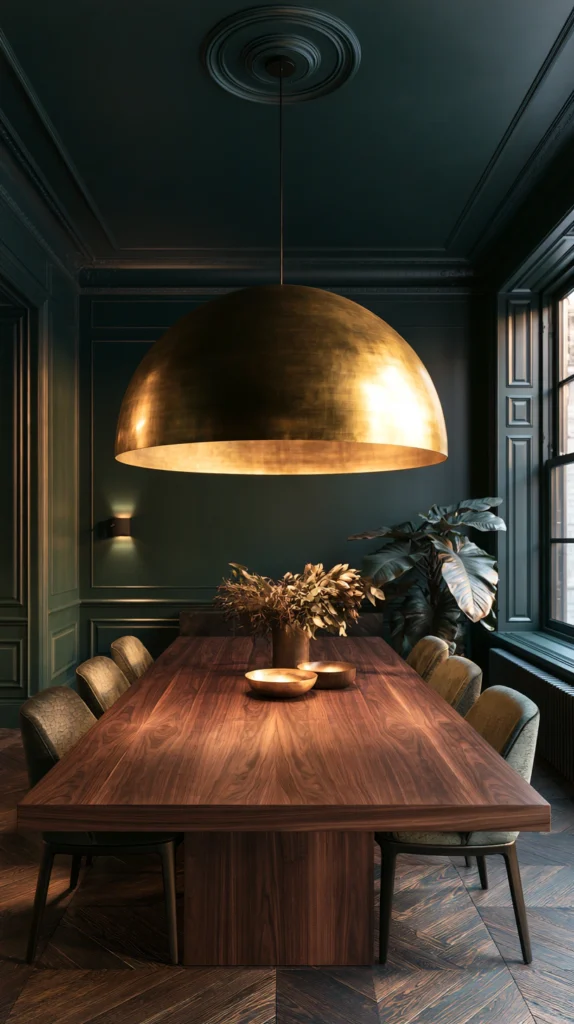
A single large dome pendant — 18 to 24 inches in diameter — hung low over the center of the dining table. The simplest and most effective brass pendant configuration.
Why the dome is the starting point
The dome is the shape most associated with directional dining light. It concentrates illumination downward onto the table surface and deflects it sideways into the room, without sending significant light upward toward the ceiling. The result: the table bright, the ceiling receding, the room dramatic before anything else is changed.
The diameter
Scale the dome to the table width. A round table at 48 inches or a rectangular table at 36 inches wide: a dome at 18 to 20 inches. A larger table: 22 to 24 inches. A dome smaller than the table width by more than half: insufficient visual weight. A dome wider than the table: overwhelming.
The brass finish
Unlacquered for a dining room — the heat from the bulb accelerates patina development more than in any other room, producing a rich, warm amber within six months of regular use.
Or brushed brass for a more matte, contemporary quality that reads modern rather than vintage.
The interior
The interior of the dome matters as much as the exterior. A white-painted interior reflects clean white light downward. A gold or brass-painted interior reflects warm amber light. For a dramatic dining room: gold or brass interior always.
The bulb
A large globe LED at 2200K to 2700K. Visible through the dome opening from a seated position — choose a bulb shape that reads as designed rather than purely functional. A globe or tubular filament: correct. A standard A19: insufficiently considered.
Cost breakdown: Wide brass dome pendant: $120–450 Warm filament globe bulb: $8–15 Total: $128–465
2. The Brass and Amber Glass Globe
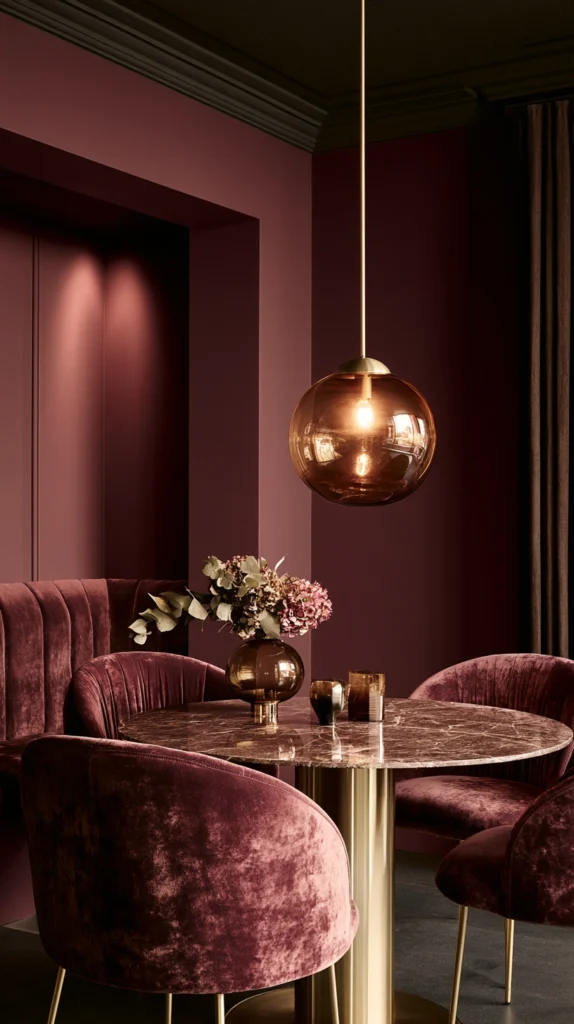
A spherical pendant in amber or smoked glass with a brass fitting, canopy, and cord — the globe: glowing warm amber from every angle when lit.
Why glass changes the quality of light
A solid brass dome reflects light downward. An amber glass globe transmits light outward — in every direction — filtered through the color of the glass. The result is not a pool of light beneath the pendant but a warm ambient glow that fills the dining room from the center outward.
The glass color
Amber: the warmest. The glass adds its own orange-amber filter to an already warm bulb, producing light close to candlelight in color temperature.
Smoked or grey glass: cooler and more contemporary. The light: filtered to a soft grey-warm rather than amber-warm.
Clear glass with a visible brass fixture: graphic and minimal. The brass: visible as a structural element inside the globe.
The fitting
Brass ceiling canopy, brass socket, brass cord cap. The glass globe: the light source. The brass: the architecture that holds it.
The size
10 to 14 inches in diameter for a globe over a dining table. Larger than this and the globe begins to feel like the primary object in the room rather than the light above the primary object.
The cluster option
Three amber glass globes hung at varied heights from a single brass canopy — 6 inches, 10 inches, and 14 inches below the canopy — creates a sculptural pendant cluster that reads as one fixture from a distance and as three individual glowing objects up close.
Cost breakdown: Amber glass globe pendant with brass fitting: $90–300 Or cluster of three globes (single canopy): $180–500 Total: $90–500
3. The Linear Bar Pendant with Multiple Bulbs
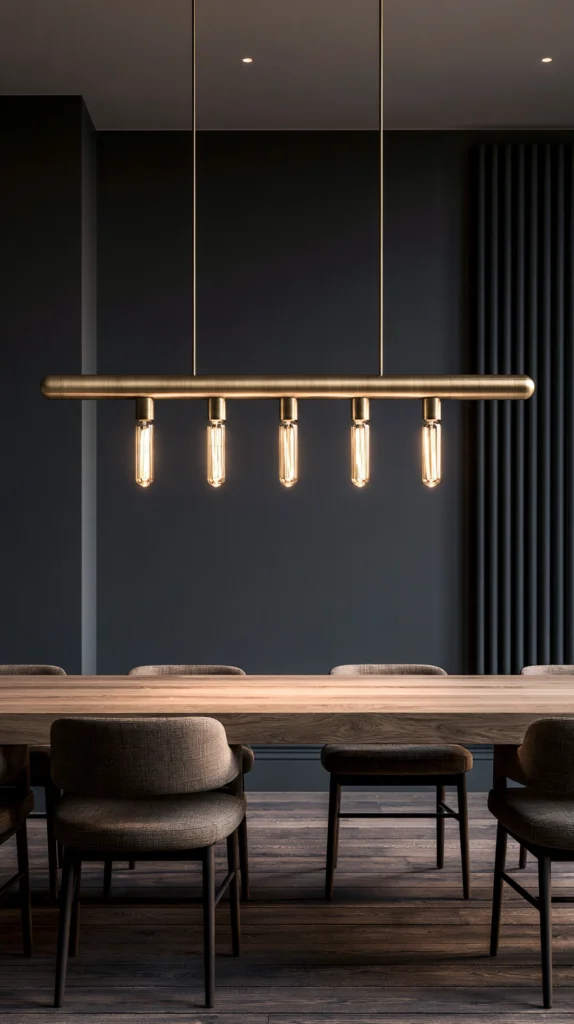
A horizontal brass bar — 36 to 48 inches long — with individual bulb sockets at regular intervals, hung parallel to the table length. The industrial and most contemporary brass pendant option.
Why a linear bar suits long rectangular tables
A long rectangular dining table — 84 to 96 inches — cannot be lit well by a single centered pendant. A single dome creates a bright center and two dim ends. A linear bar distributes light across the full table length, eliminating the unlit-end problem without requiring multiple separate fixtures.
The bar
Solid brass or brass-plated steel tube, 1 to 1.5 inches in diameter. Sockets at 12-inch intervals — three sockets for a 36-inch bar, four for a 48-inch bar.
The bulbs
Vertical tubular filament bulbs in each socket — the most graphic option. The filament visible and vertical, the brass bar horizontal. The tension between the two directions: the design.
Or globe filament bulbs for a softer, more rounded composition.
The canopy
A single rectangular brass canopy centered above the bar, with two cord drops to the bar ends. Or a single centered canopy with a single cord to the bar center — the bar then balanced on a central pivot point.
The height
Lower than a single dome can safely go — 24 to 26 inches above the table surface — because the distributed light from multiple bulbs means no single point of intensity that creates glare at eye level.
Cost breakdown: Brass linear bar pendant (36–48 inches): $150–500 Tubular filament bulbs (3–4): $25–50 Total: $175–550
4. The Rattan and Brass Combination Pendant
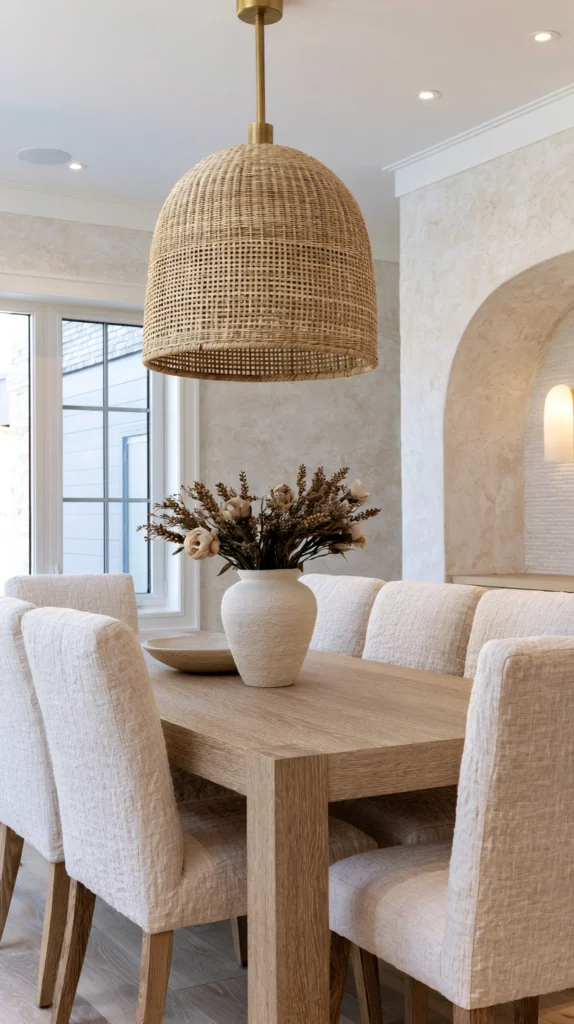
A woven rattan or wicker shade with a brass fitting, canopy, and hanging cord — organic texture combined with warm metal. The softest and most relaxed version of brass over a dining table.
Why rattan and brass resolve a tension
A purely brass pendant in a dining room built around natural materials — wood table, linen chairs, stone floor — can read as too metallic and too formal. Rattan with brass fittings introduces organic texture that softens the metal’s formality while maintaining its warmth.
The shade
A woven rattan dome or drum shade, 16 to 20 inches in diameter. Open weave — so light passes through the rattan in a dappled pattern — or tight weave — so light exits primarily downward through the open base.
Open weave in a dining room: the light pattern on the ceiling and walls adds movement and warmth to the entire room, not just the table.
The brass element
Ceiling canopy, pendant cord cap, and socket all in brass. The brass: present as a detail rather than a surface. The rattan: the primary material. The brass: the quality detail that connects it to the rest of the room’s material language.
The table pairing
Rattan and brass over a dark walnut table: the warm neutrals of the rattan against the richness of dark wood. Over a white or light oak table: the rattan reads more casual, the brass more evident. Over a marble table: the unexpected combination — organic texture and natural stone — that reads as confident.
Cost breakdown: Rattan pendant with brass fittings: $80–250 Total: $80–250
5. The Adjustable Height Brass Pendant
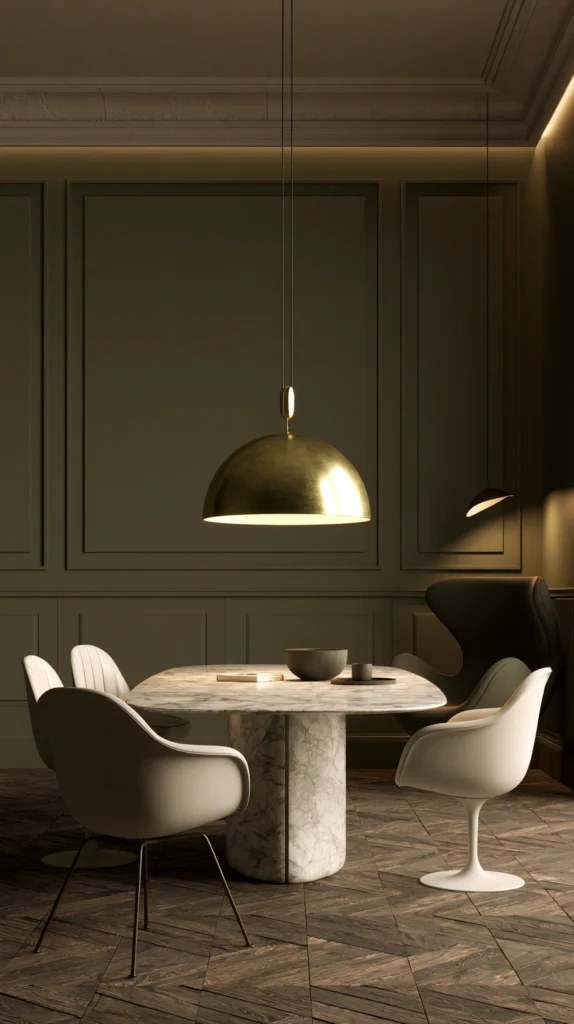
A brass pendant on a pulley system or an adjustable-height cord — the hanging height changeable between uses without tools, without an electrician, without a ladder.
Why adjustability matters in a dining room
A dining room serves dinner at different scales. A dinner for two: the pendant at its lowest, the pool of light intimate and close. A dinner for eight: the pendant raised slightly, the light spreading to cover more of the table. A morning with the table used as a work surface: the pendant at its highest, the room lit more generally.
A fixed pendant serves one use well. An adjustable pendant serves every use correctly.
The pulley mechanism
A traditional counterweight pulley — a visible hanging weight at one end, the pendant at the other, the height adjusted by raising or lowering the cord — is the most graphic and historically grounded version.
Or a retractable ceiling mount that takes up cord slack invisibly as the pendant rises.
The pendant at the end of the cord
Any pendant can be made adjustable by the mounting system rather than the pendant itself. A wide brass dome on an adjustable mount: the combination that starts and ends the list.
The visual when adjusted
At its lowest: 24 inches above the table — intimate, the pendant visible as a sculptural object at eye level from a seated position. At its highest: 36 inches — practical, well-lit, the pendant receding toward the ceiling.
Cost breakdown: Adjustable pulley ceiling mount: $40–100 Brass dome or globe pendant: $120–400 Total: $160–500
6. The Brass Cage Pendant
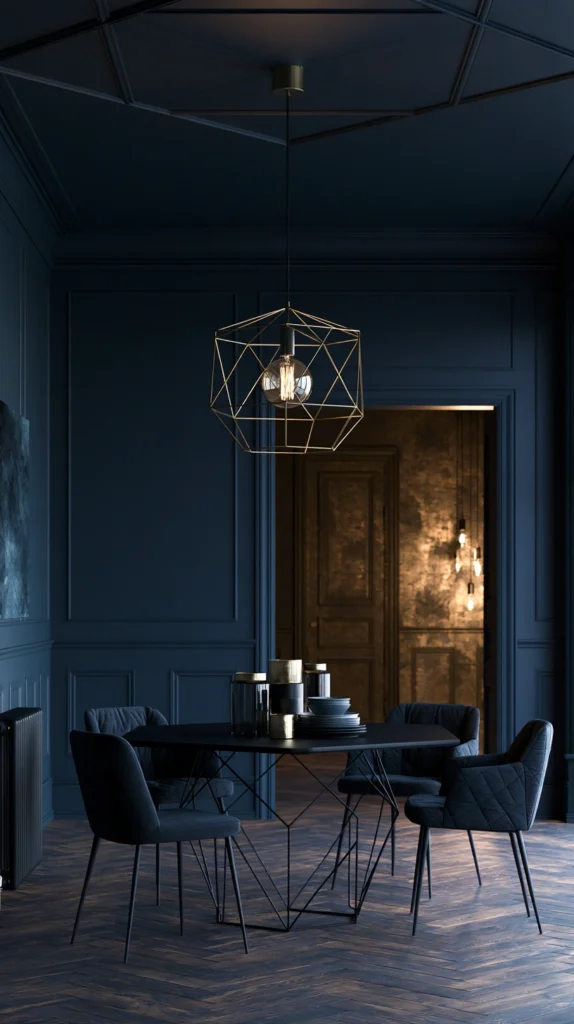
An open cage or mesh of brass wire forming the pendant structure, a visible bulb at the center, and no shade at all — the most industrial and most graphic brass pendant option.
Why no shade is a design decision
A pendant with no shade says: the bulb is beautiful enough to be seen. It also says: the room is dark enough at its edges that the unshaded light source does not create glare. Both conditions need to be true for a cage pendant to work well.
The cage form
Geometric cage: square, hexagonal, or octagonal cross-section in brass wire or flat brass bar. The geometry: the design element in the absence of a shade.
Spherical cage: a round wireframe globe in brass, the pendant echoing the globe form without its mass.
Cylindrical cage: tall and narrow, more vertical in proportion than the dome or globe, useful where ceiling height is limited.
The bulb
A large globe or tubular filament bulb — visible and chosen for its visual quality, not merely its light output. The bulb is not hidden. It is part of the object.
The room requirement
Dark walls or deep ceiling tone. A cage pendant in a white room reads as insufficient — the unshaded bulb visible against a pale ceiling is not a dramatic effect. A cage pendant against a deep navy, forest green, or charcoal dining room: the brass catching the color of the wall, the bulb bright against the dark backdrop.
Cost breakdown: Brass cage pendant: $80–280 Large globe or tubular filament bulb: $8–15 Total: $88–295
7. The Schoolhouse Globe in Brass
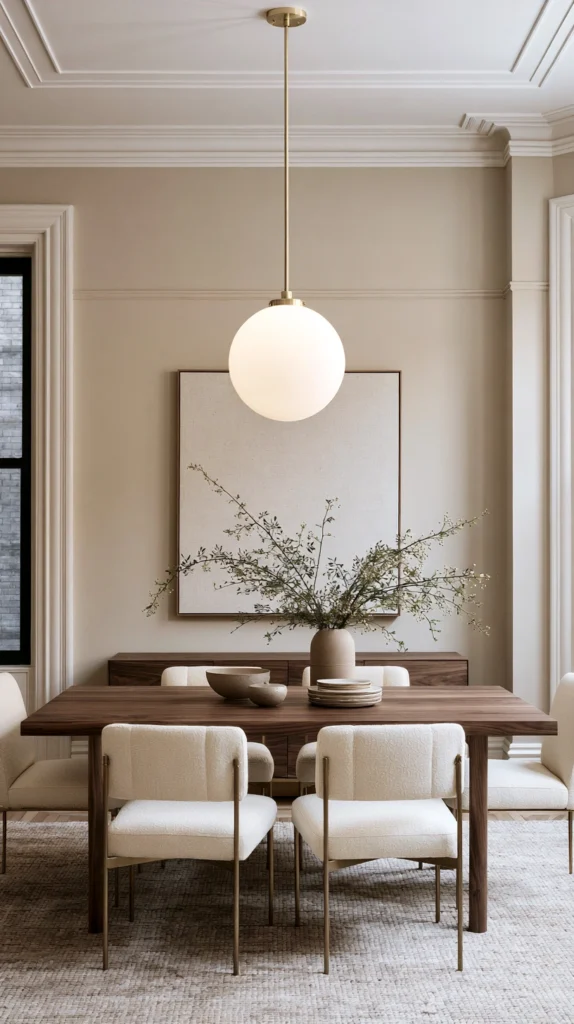
A milk glass globe on a brass ceiling fitting — the classic schoolhouse pendant, restored to its original form with unlacquered brass hardware. The most historically grounded and most quietly elegant option.
Why the schoolhouse pendant reads differently from a contemporary globe
The schoolhouse pendant is not designed to be noticed. It is designed to provide warm, diffused light and to recede into the room as a classic object rather than a statement piece. In a dining room that already has strong material decisions — dark walls, a marble table, heavy curtains — the restraint of the schoolhouse pendant is exactly right.
The globe
White milk glass: the light diffused to an even, soft glow with no hot spot visible. The globe reads as a glowing object rather than a lit object — the distinction between seeing a light source and seeing the light it produces.
Opal glass: slightly warmer and more translucent than milk glass. The light: marginally more visible as a source, warmer in tone.
The brass fitting
A porcelain or brass socket inside the globe, a brass ceiling canopy above, a short brass stem or cord between. The fitting: the detail that transforms a standard schoolhouse globe into a considered neo deco object.
The hanging height
Lower than most people expect for a schoolhouse globe — 28 to 32 inches above the table rather than the standard 36. The lower position changes the globe from a ceiling fixture to a dining light.
In a cluster
Three schoolhouse globes at matched heights over a long table: the most restrained multi-pendant arrangement. Uniform, quiet, warm.
Cost breakdown: Schoolhouse globe pendant with brass fitting: $80–220 Per globe for a cluster of three: $240–660
8. The Oversized Brass Chandelier
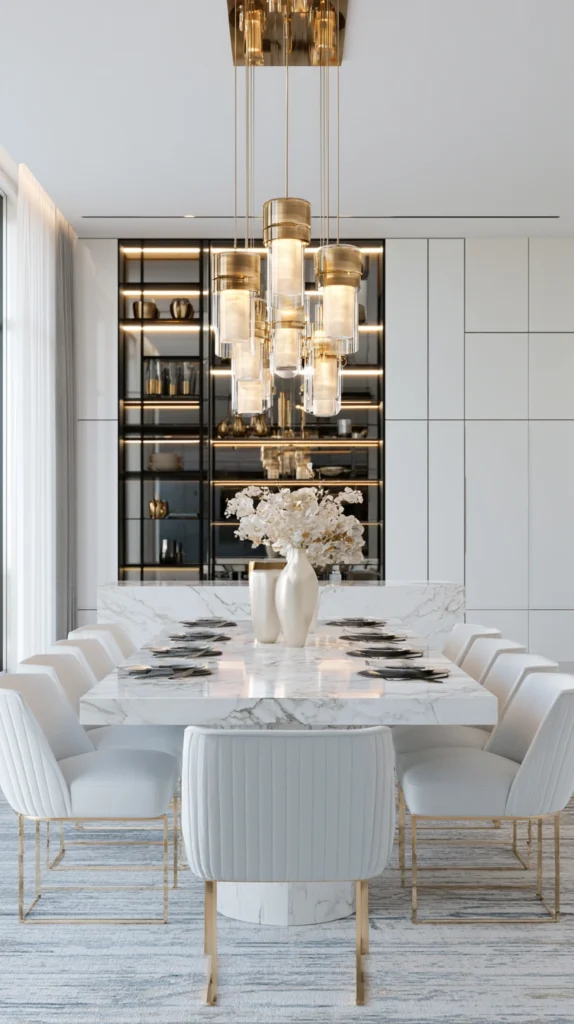
A multi-arm brass chandelier — 6 to 12 arms, individual bulbs or small shades at each arm end, 24 to 36 inches in diameter — hung over the dining table as the room’s primary statement.
Why the chandelier is a different commitment from a pendant
A pendant is a light source with an aesthetic. A chandelier is an aesthetic that produces light. The distinction matters when choosing between them: a pendant asks the room to look at the table. A chandelier asks the room to look at itself.
The brass chandelier for a dining room
Arms in unlacquered or brushed brass, extending outward from a central body at a slight upward angle — the traditional candelabra arm form. Or horizontal arms for a more contemporary, graphic composition.
Bulbs exposed at each arm end: candlestick filament bulbs in a 2200K to 2700K range. The exposed filaments: the neo deco version of the candle flame the chandelier historically replaced.
Or small linen or amber glass shades at each arm end — the light softened and directed downward, the chandelier reading as a refined object rather than a raw one.
The hanging height
The chandelier: higher than a dome pendant — 30 to 36 inches above the table — because the chandelier’s light comes from multiple points distributed across its width rather than one central source. Individual bulbs at the arm ends light the table from multiple angles simultaneously.
The room requirement
Ceiling height of 9 feet minimum. A chandelier in a room with an 8-foot ceiling reads as too close to the occupants and makes the room feel lower rather than grand.
Cost breakdown: Brass chandelier (6–12 arms): $300–1,200 Candlestick filament bulbs (6–12): $25–60 Total: $325–1,260
9. The Pendant Cluster at Varied Heights
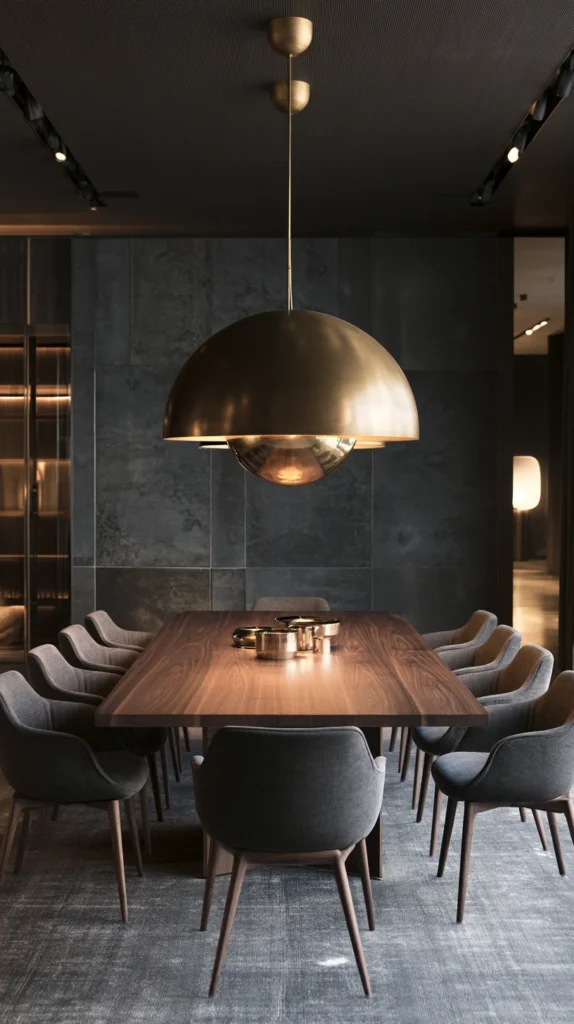
Three to five individual brass pendants hung from a single ceiling canopy at different cord lengths, creating a sculptural cluster over the dining table.
Why varied heights work better than matched heights
Matched-height clusters read as a multi-pendant fixture — an object with a predictable form. Varied-height clusters read as something assembled — pendants at different distances from the ceiling, each occupying its own position in the space above the table. The composition: organic rather than manufactured.
The height variation
The longest cord: 18 to 24 inches below the canopy. The shortest: 6 to 8 inches. The middle lengths distributed between. The total range of heights: 12 to 16 inches from highest to lowest pendant.
The pendant selection for the cluster
All the same pendant in the cluster: cohesive, the variation entirely in the heights. Two or three different pendant types at different heights: more complex and more personal-looking.
For brass: a mix of a small dome, two globes, and one bare Edison bulb at the lowest position — the bare bulb reading as intentional rather than incomplete in the context of the other shaded pendants.
The canopy
A large brass round canopy — 6 to 8 inches in diameter — from which all cords descend. The canopy: the organizing element that holds the cluster together visually as a single fixture.
Cost breakdown: Pendant cluster (3–5 pendants): $180–600 Multi-pendant brass canopy: $30–70 Total: $210–670
10. The Drum Shade in Linen with Brass Fittings
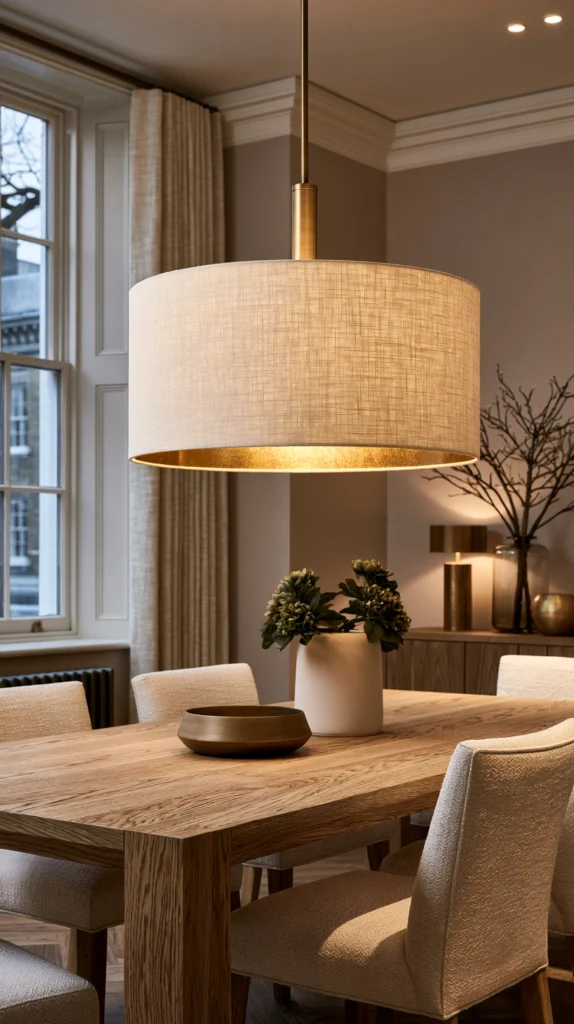
A linen or fabric drum shade — cylindrical, equal diameter at top and bottom — with brass interior fittings, brass ceiling canopy, and a visible brass cord cap. The softest and warmest pendant for a dining room that prioritizes comfort over drama.
Why the drum shade produces the warmest light
A drum shade in a warm-toned linen or cream fabric filters the bulb light through the textile before releasing it. The fabric adds its own warm cast to the already-warm bulb — the light arriving at the table having passed through brass and linen both.
The shade diameter and height
16 to 20 inches in diameter for a single drum over a dining table. Height: 10 to 14 inches — the drum taller than it is wide reads as lantern-like. The drum wider than it is tall reads as a compressed dome.
The fabric
Natural linen or cotton in cream, oatmeal, or warm white. Nothing printed or patterned — the shade: a diffuser, not a canvas.
Stitched or banded trim at the top and bottom edge in the same brass tone as the fittings — the detail that connects the shade to the hardware.
The interior
Lined in a warm gold or cream tone — the warm interior amplifying the light before it exits the shade. A white interior: insufficient. A gold interior: the correct version.
The multiple shade option
Three drum shades at matched heights over a long table — a linear arrangement, each shade centered over one-third of the table length. The arrangement: orderly, warm, and fully neo deco in its relationship between repetition and material.
Cost breakdown: Linen drum shade with brass fittings: $100–350 Three shades for a long table: $300–1,050
11. The Aged Brass and Verdigris Pendant
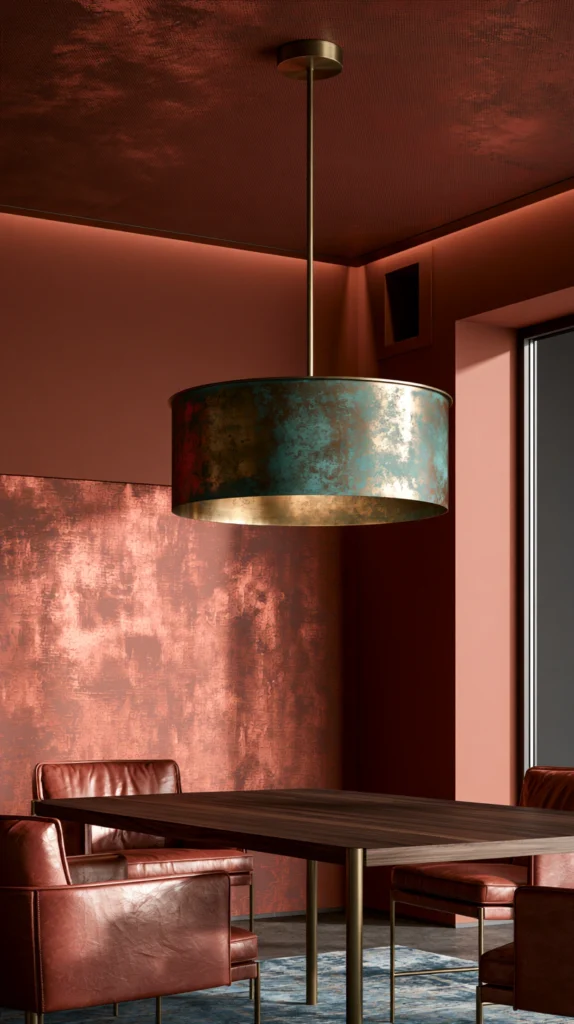
A brass pendant in which the patina has been accelerated and enhanced — aged brass with areas of verdigris, the green-grey oxidation that develops on brass and copper over decades of exposure.
Why verdigris in a dining room
Most brass pendant discussions focus on maintaining or preventing patina. This pendant embraces the fullest version of it: the green-grey verdigris that represents decades of aging compressed into a designed finish.
Against a warm dining room — dark wood, deep-colored walls, warm linen — the cool green of verdigris reads as unexpected and immediately antique. The pendant: looking as if it has been in the room for fifty years before the room was even built.
The finish in practice
Commercially available aged brass pendants with verdigris accents from specialty lighting retailers. Or a DIY patina applied to an unlacquered brass pendant using salt water, ammonia fumes, and time.
The DIY version — unlacquered brass pendant suspended over a container of ammonia for 24 to 48 hours in a sealed bag — produces a verdigris patina that deepens over subsequent weeks of exposure.
The room pairing
Verdigris brass over a dark green dining room: the patina and the wall color in dialogue. Over a deep terracotta room: the green of the verdigris against the orange-red of the wall — complementary colors producing a quietly dramatic tension. Over a dark navy room: the warmth of the brass visible through the verdigris against the cool of the blue.
Cost breakdown: Aged brass pendant with verdigris finish (specialty): $150–500 Or DIY patina on existing unlacquered pendant: $5–20 in materials
12. The Statement Brass Lantern Pendant
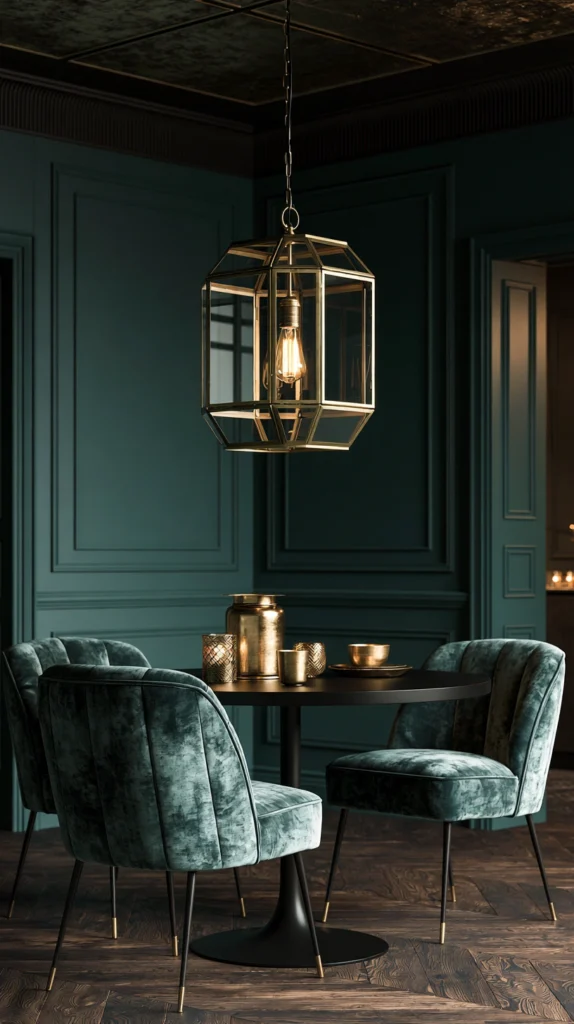
A brass lantern form — four glass panels in a brass frame, a visible bulb at the center — hung over the dining table as a pendant rather than mounted as a wall fixture. The most architectural and most formally neo deco pendant option.
Why the lantern form suits a dining room
The lantern is the direct descendant of the hanging candle lamp — the original dining room pendant. A brass lantern over a dining table references that lineage directly. It is not a contemporary design trend. It is the form that existed before the pendant light was formalized as a fixture type.
The lantern dimensions
Smaller than expected: 8 to 12 inches square and 12 to 18 inches tall. A lantern at these dimensions reads as a pendant at dining table height. Larger, and it reads as an exterior fixture brought inside.
The glass panel treatment
Clear glass: the bulb fully visible, the brass frame the primary visual element. Seeded or textured glass: the bulb obscured, the light more diffused. Amber glass: the lantern glowing amber from every angle — the most dramatic and warmest version.
The frame detail
The brass frame in an angular, geometric profile — flat bar rather than round rod — for the most distinctly Art Deco reference. Round rod frames read as more traditional and less specifically neo deco.
In a pair
Two brass lanterns hung at the same height over a long table, one above each half — the most formal and most symmetrical arrangement. The paired lanterns: acting as twin candelabras over a table set for eight.
Cost breakdown: Brass lantern pendant (single): $100–400 Pair of brass lanterns: $200–800
13. The Complete Dramatic Dining Room Built Around a Brass Pendant
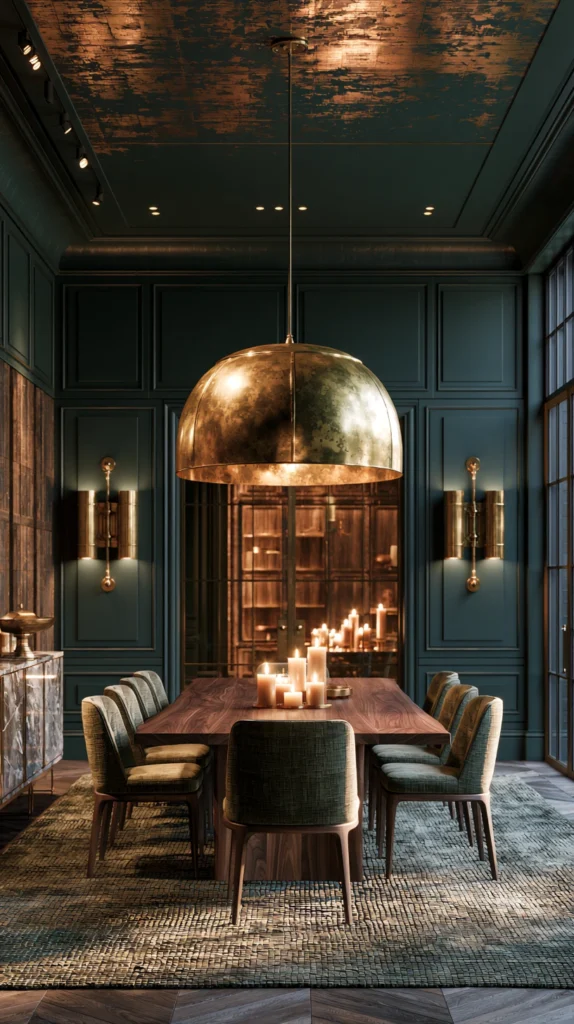
A dining room designed from the ceiling downward — the brass pendant chosen first, every subsequent decision made in response to the light it will produce and the object it will be.
What separates a dining room with a brass pendant from a dramatic dining room
A brass pendant in an otherwise unchanged room: a light source in a material. A dining room built around a brass pendant: a room where the wall color was chosen to amplify the pendant’s warmth, the table was chosen to reflect its light, the chairs were chosen to sit within its reach, and the rest of the room recedes deliberately into the darkness outside the pendant’s pool.
The elements of the complete dramatic dining room
The pendant
The first decision, not the last. Chosen for its diameter relative to the table, its hanging height relative to the ceiling, and its light quality relative to the atmosphere intended for the room.
The wall color
Deep and warm — the walls dark enough that the pendant’s pool of light reads as a zone of warmth within a darker room rather than simply adequate illumination in a well-lit one.
Forest green with a wide brass dome: the pendant amplified by the wall’s depth. Aubergine with an amber glass globe: the purple and amber working together in the same warm darkness. Deep terracotta with a rattan-and-brass dome: the most organic and earthen version. Charcoal with a brass cage pendant: the most graphic and most contemporary.
The ceiling
Darker than standard — the same color as the walls, or one shade lighter. A dark ceiling makes the pendant the room’s light source rather than a supplement to general room brightness. The pendant: providing all the drama because the room gives it nothing to compete with.
The table
Positioned directly beneath the pendant’s center point — not assumed to be already there. In many dining rooms, the table and the ceiling fitting are not aligned. The table moves to meet the light.
Dark wood or marble: both reflect the pendant’s warm light upward from the table surface. The table: both receiving and returning the light.
The chairs
Positioned within the pendant’s reach — the outermost chairs sitting at the edge of the light pool rather than outside it. If the table is 84 inches long and the pendant dome is 20 inches in diameter, the light reaches approximately 36 inches in each direction from center. The chairs at the short ends of the table: within that radius.
The room outside the pendant’s reach
Dark and deliberately underlit. A single brass wall sconce on one wall — not to light the room but to mark the room’s boundary. A sideboard in the dim periphery with two candles: present, warm, and secondary.
The room across an evening
7pm: Guests arriving. The room dim from the doorway, the table bright beneath the pendant. The brass of the fixture catching the eye from the entrance. The room: making a promise.
7:30pm: Seated. The pendant at 28 inches above the table surface. The light on the faces of the people seated. The glasses catching the pendant’s warmth. The ceiling above: dark and absent from the conversation.
9pm: The main course. The brass dome reflecting the candlelight from the sideboard back into the room from above. The two light sources — pendant and candle — in conversation. The room: exactly warm enough.
11pm: One candle remaining on the sideboard. The pendant still lit, at its full warm output. The table: the last lit surface in the room. The brass: still catching what light remains and returning it.
The complete dramatic dining room: not a room that performs drama. A room in which drama is the natural consequence of a pendant chosen at the right height in the right material above a table positioned to receive it.
Cost breakdown for the complete room: Deep wall and ceiling paint: $80–160 Brass pendant (any of the 12 above): $90–1,260 Dark wood or marble dining table: $400–2,000 Dining chairs (6): $300–1,200 Brass wall sconce: $80–200 Sideboard: $200–800 Candles and brass holders: $30–80 Rug beneath the table: $100–400 Total: $1,280–6,100
Phased over two to three seasons:
Season one ($200–500): The brass pendant — the first and most important decision Dark wall paint Warm filament bulbs throughout
Season two ($400–900): The dining table repositioned or replaced Dining chairs in a material that suits the pendant’s weight One brass wall sconce
Season three ($300–800): A rug beneath the table Sideboard with brass hardware Candles and the complete accessory layer
The dramatic dining room: not assembled in a weekend but built from the ceiling down, one decision at a time.
The question before any brass pendant decision
Before choosing a fixture, a diameter, a hanging height:
What is the primary purpose of the light over this table?
If the answer is: maximum warmth and concentration — the wide brass dome at 26 inches above the table. If the answer is: sculptural presence as much as illumination — the oversized chandelier or the pendant cluster. If the answer is: warmth without drama — the schoolhouse globe or the linen drum shade with brass fittings. If the answer is: the most committed version of the aesthetic — the complete dramatic dining room, built from the pendant downward.
The pendant is always the beginning. The room: what grows beneath it.