
15 Brass Fixture Ideas That Instantly Elevate a Bathroom
Most bathrooms are built with whatever metal finish came standard from the builder, usually chrome or brushed nickel, and most homeowners never revisit that decision.
It’s an easy detail to overlook, since a faucet or a towel bar rarely feels like a design choice the way a tile or paint colour does. But metal finish repeats more often in a bathroom than almost any other material — faucet, showerhead, cabinet pulls, mirror frame, towel bar, light fixture — and a cool, flat finish repeated that many times has a bigger cumulative effect than most people register.
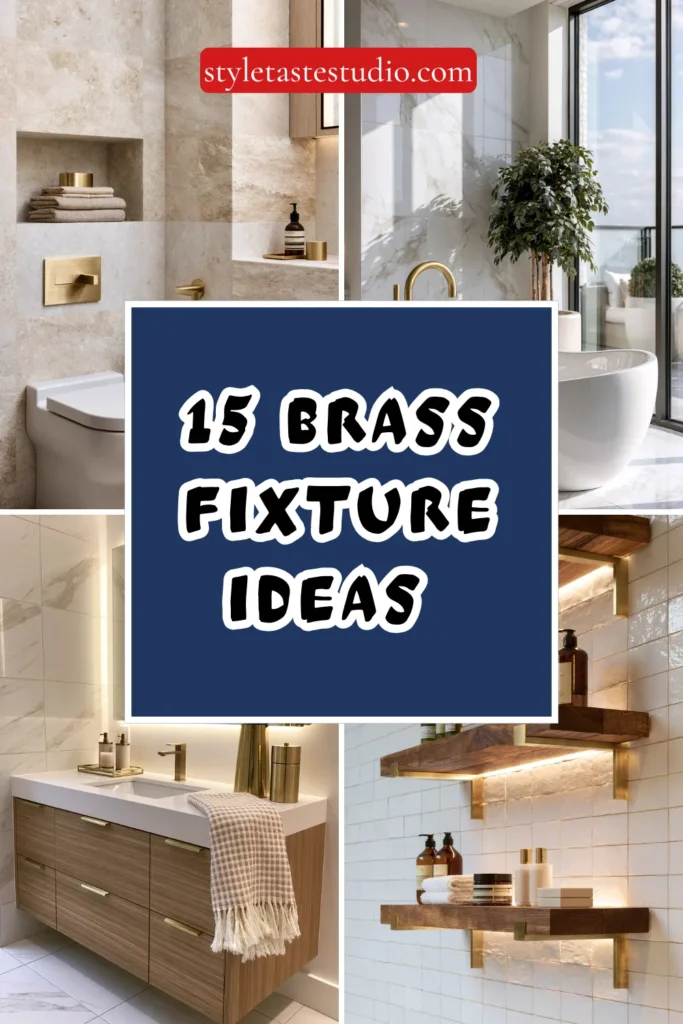
Brass changes that cumulative effect more than almost any other single swap available. It reads warmer, more considered, and closer to traditional high-end fixtures than chrome or nickel ever manage, and unlike tile or a vanity replacement, most brass upgrades don’t require touching plumbing, walls, or anything structural. A bathroom can go from builder-standard to genuinely elevated through hardware and fixture swaps alone.
The goal isn’t necessarily replacing every metal surface at once. Even a partial brass update, done with the right finish and applied consistently, shifts how the whole room reads. Here are 15 ways to make that shift.
Why Some Brass Bathrooms Read Cheap Instead of Elevated
The finish-mixing problem:
Without a consistent finish:
- Bright polished brass on one fixture, chrome left in place on another, nickel somewhere else
- No relationship between the newly updated pieces and the ones left unchanged
- The result: reads as a partially finished project rather than a considered material choice
With a consistent finish:
- One brass tone (polished, brushed, or aged) applied across every visible metal surface in the room
- Every fixture, from the faucet to the door hinges, speaking the same material language
- The result: reads as a fully considered bathroom, even if only a few individual pieces were actually replaced
The over-bright problem:
- A single, uniformly bright, mirror-polished brass finish across every fixture
- No variation in tone or sheen anywhere in the room
- The result: can read closer to costume gold than genuine material richness, particularly under bright bathroom lighting
The partial-application problem:
- Brass applied only to the most visible fixture (usually the faucet), with everything else left in its original finish
- The result: draws attention to the mismatch rather than achieving the intended elevation, since the eye immediately notices the one updated piece against everything unchanged around it
The Five Brass Bathroom Principles
Before choosing any individual idea below, these five principles separate a genuinely elevated brass bathroom from a partially updated one:
One consistent brass tone throughout:
- Polished, brushed, or aged — pick one and apply it to every fixture, not a mix of finishes
- Consistency does more for the room’s overall read than any single fixture’s individual quality
Brushed or aged over high-polish, in most bathrooms:
- A brushed or slightly aged finish reads more current and more forgiving of water spots and fingerprints
- High-polish brass looks striking in photos but shows every mark in daily use
Start with the highest-visibility fixtures:
- Faucet, mirror frame, and lighting draw the most attention and deliver the most noticeable change per dollar spent
- Smaller hardware (hinges, hooks) matters, but delivers less visible impact if the budget requires prioritizing
Pair brass with a genuine material, not just paint:
- Real brass-finished metal, not a painted or coated imitation, ages and wears differently and more attractively over time
- A quality brass finish is worth the price difference over a cheaper painted alternative, particularly in a humid bathroom environment
Balance warmth with enough white or light surface:
- Brass reads richest against white tile, marble, or a pale wall, not against an already warm or dark palette
- Too much warm tone throughout the room can tip toward heavy rather than elevated
1. The Faucet Swap
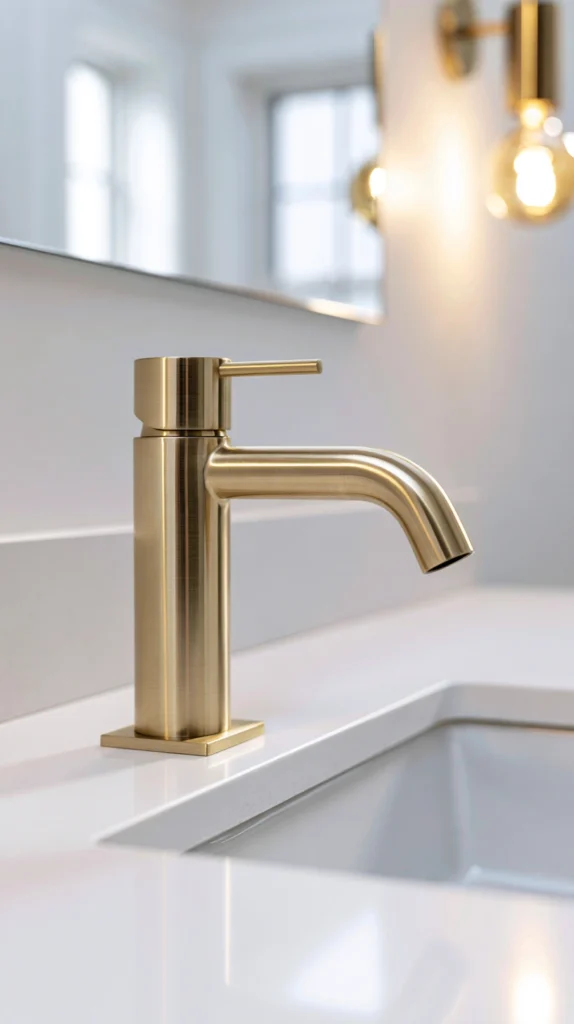
Replacing the bathroom sink faucet with a brushed or aged brass version — the single highest-visibility fixture in most bathrooms and the natural starting point for any brass update.
Why the faucet delivers the most noticeable change
The faucet is touched and viewed at close range multiple times a day, more than almost any other bathroom fixture, making it the single highest-impact swap for the effort and cost involved. A brass faucet alone, even with everything else left unchanged temporarily, immediately shifts the room’s overall impression.
Style and finish notes
- A brushed or satin brass finish resists water spots more gracefully than a high-polish finish
- Match the faucet’s overall silhouette (traditional cross-handle versus a single modern lever) to the bathroom’s existing style rather than introducing an unrelated shape
Cost breakdown
- Brass bathroom faucet: $150–320
- Total: $150–320
2. The Brass Showerhead and Shower System
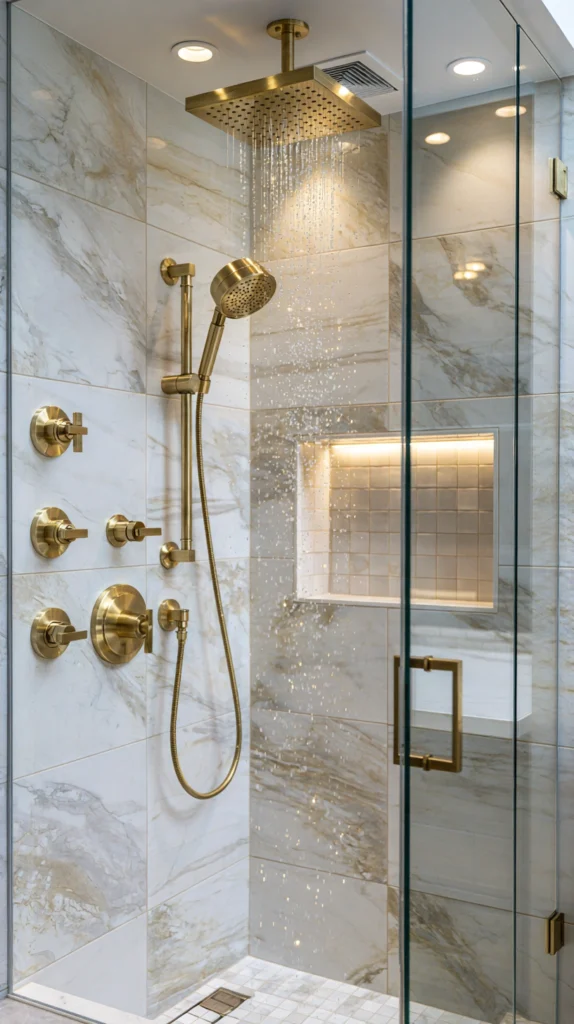
A full shower system — showerhead, handle, and any accompanying handheld unit — replaced in a matching brass finish, extending the metal update into the wet zone of the bathroom.
Why the shower system matters as much as the sink faucet
A bathroom with a brass sink faucet but a chrome shower system still reads as a partially finished update, particularly in a bathroom where both fixtures are visible from the same vantage point. Matching the shower system to the sink faucet closes that gap and extends the elevated feeling into the space actually used for bathing, not just handwashing.
Installation notes
- Full shower system replacement typically requires accessing the shower valve, which may be more involved than a simple showerhead swap depending on the existing plumbing configuration
- A showerhead-only swap, keeping the existing valve trim, is a lower-cost partial option if a full system replacement isn’t feasible
Cost breakdown
- Full brass shower system (showerhead, handle, trim): $220–450
- Or showerhead only: $60–130
- Total: $60–450 depending on scope
3. Brass Cabinet and Vanity Hardware
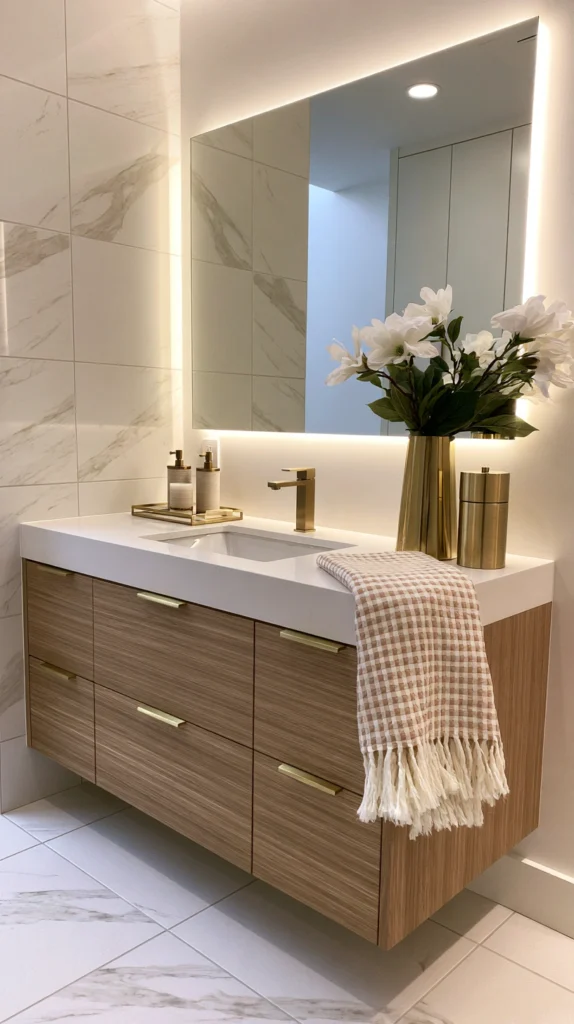
Vanity drawer pulls and cabinet knobs replaced in brushed brass, updating the storage furniture to match the plumbing fixtures.
Why hardware matters even on furniture that isn’t being replaced
An existing vanity, even one not otherwise being renovated, gets a substantial visual update through hardware alone. Because vanity hardware typically repeats several times across multiple drawers and doors, the finish shows up repeatedly throughout the room, reinforcing the brass palette established by the faucet.
Where to prioritise
- All visible pulls and knobs on the vanity, replaced as a full set for consistency
- Any additional cabinetry (a linen closet, a medicine cabinet) in the same bathroom, for full hardware consistency throughout the space
Cost breakdown
- Brass cabinet hardware (6–10 pieces): $50–100
- Total: $50–100
4. A Brass-Framed Mirror
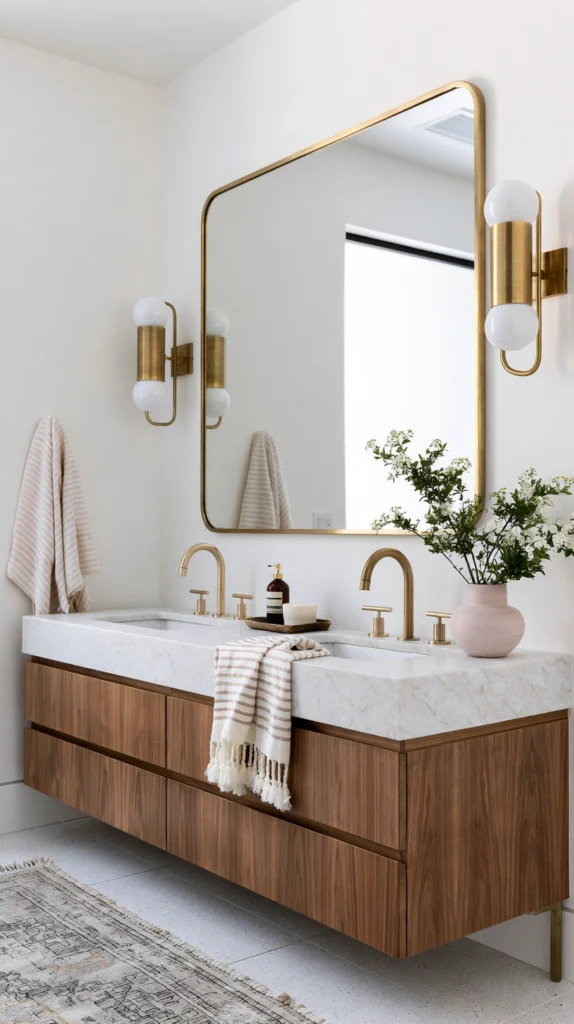
The bathroom mirror replaced or reframed in brushed or aged brass, providing both a functional update and a vertical focal point above the vanity.
Why the mirror is one of the most visually prominent brass opportunities
A mirror occupies a large, central position directly above the vanity, in the sightline of anyone using the sink. A brass frame here does significant visual work relative to its size, and unlike a plain, unframed mirror, a framed version adds architectural definition to what’s otherwise often the largest flat surface in the room.
Sizing
- Width: roughly 70–80% of the vanity’s width, standard proportion for a bathroom vanity mirror
- Frame thickness: 1–2 inches, substantial enough to read clearly without overwhelming a smaller bathroom’s proportions
Cost breakdown
- Brass-framed bathroom mirror: $120–280
- Total: $120–280
5. Brass Wall Sconces Flanking the Mirror
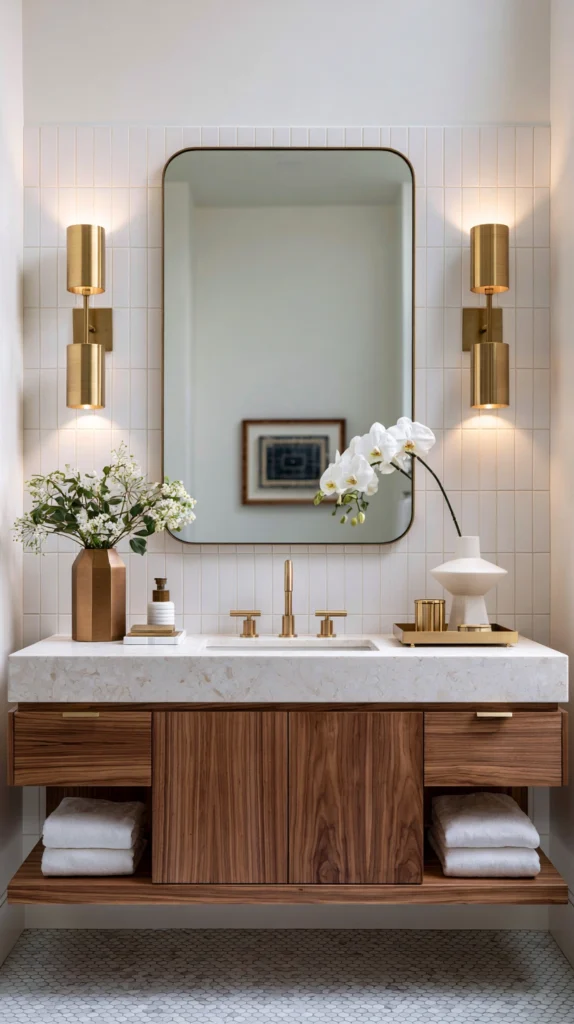
A pair of brass wall sconces, mounted on either side of the mirror, replacing a single overhead vanity light bar or an unflattering flush-mount fixture.
Why flanking sconces improve both light quality and finish consistency
Sconces positioned at face height on either side of the mirror provide more even, flattering light than an overhead fixture alone, which tends to cast shadows under the eyes and chin. Choosing them in brass extends the metal finish into the room’s lighting, one of the categories most often left unchanged during a hardware-focused update.
Placement
- Mounted at eye level, roughly 60–66 inches from the floor, with 28–36 inches of horizontal spacing between the two fixtures depending on the mirror’s width
- Warm 2700K bulbs, consistent with the lighting principle used throughout any considered room
Cost breakdown
- Brass wall sconces (pair): $90–200
- Total: $90–200
6. A Brass Towel Bar and Ring
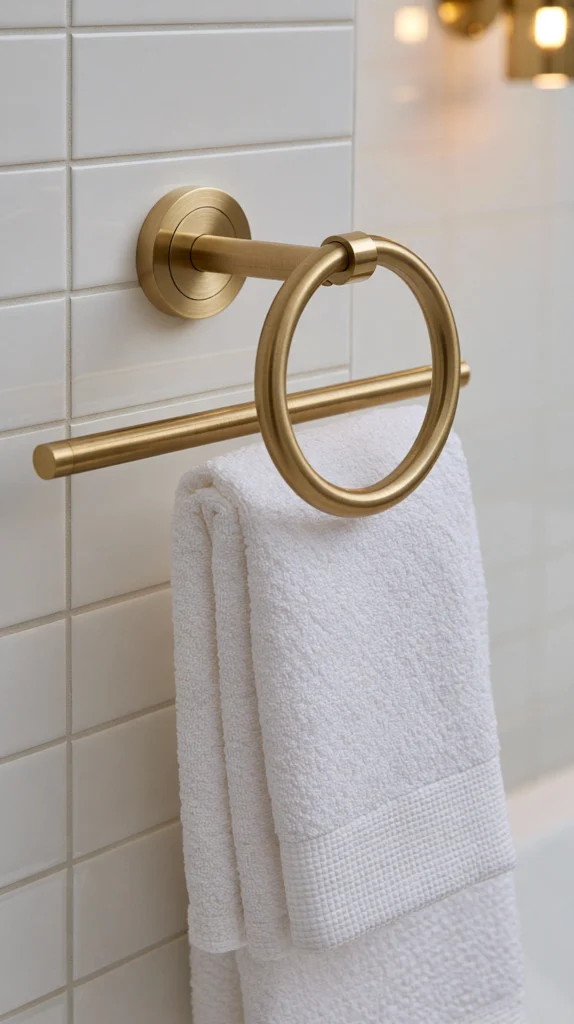
The towel bar and any accompanying towel ring replaced in a matching brushed brass finish, extending the metal palette to the room’s most frequently touched accessory hardware.
Why towel hardware shouldn’t be overlooked
Towel bars and rings are handled daily and are positioned at a height and location that draws regular attention, making their finish more noticeable in daily use than some higher-cost fixtures that are seen but rarely touched. Leaving them in the original chrome or nickel while updating the faucet and mirror creates one of the most common inconsistencies in a partially finished brass update.
Sizing and placement
- Towel bar length: 18–24 inches for a single bath towel, or 24–30 inches for a double-folded hang
- Towel ring: mounted at a height allowing a hand towel to hang without touching the counter or floor, typically 48–52 inches from the floor
Cost breakdown
- Brass towel bar: $30–60
- Brass towel ring: $20–40
- Total: $50–100
7. A Brass Toilet Paper Holder
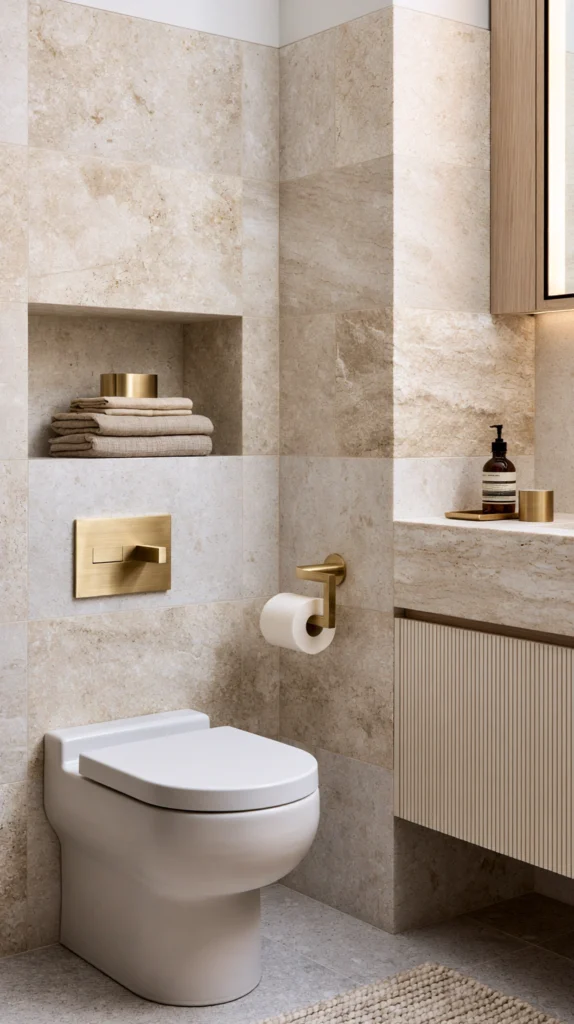
A small but frequently noticed detail — the toilet paper holder — replaced in matching brass, closing one of the smallest remaining finish gaps in the room.
Why this small fixture matters more than its size suggests
A mismatched toilet paper holder is a detail many people wouldn’t think to prioritize, but it sits at close, direct eye level for anyone seated, making it one of the more closely observed fixtures in the entire room despite its small size and low cost.
Style matching
- A wall-mounted bar-style holder in the same finish and general silhouette as the towel bar, for full hardware consistency
- Recessed or freestanding options both work equally well in brass, depending on the bathroom’s existing configuration
Cost breakdown
- Brass toilet paper holder: $18–35
- Total: $18–35
8. Brass Robe Hooks
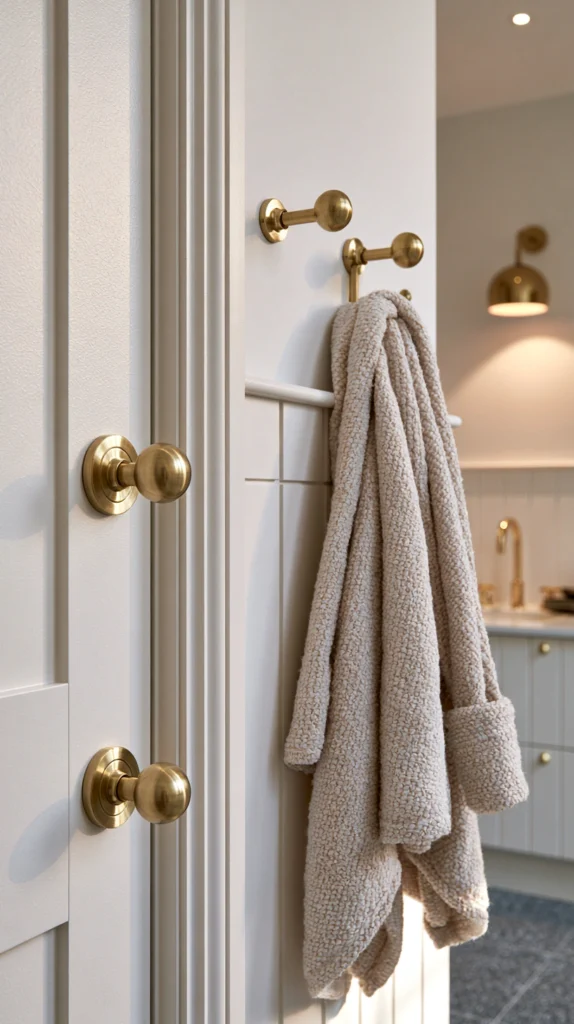
One or two robe hooks, mounted on the back of the bathroom door or on an open wall section, in the same brushed brass finish as the rest of the room’s hardware.
Why hooks complete the hardware system
Robe hooks are functional necessities in almost every bathroom, and like the towel bar and toilet paper holder, they’re frequently the last piece left in its original finish during a hardware update, simply because they’re smaller and less visually central than the faucet or mirror.
Placement
- Mounted 60–66 inches from the floor, standard robe hook height
- One hook per household member using the bathroom regularly, or a minimum of two for general guest use
Cost breakdown
- Brass robe hooks (2): $20–40
- Total: $20–40
9. A Brass Hollywood-Style Vanity Light Bar
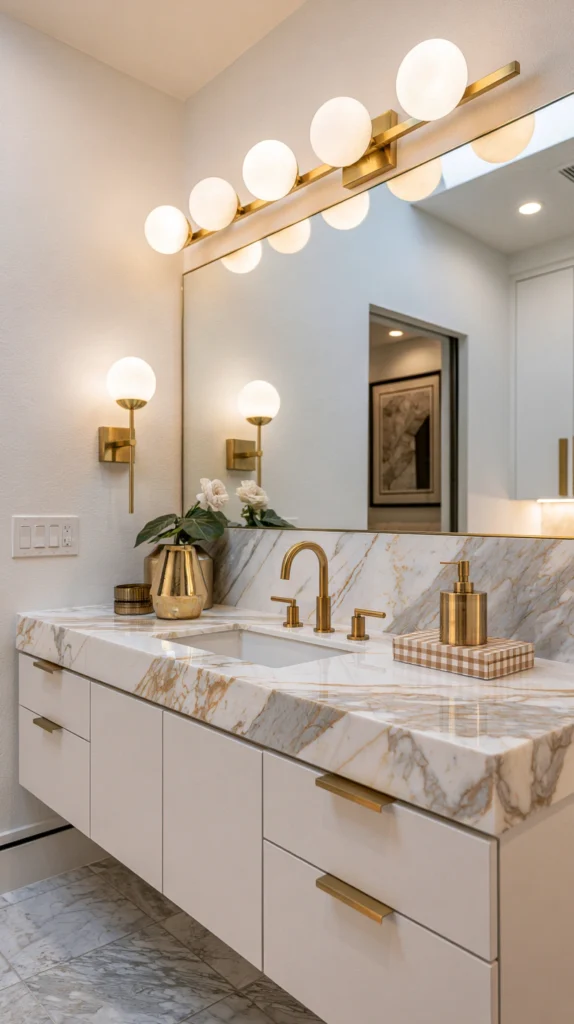
A horizontal bar of small brass-finished bulbs or globes mounted directly above the mirror, in place of or alongside the flanking sconces, for a more theatrical, dressing-room-inspired lighting statement.
Why this style suits a bathroom leaning toward a more glamorous overall design
A Hollywood-style light bar, historically associated with dressing rooms and vanity mirrors, adds both function (even, shadow-free lighting across the whole face) and a distinctly more formal, glamorous visual statement than a pair of simple sconces. It suits a bathroom already leaning toward a richer, more elevated overall palette rather than a minimalist one.
Sizing and bulb specification
- Bar width: matched closely to the mirror’s width, mounted centred above it
- Warm-temperature bulbs (2700K) in each socket, avoiding the harsher, cooler-toned bulbs sometimes used in true theatrical dressing-room fixtures
Cost breakdown
- Brass Hollywood-style vanity light bar: $110–220
- Total: $110–220
10. A Brass Freestanding Tub Filler
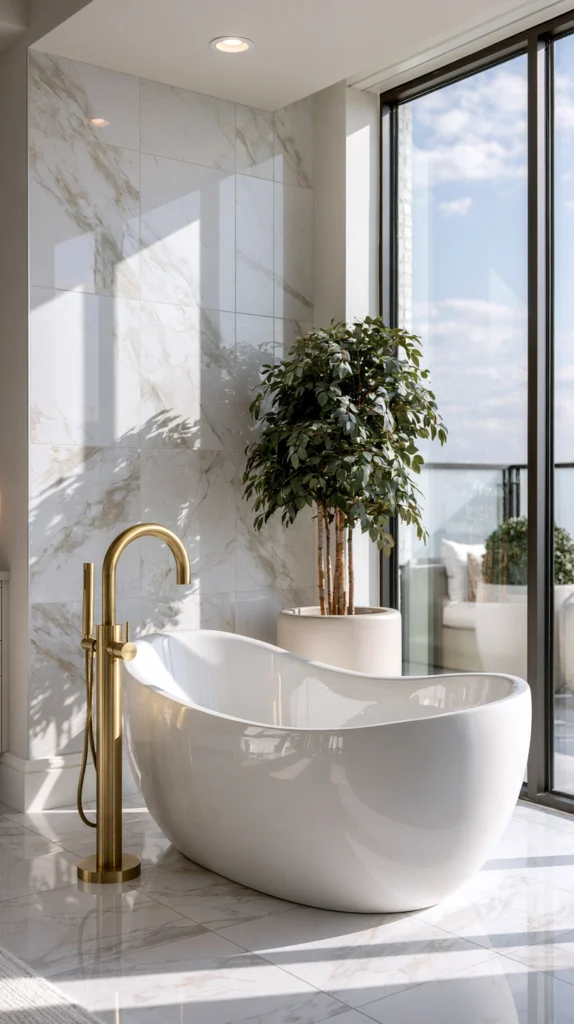
For a bathroom with a freestanding soaking tub, a brass floor-mounted or deck-mounted tub filler, replacing a standard chrome or nickel version.
Why the tub filler deserves the same consideration as the sink faucet
A freestanding tub is typically one of the most visually prominent features in any bathroom that has one, and its filler, being the largest single fixture attached to it, carries a proportionally large share of the room’s overall metal-finish impression. Leaving it in a mismatched finish while updating smaller fixtures elsewhere undercuts the room’s largest single visual investment.
Installation notes
- Floor-mounted fillers require access to plumbing running up through the floor, generally a larger installation project than a deck-mounted version
- Deck-mounted fillers, installed directly on the tub’s rim, are typically a more accessible retrofit if the tub is already in place
Cost breakdown
- Brass freestanding tub filler: $350–700
- Total: $350–700
11. Brass Drain and Overflow Covers
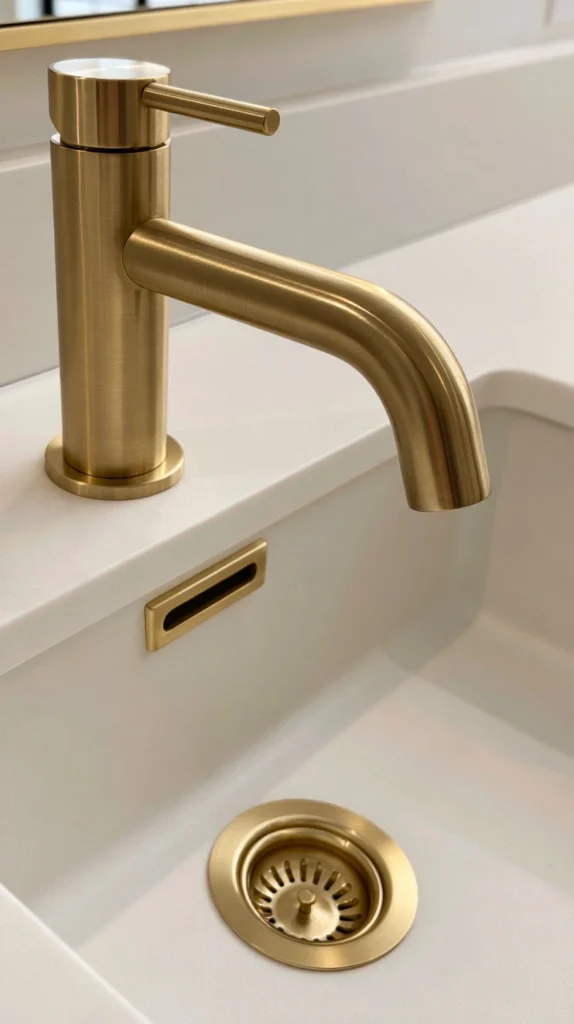
The sink and tub drain covers, along with any visible overflow plate, replaced in matching brass — a small, easily overlooked detail that closes one of the most commonly missed gaps in a full brass update.
Why drain covers are worth the small additional cost
A beautifully updated faucet directly above a chrome drain cover creates a small but noticeable inconsistency, precisely because the two fixtures sit so close together in the same sightline. Matching the drain and overflow cover to the faucet above it is a minor cost that closes one of the most visually obvious remaining gaps.
Compatibility notes
- Drain covers need to match the specific drain mechanism already installed (pop-up, lift-and-turn, or push-button), so confirm compatibility before purchasing
- Often sold specifically as a coordinating set with the faucet itself, simplifying the matching process
Cost breakdown
- Brass drain and overflow cover set: $25–50
- Total: $25–50
12. Brass Shelf Brackets
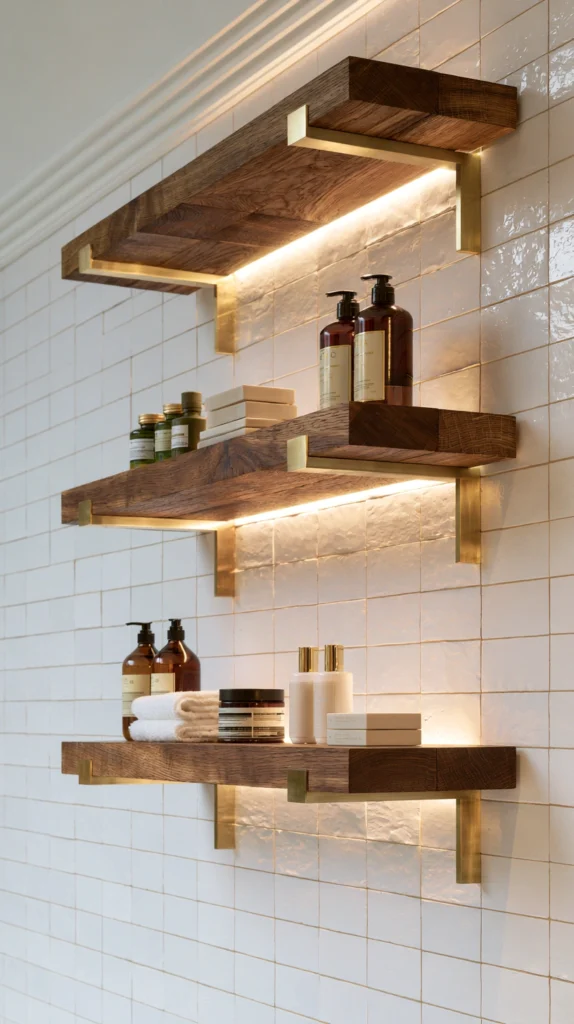
Open shelving in the bathroom — for towels, plants, or styled objects — mounted on brass brackets, extending the metal finish beyond plumbing fixtures and into the room’s storage and display elements.
Why shelf brackets carry the brass theme into styling, not just fixtures
Most of the ideas on this list involve functional hardware and plumbing. Shelf brackets are one of the few opportunities to bring the same brass finish into a styling element, reinforcing the palette in a part of the room not dictated by plumbing requirements.
Sizing and use
- Shelf depth: 8–10 inches for towels or styled objects, standard for a bathroom open shelf
- Styled with the same restraint principle used on any open shelf — a small number of considered objects, not a fully packed surface
Cost breakdown
- Brass shelf brackets (pair): $20–40
- Shelf board (if not already owned): $20–35
- Total: $20–75 depending on existing shelf ownership
13. A Brass Soap Dispenser and Tray
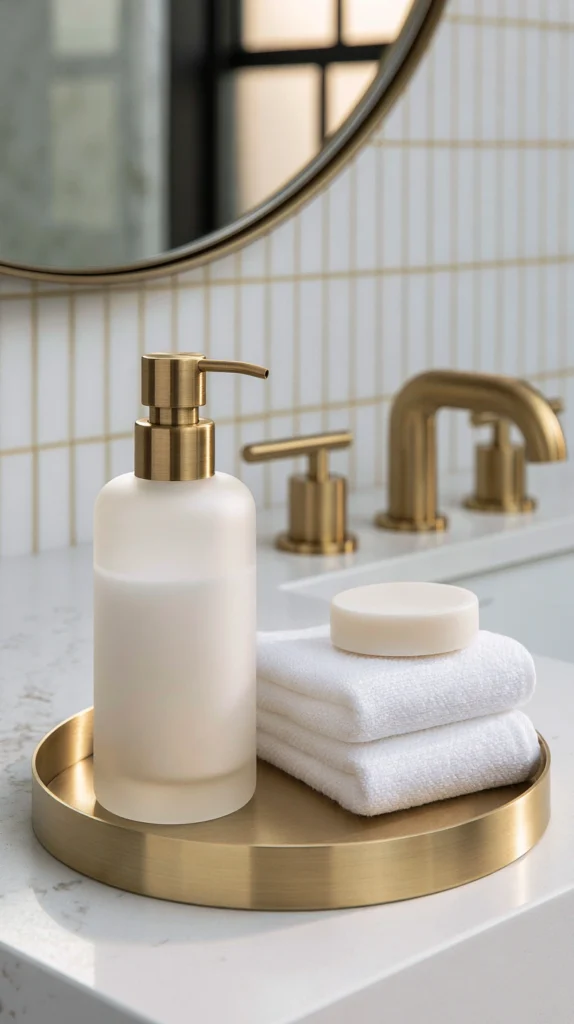
A matching brass soap dispenser and small tray on the vanity counter, replacing a plastic pump bottle or mismatched ceramic dispenser.
Why counter-level accessories matter as much as wall-mounted hardware
The vanity counter itself is a close-range, frequently viewed surface, and a plastic or mismatched soap dispenser sitting directly beneath a newly updated brass faucet creates one of the more immediately noticeable inconsistencies in a partial update. A matching dispenser and tray closes this gap at a relatively low cost.
Styling
- A small brass tray beneath the dispenser corrals it along with a hand towel or a small candle, following the same tray-grouping principle used throughout any styled surface
- A refillable glass or ceramic dispenser with a brass pump top, rather than a fully brass-bodied dispenser, balances cost with visual impact
Cost breakdown
- Brass-topped soap dispenser: $18–35
- Small brass tray: $15–30
- Total: $33–65
14. Brass Door Hardware and Hinges
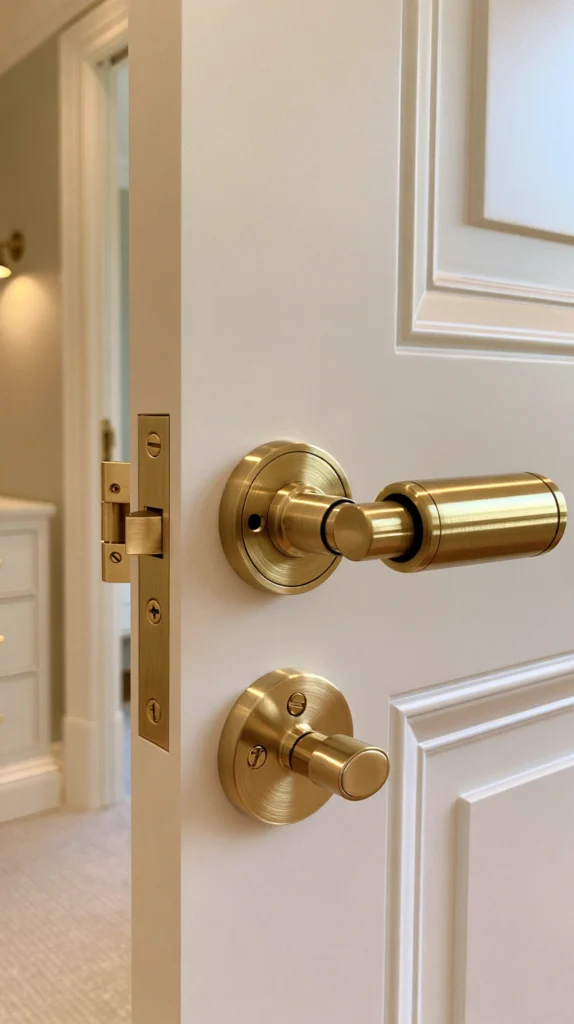
The bathroom door’s handle, lock, and visible hinges replaced in matching brass — the final, most detail-oriented layer of a full brass update.
Why door hardware is usually the last piece addressed, and worth addressing
Door hardware is rarely the first thing noticed in a bathroom, but for anyone doing a genuinely complete update, leaving the door handle and hinges in their original chrome finish is one of the more commonly missed details, particularly since hinges are visible every time the door is opened or closed.
Installation notes
- Door handles are typically a straightforward swap; hinges require removing and reinstalling the door itself, a slightly more involved project
- Confirm the door handle’s backset measurement (the distance from the door’s edge to the centre of the handle) matches the existing hardware before purchasing a replacement
Cost breakdown
- Brass door handle and lock set: $40–80
- Brass hinges (3, if replacing): $15–30
- Total: $55–110
15. The Complete Brass Bathroom
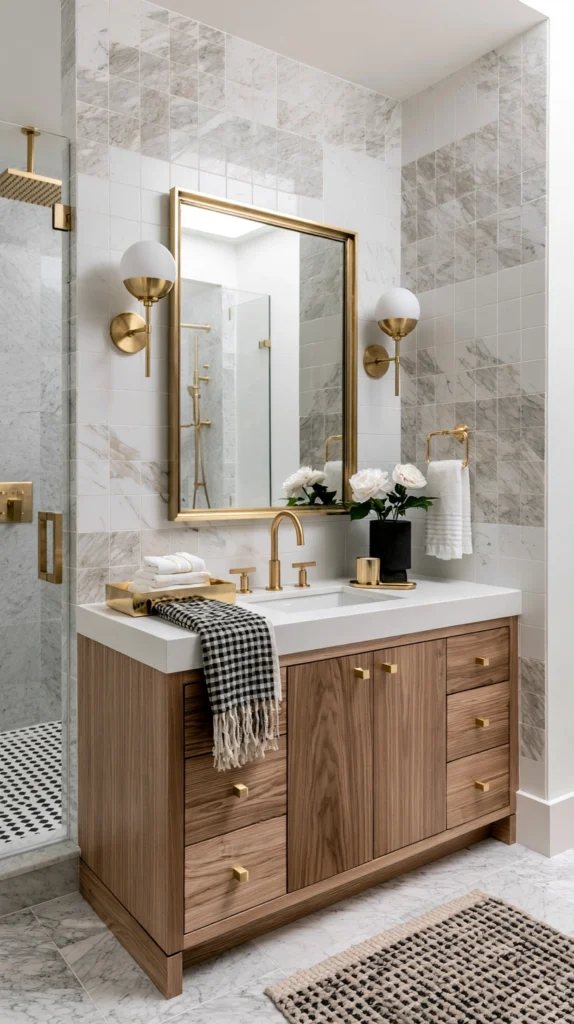
A bathroom with every brass fixture and hardware element above applied together — the definitive version of a room where every visible metal surface speaks the same material language.
What separates the complete bathroom from a partial update
A bathroom with a beautiful brass faucet and mirror, but chrome towel bars, drain covers, and door hardware left unchanged, still reads as an unfinished project to anyone who looks closely. The complete version resolves every metal surface at once, so the consistency itself — not any single fixture — becomes the room’s most elevated quality.
The elements of the complete bathroom
The plumbing fixtures:
- Brass sink faucet (Idea #1)
- Brass shower system (Idea #2)
- Brass freestanding tub filler, if applicable (Idea #10)
- Brass drain and overflow covers (Idea #11)
The mirror and lighting:
- Brass-framed mirror (Idea #4)
- Brass wall sconces or a Hollywood-style light bar (Idea #5 or #9)
The hardware:
- Brass vanity cabinet hardware (Idea #3)
- Brass towel bar and ring (Idea #6)
- Brass toilet paper holder (Idea #7)
- Brass robe hooks (Idea #8)
- Brass door handle and hinges (Idea #14)
The styling layer:
- Brass shelf brackets for open shelving (Idea #12)
- A matching brass soap dispenser and tray (Idea #13)
The bathroom in use on an ordinary morning:
Every fixture touched during a normal morning routine — the door handle, the faucet, the soap dispenser, the towel bar — carries the same warm brass finish, catching the sconce light on either side of the mirror. Nothing in the room reads as a leftover from before the update; the consistency across a dozen small fixtures does more to elevate the space than any single expensive piece could have accomplished alone.
Cost breakdown for the complete bathroom
Assuming a starting point of a builder-standard chrome or nickel bathroom:
- Faucet: $150–320
- Shower system: $60–450
- Cabinet hardware: $50–100
- Mirror: $120–280
- Sconces or light bar: $90–220
- Towel bar and ring: $50–100
- Toilet paper holder: $18–35
- Robe hooks: $20–40
- Tub filler (if applicable): $350–700
- Drain covers: $25–50
- Shelf brackets: $20–75
- Soap dispenser and tray: $33–65
- Door hardware: $55–110
Total: $1,041–2,545 (without tub filler); $1,391–3,245 (with tub filler)
Phased over two or three stages:
Stage one ($350–700):
- Faucet
- Cabinet hardware
- Towel bar, toilet paper holder, and robe hooks
Stage two ($350–800):
- Mirror
- Sconces or light bar
- Drain covers and soap dispenser
Stage three ($350–1,000+):
- Shower system
- Door hardware
- Tub filler, if applicable
The complete brass bathroom: not one striking fixture, but every visible metal surface in the room finally speaking the same finish, top to bottom.
The Question Before Any Brass Bathroom Update
Before buying a single fixture:
What’s the highest-visibility fixture currently in the least elevated finish?
If the answer is: the faucet — start there; it delivers the most noticeable change relative to cost and effort.
If the answer is: the mirror or lighting — these draw the eye nearly as much as the faucet and are often overlooked in favor of plumbing fixtures first.
If the answer is: everything is already reasonably updated except small hardware — the towel bar, toilet paper holder, and drain covers are the remaining detail-level gaps most likely to be noticed by close inspection.
If the answer is: starting completely from scratch — prioritize the faucet, mirror, and cabinet hardware first; these three alone deliver most of the room’s overall shift before any smaller detail work begins.
The project follows what’s currently creating the most visible inconsistency, not the most dramatic single fixture. A bathroom with a stunning tub filler and everything else left in chrome will read less finished than one with modest but fully consistent brass hardware throughout.
Getting Started This Weekend
The immediate brass bathroom upgrade:
Swap the faucet.
The single highest-impact change achievable in one afternoon without specialized plumbing work in most standard installations.
Replace the cabinet hardware.
A straightforward swap that extends the update to the room’s storage furniture immediately.
Add a brass towel bar and toilet paper holder.
Closes two of the most commonly noticed remaining gaps at low individual cost.
Check the drain covers against the new faucet finish.
The final, easy-to-miss detail that keeps the sink area from reading as a partial update.
The rest of the update: the elaboration of this weekend.
The finish: the beginning. The elevated bathroom: what a room becomes once every metal surface finally agrees with all the others.