
15 Fall Bathroom Lighting Ideas for a Warm Glow
Bathroom lighting is the most functional lighting in the house — and the least likely to get updated seasonally.
That’s worth changing in fall. The bathroom is where you start and end every day, and the light quality in there sets a tone before anything else does. Cool, flat bathroom lighting in October feels like a mismatch with the rest of the home.

The good news is that seasonal lighting changes in a bathroom don’t require rewiring or new fixtures. Most of the ideas here work with what’s already installed, cost under $40, and take an afternoon at most.
These fifteen ideas range from simple bulb swaps to layered lighting setups to decorative additions that add warmth and atmosphere without compromising the functional light you need for the mirror.
For more fall bathroom decor that pairs with these lighting ideas, the bathroom section on StyleTasteStudio covers seasonal updates across surfaces, textiles, and accessories.
1. Swap to 2700K Bulbs in Every Existing Fixture
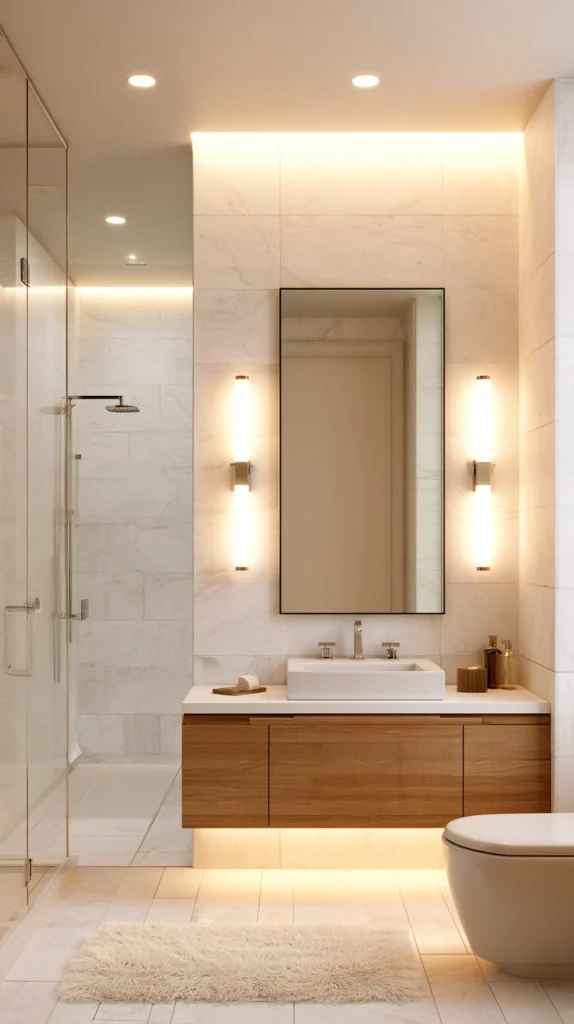
This is the fastest and cheapest change on the list. It takes five minutes and costs under $15.
Most bathroom fixtures ship with 4000K–5000K bulbs — “cool white” or “daylight” range. These are fine for task visibility but read as cold and clinical, especially in fall when the natural light outside is already warm and golden.
Replacing them with 2700K warm white LEDs shifts the entire bathroom toward amber-toned warmth without changing a single fixture or fitting.
The 2700K range is the sweet spot. It’s warm enough to feel cozy but bright enough to see clearly at a mirror — unlike 2200K “candlelight” bulbs, which are too dim for grooming tasks.
Philips Warm Glow, GE Soft White, and Sylvania Soft White all make 2700K A19 and BR30 LEDs widely available at hardware stores and online. Budget $8–$15 for a two-pack depending on wattage.
Tip: Check the fixture type before buying. Enclosed fixtures trap heat and require bulbs rated for enclosed use — this is printed on the packaging. A standard bulb in an enclosed fixture will fail early and can become a fire hazard.
Budget: $8–$20
2. Add a Plug-In Sconce Beside the Mirror
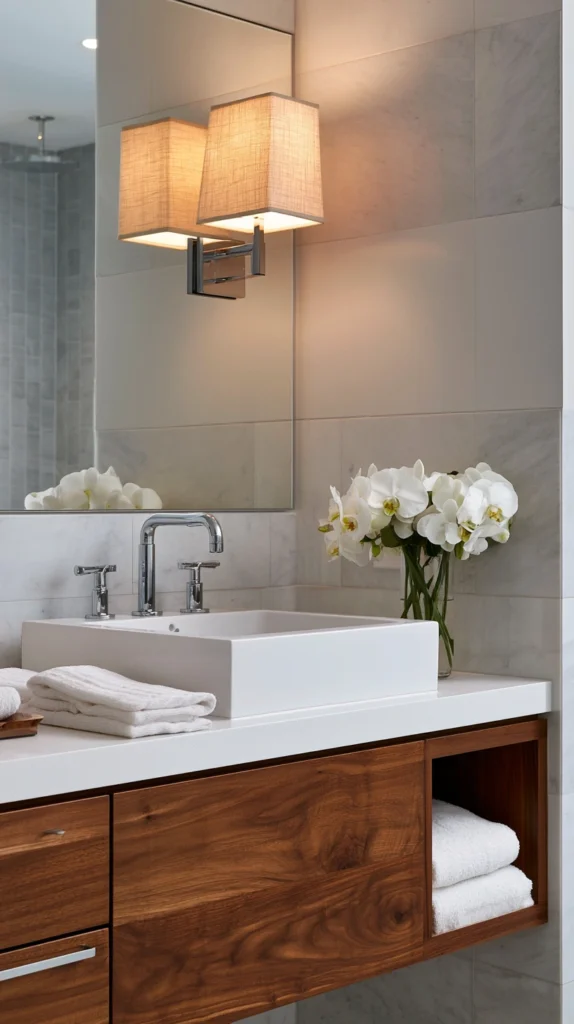
Hardwired wall sconces require an electrician. Plug-in sconces require a screwdriver and five minutes.
A plug-in sconce mounted on either side of the bathroom mirror — with the cord running down the wall and into an outlet — functions identically to a hardwired fixture for most bathroom uses. The cord can be managed with a paintable cable channel ($4–$8 at hardware stores) that sits flush against the wall and looks intentional rather than improvised.
For fall, choose a sconce with a fabric shade in a warm tone — ivory, amber, or a deep cream linen. The fabric diffuses the bulb light into a soft, scattered glow that bare-bulb or glass-shade sconces don’t produce.
Plug-in sconces in the $25–$60 range are available from Amazon, Wayfair, and Lamps Plus. Look for styles with a linen or fabric shade rather than glass or metal for maximum warmth effect.
Pair with a 2700K candelabra base bulb rated for enclosed or open fixtures depending on the shade design.
Tip: Mount sconces at eye level — approximately 60–65 inches from the floor to the center of the fixture. This is lower than most people intuitively place wall lighting, but it’s the height that eliminates shadows under the chin and around the eyes at a mirror.
Budget: $25–$70 including cord cover
3. Use Battery-Operated LED Candles on the Bathtub Ledge
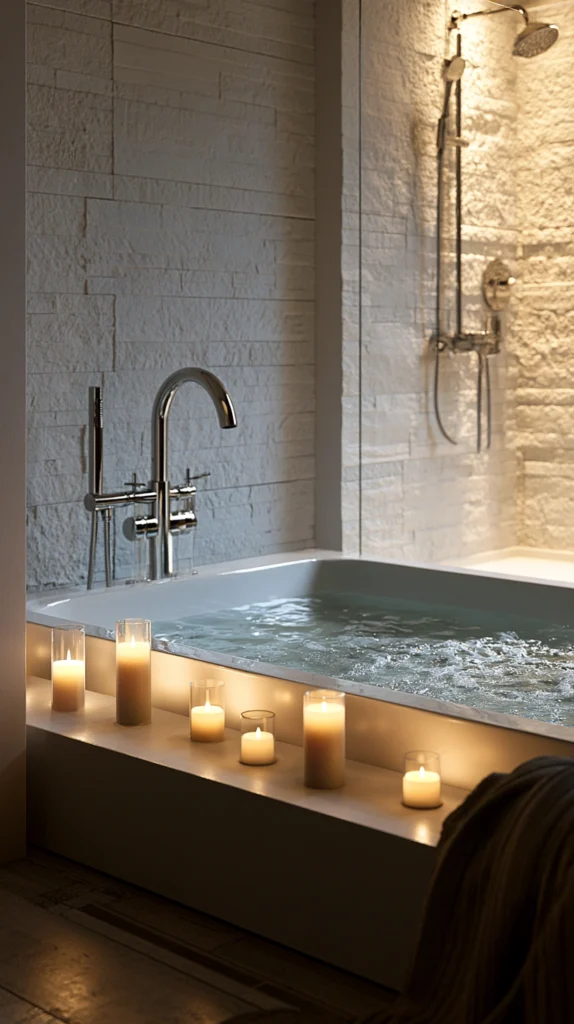
Real candles in a bathroom during a bath are a long-standing tradition. They’re also a fire risk when placed near towels, shower curtains, and any textiles within reach of a flame.
Battery-operated LED candles have closed the quality gap significantly in the past few years. Current-generation flickering LED candles — particularly those with a “flame tip” LED rather than a flat LED — produce a convincing warm flicker that reads as candlelight from any distance beyond arm’s reach.
For fall, choose LED candles in a cream or ivory wax with an amber LED tip. Avoid pure white wax — it reads as artificial in warm lighting conditions. Sizes between 3 and 6 inches work best on a bathtub ledge because they’re visible but don’t dominate the sightline.
Luminara is the most consistently recommended brand for realistic flicker movement. Their real-wax LED candles run $15–$35 each. For a budget alternative, DII and Homemory both offer convincing flicker options in the $15–$25 range for a set of three.
Tip: Use a remote-controlled set so you can turn the candles on before getting into the bath without having to reach across the ledge to switch each one individually.
Budget: $15–$40 for a set of three
4. Layer a Small Table Lamp on the Vanity Counter
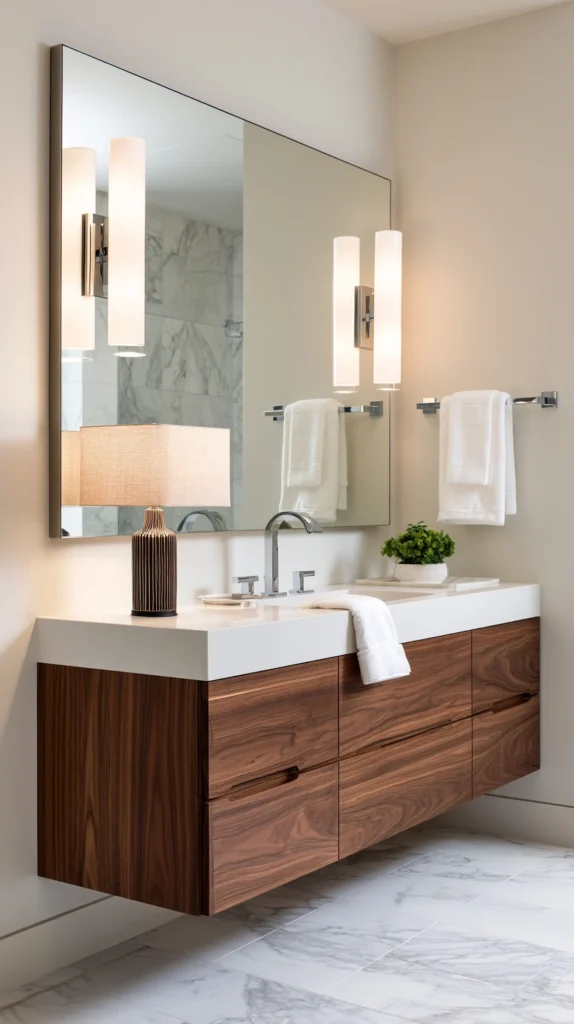
Most bathroom vanities have counter space that sits unused beyond daily products. A small table lamp placed at one end of the counter adds a third light source at a completely different height than the overhead or mirror lighting.
This lower light source is what creates the layered, residential quality that hotel bathrooms and well-designed spa spaces use. A single overhead light flattens the space. Add a lamp at counter height and the room immediately gains depth and warmth.
For fall specifically, look for a small lamp with an amber glass base or a warm terracotta ceramic base and a linen shade. The shade material matters — fabric shades scatter light in all directions rather than directing it downward like a metal shade.
Lamps with a compact footprint — base diameter under 5 inches — work on most vanity counters without crowding the functional workspace. USB-powered or battery-powered options eliminate the need for an outlet near the counter.
Target’s threshold lamp line and Amazon’s basic table lamp category both have options in the $20–$45 range that suit this use.
Tip: Place the lamp toward the back corner of the vanity counter rather than the front. This positions the light to cast forward onto the mirror and sink area rather than shining directly into your eyes when standing at the sink.
Budget: $20–$50
5. Install Dimmer Switches on Existing Overhead Lights
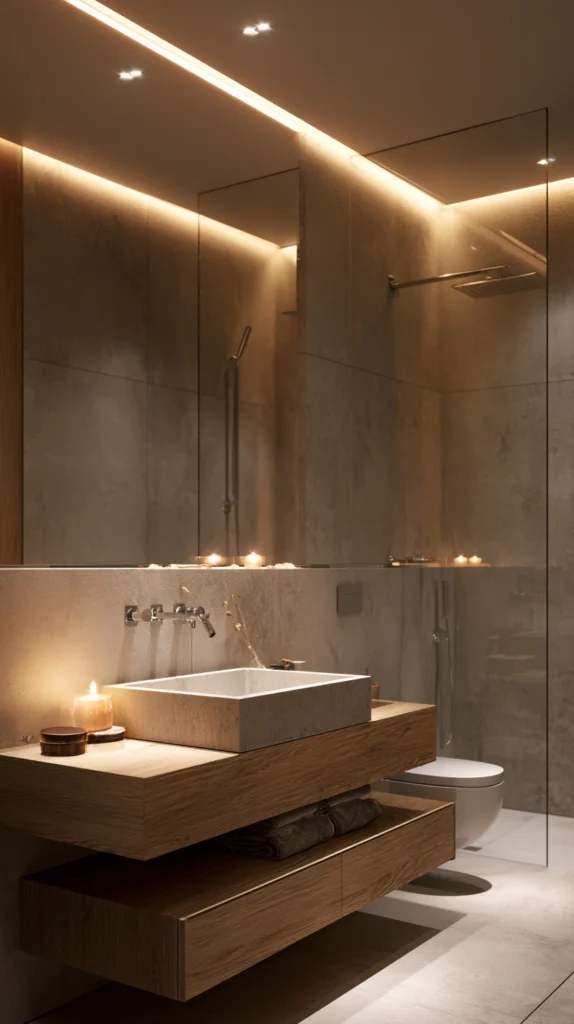
A dimmer switch changes more about a bathroom’s lighting quality than almost any other single modification — and it costs $12–$25 plus about 20 minutes of installation time.
At full brightness, overhead lights work for morning routines and task lighting. Dimmed to 40–60%, the same fixture shifts into evening relaxation mode — warm, low, and calm without requiring a separate fixture.
Most standard dimmer switches are compatible with LED bulbs, but verify before purchasing. Look for packaging that lists LED compatibility and the wattage range — a dimmer rated for 150W maximum will flicker or buzz if the connected LED draws less than the minimum rated load. Lutron Caseta and Leviton both make reliable LED-compatible dimmers in the $15–$30 range.
Turn off the circuit breaker before installation and use a voltage tester on the wires before touching them. If the existing switch has more than two wires (common in circuits with multiple switches), consult a wiring diagram before proceeding.
Tip: Install the dimmer at a level of around 70% for the first few days to allow the LED bulbs to calibrate to the dimmer’s signal. Starting at full brightness and immediately dimming can cause early flickering with some LED-dimmer combinations until the system settles.
Budget: $15–$30 for the dimmer switch
6. Hang String Lights Along a Bathroom Shelf or Window Frame
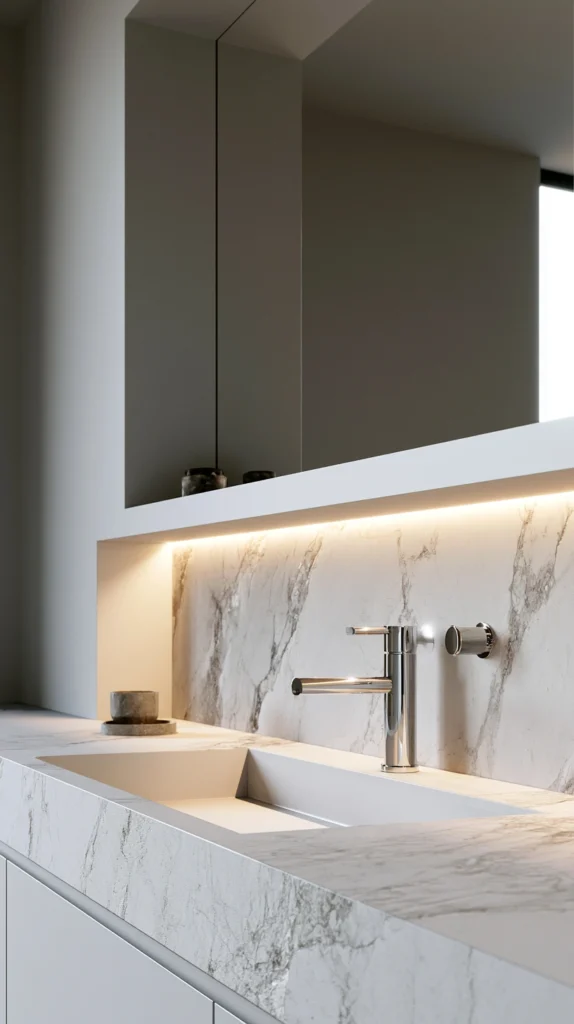
Warm white string lights — the copper wire type with micro LED bulbs — add ambient light at a height and distribution that no standard fixture can replicate.
In a bathroom, they work best along the top edge of an open shelf, draped along a window frame, or coiled in a glass vessel on the counter. The effect is soft and diffused rather than directional, which makes the bathroom feel more like a spa and less like a utility room.
For fall, choose string lights in the 2200K–2700K range — marketed as “warm white” or “amber.” Avoid cool white or multi-color strings, which break the warm seasonal tone entirely.
Copper wire micro-LED strings are flexible enough to wrap around shelf edges without needing clips or hooks. A 10-foot strand with 100 micro-LEDs runs $8–$15 and covers most standard bathroom shelf widths.
Use a smart plug or timer to set the string lights to come on at dusk automatically — this makes the ambient lighting consistent without requiring manual switching each evening.
Tip: Keep string lights away from water sources. Splashing from the sink or condensation from a shower can damage lights not rated for moisture exposure. IP44-rated string lights are water-resistant enough for bathroom use where direct water contact is unlikely.
Budget: $8–$20
7. Use a Salt Lamp as a Secondary Light Source
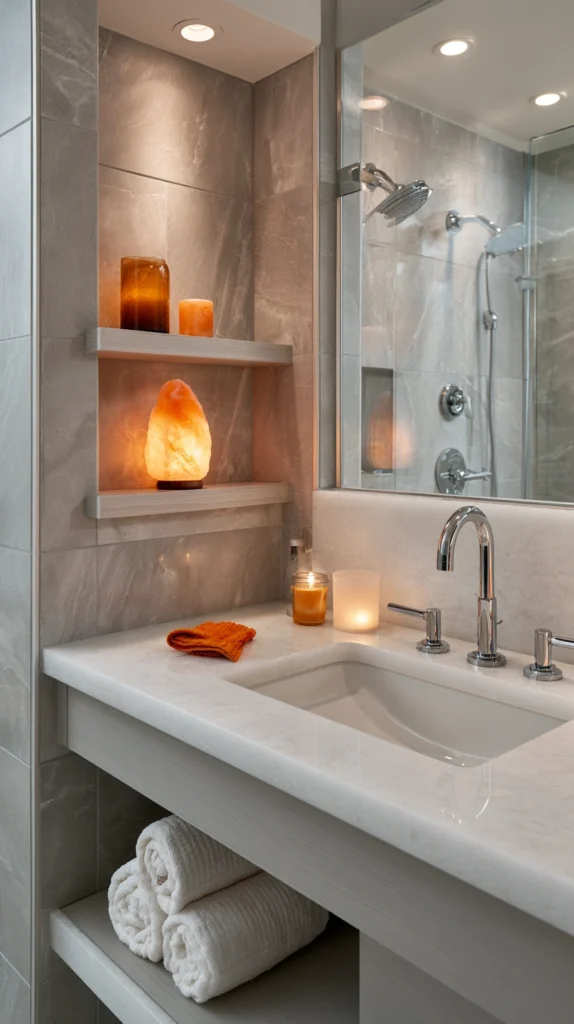
Himalayan salt lamps emit a warm, amber-orange glow that sits around 1800K–2200K — warmer than any standard LED bulb and closer to firelight than artificial light.
They don’t replace task lighting. They supplement it as a secondary ambient source that adds warmth and color that no white-spectrum bulb produces.
In a fall bathroom, a salt lamp on the toilet tank, a shelf, or a windowsill provides a constant low-level warmth that transforms the bathroom atmosphere during evening hours without any installation or wiring.
Salt lamps do absorb moisture and can “sweat” in high-humidity bathrooms. Place them on a small tray or saucer rather than directly on a wooden shelf. Turn them on for extended periods rather than frequently switching on and off — the heat from the bulb evaporates absorbed moisture and extends the life of the lamp.
Natural salt lamps in a 4–6 lb size run $15–$30 and provide enough light to function as a meaningful secondary source in a standard-sized bathroom.
Tip: Look for salt lamps with a UL-listed dimmer cord rather than a fixed cord. The dimmer allows you to adjust the brightness and, more usefully, reduce the heat output during warm weather when you want the glow but not the warmth.
Budget: $15–$35
8. Replace a Generic Mirror with a Backlit or Lighted Mirror
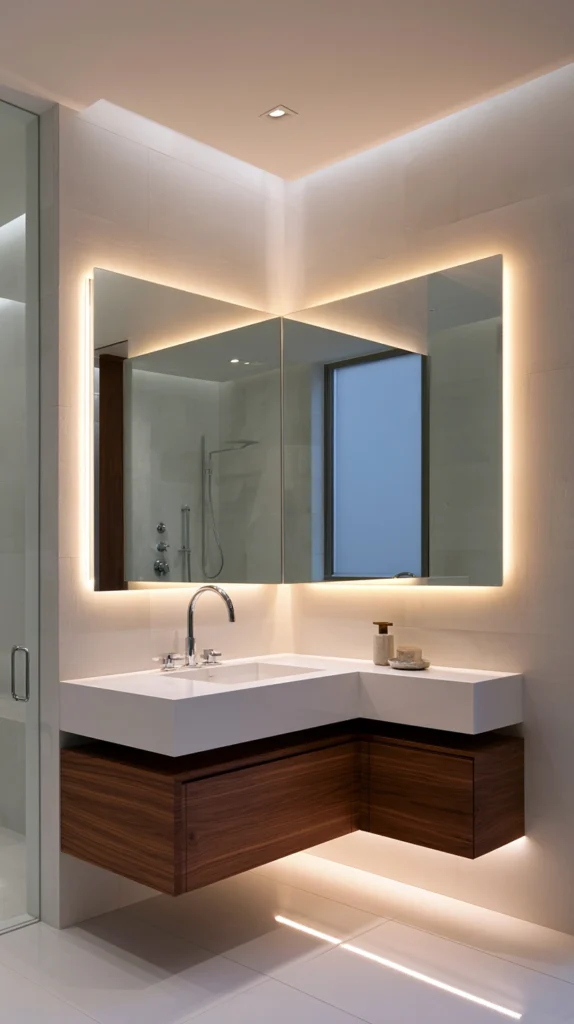
A backlit mirror — one with LED strips mounted behind or around the mirror perimeter — creates a soft halo effect that adds depth and warmth without pointing a light source directly at the face.
This is the most significant fixture investment on the list, but it replaces both the mirror and the mirror lighting in a single change. Many backlit mirrors include adjustable color temperature settings, which allows switching between warm 2700K fall-appropriate light and cooler task light for precision grooming.
For fall use specifically, set the color temperature to its warmest setting (usually 2700K–3000K) and use the backlight as the primary vanity light source during evenings. Supplement with overhead light only when needed for task work.
LED backlit mirrors start around $80–$120 for basic options and go significantly higher for larger sizes or additional features. Neutype, LVSOMT, and Keonjinn are three brands consistently reviewed positively for the price range.
Tip: Verify the mirror’s mounting requirements before ordering. Backlit mirrors are heavier than standard mirrors and require wall stud mounting or appropriate drywall anchors rated for the mirror’s weight. Most product pages list weight and mounting hardware requirements.
Budget: $80–$200
9. Add Amber Glass Votives on the Back of the Toilet Tank
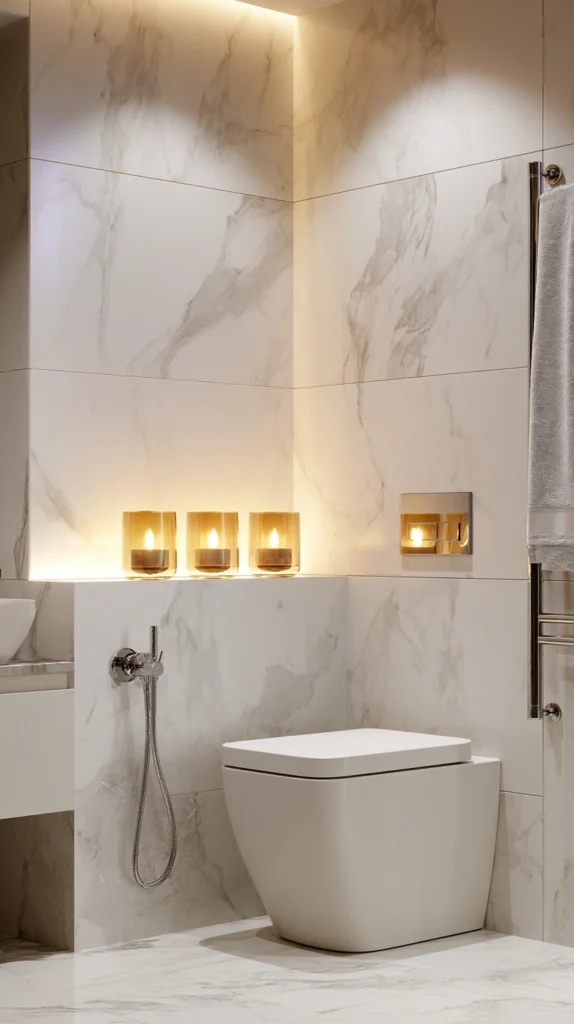
The toilet tank is one of the most consistently underused decorative surfaces in a bathroom. It’s stable, wide enough for a small arrangement, and at a height that works for shorter decorative items.
A cluster of three amber glass votives with tea lights — real or LED — placed on the tank top creates a concentrated warm light source that reads as intentional rather than incidental. Amber glass filters the light through its own color, adding an extra layer of warmth that clear glass votives don’t provide.
For fall, pair amber votives with one or two small seasonal accent pieces: a small sprig of dried eucalyptus, a mini pumpkin, or a smooth stone. Keep the total arrangement contained to the back third of the tank so the lid can be lifted without moving everything.
Amber glass votives are widely available at HomeGoods, TJ Maxx, and World Market in the $3–$8 range each. A set of three creates a full arrangement for under $25.
Tip: Use LED tea lights rather than real candles in any enclosed votive that doesn’t have significant ventilation above the flame. A small votive with a tall glass sides traps heat and can crack the glass or cause the candle to burn irregularly.
Budget: $12–$25 for three votives with tea lights
10. Create a Candlelit Shelf Vignette with Mixed Heights
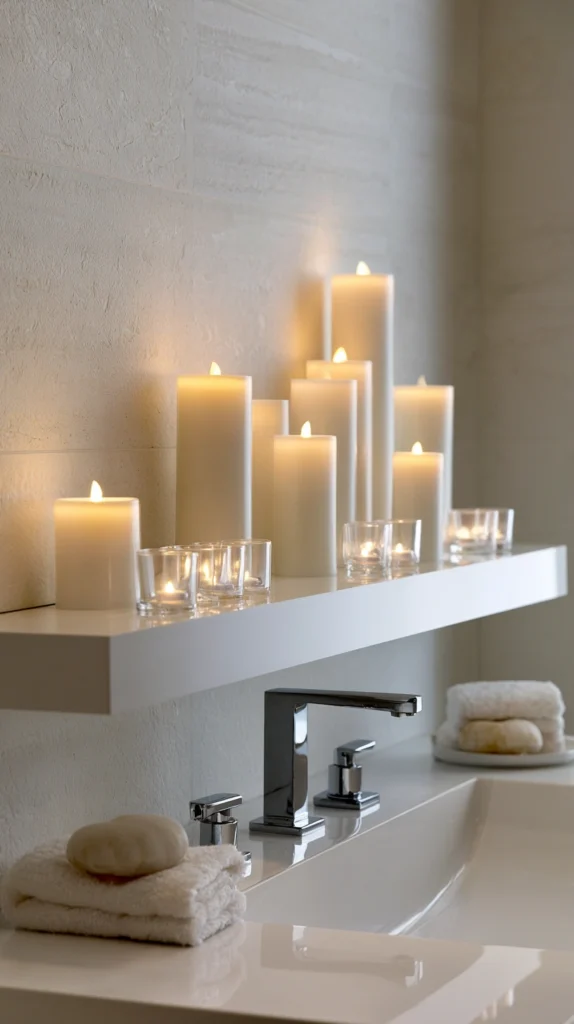
A single candle or light source on a shelf reads as placed rather than designed. A vignette — a grouping of objects at mixed heights — reads as composed.
For a fall bathroom shelf, build the vignette around lighting as the focal element: one tall pillar candle (LED for safety) as the height anchor, two smaller votives at mid-height, and one small tea light at base level. Fill the remaining space with non-lit objects that complement the fall palette — a small ceramic dish, a dried sprig, a smooth river stone.
The mixed-height approach creates shadow variation on the wall behind the shelf, which adds depth to the bathroom lighting in the evening. A flat row of same-height candles doesn’t produce this effect.
For fall palettes, choose candles in cream, ivory, or warm amber wax rather than white. White wax reads as cool in warm light conditions and breaks the warmth of the overall color temperature.
Tip: Secure the base of a tall pillar candle with a disc of museum putty before placing it on a shelf. Bathroom air movement from doors and vents can shift tall candles from their position over time, and a shifted candle changes the balance of the whole vignette.
Budget: $15–$35 for a complete shelf vignette
11. Use a Woven Basket or Rattan Shade as a Pendant Accent
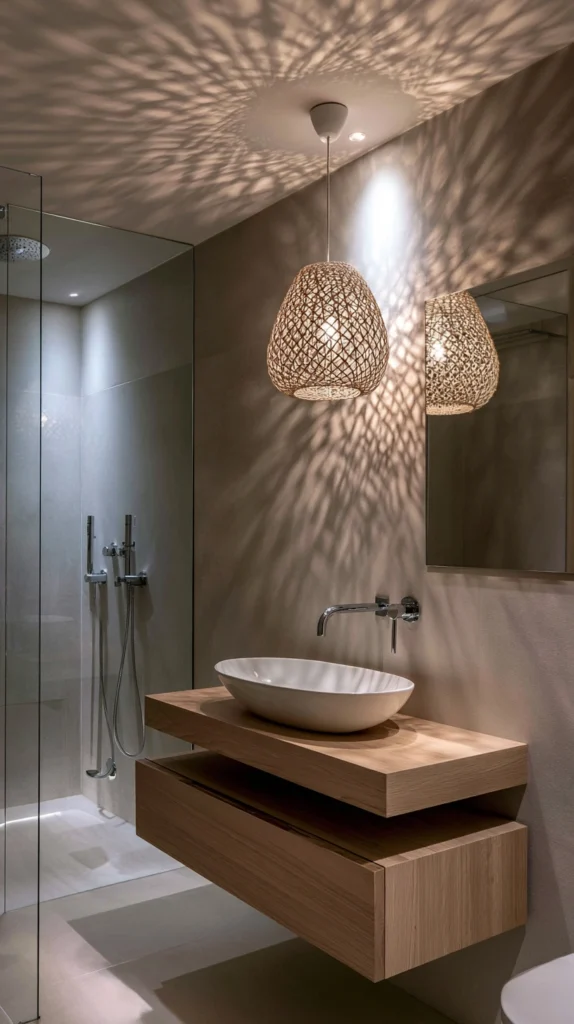
In bathrooms with a standard ceiling height of 8 feet or more, a pendant light or hanging accent over a freestanding tub, a reading corner, or a vanity end adds vertical interest that wall and counter lighting can’t.
A small rattan or woven pendant shade — the type sold as a lampshade replacement or a pendant kit — creates a warm, dappled light pattern when a 2700K bulb illuminates through the weave. The gaps in the rattan scatter small points of warm light across the ceiling and upper walls, adding movement to what is usually the flattest, most ignored surface in a bathroom.
Plug-in pendant kits allow hanging a pendant from any ceiling hook without hardwiring. The cord can be wrapped or bundled along the ceiling using cord clips if a clean look is preferred.
Rattan pendant shades run $15–$40 from Amazon, Wayfair, and specialty lighting retailers. Add a pendant cord kit for $10–$20.
Tip: Use a candelabra-base bulb in a rattan shade rather than a standard A19. The smaller bulb profile sits within the shade rather than protruding below the opening, which improves the light distribution through the weave and prevents a visible hot spot at the bottom of the shade.
Budget: $25–$60 for shade plus cord kit
12. Place a Lantern on the Floor Beside the Tub
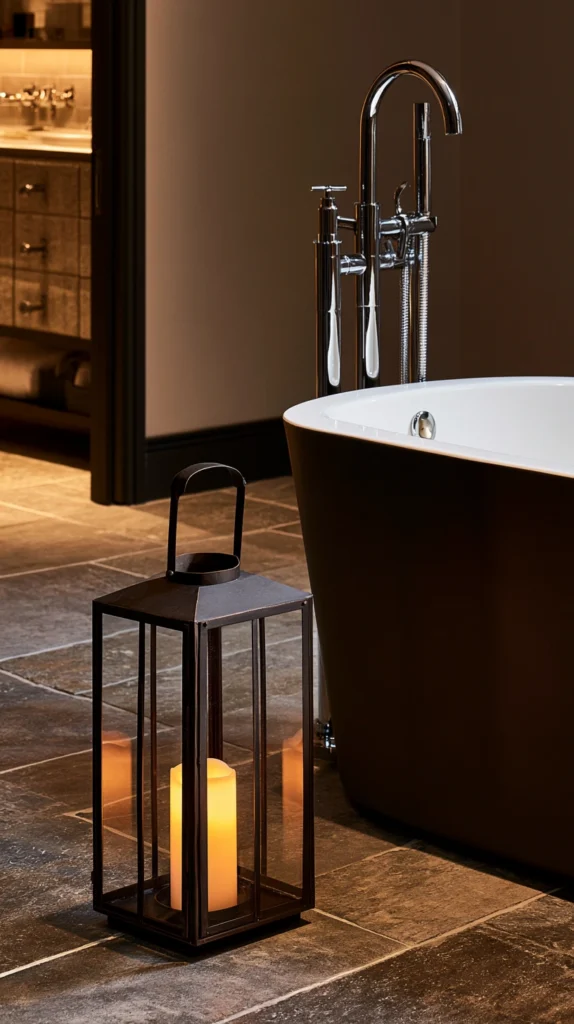
Floor-level lighting in a bathroom is unusual enough that it registers as deliberate.
A lantern — metal, wood frame, or woven rattan — placed beside a freestanding tub or in an unused bathroom corner adds warm light at ground level that overhead fixtures never reach. This low-angle light creates long shadows upward rather than downward, which is the light direction most associated with warmth and relaxation rather than task work.
For fall, choose lanterns in matte black, aged brass, or dark bronze with warm amber or clear glass panels. Pair with an LED pillar candle inside sized to fit without touching the glass. A 4×8-inch LED pillar candle fits most standard lantern sizes in the 10–14-inch height range.
Lanterns in the $20–$55 range are widely available at HomeGoods, At Home, Target, and Amazon in fall-appropriate metal finishes.
Tip: If the lantern sits on a tiled floor, place it on a small jute or woven mat to prevent the metal base from scratching the tile surface and to add a layer of texture at floor level.
Budget: $20–$55
13. Wrap String Lights Around a Wooden Ladder Towel Rack
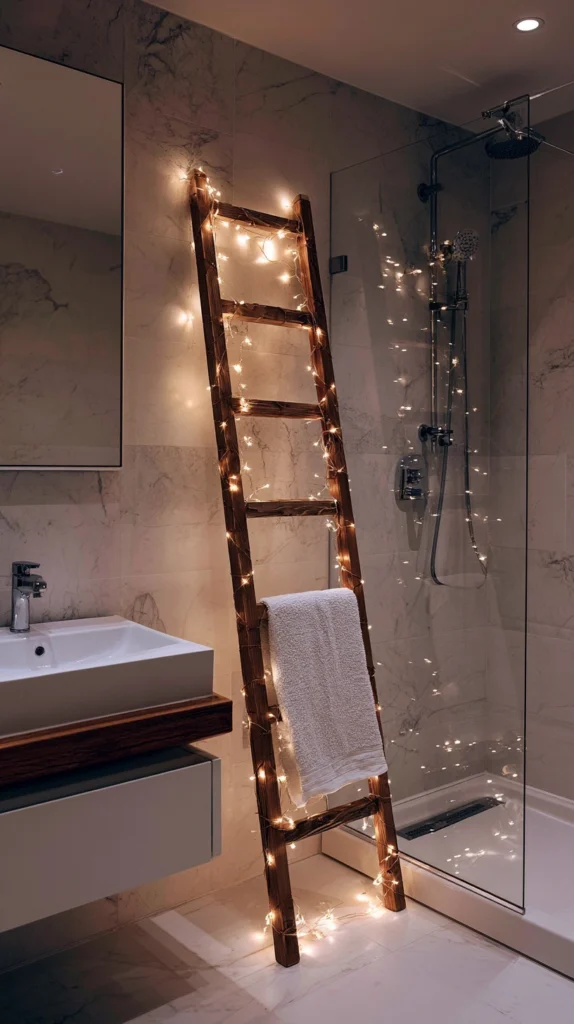
A wooden ladder leaning against the bathroom wall — used as a towel rack — is a simple styling piece that gains a second function when string lights are woven through its rungs.
Wrap copper wire micro-LED string lights around each rung from bottom to top, securing loosely so the lights distribute evenly. The warm glow of the lights through folded towels draped over the rungs creates a layered, textural lighting effect that reads as deliberate and cozy.
For fall, drape the ladder with towels in harvest tones — terracotta, rust, caramel — so the string light glow reflects back through warm-colored fabric. This connection between the textile color and the light temperature amplifies the warmth of both.
A wooden ladder towel rack runs $25–$60 at Target, IKEA, or Amazon. Add a 10-foot copper micro-LED string light for $8–$15.
Tip: Run the string light battery pack or plug behind the ladder and down the wall rather than leaving it visible on a rung. A small command hook on the back of the ladder holds the battery pack flush against the wood and out of sightlines.
Budget: $35–$75 combined
14. Use Frosted Amber Bulbs in Exposed Filament Fixtures
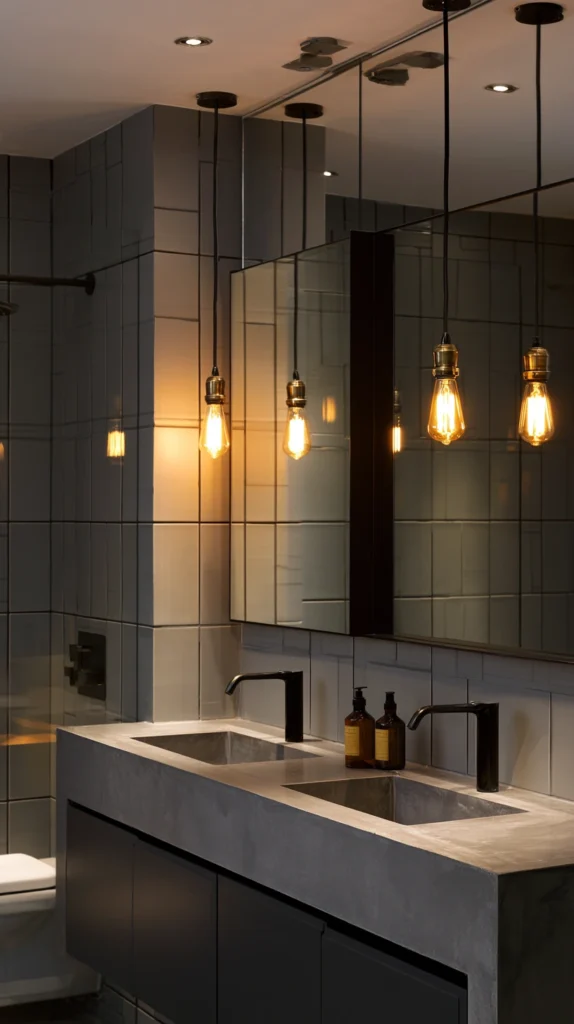
Exposed filament fixtures — the kind with visible bulb holders and no shades — are common in modern and industrial-style bathrooms. They look clean with standard bulbs. They look dramatically warmer with amber or tinted bulbs.
Amber-tinted Edison-style LED filament bulbs emit light in the 1800K–2200K range — close to firelight — while consuming the same energy as standard LEDs. In an exposed multi-bulb vanity bar, replacing clear filament bulbs with amber versions shifts the entire bathroom to a tone that’s warm enough to feel like evening lighting at all hours.
For bathrooms where this warmth would be too much at full brightness, pair amber filament bulbs with the dimmer switch from idea 5. At 70–80% on a dimmer, amber filament bulbs hit the sweet spot between visible task light and atmospheric warmth.
Amazon, Vintage Bulb Outlet, and Home Depot all carry amber LED filament bulbs in standard E26 base sizes. Budget $8–$20 for a two-pack in the 40W equivalent range.
Tip: Amber bulbs shift skin tones warm when used at the mirror — most people find this more flattering than cool light, which can make skin appear grey or sallow. If you do detailed makeup application at this mirror, supplement with a neutral-temperature task light for color accuracy.
Budget: $8–$20
15. Layer All Sources Together for an Evening Fall Bathroom Ritual
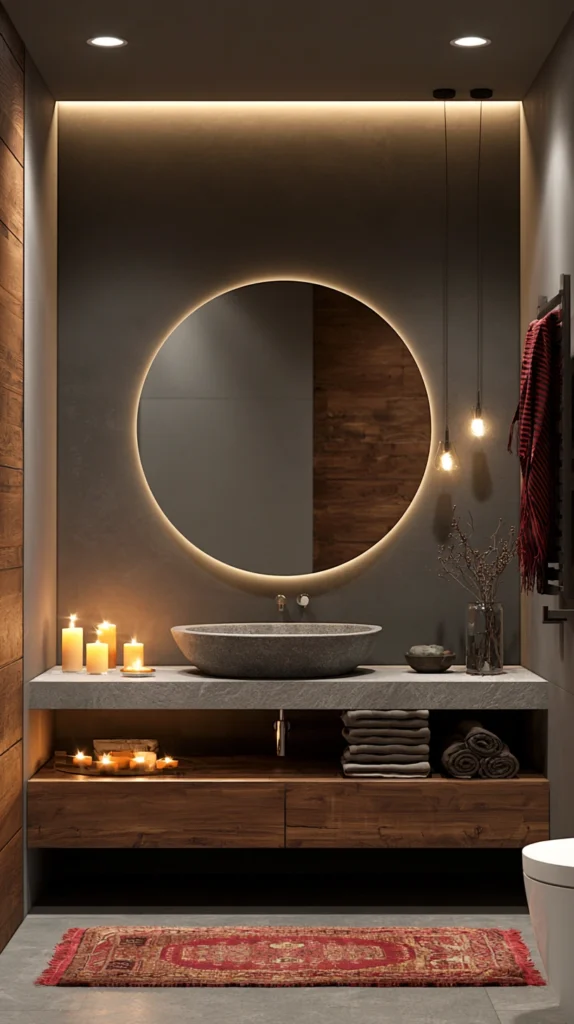
The most impactful fall bathroom lighting isn’t any single change — it’s the deliberate combination of multiple warm sources at different heights and intensities working simultaneously.
The evening ritual setup: overhead dimmed to 40%, salt lamp or amber votives providing low ambient fill, one LED candle on the tub ledge, and string lights on the shelf or ladder rack. No single source dominates. Each one fills a zone — high, mid, low — and together they create the layered light quality that makes a bathroom feel like a sanctuary rather than a utility space.
This layered approach works because warm light at multiple heights eliminates the flat single-source look that makes most bathrooms feel cold and clinical. Each additional source reduces the harshness of the others by filling in the shadows they create.
The entire layered setup can be assembled from ideas 1, 3, 6, and 9 on this list for under $60 total — a significant atmospheric change for a modest investment.
For more ideas on creating seasonal atmosphere across the full home, the fall home decor section on StyleTasteStudio covers every room with the same approach to layered, intentional seasonal updates.
Tip: Run any plug-in ambient sources — string lights, the salt lamp, LED candles with timers — through a single smart plug set to a daily schedule. When the lights come on automatically at the same time each evening, the ritual becomes effortless rather than something you have to remember to set up.
Budget: $50–$80 for a complete layered setup built from multiple ideas above
Final Thoughts
Fall bathroom lighting works because it shifts the most functional room in the house into something that actually matches the season.
Most of these changes take under an hour. The bulb swap alone changes more than people expect. Adding one or two additional warm sources builds from there until the bathroom genuinely feels different in October than it did in August.
Start with the 2700K bulb swap and one secondary source — a salt lamp, a set of votives, or string lights on a shelf. That combination alone covers the warmth and layering that makes fall bathroom lighting feel intentional.
Browse more seasonal bathroom and home decor ideas in the home design section on StyleTasteStudio.