
14 Bathroom Sconce Ideas for Better Lighting
Bathroom lighting is one of the most consequential and most consistently underestimated design decisions in any home — a space where the quality of light at face level determines not just the aesthetics of the room but the practical effectiveness of every grooming task performed within it, the apparent warmth or coldness of the materials surrounding it, and the overall quality of the experience of being in the space at every hour of the day and night.

The overhead fixture that most bathrooms rely on as their primary or sole light source is categorically the wrong tool for the job — it casts light from above, creating the downward shadows on the face that make every reflection in the mirror look harsher, older, and less accurate than the face actually is, while leaving the primary visual zone of the bathroom — the mirror and the immediate surrounding wall — in relative shadow precisely where the most light is needed most consistently.
The wall-mounted sconce positioned at face level on either side of the bathroom mirror is the correct solution — the lighting configuration used in every professional makeup studio, every quality hotel bathroom, and every thoughtfully designed residential bathroom where the designer understood that the goal of bathroom lighting is not to illuminate the room but to illuminate the face within it. These fourteen sconce ideas demonstrate exactly how to achieve that goal across a range of styles, budgets, and bathroom aesthetics.
1. The Classic Unlacquered Brass Sconce
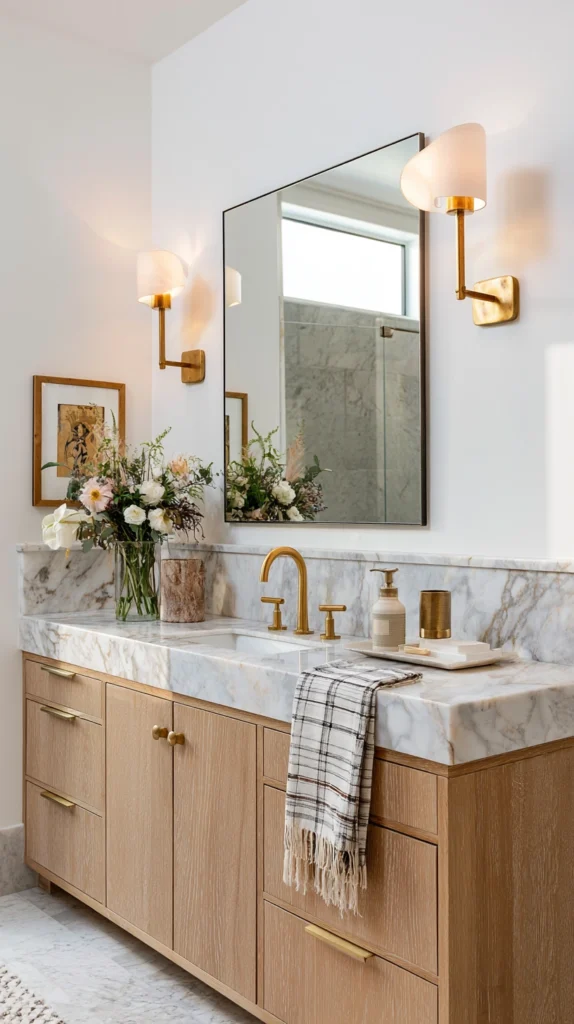
Unlacquered brass — its warm, slightly imperfect surface developing a natural patina of darkened tones and colour variation over time as it oxidises in the bathroom’s humid environment — is the sconce finish that suits the widest range of bathroom aesthetics with the most consistent and most beautiful result.
The unlacquered finish is the critical distinction: lacquered brass maintains its original bright gold tone permanently and reads as new, as artificial, as trying, while unlacquered brass develops the aged, warm, genuinely material quality that makes it one of the most desirable hardware finishes in contemporary residential design.
Mount a pair of simple cylindrical or globe-shaded unlacquered brass sconces at eye level on either side of the mirror, and the combination of the warm metal tone and the warm bulb light they carry creates a bathroom atmosphere of genuine luxury at a fraction of the cost of more elaborate interventions.
2. The Pharmacy-Style Articulating Sconce
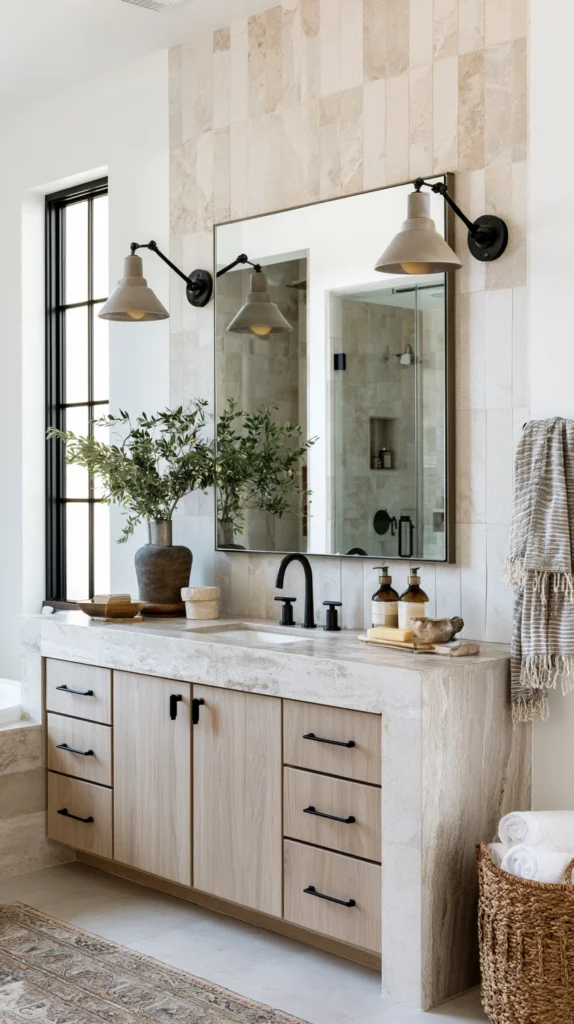
A pharmacy-style articulating sconce — its arm extending from the wall on a pivoting joint that allows the light head to be repositioned toward the mirror, toward the face, or toward any other point in the bathroom where task light is needed — is the most functionally intelligent sconce type available for bathroom use and the one that combines practical flexibility with a classic, somewhat utilitarian aesthetic that suits both contemporary and traditional bathroom designs with equal ease.
The articulating arm allows the light to be positioned precisely where it is needed for each specific task — extended toward the mirror for face illumination, pivoted toward a shelf for detailed work, angled upward for a softer ambient contribution — making a single well-positioned sconce as functionally effective as two or three fixed alternatives. Choose in aged brass, matte black, or polished nickel for the finish most consistent with the bathroom’s existing hardware.
3. The Fluted Glass Globe Sconce
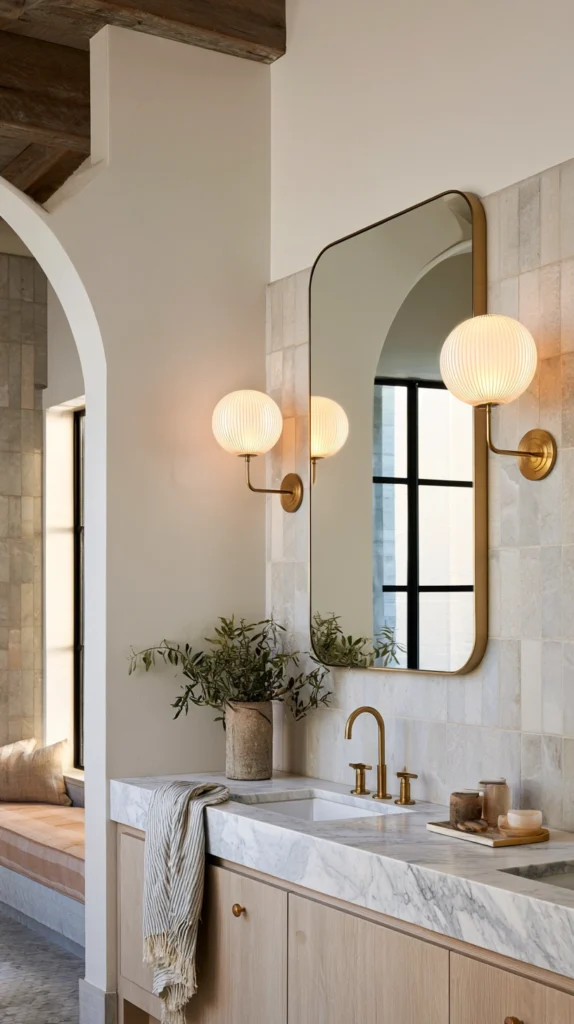
A sconce with a fluted or ribbed glass globe shade — its textured surface difusing the bulb’s light through its channels and ridges into a soft, even, slightly patterned glow that reads as simultaneously decorative and genuinely functional — has become one of the most consistently popular and most consistently beautiful bathroom sconce formats of the current moment, appearing in every bathroom aesthetic from maximalist traditional to clean contemporary with equal appropriateness and equal visual appeal.
The fluted glass diffuses the light source sufficiently to eliminate the harsh quality of a clear glass globe while maintaining the warmth and spatial interest of a visible light source, creating a bathroom sconce that contributes to the room’s decorative character as much as to its lighting quality. Mount in pairs on either side of the mirror in a warm white or amber-tinted glass for maximum warmth, or in clear fluted glass for a cleaner, more contemporary effect.
4. The Vertical Bar Sconce Mounted Beside the Mirror
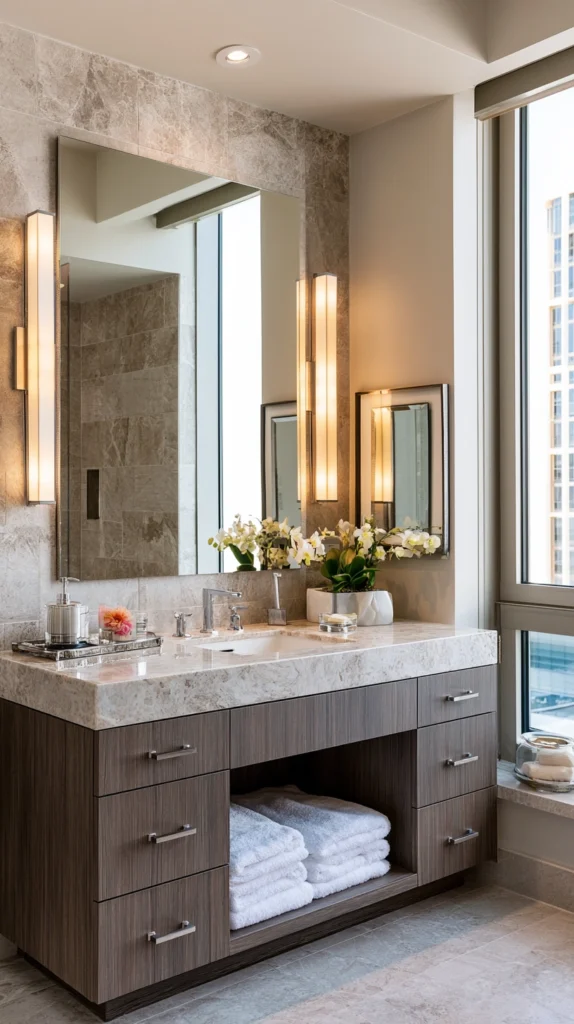
A vertical bar sconce — a slim, elongated fixture mounting multiple bulbs along its vertical length, each contributing a point of warm light to the overall output — is the bathroom sconce format most directly descended from the Hollywood vanity mirror aesthetic and the one that most completely and most effectively addresses the technical challenge of even, shadow-free face illumination when mounted correctly at eye level on both sides of the mirror.
The vertical distribution of multiple light sources along the sconce’s length illuminates the face from multiple angles simultaneously — from the top, middle, and lower sections of the fixture — eliminating the shadows that single-source sconces inevitably create at the chin or the forehead depending on their position.
Choose a bar length that covers from just below eye level to just above head height for the most complete and most flattering face illumination available from a wall-mounted source.
5. The Ceramic Sconce in an Earthy Tone
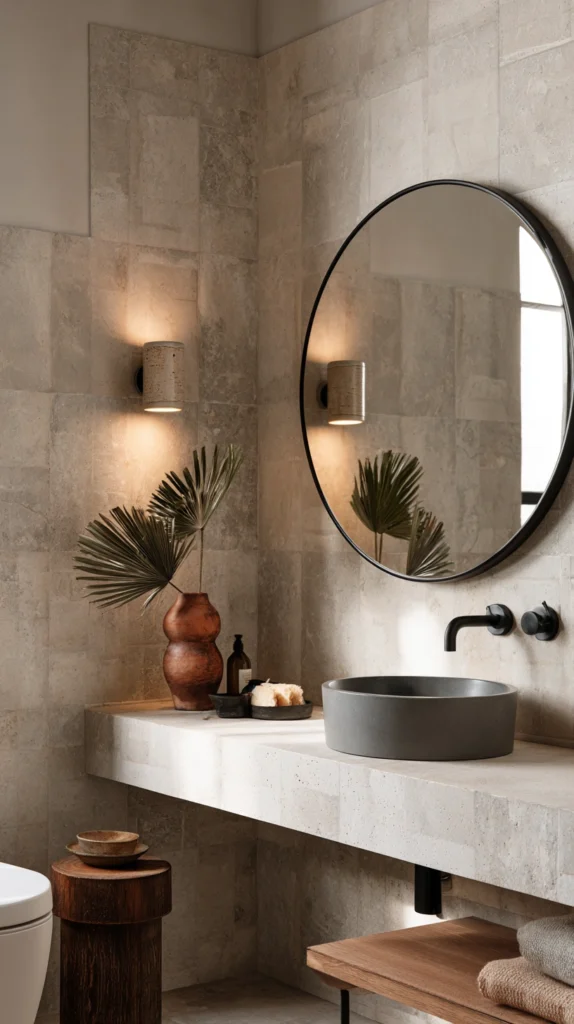
A sconce with a hand-thrown ceramic shade — its slightly irregular form, its earthy glaze in warm white, terracotta, sage, or dusty rose, and the particular quality of diffused light it produces as the ceramic material filters the bulb’s output through its walls — brings a quality of handcraft and material warmth to the bathroom wall that no metal or glass fixture achieves with the same naturalness or the same sense of genuine artisanal provenance.
The ceramic sconce works particularly well in bathrooms with natural stone surfaces, limewash walls, or terracotta tile floors — the material connection between the sconce shade and the surrounding surfaces creates a cohesion of material language that makes the bathroom feel genuinely designed rather than assembled from separate decisions.
Source from independent ceramic artists for the most interesting and most unique options, or from the growing number of design-forward lighting brands that have incorporated handmade ceramic elements into their sconce ranges.
6. The Plaster or Gypsum Sconce
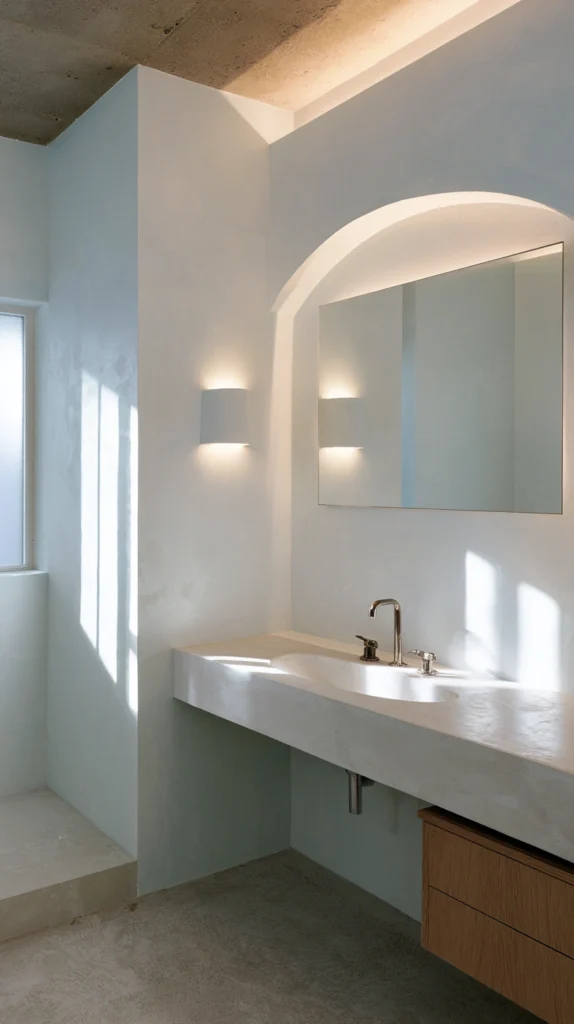
A plaster or gypsum sconce — its body cast or hand-formed in white or tinted plaster, its surface slightly rough with the texture of the casting process, its shade or arm integral to the body rather than added as a separate component — creates a sconce of extraordinary material refinement and architectural quality that blurs the boundary between fixture and wall surface in a way that no other sconce material achieves.
The plaster sconce reads as an extension of the wall itself rather than as an object attached to it, creating a lighting installation of particular architectural sophistication that suits limewash walls, Venetian plaster surfaces, and the broader plaster-and-natural-material aesthetic that defines some of the most admired contemporary bathroom design.
The fixture’s white plaster body disappears against a white or pale wall surface during the day, emerging as a warm, glowing form when lit in the evening — a quality of visual transformation that makes the bathroom feel genuinely different and genuinely extraordinary after dark.
7. The Minimalist Matte Black Sconce
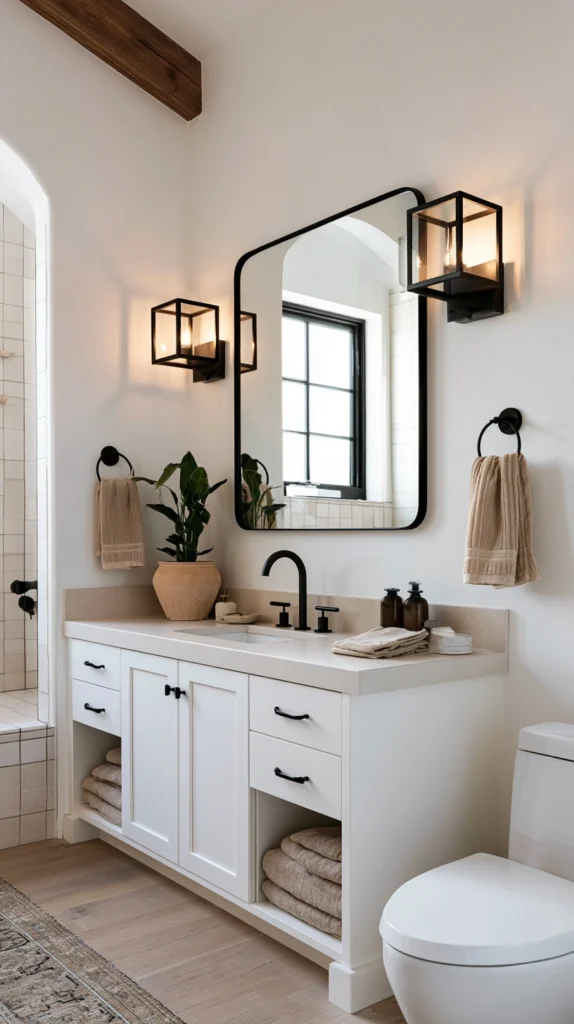
A sconce in a matte black powder-coated finish — its profile as simple and as geometrically precise as the finish will allow, its shade a plain cylinder or cone, its arm a clean right-angle bracket with no decorative detail — is the bathroom sconce that suits contemporary, industrial, and Japandi bathroom aesthetics with the greatest precision and the greatest visual authority.
The matte black finish absorbs light rather than reflecting it, making the sconce fixture itself visually recessive — it reads as a deliberate architectural element rather than a decorative object, which is precisely the quality that minimal bathroom designs require from their fixtures.
Pair with a simple integrated LED bulb in a warm colour temperature rather than a visible Edison bulb that introduces a decorative quality the aesthetic does not invite, and mount at the precise height and horizontal position that maximises functional face illumination rather than aesthetic composition.
8. The Vintage-Inspired Schoolhouse Sconce
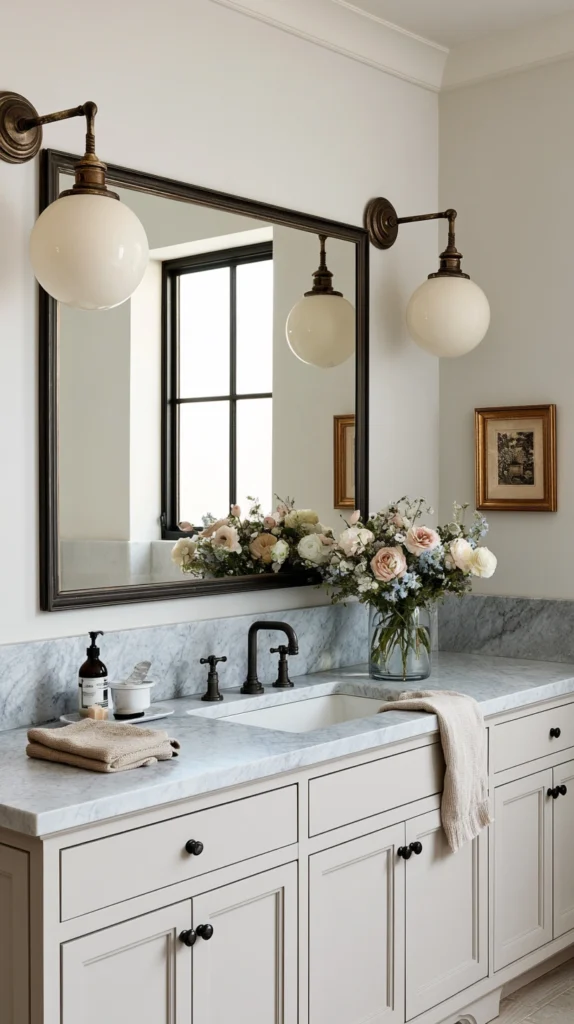
A schoolhouse sconce — its characteristic glass globe shade mounted on a simple ceiling plate with a short stem, its form derived from the utilitarian lighting of early twentieth century American institutional buildings — brings a quality of warm, nostalgic character to a bathroom wall that suits traditional, transitional, and vintage-influenced bathroom aesthetics with complete naturalness and a kind of quiet, unassuming charm that more deliberately decorative sconce styles frequently cannot match.
The schoolhouse globe’s clear or milk glass diffuses the bulb light into an even, warm glow that suits bathroom use perfectly — generous enough for task lighting, warm enough for atmospheric quality, familiar enough in form to read as comfortable and resolved rather than fashionable and temporary. Mount in pairs on either side of the mirror in a finish — aged brass, oil-rubbed bronze, chrome — that connects to the bathroom’s other hardware choices for visual coherence.
9. The Swing-Arm Sconce for Flexible Positioning
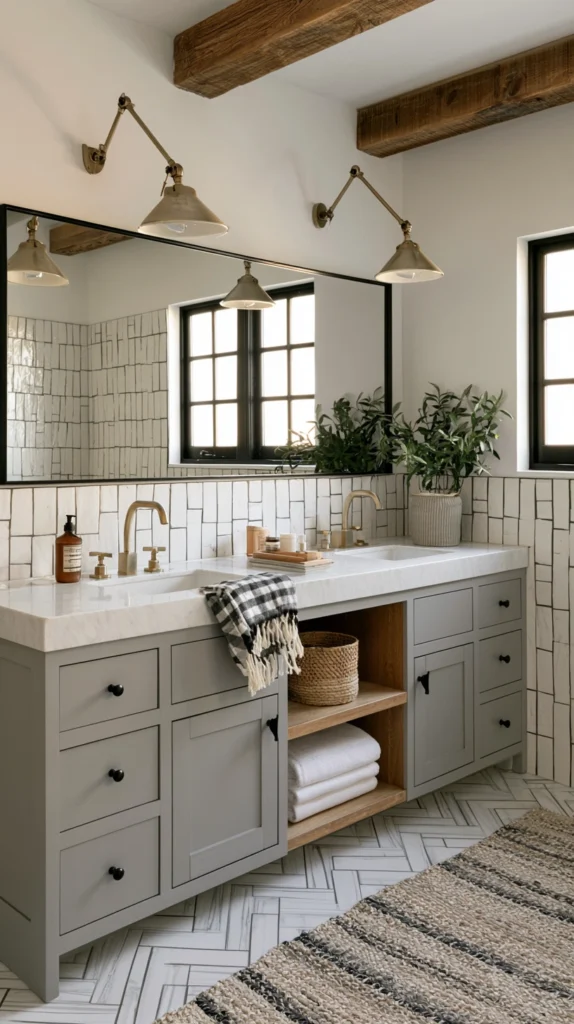
A swing-arm sconce — its arm mounted on a wall plate and extending outward on a pivoting joint that allows the fixture to be positioned anywhere within a generous arc from flat against the wall to fully extended at 90 degrees — is the sconce format that provides the greatest flexibility of light positioning in a bathroom where the mirror size, the vanity configuration, or the wall layout makes the conventional symmetrical pair placement on either side of the mirror impractical or impossible.
A single quality swing-arm sconce positioned beside a bathroom mirror can be extended outward to bring the light source close to the face for task illumination and swung back against the wall when its contribution to the room’s general ambient light is all that is needed.
Choose a swing-arm sconce with a locking joint that holds its position reliably rather than drifting back to the wall under the weight of the shade — the functional quality of the joint mechanism is the most important specification consideration in this sconce type.
10. The Backlit Mirror With Integrated Sconce Function
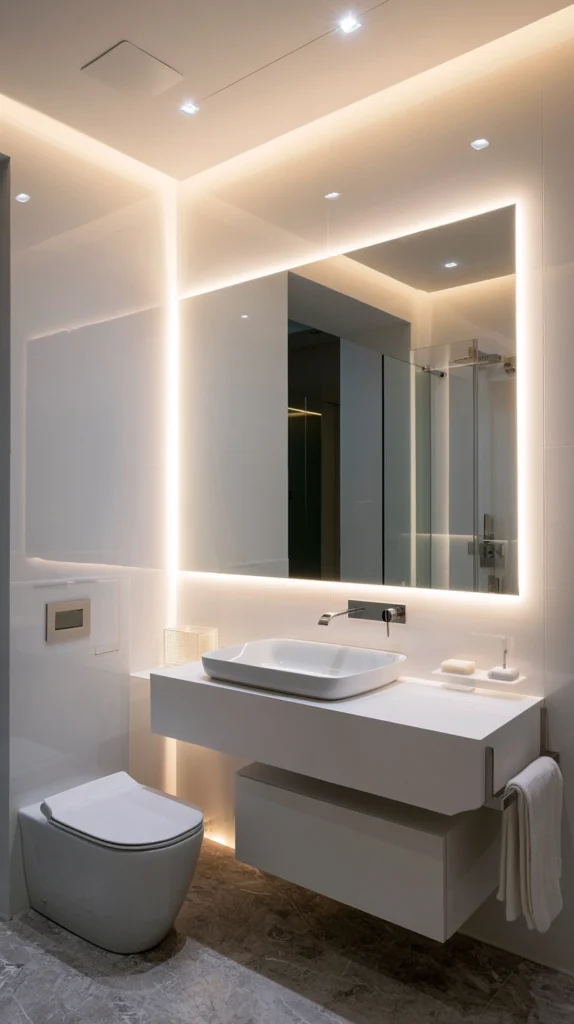
A bathroom mirror with integrated LED backlighting — a halo of warm light emanating from behind the mirror’s perimeter and washing the surrounding wall in a soft, even glow — performs the functional role of a pair of flanking sconces while eliminating the fixtures from the wall surface entirely, creating a lighting solution of considerable elegance and spatial simplicity that suits minimalist and contemporary bathrooms where additional wall-mounted hardware would introduce visual complexity the aesthetic specifically works to avoid.
The backlit mirror’s light quality — diffused, indirect, emanating from a large surface area rather than a point source — is softer and more even than most conventional sconce configurations, creating a flattering quality of face illumination that comes close to the ideal of light surrounding the mirror on all sides rather than coming exclusively from the sides.
Supplement with a dimmable overhead fixture for general ambient light, and the backlit mirror provides the face-level illumination that makes the bathroom genuinely functional for the full range of grooming tasks.
11. The Rattan or Natural Fibre Sconce
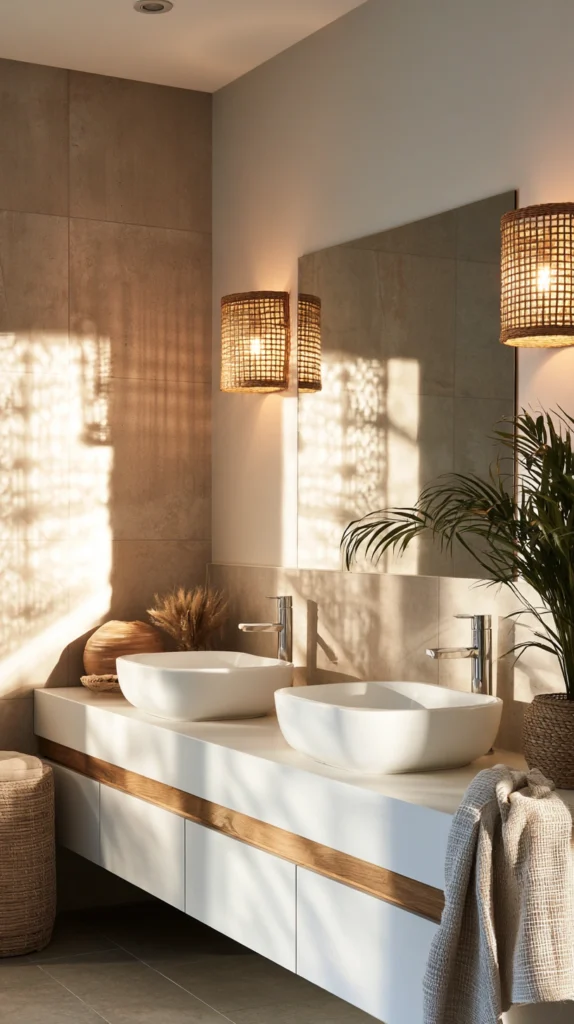
A sconce with a shade woven from rattan, seagrass, or natural fibre — its open weave creating a pattern of warm light and shadow on the surrounding wall surface as the light passes through the gaps between the woven strands — brings the organic warmth and the natural material richness of coastal and Californian bathroom aesthetics into the lighting scheme with an immediacy and a naturalness that no other shade material achieves as effectively.
The patterned light quality of the woven sconce shade — the small points of brighter light visible through the weave gaps, the warm shadow pattern cast on the wall — is a genuinely beautiful effect in a bathroom with pale walls and natural material surfaces, creating a lighting atmosphere that feels warm, organic, and genuinely designed rather than simply adequate.
Choose a shade size and weave density that balances the decorative light pattern effect with sufficient overall light output for practical bathroom use — a very tightly woven shade may look beautiful but produce insufficient light for functional grooming tasks.
12. The Industrial Exposed Bulb Sconce
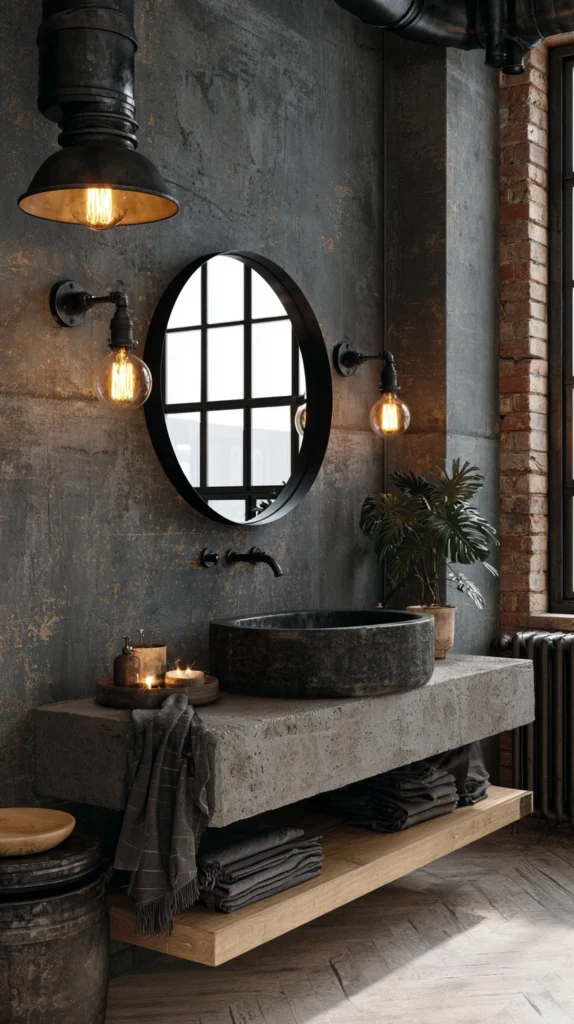
An industrial-style sconce with an exposed Edison bulb — its filament visible through a clear glass envelope, its warm amber glow contained within a simple cage or bare socket on a minimal metal bracket — creates a bathroom lighting moment of considerable raw character that suits industrial, loft, and modern rustic bathroom aesthetics with an authenticity that more polished and more finished sconce styles cannot replicate.
The exposed filament bulb is the sconce’s decorative element as much as its light source — the visible filament creates a warm, amber point of light that reads as a beautiful object independently of its illumination function, and its warm 2200K colour temperature produces the most flattering quality of face light available from any domestic bulb type.
Supplement the atmospheric but relatively low output of the exposed filament sconce with additional light sources — a recessed ceiling fixture on a separate dimmer circuit — to ensure the bathroom remains functionally lit for the full range of tasks the space must support.
13. The Oversized Statement Sconce
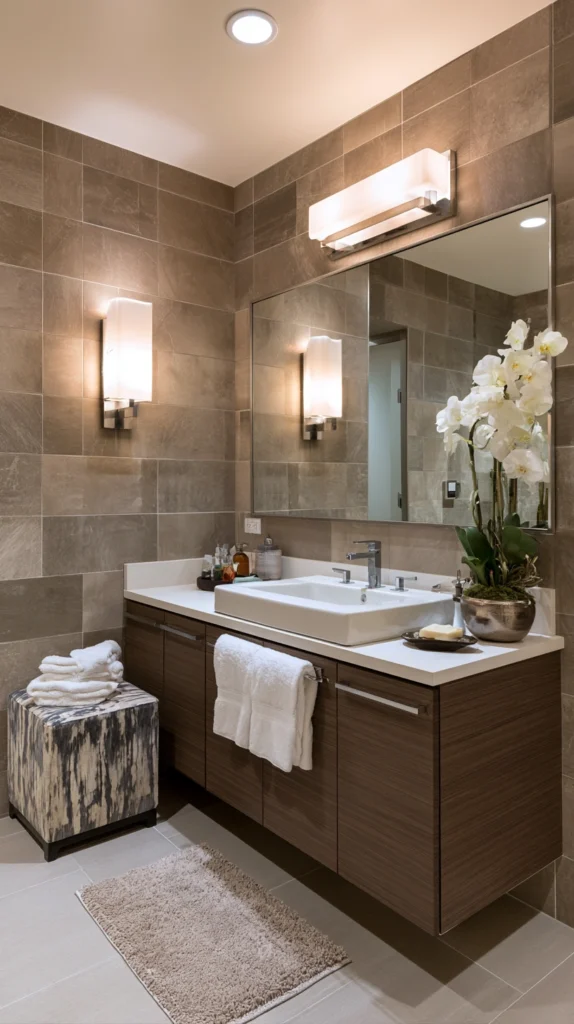
A single oversized sconce — a fixture of genuinely large scale that would be the primary decorative element of the bathroom wall regardless of its lighting function, its shade or body large enough to read as a sculptural object in its own right — creates a bathroom wall moment of considerable visual drama and considerable design confidence that smaller, more conventional sconce pairs cannot achieve with the same impact or the same memorable quality.
The oversized sconce works as a solo installation above a wide mirror, replacing the conventional pair on either side with a single large fixture that distributes light more widely and more evenly across the mirror’s full width from its overhead position.
Choose the oversized sconce for bathrooms with high ceilings and large mirror configurations where the scale of a single large fixture is proportionally appropriate — in a small bathroom with a standard ceiling height, an oversized sconce will overwhelm rather than anchor the space.
14. The Picture Light Repurposed as a Mirror Sconce
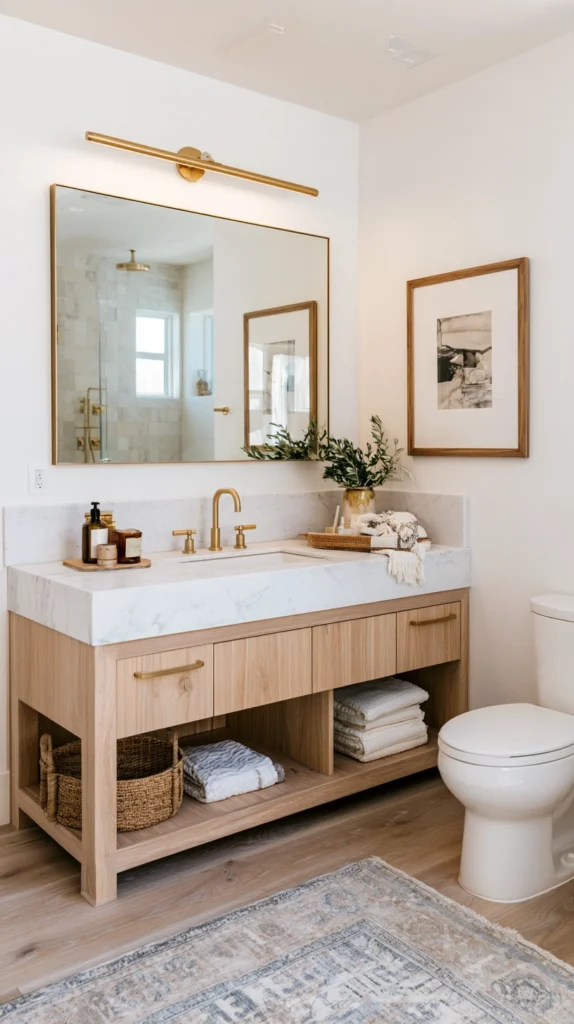
A picture light — a slim, directional fixture designed to illuminate artwork from above by casting a narrow beam of warm light downward across the surface below — repurposed as a bathroom mirror sconce by mounting it along the mirror’s top edge rather than above a canvas creates a lighting solution of considerable elegance and considerable ingenuity that delivers warm, directional face illumination from an unexpected and visually distinctive source.
The picture light mounted along the mirror’s top frame illuminates the face from a slightly overhead angle that, while not as flattering as true side lighting from flanking sconces, is significantly more flattering and more useful than a standard overhead ceiling fixture positioned further back in the room.
Its slim profile, its directional beam, and its typically beautiful finish in aged brass or polished nickel make it one of the more visually refined bathroom lighting solutions available — and one of the least commonly encountered, which gives the bathrooms that use it a quality of genuine distinction.
Final Thoughts: Getting Bathroom Sconce Lighting Right
The bathroom sconce configuration that genuinely works — that illuminates the face evenly, flatters the skin, suits the room’s aesthetic, and improves the experience of every grooming task performed within the space — is the one installed at the correct height, in the correct position relative to the mirror, and specified with the correct bulb colour temperature.
Mount sconces at eye level — approximately 150 to 165 centimetres from floor to the centre of the fixture — on either side of the mirror at a horizontal distance of 75 to 90 centimetres between them for the most even and most flattering face illumination. Always use bulbs between 2700K and 3000K — the warm colour temperatures that render skin tones accurately and create the quality of bathroom light that makes the space genuinely pleasant to be in at every hour of the day and night.