
14 Biophilic Bathroom Ideas That Bring Nature Indoors
The bathroom is the room that gets the least attention in the morning and does the most restorative work. Eight minutes before a shower. Twelve minutes after. The room that sends you into the day and receives you back from it.
Most bathrooms: clinical. Flat white surfaces, fluorescent light, no connection to anything that grows or breathes.

The biophilic bathroom designs a different experience — not just a room to wash in but a room that restores while you wash in it. The principle is not decoration. It is the same evidence-based approach that has influenced hospital design, office design, and hotel design for decades: natural materials, natural light, natural forms, and living plants measurably reduce cortisol, lower blood pressure, and improve subjective sense of wellbeing.
In the room where you begin and end each day: these effects are not incidental. They are the design brief.
Here are 14 ways to bring that brief to life.
What Biophilic Design Actually Means
Not “add a plant”:
The full definition:
- Biophilia: the innate human attraction to and connection with other living things and natural systems
- Biophilic design: creating environments that strengthen rather than sever this connection
- Not: a single plant on a shelf
- But: materials, forms, light, water, and living things together creating the sensation of natural connection
The research:
- Natural environments: reduce cortisol (the stress hormone) by measurable amounts after 20 minutes of exposure
- Views of nature: lower blood pressure and heart rate compared to urban views
- Natural materials (wood, stone): reduce self-reported stress compared to synthetic equivalents
- The research: conducted in real spaces by researchers in built environment and health fields
- The bathroom: the room where the most opportunity exists to design these effects into the morning routine
The bathroom specifically:
- The only room where the person is consistently alone
- The only room with water — itself a fundamental natural element
- The only room where the body is completely attended to
- The natural place for a restorative design brief
The biophilic elements:
- Natural materials (wood, stone, clay, linen)
- Natural forms (curves, organic shapes, no hard angles)
- Natural light (and the simulation of it when absent)
- Living plants (and their relationship to the humidity of the bathroom)
- Water as an intentional element (not just functional)
- The prospect/refuge balance (a sense of shelter and safety within a visible wider space)
1. The Living Plant Wall or Shelf (The Breathing Wall)
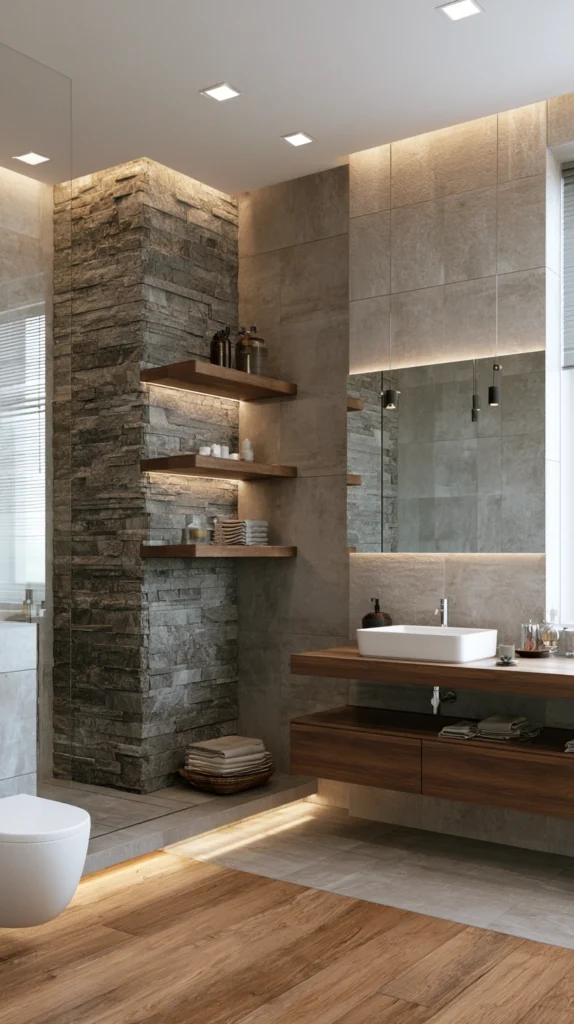
A dedicated wall or shelf system for moisture-loving plants — the design element that transforms the bathroom from a sealed room to a living environment.
Why bathrooms are better for plants than most places:
The humidity advantage:
- Bathrooms: the highest-humidity room in most homes
- Humidity: exactly what many tropical plants require
- The bathroom: the natural habitat for ferns, orchids, air plants, and tropical foliage plants
- The plant that struggles everywhere else: thrives here
The temperature:
- Bathrooms: consistently warm
- Tropical plants: warm-preferring
- The bathroom temperature: the tropical growing condition
The light challenge:
The bathroom’s primary limitation:
- Many bathrooms: minimal natural light (interior bathrooms, frosted glass, small windows)
- The biophilic design challenge: maximising whatever light is present, and compensating for its absence
Compensation strategies:
- A grow light disguised as a pendant or strip light (warm spectrum, targeted at plants)
- Rotation (plants moved to more-lit areas periodically and returned to the bathroom)
- Low-light plant selection (the most important single decision)
The low-light specialists:
For bathrooms with minimal natural light:
- Pothos (Epipremnum aureum): the most tolerant of low light and neglect
- ZZ plant (Zamioculcas zamiifolia): thrives in near-dark
- Cast iron plant (Aspidistra): literally named for its toughness
- Peace lily (Spathiphyllum): low light, flowers in the bathroom, signals clean air
- Snake plant (Sansevieria): any light level, any humidity, almost any neglect
For bathrooms with a window:
- Ferns (any variety — the Boston fern, the maidenhair, the staghorn): the most specifically bathroom-appropriate plants
- Orchids (phalaenopsis): thrive in bathroom conditions after flowering
- Air plants (tillandsia): no soil, absorb moisture from the air, ideal for hanging or displayed on stone
- Monstera: the bold tropical architectural choice
The plant wall:
The dedicated wall:
- Mounted shelves in a staggered arrangement (different heights)
- Wall-mounted pockets or air plant display systems
- The entire wall: covered in planting
- The wall: the garden view from the bath or shower
The placement:
- Opposite the shower: the steam reaches the plants
- Beside the bath: at bath-level height, visible during soaking
- Above the toilet: often unused wall space, good for trailing plants
Cost breakdown:
- Five low-light plants: $35–60
- Mounted shelving (2–3 shelves): $40–80
- Total: $75–140
The plant wall opposite the shower: stepped out of the shower into a wall of ferns and trailing pothos. The steam had beaded on the leaves. The room: not a bathroom. A greenhouse you can shower in.
Plant Wall Tips
The drainage consideration:
- Watering above a bathroom: risk of water dripping on surfaces below
- Cachepots (decorative outer pots with sealed bases): no drainage, controlled
- Or: water sparingly (bathrooms supplement plant moisture through steam)
- The steam: reduces irrigation frequency significantly
The mould prevention:
- Good air circulation: essential
- Open the bathroom door after showering
- An extractor fan: keeps moisture levels manageable
- The plant wall: not a cause of mould when ventilation is adequate
2. The Natural Stone Feature (The Earth Element)
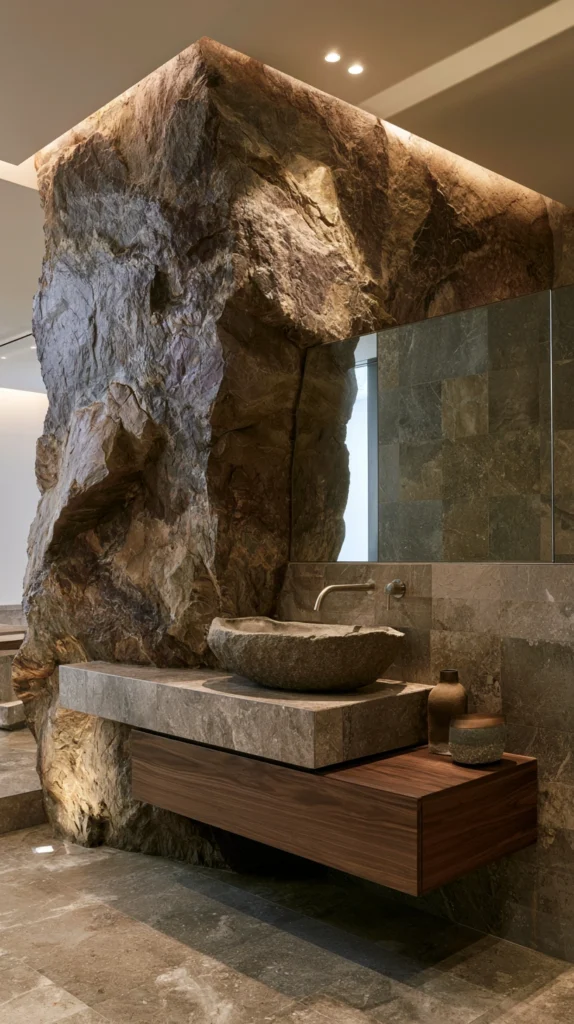
Stone — as tile, basin, shelf, or decorative feature — the material that connects the bathroom to the geological world.
Why stone belongs in the bathroom:
The material honesty:
- Stone: takes millions of years to form
- Every surface: a record of geological time
- Carrying that record into the bathroom: a connection to a timescale that makes daily concerns appear appropriately small
- The biophilic effect of stone: specifically related to this sense of permanence
The pattern:
- No two stones identical
- Each surface: varied
- The variation: the natural world’s signature
- The smooth uniformity of synthetic surfaces: the opposite
- In a biophilic bathroom: the non-uniform, natural stone always preferred over the engineered uniformity of manufactured surfaces
The types:
Marble:
- The most varied (every slab: different)
- Veining: the biological record of the stone’s formation
- Cool to the touch: the sensation of stone
- High maintenance (acid-sensitive, requires sealing)
- The luxury material: worth the maintenance for the biophilic quality
Limestone:
- Warmer-toned than marble
- Often fossiliferous (visible fossils in the stone)
- The fossil: the most direct biological connection in any material
- Equally maintenance-requiring
Slate:
- The darkest stone option
- Layered structure visible
- Almost no maintenance (sealed naturally)
- The most bathroom-practical stone
Travertine:
- Warm, pitted, ancient-looking
- The pits: natural features of the stone’s formation
- Often used in Roman baths (the most historically appropriate bathroom stone)
- The aged quality: from first installation
The specific applications:
Feature wall:
- One wall in natural stone (the rest: limewash or natural paint)
- The feature wall: the focal point of the bathroom
- Usually: the wall visible from the bath or entrance
Stone basin:
- A vessel sink carved from stone
- The most biophilic plumbing fixture available
- Stone basins: often slightly irregular (the natural form)
- The irregularity: the correct quality
Stone shelf or bench:
- A stone slab as the bath surround ledge
- Or: a stone bench beside the shower
- The stone: warm to the touch after the shower
Cost breakdown:
- Stone feature wall tiles (per square metre): $50–200 (varies enormously by stone type)
- Stone vessel basin: $150–500
- Total: highly variable, $200–700 for a meaningful stone presence
3. The Warm Wood Element (The Living Material)
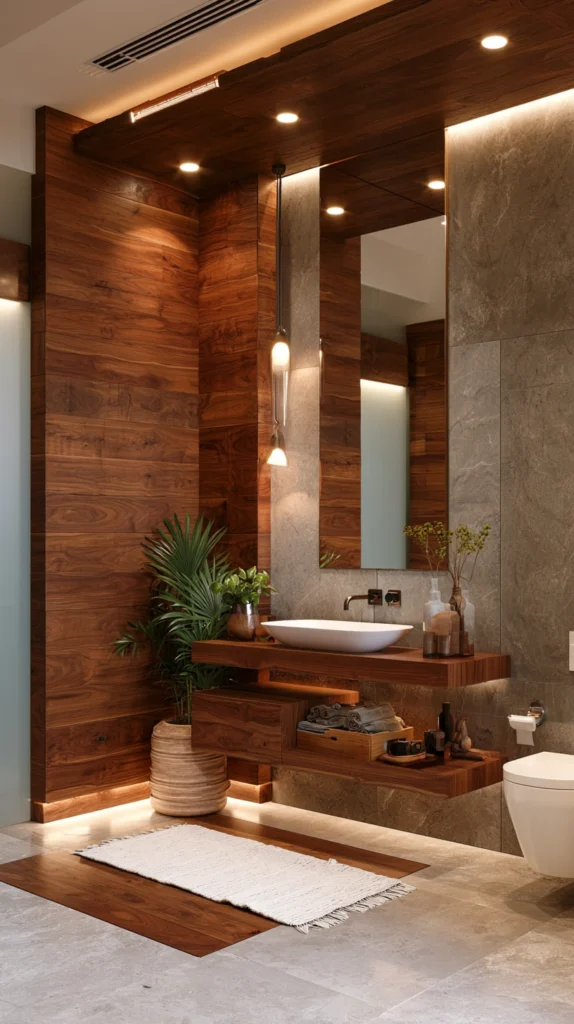
Timber — as a shelf, bath surround, floor insert, or furniture — the material that brings warmth and the memory of living things.
Why wood in the bathroom is specific and valuable:
The living material:
- Wood: was a living thing
- The grain: a record of the tree’s annual growth, response to weather, injury, and healing
- In a bathroom: a material that carries a biological history
- The other bathroom materials (ceramic, glass, chrome): no such history
The warmth:
- Thermal mass and warmth retention
- Wood feels warm underfoot and to the touch
- The warm shower, the cool tile floor: the thermal shock
- The warm shower, the warm wood floor: the smooth transition
The moisture challenge:
The primary concern:
- Wood and moisture: a managed relationship, not an impossible one
- Most woods used outdoors in rain: manageable
- The key: species selection and treatment
- The failure mode: untreated softwood in a constantly wet environment
The suitable woods:
Teak:
- The standard for outdoor and wet applications
- High natural oil content (water-resistant)
- Weathers beautifully if untreated (silvers)
- The most appropriate bathroom timber
- Bath surrounds and shower stools: typically teak
Iroko:
- Similar oil content to teak
- Less expensive
- Dark, warm
- Good for floor inserts and shelving
Western red cedar:
- Natural preservatives (thujic acid)
- Fragrant (adds an olfactory element to the bathroom)
- The scent intensifies when wet: biophilic through the nose as well as the eye
- Good for shelving, not ideal for flooring (softer)
Bamboo:
- Technically a grass
- Extremely moisture-resistant when treated
- Renewable (grows to maturity in 3–5 years versus decades for hardwood)
- The sustainable timber equivalent
The applications:
Shower stool or bench:
- Teak shower bench: the most accessible wood application in a bathroom
- No construction required: purchased and placed
- The warm seat after a shower
- Available from $30–120
Wooden bath surround or panelling:
- The bath set into or panelled with timber
- The warmth of the wood around the body of water
- The most Japanese of the bathroom applications (the ofuro aesthetic)
Floating wood shelf:
- A solid wood shelf (not veneered particle board)
- Oil-sealed against moisture
- The warm surface for plants, candles, and oils
- Different in character from every other bathroom shelf material
Cost breakdown:
- Teak shower bench: $40–80
- Solid wood floating shelf (one): $30–60
- Wood bath panel (DIY): $80–150
- Total: $40–290 depending on scale
4. The Natural Light Strategy (The Most Important Biophilic Element)
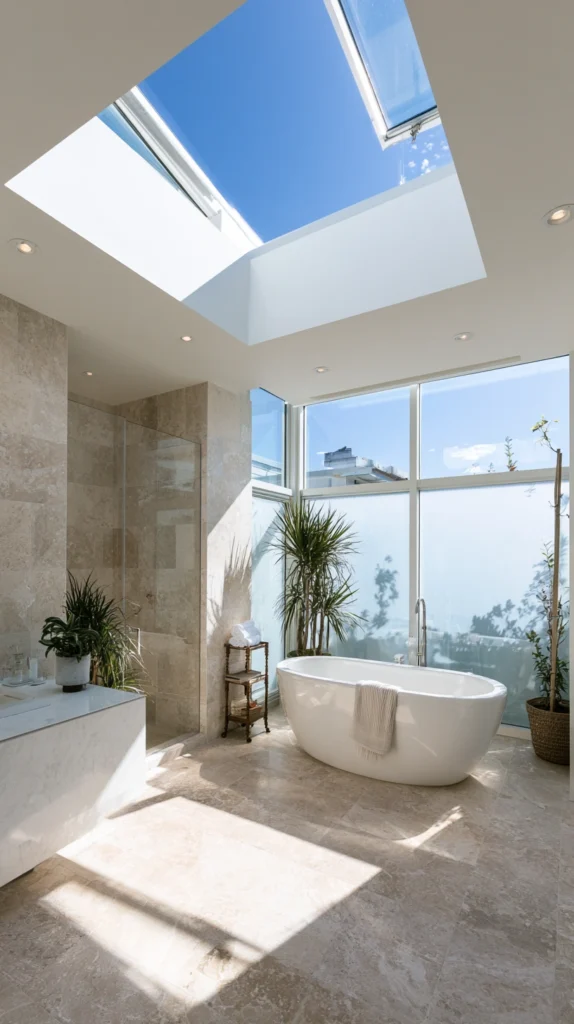
Maximising, managing, and supplementing natural light in the bathroom — the element that has the most consistently documented effect on wellbeing.
Why natural light is the most important biophilic element:
The research is clearest here:
- Daylight exposure: regulates the circadian rhythm
- Morning natural light: the primary trigger for healthy sleep-wake cycle regulation
- A bathroom with natural light used in the morning: contributing to circadian health
- The effect: not aesthetic — physiological
The most common bathroom light problem:
The interior bathroom:
- No exterior wall
- No window
- Fluorescent or LED overhead: the only light
- This bathroom: the most significant biophilic design challenge
Strategies for light-challenged bathrooms:
The skylight:
- If a ceiling below a roof void exists: a skylight is possible
- Diffuse, directional natural light from above
- In a bathroom: the most transformative single change
- The sky visible from the bath: a direct connection to the natural cycle
The internal window:
- A window from the bathroom into a naturally-lit hallway or living space
- Frosted glass: privacy maintained, light shared
- The secondary light: not daylight but borrowed daylight
- An improvement over no light at all
The solar tube:
- A flexible tube from a small roof dome to a ceiling light
- Channels daylight from the roof to interior rooms
- Surprisingly effective (a 10-inch tube: enough to significantly brighten an interior bathroom)
- Less intrusive than a traditional skylight
The light colour temperature (the critical bathroom detail):
Morning bathroom use:
- Natural light in the morning: blue-rich (stimulating cortisol production, appropriate for waking)
- Most bathroom artificial light: this blue spectrum is already there (many LEDs default to cool white)
- The morning bathroom: the one space where the conventional recommendation (warm light always) has nuance
Evening bathroom use:
- Warm light (2700K): the correct choice for evening bathing
- Dim and warm: the pre-sleep signal
- The smart solution: adjustable colour temperature and brightness
Dimmer switches:
- The morning setting: bright and appropriate colour temperature
- The evening setting: dim, warm
- Two modes, one bathroom: the biophilic light strategy
The mirror as light:
- A large mirror opposite the window: doubles the apparent light in the room
- The reflection: the same visual effect as a second window
- In a small or dark bathroom: the mirror as a light strategy, not just a vanity
Cost breakdown:
- Solar tube: $200–400 (installed)
- Dimmer switch: $15–35
- Adjustable smart bulbs: $20–40
- Total: $235–475
5. The Organic Forms (Curves Over Angles)
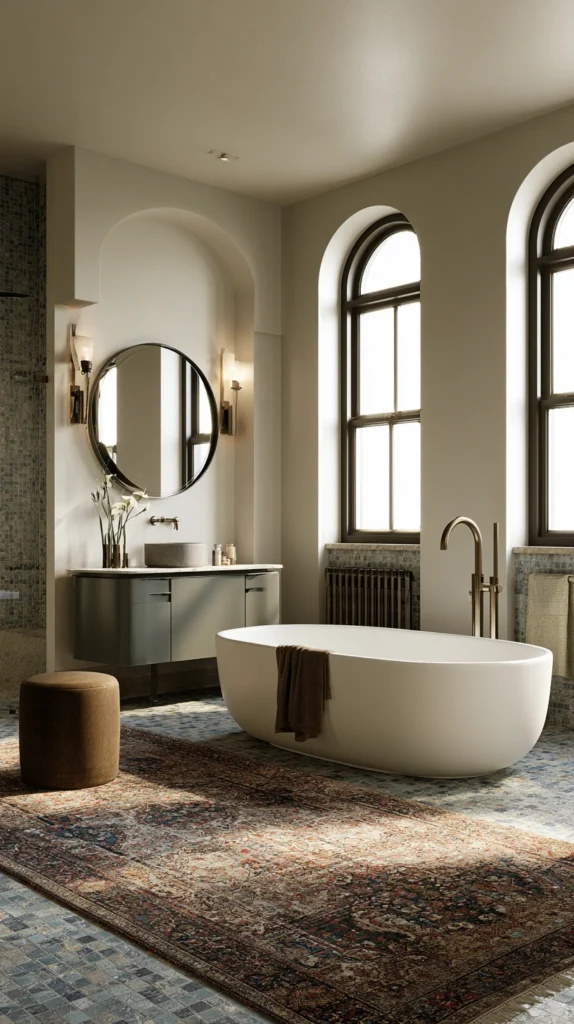
Choosing rounded basins, oval baths, and curved shelves over hard-edged rectangular alternatives — the design language of nature applied to the bathroom’s fixtures.
Why organic forms create a biophilic environment:
The nature of natural forms:
- The natural world: predominantly curved
- The right angle: a human construction (architectural efficiency)
- Organic forms: the body reads them unconsciously as natural
- The angular bathroom: signals built environment. The curved bathroom: signals natural world.
The cognitive effect:
- Sharp angles: associated (subconsciously) with danger (the sharp edge, the thorned branch)
- Rounded forms: associated with safety (the rounded river stone, the soft hill, the womb)
- The biophilic bathroom: designed for the body’s most primary signals
- Rounded: safe, comfortable, natural
The applications:
The oval or freestanding bath:
- The freestanding oval bath: the purest application of organic form in a bathroom
- No corners
- The body of water: contained in a vessel with no right angles
- The most biophilic bathing vessel
- Fibreglass or stone resin: available at various price points
- Cast iron (the heaviest and most durable): available in oval forms
The round basin:
- A circular vessel sink
- The most organic basin form
- Available in stone (the most biophilic material), ceramic, glass, or concrete
- The vessel sink format: elevates the basin off the counter, emphasising the form
The curved mirror:
- A round or oval mirror above the basin
- Instead of the rectangular mirror that matches the rectangular vanity
- The circle: harmonises with the round basin and the oval bath
- The consistent round form: the design language of the room
The curved shower niche:
An arched or rounded-topped shower niche:
- Instead of the standard rectangular recess
- The arch: the oldest architectural form suggesting something beyond the wall
- The niche: the small biophilic detail that rewards close attention
Cost breakdown:
- Round ceramic vessel sink: $80–200
- Or stone round basin: $200–500
- Round mirror: $40–150
- Total: $120–650 depending on material choice
6. The Rainfall Shower (Water as Natural Experience)
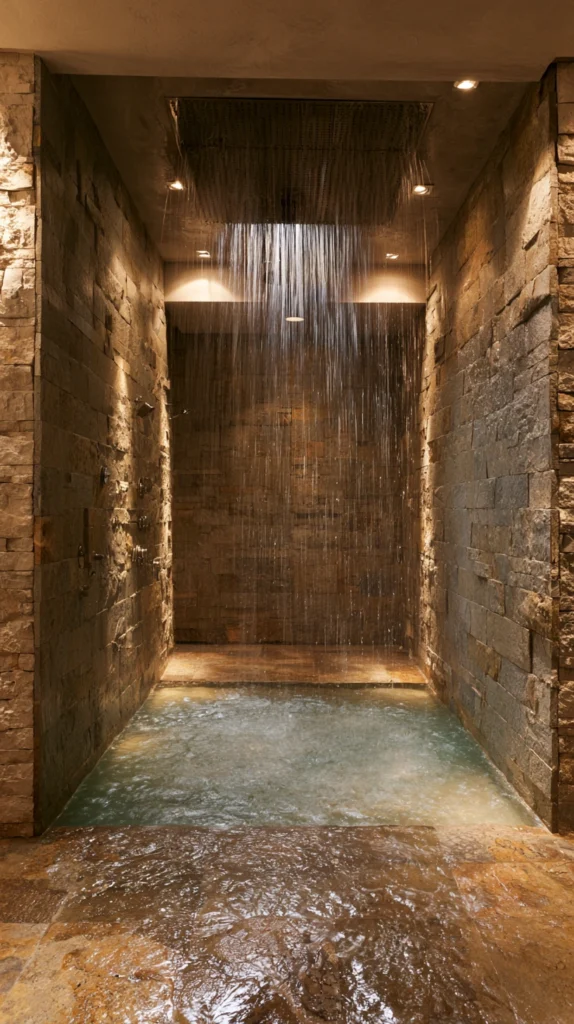
A large overhead rainfall showerhead that replicates the experience of natural water falling from above — the biophilic upgrade to the most fundamental bathroom function.
Why the direction of water matters:
The natural reference:
- Rain falls from above
- The conventional shower: water projected from the wall (a purely functional arrangement)
- The rainfall shower: water falling from directly overhead
- The body: receiving water the way the body evolved to receive water
- The ancestral memory of rain: the biophilic effect
The specific experience:
The rainfall shower:
- Warm water falling vertically
- The whole body wetted without turning
- The immersive quality: not a shower but an experience of rainfall
- The biological response: rain is associated (evolutionarily) with survival, with water, with renewal
- The shower that engages the same response: more restorative than one that does not
The showerhead:
The size:
- Larger: more immersive
- 8-inch: noticeable but modest
- 12-inch: full immersion effect
- 16-inch and above: the most complete rainfall experience
- Go larger than feels immediately necessary
The ceiling mount versus arm mount:
Ceiling mount (most biophilic):
- The head: flush in the ceiling
- No visible arm
- The water: appearing to fall from the ceiling itself
- The most complete illusion of rainfall
Arm mount (most accessible):
- An extension arm from the wall, bending overhead
- The showerhead: hanging above
- Less pure but more achievable without structural changes
- A significant improvement over a wall-mounted conventional shower
The additional sensory elements:
The sound:
- Rainfall shower: a specific and distinct sound
- Lower water pressure: a softer sound
- Higher pressure: a more intense sound
- The sound: part of the biophilic experience (the sound of rain)
The steam:
- A rainfall shower in an enclosed shower: steam accumulates
- The steam: warmth and humidity, the forest-floor experience
- Adding a steam unit: the steam shower (the most immersive biophilic shower experience)
Cost breakdown:
- Large ceiling-mount rainfall head: $80–250
- Arm-mount rainfall conversion: $40–120
- Plumber installation: $100–200
- Total: $140–450
7. The Botanical Pattern (Nature in the Surfaces)
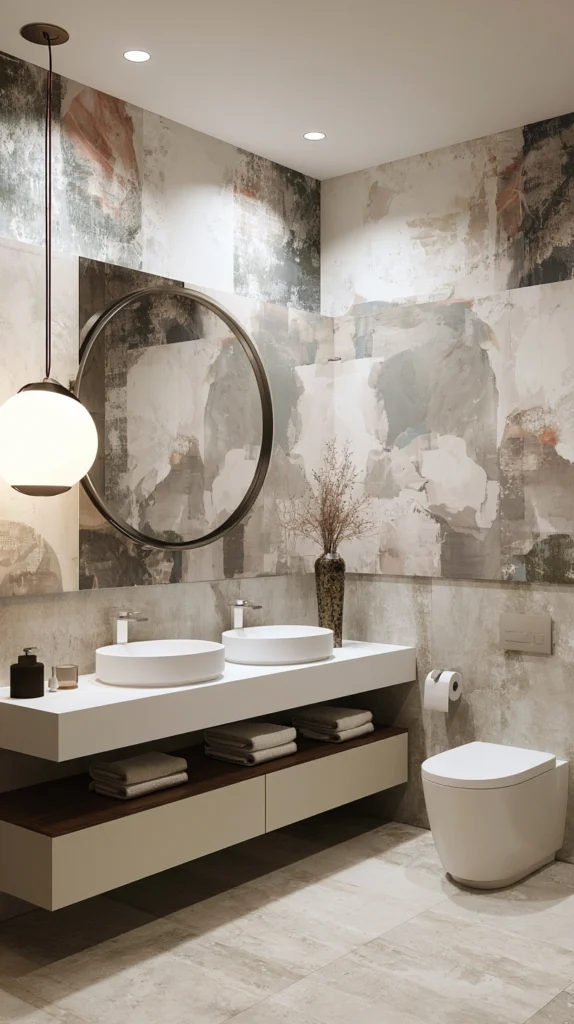
Wallpaper, tiles, or artwork featuring natural botanical patterns — the visual connection to plant forms when living plants are not possible in every area.
Why pattern as biophilic design works:
The research on natural patterns:
- The brain: processes natural patterns differently from geometric patterns
- Natural patterns (leaf structure, water ripples, tree branching): activate the visual cortex in ways associated with calm
- The mechanism: unclear, but the effect: measured
- In a bathroom: the surfaces can carry this effect even when the other biophilic elements are limited
The forms that work:
Botanical illustration:
- The detailed scientific illustration of plants
- Individual specimens rendered with precision
- The wallpaper that reads as a library of natural forms
- Most compatible with a calm, restrained bathroom palette
Large leaf motifs:
- Magnified plant forms (single large leaf across a surface)
- The scale: both familiar (a leaf) and unfamiliar (this large)
- The unfamiliarity: attentiveness (looking more carefully than at a conventional pattern)
- Attentiveness: the beginning of restoration
Water patterns:
- The ripple pattern of water on a surface
- The most specifically bathroom-appropriate natural pattern
- Water on water: the pattern that belongs here
Stone and wood grain:
- The pattern within the material (veining, grain)
- These patterns: the same visual structures as botanical patterns, from different natural systems
- A marble surface: botanical in its pattern logic even without plant forms
The application:
Feature wall wallpaper:
- One wall in a dense botanical wallpaper
- Moisture-resistant versions available for bathrooms
- Or: standard wallpaper behind a glass panel (sealed)
- The botanical wall: the room’s visual anchor
Floor tiles:
- A tile with a natural pattern (water, stone, wood grain)
- The floor: the largest surface in the bathroom
- The pattern: experienced underfoot as well as visually
Cost breakdown:
- Botanical wallpaper (one wall, moisture-resistant): $80–250
- Or: art print in a waterproof frame: $30–80
- Total: $30–250
8. The Japanese Soaking Bath (Water as Ritual)
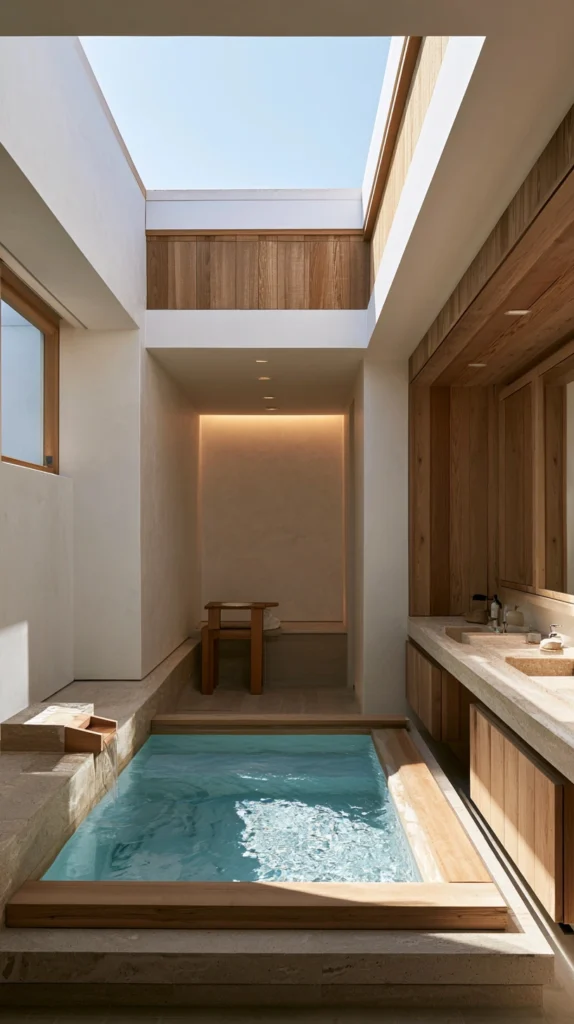
A deep soaking tub used in the tradition of the Japanese ofuro — the water feature that makes the bath a meditative rather than merely hygienic act.
Why the soaking bath is specifically biophilic:
The water element:
- Water: one of the five fundamental natural elements
- Immersion in water: a return to a primal state (the womb, the river, the sea)
- The biophilic response to water immersion: deeply embedded
- The shower: water touching the surface. The bath: the body within water.
- The biophilic experience: qualitatively different
The Japanese tradition:
The ofuro philosophy:
- In Japanese bathing culture: you wash first (shower), then soak
- The soaking: the restorative act, not the cleansing
- The water: hot and deep
- The duration: until the body is ready to leave
- The transition from bathing to soaking: a change in purpose
The design:
The deep tub:
- Minimum 18 inches of water depth
- For a seated soaking position: 20+ inches
- Standard Western tubs: 12–14 inches deep
- The Japanese soaking tub: designed for seated immersion
The temperature:
- Hot (104°F/40°C): the traditional Japanese bath temperature
- Higher than most Western bath temperatures
- The heat: the physiological agent (vasodilation, muscle relaxation, the body releasing tension)
- The heat + immersion: the most complete biophilic water experience available
The materials for the soaking bath:
Hinoki wood (Japanese cypress):
- The traditional material
- Fragrant when wet (phenol compounds release in hot water)
- The scent: a specific and unique element of the hinoki bath
- Maintenance-intensive (must be kept wet between uses or dried completely)
- The most biophilic material for a soaking bath
Stone resin or fibreglass:
- The practical alternative
- Deep and comfortable
- No wood maintenance
- Less specific but more accessible
The surrounding:
The simplest setting:
- A single wooden stool beside the bath (the wash stool)
- Bamboo or wooden floor
- A plant beside the bath (the fern or orchid)
- The lack of clutter: the Japanese aesthetic applied
Cost breakdown:
- Deep-soaking tub (fibreglass or stone resin): $600–1,500
- Or: Japanese style tub (cedar or hinoki): $1,500–4,000
- Total: $600–4,000
9. The Linen and Natural Textile Layer (Touch and Warmth)
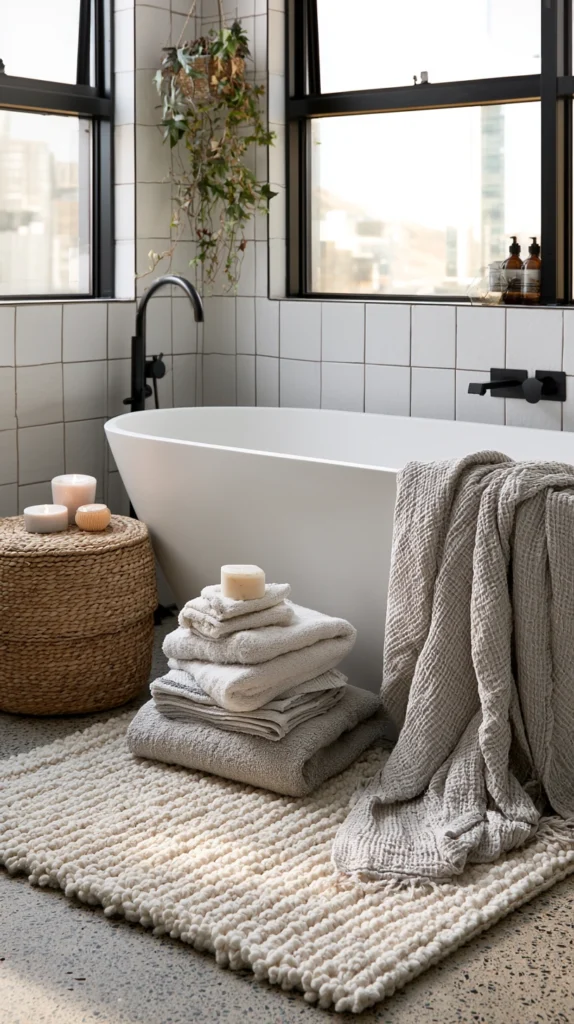
Natural fibre towels, bath mats, and textiles — linen, organic cotton, bamboo — the tactile biophilic layer that is the most accessible and most immediately changing element.
Why textiles matter to biophilic design:
The tactile sense:
- Biophilic design research: predominantly focused on visual elements
- But: touch is the sense engaged most directly in the bathroom
- The towel the body is dried with: the most-touched object in the daily routine
- The natural fibre towel: a different physical sensation from synthetic
Natural fibres versus synthetic:
The biological truth:
- Natural fibres (cotton, linen, bamboo): grown from living things
- Synthetic (polyester, microfibre): petroleum-derived
- The body: can distinguish between natural and synthetic fibre textures
- Natural fibres: absorb moisture differently (they absorb, then release — the correct towel function)
- Synthetic: absorb less, feel different
Linen specifically:
The biophilic textile:
- Linen: from flax (a plant)
- The wrinkled quality: signals natural material, not engineered uniformity
- Gets softer with every wash (the opposite of synthetic)
- Absorbs moisture well
- The linen towel: more beautiful after ten washes than before the first
The visual quality:
- Natural undyed linen: the colour of the plant it came from
- Warm cream-grey
- The colour of stone and bark
- The most biophilic neutral available
Organic cotton:
- Softer than linen
- Also ages well
- The plush towel that improves with washing
- In natural, undyed versions: the warm cream-white
Bamboo fibre:
- Exceptionally soft (softer than cotton)
- Naturally antibacterial
- The most rapidly renewable source
- Available in towels and bath mats
The arrangement:
The hotel towel arrangement:
- Rolled rather than folded
- In a basket or on a shelf
- The abundance of rolled towels: generous and visually warm
- The excess: the signal of care for the person using the bathroom
The natural basket:
- Woven seagrass or rattan basket
- Holding the rolled towels
- The woven natural material: another biophilic texture
The bath mat:
- Teak or bamboo slat mat: the wood version (see Idea #3)
- Or: a thick natural fibre woven mat
- The transition from the shower to the floor: a warm, natural surface underfoot
Cost breakdown:
- Set of four linen or organic cotton towels: $40–100
- Natural fibre bath mat: $20–45
- Woven basket for towel storage: $15–30
- Total: $75–175
10. The Indoor Waterfall or Water Sound Feature (The River Element)
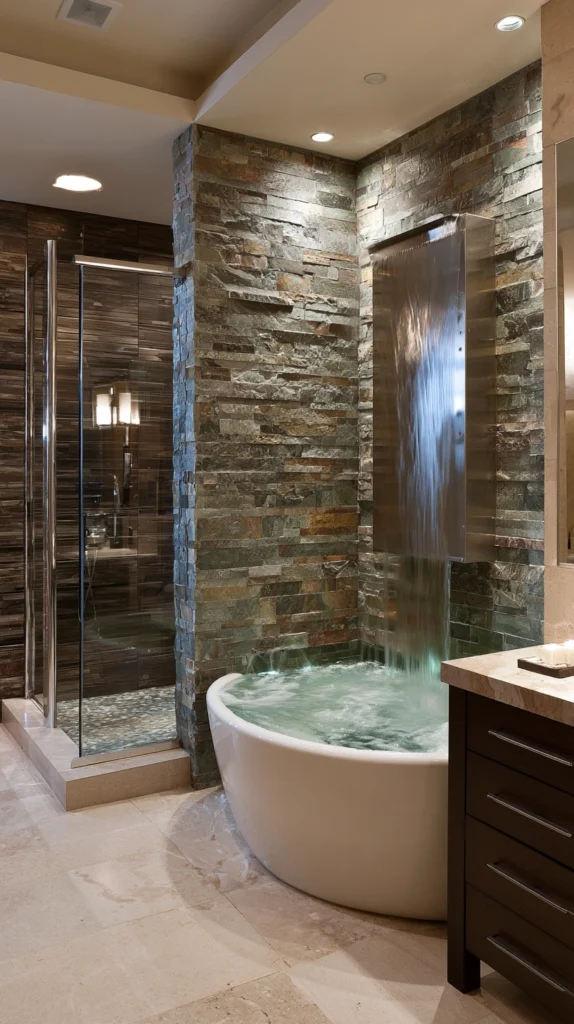
A small water feature — a wall-mounted flow, a tabletop fountain, or a water wall — that introduces the sound of moving water to the bathroom — the auditory biophilic element.
Why sound matters to biophilic design:
The acoustic dimension:
- Most biophilic design research: visual
- But: the sound of moving water is one of the most consistently documented calming stimuli available
- The mechanism: pink noise (the frequency range of water sound) masks the anxious interior monologue
- The effect: measurable reduction in perceived stress after 5 minutes of water sound
The bathroom as the ideal space:
Why the bathroom suits water sound:
- The sound of the shower: the same frequency range
- But: a shower is not always running
- A continuous water sound: available at all times in the bathroom
- The transition from a silent bathroom to a naturally-sounding one: significant
The types:
Wall-mounted water feature:
- A panel of stone or slate with water flowing down the face
- Usually recirculating (closed system, no plumbing connection needed)
- The pump: very small, near-silent
- The water: the sound
- Available as complete units: $100–400
Tabletop fountain:
- A small bowl or vessel with a submersible pump
- The simplest version
- The smallest footprint
- Placed on a shelf or the floor
- $20–80
The shower as a deliberate water sound:
- The rainfall shower (Idea #6) with attention to sound
- A specific showerhead designed for sound quality
- The mindful shower: attending to the sound of the water
The sound calibration:
Not too loud:
- The water feature: audible but not dominant
- A background sound, not a foreground one
- Adjustable pump speed: the control
- From the bath: just audible. From the shower: masked by the shower itself.
The silence of the fountain:
- Between showers and baths: the fountain the only sound
- The bathroom: not silent (silence can be as stressful as noise)
- The consistent gentle sound: the acoustic rest
Cost breakdown:
- Tabletop fountain (basic): $20–50
- Wall-mounted water feature: $100–400
- Total: $20–400
11. The Natural Scent Layer (The Olfactory Biophilic)
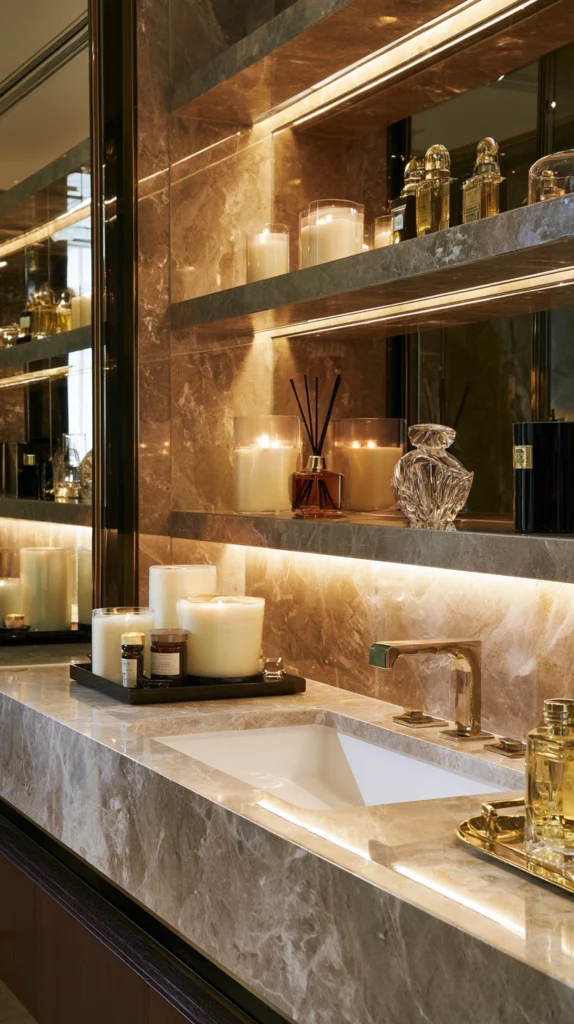
Essential oils, natural candles, dried botanicals, and cedar or eucalyptus in the shower — the sensory biophilic element that is the most immediately affecting and the most often overlooked.
Why scent is the fastest biophilic pathway:
The neurological route:
- Scent: the only sense that goes directly to the limbic system (emotion and memory)
- Without rational processing
- A natural scent: triggers an emotional and physiological response before the mind has registered what the smell is
- Forest bathing (Shinrin-yoku): the practice of being in a forest includes the scent as a primary element
- The documented effects of forest bathing: measurably related to phytoncides (volatile compounds released by trees)
The bathroom application:
Eucalyptus in the shower:
- A bundle of fresh eucalyptus hung from the showerhead
- The hot water and steam: volatilise the eucalyptus compounds
- The shower: filled with the scent of the eucalyptus forest
- The compound: the same class as the phytoncides documented in forest bathing research
- The most direct biophilic scent element available for a bathroom
Essential oil diffuser:
- A diffuser in the bathroom (not near water — the electronics and water relationship)
- Forest scents: cedarwood, pine, vetiver, sandalwood
- The botanical scents: connecting to the plant world through the nose
- The diffuser running during the morning routine: the forest brought into the room
Natural candles:
- Beeswax (the most natural available)
- Or: soy wax with botanical essential oils
- Lit before the bath: the scent present from the beginning
- The warm light and the natural scent: two biophilic elements together
Cedar:
- Cedar wood objects in the bathroom: release phytoncides passively
- A cedar bath mat, cedar shelf, cedar soap dish
- The wood: working aromatically as well as visually
- The scent intensifies when wet
The scent to avoid:
Synthetic fragrance:
- Most conventional bathroom products: synthetic fragrance
- The body: registers synthetic fragrance differently from natural
- In a biophilic bathroom: replacing synthetic with natural wherever possible
- The transition: not immediate but gradual (as products are used up)
Cost breakdown:
- Fresh eucalyptus bunch: $8–15 (lasts 2–3 weeks in the shower)
- Essential oil diffuser: $25–50
- Beeswax candles (set): $20–35
- Total: $53–100
12. The Earth and Clay Element (The Mineral Kingdom)
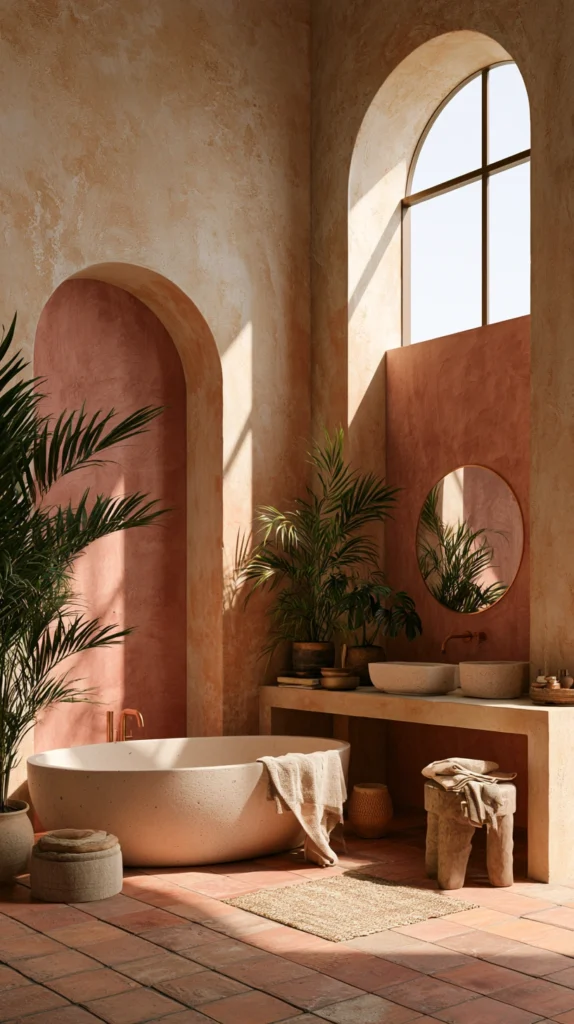
Terracotta tiles, clay vessels, raku-fired ceramics, and earthen plaster — the material that connects the bathroom to the mineral world.
Why earth-based materials are specifically biophilic:
The pre-history:
- Humans: sheltered in caves and earthen structures for most of our evolutionary history
- The clay-and-earth shelter: the body’s ancestral home
- Earth-based materials: triggering a primal recognition
- The smooth plaster wall, the terracotta floor: the oldest domestic surfaces
The warmth:
- Earth-toned materials: warm in colour (orange, ochre, cream, brown, red)
- Warm tones: associated with warmth
- The biophilic bathroom in earth tones: warm in every sense
The terracotta tile:
The material:
- Fired clay
- The imperfections of handmade versions: each tile slightly different
- The variation: the sign of a living material (made by hands from earth)
- Industrial terracotta: less variation, less specifically biophilic
- Handmade terracotta: the authentic version
In the bathroom:
- Terracotta floor tiles (sealed for water resistance)
- The warm orange-brown underfoot
- The transition from the cold tile floor to the warm terracotta: noticeable
- The colour: specifically warm
Clay vessels:
- A clay soap dish (the soap resting on an earthy material)
- A clay cup for toothbrushes
- An unglazed raku-fired vase (for a stem or dried botanical)
- The clay: the earth in the hand
Earthen plaster (limewash or clay plaster):
- A wall finished in natural clay or limewash plaster rather than paint
- The texture: soft, variable, handmade-looking
- The colour: the colour of the earth the clay came from
- The most transformative single wall treatment in a biophilic bathroom
Cost breakdown:
- Terracotta floor tiles (per square metre): $25–60
- Clay soap dish and accessories: $20–40
- Limewash or clay plaster (one wall): $30–60 materials (DIY application)
- Total: $75–160
13. The Prospect and Refuge Balance (The Spatial Biophilic)
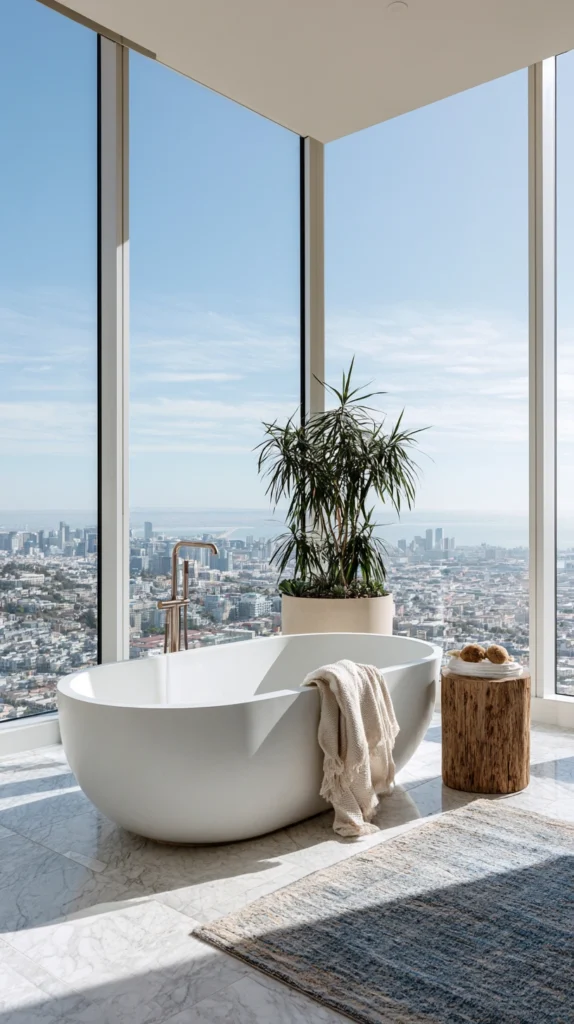
Designing the bathroom to have a sense of shelter (refuge) with a view beyond (prospect) — the spatial principle from environmental psychology that governs how comfortable any space feels.
The prospect/refuge theory:
The research:
- Jay Appleton (1975) proposed that humans have an innate preference for environments combining prospect (wide view, visibility) and refuge (enclosed, protected, sheltered)
- The preference: evolved from ancestral survival needs (seeing without being seen)
- In the built environment: spaces with both prospect and refuge: more comfortable
- The bathroom: typically high refuge (enclosed, private) with poor prospect
The biophilic bathroom challenge:
Too much refuge:
- The all-enclosed bathroom with no view or connection to the wider world
- The clinical white box: maximum enclosure, maximum visibility to the occupant of its limitations
- The result: the bathroom that feels smaller and more oppressive than its actual dimensions
The solution:
Adding prospect to a high-refuge space:
A window to a natural view:
- Even a small window: adds the visual connection beyond the room
- A view of a tree, a garden, the sky: the prospect element
- Privacy and prospect together: frosted glass at the lower section, clear at eye level or above
A skylight:
- The prospect: upward
- The sky: the most universally biophilic view
- In the bath or shower: looking up at the sky
- The most profound spatial biophilic experience in any bathroom
The internal landscape:
When external views are not possible:
- A large photographic print of a natural landscape
- Or: the plant wall (Idea #1) — the internal landscape
- The prospect within: a deep visual field created by planting, artwork, or a mirror revealing a natural scene
The ceiling treatment:
The prospect from the bath:
- Looking up: the primary view during bathing
- A painted or papered ceiling with a sky or foliage mural
- The ceiling: the biophilic landscape
- Looking up from the bath: the view into the canopy of a forest
Cost breakdown:
- This idea: primarily spatial rather than material
- Adding a skylight: $500–1,500 (installed)
- A landscape artwork or ceiling mural: $30–200
- Total: $30–1,500 depending on approach
14. The Complete Biophilic Bathroom (All Elements Working Together)
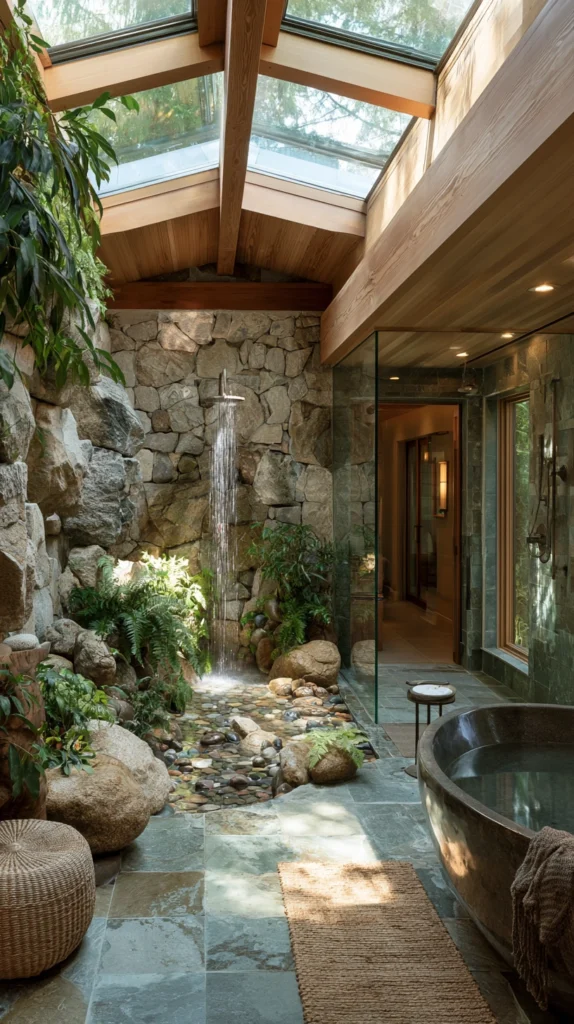
A bathroom where every design decision — material, plant, light, form, texture, scent, and water — is made in service of the biophilic brief — the room that is qualitatively different from any bathroom designed for cleanliness alone.
What the complete biophilic bathroom looks like:
The materials (earth and forest):
- Stone (marble or limestone) on the feature wall
- Teak or cedar on the floor insert, bench, and shelving
- Terracotta accessories (soap dish, toothbrush holder, small vessels)
- Linen towels in natural undyed tones
- The materials: nothing synthetic or engineered in any prominent position
The living elements:
- The plant shelf opposite the shower: ferns, pothos, one orchid
- A bunch of eucalyptus hanging from the showerhead
- Dried botanicals in an unglazed clay vessel
- The living: present in multiple categories (plants, scent, botanical material)
The water:
- The rainfall showerhead overhead (not wall-mounted)
- The deep soaking tub (if space allows)
- A small tabletop fountain on the shelf beside the bath
- Water: in three forms (shower, bath, fountain)
The light:
- A skylight or large window (or solar tube as the substitute)
- Dimmer switch on all artificial light
- Morning: brighter and cooler (if adjustable)
- Evening: dim and warm (2700K)
- A beeswax candle for the bath
The forms:
- Round basin (stone or ceramic)
- Oval bath
- Curved mirror
- Arched niches in the shower
- No prominent right angles in the primary experience
The scent:
- Eucalyptus in the shower
- Cedarwood essential oil diffuser (mornings)
- Beeswax candle (evenings)
- The natural materials: releasing their own scent (cedar, stone after water)
The sound:
- The rainfall shower: attended to as a sound
- The tabletop fountain: between showers
- The room: never completely silent
The morning routine in this bathroom:
7am:
- Enter the bathroom
- The diffuser has been on a timer (turned on at 6:50am)
- The cedarwood scent is present
- The skylight: morning light falling
- The plant wall: catching the light
7:05am:
- The rainfall shower
- The eucalyptus releasing in the steam
- The sound of the rainfall from above
- The warm wood bench in the shower (the teak)
7:15am:
- The linen towel
- The warm terracotta floor
- The stone basin, the cool water
7:20am:
- Leave the bathroom
The physiological state at 7:20am versus the conventional bathroom:
- Not documented in a study specific to this bathroom
- But the mechanisms are documented
- The natural materials, the natural light, the natural scent, the water sound, the living plants: each with a documented effect
- Together: the effect that is the point of everything on this list
The phased approach to the complete biophilic bathroom:
Month one ($75–140):
- Plant shelf (Idea #1): ferns and pothos
- Linen towels (Idea #9)
- Eucalyptus in the shower (Idea #11)
- The immediate biophilic layer
Month two ($53–100):
- Natural scent system (Idea #11 expanded)
- Rainfall showerhead (Idea #6)
- Natural sounds: tabletop fountain (Idea #10)
Renovation phase ($500–2,000+):
- Stone feature wall (Idea #2)
- Natural light improvement (Idea #4)
- Organic forms: round basin, oval bath (Idea #5)
- Earthen plaster or limewash (Idea #12)
The total:
- Phase one and two: under $300
- Renovation phase: $500–2,000+
- The complete biophilic bathroom: $800–2,300
The One Principle
Before any purchase, before any renovation:
The bathroom is not a room to wash in. It is a room to recover in.
Recovery from sleep. Recovery from the day. Recovery into the morning.
Every element on this list serves this function. The plant that breathes with you. The stone that carries geological time. The warm wood underfoot. The sound of rainfall above. The scent of cedar and eucalyptus. The soft light of morning through the skylight.
The biophilic bathroom is not designed to look like nature. It is designed to make the body feel the way it feels in nature: less guarded, less stressed, more itself.
Eight minutes each morning. Twelve minutes each evening. Thirty-eight thousand minutes across a year.
The room that best serves those minutes: worth designing correctly.
Getting Started This Weekend
The three-element biophilic start under $100:
One (or three) plants for the bathroom:
- Boston fern, pothos, or ZZ plant
- On a shelf beside the shower or opposite the bath
- Already there, already working, from the day they are placed
A bunch of eucalyptus hung from the showerhead:
- From a florist or farmers market
- The shower: transformed immediately
- Lasts 2–3 weeks
Linen towels to replace synthetic:
- Two linen or organic cotton towels
- Hang where they will be reached for daily
Total: $50–90. The bathroom: already more biophilic than it was this morning.
The complete vision: available over time. The first step: this weekend.