
14 Luxe Fall Dining Room Wall Art Ideas
There is a room in the house that benefits most from the specific richness of the autumn season — not the living room, which already has the sofa and the fireplace to provide warmth, and not the bedroom, which retreats into its own private atmosphere regardless of season. It is the dining room.
The dining room in autumn has a specific quality available to it that no other season offers — the quality of candlelight meeting a richly coloured wall, of golden light falling on warm-toned art, of the specific visual pleasure of a room whose art and whose season have arrived at the same moment and confirmed each other with complete aesthetic agreement.
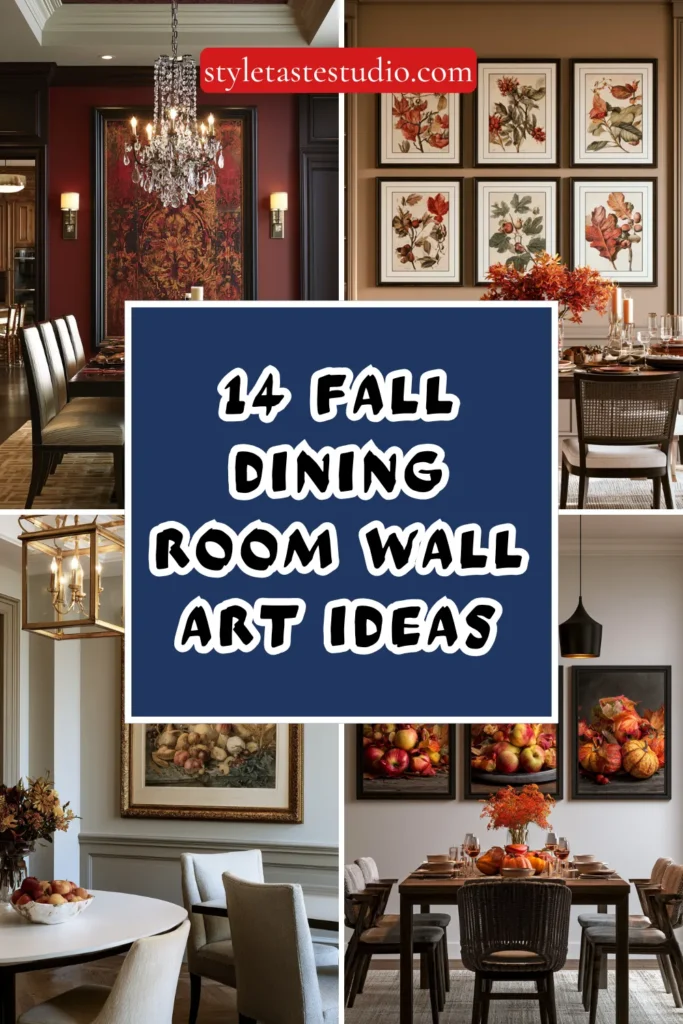
Wall art in the dining room works differently from art in any other room — it is seen from a seated position, at a specific distance, in the specific quality of evening artificial light in which most dining happens. The fourteen ideas below are art choices for this specific context, in the specific richness of the autumn season.
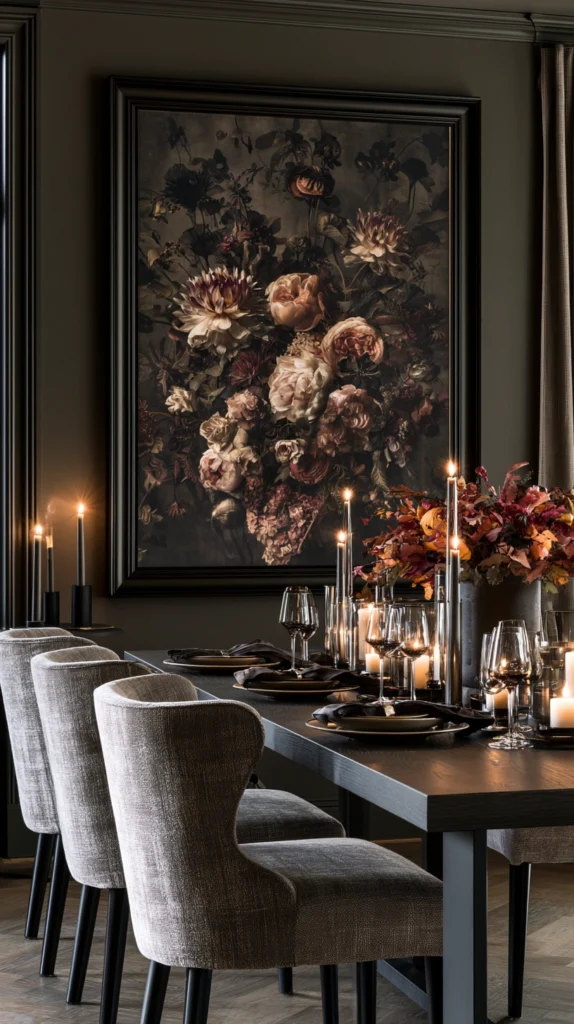
1. The Oversized Dark Botanical Print
Budget: $30 – $200
A single large botanical print — a dark-ground illustration of autumn leaves, acorns, dried seed heads, and skeletal branches in the tradition of the great eighteenth and nineteenth century natural history illustrators — hung as the dining room’s primary wall statement produces the most immediately seasonal and the most specifically luxe botanical art effect available to an autumn dining room.
A high-resolution scan of a public domain botanical illustration printed at A1 or larger — $5 – $20 at an online print service. A simple dark timber or heavy gilt frame — $20 – $80 at this scale. A purchased reproduction from an independent art print seller — $30 – $150 depending on size.
Styling tip: Print at the largest scale the wall can accommodate — the specific quality of the dark botanical illustration is most evident when individual elements are large enough to be read in detail from the seated dining position. A small botanical print across a large dining room wall reads as a small picture. The same image at A1 or A0 reads as a statement that commands the room from the seated position.
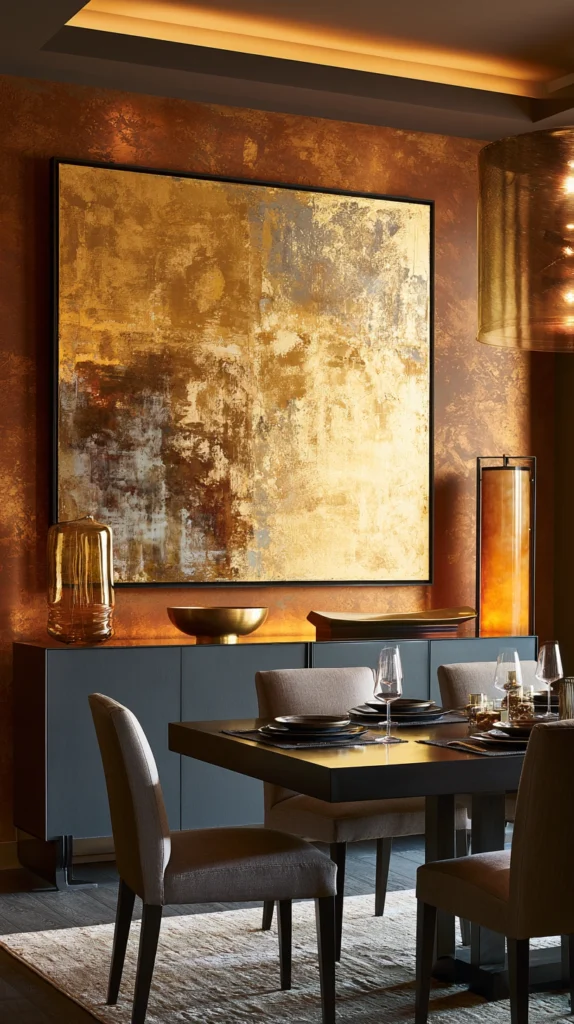
2. The Gold Leaf Abstract
Budget: $50 – $500
A large abstract work incorporating genuine or imitation gold leaf — warm amber tones, deep ochres, and the specific warm quality of metallic gold on a textured background — is the dining room’s most luxe and the most specifically autumn-evening-appropriate art choice. Gold leaf catches and amplifies candlelight and warm lamp light in a way that no printed image can approach.
A gold leaf abstract print from an independent artist — $80 – $300. A DIY gold leaf abstract — canvas, base paint in warm deep tones, imitation gold leaf applied in sections — $30 – $80 in materials. A purchased original from an emerging artist — $100 – $500.
Styling tip: Hang the gold leaf abstract on the wall most directly illuminated by the dining room’s primary warm light source — a chandelier, a pendant, or a table candelabra — so that the gold leaf’s reflective quality is activated during every dinner held in the room. Gold leaf art on a wall that is in shadow during the room’s primary use hours delivers a fraction of its potential visual impact.
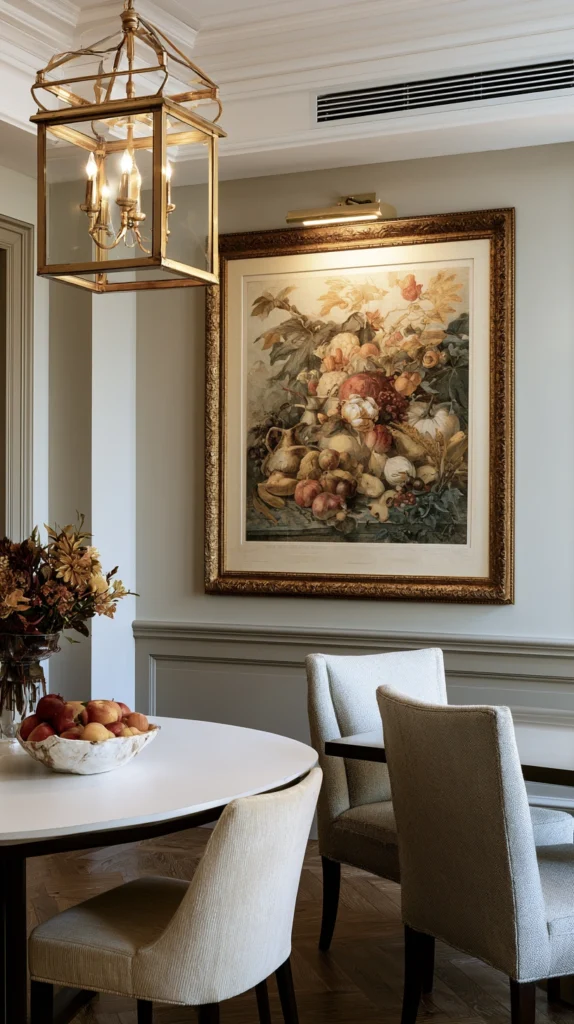
3. The Framed Vintage Harvest Print
Budget: $20 – $150
A framed vintage harvest print — a lithograph or woodblock print of autumn agriculture, a vintage seed catalogue cover, a mid-century poster of orchard fruits, or a Victorian chromolithograph of pomological specimens — gives the dining room art a narrative connection to the season’s most ancient and the most honest cultural premise: the harvest.
A high-quality reproduction of a public domain vintage harvest or pomological print — $5 – $20 printed online. A heavy gilt or warm timber frame — $15 – $80. An original vintage print from a specialist dealer — $30 – $150 depending on condition and rarity.
Styling tip: Frame vintage harvest or pomological prints in heavy, slightly ornate frames rather than simple modern ones — the subject matter of these prints belongs to a visual tradition of formal illustration that is most specifically beautiful in a frame that communicates the same quality of craftsmanship and historical weight as the image itself.
4. The Dark Moody Oil Painting or Reproduction
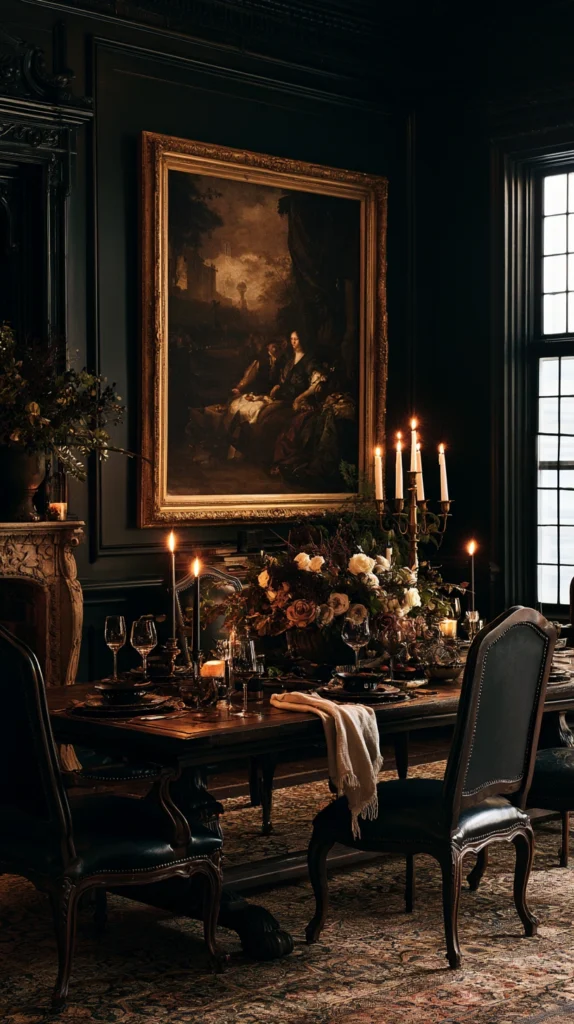
Budget: $50 – $800
A dark, moody oil painting — a Dutch Golden Age-style still life of fruit, game, and autumn botanicals, or a landscape in the warm, slightly melancholy tones of autumn light — is the most historically authenticated and the most specifically dining room-appropriate form of autumn wall art available. The Dutch Golden Age tradition produced the finest dining room art in the history of Western painting precisely because it was designed to be seen by candlelight in a room used for feasting.
A high-quality canvas print reproduction of a Dutch Golden Age still life — $60 – $200. An original oil painting in the tradition from an emerging artist — $200 – $800. A reproduction in a heavy, museum-quality frame — the frame adding as much to the effect as the image itself.
Styling tip: Choose a Dutch Golden Age still life that includes autumn botanicals — quinces, pomegranates, late-season grapes, and branches of autumn leaves — rather than a summer arrangement of roses and peaches. The seasonal accuracy of the imagery communicates that the art was chosen with the specific intention of belonging to this particular room in this particular season.
5. The Gallery Wall of Autumn Botanicals
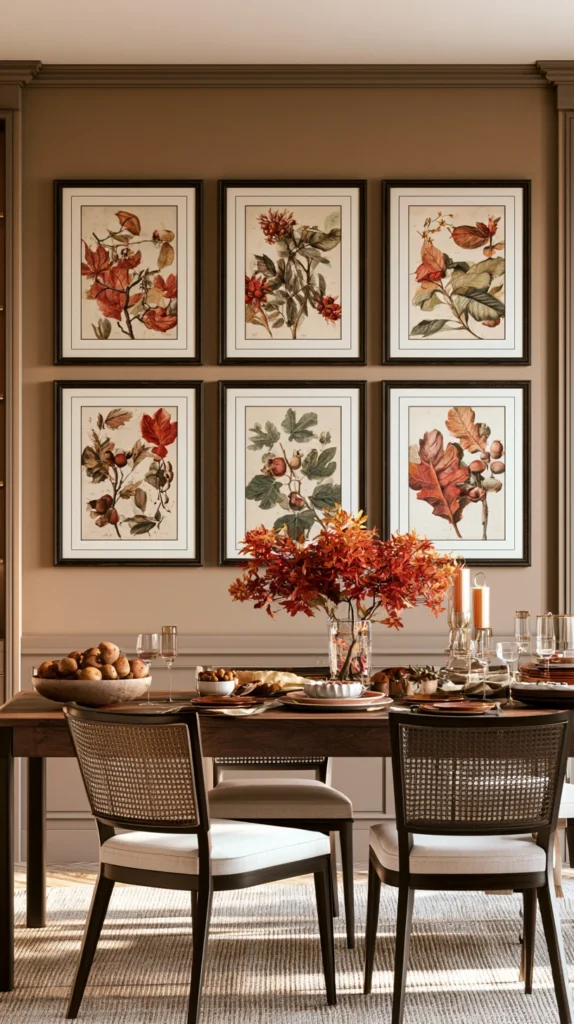
Budget: $60 – $400
A gallery wall of autumn botanical prints — a collection of eight to twelve images of autumn leaves, seed pods, fungi, and foliage in warm amber and earth tones, in consistent heavy frames — gives the dining room its most visually complex and the most seasonally abundant wall treatment. A well-composed gallery of botanical prints reads as a natural history collection of genuine cultural value.
Reproduction prints of autumn botanical illustrations — $3 – $15 each printed online. Heavy gilt or dark timber frames in a consistent profile — $10 – $30 each. A collection of ten frames — $100 – $300 in total.
Styling tip: Choose botanical prints for the autumn dining room gallery from the same illustrative tradition and the same approximate historical period — all eighteenth century watercolour illustrations, or all Victorian chromolithographs, or all mid-century woodblock prints — rather than mixing illustrative styles within the same gallery. A gallery of prints from a consistent tradition reads as a curated collection from a specific moment in the history of botanical illustration. A gallery of mixed styles reads as botanical prints in a variety of styles.
6. The Large Format Autumn Landscape Photography
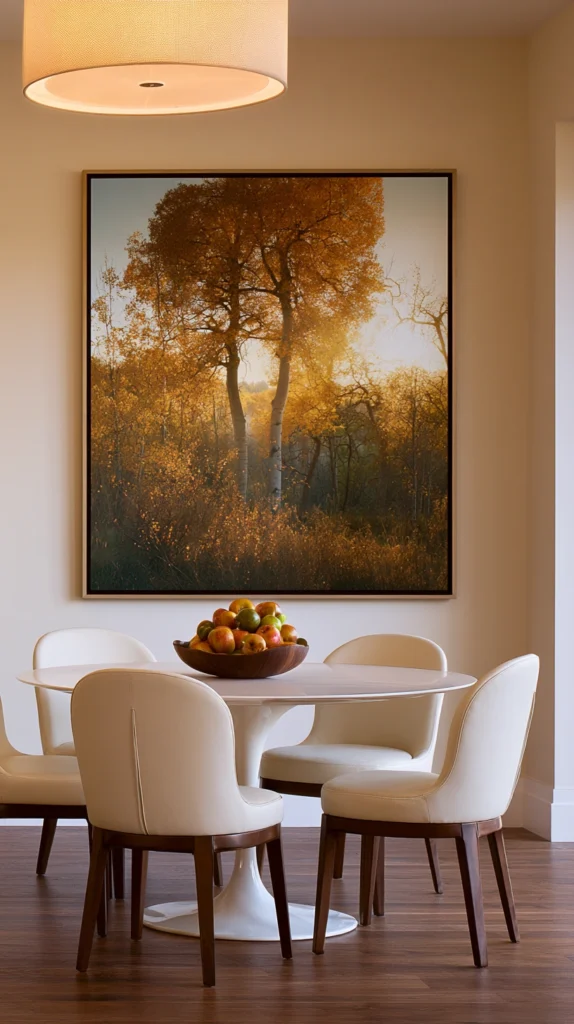
Budget: $30 – $250
A large format photographic print of an autumn landscape — a forest of turning leaves in warm amber and gold, a misty autumn morning over fields, or the specific quality of raking autumn light through bare branches — gives the dining room a window onto the season at a scale that communicates the grandeur of the natural autumn world rather than the detail of it.
A large format print from a landscape photographer — $60 – $200 at A1 or larger. A public domain or creative commons autumn landscape photograph printed online — $10 – $30 at a quality print service. A simple dark timber or brushed gold frame at scale — $20 – $80.
Styling tip: Choose a landscape photograph that was taken in the specific quality of autumn light — the raking, warm, slightly orange light of an autumn afternoon — rather than a technically excellent photograph taken in a flatter or cooler light. The quality of light in a landscape photograph determines whether it communicates the season through more than just the colour of the leaves.
7. The Antique Map in Autumn Tones
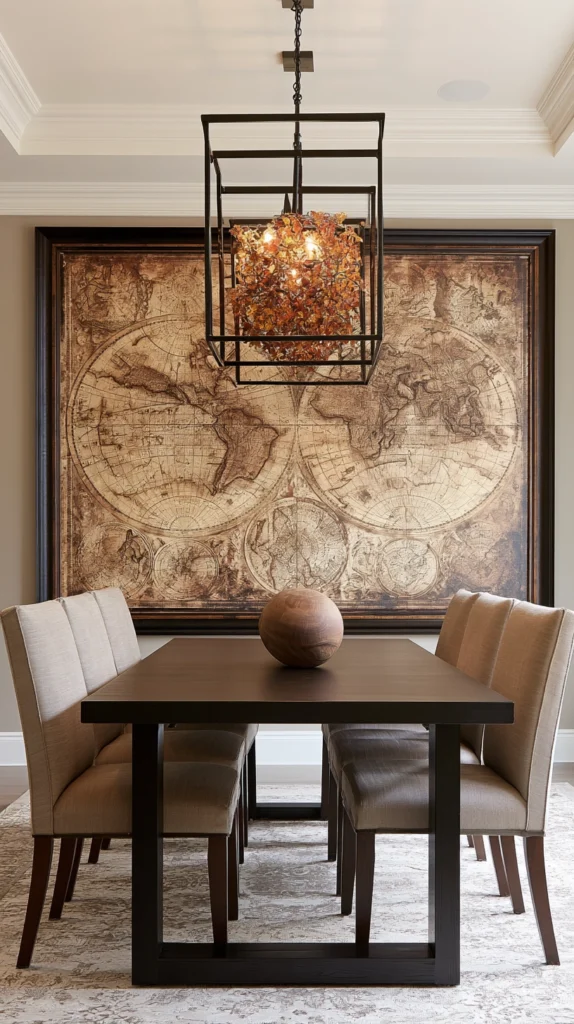
Budget: $30 – $200
An antique or reproduction antique map — in the warm amber, ochre, and sepia tones of aged cartography — gives the dining room art a quality of historical weight and navigational romance that belongs to the autumn season’s specific character. Antique maps in warm earth tones communicate the same palette as the season without requiring any literal autumn imagery.
A high-quality reproduction of a public domain antique map printed at a large scale — $10 – $30 printed online. A genuine antique map from a specialist map dealer — $50 – $200 depending on age and subject. A heavy gilt or dark timber frame at scale — $20 – $80.
Styling tip: Choose a map of a place of genuine personal significance — a region where the household has roots, a country visited and loved, or a city of particular meaning — rather than a purely decorative antique map of a random geographical subject. A map of a significant place communicates both the aesthetic quality of antique cartography and the personal value of the place it depicts.
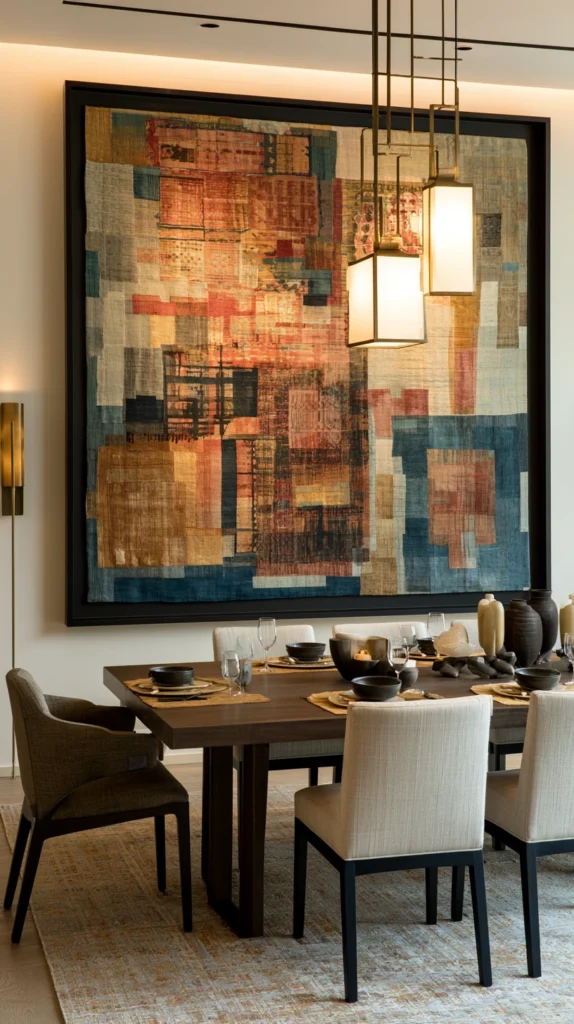
8. The Framed Textile or Tapestry Fragment
Budget: $30 – $250
A framed textile fragment — a section of vintage tapestry, a kilim fragment in warm autumn tones, a piece of embroidered fabric from a significant source, or a woven textile with a botanical or hunting pattern — gives the dining room a wall treatment of genuine material warmth and textural depth that no printed image can provide. Textiles in a dining room communicate the specific quality of medieval and Renaissance feast rooms, where tapestries were hung precisely to add warmth and decorative richness to rooms used for eating.
A kilim fragment in warm rust and amber tones — $20 – $60 from a textile market. A section of vintage tapestry — $30 – $150 from a specialist textile dealer. A simple shadow box or a timber dowel mounting system — $10 – $30 for the display solution.
Styling tip: Mount framed textiles in a shadow box that provides three to four centimetres of depth between the textile surface and the glass — so that the texture of the woven or embroidered surface is visible as three-dimensional material rather than as a flat surface pressed against glass. A textile mounted flat against glass loses much of its specific material quality. One mounted with depth retains the shadow and texture that makes the material beautiful.
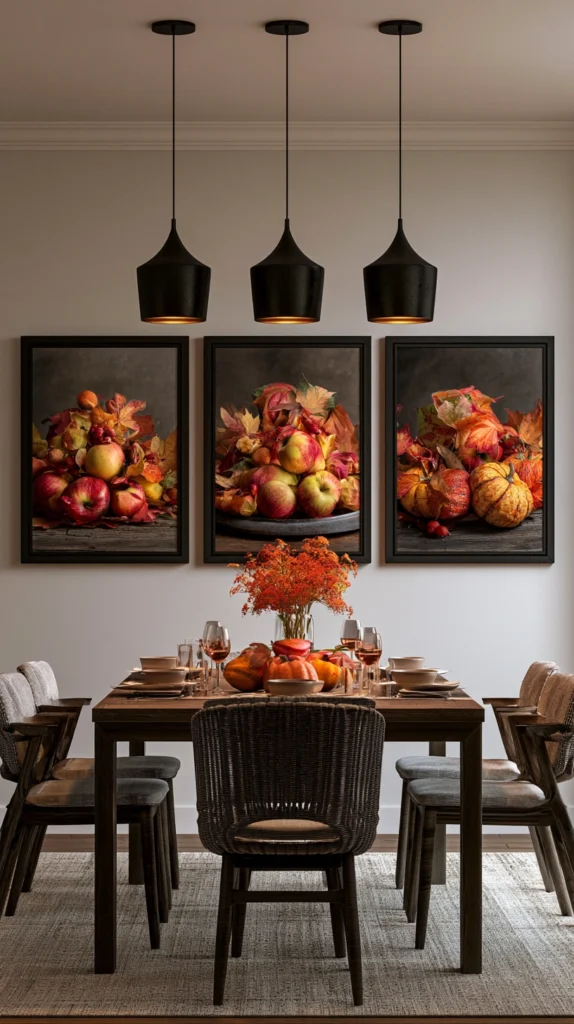
9. The Autumn Still Life Triptych
Budget: $40 – $300
Three smaller works hung as a triptych — a horizontal arrangement of three related images at the same height, equally spaced, forming a single composed visual statement — give the dining room a more architecturally resolved version of the gallery wall concept. A triptych of autumn still life studies in oil or watercolour communicates the season through repetition and variation simultaneously.
Three reproduction autumn still life prints in consistent frames — $10 – $30 each, plus $10 – $30 each for frames — $60 – $180 for the complete triptych. An original triptych commissioned from an emerging artist — $150 – $400.
Styling tip: Hang the three triptych panels with equal spacing between them — each gap consistent to the centimetre — and centre the full triptych at seated eye level, approximately 130 to 140 centimetres from the floor to the centre of the arrangement. A triptych hung at standing eye level is seen correctly only when no one is seated at the table — which is the reverse of the condition the dining room art was installed to serve.
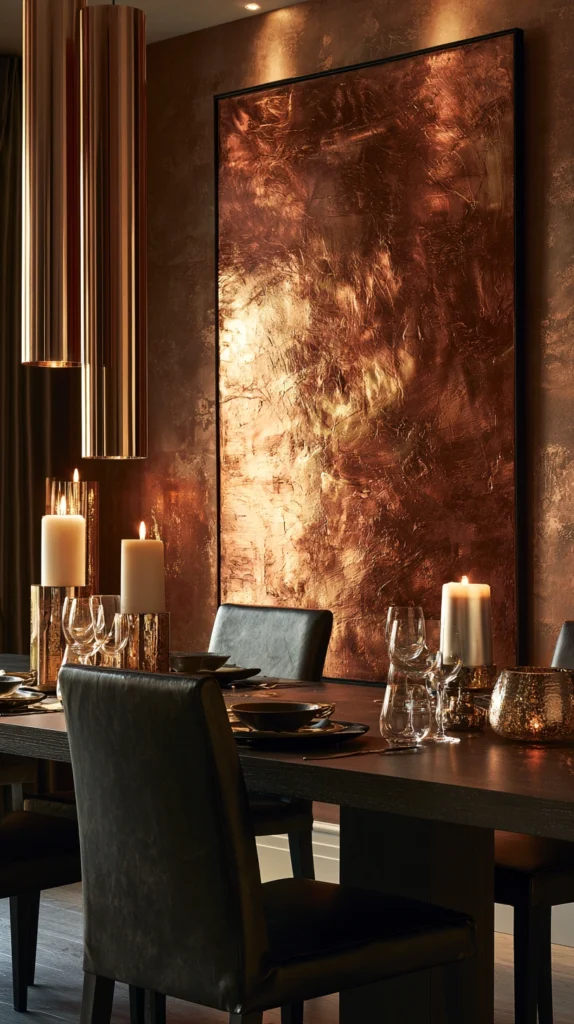
10. The Copper and Bronze Metallic Abstract
Budget: $40 – $300
A large abstract work in copper, bronze, and warm metallic tones — either a purchased art print with warm metallic inks or a DIY canvas piece in copper and bronze acrylic — communicates autumn’s palette through abstraction rather than literal imagery. The metallic quality of the work catches warm light and produces a surface of gentle luminosity that changes throughout the dining session as the candles move and the light shifts.
A large metallic art print in copper and bronze tones — $60 – $200 from an independent art print seller. A DIY abstract canvas — canvas, copper and bronze acrylic paint, a palette knife — $20 – $50 in materials. A simple floater frame in a warm gold or bronze tone — $20 – $60 at canvas scale.
Styling tip: Apply metallic paint in a palette knife rather than a brush for a DIY copper and bronze abstract — the palette knife producing a textured, impasto surface that catches light from multiple angles. Brush-applied metallic paint produces a relatively flat surface that reads as metallic in colour. Palette knife-applied metallic paint produces a surface that reads as metallic in material quality — catching and reflecting light from each raised edge.
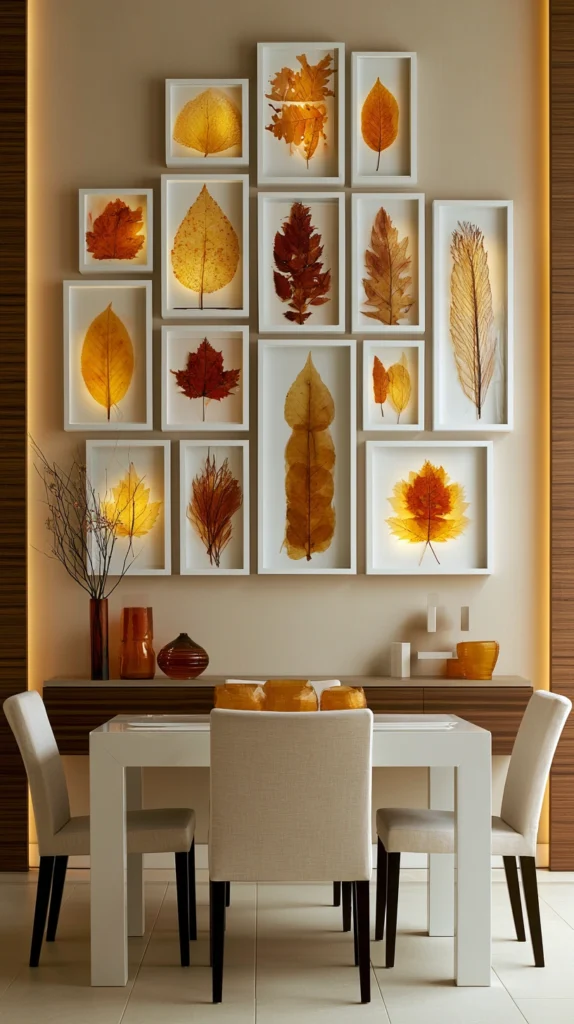
11. The Framed Amber or Pressed Autumn Leaf Collection
Budget: $10 – $80
A collection of autumn leaves — pressed and mounted individually in frames, or arranged together in a single large frame, or displayed in amber resin in small display frames — gives the dining room a wall treatment of completely genuine seasonal material. The leaves were gathered from the actual autumn world and pressed into the room’s art, bringing the season inside in its most direct and its most materially honest form.
Pressed autumn leaves mounted in frames — free if personally gathered, $5 – $15 each in frames. Leaves mounted in amber resin frames — $15 – $40 each for a pre-made option. A large herbarium-style display frame — $20 – $60 for a single large frame holding multiple specimens.
Styling tip: Label each pressed leaf with its species name — written in a clean, small script below the specimen — giving the display the quality of a genuine herbarium collection. An unlabelled pressed leaf is an autumn decoration. A labelled, species-identified pressed leaf specimen is a piece of natural history — which is a fundamentally different quality of object and a fundamentally different quality of dining room art.
12. The Dark Wallpaper Panel as Art
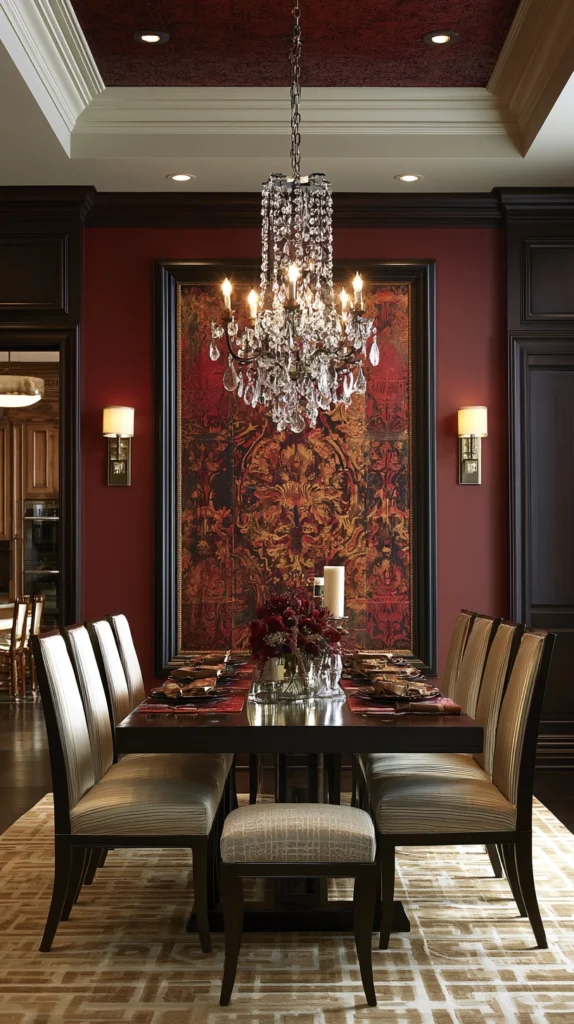
Budget: $20 – $200
A section of dark, autumn-appropriate wallpaper — a rich botanical, a moody toile, or a deep-ground damask in warm amber and rust tones — framed and hung as a large artwork rather than applied to the wall, gives the dining room a wall treatment that combines the graphic quality of pattern with the practicality and reversibility of a framed work.
A single roll of an autumn botanical or damask wallpaper — $15 – $50. A section cut to a large frame size — one to two metres in its largest dimension. A deep frame or shadow box to accommodate the wallpaper’s texture — $20 – $80 at the required scale.
Styling tip: Choose a wallpaper section that includes a complete, centred repeat of the pattern rather than cutting mid-repeat — a section displaying the pattern’s full design communicates deliberate composition. A section cut at a random point in the pattern repeat reads as a piece of wallpaper removed from a wall rather than a chosen image presented in a frame.
13. The Sculptural Autumn Wall Installation
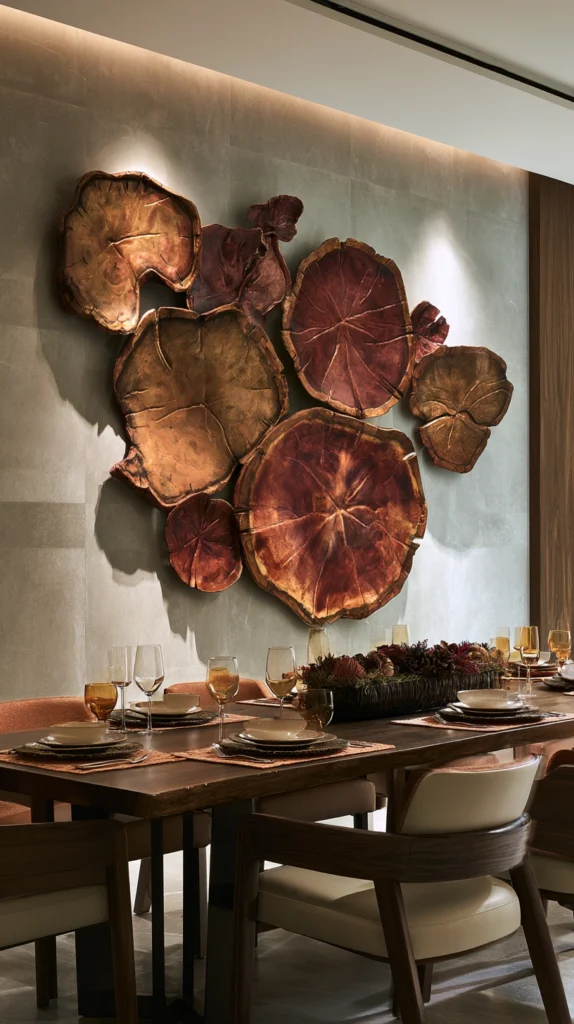
Budget: $40 – $300
A wall installation rather than a flat artwork — dried autumn botanicals arranged directly on the wall in a composed botanical arrangement, using adhesive mounting putty or small hooks, creating a three-dimensional botanical composition that extends from the wall surface into the room — gives the dining room a wall treatment of genuine material depth and sculptural quality.
Dried autumn botanicals — pampas, dried magnolia leaves, seed pods, and preserved branches — $10 – $40 per type. Adhesive mounting putty or small command hooks — $5 – $15. A framing element — a simple oval or rectangular mirror, or a section of dark painted wall — as the backdrop for the botanical arrangement — $20 – $80.
Styling tip: Compose the wall installation before attaching anything permanently — arranging all the botanical elements on a flat surface in the intended composition and photographing it as a reference before transferring the arrangement to the wall. A wall installation transferred from a pre-planned composition reads as designed. One arranged directly on the wall piece by piece reads as assembled — the difference being entirely in the quality of the compositional thinking that preceded the installation.
14. The Fully Curated Autumn Dining Room Art Moment
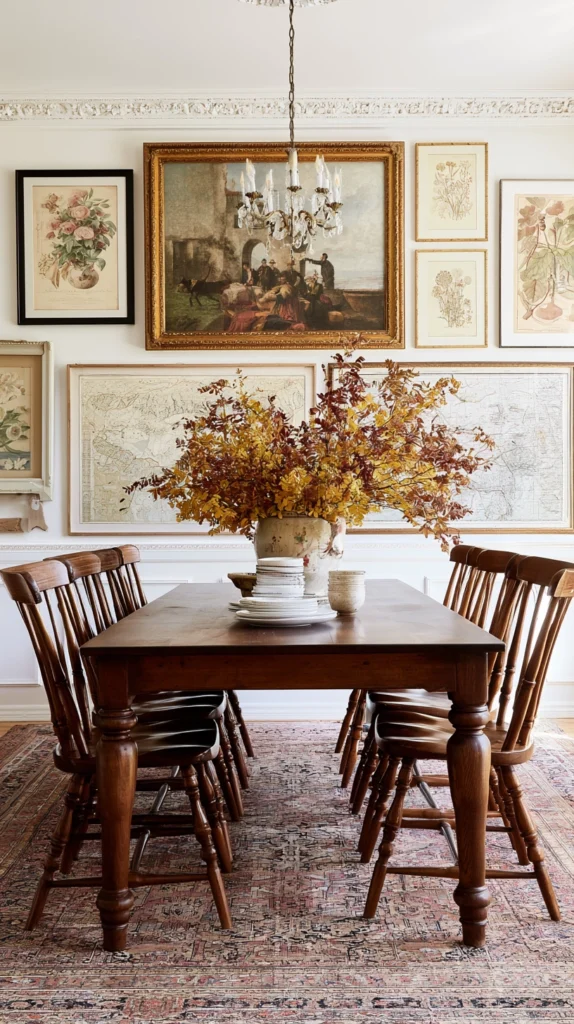
Budget: $100 – $1000
The fully curated autumn dining room art moment — a single large Dutch Golden Age-style still life reproduction in a heavy gilt frame as the primary wall statement, flanked by two smaller autumn botanical prints in matching frames,
a sculptural dried botanical arrangement on the adjacent wall, an antique map in sepia and amber tones above the sideboard, a framed kilim textile fragment on the fourth wall,
and a small framed pressed leaf herbarium collection on the wall visible from the host’s seat — is the dining room that has been given a complete, seasonally specific art programme rather than a collection of individual works placed where wall space was available.
Primary still life print and frame: $80 – $280. Flanking botanical prints: $60 – $180. Sculptural botanical installation: $50 – $150. Antique map: $30 – $110. Framed kilim textile: $40 – $180. Pressed leaf herbarium: $20 – $60. Total fully curated dining room art moment: $280 – $960 for a dining room that reads as a complete and specifically autumn cultural environment from every seated position at the table.
Styling tip: Assess the fully curated autumn dining room art programme from the seated dining position rather than from a standing assessment of the room — sitting in each chair around the dining table in turn and evaluating which art is visible, at what distance, and in what quality of light from each position.
The dining room is experienced from seated positions during the meals it hosts, and art that reads beautifully from a standing assessment but is partially obscured, oddly angled, or too small to read from the seated position has been assessed at the wrong moment. The seated position is the correct position. Everything else is a decorator’s view of a room designed for guests.
The autumn dining room’s wall art is not the most important element of a Thanksgiving or harvest gathering — the food, the company, and the specific quality of a table set with genuine care are all more important. But art that was chosen for this room, in this season, at this specific quality of warm evening light, produces a background of cultural warmth and seasonal richness against which the meal and the company are consistently, specifically, and noticeably more beautiful.
Choose the art for the candlelight. Frame it for the seated eye. And then let the season and the gathering confirm each other at the level of the wall.