
15 Neo Deco Bedroom Ideas for a Modern Art Deco Look That Feels Genuinely Luxurious
Art Deco has returned before. It always returns.
The style that defined the jazz age, the roaring twenties, the peak of a specific kind of confident, machine-age glamour, has a specific grip on the imagination that other historical periods do not. It keeps resurfacing in fashion, in architecture, in interior design, with a quality of irresistibility that more recent styles rarely achieve.
Neo Deco is not vintage revival. It is the contemporary application of Art Deco principles to a modern interior. The geometric rigour. The unapologetic luxury of the materials. The specific colour palette of the period, deep black, warm gold, rich jewel tones, ivory. The silhouettes that are simultaneously architectural and sensuous.

What changes between original Art Deco and Neo Deco is the context and the combination. Original Art Deco was optimistic about the machine and the modern. Neo Deco is nostalgic for the glamour but contemporary in its restraint. It uses fewer elements more precisely. It does not recreate the period. It references it selectively.
The bedroom is where Neo Deco is most naturally at home. The specific qualities that Art Deco brings to a room, the warmth of gold beside deep colour, the geometry of the pattern work, the luxurious surface quality of the materials, are the qualities that make a bedroom feel genuinely special to sleep and wake in.
These 15 ideas build that bedroom.
Why Art Deco Translates So Naturally to the Modern Bedroom
The original Art Deco bedroom was a room of performance as much as rest.
In the 1920s and 1930s the bedroom of a wealthy household was a receiving room as well as a sleeping room. The vanity table where one prepared for the day. The dressing room that connected to the bedroom. The bed as an object of theatrical display rather than merely a sleeping surface. The Art Deco bedroom was designed for the drama of being seen as much as for the privacy of sleep.
The Neo Deco bedroom takes this performative quality and redirects it. The drama is for the occupant rather than for visitors. The gold headboard that gleams in the morning light. The geometric bedside lamp that creates precise patterns of shadow. The velvet draping the window. These details exist for the pleasure of waking up in this specific room rather than for the performance of an identity to external observers.
This shift from public performance to private pleasure is what makes Neo Deco work in the contemporary bedroom. The glamour is personal rather than social. The luxury is experienced rather than displayed.
1. A Fan or Sunburst Headboard in Gold-Toned Metal
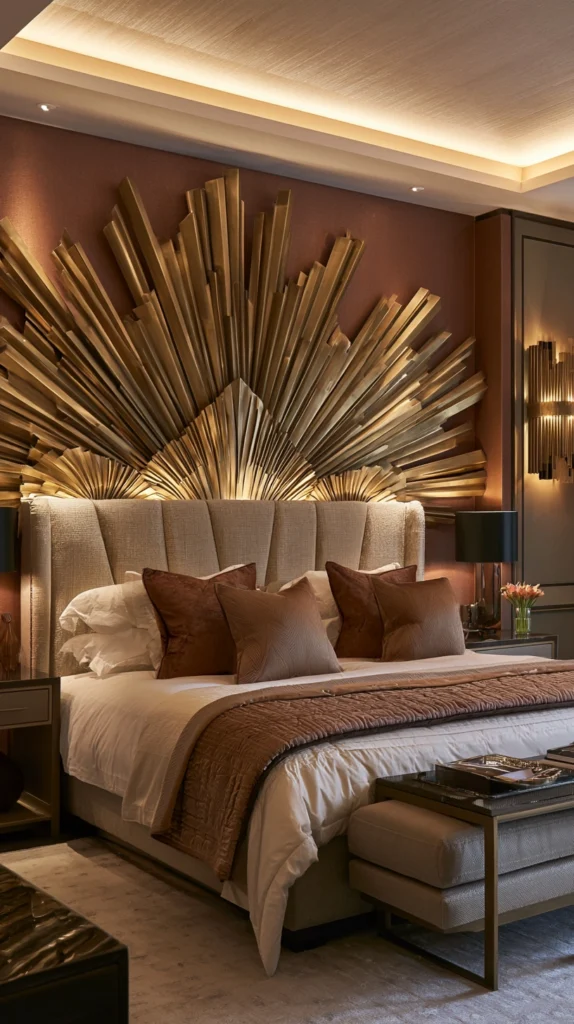
The Art Deco headboard is one of the most recognisable and most beautiful pieces of bedroom furniture in any period’s design vocabulary.
The fan form. The sunburst radiating from a central point. The stepped arch. These are the silhouettes that define the Art Deco headboard and that, in the right material, create a piece of bedroom furniture of genuinely architectural quality.
A Neo Deco headboard in powder-coated gold or antique brass metal, mounted to the wall behind the bed, creates a sculptural element that the bedroom organises itself around. It is the room’s primary architectural feature. Every other decision, the wall colour, the bedding palette, the bedside lamp style, is made in relation to it.
The size should be generous. A headboard that extends significantly above the pillow line, to mid-wall height or higher, has the presence and drama that the Neo Deco aesthetic requires. A headboard that barely clears the pillows looks functional rather than sculptural.
The fan form in gold creates the specific sunrise or sunset quality of the most iconic Art Deco imagery. The geometric precision of the fanned lines converging at the base or radiating from a central arc is the visual signature of the period.
Why the gold sunburst or fan headboard is the right starting point for a Neo Deco bedroom:
- The form is the most specific and most immediately recognisable Art Deco bedroom element
- Gold as the metallic creates the warm luxury that the period’s aesthetic requires
- The wall-mounted approach allows the headboard to be as large and as dramatic as the wall permits
- Every subsequent design decision is simplified by having this strong starting point to relate to
- The geometric precision of the fan or sunburst form is as contemporary as it is historical
- The sculptural quality of the metal headboard makes the bedroom feel genuinely furnished rather than simply decorated
2. A Deep Emerald or Sapphire Feature Wall
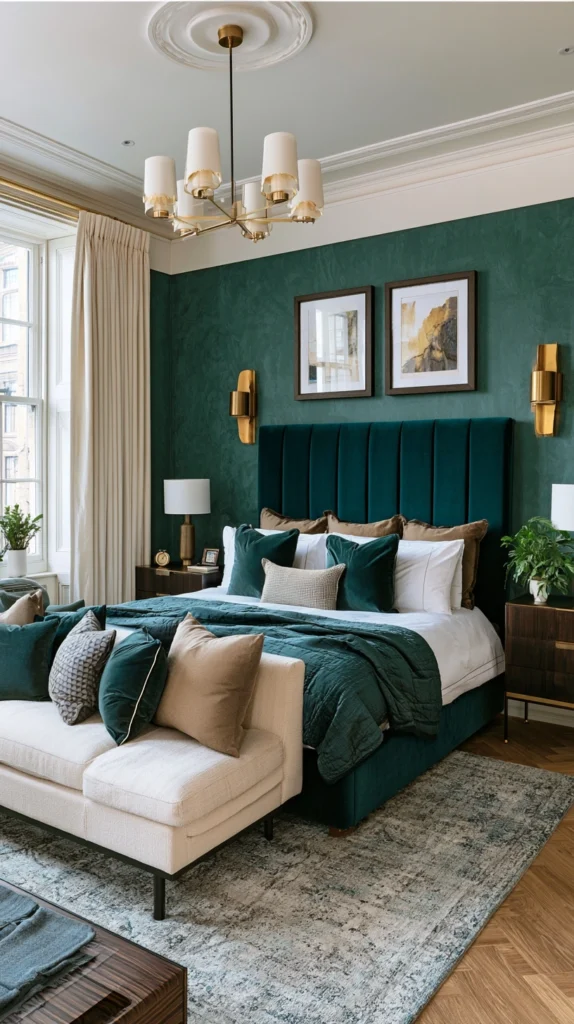
The Art Deco colour palette is not the neutral, restrained palette of subsequent mid-century modernism.
It is deep, rich, and unapologetically saturated. Emerald green. Sapphire blue. Deep burgundy. Warm ivory. The colours of gemstones and expensive textiles and the most desirable materials of the early twentieth century.
For the Neo Deco bedroom, a deep jewel-toned feature wall behind the headboard creates the colour statement that grounds the gold and the geometric elements of the room in a rich chromatic context.
Emerald green against gold is perhaps the most specifically Art Deco colour combination available. The deep green of malachite, of the Chrysler Building’s emerald lobby tiling, of the jewelled frames of Cartier pieces of the period. Against a gold metallic headboard and warm ivory bedding, emerald green creates a bedroom of concentrated, specific luxury.
Sapphire blue against gold is the cooler, more architectural alternative. Deeper and more mysterious than emerald. A blue that reads as almost midnight in low light and reveals its true depth in direct daylight.
Paint the feature wall in a deep matte finish. The matte absorbs light and makes the colour appear richer and more complex than the same colour in a satin or gloss finish.
3. Geometric Patterned Wallpaper in Black and Gold
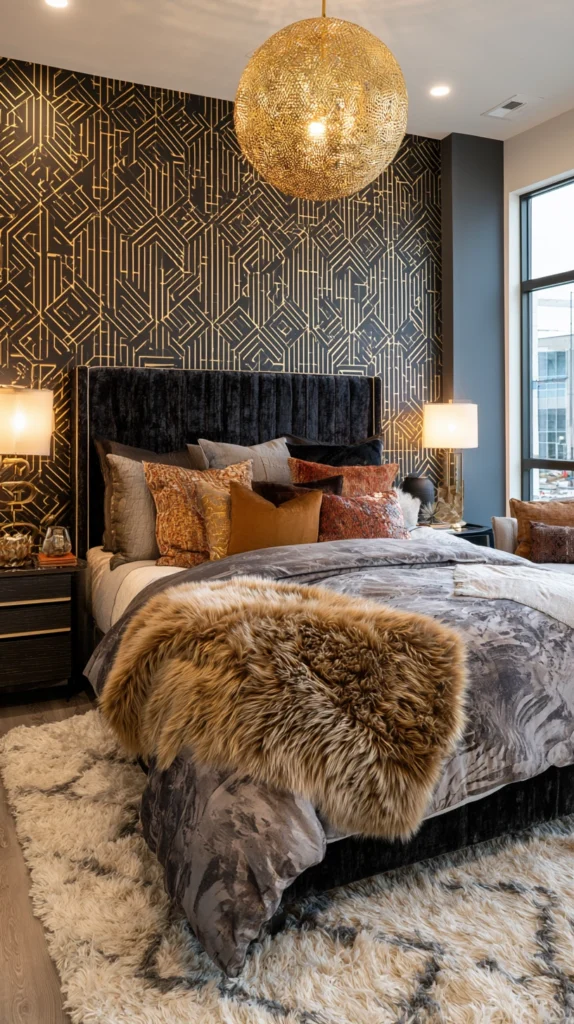
The geometric pattern is the Art Deco designer’s primary tool.
Chevrons. Stepped forms. Interlocking octagons. Sunburst fans. Repeating angular forms in which each element is precise, deliberate, and in perfect geometric relationship with its neighbours. This pattern vocabulary is the visual language of the machine age filtered through the decorative ambition of the period.
A geometric wallpaper in black and gold on the feature wall, or as a border at ceiling height above a deep painted wall, creates the Art Deco pattern reference most directly. The contrast between the black and the gold, the maximum possible tonal contrast within the warm metallic palette, creates a pattern of extraordinary graphic precision.
The scale of the geometric repeat should be appropriate to the wall’s dimensions. A large-scale geometric pattern on a small wall dominates completely. A small-scale allover geometric on a large wall creates texture rather than drama. The pattern scale should allow two to three complete repeats across the full wall width for the pattern’s logic to be readable at room scale.
Wallpaper with a metallic element, where the gold of the pattern is a genuine metallic finish rather than a flat gold print, creates the shimmer quality that the Art Deco period’s love of metallic surfaces requires.
4. Velvet Upholstery in Deep Jewel Tones
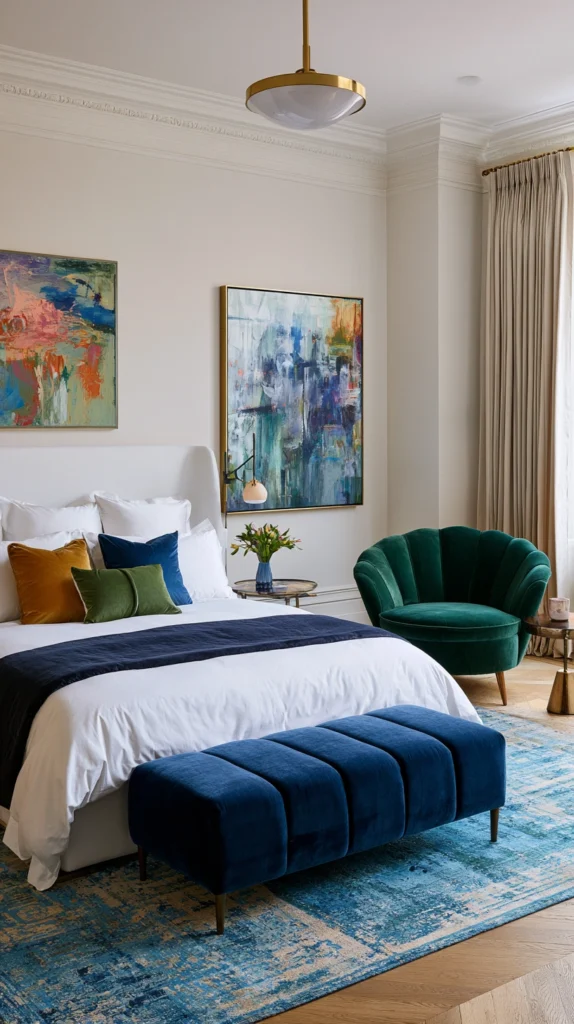
Velvet is the material most associated with Art Deco bedroom luxury.
The period’s interiors used velvet on upholstered headboards, on bed frames, on occasional chairs, on chaise longues, on window treatments. The pile of velvet, its deep absorption of light, its dramatic colour saturation, and its specific sensory quality, all embodied the period’s luxury aesthetic.
An upholstered bench at the foot of the bed in deep sapphire velvet. A curved occasional chair in emerald velvet in the corner. A headboard upholstered in a warm burgundy velvet with geometric button detail in gold. These velvet pieces carry the period’s material vocabulary into the contemporary room without any period pretension.
The button detail on upholstery is specifically Art Deco. Diamond tufting, where buttons are placed in a geometric diamond grid across the upholstered surface, creates a pattern that echoes the period’s love of geometric precision in every surface and every object.
5. Gold and Black Bedside Lamps With Geometric Shades
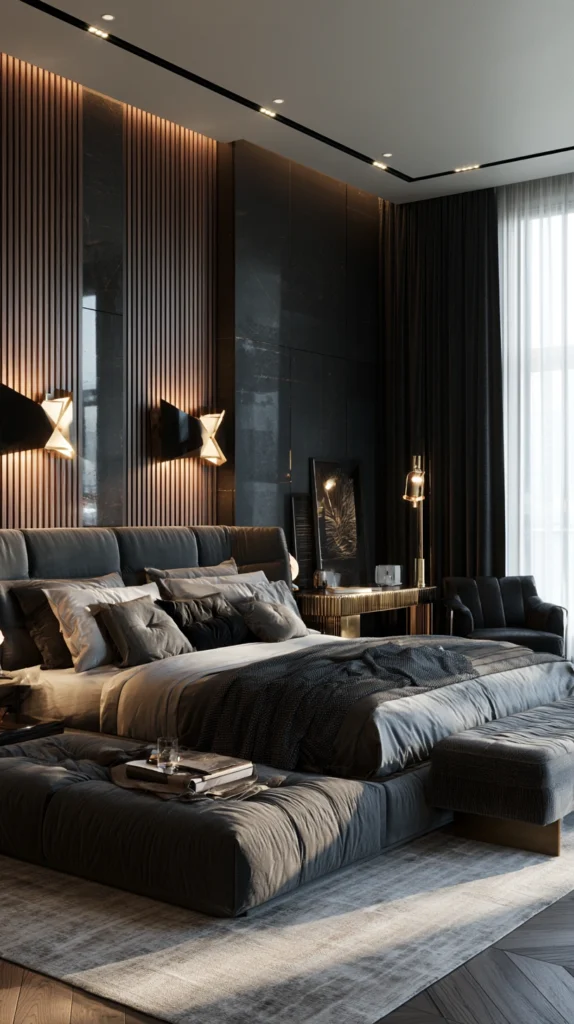
The lamp in an Art Deco bedroom is not simply a light source.
It is a sculptural object that creates specific patterns of shadow as much as it creates light.
The geometric shade of an Art Deco lamp, in metal panels with precise angles or in a faceted glass form, casts shadows that extend the room’s geometric vocabulary onto the surrounding walls and ceiling. The lamp switched off is an interesting object. The lamp switched on activates the room.
Gold-toned bases in stepped or geometric forms. Shades in black metal with cut-out geometric patterns. Or shades in frosted glass with geometric bands. Or shades in amber or topaz glass that cast warm coloured light.
A matching pair of bedside lamps, symmetrically placed on either side of the bed on bedside tables of identical height and proportion, creates the formal symmetry that Art Deco bedroom arrangements traditionally used. The symmetry is not rigid. It is considered.
The light from Art Deco-referenced lamps should be warm. At a 2700K colour temperature the gold of the lamp bases and the warmth of the coloured glass shades are amplified rather than flattened by the light source within them.
6. A Black Lacquered Bedside Table or Dresser
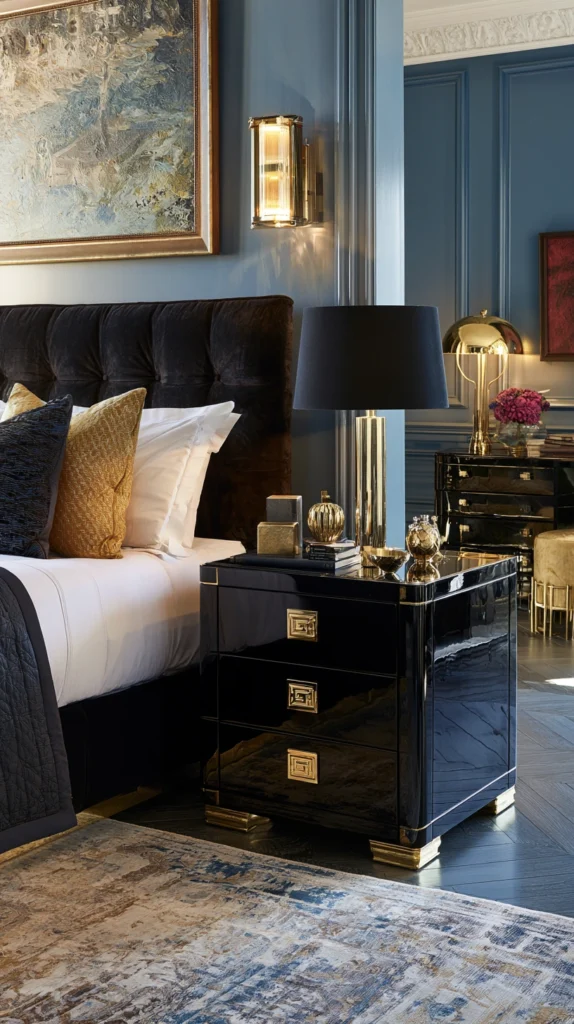
Lacquerwork, the tradition of high-gloss layered paint finish in deep black or rich red, is one of the Art Deco period’s most characteristic material choices.
Black lacquered furniture, with its extremely high gloss surface that reflects the room’s warm lighting back across its face, creates the specific quality of Art Deco luxury in furniture form. A black lacquered bedside table beside a gold headboard beside a deep emerald wall is a composition of extraordinary richness.
The lacquer surface should be genuinely high gloss. The Art Deco period’s association with lacquer was not the half-gloss of contemporary furniture coatings. It was the deep, mirror-like finish of genuine lacquer that required multiple applications and polishing to achieve. A lacquered piece of furniture in this tradition looks like liquid black glass. It reflects the room in its surface.
Gold hardware on a black lacquered piece is the most Art Deco detail available. A drawer with a gold-tone bar handle. A black chest of drawers with gold lion’s paw feet. The contrast of black and gold at the furniture scale echoes the same contrast in the wallpaper and the bedside lamp and the headboard above.
7. A Chaise Longue for Genuine Period Reference
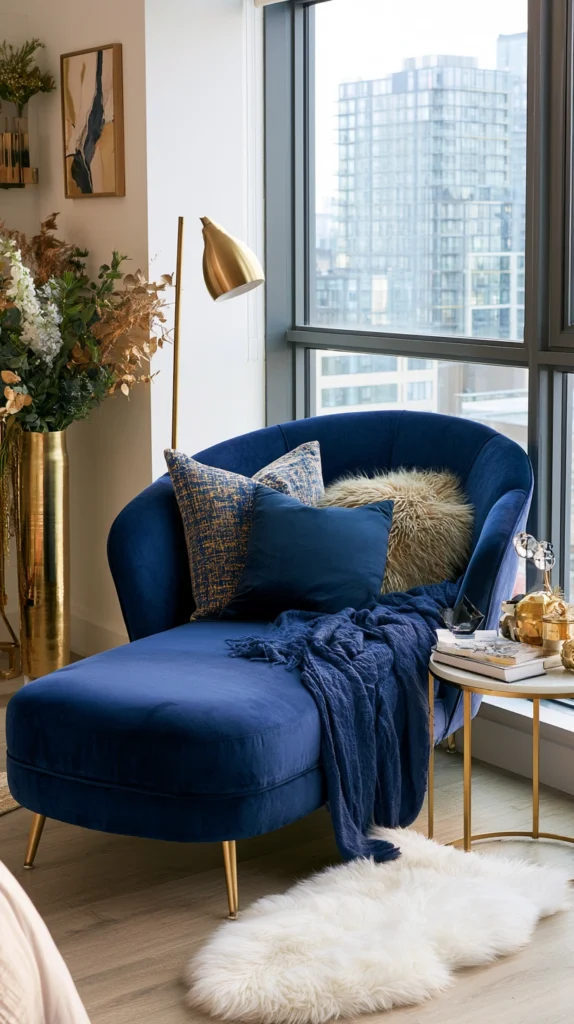
The chaise longue is the furniture piece most specifically associated with the Art Deco bedroom’s leisure aesthetic.
Not as a decorative object placed in the corner for occasional use. As a genuine resting piece that is used for reading, for reclining, for the specifically Art Deco activity of being elegantly horizontal in a beautiful room.
A chaise in a curved form, upholstered in velvet or a high-sheen fabric in one of the room’s jewel tones, with gold-toned turned legs, creates the Art Deco reference most completely. The curve of the chaise longue is an Art Deco signature, the softening of the period’s geometric angularity into a sensuous form that was as comfortable as it was beautiful.
Position the chaise where it has a view of the room’s most beautiful elements. Beside the window that admits the best morning light. Facing the headboard. At an angle that provides the room’s best diagonal view. The person lying on the chaise should feel that they are in the room’s best position.
8. A Geometric Floor Rug in Black, Gold, and Ivory
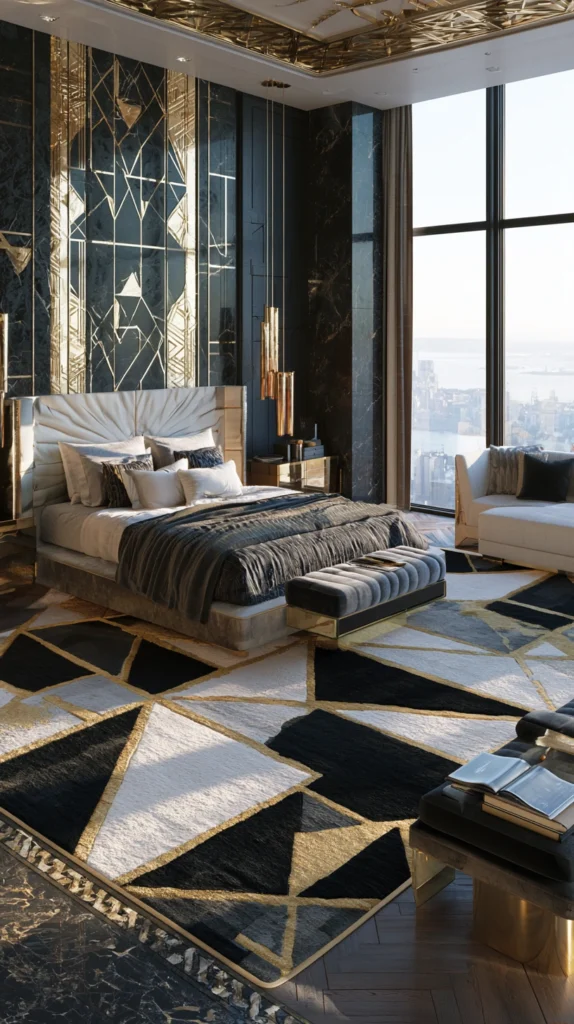
The rug in the Neo Deco bedroom anchors the room’s geometric vocabulary at floor level.
A geometric pattern in the Art Deco tradition, bold angular forms in black and gold on an ivory ground, creates the floor surface that completes the room’s geometric composition. The rug pattern echoes the wallpaper border, the lamp shade cut-out, the headboard’s fan form. The geometric language recurs across every surface and scale.
The rug should be large enough to extend under the bed and beyond the bed’s perimeter on all accessible sides. A rug that only partially occupies the floor beside the bed looks incomplete. The Art Deco rug is generous, like every Art Deco element.
The border of the rug, in a complementary geometric pattern or in a simple strong border that frames the central field, creates the defined edge that the Art Deco period’s love of contained, framed compositions requires.
9. Art Deco Wall Sconces for Symmetrical Uplighting
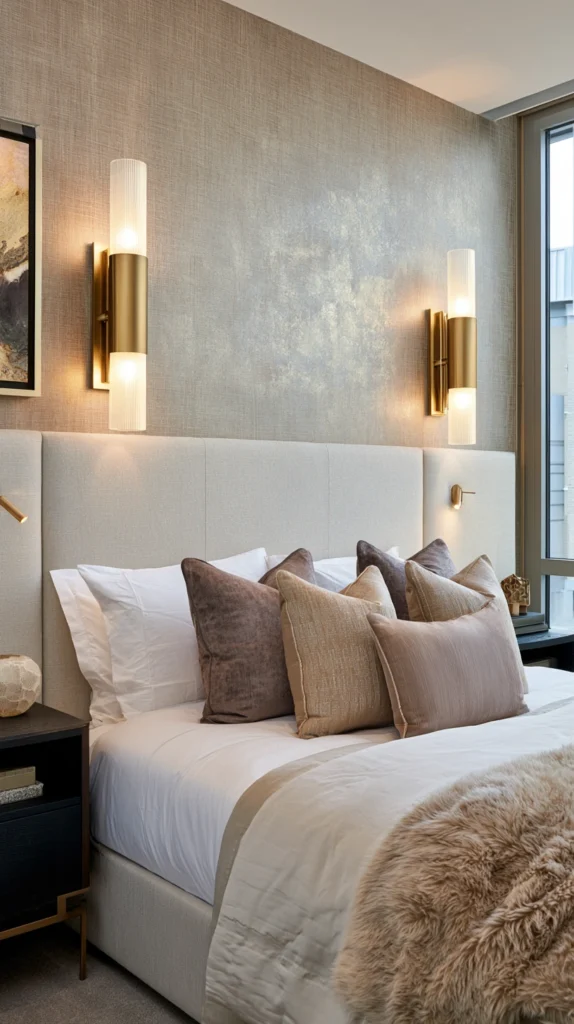
The wall sconce is the lighting solution that is specifically architectural in a way that the pendant and the table lamp are not.
Fixed to the wall as part of the room’s permanent architecture, a pair of Art Deco sconces on either side of the headboard or at the bedroom’s main wall create symmetrical uplighting that defines the room’s primary focal points with warm directed light.
Art Deco sconces in frosted glass with gold metallic frames. Torchère sconces that direct light upward in a dramatic upward fan. Angular wall-mounted fittings in polished or satin brass with geometric glass diffusers.
The symmetry of the pair is essential. Art Deco architectural lighting was almost always deployed in symmetrical pairs or groups. The single sconce on a wall looks incomplete within this aesthetic. The pair creates the formal balance that the period’s compositions required.
10. A Mirrored Dressing Table With Geometric Frame Detail
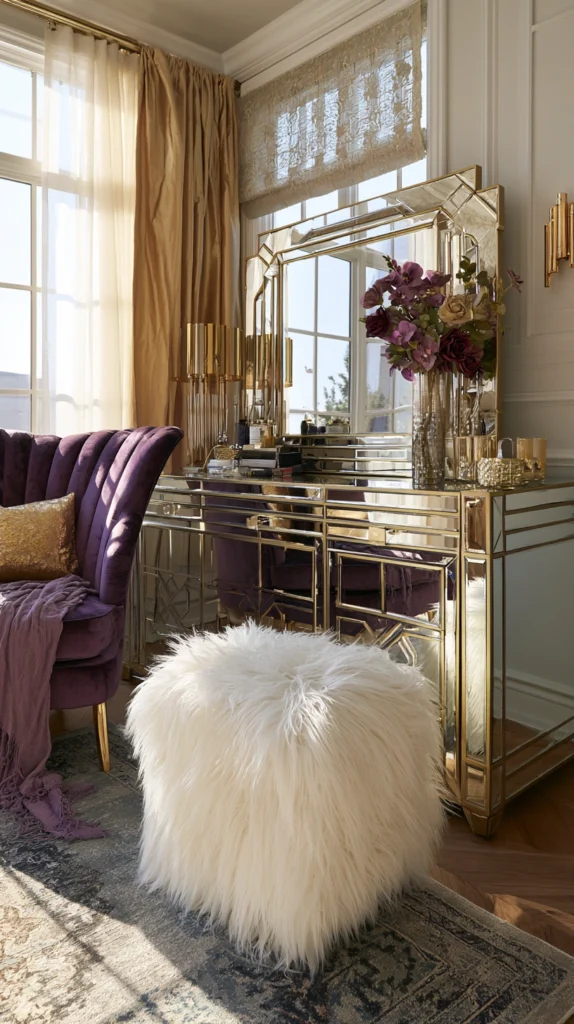
The dressing table is the Art Deco bedroom’s most functional luxury object.
The full-height mirror framed in geometric detail. The tiered drawers on either side with gold-tone hardware. The leather-topped surface where the objects of morning and evening ritual are arranged with intention. The stool in a complementary fabric, pulled precisely to the correct height for sitting with the mirror at exactly the right angle.
In the Neo Deco bedroom the dressing table is present not because morning routines require it necessarily but because the dressing table as a furniture form is among the most beautiful available in the Art Deco vocabulary. The mirror and frame. The symmetrical drawers. The specific ritual of sitting before a mirror in a beautiful room.
A mirrored dressing table reflects the room’s gold headboard and the deep jewel tone of the walls and multiplies the room’s warmth and richness in a way that a solid piece of furniture cannot.
11. Terrazzo or Geometric Floor Tiles at the Bedroom Threshold
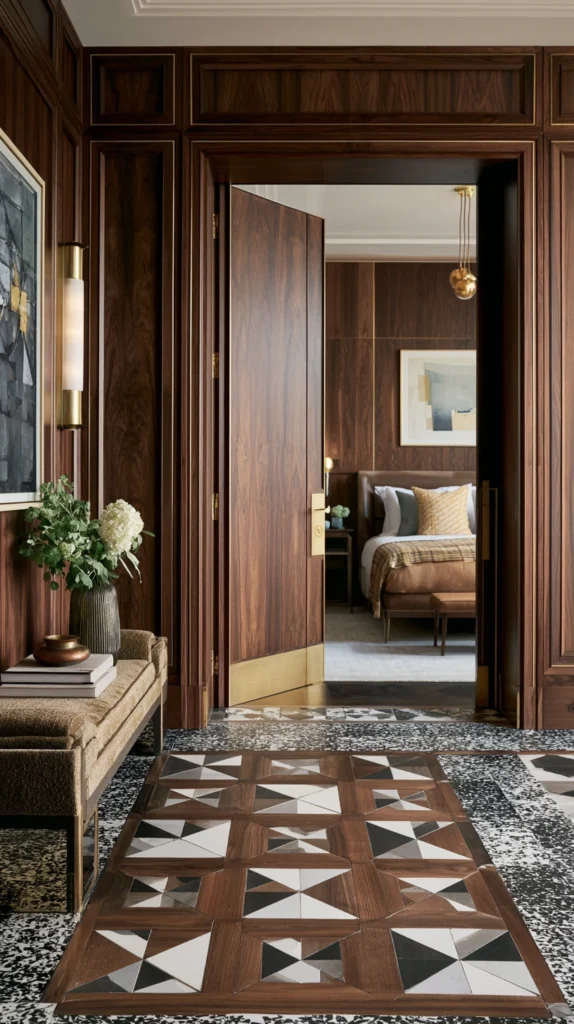
The transition from hallway or landing to bedroom in the Neo Deco room is marked by a material change at the floor level.
Terrazzo tiles in a geometric pattern, or encaustic cement tiles in an Art Deco geometric design, at the bedroom’s entrance threshold create a defined boundary between the spaces and introduce the period’s pattern vocabulary at the room’s entry point.
The tiles do not need to extend across the full bedroom floor. A band of two to three tiles at the doorway, transitioning to the main bedroom floor material, is enough to mark the transition and to introduce the geometric reference at the room’s beginning.
Art Deco geometric tile patterns in black and white, or in the warm palette of terracotta and cream and black that was common in the period’s floor tile work, suit the Neo Deco bedroom as an entry accent more precisely than as a full-room floor treatment.
12. A Black and Gold Colour Palette Throughout
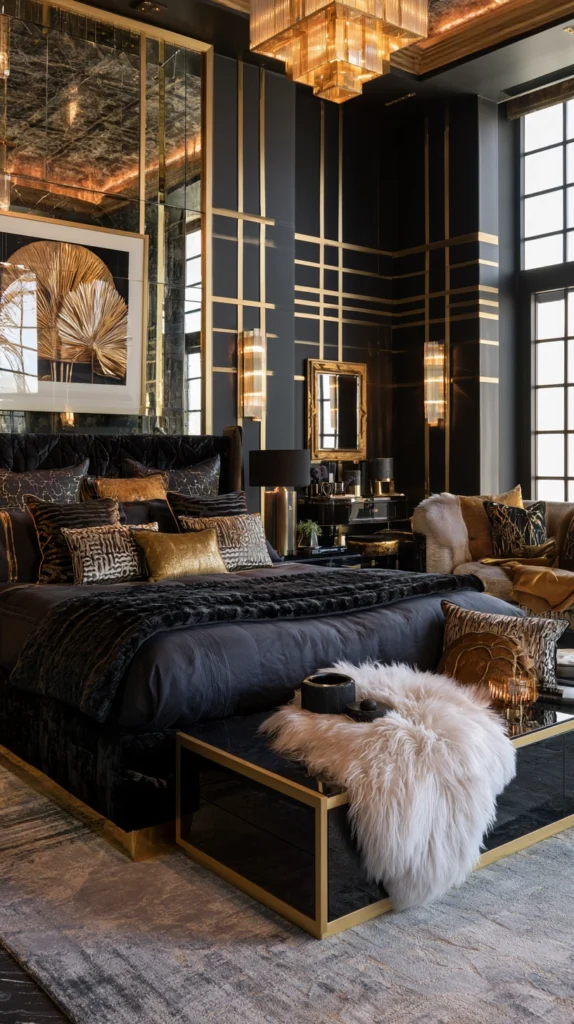
The Neo Deco bedroom reaches its most concentrated and most dramatic expression when the black and gold palette is taken throughout the room rather than used only in accent elements.
Deep black walls. Gold headboard. Black lacquered furniture with gold hardware. Gold lamp bases. Black geometric wallpaper border. Ivory and gold bedding. The room of black and gold is the Art Deco bedroom in its most committed form.
This is a significant design commitment and it is specifically for the person who wants the bedroom to feel genuinely extraordinary rather than merely stylish. The room of black and gold is not for everyone. It requires a specific confidence and a specific relationship with darkness and drama that not every person has in the space where they sleep.
But for the person whose sensibility is drawn to this aesthetic, the black and gold Neo Deco bedroom is genuinely transformative. It looks like no other bedroom. It produces a genuinely specific experience of sleeping and waking. And it is the most complete and most committed expression of the Neo Deco aesthetic available.
13. Period-Referenced Art Prints in Geometric Frames
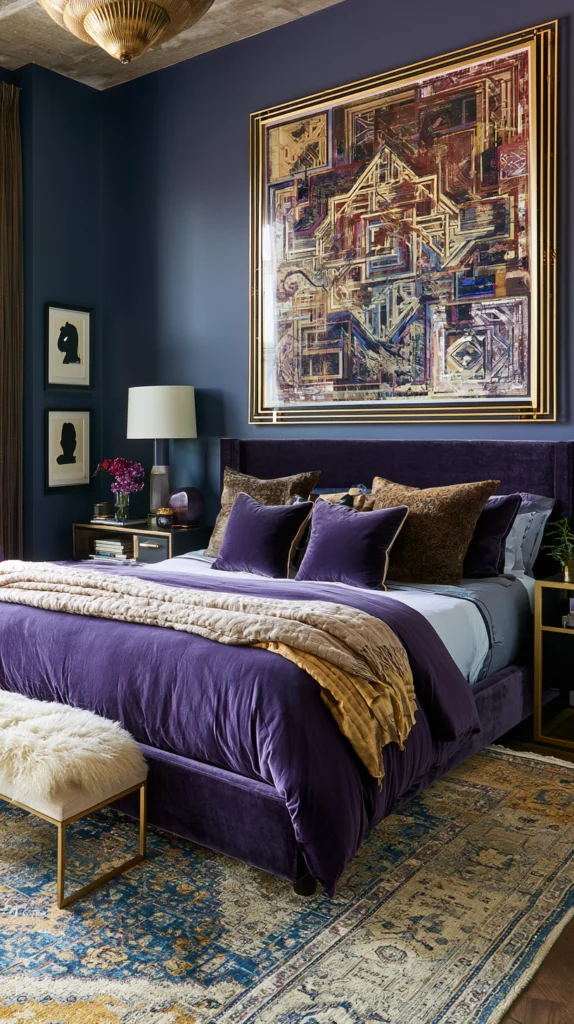
The art that hangs in the Neo Deco bedroom should reference the period’s aesthetic sensibility without being pastiche.
Original or high-quality reproduction prints from Art Deco graphic artists. Tamara de Lempicka’s portrait work. Erté’s fashion illustrations. The poster art of the Paris Metro. The travel poster art of the ocean liner companies. These images have a specific visual authority that generic Art Deco-style reproductions lack.
Frame them in geometric frames. Gold metallic with simple geometric moulding. Black lacquered frames with gold inner borders. The frames echo the room’s other geometric elements and place the art within the room’s visual vocabulary rather than treating it as isolated decoration.
A single large print of significant quality as the room’s primary wall artwork, rather than a gallery of smaller pieces, suits the Neo Deco aesthetic’s preference for bold, controlled compositions over eclectic accumulation.
14. A Sunburst Mirror as a Room-Defining Object
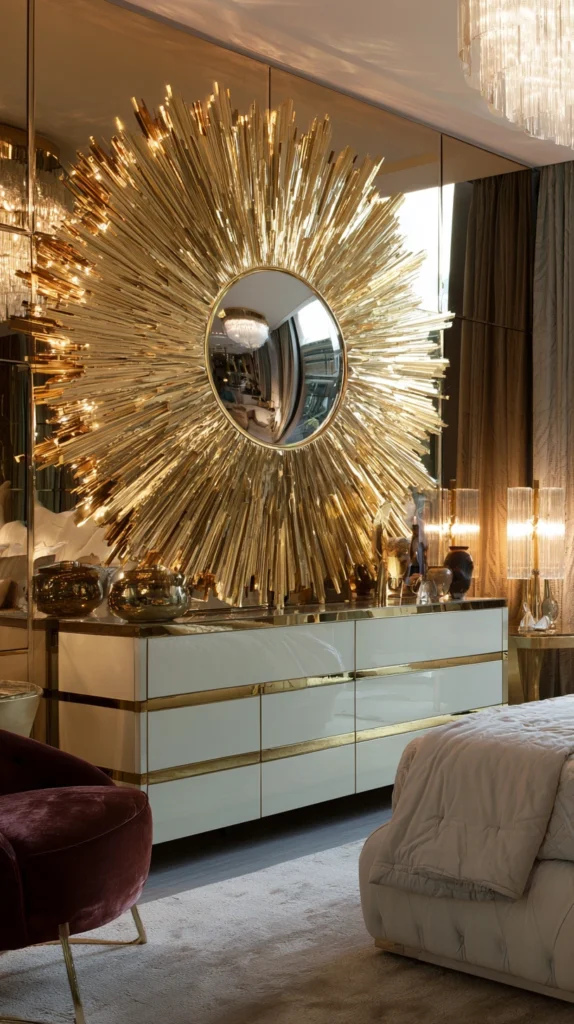
The sunburst mirror is the Art Deco decorative object with the most specific and most recognisable period identity.
Rays of mirror glass or polished metal radiating from a central circular mirror, creating the sunburst form that is one of the period’s most persistent visual signatures. As a wall object on the bedroom’s primary wall or above the dresser, the sunburst mirror creates a room-defining element that is simultaneously artwork and functional mirror.
The size should be confident. A sunburst mirror of seventy to ninety centimetres in diameter or larger creates the visual presence that the form requires. A small sunburst mirror in a large room looks decorative rather than architectural. The larger size makes it a room statement.
Gold-toned metal rays in polished or antique brass. Rays in mirrored glass that create a full-mirror object. Or a combination where some rays are mirror and others are solid metal.
Above the dresser the sunburst mirror reflects the room’s warm light and gold elements back across the room’s full depth. On a feature wall it creates a sculptural element of genuine quality that reads as strongly as any piece of artwork.
15. The Restraint That Makes Neo Deco Rather Than Retro
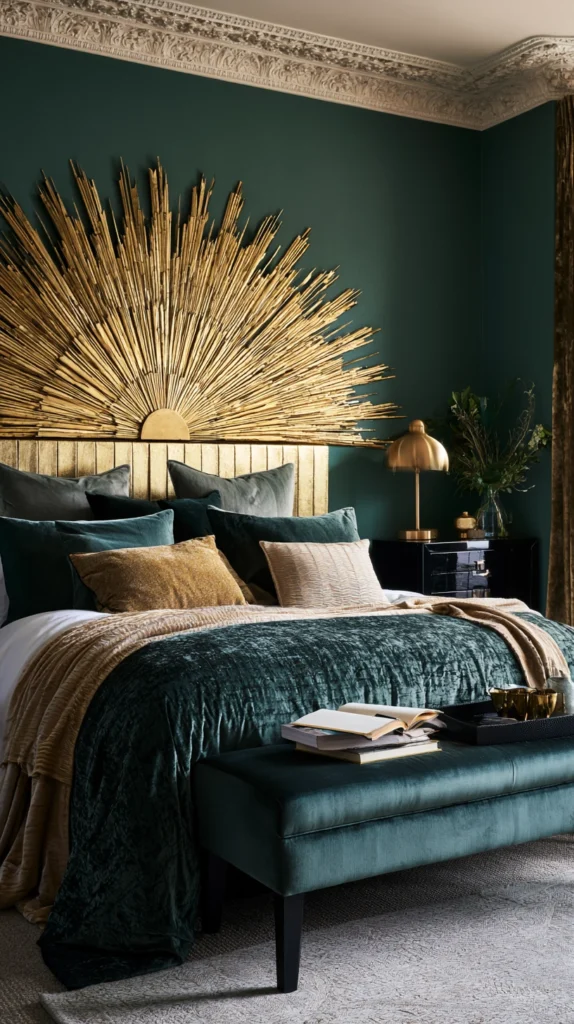
The distinction between Neo Deco and Art Deco revival is the editorial restraint applied in the selection of elements.
The full period revival bedroom would include every Art Deco reference simultaneously. Every available piece in the period’s vocabulary. The result is a room that is a museum reconstruction rather than a bedroom. Atmospheric in the way that a museum reconstruction is atmospheric. Not a place that genuinely belongs to someone living in the present.
Neo Deco selects from the vocabulary. It takes the headboard form. The colour palette. Two or three specific pattern elements. The quality of the materials. And it leaves behind the period specificity that would make the room a reconstruction.
The difference is between a room that says “I am in the style of the Art Deco period” and a room that says “I was designed by a person who finds the Art Deco period a rich reference point for thinking about luxury, geometry, and warmth.”
The first room is nostalgic. The second is designed.
Choose three or four strong Neo Deco elements and implement them with full commitment. Resist the impulse to add every available period reference. The room that has the gold sunburst headboard, the deep emerald wall, the velvet chaise, and the black lacquered dresser is more powerfully Neo Deco than the room that has all fifteen elements on this list competing for attention.
The editorial is the design.
How to Approach a Neo Deco Bedroom From Scratch
Begin with the palette.
Deep jewel tone for the walls, emerald, sapphire, or the most dramatic of all options, deep black. Warm gold as the primary metallic accent. Ivory or warm cream as the neutral that allows the room to breathe between its stronger elements.
Establish this palette with the paint before any furniture or textile purchase. The room in its palette, with no furniture except the existing bed, will immediately reveal whether the colour relationship is right.
Then the headboard. The sculptural gold metallic headboard is the investment that defines the Neo Deco bedroom most completely. It is worth spending on quality here because the headboard is the room’s primary feature.
Then the textiles. Velvet in one or two pieces. The rug in a geometric pattern. The bedding in the warm neutral that allows the wall and the headboard to be the room’s primary colour statements.
Everything else is detail and refinement that arrives over time.
Common Mistakes in Neo Deco Bedroom Design
Using too many period-specific elements simultaneously. Neo Deco is editing the Art Deco vocabulary for contemporary use. Too many elements at once produces the museum reconstruction quality rather than the genuinely designed bedroom quality.
Choosing the wrong scale for geometric elements. Art Deco geometry at the wrong scale, too large for the room or too small, reads as generic rather than period-specific. Scale geometric patterns to the room’s dimensions.
Using cold white or cool-toned lighting. The Art Deco bedroom lived in warm amber light. Cool white light makes every gold surface look brass and every jewel tone look garish. Warm lighting at 2700K is non-negotiable.
Neglecting the quality of materials. The Art Deco aesthetic is specifically about the quality and luxury of materials. Cheap velvet, thin metallic foil, and thin lacquer all communicate the opposite of what the aesthetic requires. Invest in quality on the key pieces.
Over-symmetrising. Art Deco used symmetry deliberately but not rigidly. A bedroom where absolutely everything is in perfect symmetrical balance looks staged rather than lived-in. Allow some asymmetry in the smaller elements.
Quick Summary
- A gold sunburst or fan headboard in metal is the room’s founding sculptural element around which every other decision organises
- A deep emerald or sapphire feature wall behind the headboard creates the jewel-tone foundation the Art Deco palette requires
- Geometric black and gold wallpaper introduces the period’s pattern vocabulary in the most directly referenced form
- Deep jewel-toned velvet on upholstered pieces carries the material luxury of the Art Deco bedroom into contemporary form
- Gold-toned geometric bedside lamps create specific shadow patterns that extend the room’s geometry onto surrounding surfaces
- Black lacquered furniture with gold hardware creates the period’s most characteristic material contrast in functional furniture
- A velvet-upholstered chaise longue is the furniture piece most specifically associated with the Art Deco bedroom’s leisure aesthetic
- A geometric rug in black, gold, and ivory anchors the room’s geometric vocabulary at floor level with appropriate scale
- Symmetrically paired Art Deco wall sconces create architectural uplighting that defines the room’s focal points
- A mirrored dressing table with geometric frame detail reflects the room’s warmth and richness while fulfilling a functional role
- Geometric threshold tiles at the bedroom entrance mark the room’s boundary with period pattern vocabulary
- An all-black and gold palette throughout the room creates the most concentrated and most dramatic Neo Deco expression
- Art Deco period-referenced prints in geometric frames place historically specific artistic references within the room’s vocabulary
- A large sunburst mirror in gold metal above the dresser or on the feature wall creates the period’s most recognisable decorative form
- Editorial restraint, selecting three to four strong elements rather than all available ones, is the distinction between Neo Deco and period revival
- Begin with the palette, then the headboard, then textiles, and let the details arrive over time
The Neo Deco bedroom is not an exercise in historical accuracy.
It is the application of a specific historical aesthetic intelligence to the present.
The intelligence that understood warmth and geometry to be not contradictory but complementary. That saw gold not as excessive but as the correct material expression of a room’s ambitions. That knew a bedroom should feel genuinely luxurious rather than merely comfortable.
These are not period-specific insights. They are permanent ones.
The Neo Deco bedroom that honours them honestly is a bedroom of genuine, enduring quality.
Not a recreation. A continuation.