
15 Attic Bedroom Ideas to Make the Most of Sloped Ceilings
The attic bedroom starts with a disadvantage that becomes an advantage the moment you stop treating it as a problem.
The sloped ceiling is not a design challenge. It is the room’s defining architectural feature. It is what makes an attic bedroom feel like nowhere else in the house. The low edge where the ceiling meets the wall at an angle. The specific quality of the light that comes from dormer windows rather than from wall windows. The sense of being under the roof, close to the sky, in a room that the rest of the house does not replicate.

Every standard bedroom design principle breaks in an attic room. The rule about hanging art at eye level fails where the ceiling slopes down to where the wall begins. The rule about a headboard against the tallest wall works differently when the tallest wall is the only tall one. The rule about having adequate clearance around the furniture requires rethinking when one side of every piece of furniture is potentially too close to the slope.
The attic bedroom designed for its actual architecture rather than against it is one of the most characterful and most beautiful rooms a house can contain. It has the specific quality of a room that knows exactly what it is.
Here are 15 ideas that build that room.
Why the Sloped Ceiling Attic Bedroom Has Qualities No Other Room Can Match
The attic bedroom’s sloped ceiling creates three specific spatial qualities that standard rectangular rooms cannot produce.
The first is enclosure. A bedroom where the ceiling comes down close to the floor on one or both sides feels more enclosed and more sheltered than a room with uniform ceiling height. This enclosure creates a specific quality of coziness and privacy that is instinctively appealing in a sleeping space. We are evolutionarily calibrated to seek enclosed, sheltered spaces for rest.
The second is drama. A room with a peaked ceiling at its centre reaches a height that a standard room cannot achieve on a typical floor. This peak, against which the sloped sides read as lower, creates a dramatic spatial experience that makes the room feel larger than its footprint suggests.
The third is specificity. The attic bedroom is unmistakably the room it is. Every decision about it is made in response to its specific conditions. The result is a room that looks and feels like no other room in the house and that carries the specific character of having been designed for its own unique architecture.
1. The Bed Under the Peak
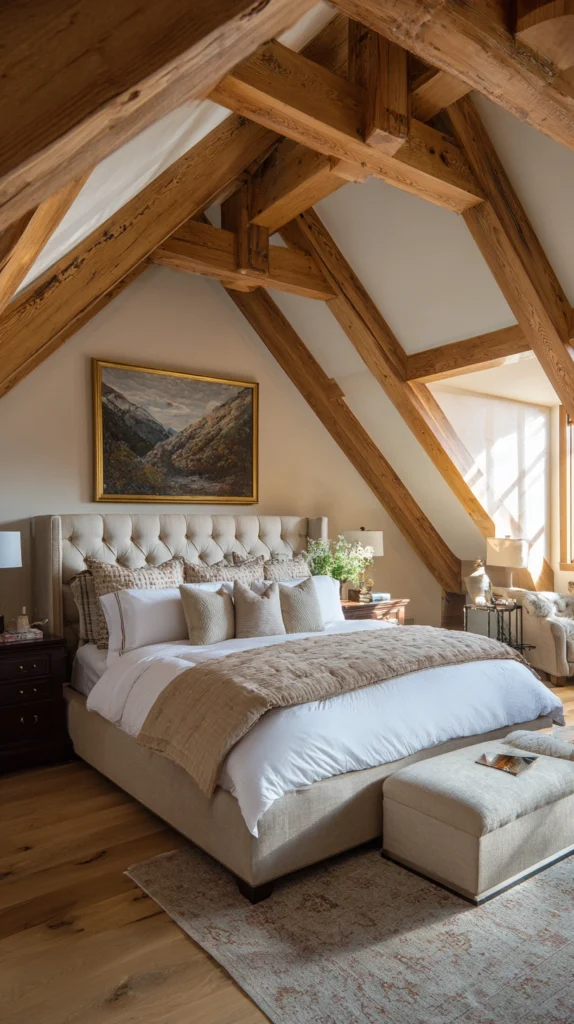
The instinct in most attic bedroom installations is to place the bed against the full-height wall, as far from the sloped ceiling as possible.
This instinct produces the worst use of the attic room’s specific spatial character.
The bed placed under the peak of the sloped ceiling, centred in the room’s highest point with the ceiling rising above it, creates the most specifically beautiful and most specifically attic use of the available space. The person lying in the bed looks up at the highest point of the sloped ceiling directly above them. The room’s drama, the height at the peak, is experienced from the sleeping position rather than from across the room.
The head of the bed can be against the wall at the peak, with the mattress extending into the room. Or the bed can be free-standing under the peak with the headboard not touching any wall.
The clearance above the mattress at the peak should be at least one and a half metres to allow comfortable sitting up in bed. Measure carefully before committing the bed to this position.
Why placing the bed under the ceiling’s peak is the best attic bedroom decision:
- The room’s most dramatic spatial quality is experienced from the sleeping position rather than from across the room
- The height at the peak provides comfortable clearance for the bed’s primary use
- The sloped ceiling on both sides from the peak creates the enveloping, sheltered quality that makes the attic bedroom specific
- The centred position under the peak is architecturally the most considered and most confident placement
- The view from the bed looking up at the peak is the room’s most specifically beautiful experience
- All furniture placement decisions for the rest of the room follow more naturally from the bed’s clear central position
2. Built-In Storage Under the Lowest Slopes
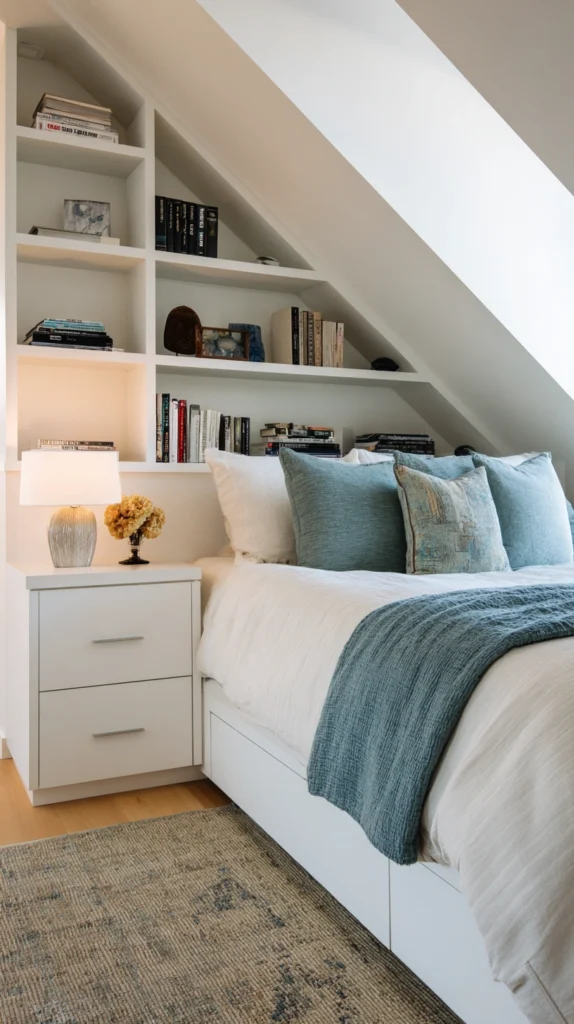
The lowest section of an attic room, where the sloped ceiling meets the floor or the wall at its lowest point, is the space that cannot be used for standing and that standard furniture cannot occupy.
This is also the space most naturally suited to built-in storage.
A continuous run of built-in drawers, cabinets, and shelves along the lowest wall, with the cabinetry height matched precisely to the available clearance at each point, creates storage that uses every cubic centimetre of the unusable-for-standing space without wasting it.
The drawers directly under the slope where clearance is less than sixty centimetres. Cabinets with doors where clearance allows opening without difficulty. Shelves in open sections where the clearance is generous enough for items to be retrieved without difficulty.
The built-in storage under the slope reads as architectural rather than furniture. Because it fits the space precisely, filling exactly the available volume, it looks as if it was always there. The room appears to have more storage than a standard room not because there is more volume but because every usable volume has been captured.
The cabinetry should be painted the same colour as the sloped ceiling above it. This colour matching makes the storage recede into the architecture and creates a seamless transition between the slope and the storage beneath it.
3. Dormer Windows Dressed as Alcoves
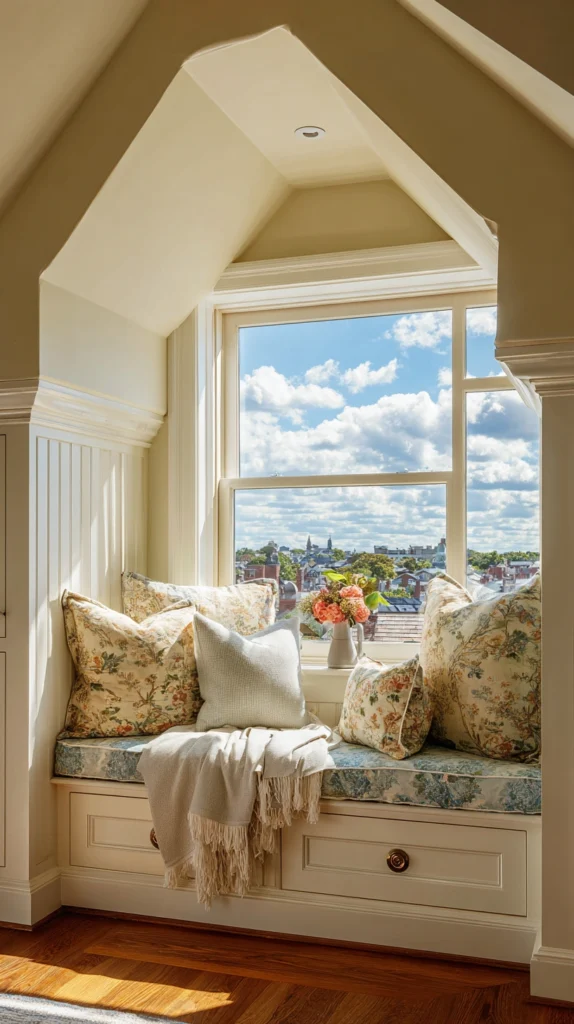
The dormer window in an attic bedroom is the room’s primary source of natural light and its specific connection to the outside world.
The space created within a dormer window, the three-sided recess that the dormer’s sides and back create, is a small room within the room. A space of specific character that is separated from the main bedroom by its enclosure while remaining connected to it.
A built-in window seat within the dormer alcove uses this space specifically. A padded cushion on the dormer floor level. Narrow shelving on the dormer’s side walls. The window in front with its view of the roof and the sky.
The dormer window seat is the room’s most specific and most coveted position. Close to the sky. In natural light. Slightly separated from the main sleeping area. It is the place for morning reading, for afternoon watching of the weather, for the specific pleasure of being very close to the outside world while remaining indoors and sheltered.
4. A Dark, Enveloping Colour on Walls and Ceiling Together
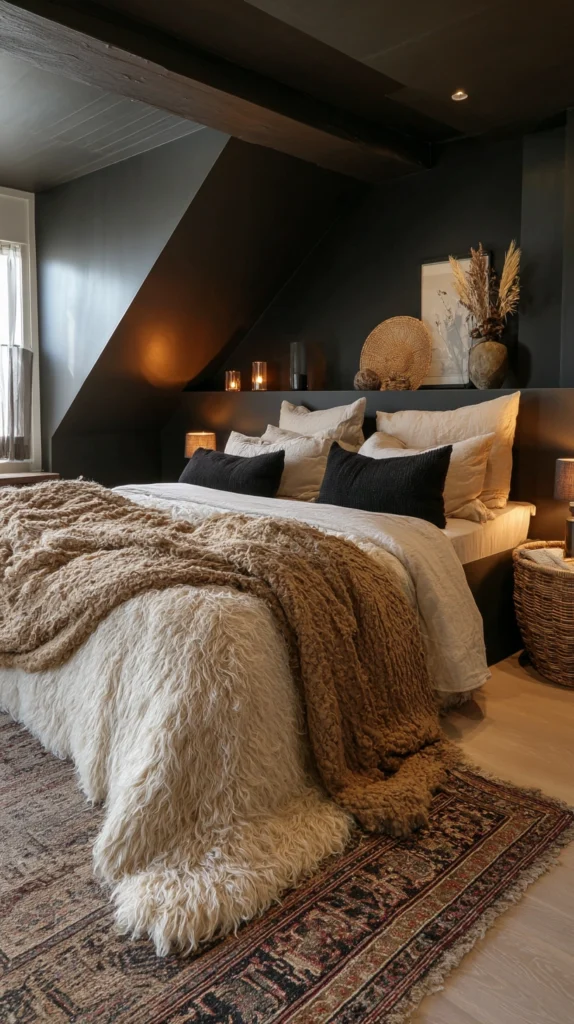
The attic bedroom is the room most naturally suited to the dark, enveloping colour treatment that makes a room feel like a sheltered space rather than an illuminated one.
Painting the walls and the sloped ceiling in the same deep tone, treating the entire room surface as a single continuous skin rather than separate planes, creates the most immersive and most specifically attic quality of any colour approach.
Deep forest green. Warm charcoal. Midnight navy. These colours on the walls and the sloped ceiling simultaneously create a room that feels like being inside the hill, inside the earth, inside the sky depending on the colour chosen.
The dark ceiling and dark walls do not make the room feel smaller in the way that design convention suggests. They make the room feel contained and sheltered in a way that pale walls cannot. The dark enveloping colour is the attic bedroom’s most appropriate response to the low, close quality of the sloped ceiling.
Pale floors and pale bedding within the dark envelope create the contrast that prevents the room from feeling oppressive. The dark room with the pale bed floating in it is one of the most beautiful bedroom compositions available.
5. Low-Profile Furniture Designed for the Slope
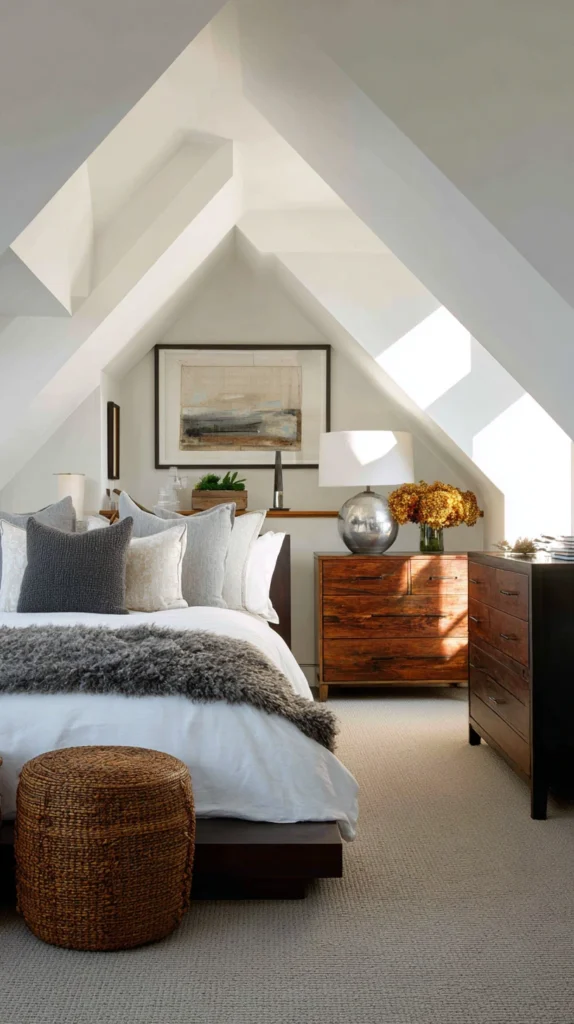
The furniture of an attic bedroom must respond to the slope.
Wardrobes of standard height cannot stand along a sloped wall. Bedside tables of standard height may work on one side of the bed but not the other if the slope is asymmetric. Standard lamps cannot stand in the low sections of the room.
This constraint is an opportunity for more considered furniture selection.
Low-profile beds, without tall headboards, sit comfortably under lower ceilings. Low dressers with multiple shallow drawers rather than tall wardrobes use the mid-height area of the room where the slope allows more clearance. Wall-mounted bedside shelves replace floor-standing bedside tables in sections where the slope prevents standard table height.
Japanese-influenced furniture, which tends toward lower profiles and floor-level aesthetics, suits attic bedrooms specifically. The futon-adjacent platform bed. The low credenza instead of the tall wardrobe. The floor cushion instead of the upright chair.
6. Exposed Roof Structure as Design Feature
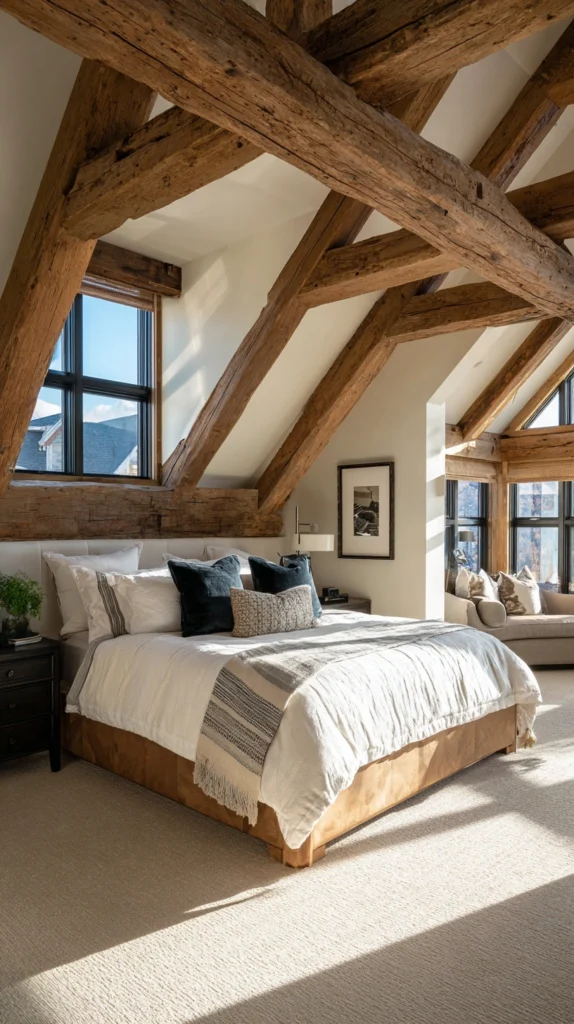
In some attic bedrooms the roof’s structural elements, the rafters, the purlins, the tie beams, are visible rather than covered by a plastered ceiling.
Treating these structural elements as design features rather than problems to disguise creates a room with the most specific and most honest expression of its architectural reality.
Dark-stained rafters against a pale plastered ceiling. Light oak beams against a dark painted background. The structural logic of the roof made visible and celebrated as the architectural event it is.
The exposed roof structure also adds the height of the rafter depth to the apparent ceiling height and creates a surface of genuine material interest against which smooth-finish furniture and bedding reads with specific beauty.
Where the roof structure is hidden behind plaster, the question of whether to expose it is a significant renovation decision. In homes where the attic bedroom is an existing conversion, the structure may already be exposed. In new conversion contexts, the decision to expose should be made in relation to the visual quality of the actual structure. Beautiful structural timber is worth exposing. Poor-quality timber with extensive repairs and metal connectors may not be.
7. Skylights for Natural Light and Sky Views
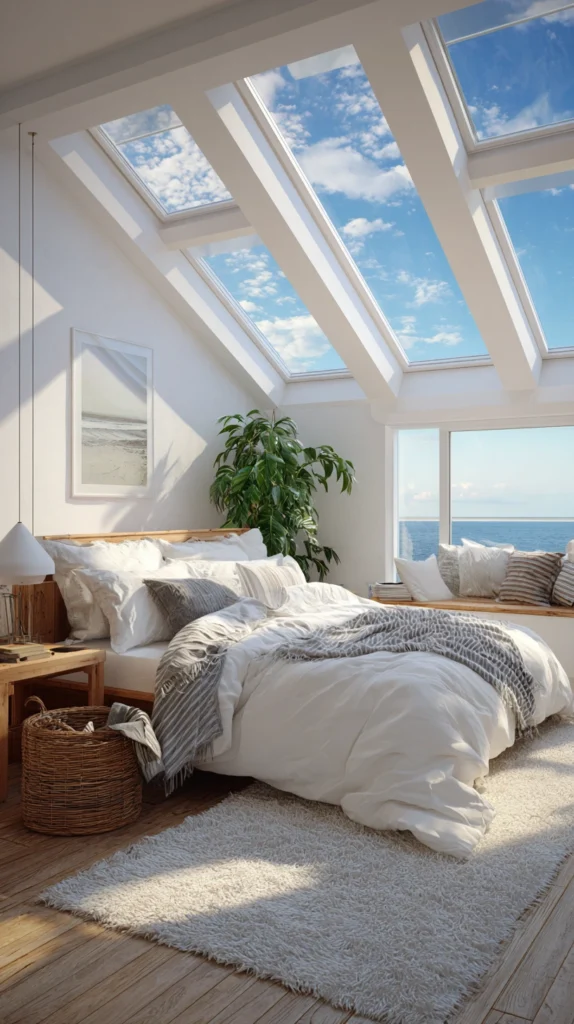
The skylight is the attic bedroom element that most dramatically transforms the room’s relationship to the outside world.
A skylight in the sloped ceiling, positioned to admit the maximum available natural light and to provide a direct view of the sky from the lying position in the bed, turns the room from an enclosed, top-floor space into a room with a window in its ceiling looking directly at the atmosphere above.
The view from a skylight in a bedroom depends on the room’s orientation and the season. A north-facing skylight provides consistent, cool, diffuse light throughout the day. A south-facing skylight provides bright, direct sunlight for much of the day that must be managed with a skylight blind for sleeping comfort. A west-facing skylight provides the dramatic quality of evening sun directly overhead.
The skylight that can be opened provides ventilation as well as light. Warm air rises and the open skylight allows the attic room’s accumulated warmth to escape through the ceiling in summer. This ventilation benefit is significant for attic bedrooms that can become uncomfortably warm on summer days.
8. Wall-Mounted Lighting That Responds to the Slope
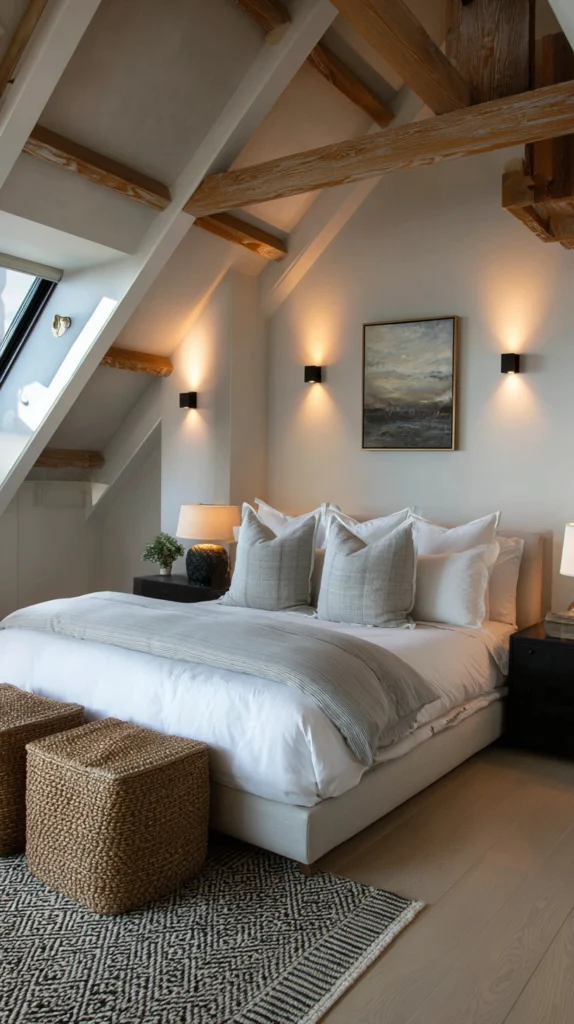
The sloped ceiling creates specific lighting challenges that standard overhead fittings cannot address.
A ceiling fixture mounted on the flat central section of a sloped ceiling illuminates the room’s peak while leaving the lower sections in shadow. A ceiling fixture mounted on the sloped section itself must be appropriate in design for the angled mounting and must provide light downward rather than horizontally.
Wall sconces at mid-height on the full-height walls provide lighting at a consistent height regardless of the sloped ceiling above. Positioned on either side of the bed they provide the reading light and ambient light that the bedroom requires without requiring the sloped ceiling to carry the light fittings.
LED strip lighting installed along the junctions between the sloped ceiling and the low knee walls creates indirect lighting that illuminates the space from its edges rather than from above. This indirect edge lighting reveals the architectural form of the room, the slope, the peak, the knee walls, through the quality of the light rather than from a central fitting.
9. A Reading Nook Under the Low Slope
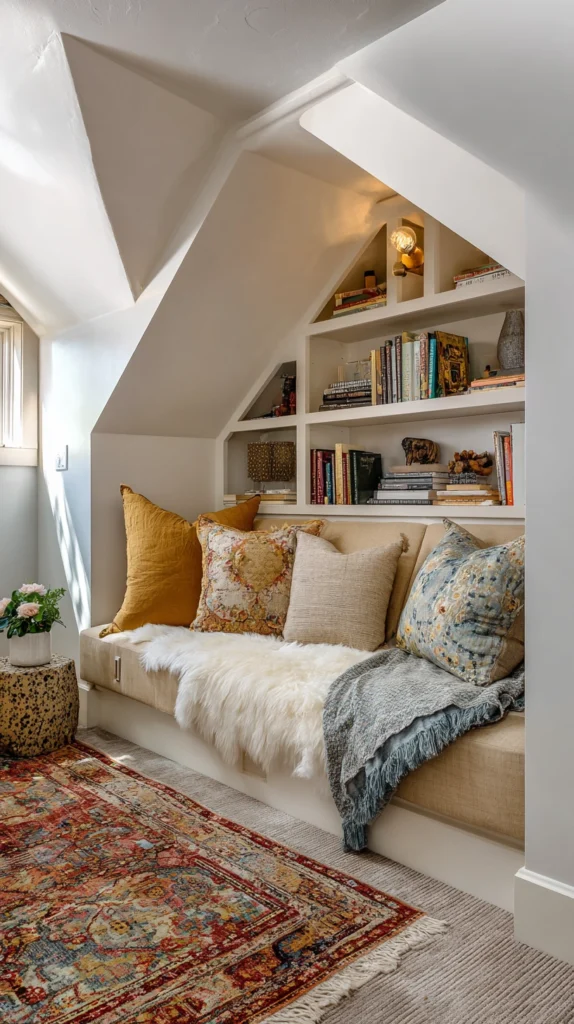
The low section of the attic room, where the sloped ceiling comes closest to the floor, is the section most natural for the creation of a reading nook.
A built-in bench seat along the low wall, with a cushion and back support, creates a reading position of specific cosiness where the ceiling is deliberately close and the enclosure is deliberately complete. The person reading in this nook is in the room’s most enclosed position. The sense of shelter and separation from the rest of the room while remaining within it is exactly what a reading nook at its best creates.
The low ceiling above the nook prevents standing in that position but reading, lying, and sitting comfortably are all achievable at the heights available in most attic low-slope sections.
Bookshelves built into the knee walls beside the nook create a library of reading material accessible from the sitting position. The nook becomes a complete retreat within the retreat.
10. Patterned Wallpaper on the Sloped Ceiling
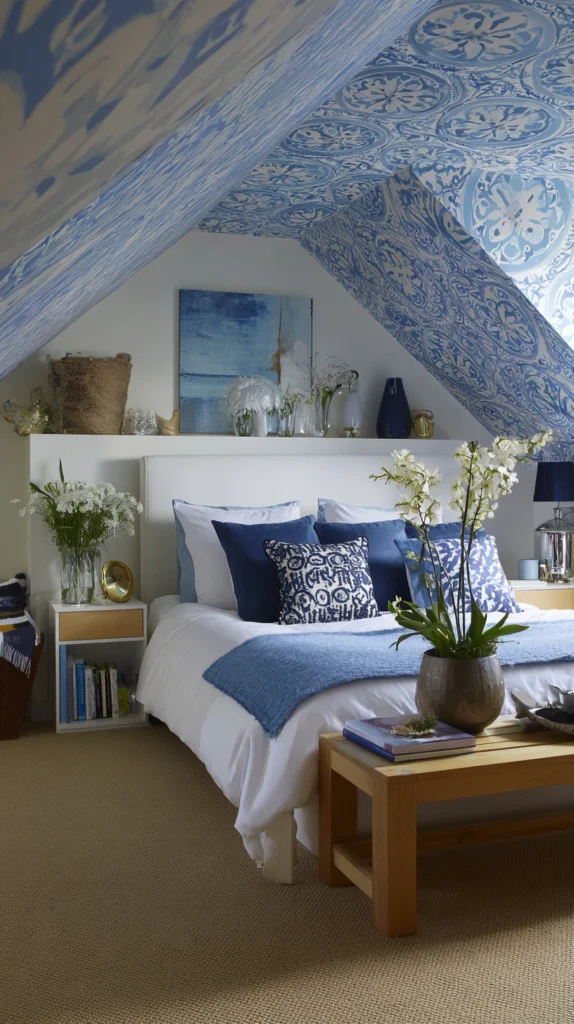
The sloped ceiling is a large, prominent surface that most attic bedrooms leave as a painted plane.
Treating the sloped ceiling with a patterned wallpaper, chosen for the surface’s specific visual prominence, creates an attic bedroom that is completely unlike any other.
A botanical print on the sloped ceiling above a simple, white-painted room creates the sensation of lying beneath a garden canopy. A celestial pattern on the ceiling of a darker room creates the sensation of being beneath the night sky. A geometric pattern on the ceiling of a room with clean, contemporary furniture creates the architectural drama of a patterned overhead surface.
The wallpaper application to a sloped ceiling is more technically demanding than wall wallpapering. The sloped surface is difficult to work on from a ladder. The length of each drop is variable as the slope rises or falls. Professional installation is strongly recommended.
11. Mirrors Positioned to Expand the Apparent Height
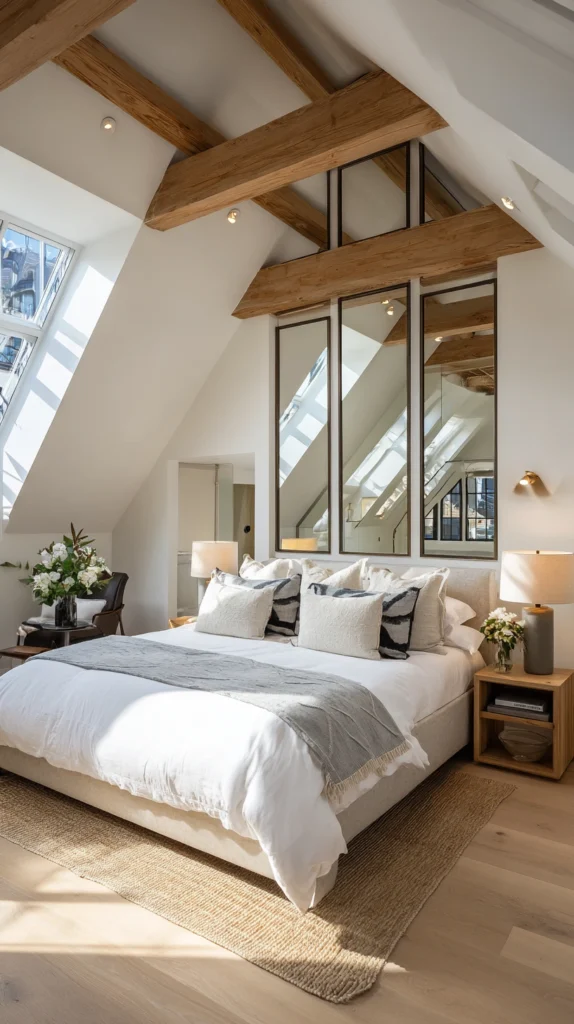
The mirror in an attic bedroom is placed with a specific purpose that differs from the standard bedroom mirror application.
Rather than a mirror that reflects the room horizontally, as a standard bedroom mirror positioned on a wall does, the attic bedroom benefits from mirrors positioned to reflect the vertical height of the room and to create the impression of the peak being higher and the slope being less steep than they actually are.
A tall, narrow mirror against the full-height wall reflects the room’s vertical dimension and appears to extend the height available. Positioned near the highest point the ceiling allows, the mirror multiplies the visual height of the room by reflection.
A mirror on the ceiling, in the peak section above the bed, is the most dramatic version of this application. Not for every person or every aesthetic but for the attic bedroom where the peak’s height is genuinely impressive and where doubling the impression of that height is the goal.
12. A Canopy That Works With Rather Than Against the Slope
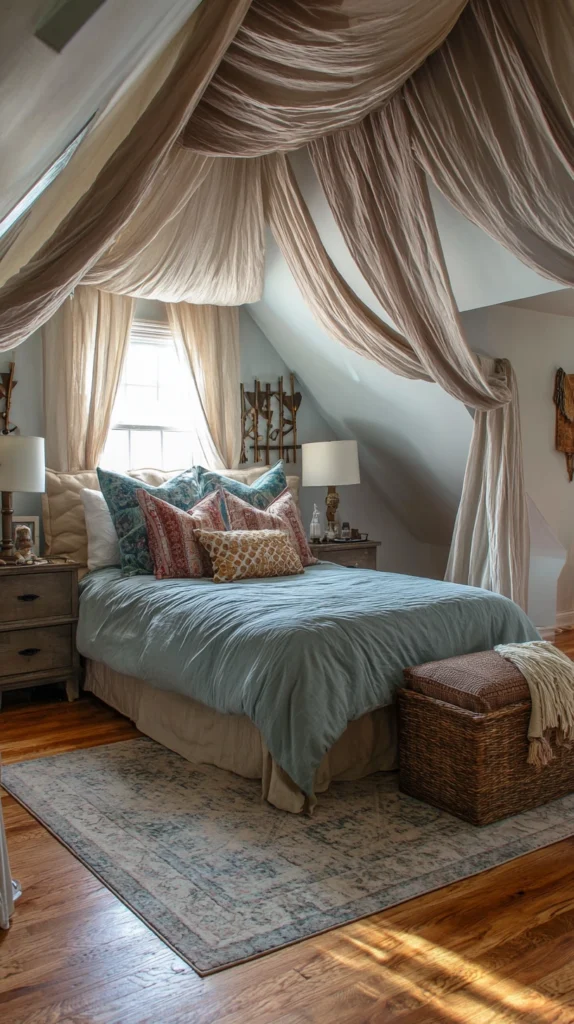
The traditional bed canopy, four-poster or ring canopy, assumes a flat ceiling of generous height.
The attic bedroom’s sloped ceiling requires a canopy reimagined for the specific conditions available.
A fabric drape fixed at the ceiling’s peak above the bed and allowed to fall on both sides creates a canopy that follows the slope rather than fighting it. The fabric falls from the peak along the slope’s angle and creates an enclosed, tent-like quality above the bed that references the tent or the teepee rather than the traditional four-poster.
This slope-following canopy in a lightweight fabric, natural linen, cotton gauze, or a sheer print, creates the enclosed quality of a canopy bed in the specific form that the attic room’s architecture permits.
13. A Window Seat in the Gable End
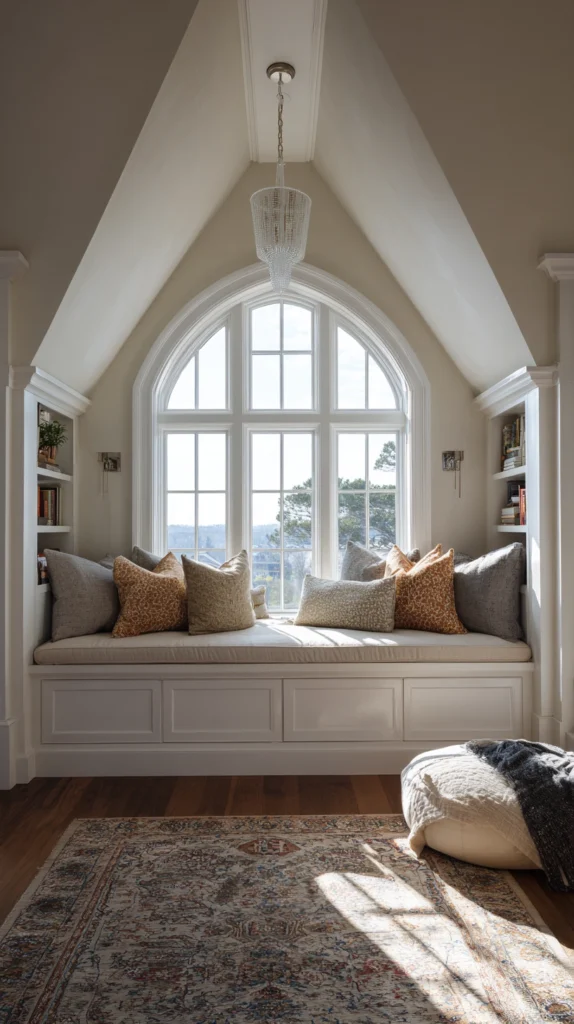
Where the attic bedroom has a gable end, the vertical wall at the room’s short end, a window in this gable creates a full-height window experience within an otherwise low-ceilinged space.
The gable end window is the attic bedroom’s full-height architectural feature and the position that allows a conventional window treatment rather than the dormer’s more complex options.
A built-in window seat below the gable window uses the gable end as a focal point of the room. The seat in the bay of the window. The window above it providing a view outward and natural light into the deepest part of the room.
The storage beneath the gable window seat, in drawers that run the full width of the seat, captures the gable end’s floor area for function rather than leaving it as empty passage.
14. Pendant Lights Hung at Different Heights for Visual Interest
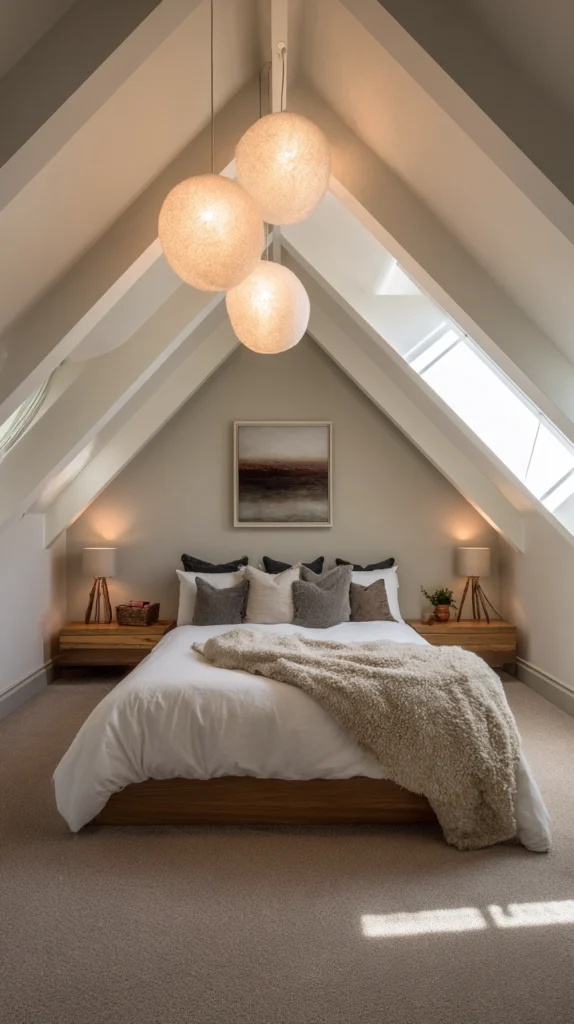
The pendant light in an attic bedroom must account for the sloped ceiling’s varying height.
Rather than a single pendant at a fixed height, which would be correct at one point in the room and incorrect at others as the ceiling slopes, a series of pendant lights hung at different heights creates a lighting installation that responds to the slope rather than ignoring it.
Pendant lights hung progressively lower as the ceiling slopes lower, tracking the ceiling’s descent, creates a visual connection between the light fittings and the room’s specific architecture. The lowest pendant at the low section. The highest pendant at the peak. The series of pendants between them following the slope.
This approach also creates a visual event in the room that uses the attic’s specific character rather than simply providing adequate light. The pendant installation becomes a design feature that references the slope rather than being installed in spite of it.
15. Embracing the Cosy Rather Than Fighting It
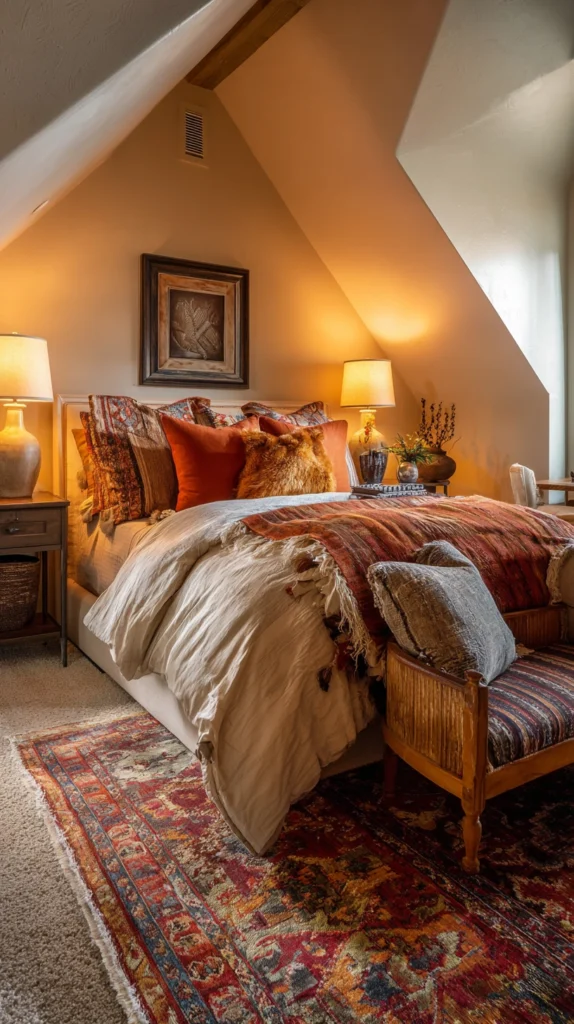
The attic bedroom succeeds when it accepts its character completely.
The room is cosy. The ceiling comes down to head height at its lowest points. The room has only one or two full-height walls. The space is intimate by nature rather than by choice.
Every design decision that tries to make the attic bedroom feel like a standard room, the furniture choices intended to create the illusion of more height, the pale colours deployed to suggest greater space, the furniture arrangement attempting to work around the slope, produces a room that succeeds only in feeling like an unsuccessful version of something else.
The attic bedroom that accepts what it is, that uses darkness and enclosure and the specific drama of the slope as the features they are, that designs for the person who will be sleeping under a sloped ceiling six inches above their head and who should find that experience delightful rather than merely adequate, is the attic bedroom that becomes the house’s most loved room.
Every house that has an attic bedroom has a room that guests specifically request. Not because it has the most space or the best light or the most generous proportions. Because it has the most character. Because it feels like nowhere else.
The design job is to make sure the room earns that reputation rather than embarrassing the architecture that naturally produces it.
How to Plan an Attic Bedroom Conversion
The attic bedroom conversion begins with a structural survey that confirms the floor’s load-bearing capacity and the head clearance available before any design decisions are made.
The building regulations applicable to attic bedroom conversions vary by jurisdiction. In the UK, Building Regulations approval is required for habitable rooms created from attic conversions and covers structural, thermal, acoustic, fire safety, and means of escape requirements. Similar requirements apply in most countries.
The minimum head clearance for a habitable room, at the room’s highest point, is typically two metres in most jurisdictions. Measure the existing clear height before any floor build-up is added.
The floor structure of most attic spaces is designed for storage loading rather than habitable room loading. Upgrading the floor structure to habitable room standards is almost always required. This is a structural joinery task that requires calculations by a structural engineer.
The thermal performance of the attic bedroom is a significant design decision. Insulation placed between and below the rafters creates a warm roof that allows the rafters to be expressed as the ceiling finish. Insulation placed above the rafters creates a cold roof that requires a separate, lower ceiling.
Common Mistakes in Attic Bedroom Design
Fighting the slope with furniture that does not fit. Standard furniture in a room where the slope begins at a height that the furniture cannot accommodate creates both a practical problem and a visual awkwardness. Furniture selection must respond to the specific clearances available in the specific room.
Using pale colours to make the room appear larger. The attic bedroom’s appeal is its specific, cosy, enclosed character. Pale colours in pursuit of the impression of more space trade the room’s genuine character for a pale imitation of a standard room.
Ignoring the low-slope storage opportunity. The space under the lowest sections of the slope is the room’s most valuable built-in storage opportunity and it is consistently missed in attic bedroom designs that use only the full-height areas.
Not considering the thermal experience. Attic rooms are significantly hotter in summer and colder in winter than rooms below them because they are closer to the building envelope. Adequate insulation, adequate ventilation, and thermal window treatments are essential for year-round comfort.
Placing the bed against the full-height wall by default. The most common attic bedroom layout decision places the bed as far from the slope as possible. This wastes the slope’s best quality, its ability to create an enclosed, sheltered sleeping space when the bed is positioned under it.
Quick Summary
- The bed placed under the ceiling’s peak creates the most specifically attic and most beautiful bedroom composition
- Built-in storage under the lowest slopes uses every cubic centimetre of the space that standing height prevents from other use
- Dormer windows dressed as alcoves with built-in window seats create the most desirable positions in the room
- Dark, enveloping colour on both walls and ceiling simultaneously creates the sheltered, intimate quality unique to attic spaces
- Low-profile furniture, including platform beds and low credenzas, responds to reduced clearance throughout the room
- Exposed roof structure celebrated as a design feature is the most authentic expression of the attic bedroom’s architectural reality
- A skylight in the sloped ceiling provides direct sky views from the sleeping position and the room’s most powerful natural light source
- Wall sconces and LED strip lighting at the ceiling-wall junctions provide lighting that responds to the slope rather than ignoring it
- A reading nook under the lowest slope with built-in shelves creates the room’s most enclosed and most cosy retreat space
- Patterned wallpaper on the sloped ceiling creates an overhead feature that no standard bedroom can match
- Tall narrow mirrors against full-height walls reflect the room’s vertical dimension to create the impression of greater height
- A slope-following fabric canopy in lightweight linen creates the enclosed sleeping quality of a canopy bed within the room’s specific form
- The gable end window seat uses the room’s full-height vertical wall feature with built-in storage beneath
- Pendant lights at varying heights that track the ceiling slope create a lighting installation that references the room’s architecture
- The attic bedroom’s appeal is its cosy, specific, enclosed character and every design decision should celebrate rather than fight this quality
The attic bedroom is not the room with the best proportions.
It is the room with the most character.
The room where the slope comes down close to the head of the person sleeping under it and the dormer window frames the sky beyond and the peak above the bed gives you just enough room and the whole room feels like it was made for you specifically because it fits too closely to have been made for anyone else.
Design it for that feeling.
Everything else is just furniture and paint.