
15 Country Farmhouse Living Room Ideas That Feel Genuinely Lived In and Loved
The country farmhouse living room is one of the most imitated and most misunderstood styles in interior design.
It gets copied constantly. Pinterest boards full of shiplap and mason jar lanterns and the word GATHER stencilled onto reclaimed wood above the fireplace. Farmhouse kitchens installed in suburban new builds that have never seen a farm. Distressed furniture in rooms with nothing genuine to distress.
The imitation misses the point entirely.
A genuine country farmhouse living room is not a collection of farmhouse-themed accessories arranged on a shelf. It is a room that has accumulated meaning over time. Where the sofa sags in the right places because it has been sat in for years. Where the rugs have worn softly because people have actually walked across them. Where the mix of furniture looks natural because it arrived from different places at different times rather than being ordered as a set from a single catalogue.
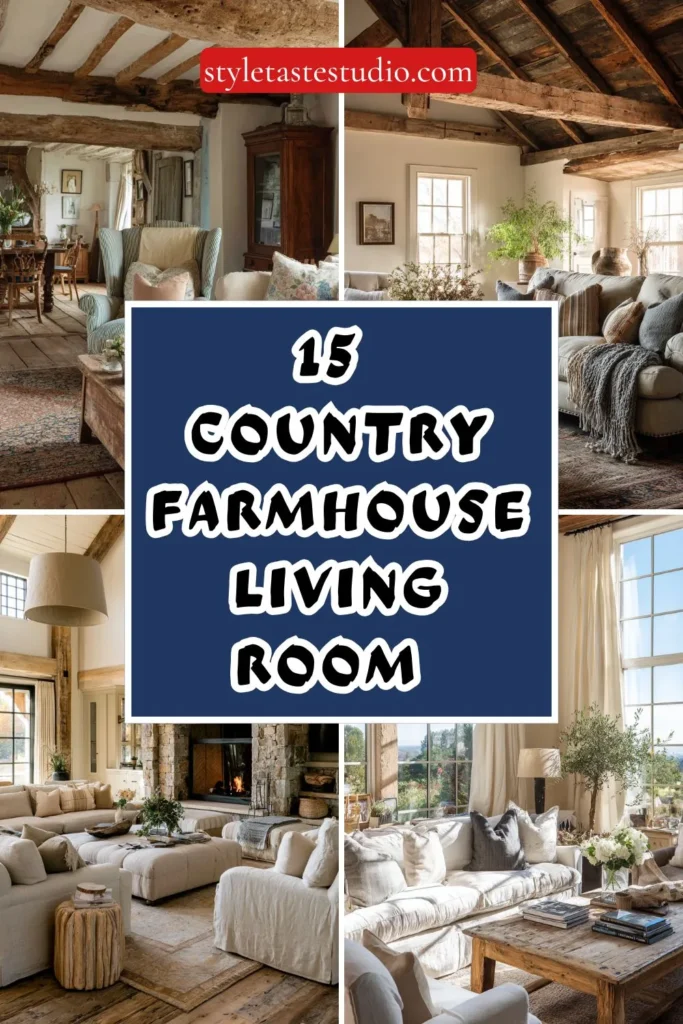
It is a room that feels inhabited rather than decorated.
These 15 ideas build that room.
Why the Country Farmhouse Living Room Feels So Compelling
The country farmhouse living room appeals because it represents something that most contemporary interiors do not deliver.
Warmth without effort. Comfort without performance. Beauty without pretension.
The aesthetic is fundamentally anti-perfectionist. A perfectly symmetrical, flawlessly coordinated room is by definition not a farmhouse living room. The farmhouse living room tolerates, in fact requires, a certain looseness. A throw draped rather than folded. Books stacked rather than arranged. A mix of old and new that no showroom could replicate because it arrived genuinely rather than being styled to look genuine.
This quality is genuinely difficult to fake and genuinely easy to achieve if you let things actually be rather than trying to control them into a particular appearance.
The other thing the country farmhouse living room delivers is sensory richness. Natural materials that smell and feel different from synthetic ones. Wood that has grain and texture. Linen that wrinkles softly. Wool that has warmth and slight roughness. Stone that has weight and cool solidity. These materials engage the senses in a way that their factory-produced equivalents cannot.
1. An Original or Reclaimed Stone Fireplace as the Room’s Heart
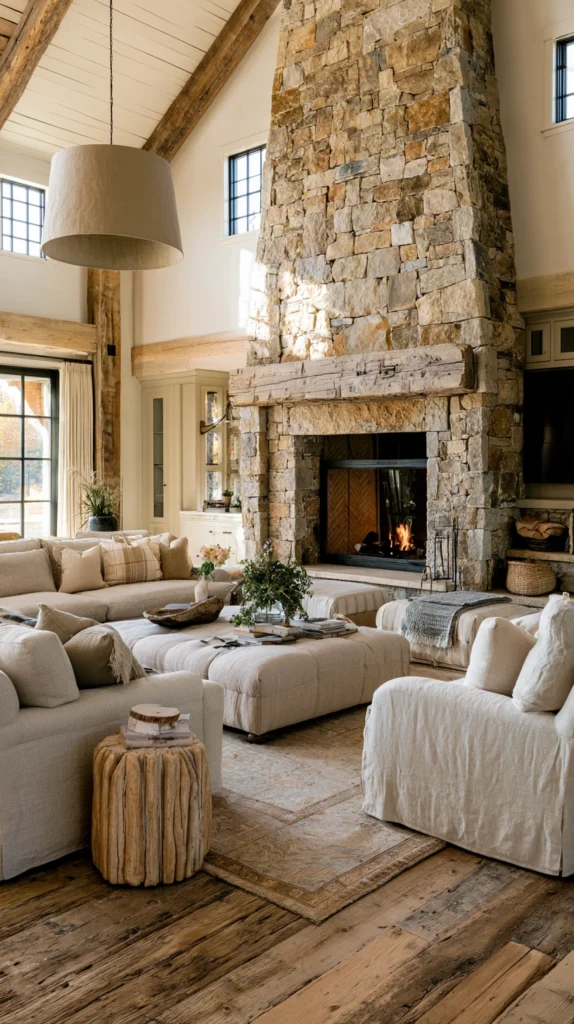
Every genuine country farmhouse living room is built around a fireplace.
Not a decorative gas insert with ceramic logs arranged to suggest warmth. A real fireplace with a genuine hearth, a proper flue, and the capacity to burn actual wood. The kind of fireplace that has been in the room for longer than anyone living in the house has been alive.
If the room has an original stone or brick fireplace that has been covered, plastered over, or blocked, exposing it is the single most transformative act in a farmhouse living room makeover. Behind the plasterboard or the tiled surround that some previous owner installed to modernise the room, there is almost always something extraordinary waiting.
Exposed stone fireplace surrounds have a weight and presence that no modern replacement can replicate. The stone itself carries the age and history of the building. The asymmetries, the wear patterns, the colour variations in the stone, all of it communicates that this room has been here and been lived in for a long time.
If the room does not have an original fireplace, a reclaimed stone surround installed around a new firebox is the most convincing alternative. Reclaimed fireplaces from architectural salvage yards in limestone, sandstone, and natural slate have an instant authenticity that new reproduction surrounds cannot achieve regardless of how carefully they are made.
Build the furniture arrangement around the fireplace without exception. Every seat should face it or be angled toward it. The fireplace is the room’s centre of gravity. Everything else organises itself in relation to it.
What makes a fireplace the right starting point:
- Every other design decision in the room follows the fireplace’s position and scale
- The gathering of people around a fire is the fundamental social act the farmhouse living room is designed for
- Real burning wood adds the scent element that makes a farmhouse living room fully sensory
- The firebox and surround provide vertical scale and architectural presence no piece of furniture can match
- Even unlit in summer the fireplace gives the room a focal point that it would otherwise lack
2. Exposed Timber Ceiling Beams
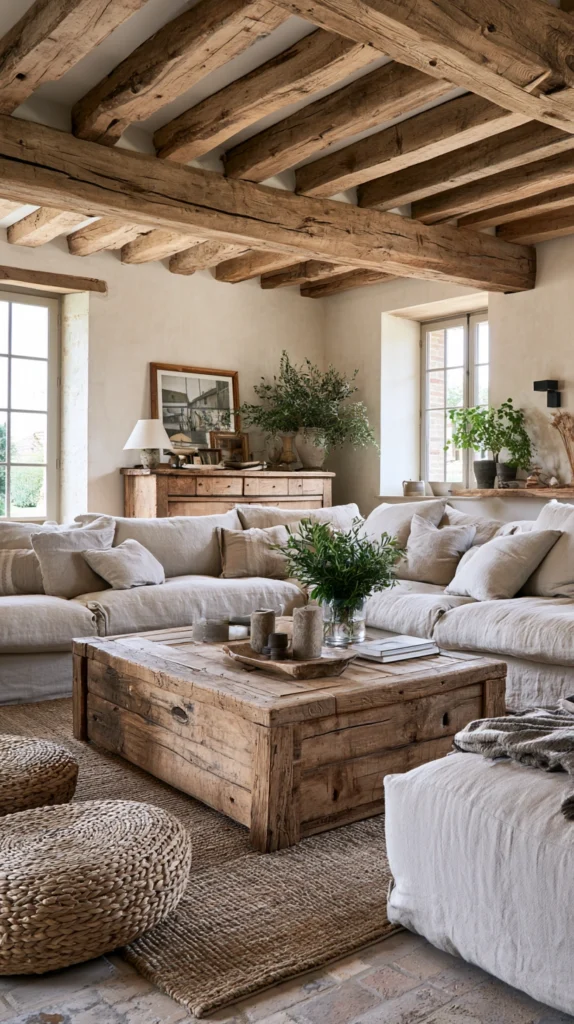
Exposed ceiling beams are to the country farmhouse living room what the fireplace is to its architectural character.
They add scale above the head. They add warmth and material depth to the ceiling that painted plaster cannot provide. They communicate the structural honesty of a genuinely old building and connect the room to the wood that frames it.
In a genuine farmhouse or period country cottage, the beams are almost certainly already there, either visible or hidden above a later plasterboard ceiling. Exposing them, oiling or lightly waxing the wood to protect it while preserving its natural colour and texture, is the right restoration choice in any room where the architecture supports it.
In a newer building, decorative beams installed on the ceiling can achieve a very similar visual effect when the material is genuine hardwood and the installation is done with the proportions of the room in mind. Hollow box beams in solid oak or pine look convincing when the beam profile has appropriate weight and the spacing reflects the structural logic of an actual timber-framed building.
The colour and finish of the beams matter enormously. Natural unstained oak or pine in a warm honey tone is the most authentic and most versatile choice. Dark-stained beams read as more formal and more architectural. Painted white beams have a coastal or Nordic character that suits a lighter, more contemporary interpretation of the farmhouse style.
3. A Squashy Oversized Sofa in Natural Linen or Worn Leather
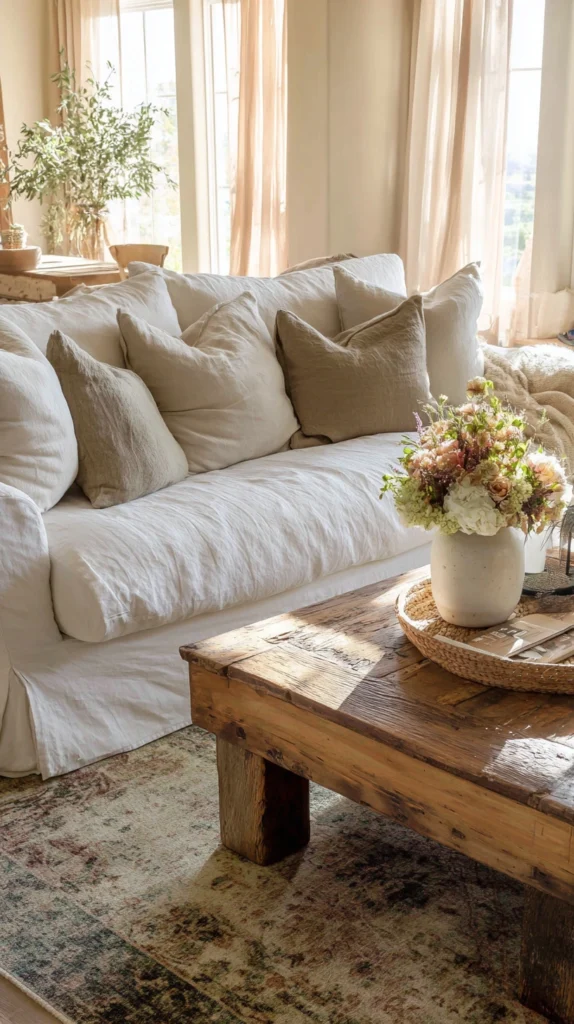
The sofa in a country farmhouse living room is not elegant or architectural.
It is generous. Deep. Soft enough to sink into. The kind of sofa that people disappear into for entire Sunday afternoons and emerge from slightly reluctant and significantly more rested.
Natural linen upholstery in a warm oatmeal, cream, or flax tone is the most authentically farmhouse choice. Linen is the fabric of the farmhouse because it is genuinely natural, genuinely breathable, and genuinely gets better looking as it ages and softens. The wrinkles that make a linen sofa look slightly imperfect from day one are the same quality that makes it look beautifully worn-in after a year.
Worn leather is the alternative of equal standing. A large leather sofa in a cognac, tan, or warm brown that has been used enough to develop a natural patina and a slight softness at the seat. Not distressed artificially. Actually worn in by being sat on by people who use it rather than sit gingerly on the edge.
The size is as important as the material. A farmhouse sofa should accommodate the entire family lying down simultaneously. The standard three-seater is insufficient. A three-seater plus a chaise, a large corner sofa, or a sofa paired with a generously proportioned two-seater or armchair gives the room the physical abundance that the style requires.
4. Layered Vintage and Antique Rugs
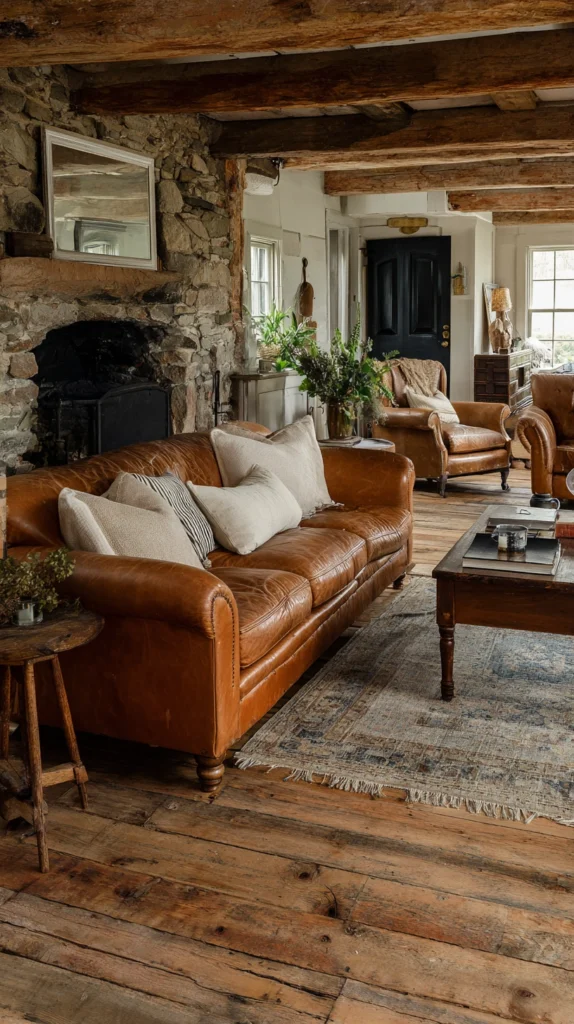
The rug situation in a country farmhouse living room is the one where the no-matching rule is most strictly applied.
A single perfectly chosen rug in a farmhouse living room looks like a farmhouse room that someone just moved into. Multiple rugs layered over each other, different patterns, different sizes, overlapping organically in front of the fireplace and under the coffee table, look like a room that has accumulated its rugs over years and decades from different sources.
Vintage Persian and Turkish rugs in warm reds, blues, and ochres are the most versatile choice for layering. Their patterns are visually complex enough that they coexist with other rugs without creating visual chaos. Their colours are muted enough by age to sit comfortably together regardless of the specific tones in each.
Kelim rugs with their flat-woven geometric patterns layer beautifully over or under more complex pile rugs. A large natural jute rug as the base layer, with a vintage Persian on top, is a combination that looks entirely natural because it echoes the practical tradition of laying rugs over floors for warmth.
Source rugs from antique markets, estate sales, online vintage dealers, and eBay rather than from homeware retailers. The slight irregularity of hand-knotted vintage rugs, the gentle fading, the occasional visible repair, adds authenticity that machine-made reproductions cannot replicate.
5. A Mix of Furniture From Different Periods and Sources
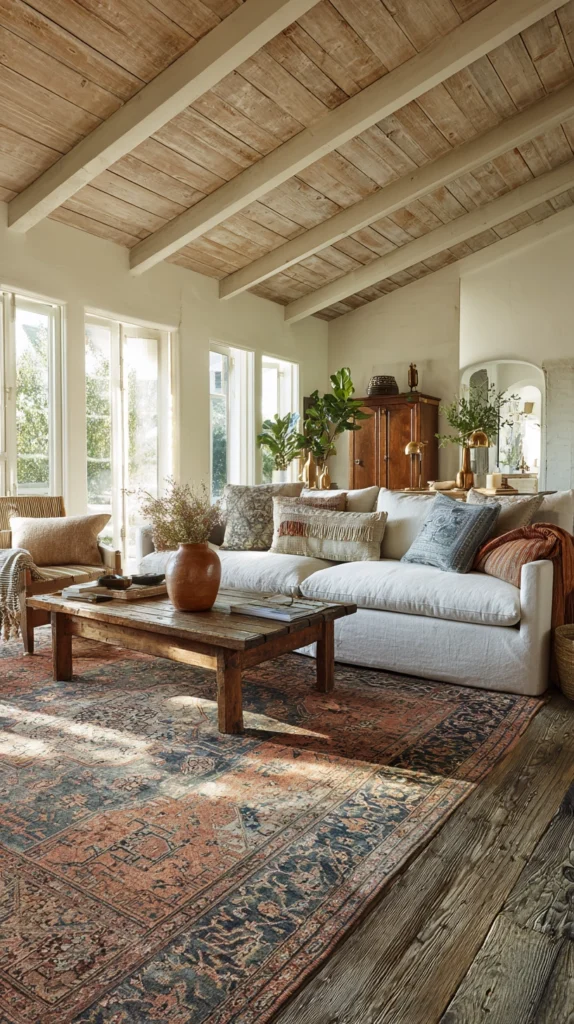
The fully matched furniture suite is the enemy of the farmhouse living room.
A sofa, two chairs, and a coffee table all selected from the same collection and delivered together in the same van on the same day produces a living room that looks like a showroom floor rather than a home. Everything is too coordinated. The room has no story. Nothing arrived from anywhere. Nothing has history.
The farmhouse living room furniture mix tells a story by implication. The Georgian wingback armchair in faded chintz that came from a grandparent’s house. The Victorian nursing chair reupholstered in a contemporary fabric. The mid-century lamp table beside the linen sofa that was new. The rustic pine coffee table from a salvage yard.
Each piece comes from somewhere different and arrived at a different time. Together they create a room that feels genuine rather than assembled.
The key to making a furniture mix work is identifying one or two elements that tie everything together despite the variety. A consistent colour palette, warm neutrals with occasional deep accents, runs through pieces of different styles and periods. Or the consistent use of one material, oak or pine, in pieces of very different designs, creates coherence through material rather than style.
6. Shiplap or Tongue-and-Groove Panelled Walls
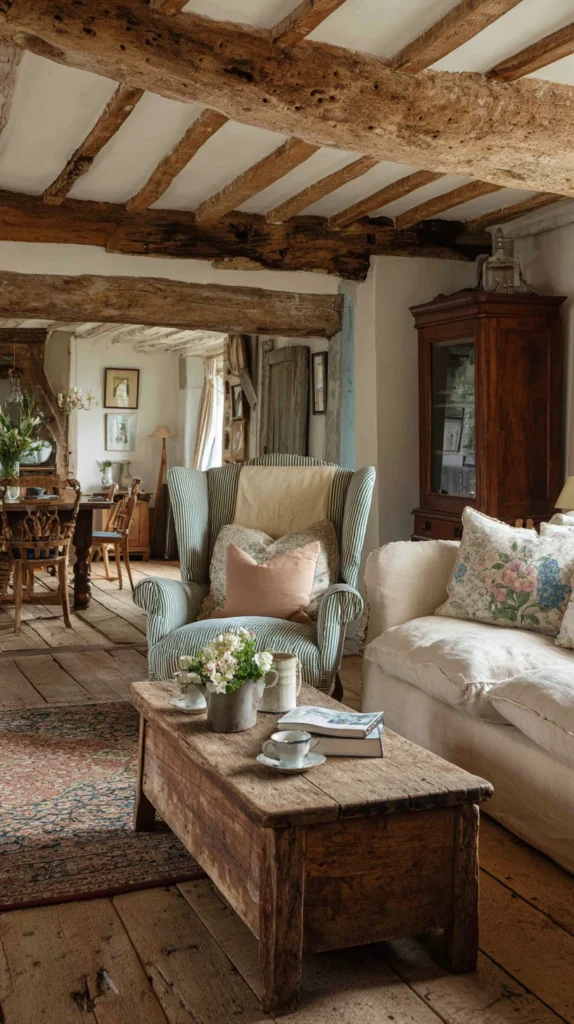
Wooden wall panelling is one of the most strongly identifying features of country farmhouse interior design.
In authentic farmhouses the panelling serves a practical original purpose. Insulation against cold external walls. Protection of plaster from moisture. A cleanable surface in rooms that received hard daily use. The functional history is part of what makes it feel right in a farmhouse context.
Shiplap, horizontal planks with a slight overlap between each board, creates a wall texture that is simultaneously rustic and precise. The horizontal lines extend the apparent width of a room and the shadow lines between the boards add depth at different times of day as the light changes.
Tongue-and-groove panelling in a vertical orientation has a more traditional, cottage-like quality. Applied to the lower half of a living room wall as a dado treatment and painted in a chalky, muted tone, it adds the same material warmth and historical reference as full-height panelling with a lighter visual weight.
The paint colour on panelling does as much work as the panelling itself. White or off-white panelling feels clean and coastal. Dark painted panelling in forest green, navy, or deep charcoal feels more dramatic and more enclosing. A warm sage or duck egg blue sits between the two and suits the farmhouse style beautifully in rooms with good natural light.
7. A Dresser or Welsh Dresser Displaying Ceramics and Pottery
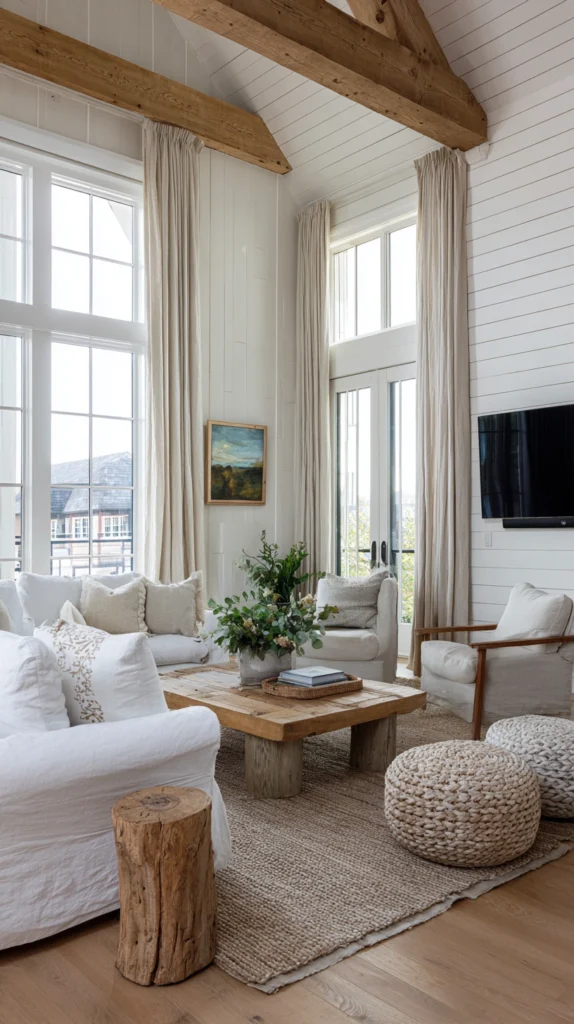
The Welsh dresser is the piece of furniture that most completely represents the country farmhouse aesthetic.
An upper section of open shelves displaying crockery, ceramics, and pottery. A lower section of closed cupboards and drawers for less decorative storage. Often painted in a traditional farmhouse colour but equally beautiful in its natural pine or oak finish.
The dresser does something that no other piece of furniture in a living room can quite replicate. It displays the domestic objects of the house in a way that makes them part of the room’s decoration rather than hidden behind closed doors. Blue and white willow pattern plates. Hand-thrown ceramic mugs in earthy glazes. A collection of jugs. A few pieces of simple white creamware.
The display does not need to be perfect. It should not be perfect. Objects should be placed as they would be placed by someone who actually uses them and then puts them back. Stacked slightly unevenly. Mixed in scale. A few pieces slightly out of alignment.
This quality of genuine use is more beautiful in a farmhouse living room context than any amount of careful styling.
8. Chalky, Matte Paint in Warm Heritage Colours
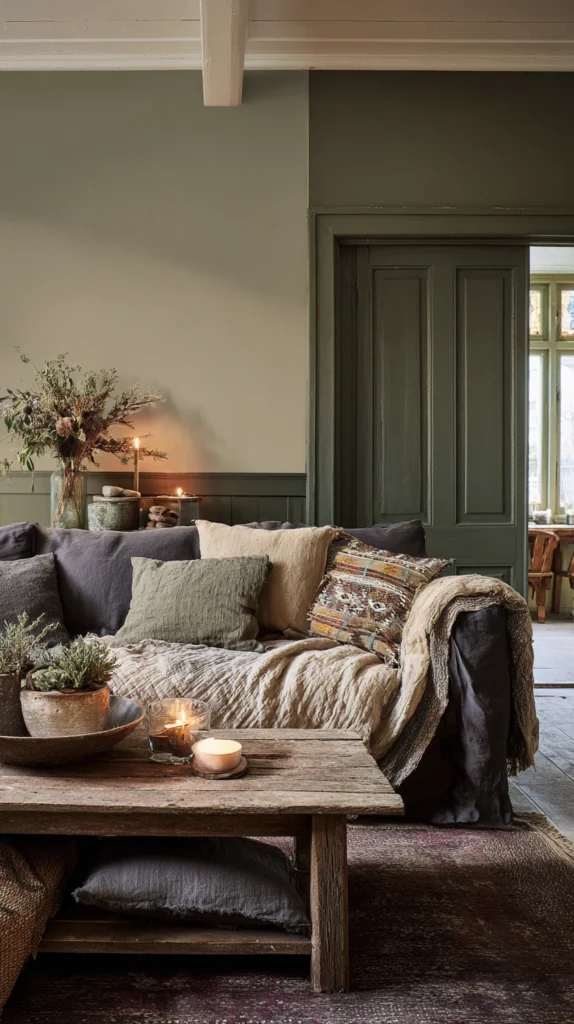
The walls of a country farmhouse living room should never be brilliant white.
Brilliant white is the colour of new plaster, clinical spaces, and rooms that have not yet been decorated. It is too bright, too reflective, and too modern for a room that is trying to feel as if it has accumulated its character over decades.
Heritage paint ranges, the colours developed by Farrow and Ball, Little Greene, and similar companies to reference the pigment qualities of eighteenth and nineteenth century paints, are exactly right for the farmhouse living room. They have a depth and complexity in their tone that modern mass-produced paints lack. They look different in morning light than in evening light. They read as warm rather than cold even in cooler tones.
Old White. Dead Salmon. String. Elephant’s Breath. Mouse’s Back. The names communicate the organic, slightly dusty quality of the tones themselves. These colours look like they belong in old buildings because they were developed to reference the colour quality of old buildings.
Apply in a matte or dead-flat finish. The matte finish absorbs light rather than reflecting it and creates walls that feel warm and deep rather than bright and flat. Eggshell or satin finishes on farmhouse walls look too polished, too finished, too new.
9. Handmade and Studio Ceramics Throughout
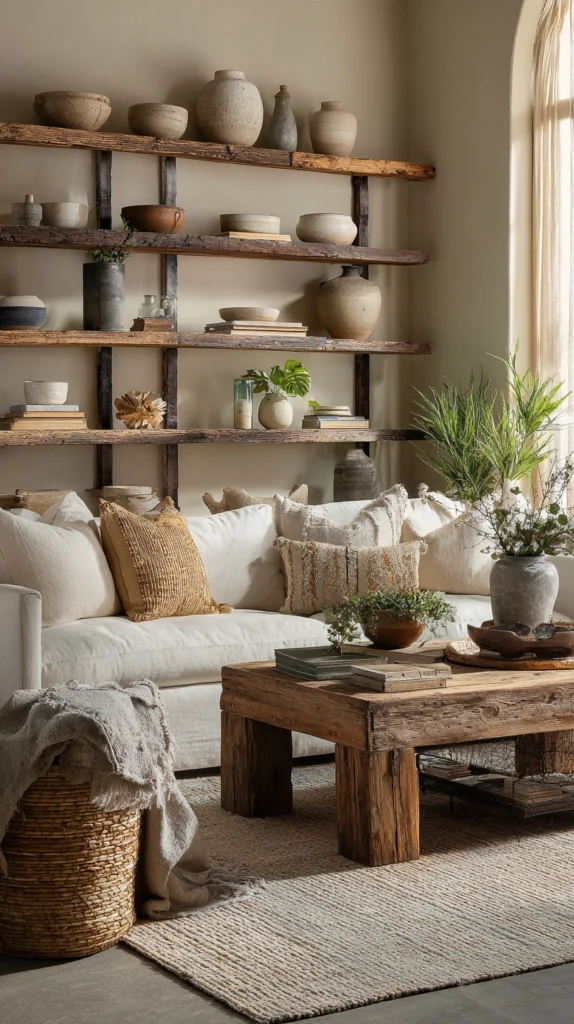
Mass-produced accessories in a country farmhouse living room always look slightly out of place.
Too uniform. Too perfect. Too obviously made by a machine in a factory rather than a person in a workshop.
Handmade and studio ceramics are the alternative that the farmhouse living room requires.
Hand-thrown vases with slight asymmetry in their form. Glazed in earthy, organic tones, ash glazes in warm cream and grey, iron-rich glazes in deep brown and black, celadon glazes in soft grey-green. The slight variations in surface and form that identify an object as handmade rather than factory-produced.
These pieces do not need to match. In a farmhouse living room context a collection of handmade ceramics in related but not identical earthy tones looks more beautiful than a curated set from a single designer. The variety communicates that the collection has been assembled over time from different makers and different markets.
Source ceramics from local studio potters, craft markets, independent galleries, and online platforms that support independent makers. The story behind each piece, this one was bought at a market in Cornwall, this one was made by a potter whose workshop is ten miles away, adds a layer of meaning that factory-produced accessories can never carry.
10. A Kitchen Garden Window or Garden View
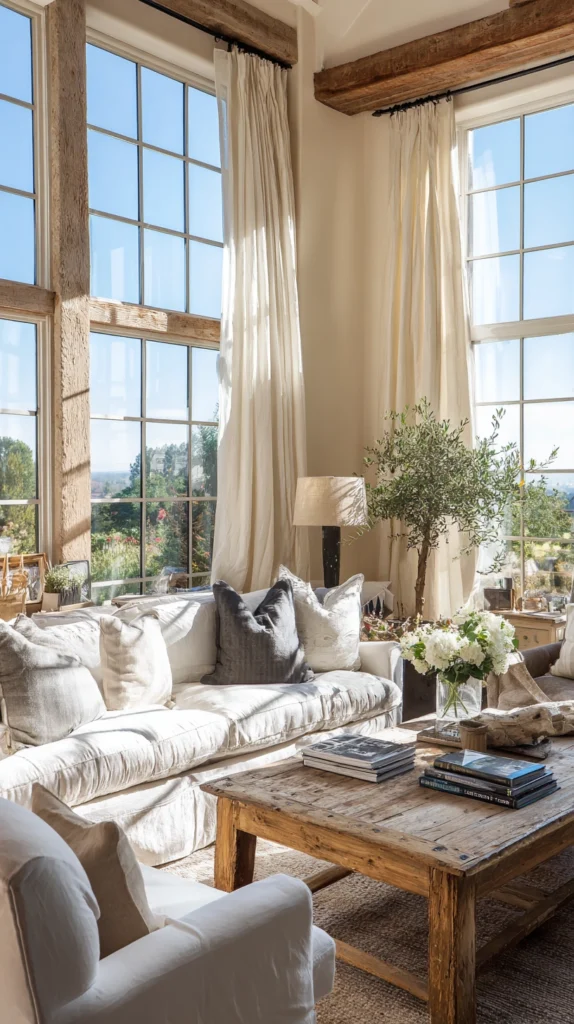
The country farmhouse living room is incomplete without a visual connection to the outside.
In a genuine farmhouse the windows look onto garden, field, or hedgerow. The room does not feel sealed off from the natural world. It maintains a visual dialogue with the landscape beyond the glass.
In a suburban or urban farmhouse living room the equivalent connection might be a window that looks onto a well-planted garden rather than a bare fence. Or a view of a kitchen garden or flower border that has been positioned specifically to be seen from the main seating area.
The window treatment should never obstruct this view unnecessarily. Heavy, light-blocking curtains that are kept closed defeat the purpose entirely. In a country farmhouse living room the window treatment should be as light and open as possible during the day. Simple linen panels that frame the window without obscuring it. A Roman blind in a natural fabric that rolls up completely above the glazing. Shutters that fold fully open and stay open.
The view of a garden from a warm, comfortable living room on a cold afternoon is one of the most fundamentally farmhouse pleasures available. Design the room to allow it.
11. Natural Flowers and Botanical Elements
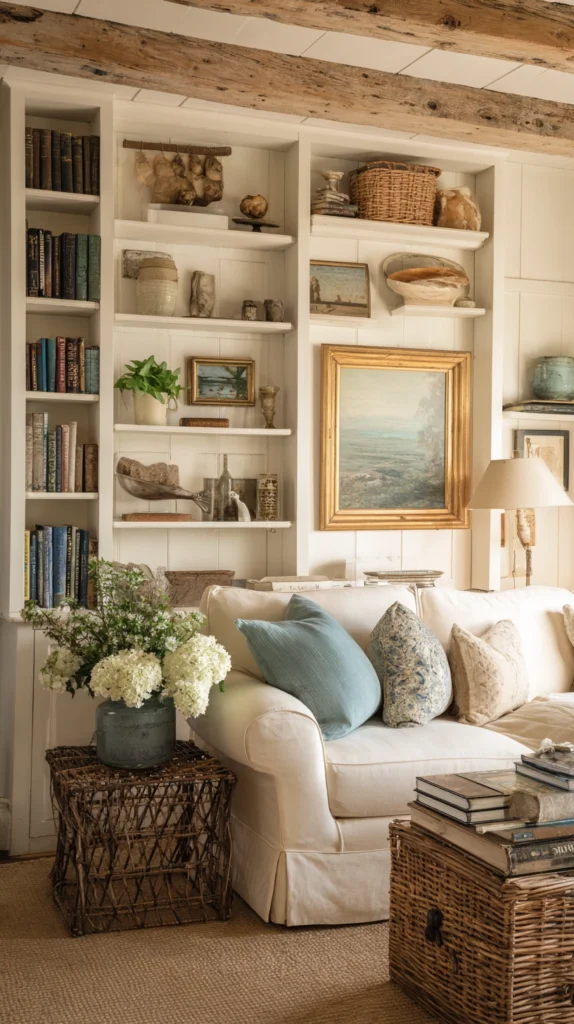
Cut flowers and natural botanical elements belong in a country farmhouse living room in a way that they belong in very few other interior styles.
Not flowers arranged with florist’s precision in a clear glass vase on a glass table. Flowers picked loosely from a garden or hedgerow and placed in an earthenware jug or a wide-necked ceramic vase. The kind of arrangement that looks like it took two minutes because it did.
Cow parsley in a tall jug. Garden roses loosely placed in a cream ceramic. Eucalyptus stems in a brown stoneware vase. Wild grasses in a glass bottle. The loose, unstructured quality of the arrangement is the quality that makes it right for the farmhouse style.
Beyond cut flowers, botanical elements that have dried naturally rather than been processed for display add texture and longevity. Dried lavender tied with twine hanging from a beam. A seed head display in a tall vase. Dried allium heads mixed with dried grasses in a basket. Pine cones collected and placed in a wooden bowl by the fireplace.
These elements connect the room to the seasonal rhythm of the garden and the natural world in a way that is entirely genuine rather than decorative in the manufactured sense.
12. Open Shelving Filled With Books and Collected Objects
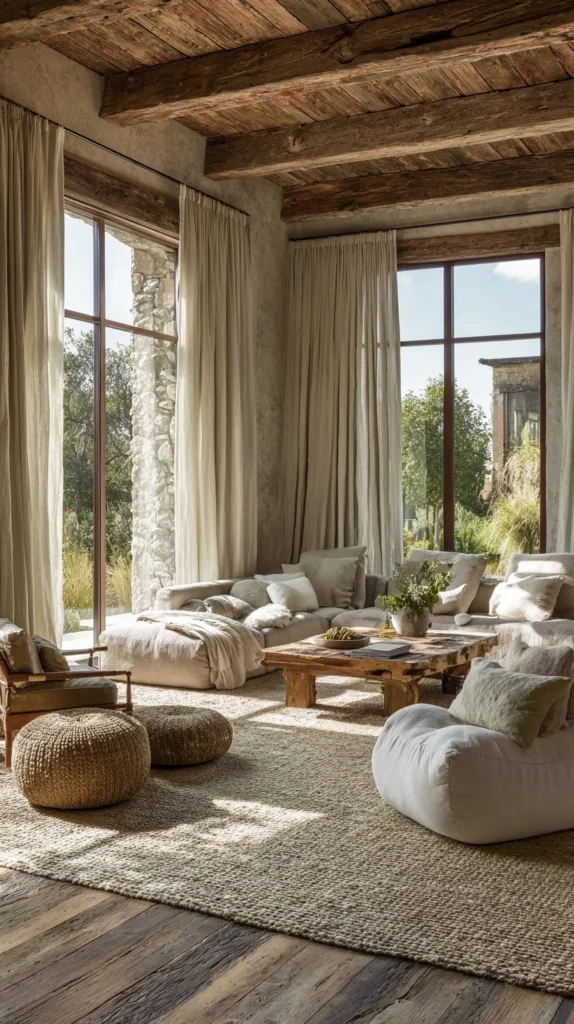
Books are essential to the country farmhouse living room.
Not books arranged by spine colour for photographic purposes. Books arranged by how they are actually used. The novels and the cookbooks and the gardening references all together in the order in which they were most recently read or pulled from the shelf.
Open shelving that holds books, ceramics, plants, candles, and the various objects that accumulate in a genuinely lived-in room creates the visual richness and personal character that the farmhouse style requires.
Built-in bookshelves flanking a fireplace are the most traditional and most beautiful configuration. The shelves fill the alcoves on either side of the chimney breast, the books and objects sit at different heights across the shelves, and the whole composition creates a visual warmth and complexity around the fireplace that painted alcoves cannot match.
The shelving should not be too styled. One row of books arranged by height with a single ceramic object at each end of each shelf is too controlled. Books stacked horizontally where there was no vertical space for them to stand. A plant trailing over the edge of a middle shelf. A framed photograph propped at an angle against a row of books. The slight looseness of genuine use is the right aesthetic.
13. Natural Linen and Cotton Curtains That Pool on the Floor
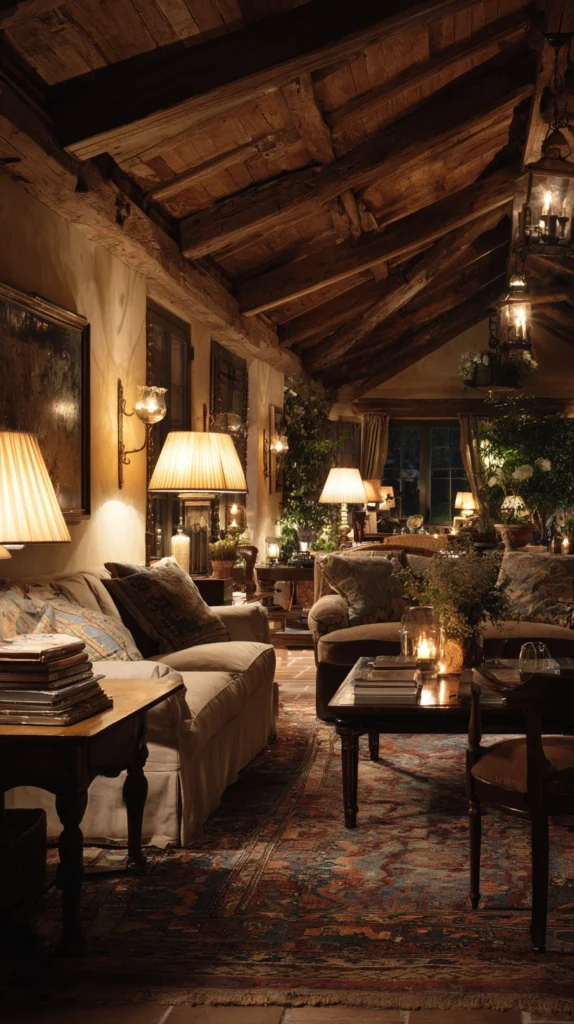
Curtains in a country farmhouse living room have a specific character that short, neatly hemmed curtains on a standard track cannot provide.
They are long. Longer than the window. Long enough that the excess fabric pools slightly on the floor at the base.
This pooling or breaking at the floor is one of the most immediately identifiable characteristics of a genuinely farmhouse curtain treatment. It communicates generosity and ease. The curtains were made without the precise measurement of a centimetre-correct hem and the effect is luxurious rather than slovenly.
Natural linen or heavyweight cotton in cream, off-white, or a warm muted stripe are the most appropriate curtain fabrics. The material should hang with weight rather than float. A lightweight cotton voile is too insubstantial. A heavy linen interlined to give it body and drape falls in the deep, generous folds that make a farmhouse curtain look as it should.
Hang from a simple wooden or iron pole rather than from a track. The pole is visible as part of the design rather than being hidden behind a pelmet. Simple ring-top curtains, or curtains with eyelets in a large size, hang from the pole in a way that can be adjusted manually rather than controlled by a cord system.
14. Candles and Warm Lighting That Never Includes a Central Overhead Light
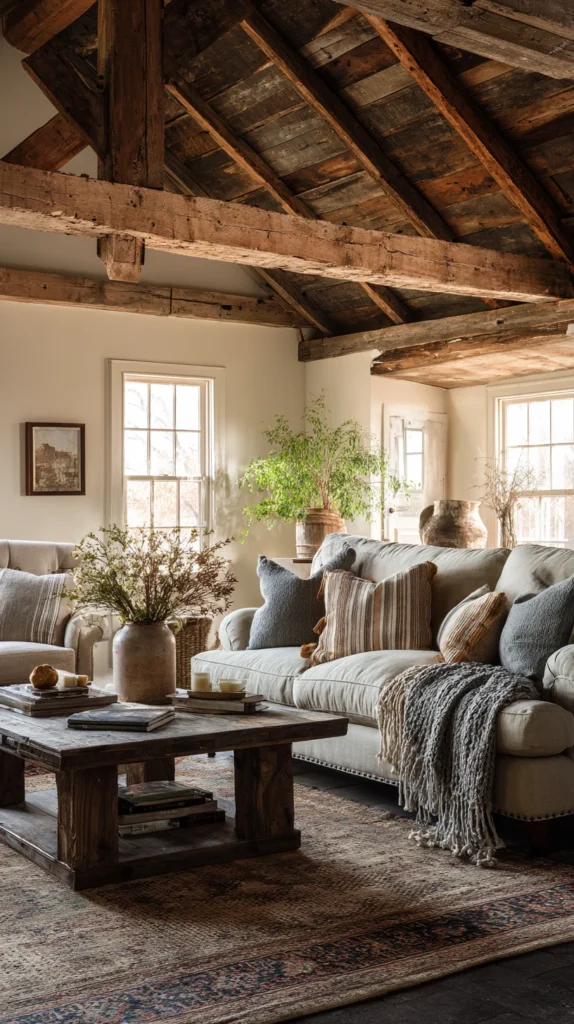
The overhead light is the enemy of the country farmhouse living room atmosphere.
A single overhead light source fills the room with flat, undifferentiated brightness that eliminates shadow, drains warmth from every surface, and makes the room look like a car showroom rather than a place where people gather and rest.
In a genuine farmhouse living room the overhead light, if it exists at all, is used only when absolutely necessary. Day to day, evening to evening, the room is lit by multiple small warm sources positioned at different heights throughout the space.
Table lamps on every surface in warm amber tones. A floor lamp beside the main reading chair. Candles on the mantelpiece and the coffee table. An antique or vintage chandelier above the fireplace that provides ambient glow rather than direct task illumination.
The candles are non-negotiable. Not decorative candles that are never lit. Real candles in actual candleholders that are lit every evening without exception. The quality of candlelight against the warm colours and natural materials of a farmhouse living room is irreplaceable by any electric light source. The flickering, the subtle shadow movement, the warm colour temperature, all of it is specific to actual combustion and cannot be faked.
Use pillar candles in simple iron or wooden holders. Taper candles in antique candlestick holders on the mantelpiece. Church candles of different heights grouped together on a wooden board as a centrepiece. The candles add scent, warmth, and a specific quality of light that completes the farmhouse living room more fully than any other single element.
15. The Dog Bed, the Muddy Boots by the Door, and All the Evidence of Real Life
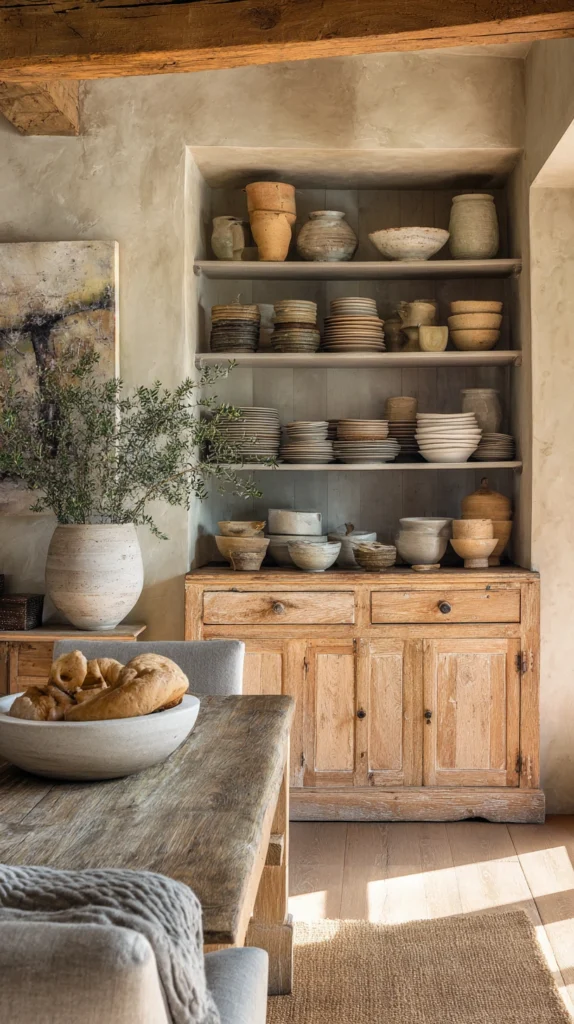
The most important element of the country farmhouse living room cannot be purchased.
It is the evidence of genuine habitation.
The dog bed in the corner that is slightly too large for the space it occupies but cannot be moved because it is where the dog has always slept. The muddy boots left inside the door because someone came in from the garden and has not yet taken them to the utility room. The children’s drawing that appeared on the fridge but has migrated to be propped against the wall. The half-finished novel open face-down on the arm of the sofa.
These things are not decorating decisions. They are the accumulation of daily life in a room that is genuinely used and genuinely loved. They are exactly what makes the difference between a farmhouse living room that has been professionally styled and one that actually is a country farmhouse living room.
The paradox of the farmhouse style is that the more you try to achieve it through deliberate decoration, the less convincing it becomes. The rooms that most perfectly embody it are the rooms where the occupants stopped thinking about how it looks and simply lived in it for long enough that the living showed.
Every item listed in this article creates the foundation and the conditions. The last and most essential ingredient is simply time and actual use.
Let the room be lived in. The rest follows.
How to Build a Country Farmhouse Living Room Gradually
The country farmhouse living room cannot be created in a weekend.
And attempting to create it in a weekend, in a single shopping trip to a farmhouse-themed homeware retailer, produces exactly the imitation that the genuine article is not.
Build it gradually. Start with the structural elements that create the architectural character. The fireplace if the room has one or can have one. The wall treatment in the right colour. The ceiling if beams are possible.
Then the furniture. The sofa comes first because everything else organises around it. Take time finding the right sofa. Buy it from a maker who uses natural materials. Or buy it secondhand and have it recovered in a linen or natural fabric that suits the room.
Add rugs. Start with one vintage rug of the right scale for the seating area. Add layers over time as the right pieces become available.
The accessories, the ceramics, the books, the botanical elements, the candles, come last and accumulate naturally as you collect, receive, and find things that belong in the room. This is the stage that cannot be rushed because it is the stage where the room develops genuine character rather than assembled appearance.
Common Mistakes in Country Farmhouse Living Rooms
Buying everything new from the same source. The farmhouse living room looks genuine when it has been assembled from multiple sources over time. A room furnished entirely from one retailer always reads as a style rather than a home.
Over-decorating with farmhouse signage. Words stencilled on wooden boards. Signs reading HOME or GATHER or FAMILY. These objects announce the farmhouse aesthetic in a way that genuine farmhouse rooms never do. They are the most reliable indicator that a room is performing farmhouse rather than being farmhouse.
Choosing furniture that is too formal or too precise. Perfectly proportioned, perfectly symmetrical, perfectly matched furniture is not farmhouse furniture. Scale up. Soften. Choose pieces with character over pieces with refinement.
Using brilliant white paint. The most common farmhouse colour mistake. Brilliant white makes a room look like a new building rather than an old one.
Making it too tidy. A farmhouse living room that is immaculately tidy has had its soul removed. Some evidence of life should always be visible.
Ignoring the ceiling. A farmhouse living room with a flat, featureless ceiling and brilliant white paint overhead is working against every design decision made below ceiling height. Address the ceiling.
Synthetic materials in natural material contexts. A polyester throw on a linen sofa. Plastic flowers in an earthenware vase. Synthetic rug fibres under furniture in natural wood. These combinations break the material honesty that the farmhouse style depends on.
Quick Summary
- A real stone fireplace or reclaimed stone surround is the non-negotiable starting point around which everything else organises
- Exposed timber ceiling beams add scale, material warmth, and structural honesty that no other ceiling treatment provides
- A deep, generously proportioned sofa in natural linen or worn leather is the room’s most important piece of furniture
- Layered vintage and antique rugs from different sources look more genuinely accumulated than any matched set
- Furniture from different periods and sources creates the honest mix that matched suites can never replicate
- Shiplap or tongue-and-groove wall panelling in heritage matte paint adds material warmth and historical reference simultaneously
- A Welsh dresser displaying ceramics and crockery brings domestic life openly into the living room’s decoration
- Heritage paint ranges in matte or dead-flat finish create walls that look as old as the style requires
- Handmade studio ceramics in earthy organic glazes have the material honesty that mass-produced accessories lack
- A window view onto a well-planted garden maintains the visual connection to the natural world that farmhouse rooms need
- Loose flowers picked or arranged in earthenware and stoneware vessels is always right for this style
- Open bookshelves with genuine use patterns, plants, ceramics, and accumulated objects create personal visual richness
- Long linen curtains that pool on the floor on a visible wooden or iron pole are more farmhouse than any short neat alternative
- Multiple warm light sources including real lit candles replace the overhead light that kills farmhouse atmosphere
- The evidence of genuine daily habitation, the dog, the boots, the open book, is the ingredient that cannot be bought
- Build gradually from structural elements to furniture to soft furnishings to accessories and then let life do the rest
- Never buy everything new from one source, never use farmhouse signage, never paint the walls brilliant white
The country farmhouse living room is not a style applied to a room.
It is a room that has been lived in well for long enough that it shows.
Every idea in this article builds toward that quality. But the quality itself is produced by the people in the room and the life they live in it.
Design the room properly. Then forget you designed it. Live in it instead.
That is how a farmhouse living room actually gets made.