13 Kitchen Shelves Instead of Cabinets Ideas That Actually Work in Real Homes
Open shelving in a kitchen is one of the most debated decisions in home design.
Half the internet will tell you it is the only choice that looks beautiful, feels human, and makes a kitchen worth spending time in. The other half will tell you it collects grease, requires constant tidying, and you will regret it within six months.
Both sides have a point.
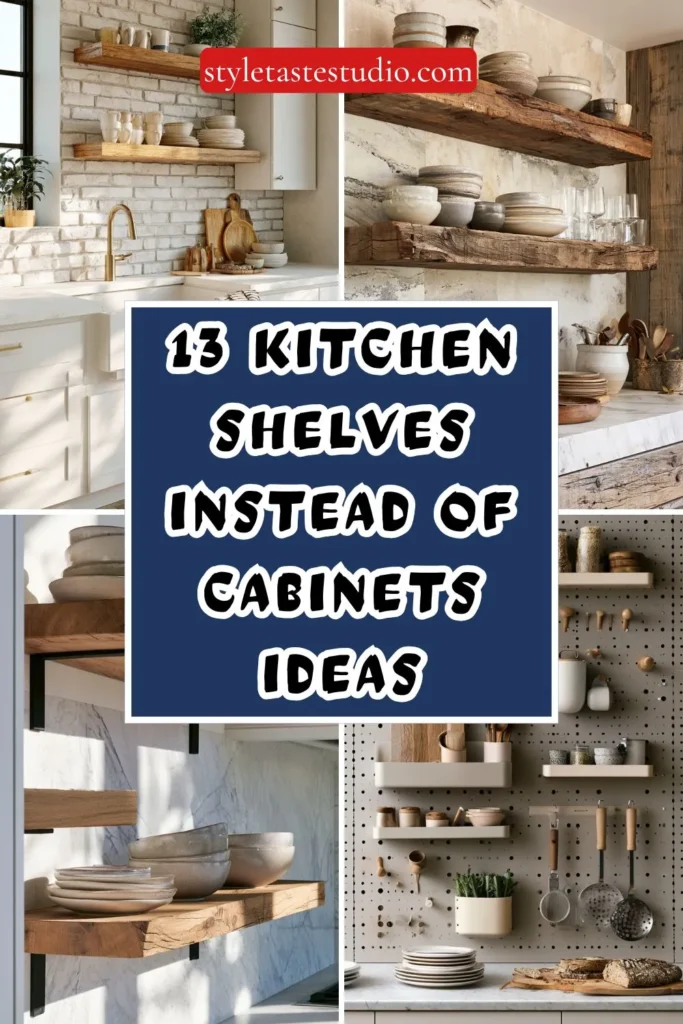
The truth is that kitchen shelves instead of cabinets work extraordinarily well when the idea is executed properly. And they fail spectacularly when they are not.
The difference between a kitchen open shelf situation that looks like a styled magazine spread and one that looks like organised chaos is not luck or personality type. It is decisions. The right material. The right bracket. The right objects are displayed. The right zone of the kitchen to go open versus closed.
Get those decisions right and open shelving is genuinely one of the most beautiful things you can do to a kitchen.
Here are 13 ideas that get it right.
Why Kitchen Shelves Instead of Cabinets Work Better Than People Expect
The cabinet door is a lie.
It promises order. It delivers a dark box where things get pushed to the back and forgotten. Where the same three items get used daily and the other twenty-three collect dust behind a closed door that keeps them invisible and therefore irrelevant.
Open shelving forces honesty. Everything on a shelf is visible. Which means only things worth seeing go there. Which means the kitchen becomes more organised rather than less, because the lazy option of pushing something behind a door no longer exists.
Open shelves also make a kitchen feel larger. The visual depth of shelves against a wall opens a room up in a way that solid cabinet fronts close it down. They bring personality. They let you display the objects that make your kitchen yours rather than hiding everything behind identical doors.
And practically, open shelves make everything genuinely accessible. The thing you need is visible, reachable, and back in its place in a single motion.
The key is knowing which parts of the kitchen to open up and which to keep closed.
1. Thick Solid Wood Shelves on Simple Brackets
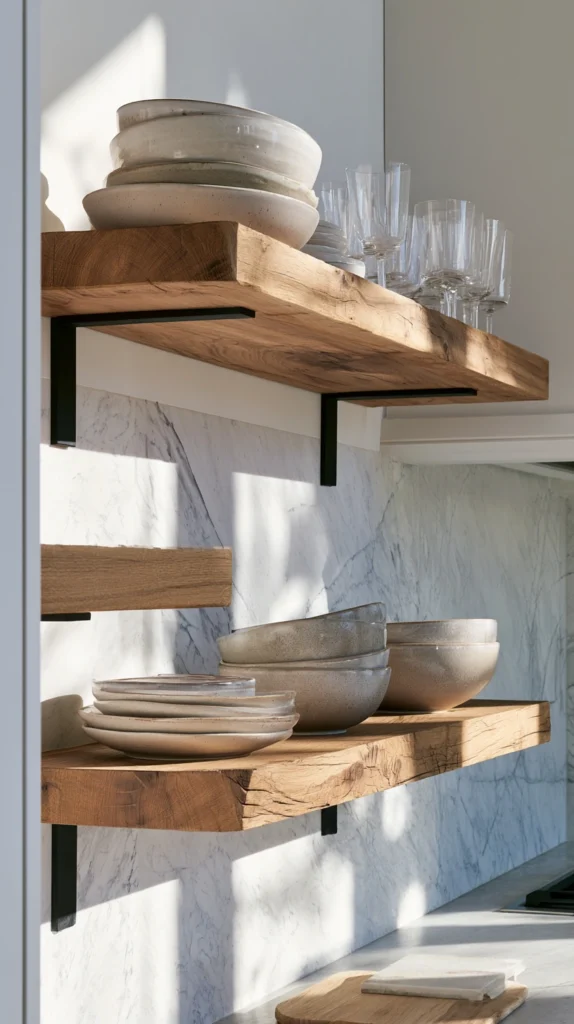
The solid wood shelf is the starting point for almost every beautiful open kitchen shelf situation.
Not thin plywood with a veneer. Not MDF painted to look like wood. Solid hardwood with real thickness and real grain. Three to four centimetres thick at minimum. Thick enough that the shelf looks substantial and permanent rather than afterthought temporary.
Oak is the most popular choice and for good reason. The grain is beautiful, the colour warms with age, and it is available in long runs that span an entire kitchen wall without a join. Walnut is darker and richer, spectacular against white walls and black fixtures. Ash is lighter with a finer, more even grain that suits contemporary kitchens with a Scandinavian character.
The bracket is the other decision. Simple raw steel brackets in black or natural finish have a clean, architectural quality that suits any style. Wooden corbel brackets have a traditional quality that suits farmhouse and period kitchens. Hidden floating shelf hardware gives no visible support at all and creates a wall-mounted effect that looks as expensive as anything in a kitchen.
Finish the wood with a food-safe oil rather than paint or varnish. The oiled surface feels natural and warm. It is easy to spot-treat when it shows wear. And it gets better looking with time and use rather than chipping and peeling.
What makes a solid wood shelf work in a kitchen:
- Minimum three to four centimetres of thickness so the shelf looks substantial
- Hardwood species with genuine grain rather than painted composite materials
- Food-safe oil finish that handles moisture and wipes clean easily
- Brackets chosen to complement the overall kitchen style and hardware finish
- Depth of thirty to thirty-five centimetres which fits standard dinner plates without overhang
2. Floor-to-Ceiling Open Shelving on One Wall
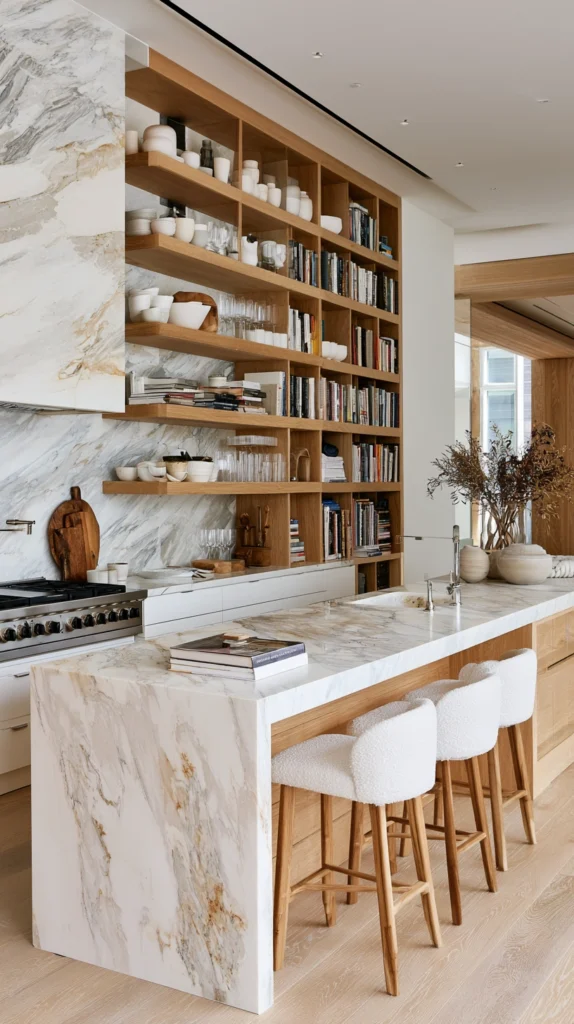
Instead of removing upper cabinets and leaving the lower cabinets in place, consider dedicating one entire wall to floor-to-ceiling open shelving.
This approach turns a functional storage decision into a genuine architectural statement. The shelving becomes the defining feature of the kitchen rather than just the replacement for cabinet doors.
A full-height shelving wall in a kitchen serves every storage need that cabinets would serve while looking dramatically more interesting. Lower shelves hold everyday crockery and glassware. Middle shelves at the most visible and accessible height display the items you are proudest of. Upper shelves store less frequently used items like seasonal serving dishes, cake stands, and preserve jars.
The visual effect of a floor-to-ceiling shelf wall filled with organised kitchen objects, crockery stacked, glasses lined up, plants and ceramics adding interest, is one of the most striking things you can create in a kitchen.
Keep the opposite wall in solid cabinetry. The contrast between a fully open shelf wall and a fully closed cabinet wall creates a dynamic that makes both elements look more intentional. The kitchen does not look unfinished. It looks designed.
3. Shelves Built Into a Kitchen Alcove or Recess
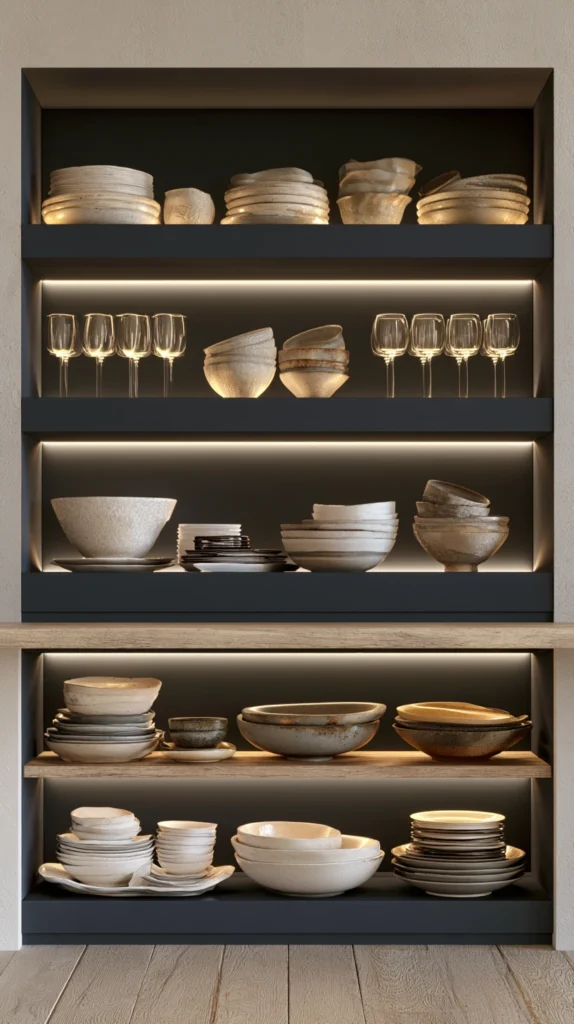
An alcove or recess in a kitchen wall is a shelving opportunity that most kitchens waste by filling with a single cabinet or leaving as dead space.
Built-in shelving fitted precisely into an alcove creates something that looks genuinely bespoke rather than installed. The shelves fit the space exactly. The uprights are flush with the surrounding wall. The result looks like the shelves were always there rather than added later.
Alcove shelves in a kitchen work particularly well at either end of a run of cabinets where a chimney breast or a structural pier creates a recessed area beside the main kitchen. These are the spaces that fitted kitchens traditionally ignore because they are awkward to fill with standard cabinet units.
Built-in alcove shelves fill these spaces perfectly and give the kitchen additional storage and display without any awkward gaps or filler panels. The surrounding cabinets make the alcove shelving feel contained and the overall kitchen composition reads as considered rather than assembled from standard parts.
Paint the inside of the alcove a different colour from the surrounding wall. A deeper tone that makes the alcove recede and the displayed objects advance. Even a subtle tonal difference creates depth and intention that a single uniform wall colour cannot.
4. Industrial Steel and Wood Shelving
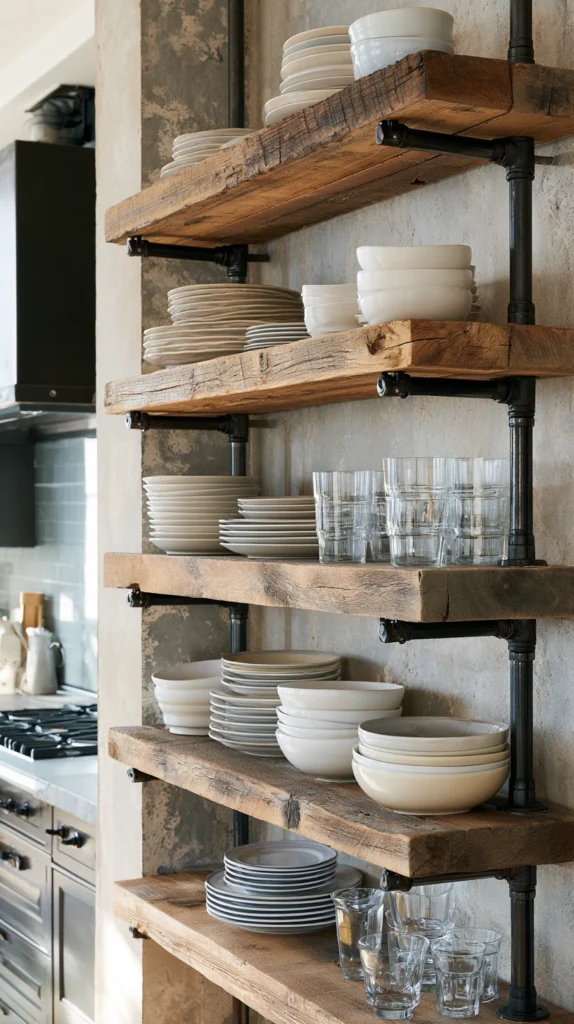
The combination of raw steel brackets and solid wood shelves has become one of the defining visual elements of the contemporary kitchen aesthetic.
And it deserves its popularity entirely.
The contrast between the cold precision of black powder-coated steel and the warm grain of natural timber creates a tension that is visually compelling and practically excellent. The steel brackets are genuinely strong and handle the weight of fully loaded kitchen shelves without any flexing or movement. The wood surface is warm, wipeable, and beautiful.
This combination works across a wide range of kitchen styles. In an industrial kitchen with exposed brick, polished concrete floors, and dark cabinetry it feels entirely native. In a white Shaker kitchen it provides a graphic contrast that lifts the whole space. In a Japandi kitchen with warm wood tones and minimal clutter it adds a considered material detail.
The pipe-and-flange version of this system, threaded steel pipe with black flanges screwed to wall and shelf, is the most DIY-accessible option and one of the most handsome. The pipes can be configured in almost any spacing and the whole system can be adjusted or extended after installation without any specialist knowledge.
5. Floating Glass Shelves for a Light and Airy Feel
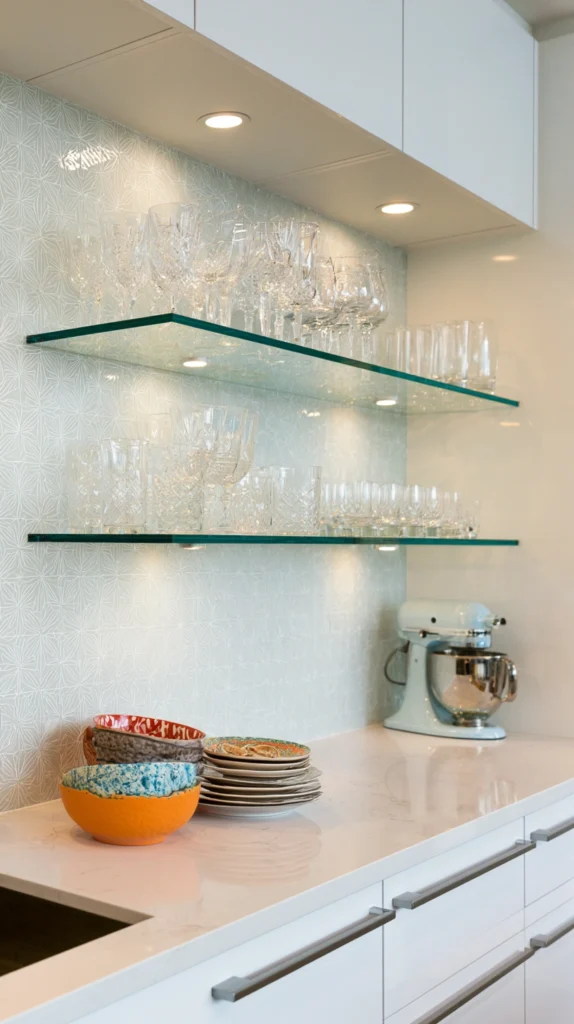
Glass shelves in a kitchen do something no other shelf material can.
They disappear.
A glass shelf between two walls in a small kitchen, or cantilevered from a single wall with hidden hardware, creates floating storage that does not visually reduce the space around it. The objects placed on a glass shelf appear to hover against the wall rather than sitting on a surface.
This matters enormously in small kitchens where adding any physical element risks making the space feel more cramped. Glass shelves give you the storage of a shelf with almost none of the visual weight.
Tempered glass in a minimum of ten millimetres thickness is the correct specification for kitchen shelves. This thickness handles the weight of loaded shelving without any noticeable flex and is genuinely safe if it were ever to break, shattering into small rounded pieces rather than sharp shards.
Glass shelves are the right choice for displaying glassware specifically. Glasses on a glass shelf look as if they are part of the same continuous transparent material. The effect is particularly beautiful when lit from below with LED strip lighting that makes both the shelf and the glass objects on it glow.
6. Open Shelves Only Above the Sink
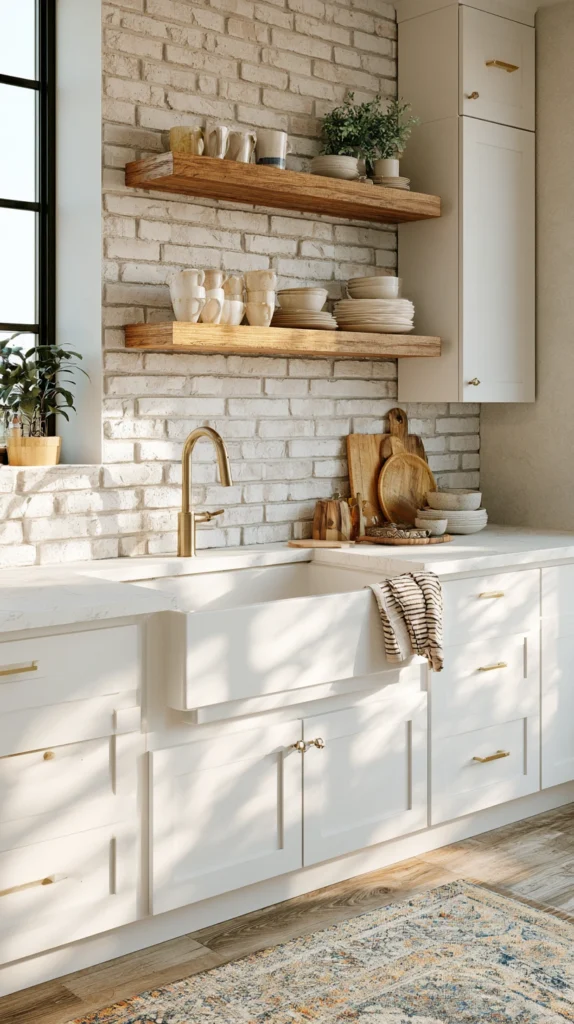
The most cautious and most universally recommended entry point into kitchen open shelving is a single pair of shelves above the sink, replacing the upper cabinet that would typically sit there.
Above the sink is the natural place for open shelves in any kitchen. It is the area where the most frequently used items live. Dish soap, hand wash, a pot plant, drying herbs, and the cup you reach for a dozen times a day. None of these benefits from being behind a cabinet door. All of them look better on an open shelf.
It is also the area where removing an upper cabinet makes the biggest difference to the feeling of the kitchen. That cabinet above the sink, directly in the primary sight line when standing at the worktop, is the first thing that closes a kitchen in. Replacing it with open shelves immediately opens the space up and brings light into the kitchen’s most-used zone.
Start with two shelves above the sink. Live with them for a full kitchen season before deciding whether to extend open shelving further. Most homeowners who start with two shelves above the sink end up removing more cabinets within a year.
7. A Ladder Shelf as a Standalone Kitchen Storage Piece
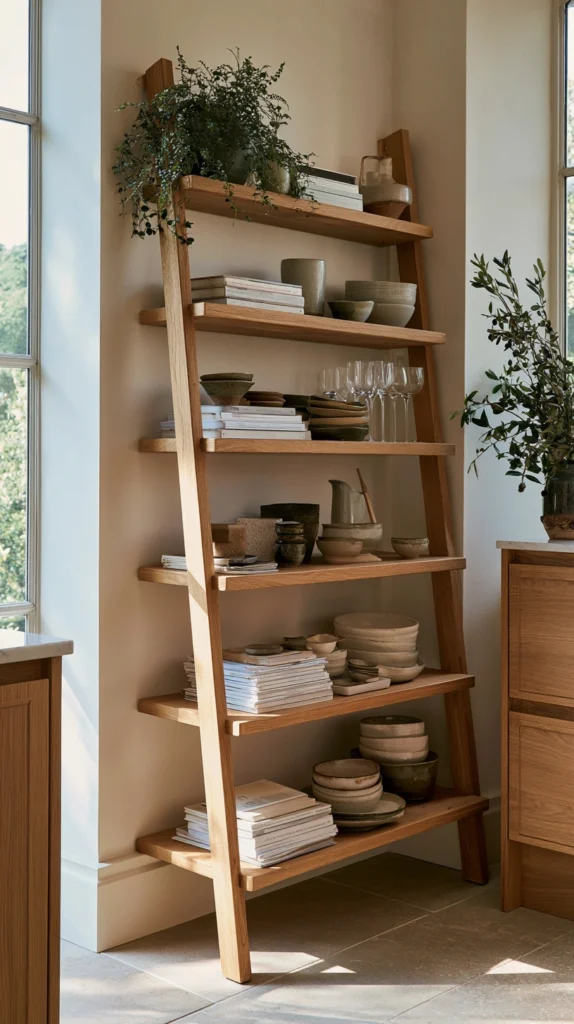
The freestanding ladder shelf is the solution for renters, for temporary kitchens, and for homeowners who want to test open shelving before committing to permanent wall-mounted installation.
A ladder shelf leaned against a kitchen wall provides four to five levels of open storage without a single screw in the wall. It can be moved, repositioned, or removed entirely without any trace.
A well-chosen ladder shelf in a kitchen looks considered rather than impermanent. A solid oak ladder shelf in a natural finish leaned against a painted kitchen wall is genuinely beautiful. A black powder-coated steel ladder shelf in an industrial kitchen looks completely intentional.
Use the ladder shelf for the display items rather than the daily-use heavy crockery. Cookbooks. A collection of ceramic mugs. A plant that trails down from a higher rung. The items that make the kitchen feel personal rather than the items that need to be most accessible.
The ladder shelf works particularly well in a kitchen with limited wall space for mounting but a spare floor area at the end of a run of cabinets or beside a freestanding island.
8. Shelves With Integrated LED Lighting
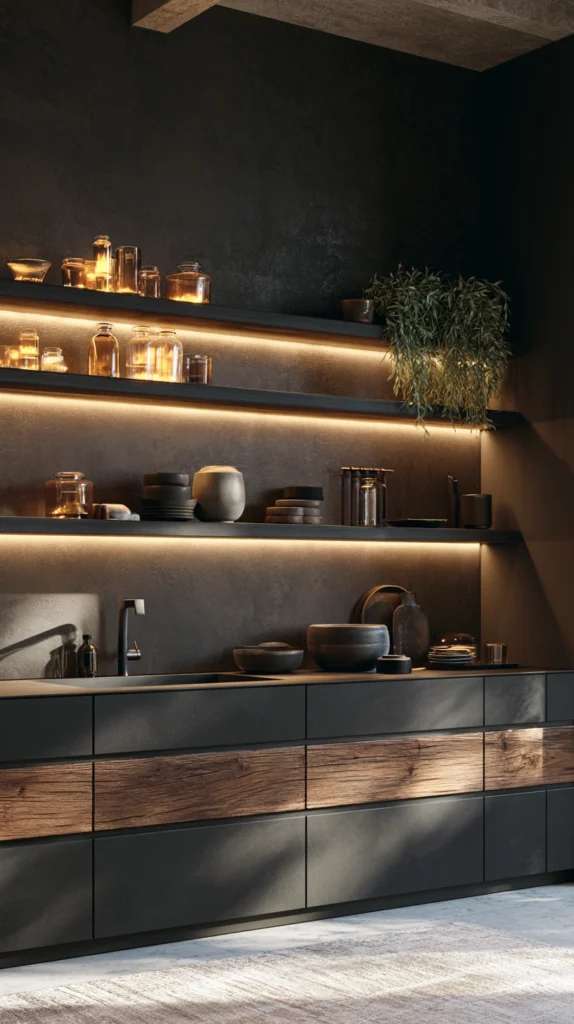
A lit shelf is a fundamentally different object from an unlit one.
LED strip lighting fixed to the underside of each shelf, or to the back wall of a shelf bay, transforms open kitchen shelving from functional storage into something that genuinely glows and creates atmosphere.
Warm white LED strips fitted to the underside of shelves create pools of warm light on the worktop below. This is practical task lighting for food preparation while also being extraordinarily atmospheric on a dark evening when the overhead lights are dimmed.
Backlit shelving, where the LED strip runs along the back wall of the shelf bay and illuminates the objects from behind, creates a completely different effect. The silhouettes of glasses, ceramics, and bottles are caught in the light. Everything on the shelf becomes a slightly luminous object rather than a flat, day-lit one.
This approach works particularly beautifully in open shelving built into an alcove, where the recess contains and focuses the light in a way that wall-mounted shelves in an open space cannot.
The LED strip is one of the most affordable additions you can make to any shelf installation and one of the most transformative.
9. Corner Open Shelving That Solves the Dead Corner Problem
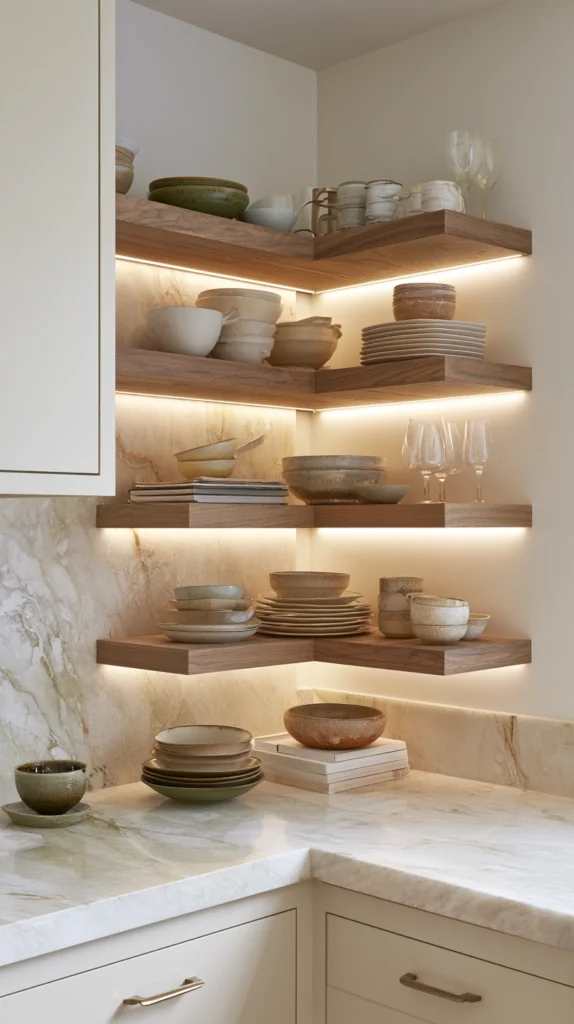
The kitchen corner is one of the most notoriously difficult spaces in any fitted kitchen.
Corner cabinet solutions, carousels, pull-out units, and magic corners all attempt to make the deep, awkward kitchen corner accessible. None of them do it particularly well. All of them are expensive relative to what they provide.
Open corner shelving solves the problem simply and beautifully.
Diagonal shelves that cut across the corner at forty-five degrees, or curved shelves that follow the inside of the corner in a quarter-circle, make the corner space completely visible and fully accessible from both adjacent angles.
The corner becomes a display opportunity rather than a storage problem. The angle of the diagonal or curved shelf creates an interesting shape that straight shelves cannot provide. Ceramics, plants, and decorative objects sit particularly well on corner shelving because the angle shows them from multiple directions simultaneously.
Building open corner shelves in a kitchen also connects two separate runs of shelving into a single continuous composition that flows around the corner rather than stopping abruptly at each side.
10. Shelves Painted the Same Colour as the Wall
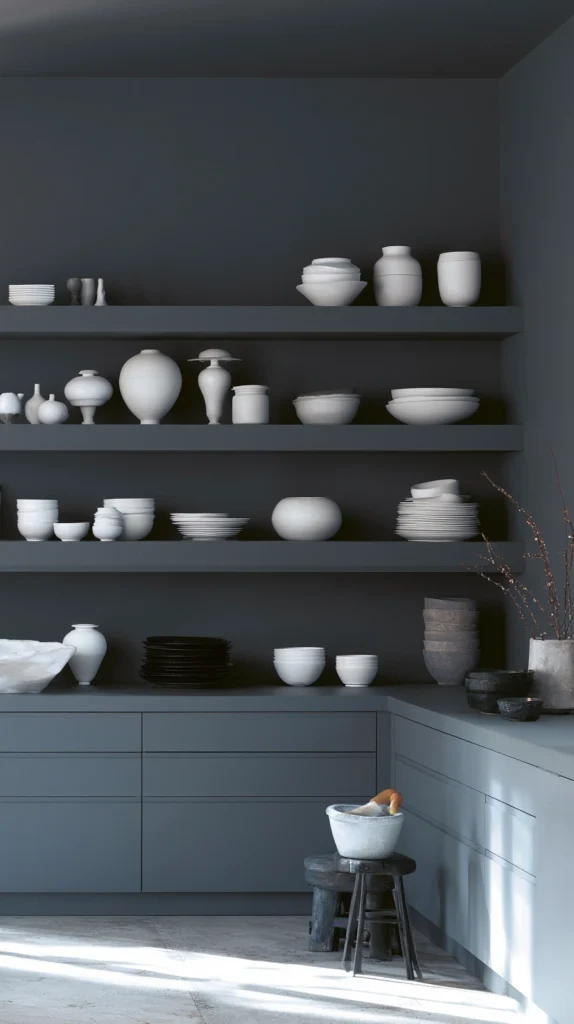
The most sophisticated version of open kitchen shelving is shelves that almost disappear into the wall behind them.
Painting wooden shelves and their brackets in exactly the same colour as the wall they are mounted on creates a monochromatic effect where the shelf and the wall read as a single surface. The objects displayed on the shelves appear to float against the coloured background with no visible shelf structure beneath them.
This technique works particularly well with deep, matte wall colours. A dark green kitchen with dark green shelves looks more like a built-in piece of architecture than a shelf installation. A dusty blue kitchen with matching shelves creates a seamless, enveloping quality that a contrasting shelf colour never achieves.
The shelf colour should match the wall in both hue and finish. A matte wall with a gloss shelf breaks the illusion. A matte wall with a matte shelf in the same colour creates the effect.
This is the technique that makes open shelving look expensive regardless of the actual cost of the materials. A simple wooden shelf on a painted bracket, painted the same colour as the wall, can look more designed than a bespoke shelf in expensive hardwood with contrasting brackets.
11. A Pegboard System as a Kitchen Shelf Alternative
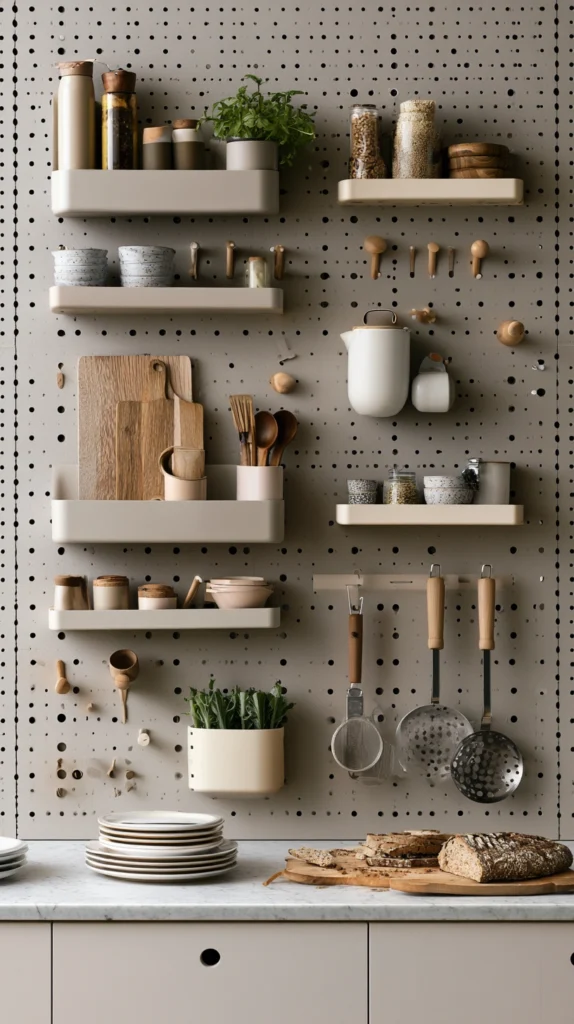
The pegboard is the open shelving system that gives a kitchen maximum flexibility at minimum cost.
A sheet of pegboard fixed to a kitchen wall and fitted with the appropriate hooks, shelves, rails, and holders creates an entirely customisable storage and display system that can be reconfigured in minutes without any tools.
Move the shelf bracket from one set of holes to another. Add a hook for a new pan. Remove the spice rack and replace it with a small shelf for a plant. The pegboard adapts to changing needs in a way that fixed shelving cannot.
The aesthetic of a pegboard kitchen wall is specific. It has an organised-workshop quality that suits industrial, Japandi, and contemporary kitchen styles very well. In a traditional or cottage-style kitchen it can feel too utilitarian. Know your style before committing to pegboard as your primary open storage.
Paint the pegboard rather than leaving it raw. A painted pegboard in a colour that contrasts with or complements the kitchen reads as designed. A raw unpainted pegboard in a kitchen reads as unfinished.
The hooks, shelves, and accessories for pegboard are available in brass, copper, black steel, and natural wood finishes that can match the hardware and material palette of the kitchen exactly.
12. Open Shelving in a Kitchen Island
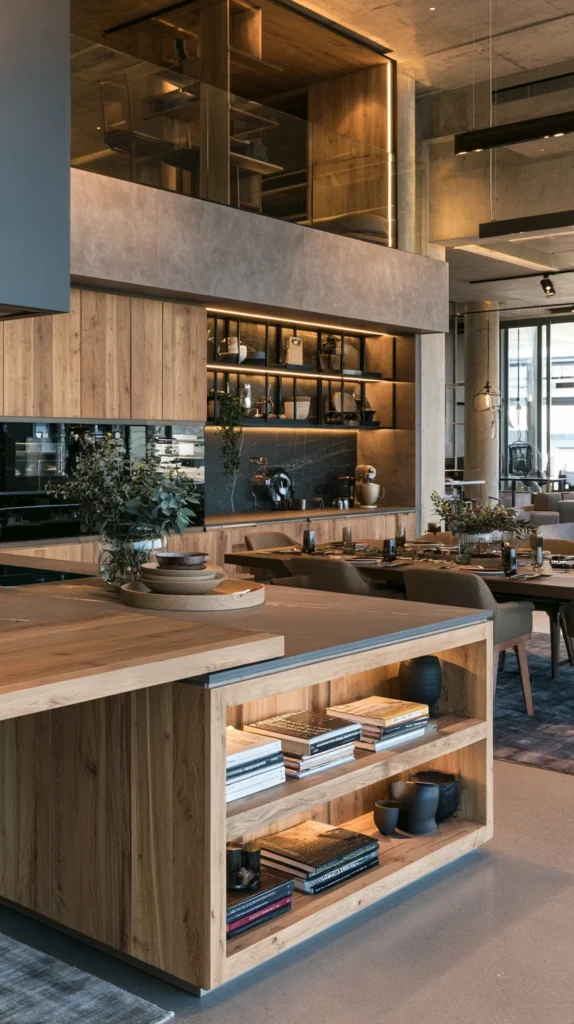
Most kitchen islands have closed cabinets on all sides.
Opening up one or two sides of the island with open shelving rather than cabinet doors creates storage that is accessible from both the kitchen and the adjacent living or dining area without requiring anyone to walk around the island to reach a cabinet.
The island open shelf side typically faces the living or dining area. From this direction it displays a curated selection of objects that look beautiful from the seating area. Cookbooks arranged by spine colour. A collection of interesting bottles. A plant that trails down from the shelf above.
From the kitchen side the closed cabinets handle the practical storage that does not need to be on display.
This configuration makes the island feel less like a piece of kitchen furniture and more like a piece of furniture that belongs in the whole room. The open shelving side reads as part of the living space rather than purely as kitchen storage.
A breakfast bar overhang on the same side as the open shelving creates a continuous design element that unifies the island’s kitchen-facing function with its living-space-facing personality.
13. Reclaimed and Salvaged Wood Shelves
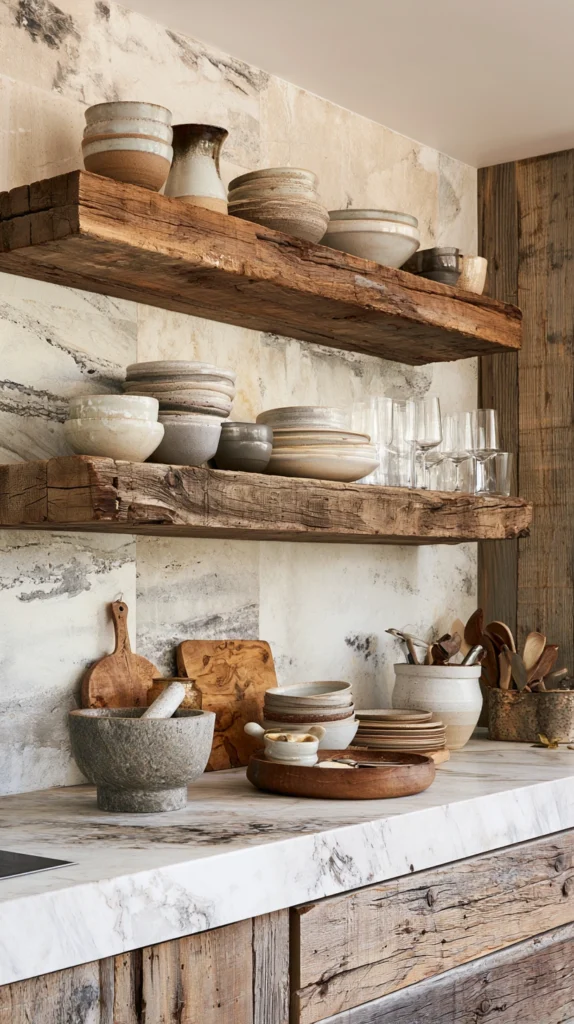
The most characterful kitchen shelves are the ones that arrived from somewhere else.
A length of reclaimed timber from a demolished Victorian school, a scaffold board from a building site, a beam salvaged from a barn conversion, a slice of a fallen garden tree milled into a thick slab. These materials bring a history and character to a kitchen shelf that new timber simply cannot replicate.
The marks, the nail holes, the saw cuts, the colour variation, and the surface texture of reclaimed wood are not imperfections. They are the record of the material’s previous life and they make the shelf genuinely interesting rather than generically attractive.
Reclaimed wood shelves age differently from new wood. They have already done most of their moving and settling. The colour is already established. The character is already formed. They arrive looking right immediately rather than needing years of use to develop the patina that makes a shelf feel like it belongs.
Source reclaimed timber from architectural salvage yards, online salvage dealers, and local demolition sites. Treat with a food-safe oil rather than paint or varnish to preserve the natural surface and colour of the material. Mount with simple brackets that do not compete with the character of the wood.
A reclaimed wood shelf in a new kitchen is the element that stops the kitchen feeling brand new and starts it feeling lived in.
What to Display on Open Kitchen Shelves
The display is as important as the shelf itself.
Open kitchen shelving only looks good if the objects on it are worth looking at and organised in a way that reads as intentional rather than random.
Group objects by type. All the glasses together. All the white crockery stacked. All the ceramics in a cluster. The organisation does not need to be rigid but it needs to have a logic that the eye can read from across the room.
Choose objects that share a colour palette even if they vary in material and form. A collection of crockery in cream, white, and natural stone tones looks cohesive on a shelf regardless of how many different pieces it contains. The same number of pieces in ten different colours looks chaotic.
Add living elements. A trailing pothos. A small herb pot. A single stem in a simple vase. Plants break the regularity of stacked objects and add the organic, imperfect quality that makes open shelving look like a place where someone actually cooks rather than a styled showroom.
Edit ruthlessly. The number of objects on an open shelf should be roughly half of what you think you need. Empty space on a shelf is not wasted space. It is the breathing room that makes everything else look considered.
Common Mistakes With Kitchen Open Shelving
Going open everywhere at once. Removing every upper cabinet in a kitchen simultaneously creates a space that feels unanchored and requires an impossible level of daily tidying. Keep some closed storage and open the rest gradually.
Choosing shelves that are too shallow. A shelf depth of less than twenty-five centimetres is too shallow for standard dinner plates. Thirty to thirty-five centimetres is the correct depth for kitchen open shelving.
Neglecting the wall behind the shelves. The wall behind open shelves is visible at all times. Paint it a considered colour, tile it, or add a material that looks beautiful as a backdrop.
Displaying everything. The items stored in kitchen cabinets are not all worth displaying. Cleaning products, plastic containers, and mismatched objects from the back of the cabinet do not belong on an open shelf.
Not considering the cooking zone. Open shelves directly beside or above a hob collect grease from cooking rapidly. Keep open shelving away from the primary cooking zone or plan for more frequent cleaning of anything displayed there.
Underestimating the maintenance. Open shelves need dusting and wiping regularly. Not daily but weekly. The commitment is not enormous but it is real. Do not install open kitchen shelving if you are not prepared to maintain it.
Quick Summary
- Thick solid hardwood shelves on simple brackets are the most beautiful and most versatile kitchen shelf option
- A floor-to-ceiling open shelf wall makes the shelving an architectural feature rather than a storage decision
- Alcove shelving fits awkward spaces perfectly and looks genuinely bespoke rather than installed
- Industrial steel and solid wood is one of the most popular combinations for good practical and aesthetic reasons
- Glass shelves make storage almost invisible and are the ideal choice for displaying glassware
- Two shelves above the sink is the lowest-risk, highest-impact starting point for anyone uncertain about open shelving
- A freestanding ladder shelf is the renter-friendly and commitment-free way to test open kitchen shelving
- LED strip lighting on the underside or back of shelves transforms the shelf from storage into atmosphere
- Corner open shelving solves the kitchen corner problem more simply and beautifully than any cabinet system
- Painting shelves the same colour as the wall creates a monochromatic effect where objects appear to float
- A pegboard system provides maximum flexibility and adaptability at minimum cost
- Opening one side of a kitchen island with shelves makes it belong to the whole room rather than just the kitchen
- Reclaimed and salvaged timber brings immediate character that new wood takes years to develop
- Display half as many objects as you think you need and leave the rest in closed storage somewhere else
- Group by type, share a colour palette, add plants, and edit ruthlessly
The kitchen shelf instead of a cabinet is not a trend.
It is a decision about what kind of kitchen you want.
One where everything is hidden behind doors and the room could belong to anyone. Or one where the objects you have chosen say something about who cooks there and what they care about.
Open shelving makes a kitchen personal.
And a personal kitchen is always a better kitchen.