12 Garden Arbor Ideas for a Romantic Entrance
An arbor does something almost no other garden structure can manage on its own, it turns a simple act of walking through a gap in a fence into an actual moment.
That’s the whole appeal, really. A path with no arbor is just a path. The same path with a vine-covered archway overhead becomes an entrance, a threshold, the kind of spot people instinctively pause under for a photo without anyone suggesting it.
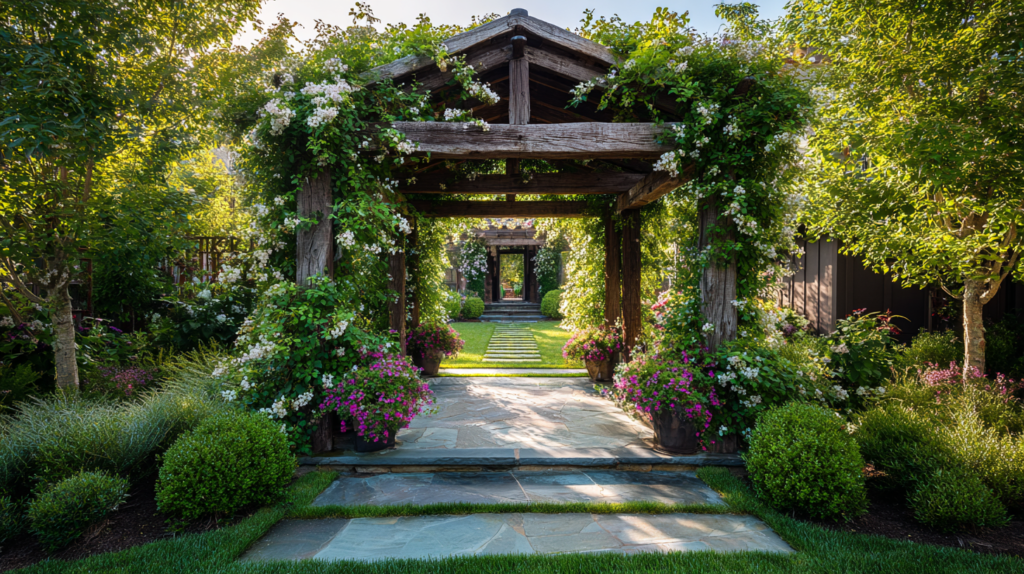
Getting that effect doesn’t require an elaborate build. Even a simple wooden frame, once a climbing rose or clematis has a season or two to work with it, delivers genuine romance for a fraction of what a formal garden renovation would cost.
Here are 12 garden arbor ideas built specifically around that entrance moment.
Every one of these can be adapted to whatever’s already growing near your own front walk or garden gate.
1. Classic White Wooden Arch With Climbing Roses
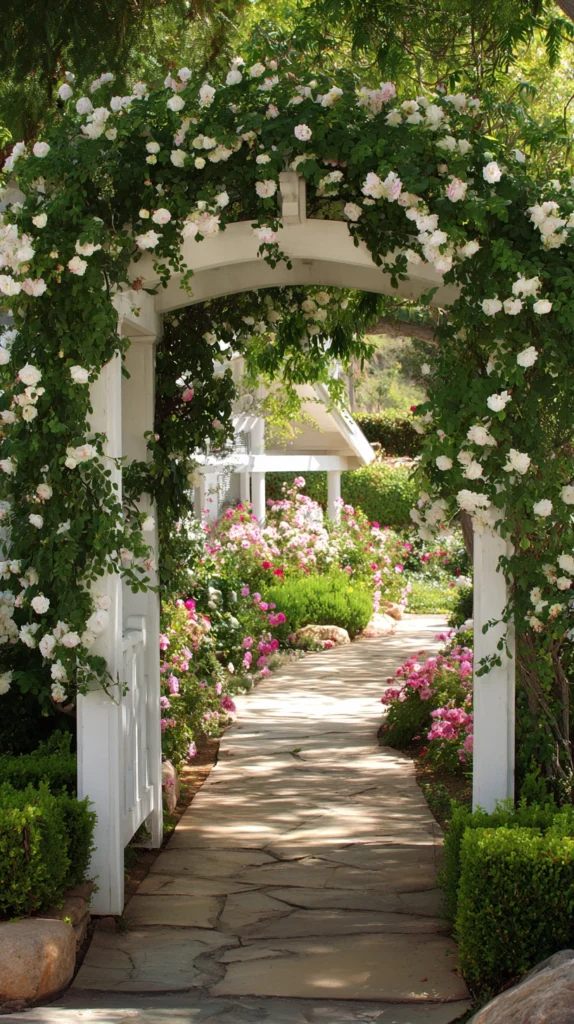
A simple painted wooden arch, finished in crisp white, planted with a climbing rose variety on each side to fill in over a couple of growing seasons.
There’s a reason this combination shows up in nearly every romantic garden photo you’ve ever seen, the clean white structure gives climbing roses something to actually show off against, rather than competing with a busier or more textured material.
I built a basic cedar arch, painted it in a bright white exterior enamel, and planted a pink climbing rose on one side and a soft apricot variety on the other, letting them meet and intertwine at the top by the second summer.
Budget tip: A pre-cut arch kit from a home improvement store costs considerably less than a custom-built structure and still delivers the same classic silhouette once painted and planted.
A few things worth getting right:
- Choose a rose variety specifically bred for climbing, since bush roses trained upward rarely achieve the same dense coverage
- Prime bare wood thoroughly before painting, since untreated cedar can bleed tannins through a lighter paint color over time
- Tie new canes loosely to the frame as they grow rather than waiting until the plant is fully established, which makes training considerably easier
By the third season, an arch like this needs almost no additional decoration, since the roses themselves become the entire visual event.
Choosing paint over stain turned out to matter more than I expected once the roses filled in, since white specifically reflects light back up through the canes in a way that made the blooms noticeably brighter against the structure than they’d looked on a similar arch I’d seen finished in natural wood.
2. Rustic Cedar Log Arbor With Wisteria
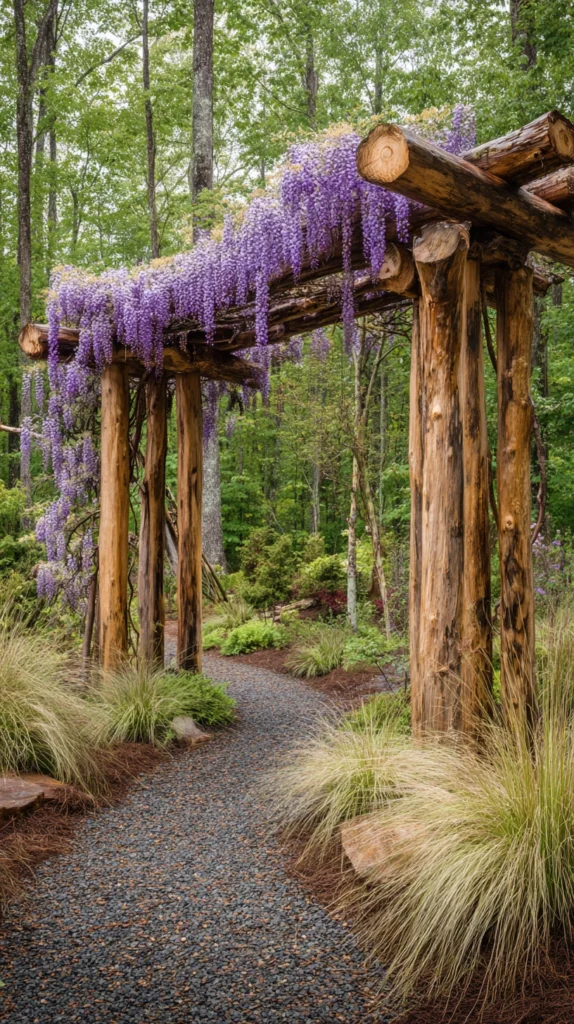
A more organic, less finished arbor built from unpeeled cedar logs and branches, planted with wisteria for dramatic, cascading spring blooms.
Wisteria demands a genuinely sturdy structure, since mature vines grow remarkably heavy over time, and a rustic log-built arbor tends to have the substantial, permanent feel this particular vine actually requires.
I built my arbor from thick cedar logs sourced from a local sawmill, using traditional mortise joints rather than screws for a more authentic, old-world look, then planted wisteria at the base of each upright post.
Budget tip: Contacting a local sawmill or tree service directly for cedar logs often costs significantly less than purchasing milled lumber, especially if you’re willing to do some of your own peeling and finishing work.
A few build considerations:
- Use logs at least 6 inches in diameter for the main uprights, since wisteria’s mature weight genuinely stresses a lighter structure over time
- Set posts in concrete footings below frost line, given how much additional weight the structure needs to support once vines mature
- Prune wisteria aggressively each year, both to control its size and to encourage the dense flowering rather than just excessive vine growth
This combination takes real patience, often three to five years before wisteria blooms reliably, but few plants deliver a more dramatic spring display once established.
I underestimated how much the mature vine would eventually weigh, and by year four one of the crossbeams had visibly begun to sag, which meant adding a mid-span support post I hadn’t originally planned for but should have built in from the start.
3. Metal Garden Gate Arbor With Clematis
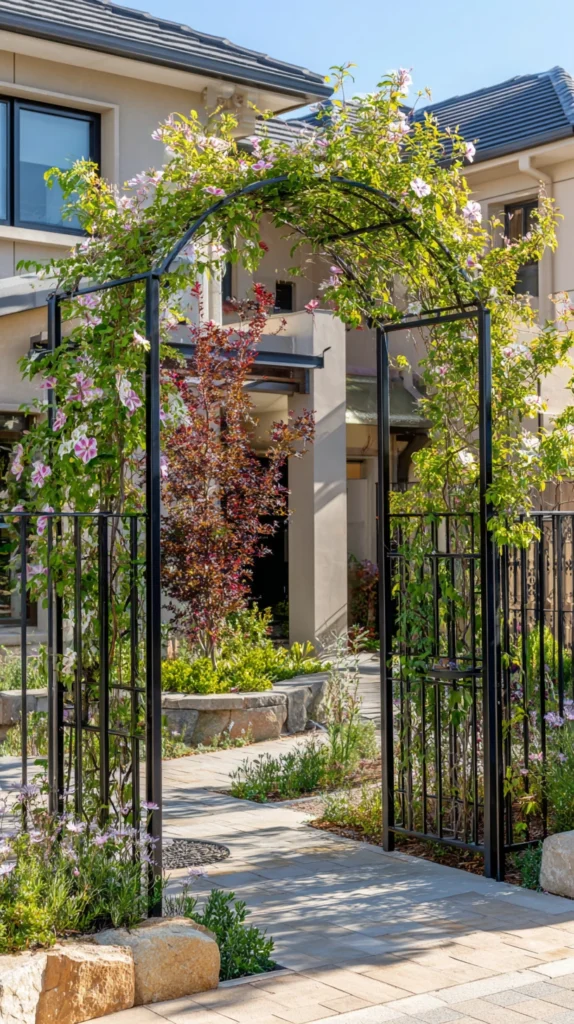
A decorative wrought iron or steel arbor built directly around a garden gate, using the gate itself as the entrance’s functional centerpiece with clematis climbing the surrounding framework.
Combining an arbor with an actual working gate adds a layer of function that a purely decorative arch doesn’t offer, giving the entrance both a genuine sense of arrival and a practical boundary marker.
I installed a black wrought iron arbor with an integrated gate at the entrance to my back garden, training two different clematis varieties, one early summer bloomer and one that flowers into fall, up either side of the frame.
Style tip: Choose a metal finish that will weather gracefully rather than one that shows rust unevenly, since this structure typically stays in place far longer than a wooden arbor and needs to age well over many seasons.
A few practical notes:
- Choose clematis varieties with staggered bloom times to keep color present across a longer stretch of the growing season
- Provide additional twine or wire support in the early stages, since clematis tendrils need something thin to actually grip before thicker growth develops
- Oil or treat hinges regularly if the gate sees daily use, since a stiff or squeaky gate undercuts the romantic effect the surrounding planting is meant to create
Metal structures like this tend to outlast wooden alternatives by decades, making this a strong choice if you want the arbor itself to be a genuinely permanent garden feature.
The powder-coated finish I chose has held up considerably better than an older painted iron gate I’d previously owned elsewhere on the property, which needed re-painting every few years just to keep rust from creeping in along the welds.
4. Twin Arbor Pathway With a Repeating Rhythm
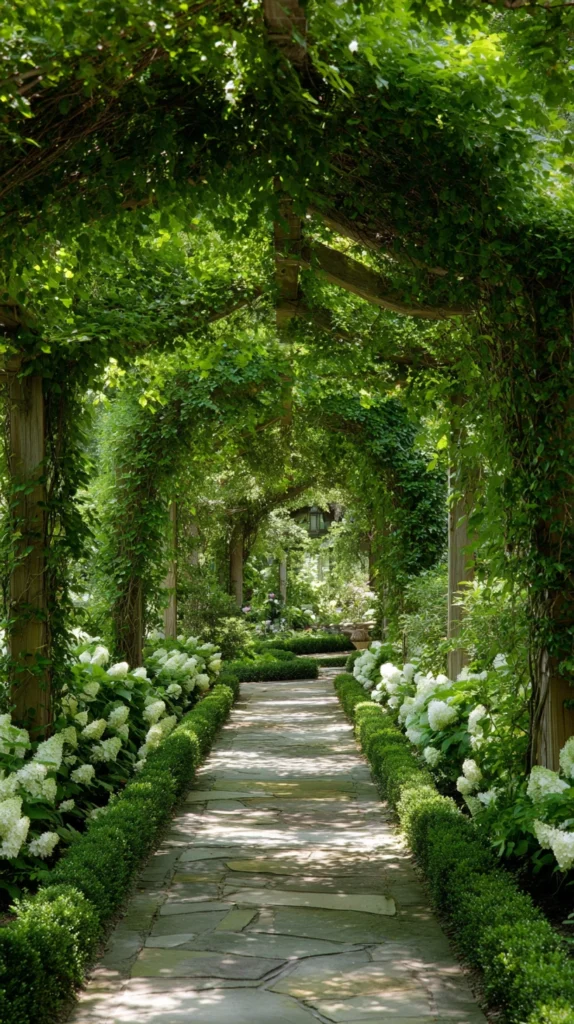
Two or more matching arbors spaced along a single garden path, creating a repeating rhythm of archways rather than a single entrance point.
A repeated arbor sequence does something a single arch can’t, it turns an entire walk into a series of framed moments instead of one brief threshold, which reads as considerably more grand for a relatively modest additional cost per structure.
I installed three matching cedar arbors spaced 10 feet apart along my main garden path, planting climbing hydrangea up each one so the entire walk fills in as a continuous, softly framed tunnel by midsummer.
Budget tip: Building multiple simple arbors from the same basic kit or plan costs less overall than one elaborate, oversized single structure, since materials and labor scale in a straightforward way across identical builds.
A few things worth planning:
- Space arbors evenly and consistently, since uneven spacing is immediately noticeable once you’re standing at one end of the path looking down its length
- Choose a single plant variety to repeat across all arbors rather than mixing different climbers at each one, which keeps the overall effect reading as a deliberate sequence
- Confirm the path width comfortably fits beneath the narrowest point of the arbors, especially once mature growth adds real bulk to the structure
Walking beneath a full sequence like this, especially once the plants have filled in, delivers a considerably more theatrical entrance experience than any single arbor manages alone.
I initially spaced my three arbors slightly differently to account for an existing tree root I didn’t want to disturb, and the small inconsistency was noticeable enough from one end of the path that I ended up rerouting the walkway slightly instead of compromising the spacing.
5. Arbor Bench Combination for a Seated Threshold
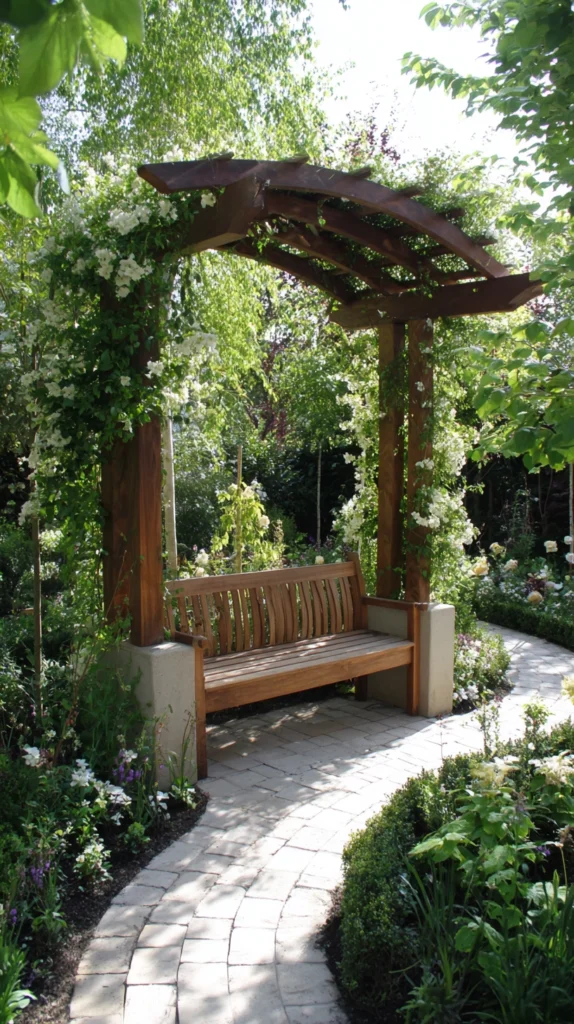
An arbor built with an integrated bench at its base, turning the entrance itself into a place to actually sit and linger rather than just pass through.
Most arbors are designed purely as a walk-through feature, but adding seating directly beneath the structure changes its entire function, giving people a reason to stop at the threshold rather than moving straight past it.
I built a simple arbor with a built-in bench spanning the base, planted with a fragrant jasmine vine trained up both sides, positioned at the entrance to a small side garden where the seat now gets used almost daily.
Budget tip: Building the bench directly into the arbor’s structural frame, rather than adding a separate freestanding bench afterward, saves on materials since the arbor’s existing uprights can double as the bench’s support posts.
A few build considerations:
- Size the bench for genuine comfort, generally at least 18 inches deep and a standard seat height around 17 to 19 inches
- Choose a fragrant climbing plant specifically for this application, since the seated vantage point puts visitors in direct proximity to the scent in a way a simple walk-through arbor doesn’t
- Weatherproof or cushion the bench seat appropriately, since a purely decorative bench that’s uncomfortable to actually sit on defeats the entire purpose of adding one
This combination works especially well positioned to catch a specific view, since the whole point is encouraging someone to pause and actually look around rather than just walk through.
My first bench design sat a bit too upright for genuinely comfortable lingering, and adding a slight backward tilt to the backrest on the rebuild made an enormous difference in how long people actually stay seated there once they sit down.
6. Moon Gate Circular Arbor
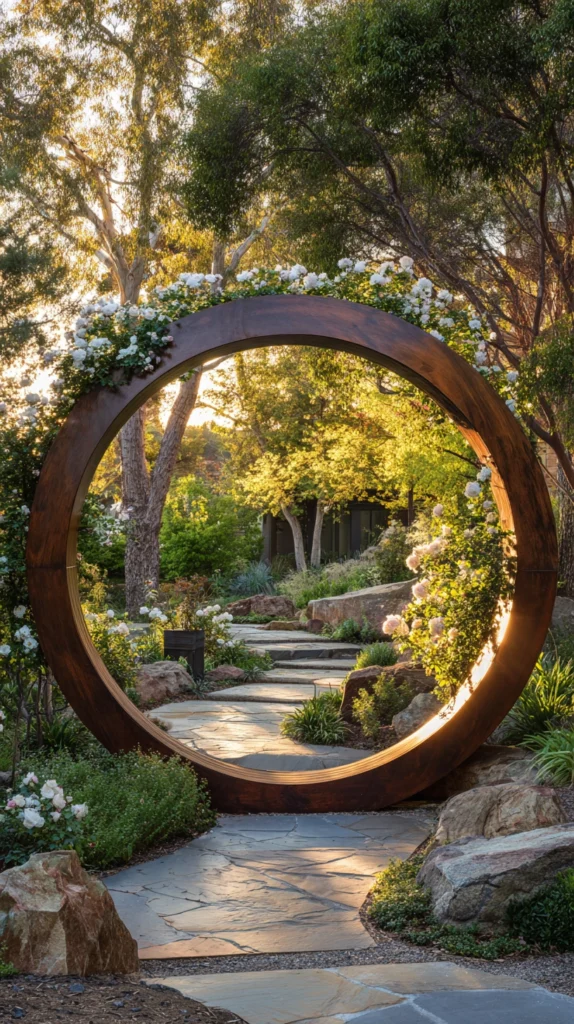
A fully circular arbor, sometimes called a moon gate, built as a complete ring rather than a traditional peaked or arched top.
The circular shape reads as distinctly more formal and intentional than a standard arch, and it creates a genuinely striking frame for whatever view sits directly beyond it, whether that’s a specific tree, a piece of garden art, or simply the garden path continuing onward.
I built a circular moon gate from curved laminated wood sections, painted a deep charcoal, and trained a climbing rose to grow along the ring’s curve rather than straight up a vertical post.
Style tip: Position a moon gate so it deliberately frames something specific beyond it, since an entry that leads to nothing in particular loses much of the impact this striking shape is capable of delivering.
A few build considerations:
- Source curved laminated wood sections from a specialty supplier rather than attempting to bend standard lumber yourself, since achieving a clean circular shape requires specific bending techniques
- Train vines to follow the ring’s actual curve deliberately, tying new growth at regular intervals rather than letting it default to growing straight
- Anchor the structure with a genuinely substantial footing, since a circular shape distributes weight differently than a standard peaked arch and needs stable support at its base
A well-placed moon gate becomes one of the most photographed features in almost any garden that has one, simply because the shape itself is unusual enough to draw the eye immediately.
Getting the rose to actually follow the circular curve rather than growing straight up past it took more hands-on training than I expected, with weekly tying sessions through most of that first growing season before the cane finally started curving on its own.
7. Rose-Covered Arbor Over a Garden Gate at the Property Line
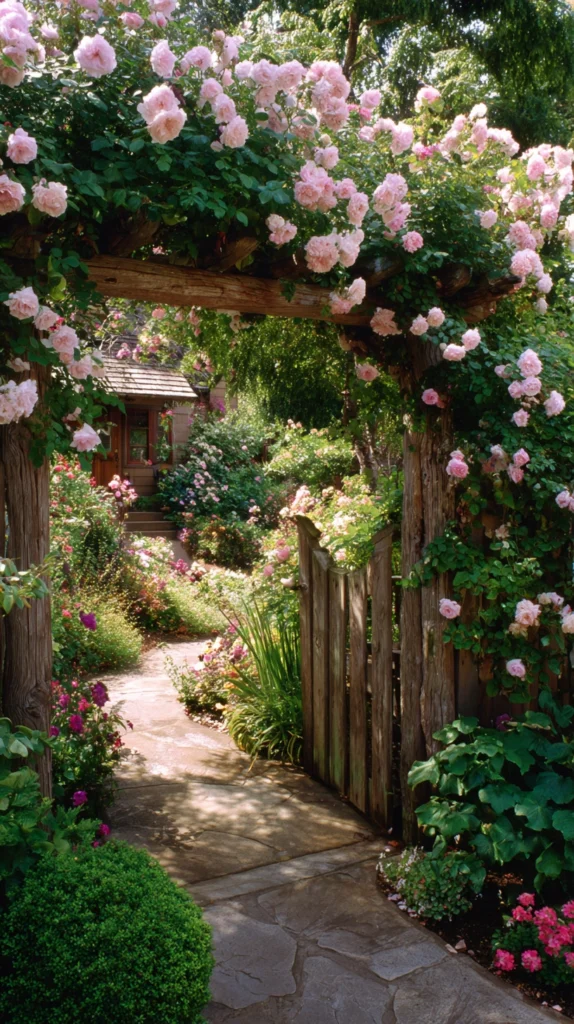
An arbor positioned specifically at a front yard’s property line or fence gate, marking the transition from public street to private garden with climbing roses trained overhead.
Positioning an arbor at the actual property boundary, rather than somewhere deeper inside the garden, gives visitors a clear, immediate sense of arrival the moment they step off the sidewalk.
I built a simple wooden arbor directly over my front gate, planted with a fragrant old garden rose variety chosen specifically for its scent, so visitors are greeted with fragrance before they’ve even reached the front door.
Budget tip: A front gate arbor typically needs to span a narrower opening than a garden pathway arbor, which means less material and lower overall cost for what’s often the single highest-visibility structure on this entire list.
A few practical notes:
- Choose a scented rose variety specifically for this location, since the fragrance payoff matters more here than almost anywhere else in the garden
- Confirm local setback requirements or HOA guidelines before building anything directly at a property line
- Size the gate opening generously enough for two people to pass through comfortably side by side, rather than a narrow single-file passage
This is one of the highest-impact placements on this entire list, since it’s the very first garden feature anyone sees before setting foot on the property at all.
I chose a rose variety mostly for its color at first, only to look up its scent profile afterward and discover it was barely fragrant at all, which is the mistake that led me to swap it out a year later for an old garden variety specifically known for its perfume.
8. Vine-Covered Arbor Tunnel Leading to a Garden Room
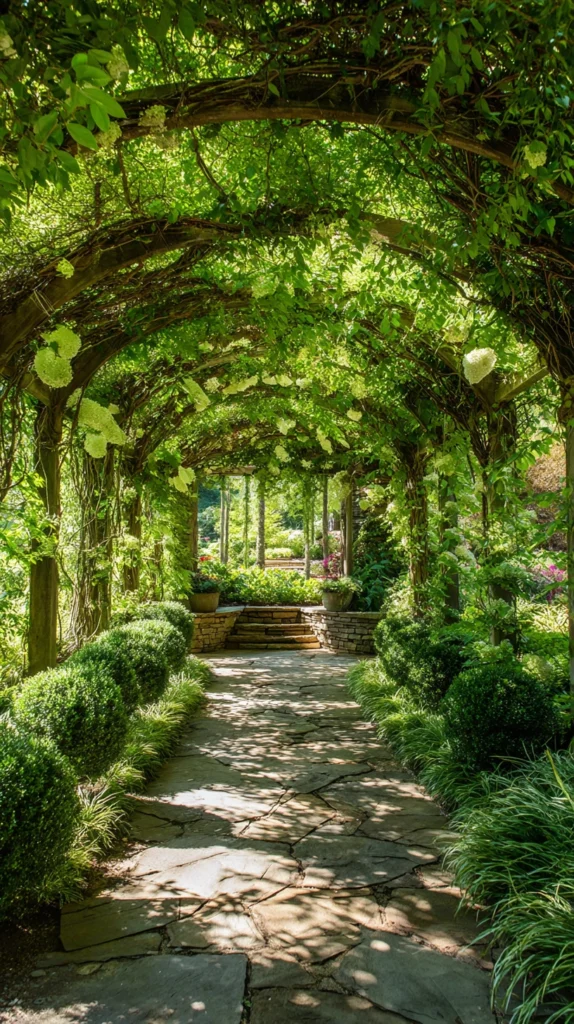
An extended arbor structure, essentially several connected arches forming a full tunnel, leading from a main lawn or patio into a smaller, more enclosed garden room beyond.
A tunnel arbor does more than frame a single threshold, it creates an actual journey, building genuine anticipation as visitors walk through a shaded, plant-covered passage before emerging into whatever space waits on the other side.
I built a 12-foot tunnel from five connected cedar arches, spaced closely enough that climbing hydrangea and clematis fill the gaps almost completely by midsummer, leading from my main patio into a small, secluded reading garden.
Budget tip: Building a tunnel from several smaller, identical arch sections costs less overall than commissioning one long custom structure, since the repeated simple design keeps both materials and labor more manageable.
A few things worth planning:
- Space individual arches close enough together that plant growth actually connects them into a continuous tunnel rather than reading as separate, disconnected arches
- Choose fast-filling vines specifically for a tunnel application, since gaps in coverage are more noticeable in this format than on a single standalone arch
- Consider the tunnel’s total length carefully, since anything much beyond 15 to 20 feet can start to feel more like a maintenance project than a magical passage
Walking through a fully filled tunnel arbor is one of the more genuinely immersive experiences a garden can offer, closer to entering a room than simply passing under a single arch.
The middle section of my tunnel filled in noticeably slower than the two ends, since it gets less direct sun for a good part of the day, and I ended up adding a shade-tolerant clematis specifically to that one section rather than assuming the same variety would perform identically all the way through.
9. Reclaimed Window Frame Arbor for Cottage Charm
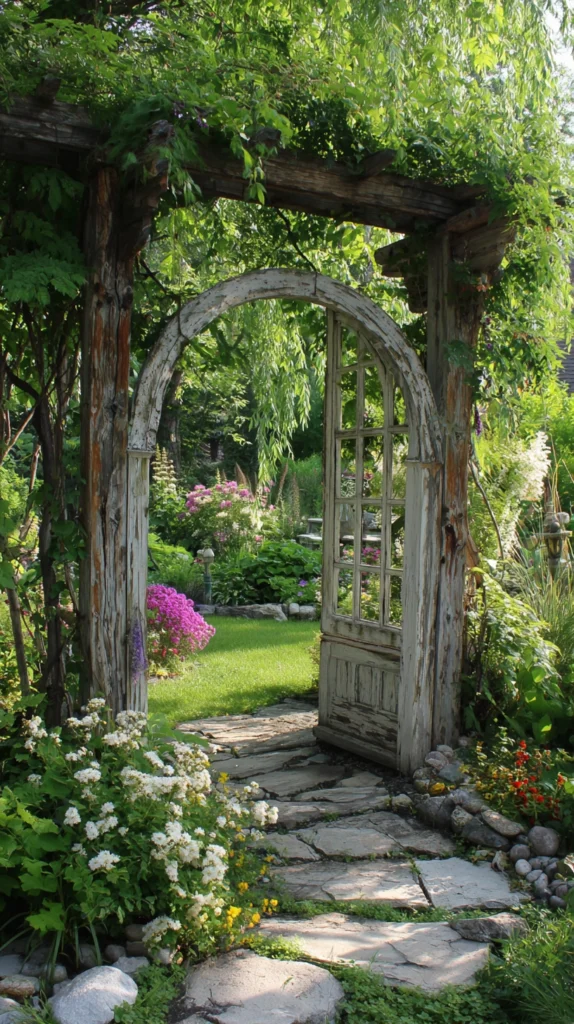
An arbor built using a salvaged, oversized window frame or door frame as the primary structural element, planted with climbing vines that soften the reclaimed material’s weathered character.
Repurposed architectural salvage brings genuine age and history into a garden entrance in a way that new lumber simply can’t replicate, no matter how carefully it’s distressed or finished.
I built an arbor around a salvaged arched window frame found at an architectural salvage yard, mounting it on simple wooden posts and training a mix of climbing roses and morning glory through the original window’s decorative ironwork.
Budget tip: Architectural salvage yards often sell unusual, oversized pieces like arched windows or doors at prices well below what a comparably ornate new structure would cost to have custom built.
A few practical notes:
- Inspect any salvaged material carefully for structural soundness before building around it, since decorative age and actual structural rot are two very different things
- Treat or seal any exposed wood or metal appropriately for outdoor exposure, since salvaged pieces were often originally designed for indoor use only
- Choose vines that complement rather than obscure the salvaged piece’s original decorative details, since the whole point is showcasing that unique character
This is one of the more unpredictable builds on this list, since it depends entirely on finding the right piece, but it delivers a level of genuine character that’s difficult to achieve with any new material alone.
The frame I found had a small section of rot hidden behind decades of paint that wasn’t visible until I started sanding it down, so budgeting extra time for unexpected repair work on any salvaged piece saved me from a frustrating surprise partway through the build.
10. Twin Flanking Arbors Around a Central Statue or Fountain
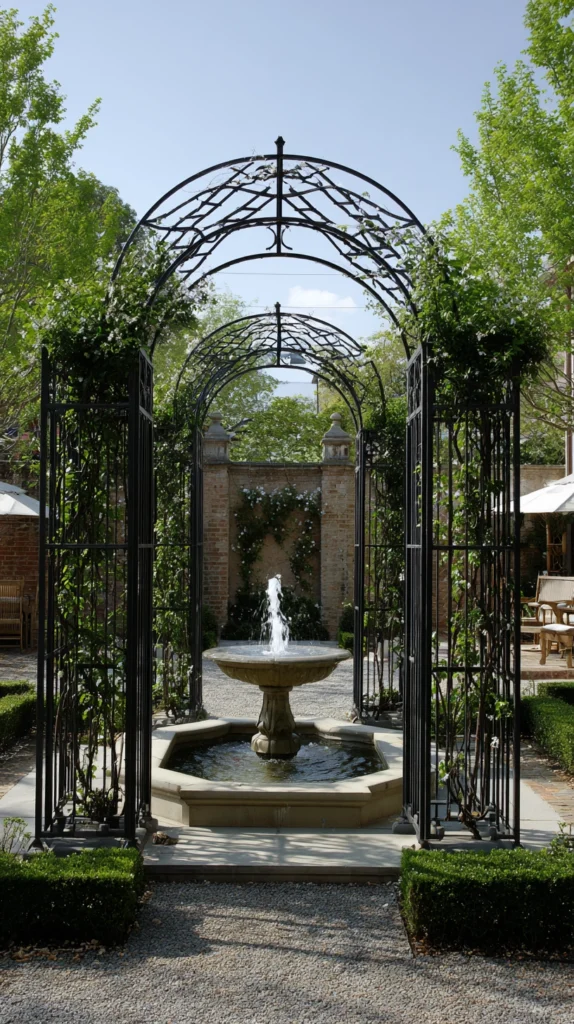
Two matching arbors positioned on either side of a central garden feature, like a statue or small fountain, framing it symmetrically rather than serving as a walk-through structure themselves.
This approach uses arbors purely as a framing device rather than a passage, creating a formal, symmetrical composition around whatever centerpiece the garden already has.
I positioned two matching iron arbors on either side of a small stone fountain, planting matching clematis varieties up each one so the fountain sits centered within a symmetrical green frame rather than standing alone in open space.
Style tip: Keep both arbors and their plantings genuinely identical rather than similar, since even small differences in size or plant choice become immediately obvious once the composition depends on exact symmetry.
A few practical notes:
- Measure carefully to ensure both arbors sit at precisely equal distances from the central feature
- Choose identical plant varieties for both structures specifically, since mismatched bloom times or growth habits will break the symmetrical effect this design depends on
- Consider matching lighting at the base of each arbor for a composition that holds its impact after dark as well as during the day
This is one of the more architecturally deliberate ideas on this list, relying on precise symmetry rather than the looser, more organic feel most other arbor styles lean into.
One clematis grew noticeably faster than its twin the first season despite identical planting, a difference that turned out to come down to slightly better afternoon sun on one side, so I’ve had to prune the faster grower back deliberately each year just to keep the pair looking evenly matched.
11. Compact Arbor for a Narrow Side Yard Passage
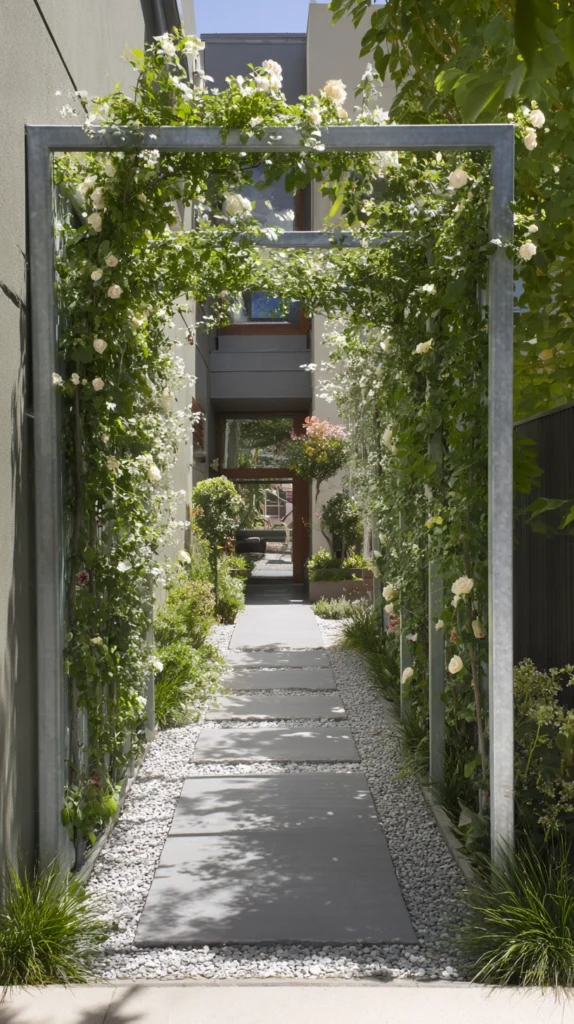
A slim, minimally framed arbor scaled specifically for a narrow side yard passage, where a bulkier structure would feel cramped or obstructive.
Narrow side yards are often skipped entirely when it comes to garden features, but a properly scaled, slender arbor can bring genuine charm to a passage that most people treat purely as a utility walkway between the front and back yard.
I built a narrow, minimal arbor from thin galvanized pipe, just wide enough to comfortably clear a single person walking through, training a lightweight annual vine up each side rather than a heavier perennial that would eventually demand more structural bulk.
Budget tip: Thin galvanized pipe and simple pipe fittings cost considerably less than dimensional lumber for a structure this size, and the material naturally suits a narrow, minimal aesthetic without requiring any additional finishing.
A few things worth knowing:
- Choose a genuinely lightweight annual vine, like morning glory or sweet pea, for a slim structure that isn’t built to support a heavier perennial’s mature weight
- Keep the structure’s overall footprint minimal, since a bulky arbor in an already narrow passage creates a cramped, obstructed feeling rather than a charming one
- Position the arbor at the passage’s actual entrance point, typically where the side yard meets either the front or back yard, rather than somewhere in the middle of an otherwise plain walkway
This is one of the more overlooked opportunities on this entire list, since most narrow side yards get treated as pure function with no attention paid to how the space actually feels to walk through.
12. Arbor With Hanging Lanterns for Evening Romance
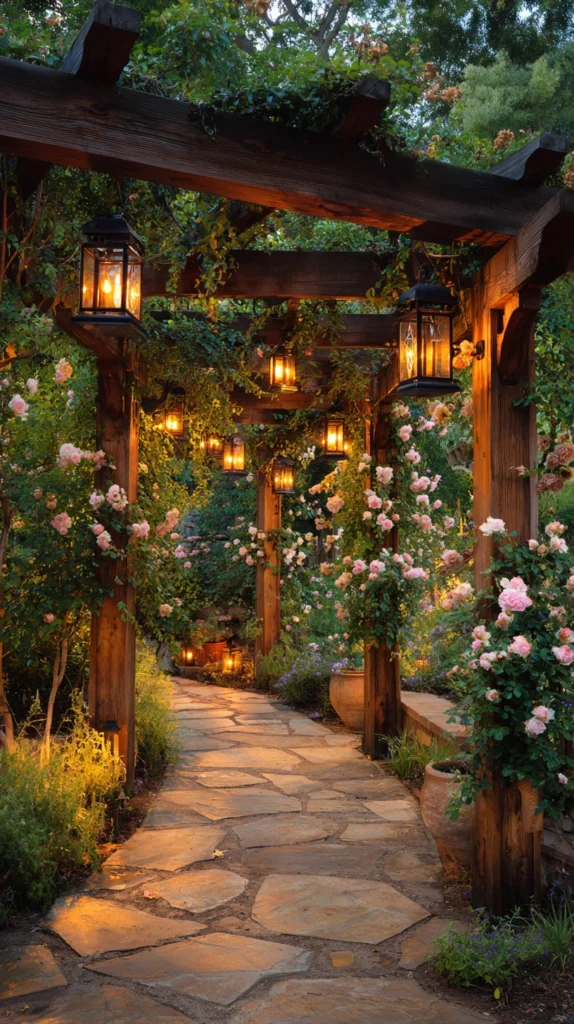
A standard wooden or metal arbor fitted with hanging lantern hooks along its crossbeam, extending the romantic effect into the evening hours rather than relying purely on daylight and bloom.
Most arbor planning focuses entirely on daytime appearance, but adding a simple lighting element means the structure keeps delivering its intended atmosphere well after the sun goes down.
I added simple iron hooks along my arbor’s crossbeam, hanging a mix of small lanterns and mercury glass votives that cast a warm, flickering glow across the climbing roses trained up either side.
Budget tip: Simple battery-operated LED lanterns cost relatively little and avoid the need to run any electrical wiring out to a garden structure, while still delivering genuine warm light after dark.
A few practical notes:
- Choose warm-toned bulbs specifically, generally in the 2700K range, since cooler white light undercuts the romantic effect this addition is meant to create
- Space lanterns evenly along the crossbeam rather than clustering them, for a more balanced glow across the entire structure
- Use weatherproof or battery-powered fixtures specifically if the arbor sits somewhere without easy access to an outdoor outlet
This is one of the simplest additions on this entire list, and it’s also one of the most effective at extending an arbor’s romantic impact well beyond the hours when its flowers are actually visible.
If You’re Building Just One Arbor This Season
The classic white wooden arch with climbing roses remains the most forgiving place to start, since the materials are widely available, the build itself doesn’t require specialized skills, and the combination has been proven in countless gardens for a reason.
Plant Pairings Worth Considering Beyond the Usual Roses
- Clematis and climbing hydrangea for a soft, layered look with staggered bloom times
- Wisteria paired with a genuinely substantial structure built specifically to handle its eventual weight
- Fragrant jasmine or old garden roses positioned specifically near seating or a front entrance where scent has the most impact
The Detail Most People Get Wrong
Most disappointing arbors aren’t a problem with the structure itself, they’re a mismatch between the plant chosen and the structure’s actual strength, a delicate lattice arch loaded with heavy wisteria, or a flimsy metal frame expected to support a mature climbing rose for decades. Match the plant’s eventual mature weight to the structure’s actual load capacity before planting anything, rather than choosing the plant first and hoping the arbor holds up.