
9 Statement Ceiling Light Ideas for a Living Room
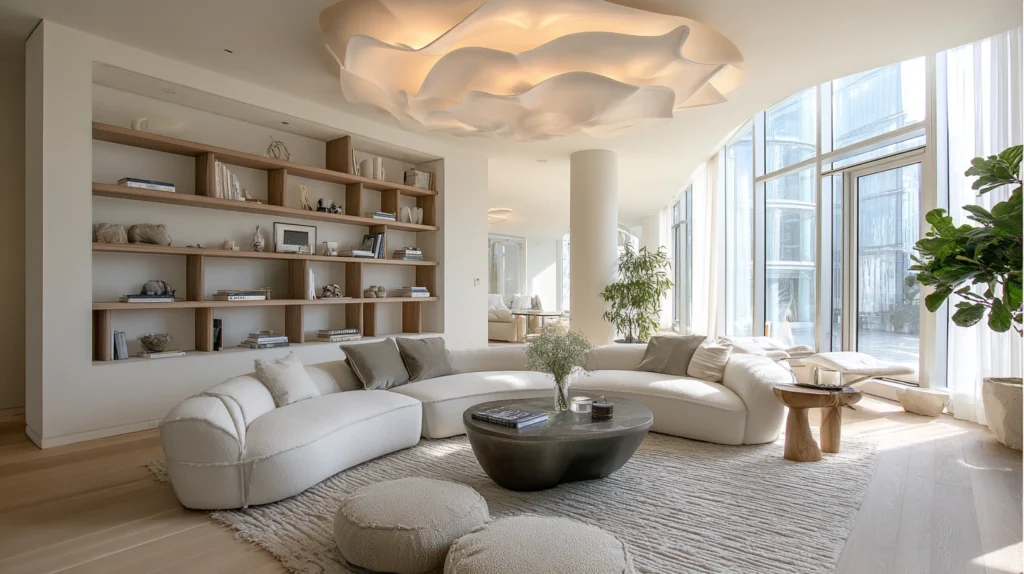
Walk into most living rooms and the ceiling fixture is the one thing nobody actually chose on purpose, just whatever flush-mount dome came standard when the house was built.
That’s a genuine missed opportunity, since the ceiling is one of the few surfaces in a living room that isn’t already competing with furniture, art, or a rug for attention. A fixture with real presence up there does something no amount of styling at eye level can replicate, it gives the whole room a focal point the moment you walk in, before you’ve even looked at anything else.
Getting this right isn’t just about picking something dramatic off a lighting showroom floor. Scale, ceiling height, and the room’s overall proportions all matter more than the fixture’s style, and getting those wrong is what turns a genuinely beautiful light into something that looks oddly small or overwhelming once it’s actually installed.
Here are 9 statement ceiling light ideas built specifically for the proportions and demands of a living room, rather than a dining nook or entryway.
Each one includes the sizing and installation details that tend to separate a fixture that looks right from one that just looks expensive.
1. An Oversized Drum Pendant as a Soft, Enveloping Centerpiece
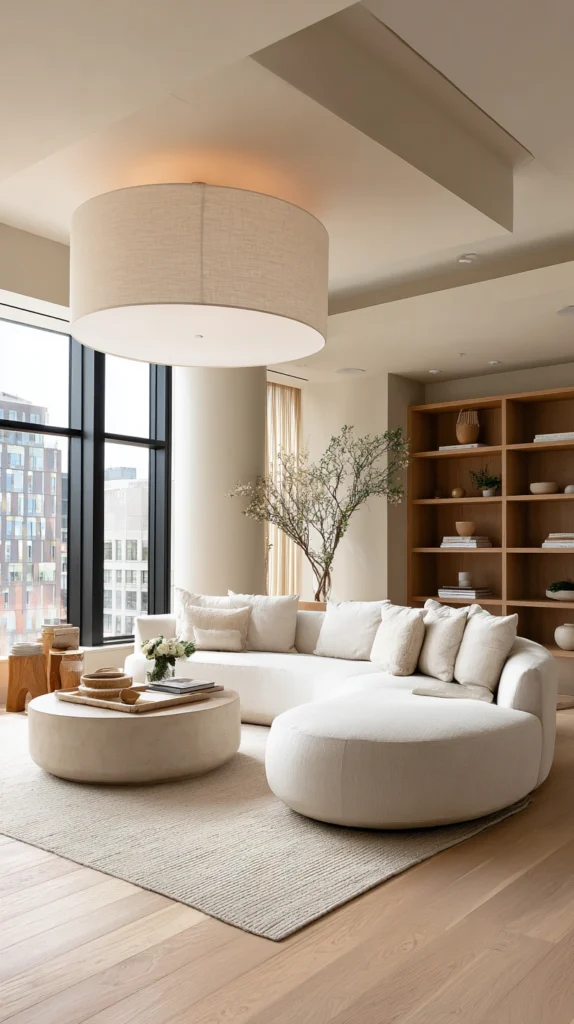
A large fabric or woven drum shade, hung low and centered in the room, delivering ambient, diffused light rather than the harsher glow of an open fixture.
Drum pendants work particularly well in living rooms because the shade itself softens light in every direction, filling a room with an even, flattering glow rather than the harsh downward wash a bare bulb or open metal fixture produces. The larger the drum, the more dramatic this effect becomes, since scale is really the entire visual statement this style depends on.
I hung a 30-inch linen drum pendant in the center of my living room, sized deliberately larger than what most lighting guides recommend for a room this size, since an undersized drum tends to look accidental rather than intentional.
Style tip: When choosing between two drum sizes that both seem plausible for your room, size up rather than down, since an oversized drum reads as a deliberate design choice while an undersized one looks like an afterthought.
A few things worth getting right:
- Hang the bottom of the shade at least 7 feet from the floor in a room with regular foot traffic beneath it, since drums extend low by design
- Choose a fabric or woven shade specifically for the softest, most diffused light quality, since a solid opaque shade blocks more light than most people expect
- Confirm your ceiling height can accommodate the drop without the fixture feeling like it’s hanging into the room’s usable space
A well-proportioned drum pendant tends to become the visual anchor of an entire living room, doing more to establish the room’s overall mood than almost any other single fixture style.
2. A Sculptural Chandelier With Deliberately Asymmetrical Branches
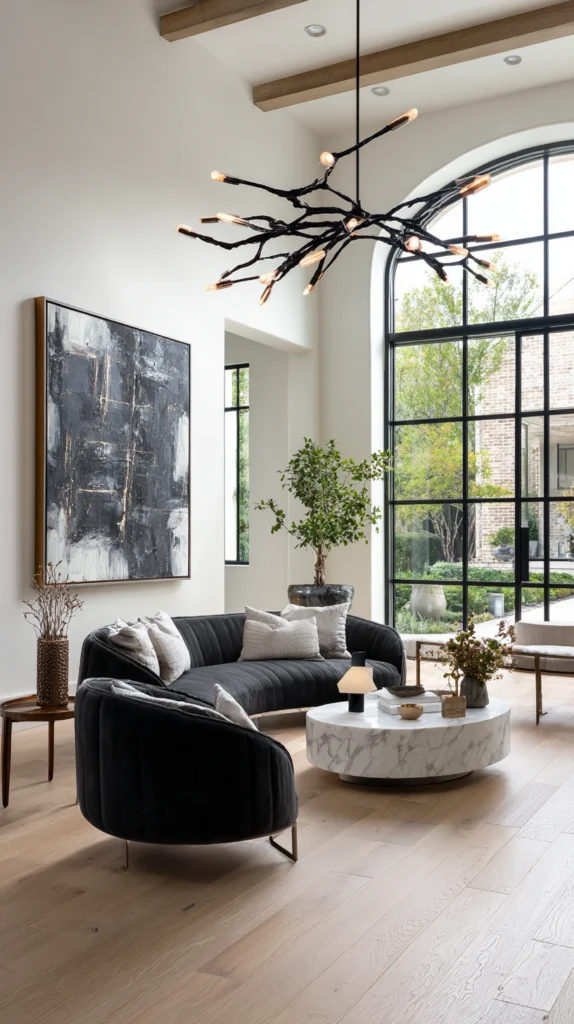
A chandelier built around an irregular, branch-like metal frame rather than the traditional symmetrical arrangement of arms radiating from a central point.
Asymmetrical sculptural chandeliers bring genuine artistic presence to a living room ceiling, functioning almost as a piece of suspended sculpture that happens to also provide light. The irregular branching pattern catches shadow and light differently depending on the viewing angle, which gives the fixture a sense of movement that a traditional symmetrical chandelier simply doesn’t offer.
I installed a black metal branch-style chandelier off-center above my living room’s seating area, deliberately positioning it slightly toward the window side of the room rather than dead center, since the asymmetrical fixture actually suits an asymmetrical placement better than a perfectly centered one would.
Budget tip: A single dramatic sculptural chandelier often costs less than people expect once compared to a matching set of smaller pendant fixtures that would be needed to achieve a similar visual impact spread across the ceiling.
A few things worth getting right:
- Position the fixture based on your seating arrangement’s actual center rather than the room’s geometric center, since living rooms are rarely used symmetrically
- Choose a finish that reads well both lit and unlit, since sculptural chandeliers spend plenty of daylight hours simply existing as a design object rather than a functioning light source
- Confirm the fixture’s bulb count and wattage genuinely provide enough ambient light for the room, since some sculptural designs prioritize visual drama over actual illumination
This style suits a living room that already leans toward an eclectic or gallery-like aesthetic, where the ceiling fixture functions as much as art as it does lighting.
3. A Cluster of Multiple Pendants at Varying Heights
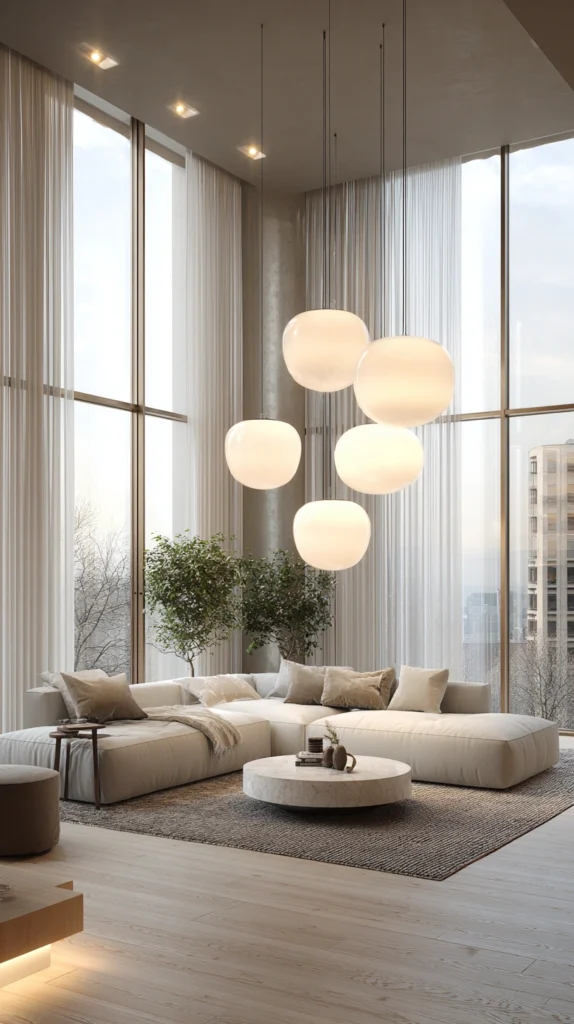
Several individual pendant lights, grouped together and hung at deliberately staggered heights rather than a single large fixture centered on the ceiling.
A pendant cluster delivers a different kind of visual interest than one big statement piece, since the varying heights create genuine depth and movement across the ceiling plane. This approach also lets you mix pendant shapes, sizes, or even finishes within a single grouping, which a single fixture obviously can’t offer.
I hung five glass globe pendants in a loose cluster above my living room’s conversation area, staggering the drop lengths so the lowest hangs about a foot below the highest, creating a layered effect rather than a flat, uniform row.
Style tip: Vary the drop height in a genuinely irregular pattern rather than a simple ascending or descending line, since true randomness within the cluster reads as more intentional and organic than a predictable, mechanical stagger.
A few things worth getting right:
- Group pendants close enough together that they read as one cohesive cluster rather than several separate, disconnected fixtures scattered across the ceiling
- Choose a consistent finish or glass style across all pendants in the cluster, even if the individual shapes or sizes vary, to keep the grouping visually unified
- Confirm your electrical box and mounting canopy can actually accommodate multiple pendant cords from a single ceiling point, since this often requires a specific multi-port canopy rather than a standard single fixture mount
This approach works especially well over a specific zone within a larger open living space, marking out a conversation or reading area distinctly from the rest of the room without requiring any actual wall or divider.
4. A Geometric Metal Cage Pendant for Modern Structure
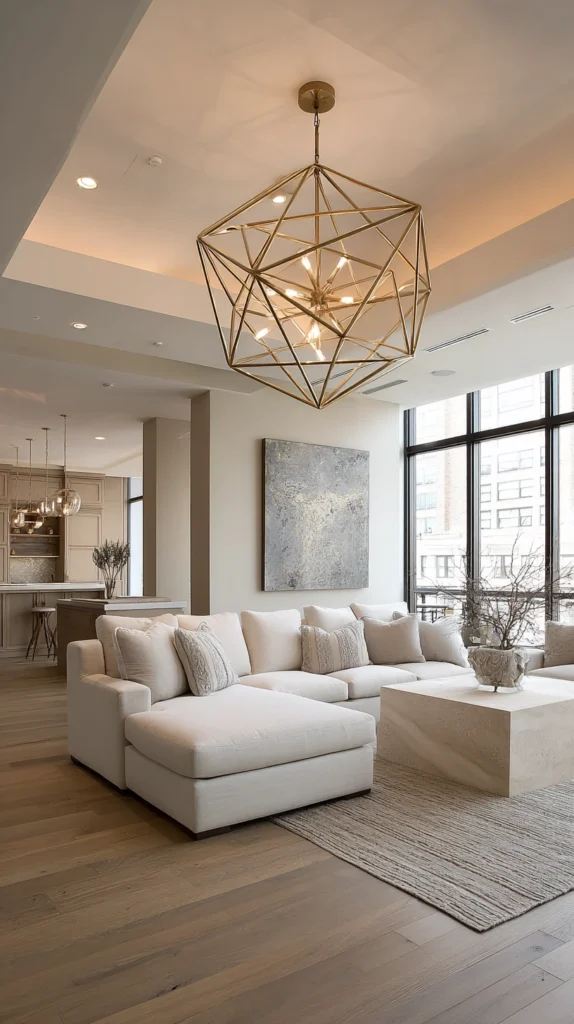
A pendant built from an open geometric metal frame, often spherical, cubic, or faceted, exposing the bulb inside rather than concealing it behind a solid or fabric shade.
Cage-style pendants deliver a distinctly architectural quality that softer, shaded fixtures don’t offer, since the exposed geometric structure itself becomes the visual focus rather than the light it produces. This style tends to suit a room already built around clean lines and a more minimal material palette, where the fixture’s structure needs to hold its own against simpler surrounding decor.
I installed a large faceted brass cage pendant above my living room’s seating area, choosing a warm metal finish specifically to soften what could otherwise read as a fairly cold, industrial fixture in an already warm-toned room.
Budget tip: A single oversized cage pendant typically costs less than a comparable sculptural chandelier with a similar visual footprint, since the open metal structure requires less material and labor than a fixture with a fully built shade or multiple arms.
A few things worth getting right:
- Choose a bulb style that complements the exposed structure, since the bulb itself is genuinely visible and part of the overall look rather than hidden inside a shade
- Consider a dimmer specifically for this style, since an exposed bulb at full brightness can read as harsh compared to a shaded fixture at the same wattage
- Match the metal finish to your room’s existing hardware or fixtures where possible, since an exposed metal cage draws more attention to its specific finish than a fabric-shaded alternative would
A geometric cage pendant works particularly well as the singular statement piece in a room that’s otherwise kept fairly simple, letting the fixture’s structure do the visual work without competing against a lot of other bold elements.
5. A Layered Tiered Chandelier for Traditional Drama
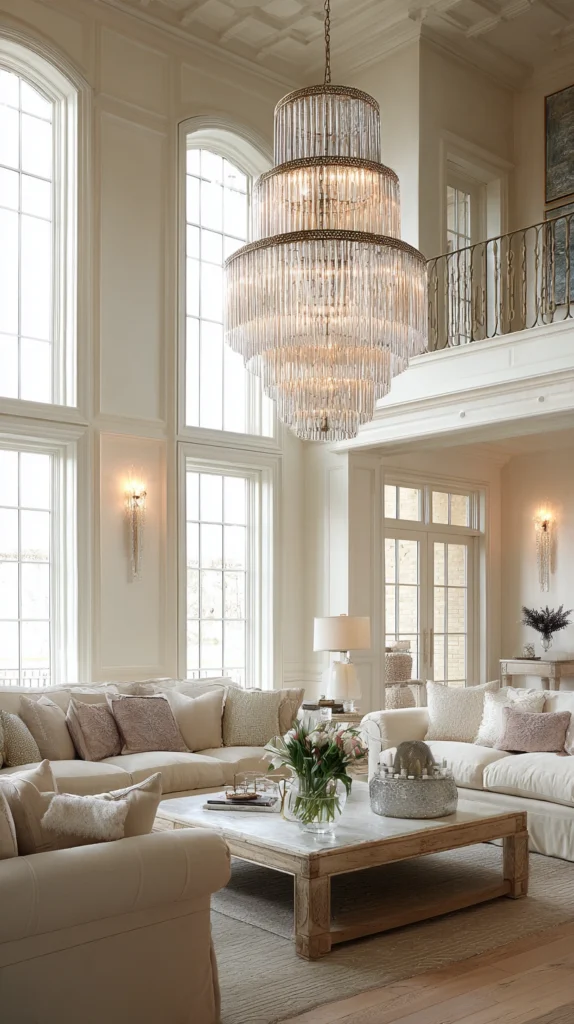
A chandelier built with multiple stacked tiers or rings, often finished in crystal, glass, or metal, delivering the kind of formal grandeur associated with more traditional or transitional interiors.
Tiered chandeliers bring genuine old-world formality to a living room ceiling, and the multiple layered rings create visual complexity that reads as considerably more elaborate than a single-tier fixture, even at a similar overall size. This style tends to work best in a room with genuinely higher ceilings, since the multiple tiers need vertical room to actually read as distinct layers rather than a single compressed mass.
I installed a three-tier iron and glass chandelier in my living room, which has just over 9 feet of ceiling height, giving the fixture enough vertical room to hang with each tier clearly visible rather than crowded together.
Style tip: Reserve a genuinely tiered chandelier for a room with at least 9 feet of ceiling height, since a lower ceiling compresses the tiers visually and can make the fixture read as bulky rather than elegant.
A few things worth getting right:
- Measure your actual ceiling height before committing to a multi-tier design, since this style demands more vertical clearance than almost any other fixture on this list
- Choose a finish and material that complements your room’s existing formality level, since an ornate crystal tiered chandelier can look mismatched in an otherwise casual, relaxed living room
- Plan for a genuinely secure electrical box and mounting hardware, since tiered chandeliers carry considerably more weight than simpler pendant styles
This style suits a living room that’s leaning into a more traditional or transitional design direction overall, where the ceiling fixture is meant to feel like a genuine architectural centerpiece rather than a subtle accent.
6. A Woven Natural Fiber Pendant for Textural Warmth
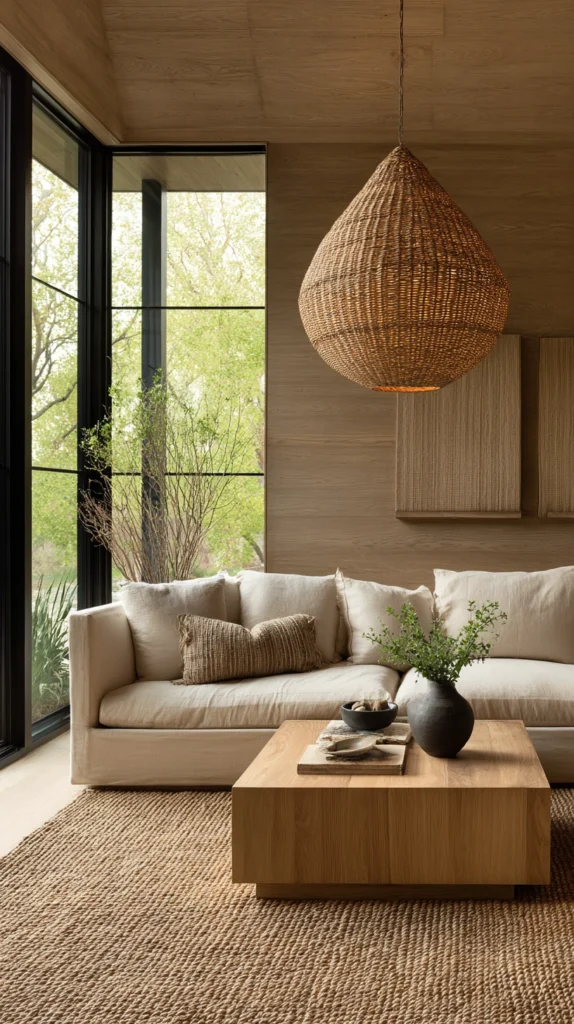
A large pendant shade woven from natural materials like rattan, seagrass, or jute, delivering warm, dappled light through the shade’s natural gaps and texture.
Woven natural fiber pendants bring a considerably softer, more organic quality to a living room ceiling than metal or glass fixtures, and the natural material’s texture catches light in a way that creates a genuinely warm, dappled glow across the ceiling and surrounding walls rather than a single focused beam.
I hung a large woven rattan pendant above my living room, drawn specifically to how the light filters through the natural gaps in the weave, casting soft shadow patterns across the ceiling that shift depending on the time of day and which lamps are on elsewhere in the room.
Budget tip: Natural fiber pendants are often considerably less expensive than comparable metal or crystal statement fixtures, making this one of the more affordable ways to introduce genuine visual drama to a living room ceiling.
A few things worth getting right:
- Choose a shade with a denser weave if you want more directed light, or a looser weave specifically for the dappled shadow effect this style is known for
- Pair with a warm-toned bulb, since natural fiber shades tend to suit warmer light temperatures better than cooler, bluer options
- Confirm the fixture’s weight and mounting hardware are appropriate, since larger woven shades, while lighter than metal or crystal, still require secure ceiling support
This style fits naturally into a living room already leaning toward warm wood tones, natural textiles, or a relaxed, organic overall aesthetic, softening the ceiling in a way that a more structured metal or glass fixture doesn’t achieve.
7. A Bold Colored Glass Pendant as a Focal Accent
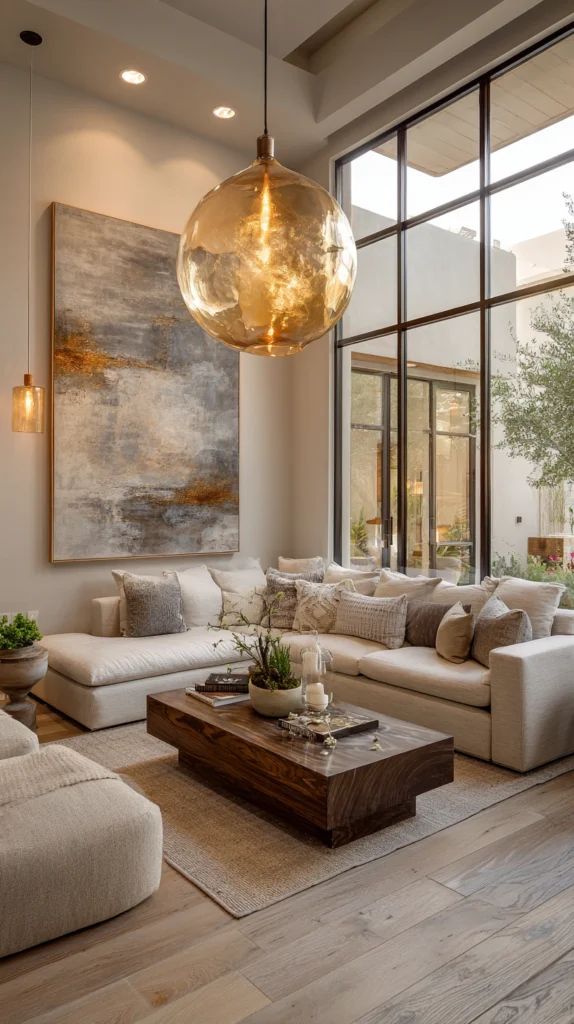
A statement pendant made from richly colored glass, whether deep amber, smoky gray, or a saturated jewel tone, used specifically to introduce color at the ceiling level rather than relying entirely on wall paint or textiles for that role.
Colored glass pendants do double duty as both a light source and a genuine color accent, and positioning that color at the ceiling specifically draws the eye upward in a way that a colored wall or piece of furniture at standard eye level doesn’t achieve in quite the same way.
I installed a deep amber glass pendant in my living room, choosing the color specifically to echo the warm wood tones already present in my flooring and furniture, rather than treating the fixture as an unrelated color accent competing with everything else in the room.
Style tip: Choose a glass color that relates to at least one other element already in the room, whether that’s flooring, an accent wall, or a key piece of furniture, since an isolated, unrelated color at the ceiling can look like a mismatched afterthought rather than an intentional design choice.
A few things worth getting right:
- Consider how the specific glass color affects the actual light cast into the room, since deeply saturated glass can tint the ambient light noticeably compared to clear or lightly tinted alternatives
- Pair colored glass pendants with simpler surrounding decor, since the fixture itself already introduces a strong color statement that doesn’t need much additional competition
- Test the fixture’s actual light output before committing, since some deeply colored glass reduces overall brightness more than expected compared to clear glass options
This approach suits a living room where you want genuine color impact without committing to a bold paint color across an entire wall, concentrating that visual punch into a single, more contained fixture instead.
8. A Minimalist Linear Suspension Light for Low or Sloped Ceilings
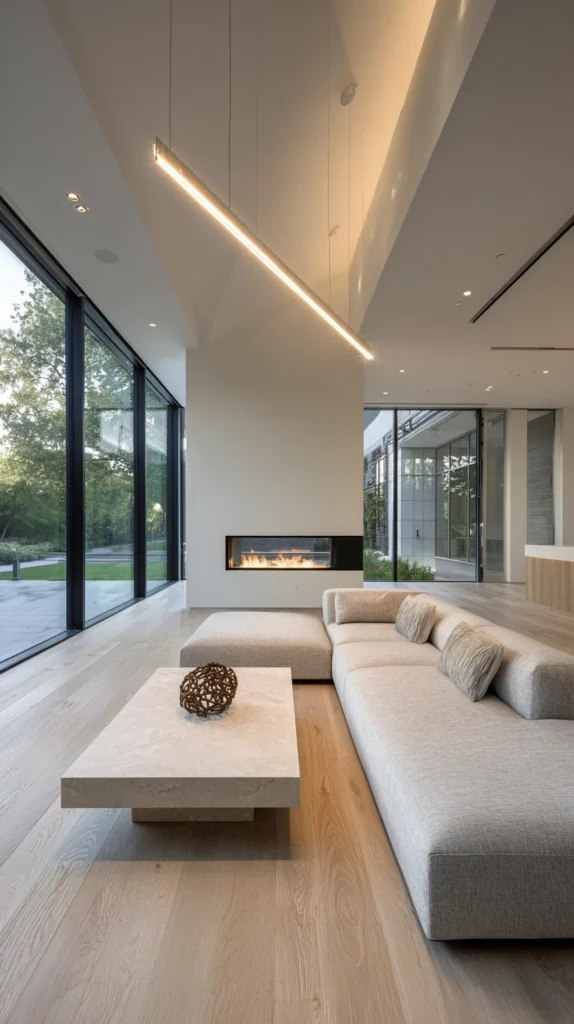
A slim, horizontal suspension fixture mounted flush or nearly flush against the ceiling, delivering a clean, understated statement specifically suited to rooms where a low ceiling or sloped architecture rules out anything with significant vertical drop.
Not every living room has the ceiling height to accommodate a dramatically hanging chandelier or oversized pendant, and a linear suspension fixture solves that by delivering genuine visual presence along the horizontal plane instead, working with a low or angled ceiling rather than fighting against it.
I installed a slim, 6-foot linear LED suspension fixture along the ridge of my living room’s sloped ceiling, which has barely 7.5 feet of clearance at its lowest point, making anything with real vertical drop impractical without regularly bumping into it.
Budget tip: Linear LED fixtures are often more energy-efficient than traditional multi-bulb chandeliers or pendants, which can meaningfully reduce the fixture’s ongoing electricity cost compared to a more traditional statement lighting choice.
A few things worth getting right:
- Measure your ceiling’s actual lowest clearance point carefully before choosing any fixture with vertical drop, since a sloped or low ceiling has less room to work with than it might initially appear
- Choose a fixture length proportional to your room’s largest wall or seating arrangement, since an undersized linear fixture can look stranded on an oversized ceiling plane
- Confirm the fixture includes dimming capability, since linear LED fixtures can run brighter than expected for ambient living room lighting at full output
This style proves that a genuinely low or awkwardly sloped ceiling doesn’t have to rule out a real statement fixture, it just requires choosing one built specifically for horizontal rather than vertical drama.
9. A Vintage or Salvaged Fixture With Genuine History
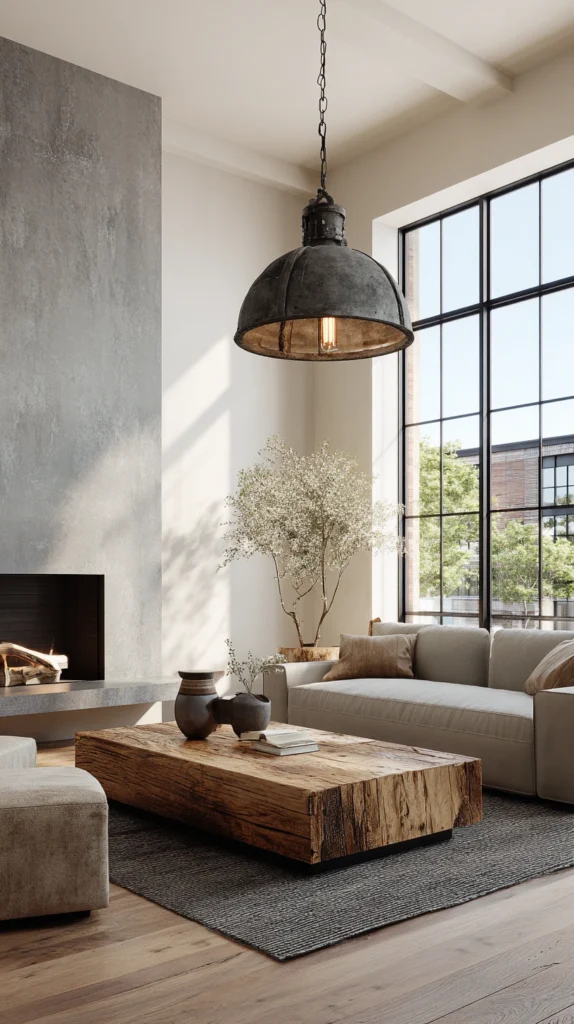
An antique or architecturally salvaged light fixture, rewired for safe modern use, bringing authentic age and character into a living room that new manufactured fixtures simply can’t replicate.
A genuinely old fixture, whether a rescued industrial pendant, an antique brass chandelier, or a salvaged piece from a demolished building, carries a level of history and unique character that even the most well-designed new fixture struggles to match. No two salvaged pieces are ever quite identical, which means this approach guarantees a ceiling fixture nobody else’s living room has.
I found a large industrial pendant at an architectural salvage yard, originally pulled from an old factory building, and had it professionally rewired and fitted with a new socket before hanging it above my living room’s main seating area.
Budget tip: Architectural salvage yards often price genuinely old fixtures below what a new manufactured piece with a similar aesthetic would cost, since you’re paying for a rescued item rather than new production and retail markup.
A few things worth getting right:
- Always have vintage or salvaged fixtures professionally rewired before installation, since old wiring and sockets are rarely safe for continued use without inspection and updating
- Inspect the fixture carefully for structural soundness, particularly at any welds or joints, since decorative age and genuine structural integrity are two very different things
- Confirm the fixture’s original mounting hardware is compatible with modern electrical boxes, or budget for an electrician to adapt it properly rather than attempting a mismatched installation yourself
This approach rewards patience and a willingness to search, since finding the right salvaged piece can take considerably longer than simply ordering a new fixture, but the result is a ceiling light with a story and a level of character no catalog item can genuinely replicate.
If You Only Remember One Sizing Rule
Whatever style you choose, err toward a larger fixture rather than a smaller one relative to your room’s size, since an undersized statement light is one of the most common reasons a genuinely beautiful fixture ends up looking like an afterthought once it’s actually installed.
Measurements Worth Taking Before You Shop
- Your room’s actual ceiling height at the fixture’s intended location, not just a general estimate
- The distance from the fixture’s intended position to your main seating area, since this affects how low a pendant can safely hang without becoming an obstruction
- Your electrical box’s weight rating, especially for anything heavier than a standard pendant, like a multi-tier chandelier or a substantial salvaged piece
The Detail That Separates a Statement Light From a Mistake
A dramatic fixture that’s the wrong scale for its room reads as a mistake no matter how beautiful the piece itself actually is, while a well-proportioned fixture in a more modest style can still feel like a genuine statement simply because it fits its space with real confidence. Get the scale and ceiling height right first, and the specific style becomes a matter of taste rather than a design risk.