
14 Fan Arch Decor Ideas for a Sleek Neo Deco Room
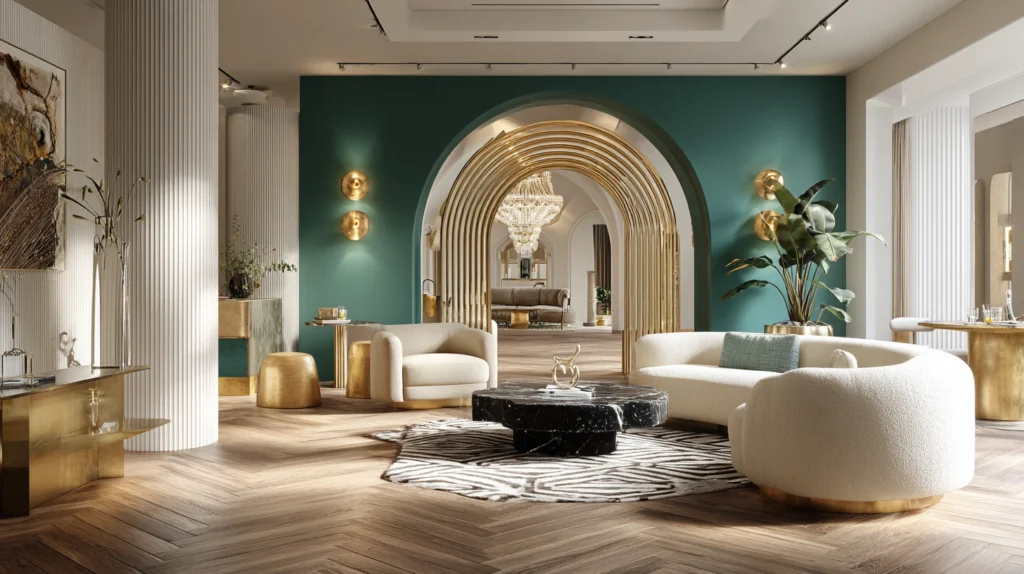
The fan arch was the shape that made everything else in the room look more considered.
Not the furniture, which had been chosen carefully. Not the wall color, which had been repainted twice to get the tone right. Not the brass lamp, which was doing everything it was supposed to do.
The arch. A semicircle of brass-finished metal with radiating spokes — a fan arch mirror above the console table — and suddenly the room had a visual language it had been working toward without knowing it. The shape: unmistakably geometric, unmistakably of a particular era, unmistakably neo deco in a way that softer forms never quite achieve.
Fan arches — the sunburst semicircle, the radiating half-circle, the scalloped dome — come directly from the grammar of Art Deco. They appear in the decorative ironwork of 1920s buildings, in the fanlight windows above grand entrance doors, in the metalwork of Chrysler Building spandrels, in the marquee panels of old hotel lobbies. Brought into a contemporary interior, they do what all good historical references do: they make the room feel placed in time and deliberate about it.
Here are 14 fan arch decor ideas — from a single mirror to a fully realized neo deco room built on the form — built on that understanding.
Why Fan Arches Work Specifically in Neo Deco Interiors
The geometry effect
Without fan arch forms: A room with warm materials, brass accents, velvet upholstery. The mood: rich, warm, considered. The specific era: unlocated. The room could be many things.
With a fan arch element: The same room. The eye: landing on the radiating spokes, reading the shape immediately as a specific geometric vocabulary. The room: located. The neo deco intention: announced.
The historical weight
The fan arch is not a generic decorative motif. It is specifically associated with the period between 1920 and 1940 — with the architecture that believed geometry was optimism, that symmetry was dignity, that pattern in metal and stone was the appropriate language for a civilization that had decided to be modern.
Using it in a contemporary interior is not nostalgia. It is quotation — the deliberate use of a precise historical form to say something specific about how the room understands beauty.
The radiating spoke principle
What makes a fan arch work as a decor form is the radiating spoke — the lines that emerge from a common origin point and spread outward to the arc above. The origin point: a visual anchor. The radiating lines: movement outward from that anchor. The arc: a boundary that contains the movement and gives it definition.
A circle without radiating spokes is complete but static. A fan arch with radiating spokes is complete and dynamic — the eye following the spokes outward and the arc inward simultaneously.
The scale relationship
A fan arch at small scale — a 6-inch decorative object — reads as an accent. At medium scale — a 24-inch mirror — reads as a statement. At large scale — a 48-inch wall installation or a full architectural fanlight — reads as architecture. The form: equally correct at every scale. The room: determining which scale belongs.
The five forms the fan arch takes in a room
Before choosing any design:
Mirror — the fan arch as a reflective object. The most functional and most widely used version.
Wall art or metal sculpture — the fan arch as a purely decorative object, hung or mounted without a functional role.
Architectural detail — the fan arch as part of the room’s structure: a fanlight window, an arched door surround, a built plaster fan above a fireplace.
Furniture form — the fan arch expressed in furniture: a fan-back chair, a cabinet with a scalloped arch panel, a headboard in a radiating spoke pattern.
Textile and surface pattern — the fan arch as a printed or woven motif on a rug, a cushion, a wallpaper, or a tile.
1. The Brass Fan Arch Mirror
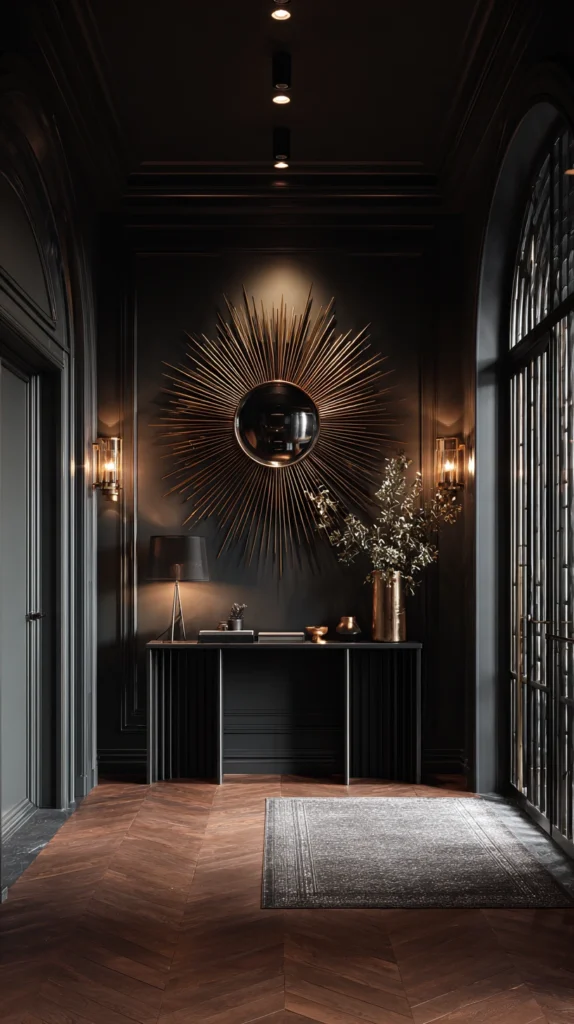
A semicircular mirror with brass radiating spokes extending from the mirror’s lower center to the arc above — the single object most associated with the neo deco aesthetic and the one that delivers the most immediate visual transformation.
Why the fan arch mirror is the starting point
It is functional and decorative simultaneously. A mirror belongs on a wall above a console, above a fireplace, in an entryway — in all the positions where a wall needs an anchor. A fan arch mirror in brass does the anchor’s job while announcing the room’s geometric language.
The frame construction
Solid brass or brass-plated metal spokes, 5 to 9 in number, radiating from a common point at the mirror’s lower edge. The outer arc: a continuous brass band completing the semicircle. The glass: either occupying the full interior of the arch, or positioned as a smaller circle at the center with the spokes visible around it.
Full-glass interior version: the mirror reading as a large reflective surface with brass framing. More functional, less graphic.
Spoke-visible version: the brass spokes crossing the mirror surface, the reflection broken by the geometry. More sculptural, less purely functional.
The size
24 to 32 inches in diameter for a console table or fireplace position. 36 to 48 inches for a bedroom or living room statement wall. 18 to 22 inches for a bathroom or small entryway.
The placement height
The mirror’s center point at eye level from a standing position — approximately 57 to 60 inches from the floor to the mirror’s center. For a console table position: 6 to 8 inches above the console surface to the mirror’s lower edge.
Cost breakdown: Small brass fan arch mirror (18–22 inches): $80–220 Medium (24–32 inches): $150–450 Large (36–48 inches): $300–800 Total: dependent on size chosen
2. The Fan Arch Metal Wall Sculpture
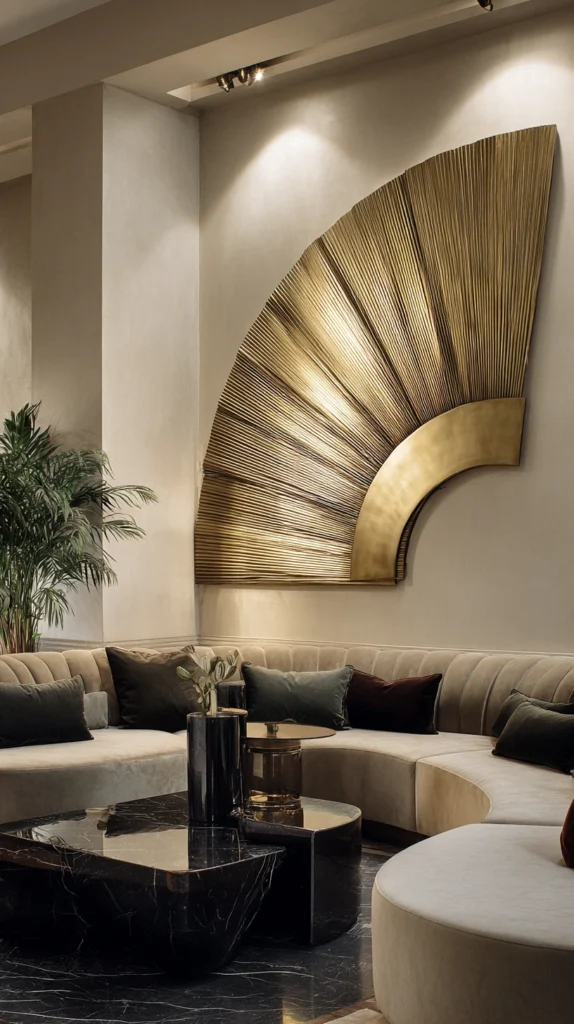
A fan arch in punched or cut brass, copper, or blackened steel — no mirror, no function — hung on the wall as a purely decorative object. The form: the whole point.
Why the wall sculpture reads differently from the mirror
A mirror is seen in its reflection as much as in its frame. A wall sculpture is seen only as itself — as an object with a specific shape, a specific material, and a specific relationship to the wall behind it. The wall sculpture: more purely geometric, more immediately about the form.
The material options
Brass or unlacquered brass: warm, aging with exposure, most consistent with the neo deco material palette.
Copper: warmer than brass, more orange in tone, developing a distinctive green-brown patina over years. More dramatic than brass and more specific in its reference to industrial decorative metalwork.
Blackened steel: the coolest and most graphic version. The fan arch form in dark metal against a light wall: pure geometry without warmth. Against a dark wall: the form visible in its shape rather than its material.
The spoke pattern
Uniform spokes at equal spacing: the most architectural version. The geometry: precise and formal.
Graduated spokes — narrower at the edges, wider at the center — for a more organic quality. The pattern: reading as leaves or feathers as much as mechanical spokes.
Layered spokes at two depths — a background arc and foreground radiating lines — casting shadow on the wall behind. The three-dimensional quality: visible and variable as the room’s light changes.
The grouping option
Three fan arch sculptures at different scales — large, medium, small — arranged on one wall as a family of related objects. The grouping: reading as a single wall installation while each piece remains an individual object.
Cost breakdown: Small brass fan arch wall sculpture (12–16 inches): $50–150 Medium (20–28 inches): $100–300 Large (30–40 inches): $200–500 Set of three in varied sizes: $180–600
3. The Fan Arch Fanlight Window
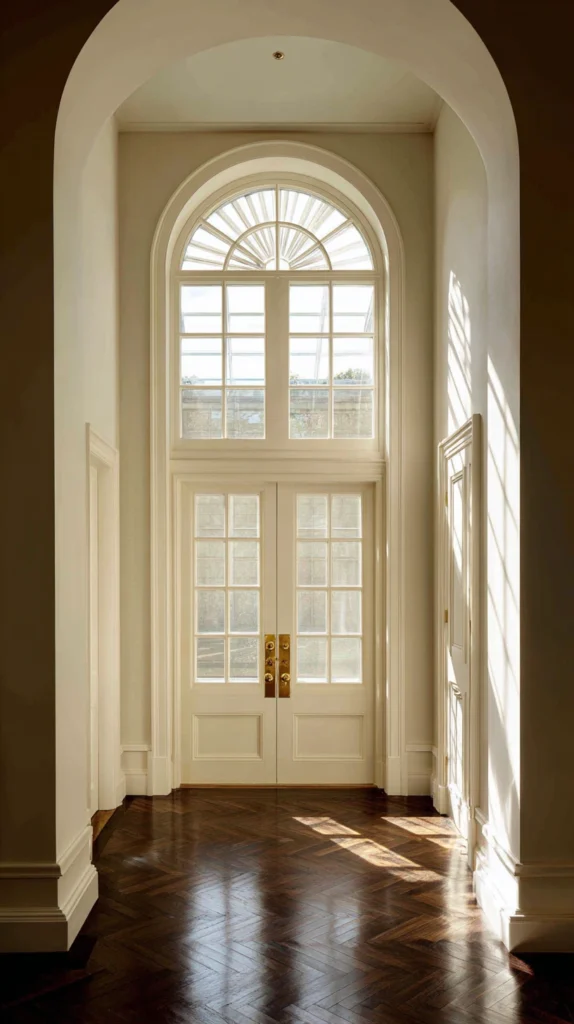
A true architectural fan arch — the semicircular window above a door or at the top of a tall window opening, with glazing bars arranged in the radiating spoke pattern — as a structural feature of the room rather than a decorative addition to it.
Why the architectural version is a different category
Everything else on this list is brought into the room. The fanlight is of the room — built into it, letting light through it, changing the quality of natural light that enters the space. An architectural fan arch is not a reference to the form. It is the form.
The existing fanlight
Many homes built between 1880 and 1940 have fanlight windows above the front door or in formal reception rooms — already present, often painted over, the glazing bars hidden under decades of interior and exterior paint. Stripping and restoring an existing fanlight: the most authentic and most architecturally significant version of this idea.
The new installation
A custom fanlight installed above an interior doorway — between a hallway and a living room, between a dining room and a kitchen — allows natural light to travel between rooms while introducing the fan arch form as an architectural divider.
Custom fanlight window with brass glazing bars: $400–1,200 fabricated and installed by a joinery specialist.
The faux fanlight
A decorative fanlight panel — a non-structural frame with spoke-pattern glazing bars in brass or painted wood, mounted on the wall above a door opening without actually opening into the adjacent space. The form: architectural in appearance, decorative in function.
Cost breakdown: Restoration of existing fanlight: $200–600 New custom fanlight installation: $400–1,200 Decorative faux fanlight panel: $80–250
4. The Fan Arch Headboard
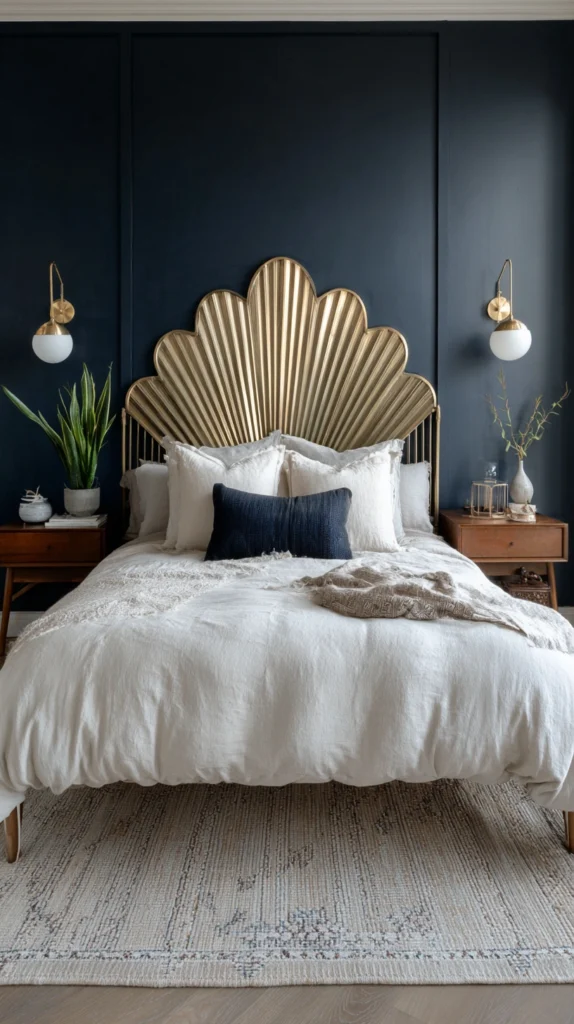
A bed headboard in a fan arch form — the semicircle rising above the pillow line, the spokes radiating from the mattress height to the arc above — as the primary neo deco form in the bedroom.
Why the headboard is the right scale for the bedroom
A bedroom needs a focal point at the head of the bed. A fan arch headboard provides that focal point in the specific geometric vocabulary of neo deco while performing the headboard’s primary function: defining the sleeping end of the room and giving the eye something to anchor on from the doorway.
The material options
Brass or brass-plated metal spokes on a painted MDF frame: the most affordable version. The brass: present in the spokes, the MDF: painted to match the wall so it recedes.
Solid upholstered panel with brass nail-head trim in a fan arch pattern: the softest version. The arc and spokes formed by the brass nail-heads against the upholstery. The form: implied by the trim rather than structural.
Wrought iron or blackened steel in the fan arch form: the most graphic and most durable version. The headboard: as much a piece of metalwork as a piece of furniture.
The wall relationship
The fan arch headboard works best against a plain, single-color wall — either the same tone as the bedding for a quiet version, or a deep contrasting tone (navy, forest green, terracotta) for a version where the headboard reads clearly as the room’s central graphic object.
The bedding response
Simple, horizontal bedding — white linen, fitted closely — so the headboard’s geometry is not competed with from below. The bedding: the calm field against which the fan arch reads.
Cost breakdown: Brass-frame fan arch headboard (queen): $300–800 Upholstered with brass nail-head fan arch pattern: $400–1,000 Wrought iron fan arch headboard: $250–700
5. The Fan Arch Cabinet Door Panel
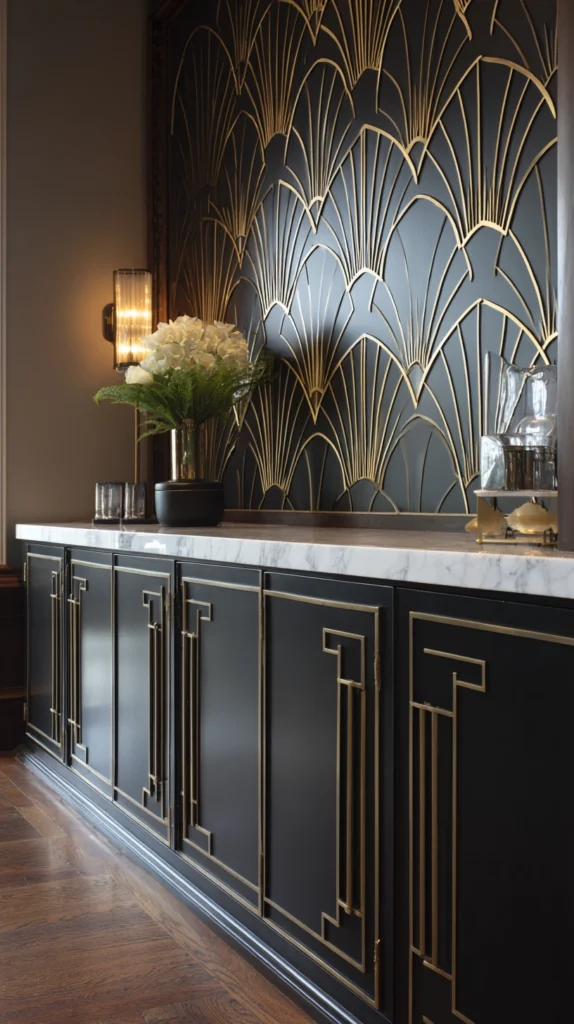
A cabinet or armoire with fan arch panels on the door faces — either inset into the door frame as a decorative carved or routed panel, or applied as a brass strap overlay in the fan arch form — for the neo deco form at furniture scale.
Why cabinet doors carry the fan arch effectively
Cabinet doors are vertical surfaces seen at close range and at a distance simultaneously. An inset fan arch panel on a cabinet door reads as geometry from across the room and as crafted detail up close. The door: performing its storage function while contributing the room’s most precisely neo deco surface.
The routed panel version
A panel router used to cut the fan arch pattern into the door face at a depth of 1/8 to 1/4 inch. The routed lines: catching shadow and producing a relief-like quality. Painted over in a single color: the relief present as texture and shadow. In a contrasting color within the routed channel: the pattern clearly two-toned.
The brass overlay version
Thin brass bar or brass strapping bent to the fan arch form and adhered or screwed to the existing cabinet door face. The brass: applied to the door rather than integral to it. More easily reversed, more immediately dramatic.
The existing cabinet adaptation
An existing wardrobe, bookcase, or sideboard with flat door panels: the most accessible application. The brass overlay applied to existing doors: the cabinet transformed without replacement.
The hardware pairing
Brass knobs or pulls in a rounded, dome-capped form — the curve of the hardware echoing the arc of the panel. Not angular hardware, not linear bar pulls — the rounded form is the correct companion to the fan arch’s curved top.
Cost breakdown: Brass strap overlay for existing cabinet (per door): $30–80 Routed panel and painting (professional, per door): $80–200 New cabinet with fan arch panels: $300–1,200
6. The Fan Arch Rug
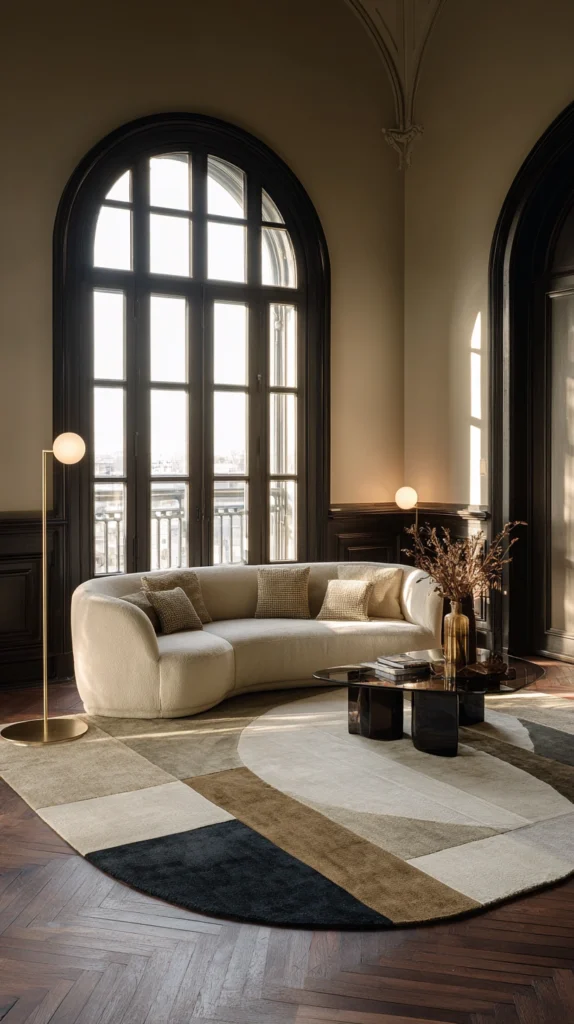
A large area rug with a fan arch or scallop pattern — the semicircular form repeated across the rug field as the primary motif — bringing the neo deco geometry to the floor plane.
Why the rug is an underused vehicle for the fan arch form
Most fan arch decor decisions happen at eye level or above — mirrors, wall sculptures, headboards. A fan arch rug introduces the geometry at floor level, where it is seen from above rather than straight ahead. The viewing angle: different, the reading: pattern rather than object, the room: carrying the neo deco form on every plane simultaneously.
The pattern arrangement
All-over scallop repeat: rows of fan arches interlocking across the full rug field. The individual arc: not dominant. The pattern as a whole: a field of geometric texture.
Single large fan arch at the rug center: the form as a medallion rather than a repeat. The room’s other fan arch elements — mirror, sculpture — echoed at the floor.
Border-only fan arch: the fan arch form running as a decorative border around a plain rug field. The geometry: framing the floor zone rather than filling it.
The palette
For a neo deco room: warm tones within the fan arch pattern. Gold or ochre arcs on a deep navy or forest green ground. Cream arcs on a terracotta ground. Brass-tone pile on a charcoal background.
The pile height
Low pile or flat weave — the fan arch geometry requires a smooth surface to read clearly. High pile blurs the boundary between arc and ground, which softens the graphic quality the form depends on.
Cost breakdown: Fan arch or scallop pattern rug (5×8): $100–400 Custom or specialty fan arch rug: $300–900
7. The Fan Arch Tile Installation
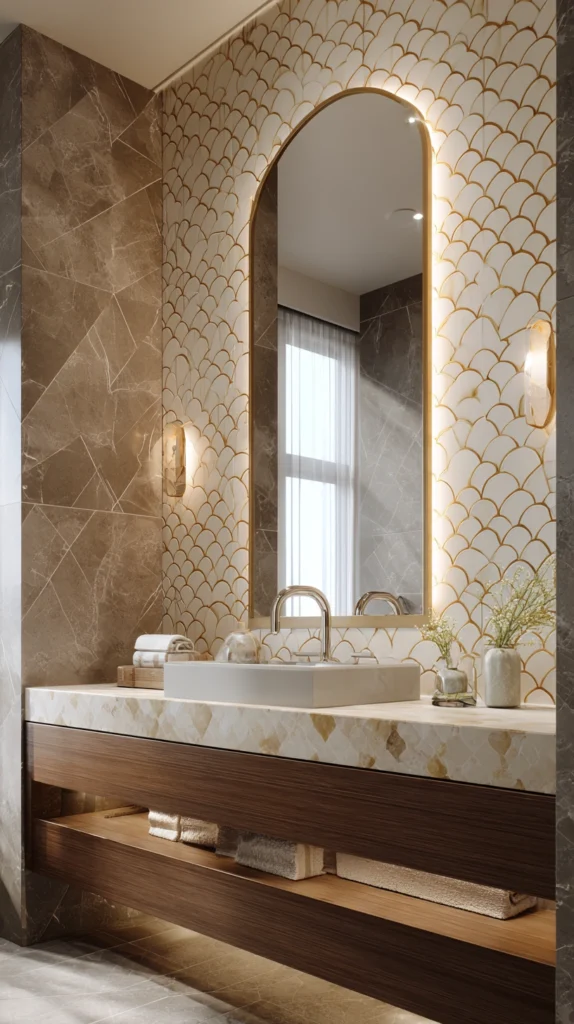
Scalloped or fan arch tiles — the individual tile in the shape of a fan arch, or standard tiles laid in a fan arch arrangement — on a bathroom wall, kitchen backsplash, or fireplace surround.
Why tile produces the most permanent and most precise version of the form
A painted fan arch can be changed. A mirrored fan arch can be moved. A tiled fan arch is fixed, precise, and present at a scale that makes the geometric vocabulary structural rather than decorative. The tile installation: the form built into the room in the most literal sense.
The scallop tile
A scalloped tile — each tile in a rounded fan shape, laid in overlapping rows like fish scales or roof tiles — is the most widely available fan arch tile form. Available in ceramic, porcelain, and Zellige versions. Installed in a single color for a tonal textured surface. In two alternating colors for a more explicitly geometric result.
The color choice for neo deco
White scallop tiles on a white wall: the texture visible, the color unified. Subtle in daylight, more dimensional in raking light or evening lamp light.
Cream or warm white scallop tiles with a deep grey or black grout: the fan arch form clearly outlined, the wall reading as distinctly geometric from across the room.
Terracotta or sage green scallop tiles: the color and the form in combination, the room’s material warmth carried up to the wall surface.
The installation scale
A full bathroom wall in scallop tile: the room organized entirely around the form. A fireplace surround only: the form concentrated at the room’s focal point. A kitchen backsplash panel: the form contained within a functional zone.
Cost breakdown: White ceramic scallop tiles (25 sq ft): $60–150 Zellige scallop tiles (25 sq ft): $150–400 Grout and installation materials: $30–60 Professional installation (25 sq ft): $200–450 Total (DIY): $90–210 / Total (professional): $290–660
8. The Fan Arch Wallpaper
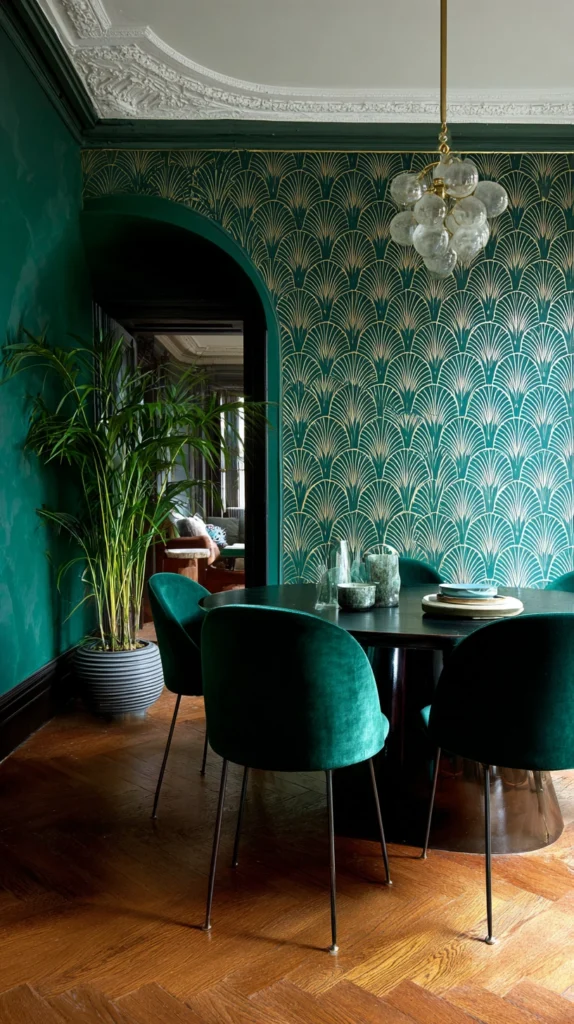
Wallpaper with a fan arch or scallop motif — the form repeated across the wallpaper field in a single color, two tones, or a multicolor arrangement — on an accent wall, in a hallway, or lining the inside of a bookshelf or cabinet.
Why wallpaper scales the fan arch form in a way objects cannot
A single fan arch mirror: one iteration of the form. A fan arch wallpaper: the form repeated across an entire surface, producing a pattern field rather than a statement object. The two approaches: achieving different things. The mirror: the eye landing on one precise instance of the form. The wallpaper: the eye moving through an infinite repetition of it.
The scale of the repeat
Small repeat (3 to 5 inches): the wall reads as a textured surface at a distance, the fan arch form visible only at close range. Suitable for bedrooms and rooms where continuous occupation makes a bold pattern tiring.
Medium repeat (6 to 9 inches): the form clear from across the room, the pattern graphic but not overwhelming. The most versatile scale for a living room or dining room feature wall.
Large repeat (10 to 14 inches): the form architectural, the pattern dominant. Most effective in transition spaces — entryways, hallways, stairwells — where the occupant passes through rather than sits within.
The color for a neo deco room
Gold or brass-toned fan arches on a deep jewel-toned ground — navy, forest green, aubergine. The fan arch: bright against the dark background, the neo deco reference clear.
Or a tone-on-tone version: cream arcs on a warm white ground, the form present as texture rather than contrast.
The bookshelf liner application
Fan arch wallpaper applied to the interior back panel of a bookshelf — the form visible between books and objects on the shelf. Small repeat for this use: the pattern readable in the gaps without overwhelming the objects in front of it.
Cost breakdown: Fan arch wallpaper per roll (approx. 56 sq ft): $45–180 Bookshelf liner (one standard bookcase): $20–60 Total: $20–180 depending on application
9. The Fan Arch Ceiling Medallion
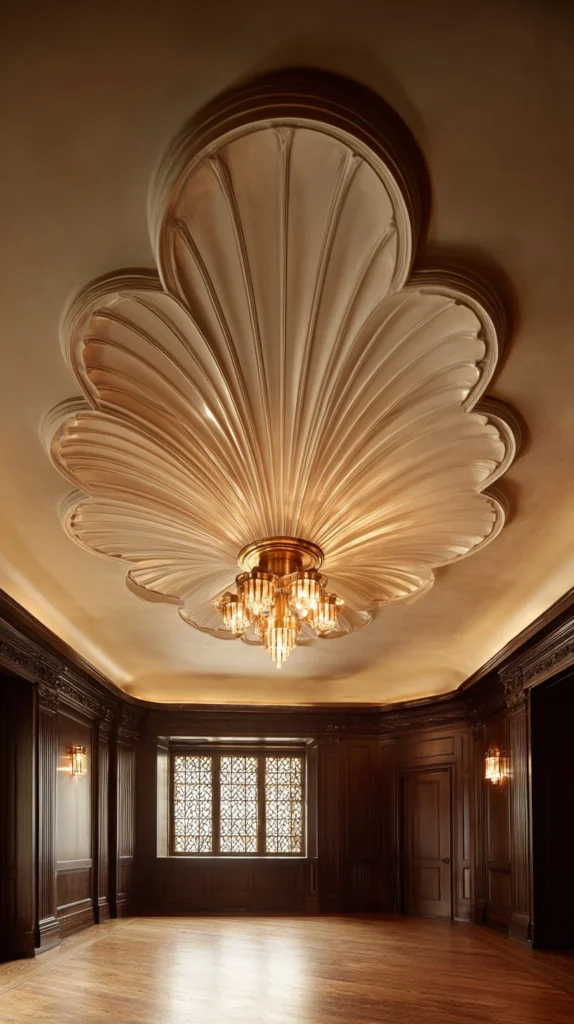
A ceiling medallion in a fan arch form — radiating from the light fitting outward to the medallion’s outer edge — restoring the ceiling as a decorated surface and anchoring the room’s neo deco geometry from above.
Why the ceiling medallion is the most overlooked fan arch application
Everything else on this list is vertical — on walls, on furniture, on the floor. A ceiling medallion is horizontal, seen from below, visible to everyone in the room simultaneously. It is the form experienced most communally and the one most associated with the architectural ceilings of the Art Deco period.
The medallion form
A standard ceiling medallion with a fan arch or sunburst pattern — radiating grooves or ridges extending from the central light fitting hole to the medallion’s outer edge. The radiating pattern: a fan arch lying flat on the ceiling plane, seen from below rather than from the front.
Pre-made polyurethane medallions with this pattern: $30 to $150 depending on diameter. Available from Ekena Millwork and similar architectural detail suppliers.
The finish
Painted the same color as the ceiling: the relief visible as shadow and texture, the color unified. Appropriate for rooms where the ceiling is a presence rather than a statement.
Painted in a contrasting color or gilded in brass or gold metallic: the medallion reading as a decorative object rather than an architectural detail. The fan arch: visible and deliberate from every seat in the room.
The light fitting relationship
A brass ceiling rose or brass-finish light fitting at the medallion center: the material continuity between ceiling feature and light source. The medallion: framing the fitting as the fitting frames the bulb.
Cost breakdown: Pre-made polyurethane fan arch medallion: $30–150 Gilding or specialty paint: $15–40 Brass ceiling rose: $20–60 Total: $65–250
10. The Fan Arch Console Table Vignette
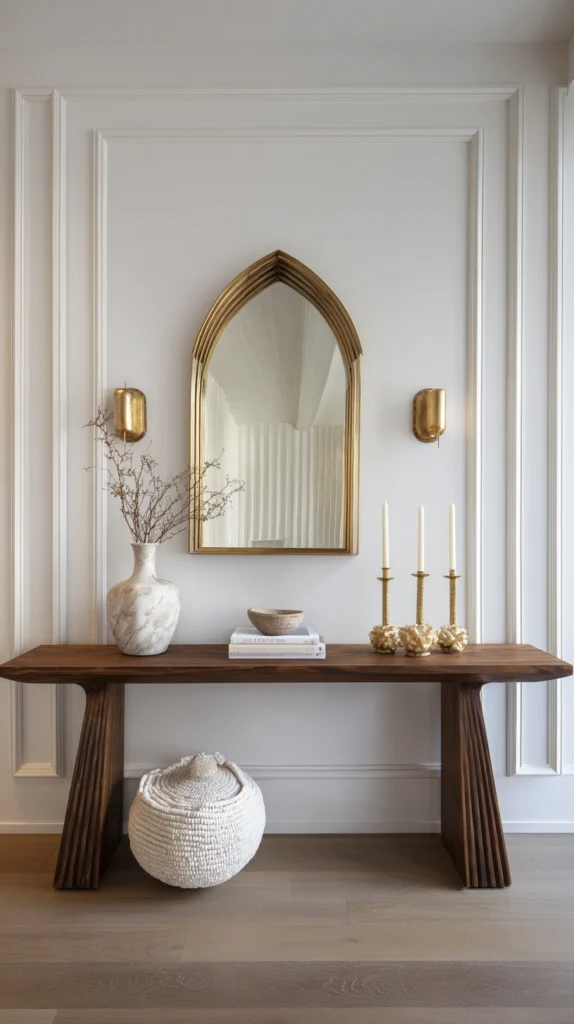
A complete vignette built around the fan arch mirror — console table, mirror, and the objects placed between them — as the most contained and most composed expression of the neo deco aesthetic.
Why the vignette is a complete design unit
A fan arch mirror on its own is an object. A fan arch mirror above a console table, with objects arranged on the table in response to it, is a vignette — a small, self-contained composition that reads as designed from the moment it is seen. The entryway, the hallway, the living room wall: all transformed by this single composed arrangement.
The console table
Narrow — 12 to 14 inches deep — in a dark wood or brass-and-glass construction. The depth: shallow enough not to interrupt movement past it, deep enough to hold the vignette’s objects.
The mirror placement
6 to 8 inches above the console surface to the mirror’s lower edge. The mirror centered on the table’s width. The reflection from the mirror’s lower section: the console surface and its objects, reflected back and doubled.
The object arrangement
Two brass candlesticks at equal heights flanking a central object — a sculptural vase, a small plant in a brass pot, a stack of books with a small object placed on top. Symmetrical on the outer edges, asymmetrical in the center — the arrangement: balanced but not matched.
One object at each side of the table at a height lower than the candlesticks: a small ceramic piece, a single stone, a brass bowl. The composition: three heights, three materials, one surface.
The lighting
A brass table lamp at one end of the console, asymmetrically placed — the lamp not centered but positioned to light the vignette from the side. Or a picture light mounted above the mirror, casting warm light downward onto the surface below.
Cost breakdown: Console table: $150–500 Fan arch mirror: $150–450 Brass candlesticks (2): $25–80 Central sculptural object: $20–80 Brass bowl or ceramic side pieces: $15–50 Total: $360–1,160
11. The Fan Arch Pendant or Chandelier
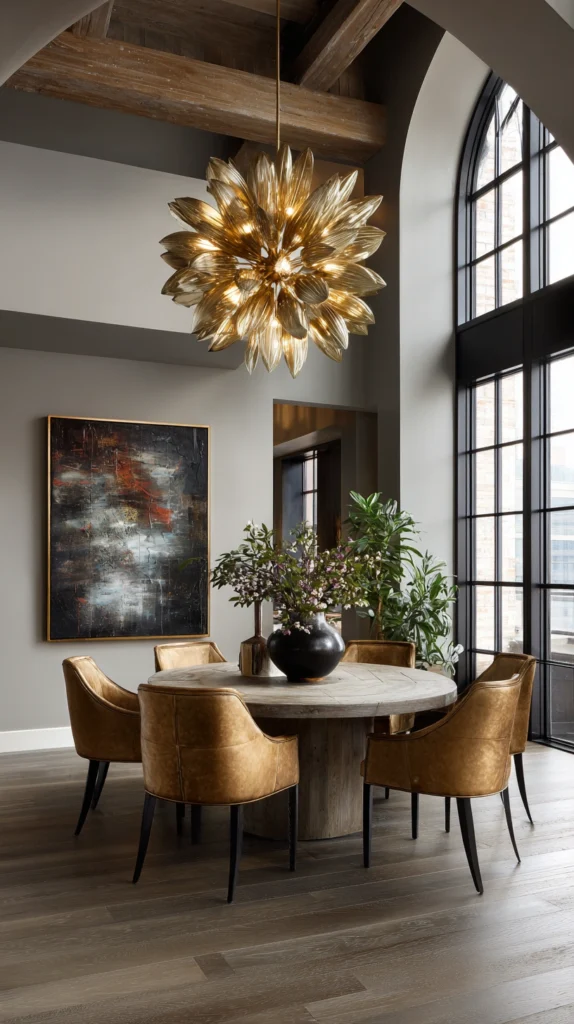
A pendant light or chandelier in which the fan arch form is expressed in the fixture itself — a semicircular shade, a radiating spoke frame, or a layered scallop form — hanging above a dining table, over a bed, or in an entryway.
Why the light fitting is the highest-impact application of the form
A fan arch object is seen. A fan arch light fitting is seen and its light is felt throughout the room. The form: present in itself. The light it produces: present everywhere. The chandelier or pendant in a fan arch form doubles its influence — the aesthetic of the object and the warmth of the light it casts.
The fan arch chandelier
A semicircular frame of brass spokes forming the outer edge of the chandelier, individual bulbs or small shades at the spoke ends. The chandelier: the fan arch form in three dimensions — a dome of brass spokes seen from below as a radiating circle and from the side as a fan arch.
The scallop shade pendant
A pendant shade made of overlapping scallop panels — each panel in the fan arch form — assembled into a spherical or dome shade. In brass, in Rattan, or in ceramic: each material producing a different quality of light through the scalloped gaps.
The ceiling rose detail
A fan arch ceiling rose matching the fitting: the form continued at the ceiling connection point. The fitting and its mounting: a continuous geometric composition from ceiling surface to pendant base.
The hanging height
Over a dining table: 28 to 32 inches above the table surface. Over a bed: 18 to 24 inches above the mattress. In an entryway: high enough to clear the tallest expected occupant — 84 inches from floor to bottom of fitting.
Cost breakdown: Fan arch or scallop shade pendant: $100–400 Brass spoke chandelier: $300–1,000 Total: $100–1,000
12. The Fan Arch Window Treatment
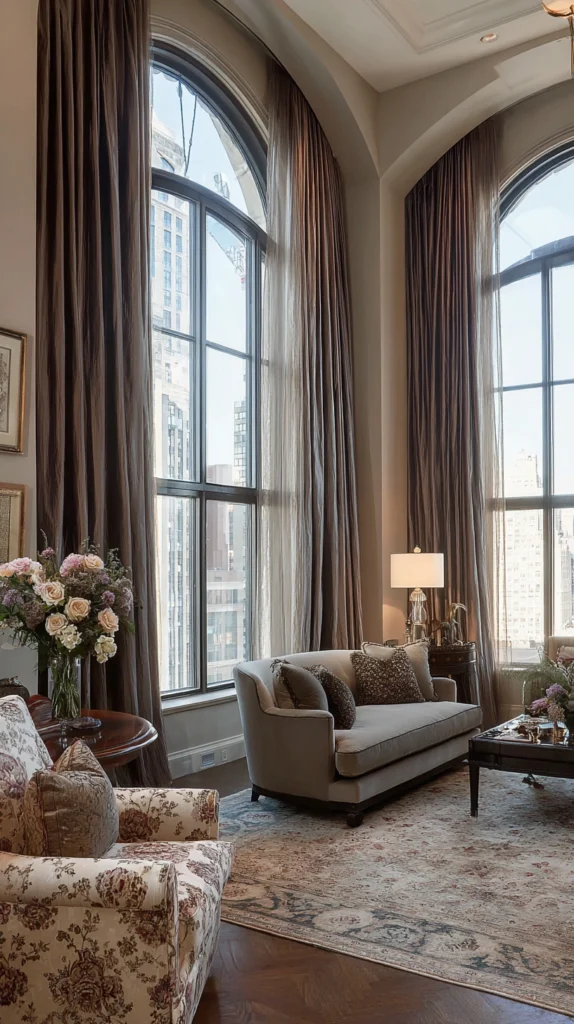
A curtain or blind with the fan arch form expressed in the heading — a fan-pleated heading that creates radiating pleats from each pleat point across the curtain width — or a Roman blind in a fan arch motif fabric.
Why the window is a natural position for the fan arch
The fanlight window — the architectural origin of the form — is itself a window element. Bringing the fan arch into the window treatment continues the form’s natural association with window architecture rather than departing from it.
The fan pleat heading
A fan-pleated curtain heading — sometimes called a goblet pleat or trumpet pleat — creates a series of inverted fan arch forms across the curtain top. The pleats: opening outward from a pinch point, the fabric spreading in a fan that references the arch without depicting it explicitly.
In a heavy linen or velvet fabric, the fan pleats read as formal and substantial. In a lighter sheer, they read as decorative and delicate.
The fan arch fabric
A fabric printed with the fan arch or scallop motif used as Roman blind material — the form present in the surface pattern when the blind is lowered. A subtle version: a tonal scallop print in the same color family as the wall. A bold version: a contrasting scallop print that reads as an explicit fan arch statement at the window.
The brass hardware
Brass curtain rod, brass rings, brass holdbacks or tieback hooks. The window treatment: carrying both the fan arch form in its heading or fabric and the brass material language of the neo deco room in its hardware.
Cost breakdown: Fan pleat curtains in linen or velvet (per panel): $80–250 Fan arch print Roman blind: $60–200 Brass curtain rod and rings: $35–90 Total: $95–540 per window
13. The Fan Arch Built-In Plaster Detail
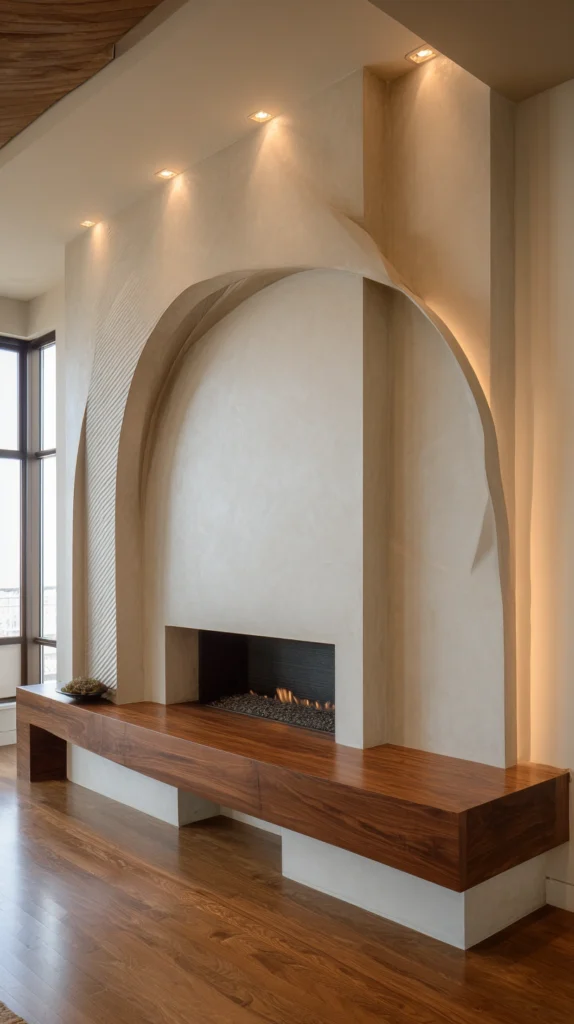
A fan arch relief — the semicircle with radiating spokes — applied to the wall in plaster or joint compound as a permanent architectural detail, integrated into the wall surface rather than placed against it.
Why the built-in plaster version is a different category from wall sculpture
A metal wall sculpture is an object placed on a wall. A plaster relief is a part of the wall — continuous with its surface, casting shadow from within its own geometry, painted as one surface with the wall that surrounds it. The relief: of the architecture, not applied to it.
The construction method
A plaster fan arch relief can be fabricated as a pre-cast unit from a specialty architectural supplier and adhered to the wall surface — the most precise version, with clean lines and consistent depth throughout.
Or built by hand using joint compound applied in sections — the fan arch lines masked with tape, the compound built up within each spoke section to 1/4 inch above the surrounding wall, the tape removed and the edges refined while wet.
The painted finish
Painted the same color as the surrounding wall: the relief present as shadow and depth, visible in raking light, absent in flat overhead lighting. The form: quiet and architectural.
Painted in a contrasting color or gilded: the relief explicit and graphic. Each spoke a different tone from the wall. The fan arch: unmistakable from across the room.
The scale
A fan arch plaster relief at architectural scale — 36 to 48 inches across — above a fireplace, above a doorway, or as the central feature of the primary wall. At this scale, the relief functions as the room’s architectural focal point rather than a decor element placed within it.
Cost breakdown: Pre-cast architectural plaster fan arch: $80–300 DIY joint compound fan arch: $15–40 in materials Painting or gilding: $20–60 Total: $35–360
14. The Fully Realized Neo Deco Fan Arch Room
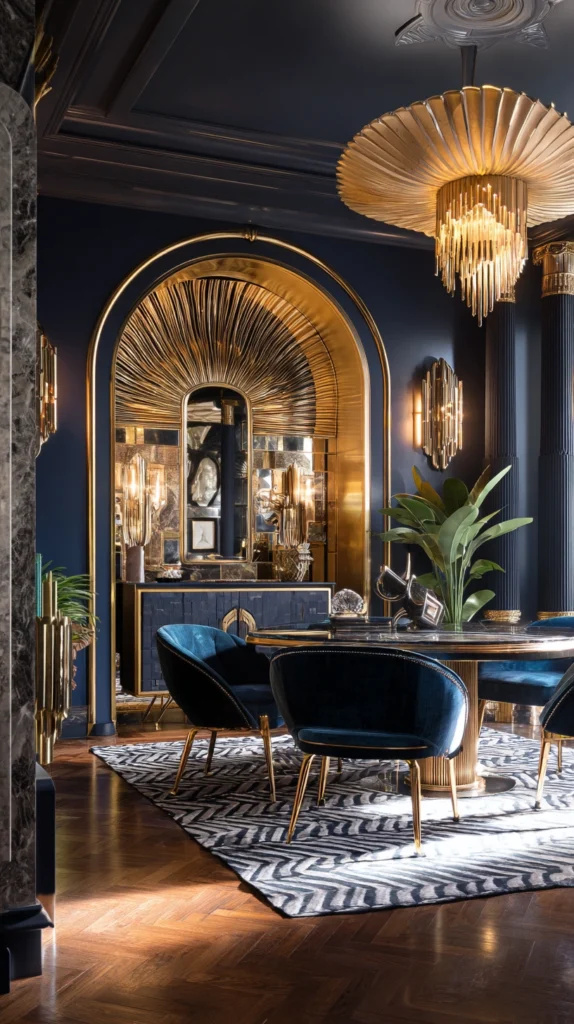
A room in which the fan arch is not one element among many but the organizing geometric principle — present on the walls, on the furniture, at the ceiling, at the floor, and in the light — every surface and object holding some version of the same fundamental form.
What separates a neo deco room from a room with neo deco objects in it
A fan arch mirror in an otherwise unchanged room: an object with a specific historical reference. A room where the fan arch form is present at multiple scales, in multiple materials, across multiple surfaces: a room with a design language. The difference: whether the form was chosen once or whether it was chosen as the principle around which every other choice was made.
The elements of the fully realized neo deco fan arch room
The walls
One wall carrying the fan arch explicitly — a large brass wall sculpture, a plaster relief, or a fan arch wallpaper. The remaining walls: plain, in a deep warm tone that gives the fan arch the backdrop it needs to read clearly.
The ceiling
A fan arch ceiling medallion at the central light fitting, painted in a contrasting tone or gilded, so the form is present overhead as well as on the walls.
The floor
A fan arch or scallop rug in a warm palette — the form at floor level, seen from above, completing the room’s geometric presence on every horizontal and vertical plane.
The light fitting
A brass fan arch chandelier or a scallop shade pendant, connecting the ceiling medallion to the room below and producing the warm amber light that makes brass and deep wall colors read at their richest.
The furniture
At least one piece carrying the fan arch in its form: a fan arch headboard in a bedroom, a fan arch cabinet door in a living room, a fan arch back chair in a dining room. The furniture: continuing the geometric language at a human scale.
The objects
Fan arch mirror above the console or fireplace. Brass fan arch wall sculpture on a secondary wall. The objects in between: simple, warm-toned, non-competing. The fan arch: the statement. Everything else: the response.
The metals
Brass throughout — consistent, unlacquered where possible, developing patina across all surfaces simultaneously. The brass: unifying the fan arch form across every material it appears in.
The room across a day
Morning: The fan arch relief or wallpaper in clear daylight, the geometry precise and graphic. The ceiling medallion casting its radiating shadow in the flat morning light.
Afternoon: The brass objects warming as the afternoon sun crosses the room. The scallop tile or fan arch rug catching the changing light angle and reading differently than in the morning.
Evening: The brass chandelier lit, its form visible as a dome of radiating spokes from below. The unlacquered brass of the wall sculpture deepening in the lamp light. The fan arch mirror returning the light from across the room. Every surface: the same form at a different scale and in a different material, the room unified.
11pm: One lamp. The fan arch mirror still returning light from its corner. The plaster relief above the fireplace: its spokes present as shadow only. The room: requiring little light to feel complete, because the geometry does not require illumination to be present — it requires only the memory of the light that revealed it earlier.
The fully realized neo deco fan arch room: not a room decorated with a historical motif, but a room that chose its geometry first and let everything else follow.
Cost breakdown for the complete room: Deep wall paint: $40–120 Fan arch plaster relief or large wall sculpture: $100–500 Ceiling medallion (fan arch): $30–150 Fan arch rug (5×8): $100–400 Brass chandelier or fan arch pendant: $300–1,000 Fan arch headboard or furniture piece: $250–1,000 Fan arch mirror: $150–450 Console table and vignette objects: $200–600 Brass accessories throughout: $80–200 Total: $1,250–4,420
Phased over two to three seasons:
Season one ($250–600): The fan arch mirror — the first and most defining object Deep wall color — the backdrop the form requires Warm brass lighting throughout
Season two ($300–700): The fan arch rug or scallop tile installation A furniture piece carrying the arch form Ceiling medallion with brass fitting
Season three ($400–1,000): The plaster relief or large wall sculpture The full vignette assembled The complete accessory layer in brass
The neo deco fan arch room: not purchased in a weekend but assembled over time, from the mirror outward, each decision a response to the form that began it.
The question before any fan arch decision
Before choosing a mirror, a tile, a pendant:
What is the primary reason for wanting this form in this room?
If the answer is: immediate transformation — the large brass fan arch mirror, placed first, before any other change. If the answer is: permanent architectural presence — the plaster relief or the fanlight window installation. If the answer is: pattern at surface scale — the fan arch wallpaper or the scallop tile. If the answer is: the fullest version of a room built around this geometry — the complete neo deco room, assembled from the mirror outward over two or three seasons.
The design follows the level of commitment. Every idea on this list is the same fundamental form — the radiating semicircle, the geometry of optimism — at a different material, scale, and price point.
The single fan arch mirror in the right position: already the beginning. The complete room, built with intention around that form: a space that knows precisely what it is and why.
That precision: the whole point of the geometry.