
13 Fireplace Mantel Decor Ideas That Make the Most Important Surface in the Room Work Harder
The mantelpiece is the most important horizontal surface in any room that has one.
Not because it is the largest. It is usually not. Not because it is the most useful. It rarely holds anything that could not be held equally well somewhere else.
It is the most important surface because of where it sits. Above the fireplace that is the focal point of the room. At eye level when standing. In the sightline of every person who enters the space and every person who sits in it. The mantelpiece is what the room looks toward when there is nothing else to look at.
Which means that what sits on it matters enormously.

Most mantelpieces are either over-decorated or under-thought. Crowded with objects that arrived one at a time and were never edited down into a considered composition. Or stripped bare in a minimalist impulse that leaves the room’s most significant surface empty and the eye with nowhere interesting to rest.
The mantelpiece deserves better than either outcome.
Here are 13 ideas for decorating a fireplace mantel that make the surface do what it is perfectly positioned to do. Create a composition that the room returns to constantly and never tires of.
Why the Mantelpiece Is the Hardest Surface to Decorate Well
The mantelpiece is difficult because it has three characteristics that no other surface in a room combines simultaneously.
It is elevated. Objects on a mantelpiece are at eye level or above, which means they are seen from the front rather than from above. Styling principles that work for a coffee table, which is seen from above, do not transfer directly to a mantelpiece.
It is narrow. Most mantelpieces are twenty to thirty centimetres deep. There is no room for objects placed in depth, the way a sideboard or shelf display might be arranged in layers front to back. Everything must be visible from a single frontal plane.
It has a definite width. Unlike a shelf that continues behind furniture and into corners, the mantelpiece has two clear ends. The composition must work within those fixed horizontal boundaries rather than extending indefinitely.
These three characteristics mean that a mantelpiece display is essentially a flat, frontal composition within a defined frame. More like arranging a piece of artwork than styling a surface.
The principles that govern the best mantelpiece displays come from art composition rather than from interior styling. Balance. Hierarchy. Tension. Negative space. The same principles that make a painting work make a mantelpiece display work.
1. A Large Mirror That Doubles the Room
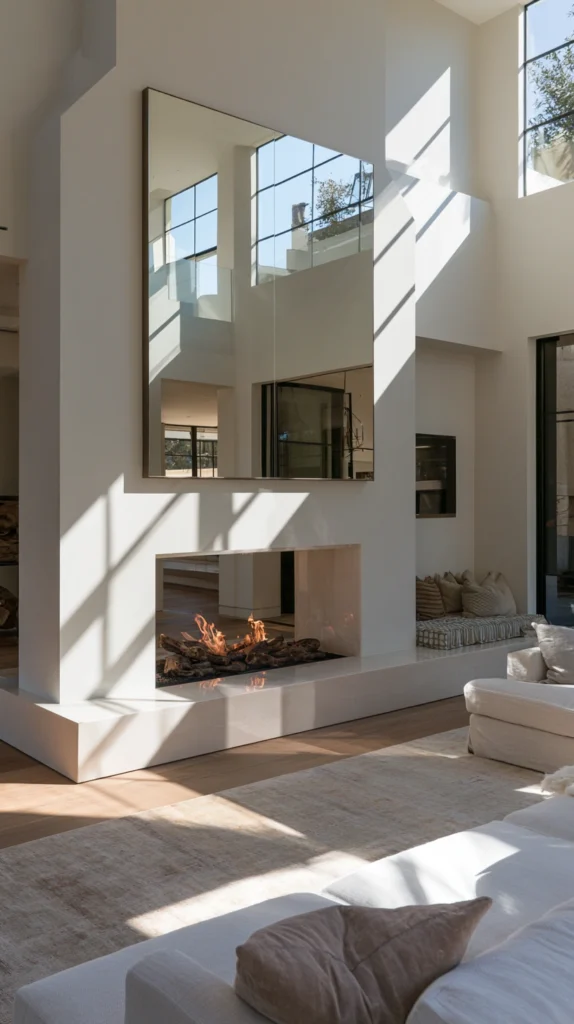
The large mirror above the mantelpiece is one of the oldest and most reliably successful interior design decisions available.
It works on multiple levels simultaneously. It reflects the room into itself, making the space feel significantly larger than it actually is. It doubles the visual interest of whatever is placed on the mantelpiece below it because the reflection shows a different angle of the same objects. It fills the vertical space above the mantelpiece with something that actively contributes to the room rather than leaving a wall to be decorated separately.
The mirror should be proportionate to the mantelpiece below it, and to the wall it sits on. A mirror that is significantly narrower than the mantelpiece looks undersized and tentative. A mirror that extends wider than the mantelpiece creates an expansive, confident statement. The mirror should reach comfortably above eye level when standing, typically to within thirty to forty centimetres of the ceiling.
The frame matters as much as the mirror itself. A gilded ornate frame in a period room. A simple black metal frame in a contemporary space. A salvaged tarnished frame in an eclectic, layered interior. The frame is the object you see when the mirror is doing its reflecting work, and it should be chosen with as much care as any piece of decorative art.
Lean the mirror rather than hanging it if the mantelpiece shelf is deep enough to support it safely. A leaned mirror has a more relaxed, contemporary quality than one hung flush to the wall. The slight gap at the top between the mirror and the wall creates a shadow line that adds depth and dimension.
Why a large mirror is the most consistently successful mantelpiece treatment:
- Reflects light and space to make the room feel significantly larger
- Fills the vertical space above the mantelpiece in a single, considered decision
- Doubles the visual interest of the display below it through reflection
- Works in every interior style from formal traditional to relaxed contemporary
- Creates a practical surface for a final check before leaving the room
- Requires almost no styling around it to look complete and considered
2. An Asymmetric Art and Object Display
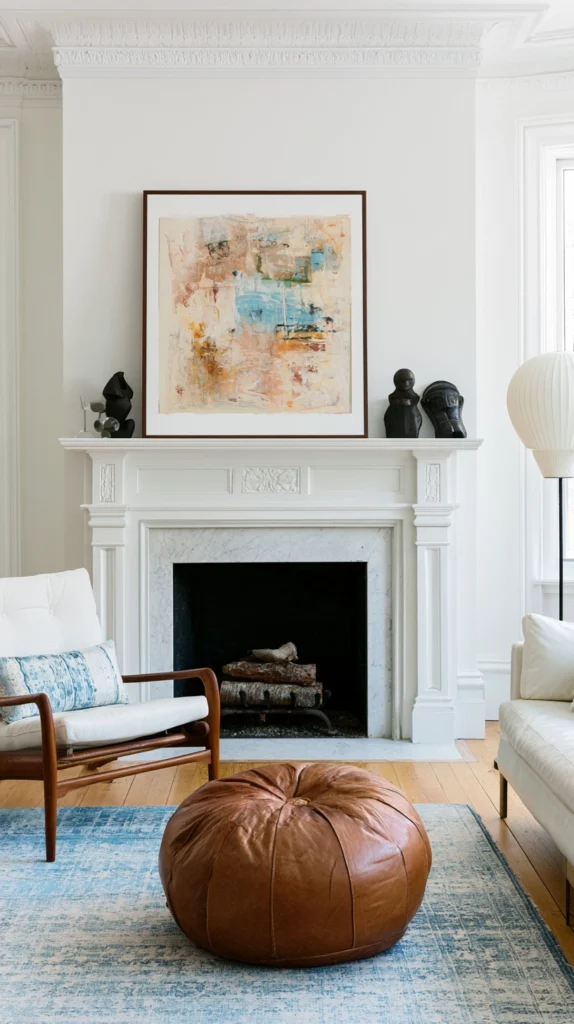
The symmetric mantelpiece display, the exact same thing on both sides of a central object, is the most common approach and the least interesting.
Symmetry communicates order and formality. In a formal traditional room, a Georgian drawing room or a panelled library, it may be exactly right. In most contemporary living rooms it produces a display that looks arranged rather than lived-in, deliberate in a rigid way rather than considered in a human one.
An asymmetric display uses balance without symmetry. The eye reads an asymmetric display as balanced when the visual weight is distributed across the mantelpiece without being mirror-identical on each side.
A tall piece of artwork leaned on one side of the mantelpiece. A cluster of objects of varying heights in the centre and toward the other side. A single significant object near one end balanced by a group of smaller objects toward the other.
The key to successful asymmetry is ensuring that the overall visual weight reads as balanced even though the distribution is not equal. A tall, visually heavy painting on the left balanced by three medium-height objects on the right. The height difference is compensated by the number difference. The eye reads both sides as weighted and the display feels dynamic rather than static.
3. A Gallery of Framed Art
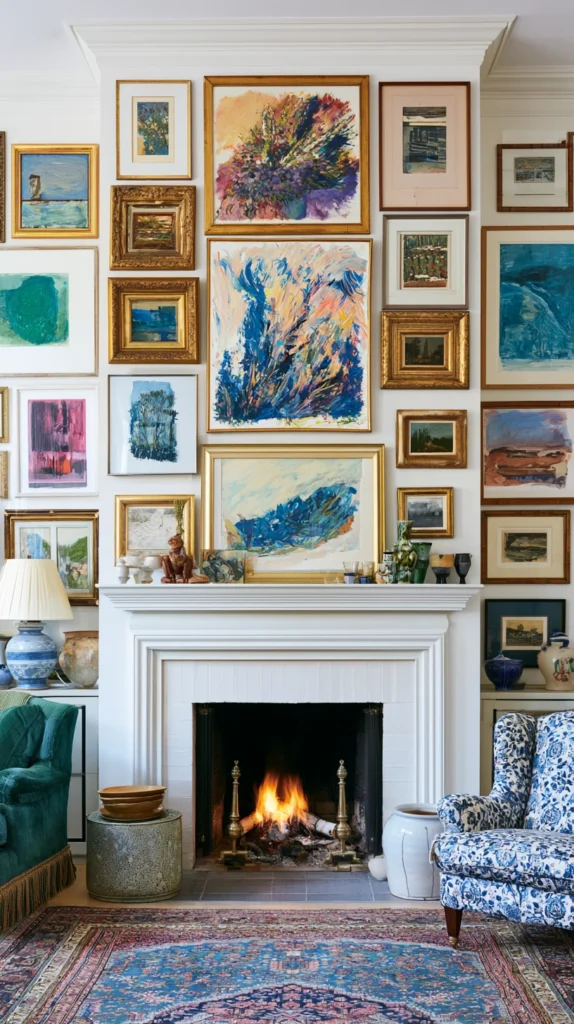
The mantelpiece as the base of a floor-to-ceiling or wall-to-wall gallery wall treats the mantelpiece and the wall above it as a single composition rather than two separate surfaces.
Framed photographs, prints, drawings, and paintings of different sizes, in frames of different materials but consistent colour, arranged across the wall above the mantelpiece and onto the mantelpiece shelf itself create a display of extraordinary warmth and personal character.
The gallery wall that extends down onto the mantelpiece shelf is more grounded and more complete than one that starts above the mantelpiece. The shelf gives the gallery a physical base, a place where three-dimensional objects can anchor the two-dimensional images above them.
On the shelf itself, lean smaller framed pieces against the wall alongside objects and candles. The leaned frames connect the horizontal display on the shelf to the vertical gallery on the wall in a way that hangs framing cannot achieve.
The gallery approach works in virtually any interior style. The consistency of frame colour throughout, all black frames, all natural wood, all gilded, provides the cohesion that allows diverse images and objects to coexist without visual chaos.
4. Seasonal Decor That Changes Throughout the Year
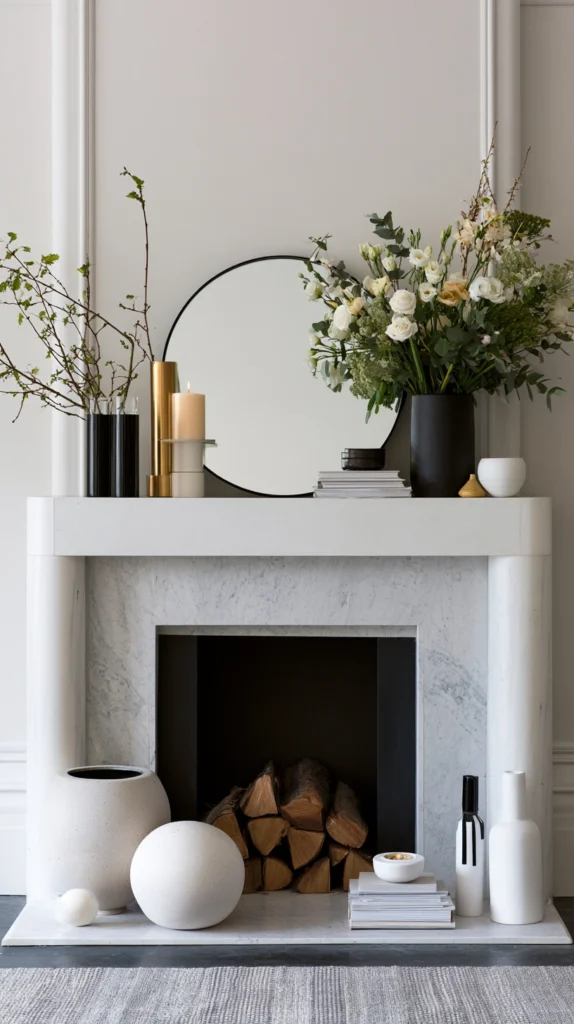
The mantelpiece that changes with the seasons is the mantelpiece that never becomes invisible through familiarity.
The same display in the same position year after year eventually stops being seen. The eye habituates to it. The brain registers it as background information rather than as something to engage with.
A mantelpiece that evolves seasonally forces fresh attention every time it changes. The change itself creates interest beyond the interest of the new display.
Spring: blossom branches in a tall vase. Pale eggs in a ceramic bowl. Botanical prints in fresh greens and cream. The mantelpiece that signals the season before the garden fully confirms it.
Summer: garden flowers cut and placed loosely in a mix of vessels. Trailing greenery spilling over the mantelpiece edge. Shells and smooth stones from a recent beach day. The casual abundance of the growing season translated onto the shelf.
Autumn: dried seed heads and grasses in warm amber vessels. Carved pumpkins replaced weekly as they age. Candles in deeper tones. The last dahlias before frost.
Winter: evergreen branches across the mantelpiece length. Pinecones and dried fruits. Candles of increasing presence as the evenings lengthen. And at Christmas, whatever combination of tradition and contemporary feeling the household considers correct.
5. Candles in Varying Heights and Groups
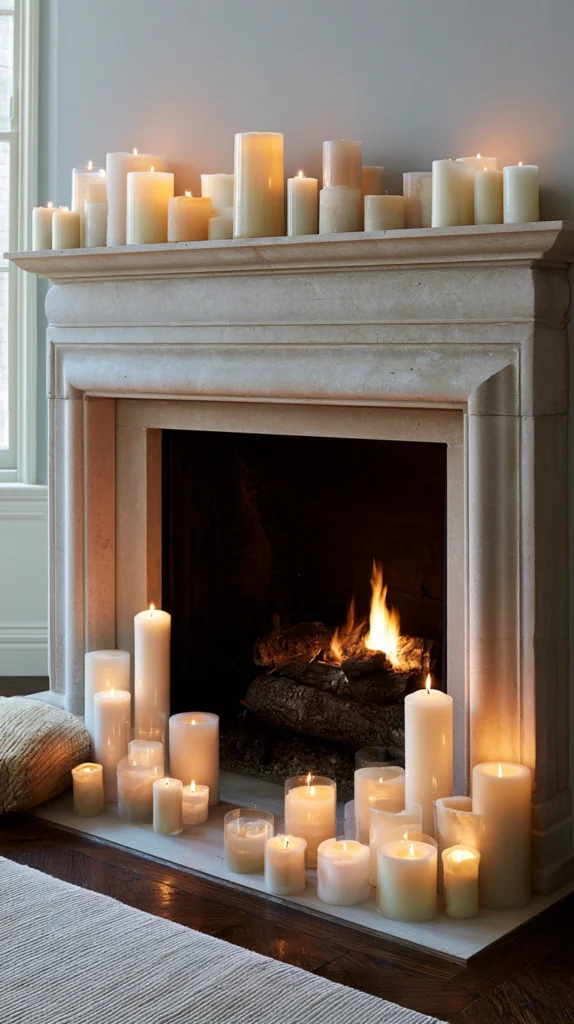
Candles on a mantelpiece are not a style choice.
They are a fundamental element of how the room is experienced in the evening hours when the fireplace and the mantelpiece together become the warmest and most visually compelling zone in any room.
The candle arrangement should vary in height significantly. A single height of candle produces a flat, uniform line that reads as a shop display rather than a personal arrangement. Candles of three or four different heights, pillar candles, taper candles in candlestick holders of different sizes, tea lights in glass holders at the lowest level, create a landscape of flame rather than a row.
Group candles rather than spacing them evenly. Three pillar candles in a cluster on one side of the mantelpiece. A pair of tall tapers in the centre. A low cluster of tea lights toward the other end. The groupings create pools of light and shadow that are more visually interesting than evenly distributed single flames.
Mix holder materials rather than matching them. Iron candlestick holders beside a brass pair beside a simple wooden pillar holder. The variation in material echoes the variation in height and creates the accumulated, personal quality that distinguishes a lived-in mantelpiece from a styled one.
Real, lit candles transform a mantelpiece in the evening in a way that no decorative object can replicate. The movement of the flames, the warmth of the light, the slight smell of beeswax. Light them every evening without exception.
6. A Single Large Statement Object
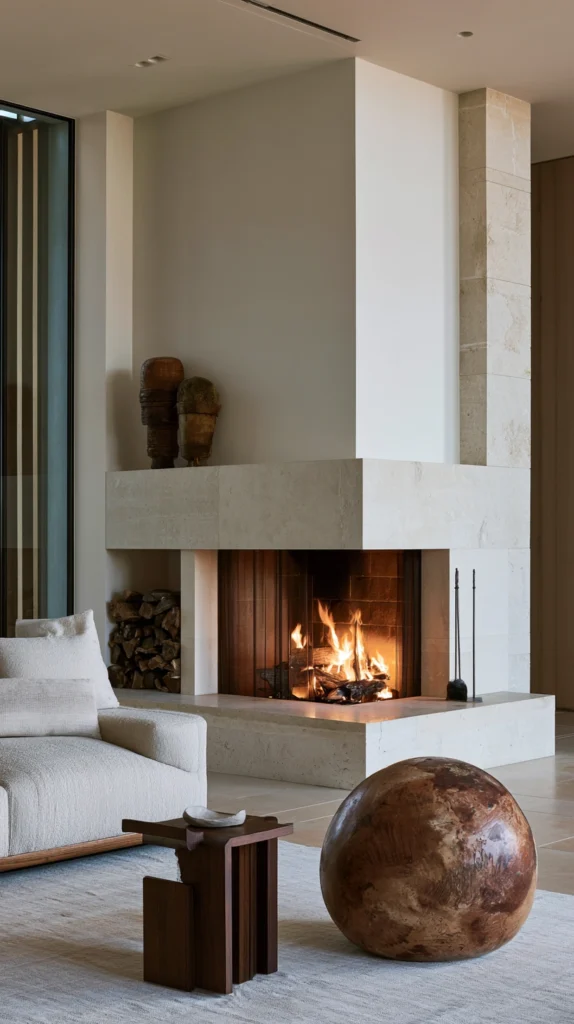
The counterpoint to the layered, complex mantelpiece display is the single object of such presence and quality that it needs nothing around it.
One extraordinary piece of ceramic. A large bronze or stone sculpture. A single dramatic vase of unusual form. An antique clock of compelling character. One object that is interesting enough to bear the full weight of the mantelpiece without any supporting cast.
This approach requires more confidence than the layered arrangement because there is nowhere to hide. One object on a mantelpiece is visible in a way that one object in a group of seven is not. The object must genuinely be extraordinary rather than merely nice.
The empty space around the single statement object is not emptiness. It is the breathing room that allows the object to be fully seen and fully appreciated. Negative space on a mantelpiece performs the same function as white space in a painting. It allows the positive elements to read clearly rather than competing with surrounding noise.
This is the approach for the household that has one genuinely exceptional piece and wants it to be seen rather than contextualised among lesser objects that dilute its impact.
7. A Clock as the Central Architectural Element
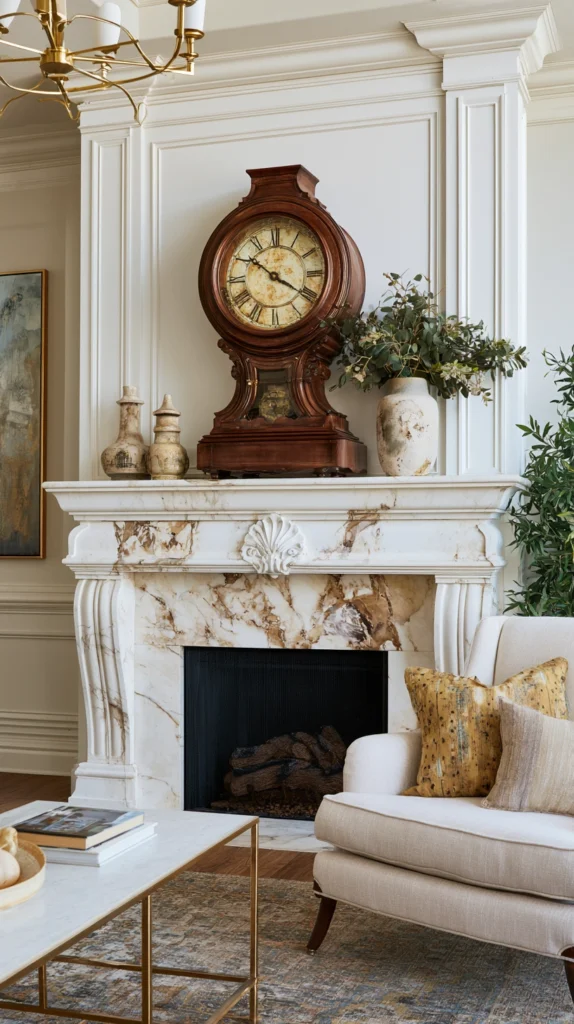
The mantelpiece clock is one of the oldest and most enduring mantelpiece traditions in the history of interior design.
For several centuries before any other timekeeping device was accessible, the mantelpiece clock was the most significant functional object in a household. It sat in the most prominent position in the most important room. Every other object on the mantelpiece organised itself in relation to the clock.
A good antique or vintage mantelpiece clock still carries that centrality even in a room where everyone has the time on their phone. Its physical presence, the tick that marks time in a room rather than merely displaying it, and its position as the organising element of the mantelpiece display give it an authority that no purely decorative object can replicate.
Pair an antique clock with objects of similar period or complementary character. Candlesticks of the same approximate era. A small sculpture or figurine. A framed miniature or small painting. The clock becomes the anchor and everything else relates to it.
Or place a contemporary clock design in a modern setting where the familiar form of the clock type is freshly interpreted in new materials. The clock reference remains. The execution is entirely current.
8. Natural and Organic Elements
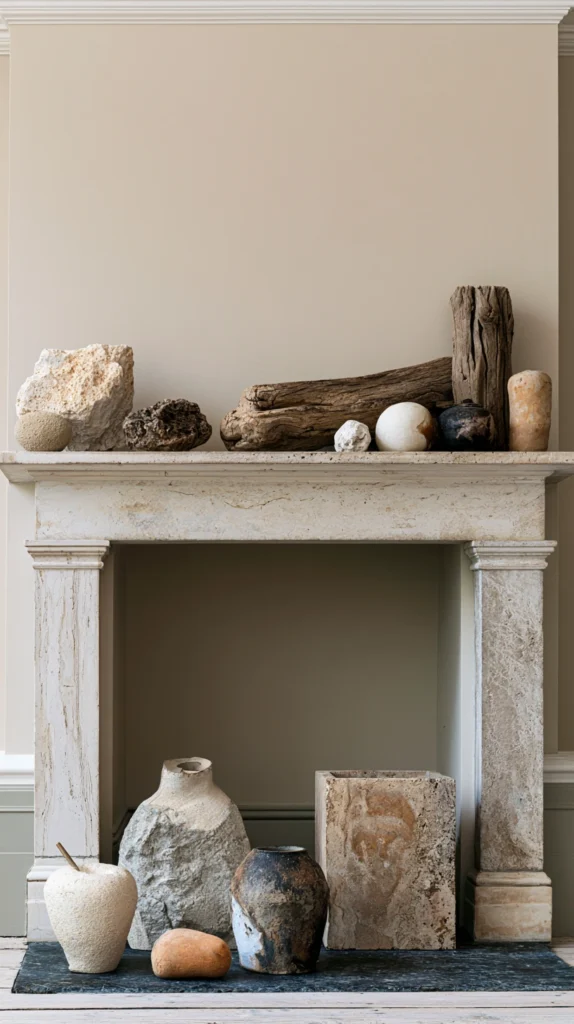
The mantelpiece that contains natural and organic elements connects the room to the living world outside in a way that manufactured objects cannot replicate.
Branches were brought in from the garden and placed in a tall vase. Their form, irregular and genuine, is more visually interesting than any vase designed to replicate the same organic quality. A large dried seed head. A piece of driftwood of unusual form. A cluster of pine cones of different sizes. A piece of coral. Smooth river stones in a shallow bowl.
These objects cost nothing or almost nothing. They can be found rather than bought. And they carry a quality of genuine natural origin that handmade ceramics approach but never quite reach.
The combination of natural organic elements with crafted objects, a piece of driftwood beside a hand-thrown ceramic vase, stones beside a cast-iron candleholder, creates a mantelpiece that reads as genuinely eclectic rather than assembled from a single shopping source.
Change the natural elements with the seasons. The driftwood stays year-round. The branches change from bare winter stems to blossom to full summer foliage to autumn berries as the year moves. The mantelpiece becomes a calendar of the natural world outside the window.
9. Books Stacked Horizontally as a Styling Element
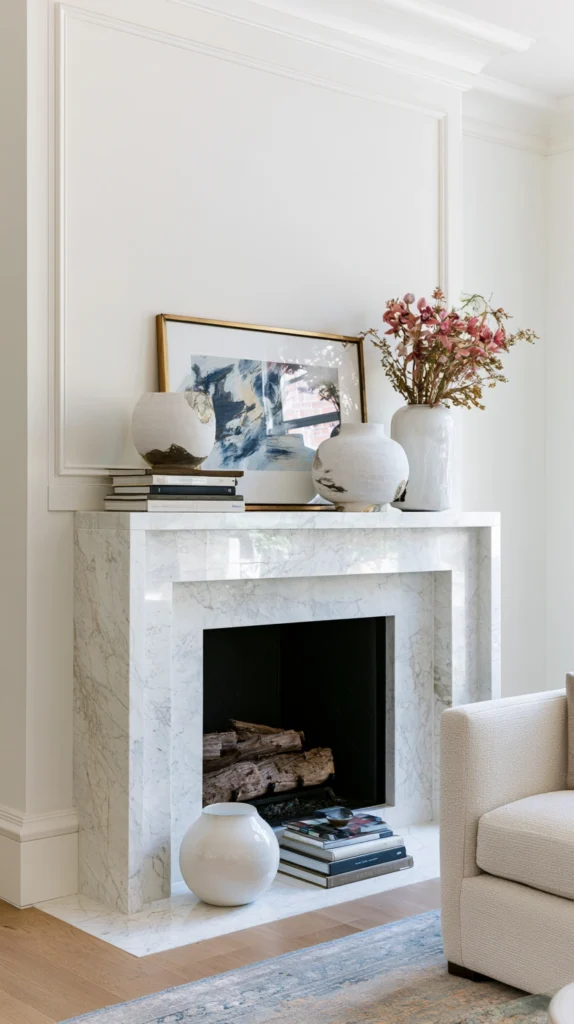
Books on a mantelpiece add an intellectual quality and a personal character that ceramics and candles alone cannot provide.
Not books displayed vertically spine-out in the way a bookshelf would hold them. Books stacked horizontally in groups of two or three, with an object placed on top of each stack. A stone bookend holding a candle. A small plant balanced on a stack of art books. A ceramic bird perched on the top volume of a travel photography collection.
The horizontal stacks create distinct levels on the mantelpiece surface without adding height. The books lift smaller objects to different heights and add visual complexity that a flat surface cannot achieve on its own.
Choose books that have covers and spines worth seeing. Large art, photography, and design books in linen or cloth covers. Books that are genuinely read and genuinely valued rather than arranged purely for appearance.
The titles visible on the spines or covers of the books add a layer of personality to the display. The volumes a household chooses to display on its most prominent surface say something about what that household cares about. That message, entirely personal and entirely genuine, is the kind of information that makes a room feel inhabited by real people.
10. A Sculptural Botanicals and Dried Flower Display
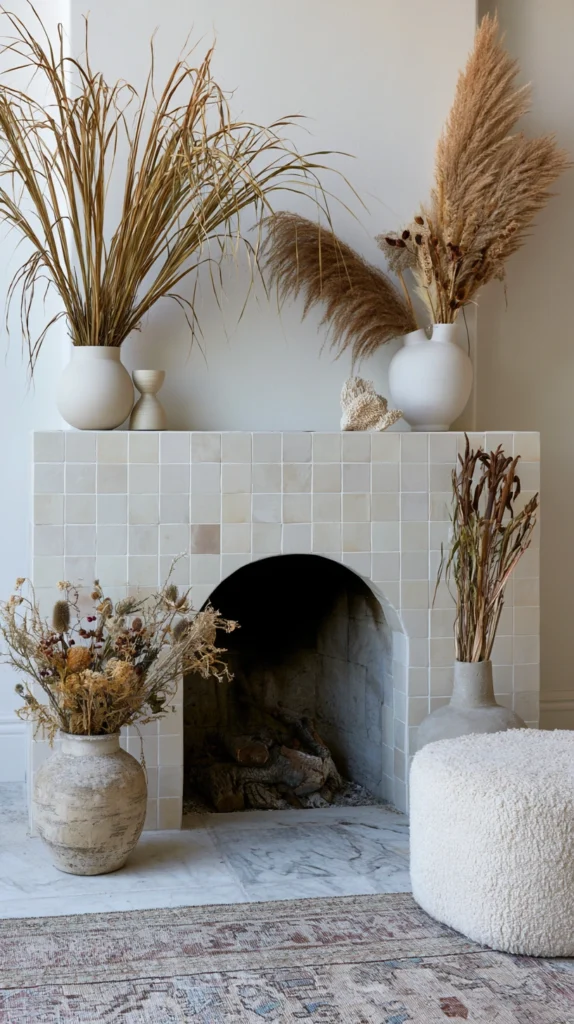
Dried botanicals on a mantelpiece bring the sensory richness and visual complexity of living flowers in a form that requires no water, no maintenance, and no replacement.
Dried pampas grass in a large vessel at one end of the mantelpiece. Bunches of dried lavender tied with raffia hanging from a hook at the wall. A glass cloche containing a delicate dried flower arrangement. A bundle of dried eucalyptus propped against the mirror. Dried honesty seed pods in a small vase, their silver disc-shaped cases catching light differently at different times of day.
The textures of dried botanicals are as varied and as interesting as the textures of any crafted object. Feathery pampas plumes. The papery disc of honesty. The rough, bristled texture of dried thistles. The smooth, satiny surface of dried poppy heads.
Dried botanicals add a seasonal quality without requiring seasonal replacement. A pampas display installed in autumn remains appropriate and beautiful through winter and into spring. The slight fading and slight ageing of the material over time adds character rather than suggesting neglect.
11. A Mantelpiece Styled Around One Dominant Colour
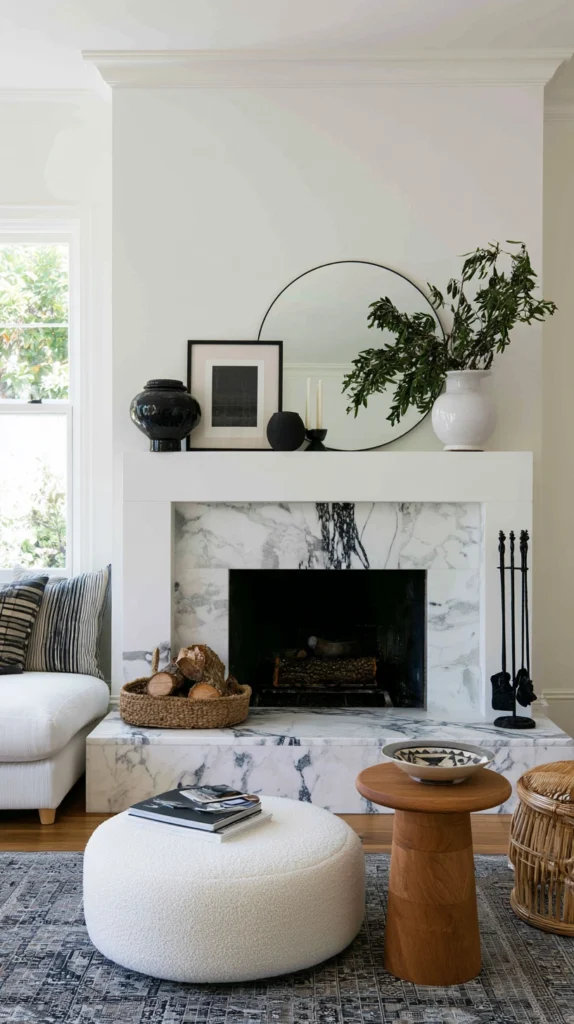
The most cohesive mantelpiece displays are often those organised around a single dominant colour rather than by material, period, or theme.
A collection of objects in cream and white. Vessels of different forms, periods, and materials, all in the same colour family. A white marble clock beside a cream ceramic vase beside a white plaster sculpture beside a milk glass candleholder beside a cream linen-bound book. The colour variation between each white is the detail that prevents the display from being monotonous. The overall impression is serene, unified, and quietly complex.
The same principle applied to a single accent colour produces different but equally effective results. A green mantelpiece display where every object carries some shade of green. Sage green ceramics, dark bottle glass, malachite stone objects, trailing green plants, a print with green as its dominant tone. The discipline of the colour rule creates a display that looks designed rather than assembled.
The colour-disciplined mantelpiece is the approach that makes any space feel more considered and more deliberate. It works regardless of the quality or cost of the individual objects because the cohesion of the overall display carries everything within it.
12. Layered Lighting for the Mantelpiece Zone
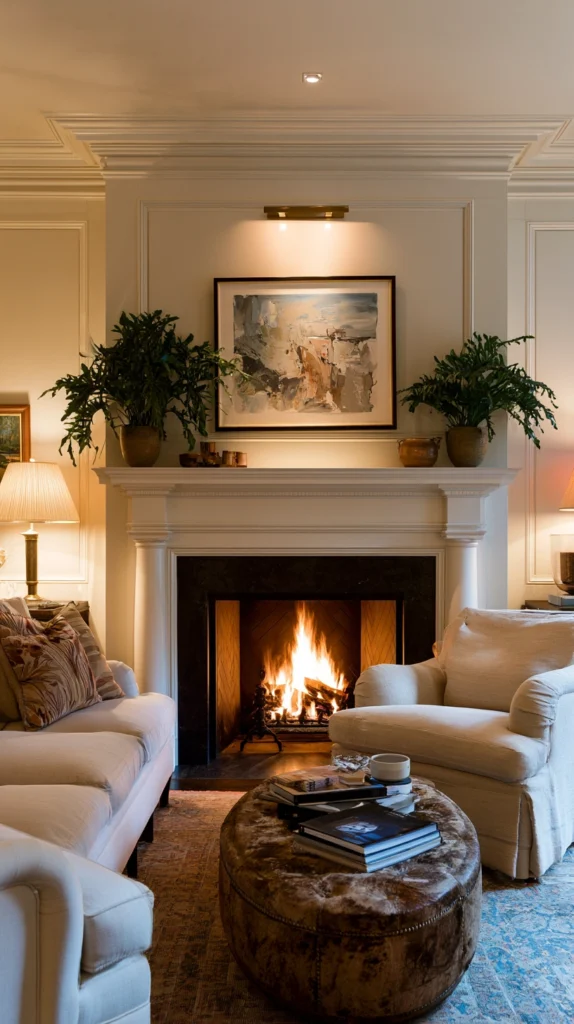
The mantelpiece is not just a display surface. It is a lighting zone.
The area above the fireplace, where the mantelpiece display is positioned, is where a room’s atmospheric lighting can be most creatively deployed. The combination of candles on the mantelpiece, a wall light or picture light above it, and the light from the fire below, creates the warmest and most layered lighting in any room.
A picture light mounted above the mirror or artwork on the wall above the mantelpiece casts directional warm light downward onto the mantelpiece display. This focused, warm light makes objects on the mantelpiece visibly three-dimensional in a way that ambient room lighting cannot. The shadows created by directional lighting reveal form and texture in even simple objects.
LED strip lighting concealed along the inner top edge of the firebox opening casts upward light onto the hearth objects and creates a warm glow from the fireplace zone when no fire is burning.
Combining the picture light above, the candle light at mantelpiece level, and the warm strip light below creates a three-layer lighting system for the fireplace zone that makes the whole architectural element feel alive and significant at any hour of the day.
13. Personal and Meaningful Objects That Tell the Room’s Story
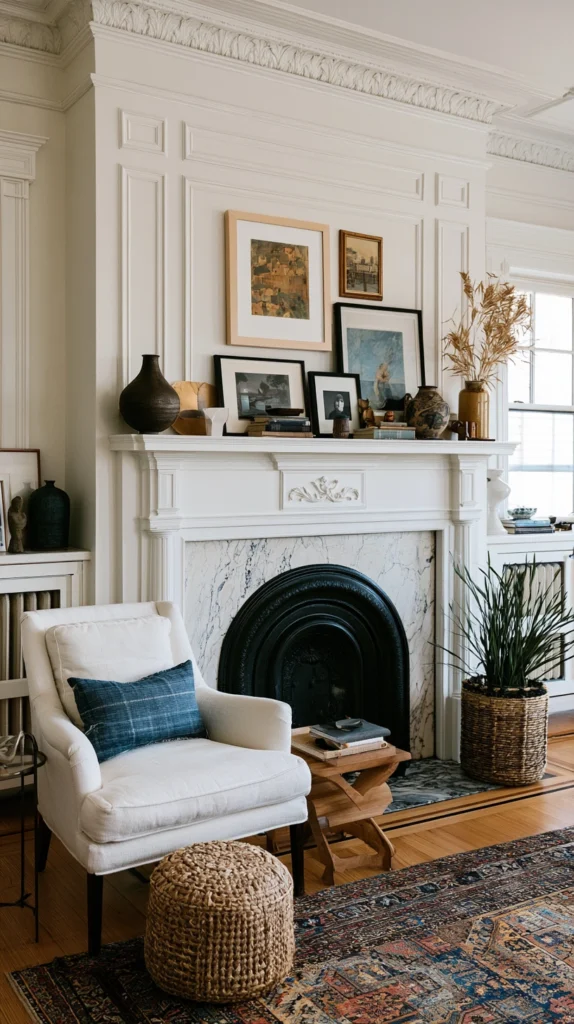
The mantelpiece is the surface in any home most naturally suited to displaying the objects that matter most to the people who live there.
Not because it is formal, though it is. Not because it is elevated, though it is. But because it is the surface that people look toward most consistently in any room with a fireplace. Whatever sits there is seen repeatedly and noticed regularly.
The family photographs in frames that vary because they were bought at different times from different places. The small sculpture brought back from a meaningful trip. The inherited clock that was a grandparent’s. The ceramic bought from a market in a city that changed the way the household thought about something. The shell from the beach where something important happened.
These objects are not necessarily beautiful in the way that professionally selected decorative objects are beautiful. They are meaningful in a way that professionally selected objects are not. And that meaning creates a display that is genuinely personal rather than generically attractive.
The personally meaningful mantelpiece is the most difficult to advise on because the objects that belong on it are entirely specific to the people who live with them. But it is also the most rewarding to look at, year after year, because it always contains something worth remembering and always tells the room’s truest story.
The rule is simple. Keep only the objects that genuinely mean something. Remove the objects that simply fill space. The resulting display will be smaller and more considered than what it replaced and will be more beautiful for exactly that reason.
How to Edit a Mantelpiece Display
Most mantelpieces need less rather than more.
The instinct when a display is not working is to add something new. The display usually needs something removed.
Start by clearing everything from the mantelpiece completely. Place everything that was on it on the floor where you can see all of it simultaneously. Look at what you have.
Now put back only the objects you actively chose to put back. Not the objects that have been there long enough to seem like they belong. Not the objects that are there because taking them away would require deciding where else they should go. Only the objects that you actively want on the mantelpiece and could say why.
This process typically results in returning roughly half of what was on the mantelpiece. The objects that return are the ones that belong there. The ones that do not return reveal themselves as space-fillers that had never been consciously chosen.
The resulting display will feel immediately more considered and more resolved. The negative space around each object will allow it to be properly seen for the first time in months or years.
Edit every six months. Objects that seemed essential six months ago may have exhausted their meaning. New objects may have arrived that belong on the mantelpiece more genuinely than some of what is already there. The edited mantelpiece is always more beautiful than the unedited one.
Common Mistakes in Fireplace Mantel Decor
Matching everything too precisely. Objects that are identical in height, identical in colour, and identical in material produce a display that looks purchased as a set rather than assembled over time. Vary the height, vary the material, keep the palette consistent but not uniform.
Placing objects too far apart. Objects spread individually across the full width of a mantelpiece look lonely and unrelated. Group objects into clusters with defined negative space between the groups rather than uniform spacing between individual objects.
Ignoring the vertical dimension. A mantelpiece display that is entirely the same height reads as flat and uninspiring. Use objects of dramatically different heights and lean framed pieces at different angles to create a varied skyline above the mantelpiece edge.
Neglecting the hearth. The hearth below the mantelpiece is part of the same composition. Candles, log baskets, fire tools, and a fireside rug contribute to the fireplace zone even when they are below the mantelpiece level. A beautifully styled mantelpiece above a neglected hearth is an incomplete composition.
Over-decorating for photographs. The mantelpiece you style for photographs looks good in photographs. The mantelpiece you style for daily life looks good every day. Decide which you are designing for.
Never editing. Objects accumulate on mantelpieces the way objects accumulate everywhere. Without regular editing the display becomes cluttered gradually and invisibly. A mantelpiece that was considered when it was styled becomes crowded over time without any single addition causing the problem. Edit every season without fail.
Quick Summary
- A large mirror above the mantelpiece fills the vertical space, doubles the room, and makes any display more complex through reflection
- Asymmetric balance is more interesting and more alive than symmetric arrangement in most contemporary interiors
- A gallery wall that extends down onto the mantelpiece shelf treats the wall and the mantelpiece as one continuous composition
- A seasonal mantelpiece display prevents habituation and keeps the room’s most prominent surface genuinely alive throughout the year
- Candles in varying heights grouped rather than evenly spaced create a landscape of flame rather than a uniform row
- A single extraordinary object with generous negative space around it requires more confidence and produces more impact than a complex arrangement
- An antique or contemporary clock organises the mantelpiece display as the central architectural and cultural element
- Natural and organic elements found rather than bought bring genuine material origin that manufactured objects cannot replicate
- Horizontally stacked books lift objects to varying heights and add intellectual personality to the display
- Dried botanicals bring the richness of living flowers in a maintenance-free and seasonally long-lasting form
- A single dominant colour applied consistently across varied objects produces a unified, serene, and quietly complex display
- Layered lighting with a picture light above, candles at level, and warm light below makes the whole fireplace zone feel alive
- Personally meaningful objects are always more interesting to return to than generically attractive ones
- Clear the mantelpiece entirely before re-editing to see what genuinely belongs there rather than what has accumulated over time
- Group objects into clusters with negative space between them rather than spreading individual objects across the full width
The mantelpiece is not a shelf that happens to be above a fireplace.
It is the room’s biography. The surface where the household puts what it considers most worth looking at.
Most mantelpieces are telling a story by accident. Objects arrived and stayed and accumulated into a display that nobody ever quite chose.
The best mantelpieces tell their story deliberately.
Edit yours until it says exactly what you mean.