
15 Brass Aesthetic Living Room Ideas for a Neo Deco Look
The brass lamp was the decision that made every other decision in the room make sense.
Not the sofa. Not the rug. Not the gallery wall that took three attempts to get right.
The lamp. A single unlacquered brass arc lamp in the corner, and suddenly the room had a temperature it hadn’t had before. Warm in a different way from the warm the linen throw had been trying to achieve. Metallic warmth. Reflective warmth. The kind that shifts with the light rather than staying fixed.
Brass does something in a living room that no other metal quite manages. Gold is too formal, too finished, too committed to luxury as a performance. Chrome is too cool, too clinical, too much of a different era. Brass sits between them — warm enough to feel inviting, aged enough to feel found rather than purchased, shiny enough to catch the light without demanding attention.
The neo deco living room builds on this quality. It takes the geometry and richness of Art Deco — the bold shapes, the warm metals, the layered materials — and strips away the theatrical excess. What remains is a living room that feels considered and warm and slightly glamorous without feeling like a stage set.

Here are 15 brass aesthetic living room ideas — from a single lamp to a fully realized neo deco interior — built on that understanding.
Why Brass Works Specifically in a Neo Deco Living Room
The patina effect
Without brass: A living room in warm neutrals, well-styled, comfortable. The light: pleasant and even. The room: resolved but flat. Nothing to catch the eye differently at 7pm than at 2pm.
With brass: The same room at 7pm. The lamp base catching the warm light and returning it from a different angle. The side table edge catching the ceiling reflection and holding it for a moment. The room: alive in a way it wasn’t before. Dynamic. The brass doing more at dusk than anything in the room does at noon.
The historical reference
Art Deco, at its core, was about the democratization of luxury — the belief that good design, rich materials, and beautiful objects belonged in every home rather than only in palaces and hotels. The neo deco living room inherits that belief. Brass is not a rich person’s material. It is a good decision made in the right place.
The warm metal advantage
Brass amplifies warm light. A 2700K bulb in a brass lamp reads warmer than the same bulb in a chrome lamp. A brass mirror frame reflects the room with a slight amber cast that a silver frame doesn’t produce. Every warm light source in the room reads more golden when there is brass nearby to amplify it.
The unlacquered difference
Unlacquered brass — the version that ages and develops a patina — is almost always the better choice for a living room. Lacquered brass stays bright and static. Unlacquered brass develops warmth and character over months of handling and light exposure. The patina: not decay but improvement.
The five ways brass enters a living room
Before choosing any design:
Lighting — the highest-impact entry point. A brass floor lamp, table lamp, or pendant carries more visual presence per dollar than any other brass element.
Hardware — the lowest-commitment entry point. Drawer pulls, curtain rods, switch plates, and door handles replaced in brushed or aged brass. Quiet, cumulative, irreversible in the best sense.
Furniture frames — coffee table legs, side table frames, sofa legs, bookshelf supports. The structural elements of furniture replaced or chosen in brass.
Mirrors and frames — brass-framed mirrors and picture frames, reflecting and amplifying the warm light already in the room.
Decorative objects — vases, candlesticks, bowls, trays. The most flexible and least permanent version. Also the least transformative on its own.
1. The Brass Arc Floor Lamp
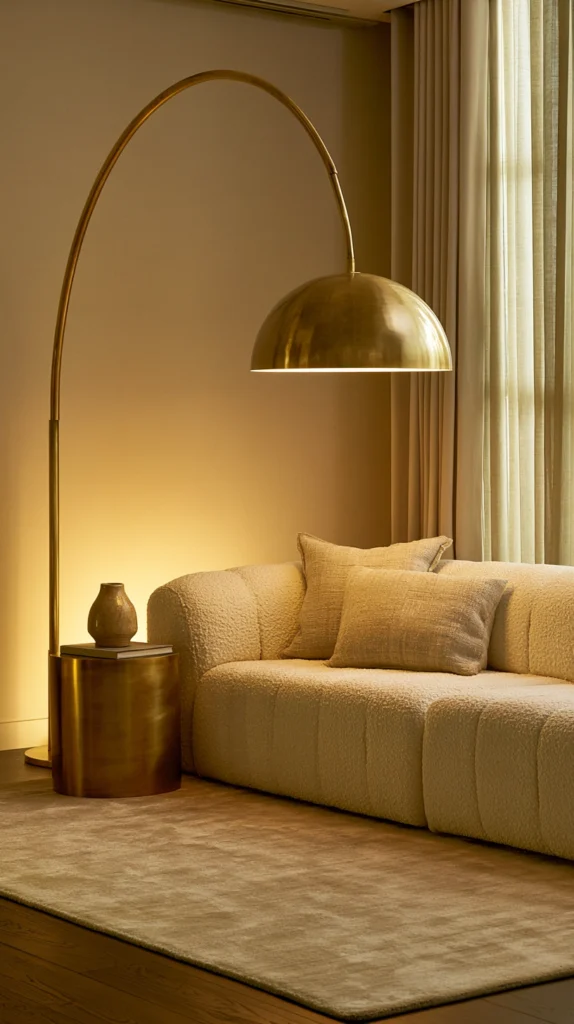
A single brass arc floor lamp — a long curved arm extending over the sofa or reading chair, a weighted base on the floor — as the room’s primary ambient light source and its first and most decisive brass element.
Why the arc lamp is the right first move
It occupies the corner. It lights the seating area from above at an angle no ceiling fixture matches. It is visible from every point in the room. And in unlacquered brass, it develops a warmth over months that a new lamp cannot replicate.
The lamp
A long arc — 60 to 80 inches of arm — with a weighted base heavy enough to anchor the curve without tipping. A shade in a warm material: linen, cotton, or amber glass. Never white plastic, which breaks the warmth the brass is building.
The shade shape: a wide dome or a drum, never a cone. Cone shades direct light downward. Domes scatter it into the room.
The positioning
Behind the sofa, arcing forward over the seating area. Or beside the reading chair, arcing inward over the arm. The lamp: the light source that reads from the sofa position as warm overhead light, and from the doorway as a sculptural brass object in the corner.
The bulb
2700K warm white, 800 lumens minimum. The lamp is doing the work of overhead lighting — it needs to be bright enough to function, warm enough to feel atmospheric.
The supporting decision
One other brass element nearby — a side table with brass legs, a brass tray on the coffee table — so the lamp reads as the beginning of a material language rather than an isolated object.
Cost breakdown: Brass arc floor lamp: $120–400 Warm white bulb: $5–10 Total: $125–410
2. The Brass-Legged Coffee Table
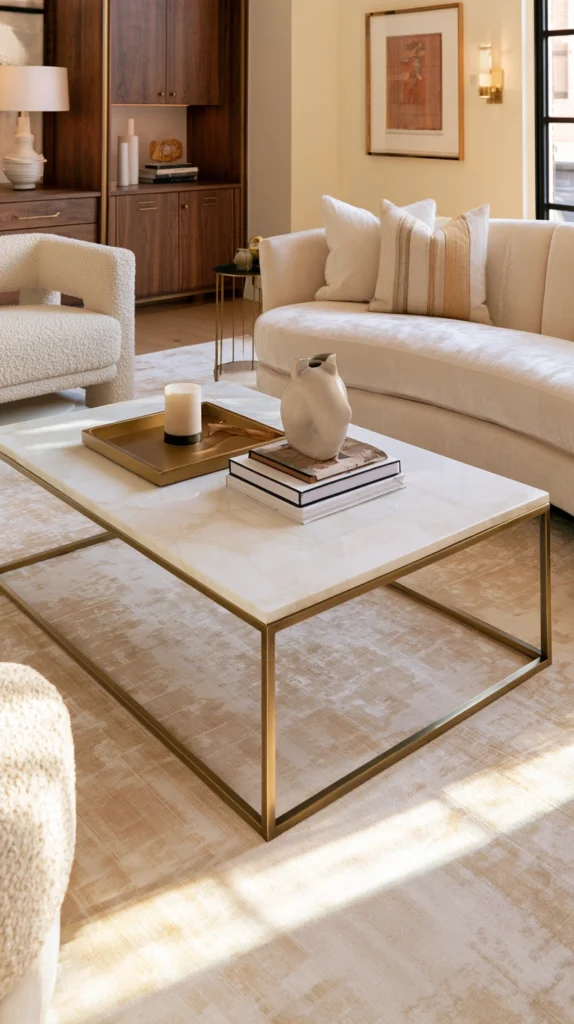
A coffee table with a glass, marble, or stone top and visible brass legs or a brass frame — the piece that brings the warm metal to the center of the room rather than its periphery.
Why the coffee table carries more brass than expected
The coffee table is the horizontal focal point of a living room. It is looked at from the sofa, walked around, used multiple times daily. A brass-framed coffee table is seen from every angle, at close range, throughout the day. More exposure to the material than almost any other single piece.
The top material
Glass over a brass frame: the clearest and most graphic version. The brass structure fully visible. Marble or stone with brass legs: the richest and most neo deco version. Two luxury materials in deliberate combination. Dark wood with brass hairpin legs: the warmest and most accessible version.
The proportions
Lower than standard where possible — 14 to 16 inches rather than 18 — reinforcing the low horizontal quality that neo deco interiors use to ground their richness.
Wide enough to hold a tray, a stack of books, two candles, and still have clear surface. For a standard sofa length of 84 inches, a coffee table at 48 to 55 inches long is proportional.
The styling
A large brass or dark ceramic tray in the center. A stack of two or three books with warm-toned covers or spines. One statement object — a sculptural vase, an oversized candle, a single branch in a low vessel. The table: dressed simply so the brass frame reads clearly rather than disappearing under a crowded surface.
Cost breakdown: Brass-framed coffee table: $250–800 Styling objects (tray, books, vase): $40–90 Total: $290–890
3. The Unlacquered Brass Mirror
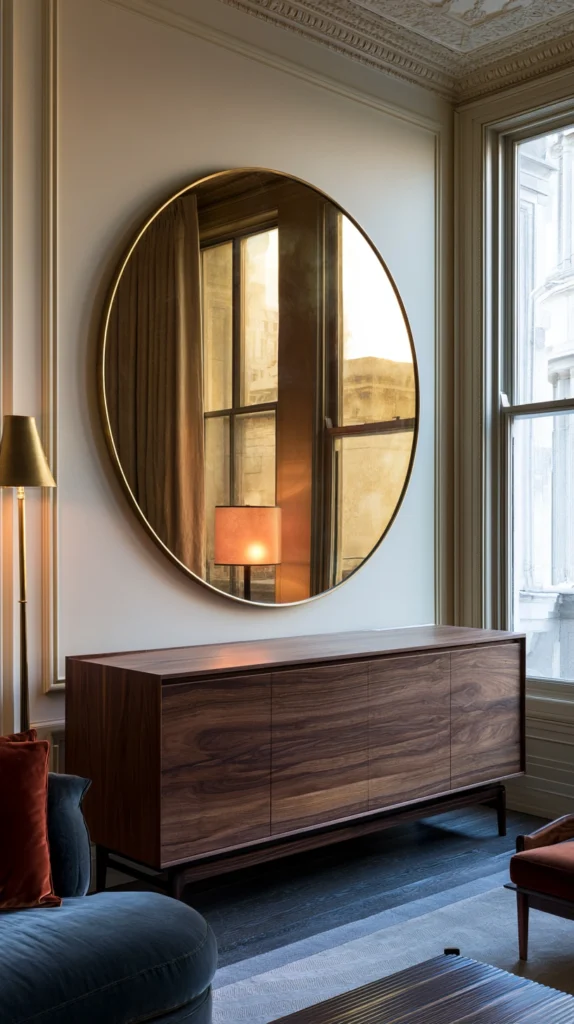
A large brass-framed mirror — round, arch-topped, or rectangular with a bold frame profile — mounted on the wall opposite the room’s primary light source, returning every lamp and window in the room from a brass-edged frame.
Why mirrors amplify the brass effect beyond their own presence
A brass object catches the light in front of it. A brass-framed mirror catches the light in front of it and also reflects the rest of the room — including every other brass element — back from a different angle. One mirror effectively multiplies every brass surface in the room.
The frame profile
Bold, not delicate. A 2 to 4-inch frame in aged or unlacquered brass reads as neo deco. A thin 1/2-inch frame reads as a picture frame that happens to be reflective.
The shape for a neo deco room: a circle or an arched top. Both are geometric without being rigid — the curve softens the formality of the metal.
The placement
Opposite the primary light source for maximum reflection — a window by day, the main lamp grouping by evening. Centered on the wall, at a height where the lower edge sits approximately at eye level from a seated position.
The size
Large enough to reflect the room rather than just the wall in front of it. For a standard living room wall, 30 to 40 inches in diameter or width. Smaller mirrors in brass frames work as objects. Larger mirrors work as atmosphere.
The aging
Unlacquered brass frames develop a patina within six to twelve months of placement near a window — the finish shifting from bright gold to a deeper, more complex warm amber. The patina: the goal, not the problem.
Cost breakdown: Large brass-framed mirror: $120–450 Total: $120–450
4. The Brass Hardware Upgrade Throughout the Room
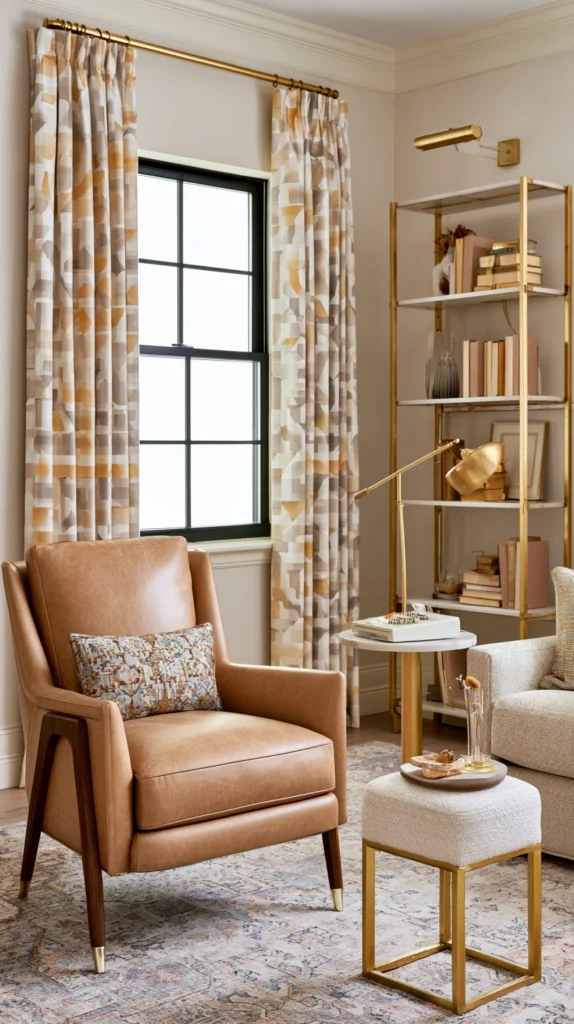
Every piece of hardware in the living room — curtain rod, curtain rings, picture hooks, shelving brackets, cabinet pulls — replaced in brushed or aged brass. No single dramatic change, but a quiet accumulation that eventually reads as a material decision.
Why hardware is underestimated
Hardware is seen constantly and ignored consciously. It is the detail that design-literate visitors notice without knowing they are noticing. A room with silver hardware and warm brass lamps contains a small visual argument — two metal tones competing rather than reinforcing. A room with brass hardware throughout contains no such argument.
The replacement sequence
Start with the most visible: curtain rod, then picture hooks and frames, then any shelving hardware, then cabinet pulls if there are built-ins.
Leave the permanent fixtures — switch plates, outlet covers, door hinges — for last. These require tools and commitment. The portable hardware comes first.
The finish choice
Brushed brass rather than polished for a living room — polished brass shows fingerprints and reads as more formal. Brushed reads as deliberate warmth without the high-maintenance quality of a high-sheen finish.
Aged brass (sometimes labeled antique brass or oil-rubbed brass) for the most lived-in, neo deco quality. The finish: as if the hardware has always been there.
The curtain rod
The most visible single piece of hardware in most living rooms. A 1-inch diameter brass rod at ceiling height rather than just above the window frame — the height: the detail that matters as much as the material.
Cost breakdown: Brass curtain rod and rings: $35–90 Brass picture hooks and frames: $30–80 Brass cabinet and shelf hardware: $25–60 Total: $90–230
5. The Brass and Velvet Combination
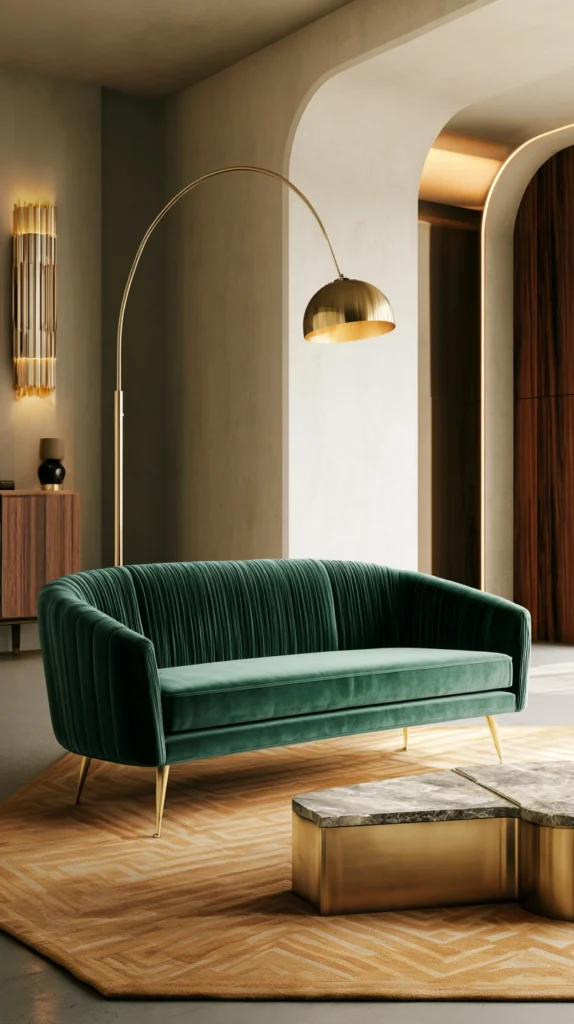
Deep velvet upholstery — in emerald, navy, burnt orange, or deep plum — paired with brass legs, brass arms, or brass trim on the sofa or armchair. The combination most associated with neo deco and the one that delivers the most complete version of the aesthetic in a single furniture purchase.
Why velvet and brass reinforce each other
Velvet absorbs light. Brass reflects it. In the same piece of furniture, or placed in proximity, the contrast between the two surface behaviors creates a richness that neither material achieves alone. The velvet: deep and soft. The brass: precise and bright. Together: unmistakably neo deco.
The velvet color for a neo deco room
Emerald green with brass legs: the most classic combination. Deep navy with brass arms: the most restrained and contemporary version. Burnt orange or terracotta velvet with brushed brass: the warmest and most current. Deep plum or aubergine with aged brass: the most dramatic and most committed.
The brass element on the furniture
Tapered brass legs on a sofa or armchair — the most common version. Brass armrests or arm caps — more formal, more distinctly deco. A brass nail-head trim along the sofa silhouette — the most traditional and the most specific to Art Deco heritage.
The rest of the room
Neutral walls — warm white or deep off-white — so the velvet-and-brass piece reads clearly rather than competing with the wall color for attention.
One other brass element nearby — the arc floor lamp positioned behind the velvet sofa, the brass coffee table in front of it.
Cost breakdown: Velvet sofa or armchair with brass legs: $500–1,800 Total: $500–1,800
6. The Brass Bar Cart or Drinks Trolley
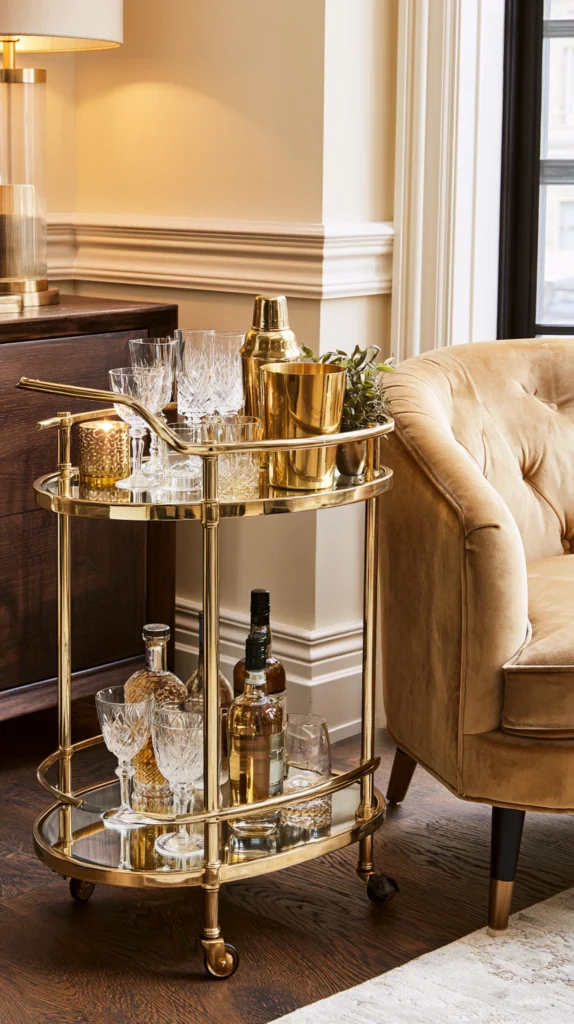
A brass bar cart — two tiers, visible brass frame and handles, glass or mirrored shelves — positioned in a corner of the living room as a concentrated display of the aesthetic.
Why the bar cart is the most social brass object
The bar cart is used in the presence of guests. It is reached toward, arranged, admired, and discussed. A brass bar cart in a living room is not passive decor — it is an active part of how the room functions at its best.
The cart
Brass frame and push handle. Glass shelves rather than solid — transparency keeps the frame visible from all angles.
Two tiers: upper for spirits and active-use objects, lower for backup bottles, a champagne bucket, or glasses stored upside down.
The styling
Four to six bottles — not a full liquor store, not a single lonely bottle. A few glasses of varied types. One ice bucket in silver or brass. One or two non-drinking objects — a small plant, a brass candle, a book with a good cover — to prevent the cart from reading as purely functional.
The placement
A corner rather than the center of a wall — the cart: a destination object, approached from one direction. Lit from above by an existing lamp or a small directional spotlight clipped to the wall above it.
The brass maintenance
Wipe with a dry cloth after use. Polish with Bar Keepers Friend once or twice a year if fingerprints accumulate. Unlacquered carts will develop patina — lean into it. The aging: part of the object’s value.
Cost breakdown: Brass bar cart: $150–500 Styling objects (glasses, ice bucket, plants): $40–100 Total: $190–600
7. The Brass Picture Rail and Gallery Wall
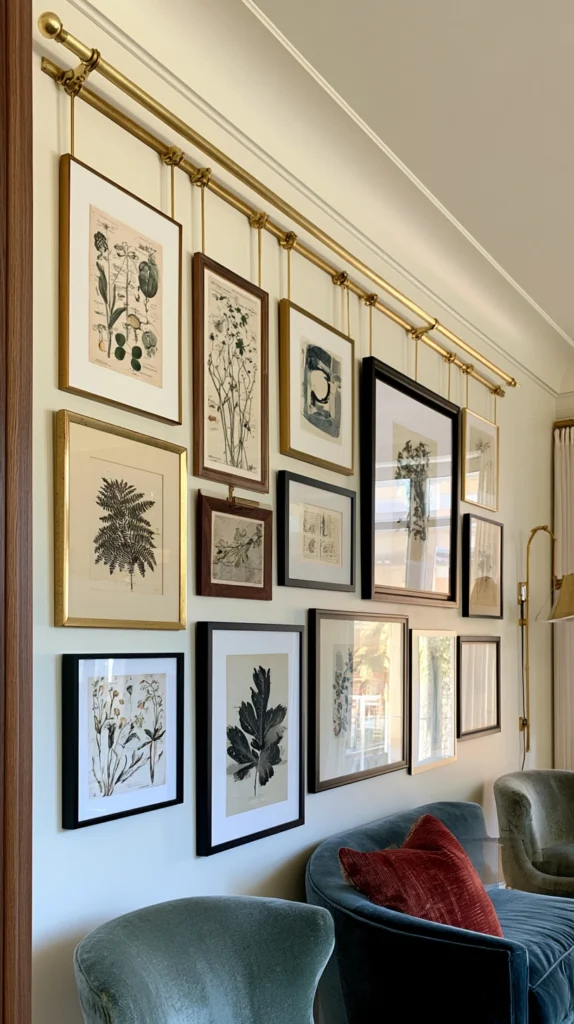
A brass picture rail — the original Victorian-era hanging system, a continuous horizontal rail near the ceiling from which pictures hang on adjustable hooks and wires — combined with a gallery wall of warm-toned art. The system: both a display method and a brass architectural feature.
Why picture rails suit neo deco rooms
Picture rails were used extensively in the early twentieth century — the exact period that Art Deco emerged from. A brass picture rail in a neo deco living room is not a reference; it is the original material. The connection between the historical period and the contemporary aesthetic: visible in the hardware.
The rail
Brass or brass-effect picture rail molding, mounted 1 to 2 inches below the ceiling on the primary display wall. Standard rail: 1 to 1.5 inches tall, available in continuous lengths up to 10 feet.
The hanging system
Brass S-hooks and adjustable steel cable or cord. The hanging wire visible — not hidden — so the system is part of the display.
The gallery arrangement
Frames in brass, dark wood, and black — three finishes, not more — hung at varied heights within the rail system. The variety of hanging lengths: the detail that makes a picture rail gallery look different from a standard gallery wall. Objects hanging at different depths from the ceiling rather than aligned to a single height.
The art
Warm-toned: amber photography, botanical illustration in ochre and brown, abstract mark-making in gold and rust. One or two pieces in deeper jewel tones — the visual anchor of the arrangement.
Cost breakdown: Brass picture rail molding (12 feet): $40–80 Brass hooks and hanging wire: $20–40 Frames (6–8, assuming existing art): $60–150 Total: $120–270
8. The Brass Fireplace Surround and Accessories
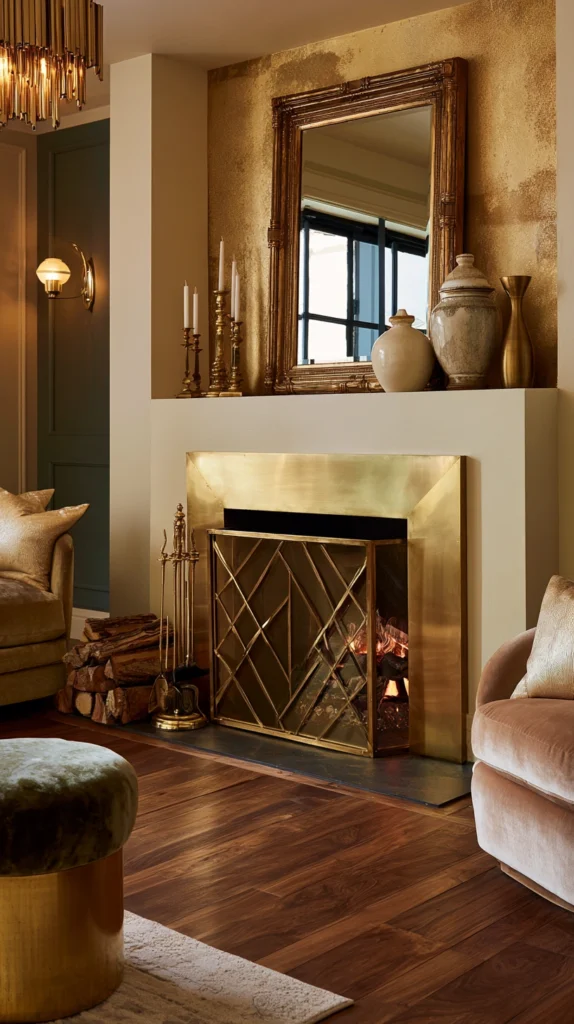
Brass applied to the fireplace — as a surround material, as a fire screen, as a set of fire tools — making the room’s existing focal point warmer and more deliberately metallic.
Why the fireplace is the natural home of brass
Firelight and brass have the same color temperature. The amber of a flame and the amber of unlacquered brass: the same warmth, the same quality of shifting light. Brass at the fireplace doesn’t contrast with the fire — it continues it.
The surround
Existing tile or painted plaster surround replaced or covered with brass sheet or brass-effect porcelain tile. A brass inlay strip along the fireplace opening edge — the minimum version, 2 to 3 inches of visible brass at the innermost edge of the surround.
Or the mantel shelf in natural brass — not gold-painted wood, but actual brass plate cut to the mantel dimensions and fixed in place.
The fire screen
A geometric brass fire screen — the most neo deco object available for a fireplace. A sunburst pattern, a chevron grid, or a simple arched frame in unlacquered brass. The screen: visible when the fire is not lit as a piece of metalwork. Invisible when lit, because the fire behind it is more interesting.
The tool set
A matching brass poker, brush, tongs, and log holder. These are functional objects used in the presence of guests — their material quality is noticed at the moment of use.
The mantel styling
Three or four objects in complementary materials. A large brass or ceramic vase. Two candles in brass holders. One piece of art or a mirror in a brass frame. The mantel: an extension of the fireplace’s warmth, not a separate display surface.
Cost breakdown: Brass fire screen: $100–350 Brass tool set: $80–200 Brass mantel accessories (vases, candles): $50–120 Total: $230–670
9. The Brass Pendant Light Over a Reading or Seating Zone
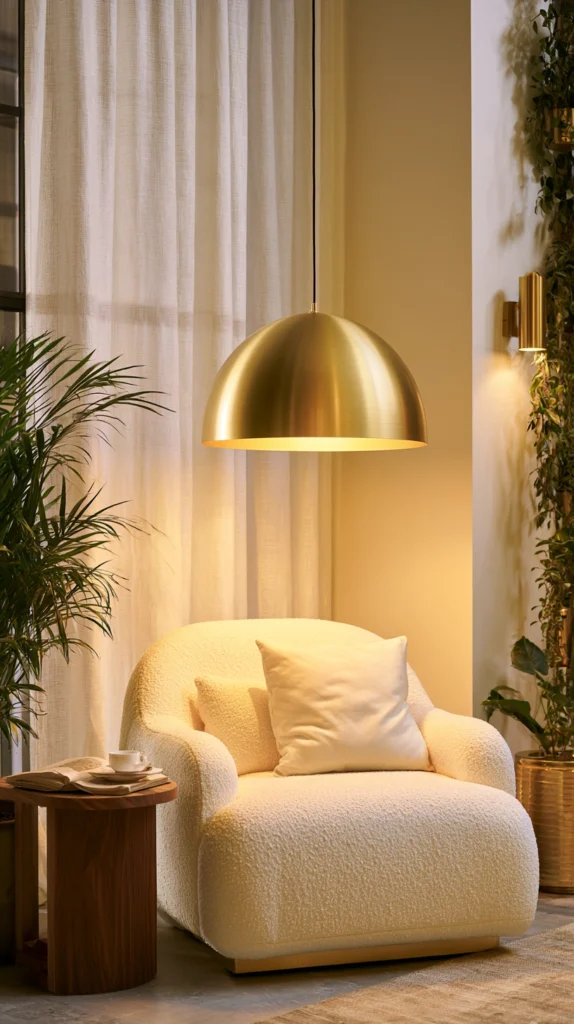
A brass pendant light — a dome, a globe, or a cage silhouette — hung at low height over the main seating area or reading zone, creating a pool of warm directed light that overhead fixtures never achieve.
Why pendant placement matters more than pendant design
A pendant hung at ceiling height is an overhead light. The same pendant hung at 5 to 6 feet from the floor — low enough to be visible as an object from the sofa, high enough not to interrupt sightlines — is an atmosphere light. The difference: everything.
The shade shape for neo deco
A wide brass dome, 14 to 18 inches in diameter. The dome: directing warm light downward and outward rather than in a single sharp cone.
Or a glass globe in amber or smoked glass with a brass fitting — the globe: visible as a glowing object from every angle in the room.
The cord
Fabric-covered cord in black, cognac leather, or natural cotton — not white plastic. The cord visible from ceiling to pendant — not hidden — as part of the object’s composition.
The bulb
A visible Edison filament, rated at 2200K to 2700K. The filament: warm amber at close range. The brass: amplifying it.
The canopy
A brass ceiling canopy, not a chrome or white one. The canopy: the connection between the pendant and the ceiling. The detail most often overlooked and most visible when wrong.
Cost breakdown: Brass dome or globe pendant: $80–280 Fabric cord and brass canopy (if not included): $25–60 Edison filament bulb: $8–15 Total: $113–355
10. The Brass Bookshelf and Display System
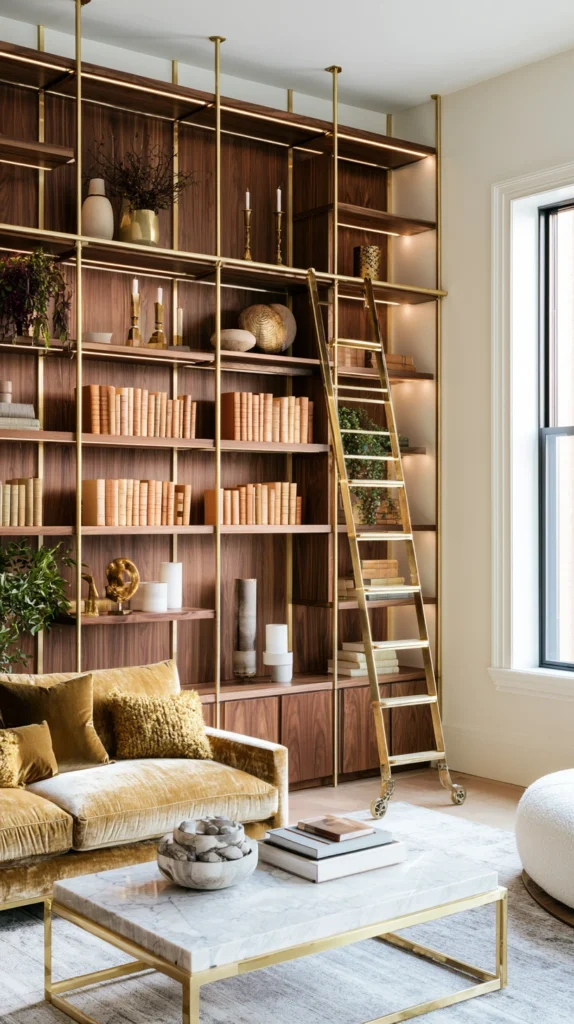
Floor-to-ceiling shelving with a brass ladder — the rolling library ladder in unlacquered brass on a brass rail — or a brass-framed shelving system, for the most fully realized neo deco library wall.
Why the library ladder is the most theatrical brass object
A rolling brass ladder is functional, beautiful, and unexpected. It is used in front of guests. It moves. It makes a sound. It announces that the books on the shelves are genuinely accessed and that the room takes its books seriously. No other brass element delivers as much character per object.
The ladder
An unlacquered brass rolling library ladder on a ceiling-mounted rail in matching brass. Available from specialty retailers in heights from 6 to 12 feet.
Or — the more accessible version — a non-rolling brass leaning ladder propped against the shelves, moved by hand. The same aesthetic impact at a lower cost and without the ceiling rail installation.
The shelving
Dark wood — walnut, oak in a dark stain — so the brass ladder reads clearly against it. Light shelving and brass ladder: the contrast insufficient. Dark shelving and brass ladder: the contrast the object needs.
The styling
Books arranged by spine color within each shelf — warm tones (amber, rust, cream, brown) grouped, cool tones separated. Objects tucked between book groups: a small brass candlestick, a ceramic object, a small plant. The shelf: not a display of objects but an accumulation of things that belong there.
Cost breakdown: Brass rolling ladder with rail hardware: $400–1,200 Or brass leaning ladder: $150–400 Total: $150–1,200
11. The Brass Side Table Cluster
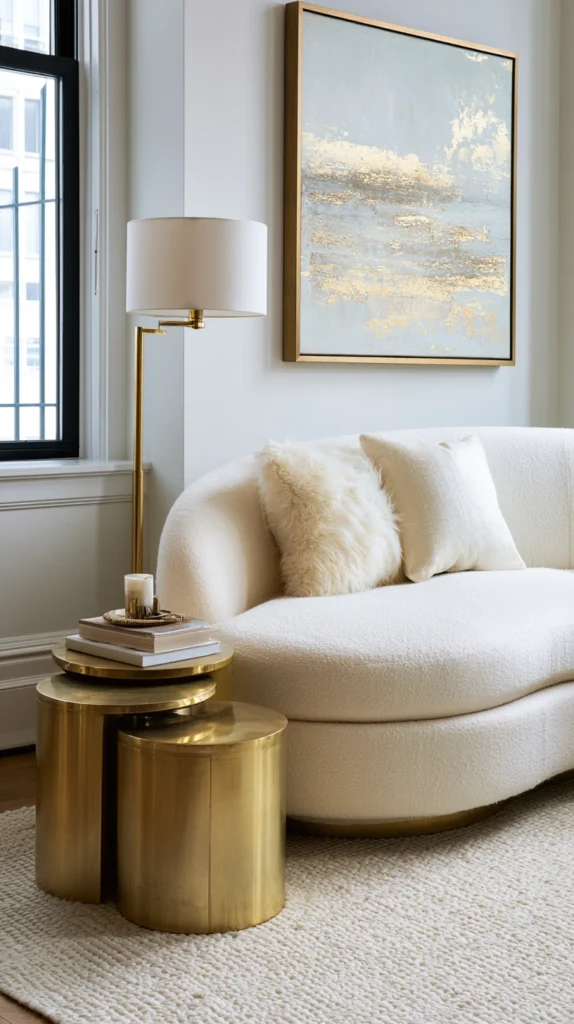
Two or three small brass side tables of varying heights — used as a cluster beside the sofa or reading chair rather than as matched pairs — creating an organic, layered surface arrangement.
Why side table clusters beat matching pairs
Matching side tables are symmetrical. Symmetry in a neo deco living room reads as interior design. A cluster of mismatched brass side tables at different heights reads as collected — as if each piece was found or chosen separately over time, which is the quality neo deco interiors reach toward.
The tables
One tall, thin side table — 26 to 28 inches — as the lamp surface. One medium martini-style table — 22 to 24 inches — for a drink and a book. One low round table — 14 to 16 inches — for the object that needs to be at coffee table height beside the sofa arm.
Each one in a slightly different brass finish — polished, brushed, and aged if possible — for a collected rather than purchased quality.
The styling
The tall table: one lamp only. The medium table: one drink, one book, one small object. The low table: one vase or a small plant. None of the surfaces cluttered. The brass frame of each table: the point, not the objects on top of it.
The floor treatment
A rug that extends beneath the cluster, connecting the three tables to each other and to the sofa. Without a rug, the cluster reads as scattered. With a rug, it reads as a zone.
Cost breakdown: Brass side tables (3, varied heights): $120–450 Total: $120–450
12. The Brass and Marble Combination
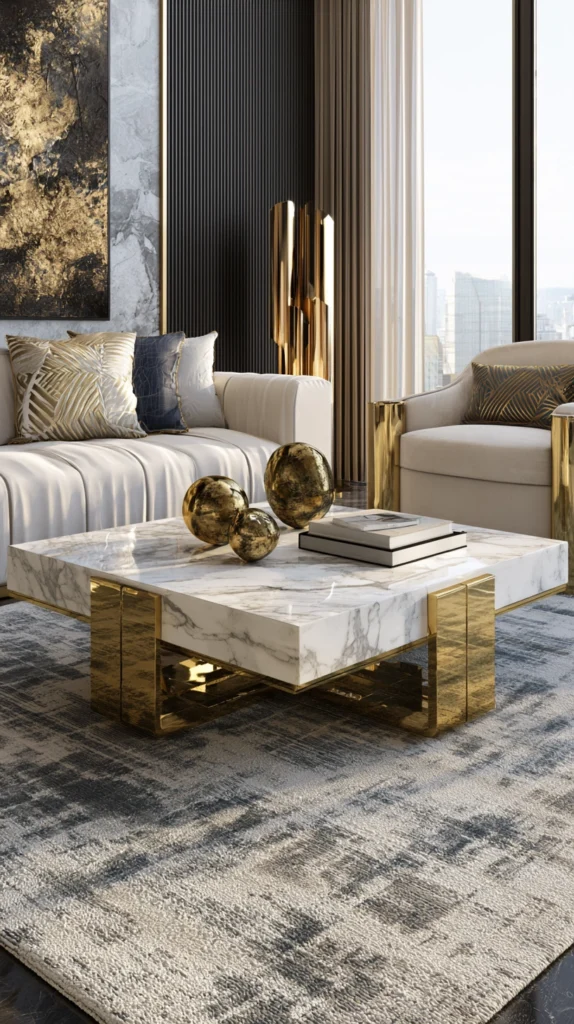
Brass paired with white or cream marble — as a coffee table, a side table, a fireplace surround, or a decorative tray — for the richest and most formal version of the neo deco material palette.
Why marble and brass belong together in this aesthetic
Both materials are associated with the same historical period and the same design philosophy: the early twentieth century belief that beauty and luxury had a place in domestic life. Marble was the prestige material of Art Deco interiors. Brass was the warm metal that ran through them. Together they are not a trend — they are the original.
The combination at different scales
Large scale: A marble coffee table with brass legs or a brass inlay border. The room: anchored by two luxury materials in the center.
Medium scale: A marble-topped side table on brass legs. The combination contained but fully stated.
Small scale: A marble tray with brass handles on the coffee table. The minimum version — less than $50 in cost, the combination correctly stated.
The marble tone for brass
White marble with grey veining: the most classic pairing. The veining: dark enough to contrast with the white, not so dark it competes with the brass.
Cream or warm white marble: the warmest pairing. The marble and the brass: both in the same warm temperature, mutually reinforcing.
Green or dark marble: the most dramatic pairing. Reserved for a room confident enough in its palette to add another strong element alongside the brass.
The maintenance reality
Marble requires sealing once a year and immediate attention to spills — wine, citrus, and coffee will etch unsealed marble. The trade is worth making. A well-maintained marble surface ages as well as unlacquered brass.
Cost breakdown: Marble and brass coffee table: $300–900 Or marble tray with brass handles: $30–80 Total: $30–900 depending on scale
13. The Brass Ceiling Medallion and Chandelier
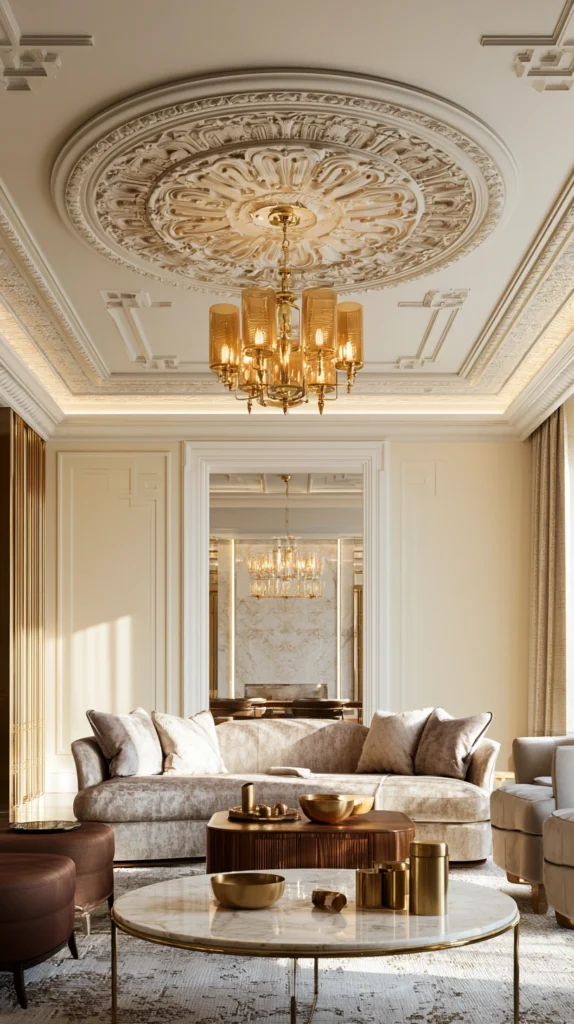
A brass ceiling medallion — a decorative plaster or resin disc installed around the ceiling light fitting — combined with a small brass chandelier or a statement brass pendant, restoring the ceiling as an architectural surface rather than an afterthought.
Why the ceiling is the most overlooked neo deco surface
Art Deco interiors treated the ceiling as a design surface — coffered, decorated, and lit as deliberately as the walls. The neo deco living room doesn’t need to go that far. A brass ceiling medallion and a brass light fitting restore the ceiling’s presence without the cost or commitment of plasterwork.
The medallion
A pre-made plaster or polyurethane ceiling medallion — 12 to 18 inches in diameter — primed and painted in the ceiling color, then dry-brushed with gold or brass paint on the relief detail. The medallion: almost invisible during the day, present in warm lamp light when the texture catches the glow.
Or painted in a contrasting warm cream, making the relief detail readable as a deliberate decorative element.
The chandelier
A small brass chandelier — 5 to 8 arms, 18 to 24 inches in diameter — at the center of the medallion. The chandelier for a neo deco room: not crystal, not chrome, not opaque white glass. Brass arms, amber glass shades, or visible Edison filaments in brass fixtures.
The combined effect
The medallion: framing the chandelier from above. The chandelier: providing warm light that catches the medallion’s relief from below. The ceiling: a warm, textured surface rather than a flat white plane.
Cost breakdown: Ceiling medallion: $25–80 Brass chandelier (small): $150–500 Total: $175–580
14. The Brass Accessory Layer
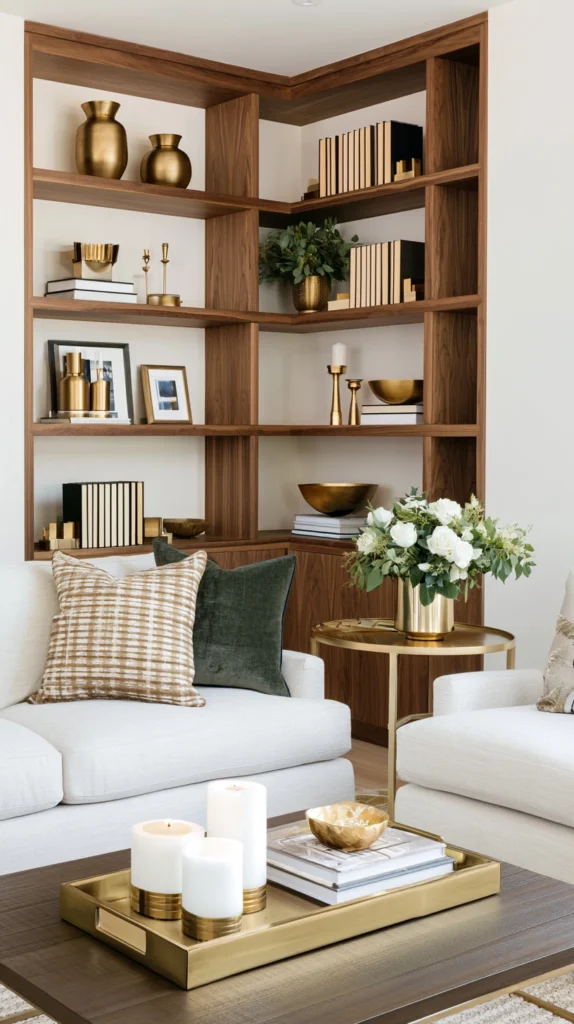
Brass in the living room without any single large piece — carried instead through an accumulation of smaller objects that together create a material presence as significant as any single lamp or table.
What the accessory layer includes
A brass tray on the coffee table — the first object. The surface for every other object on the table.
A set of brass candlesticks — two or three at different heights on the mantel or a side table. The vertical brass element that every room with a horizontal concentration needs.
A brass bowl or vase — 8 to 12 inches — filled with nothing, or with dried stems, or with seasonal objects. The object that reads as sculptural without trying.
A brass magnifying glass on the bookshelf, or a brass bookend set, or a brass letter opener on the desk-adjacent surface. The detail that gets seen at close range by guests and remembered.
A brass picture frame on the side table — one photograph, one brass frame. The personal object in the material language.
The accumulation principle
Each object on its own: modest. A brass tray plus two candlesticks plus a vase plus one picture frame: a material language. The room: visibly of a piece in a way it wasn’t with four separate objects from four different material families.
The budget advantage
The accessory layer can be built gradually — one object per month, sourced from thrift stores, antique markets, and online secondhand platforms — at a total cost far below any single piece of brass furniture.
Cost breakdown: Brass tray: $20–60 Brass candlesticks (2–3): $25–80 Brass vase or bowl: $20–60 Brass picture frame: $10–30 Brass bookends or detail object: $15–40 Total: $90–270 — built over time, purchased secondhand where possible
15. The Fully Realized Neo Deco Brass Living Room
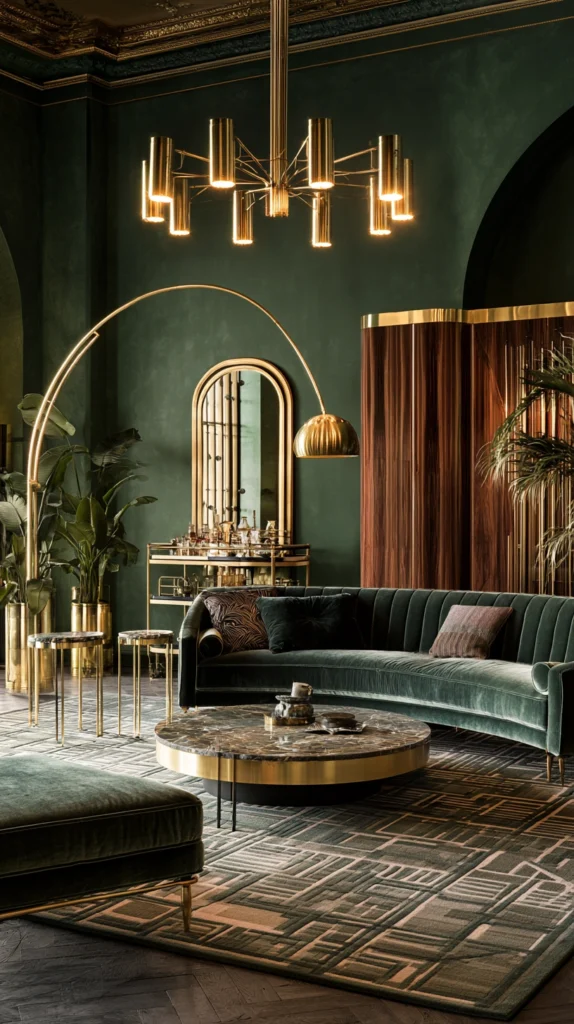
A living room designed around brass as the organizing material principle — every metal surface in warm brass, every warm light source amplified by it, every furniture choice made in response to it.
What separates the complete room from an accumulation of brass objects
A brass lamp and a brass coffee table: objects that happen to share a material. A fully realized neo deco room: a space where the material logic is consistent from the ceiling fixture to the hardware to the tray on the coffee table. The difference: whether the room was assembled or designed.
The elements of the complete neo deco brass living room
The walls
Deep and warm — forest green, navy, deep terracotta, warm cream — so the brass reads against a surface that amplifies it. Brass against white: graphic and modern. Brass against a deep warm tone: rich, layered, neo deco.
The ceiling
Not white. Off-white, pale gold, or the same deep tone as the walls in a full-envelope treatment. A brass ceiling medallion at the central fixture.
The lighting
Three brass sources: a floor lamp, a table lamp, and an overhead fixture. All warm bulbs — 2700K or warmer. No overhead lighting used alone. The room: always lit by lamps in addition to, or instead of, the ceiling.
The furniture
One large piece in velvet, leather, or textured linen — in a jewel tone or a deep neutral. Brass legs or brass arm detail.
One brass-framed coffee table, glass or marble top.
Two side tables in brass at different heights.
The metals
Brass only — not mixed with chrome or silver. The single-metal-tone rule is the discipline that makes a neo deco room read as designed rather than assembled. One warm metal throughout: the brass version of a single color palette.
The textiles
A rug in warm tones — ochre, rust, deep gold, cream — large enough that all furniture sits on it with front legs at minimum. One throw in a jewel tone. Cushions in two to three coordinating colors, none of them competing with the brass.
The plants
Three plants at different heights. The brass pot: the decision that ties each plant to the material language without overpowering the plant itself.
The room across an evening
6pm: The lamps switched on. The brass arc lamp behind the sofa casting warm light across the velvet cushions. The brass mirror returning a reflection of the lamp from across the room. The room: already different from what it was at 3pm.
7pm: A guest arriving. The brass bar cart in the corner approached. The brass handles warm in the hand. The glass catching the lamp light. The room: at its best in the presence of people.
9pm: The overhead fixture off. Two lamps only. The brass coffee table edge catching the lamplight from below. The mirror returning the room slightly warmer than it actually is. The chandelier: the only overhead element still present, at low brightness.
11pm: One lamp. The room: small and warm and still. Every brass surface: still present, catching whatever light remains. The neo deco room: not needing much light to feel complete.
The complete room: not a collection of purchases but a set of decisions made in response to a material understood from the start.
Cost breakdown for the complete room: Deep wall paint: $40–120 Brass floor lamp: $120–400 Brass pendant or chandelier: $150–500 Brass table lamp: $80–250 Velvet or upholstered sofa: $600–1,800 Brass-framed coffee table: $250–800 Brass side tables (2): $80–300 Brass mirror: $120–450 Brass bar cart: $150–500 Rug: $100–400 Textiles (throw, cushions): $80–200 Brass accessories (tray, vases, candlesticks): $90–200 Plants in brass pots (3): $60–150 Total: $1,920–6,070
Phased over two to three seasons:
Season one ($300–600): The brass arc floor lamp One brass-framed mirror The hardware upgrade throughout
Season two ($400–900): A velvet or upholstered piece with brass legs The brass coffee table or side table cluster The bar cart
Season three ($600–1,500): The wall color commitment The chandelier and ceiling medallion The complete accessory layer
The neo deco brass living room: not a weekend project but a material conversation built over time, from the first lamp outward.
The question before any brass decision
Before choosing a lamp, a frame, a piece of furniture:
What is the primary reason for wanting this feeling in the room?
If the answer is: full transformation — the complete room, starting with the wall color and the lighting. If the answer is: testing the aesthetic first — the brass arc lamp and one mirror. If the answer is: warmth without any large purchases — the hardware upgrade and the accessory layer. If the answer is: the simplest possible entry — one brass tray, two candlesticks, one lamp already in the room relit with a warmer bulb.
The design follows the level of commitment available. Every idea on this list serves the same neo deco brass aesthetic at a different scale, material, and price point.
The single brass tray on the right surface: already more than nothing. The complete room, built with intention: an atmosphere that holds every quality of light the living room will ever produce and returns it, warmer, from every surface.
That warmth: the whole point of the material.