
15 Stepping Stone Path Ideas for a Charming Garden Walkway
A stepping stone path does something in a garden that no other design element quite replicates.
It creates a journey.
Not a destination. Not a direct route between two points taken with the efficiency of a paved driveway. A journey that asks for a specific kind of movement, deliberate, step by step, foot placed on stone, attention on the ground and the next stone and the plants growing between them.
This quality of invited attention is what makes stepping stone paths one of the most distinctively beautiful garden features available. The path through a garden that requires you to look at where you are going forces you to look at the garden. The moss between the stones. The thyme releasing fragrance as your foot brushes it. The way the irregular stones sit differently in the ground at each step.
A well-laid stepping stone path transforms a garden from a space you move through to a space you experience.
Here are 15 ideas for creating that experience in every style of garden.
Why Stepping Stone Paths Are the Most Human-Scale Garden Feature
Every garden path communicates something about what kind of movement it was designed for.
A wide, straight, continuously paved path communicates efficient transit. Move quickly from here to there. Do not stop. Do not look sideways. The path is infrastructure.
The stepping stone path communicates something different. Move slowly. Place each foot with intention. Look down at the stone you are stepping onto and look up at the garden on either side. The path is not infrastructure. It is an invitation.
This communication is specific to stepping stones because the stepping stone path requires a specific kind of movement that paved paths do not. The slight irregularity of the spacing. The need to judge the next stone’s position before stepping onto it. The small physical commitment of lifting the foot to the right height for the next stone rather than shuffling along a flat surface.
These small physical requirements create the specific engagement with the garden that makes a stepping stone path more than a practical surface. The person walking a stepping stone path is in the garden rather than passing through it.
1. Natural Irregular Flagstones in a Lawn
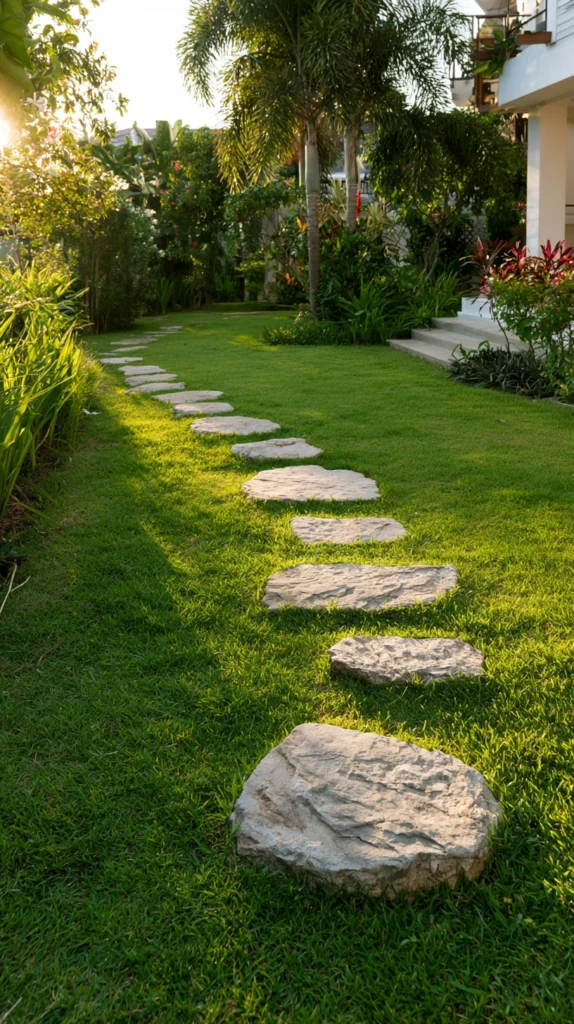
The classic stepping stone path through a garden lawn is one of the most enduring and most beautiful garden design decisions available.
Natural irregular flagstones, set flush with the lawn surface at the correct spacing for a natural walking pace, create a path that looks as if it arrived in the garden rather than being installed in it. The irregular shapes fit together with the imprecision of natural stone and each stone is slightly different from its neighbours in colour, texture, and outline.
The flagstone material determines the path’s character. Grey slate has a cool, architectural quality. Warm buff sandstone has the specific colour of old garden walls and cottage paths. Pale limestone is luminous in low light. Dark basalt is dramatic and contemporary. The stone should be chosen in relation to the surrounding garden’s character and materials.
Set the stones into the lawn at the correct depth so the top surface is flush with the grass. If the stones project above the lawn surface they create a trip hazard and complicate mowing. Flush with the lawn, the stones allow a mower to pass over them and the grass grows to their edges without any trim maintenance required.
The spacing should reflect a natural walking pace rather than an idealised stride. Walk the intended route and mark where your feet fall naturally. Set the stones at those positions rather than at a regular measured interval. Natural spacing that responds to a real stride feels right to walk on. Measured spacing that does not match the natural step feels awkward.
Why natural irregular flagstones in a lawn is the most universally beautiful stepping stone path:
- Irregular natural stone looks as if it belongs in the garden rather than being placed there
- Flush installation allows mowing without edge trimming and eliminates trip hazards
- Natural stone weathers and ages beautifully, developing moss and lichen that increases its beauty over time
- The spacing matched to a real walking stride makes the path comfortable and natural to use
- Works in every garden style from cottage to contemporary, formal to wild
- Natural stone in warm or cool tones suits different garden characters and regional materials
2. Reclaimed York Stone With Planted Gaps
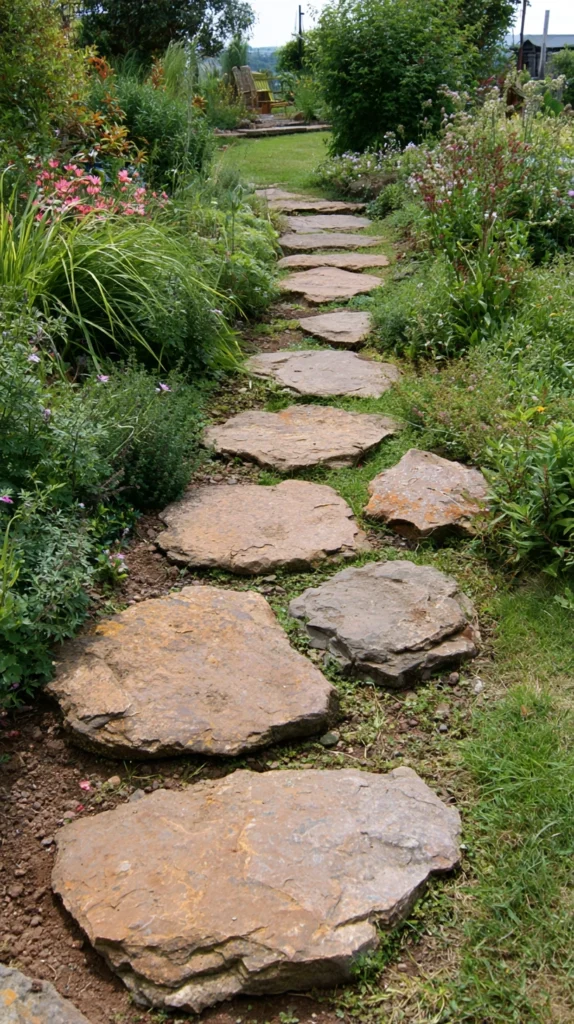
York stone is the most beloved of all English garden stone materials.
Its warm, honey-toned surface. The specific weathering that develops across its face after decades of outdoor exposure. The colour variation within each slab, darker in rain, warmer in dry sun, that changes the character of the path with the weather. These qualities have made York stone the material of choice for garden paths in the English tradition for generations.
The reclaimed York stone path has an additional quality beyond the stone’s intrinsic beauty. The weathering and the character of stones reclaimed from old buildings and paths carries the history of their previous use. The slight hollowing where generations of feet have worn the surface. The staining from decades of weather. These marks are the stone’s biography and they make the path feel older than its installation.
Between the reclaimed slabs, plant creeping thyme, Corsican mint, or baby’s tears. These low-growing plants establish in the gaps between the stones and grow to soften the edges of each slab. The planted gaps prevent weeds from establishing, eliminate the need for gap weeding or gap filling, and add the fragrance element that planted paths provide.
The combination of warm, aged reclaimed stone and fragrant, soft planted gaps is the most specifically beautiful stepping stone path available and the most consistent with the traditional English garden aesthetic.
3. Circular Stepping Stones Through a Planting Border
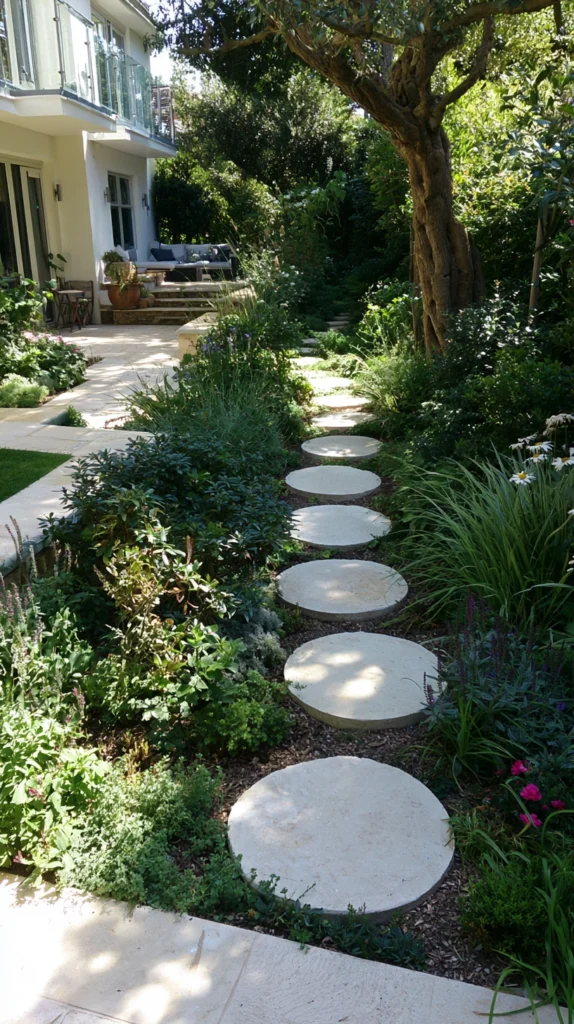
The stepping stone path through a planting border is the design solution that gives access to the heart of a planted bed without any formal path structure.
Circular stepping stones of consistent diameter, set at walking pace intervals through the planting, create a route through the border that allows access for planting, weeding, and harvesting without the compaction that walking on unprotected soil would cause.
The circular form is important. Irregular stones in a planting border compete visually with the varied forms of the plants around them. Consistent circles create a geometric regularity that reads as intentional placement rather than casual setting.
The stone material can be cast concrete in a natural aggregate finish, which is affordable and available in consistent circular forms. Natural stone discs cut from a larger boulder. Reclaimed millstones, which are specifically beautiful but difficult to find in sufficient quantity. Concrete pavers with a riven surface finish that replicates the texture of natural stone.
The plants growing around and between the circular stepping stones should be allowed to encroach slightly onto the stone edges. A circle of stone with a perfectly clean edge, no plant encroachment and no moss, looks recently installed. A circle of stone with thyme and alchemilla spilling over its edges looks settled and established.
4. Timber Round Slices for a Woodland Path
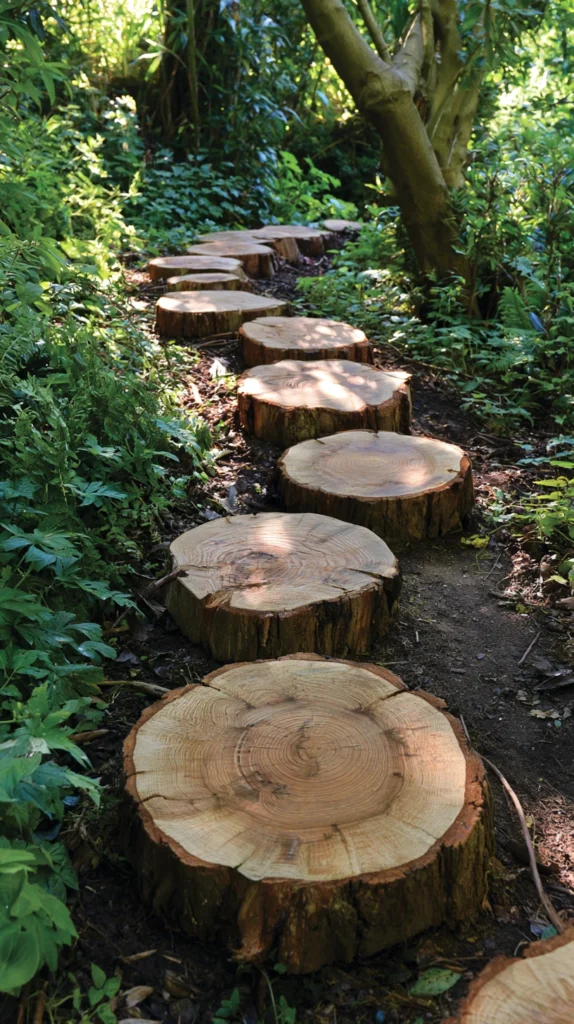
The path through a woodland or shaded garden area benefits from materials that reference the wooded environment rather than the hard stone of a formal garden.
Cross sections of timber, cut from large logs to a depth of ten to fifteen centimetres and treated against rot and insect damage, create stepping stones of genuinely organic character. Each disc is unique in its grain pattern, in the weathering of its surface, and in the irregularity of its outline where the bark edge is preserved.
The timber disc path belongs specifically in the dappled shade of a woodland garden or in the shadow of large deciduous trees where stone paths look too formal and too hard for the soft, organic character of the planting.
The treatment of the timber determines its longevity. Untreated timber discs in a damp, shaded position deteriorate rapidly and require frequent replacement. Discs treated with a hardwood preservative, or using naturally durable species like oak, sweet chestnut, and larch, last significantly longer but will eventually require replacement as any organic material in contact with the soil does.
Set the timber discs at a slight angle, not absolutely level, to allow rainwater to run off the surface rather than pooling. A pool of standing water on a timber disc becomes a slipping hazard and accelerates the wood’s deterioration.
5. Slate Stepping Stones in a Contemporary Garden
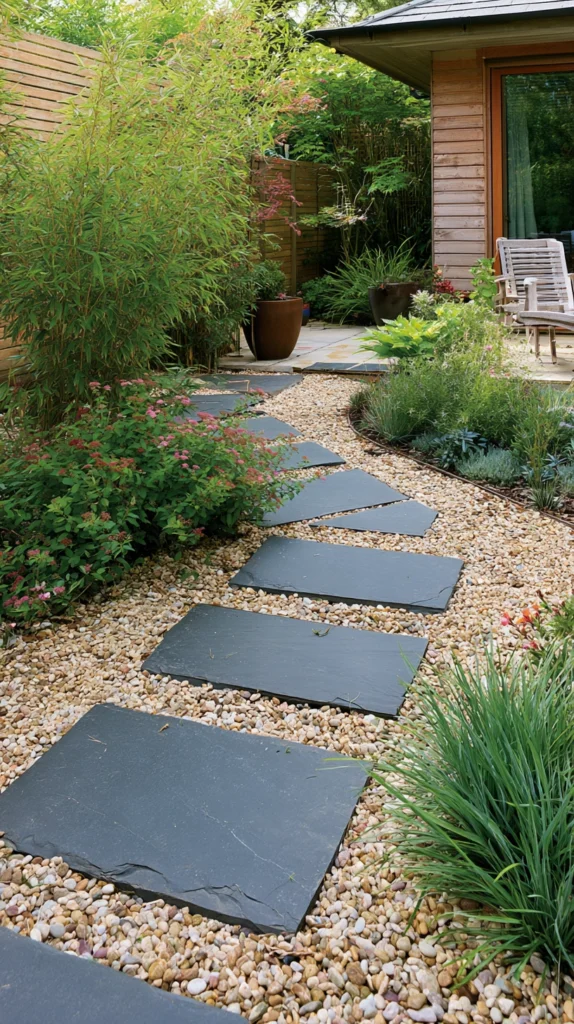
Slate’s dark, smooth surface and its naturally cleaving planes that create flat faces make it the stepping stone material most suited to the contemporary and minimalist garden.
Large format slate slabs, from sixty by forty centimetres to over a metre in their longest dimension, set at carefully measured intervals across a gravel garden or through a planting of ornamental grasses, create a stepping stone path of specifically architectural character.
The dark grey or near-black of Welsh slate contrasts dramatically with pale gravel and the warm tones of ornamental grass foliage. The smooth, flat surface of the slate reads as precise and intentional in a way that irregular natural stone does not.
The gaps between large slate stepping stones in a gravel garden can be filled with the same gravel as the surrounding area, making the path indistinguishable from the gravel surface between steps. Or they can be planted with low, spreading plants that contrast with the dark slate. Or they can be left as open gravel, with the path defined entirely by the slate surfaces.
Slate is significantly smoother underfoot than riven natural stone and can become slippery when wet or when moss develops on the surface. An anti-slip treatment applied annually, or a surface that has been machine-textured for slip resistance, addresses this practical concern.
6. A Dry-Laid Mosaic Stepping Stone Path
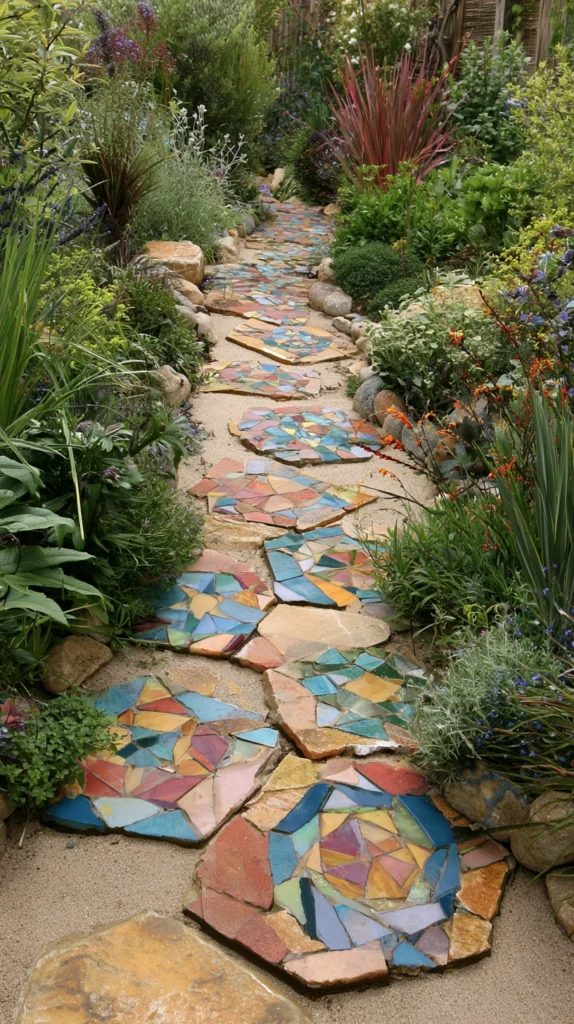
The mosaic stepping stone is the most artistically ambitious version of the stepping stone path idea.
Individual stepping stones created from mosaic, small pieces of ceramic, glass, or natural stone set in mortar on a concrete or timber base, bring the decorative art tradition of mosaic to the most utilitarian of garden surfaces.
A mosaic stepping stone can be purely abstract, using colour and pattern for their own sake in a geometric or flowing design. It can be representational, incorporating plant forms, animals, geometric patterns, or symbolic imagery that relates to the garden’s character or the household’s identity.
The mosaic stepping stone path is the most time-intensive to create and the most rewarding when it is finished. A path of twelve to fifteen mosaic stones, each individually designed and made, creates a garden surface of extraordinary uniqueness that no manufactured product can replicate.
The materials used in outdoor mosaic must be frost-resistant. Vitreous glass mosaic tesserae are specifically manufactured for outdoor use and are the most reliable choice. Ceramic tiles specified for outdoor use handle frost without cracking. Natural stone pebbles and tumbled glass are frost-resistant by their nature.
The grouting material should be specifically rated for outdoor use and should be a colour that complements rather than dominates the mosaic design.
7. Exposed Aggregate Concrete Stepping Stones
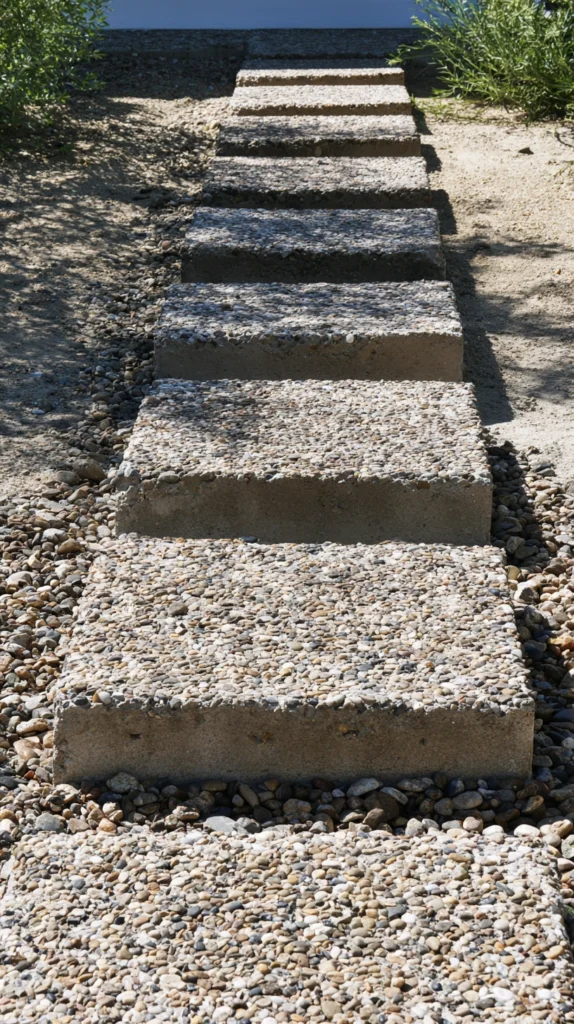
Exposed aggregate concrete is the stepping stone material that provides the most colour and texture variety within the concrete category.
Standard poured concrete stepping stones in a grey finish are functional but visually neutral. Exposed aggregate concrete, where the surface is finished to reveal the stones, shells, or glass pieces within the concrete mix, creates a surface of genuine visual interest and texture.
The aggregate material determines the final character of the stepping stone. Local river pebbles in a warm buff concrete matrix create a path that looks as if the stones were gathered from a nearby stream. Sea glass aggregate in white concrete creates a coastal quality. Warm terracotta aggregate in a sand-coloured concrete creates a Mediterranean warmth. Polished pebbles in contrasting tones create a path surface with the visual density of a decorated object.
The aggregate surface is also functionally better than smooth concrete for outdoor paths. The texture provides grip in wet conditions and reduces the slipping hazard that smooth concrete creates.
Cast the stepping stones in circular or irregular moulds that suit the garden’s character. A square or rectangular stepping stone in exposed aggregate reads as slightly rigid. A circular or irregular form in the same material reads as more relaxed and more garden-like.
8. A Grass and Stone Alternating Grid
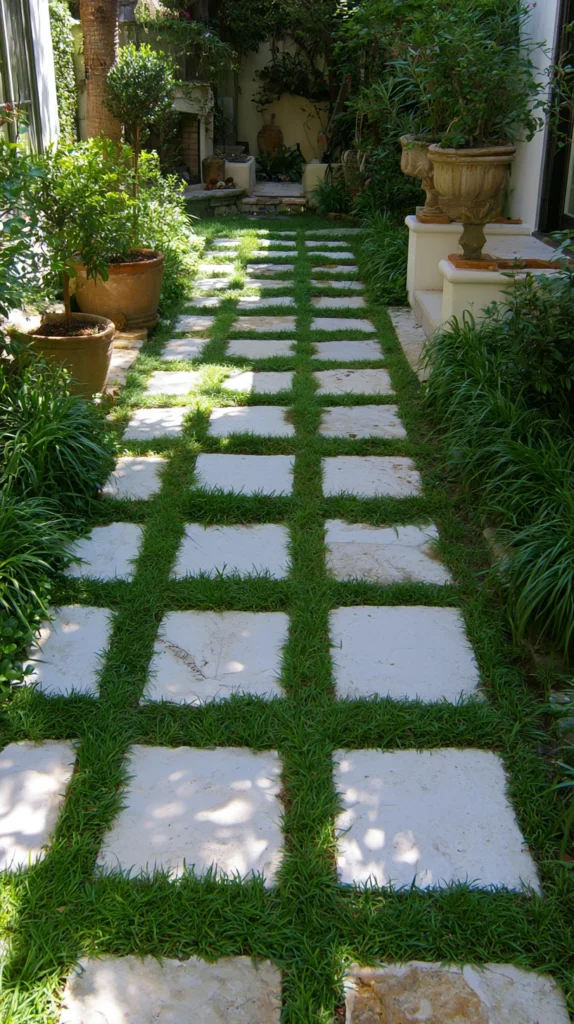
The alternating grid of stone and grass is the stepping stone path idea that is also a garden design statement.
A regular grid of stone squares, with grass growing in the grid gaps between them, creates a path surface that is part lawn and part pavement. The grass and the stone alternate across the path’s width and the path reads as a composition of two materials rather than a single surface.
This works best with precise, regular stone squares rather than irregular flagstones. The geometric precision of the grid requires the geometric precision of a square or rectangular stone form. Irregular stones in a regular grid create a visual tension between the regularity of the grid and the irregularity of the stones.
The grid path in a formal garden with clipped hedges and geometric planting is one of the most classically beautiful garden designs available. The green squares of the grass against the stone create a chequerboard quality that suits the precision of a formal garden perfectly.
Maintain the grass in the grid gaps carefully. Grass in narrow grid gaps is difficult to mow and may require hand trimming. Substitute the grass with a low, non-grass ground cover, moss, thyme, or baby’s tears, that requires less maintenance than mown grass in confined spaces.
9. Reclaimed Cobblestone or Brick Stepping Stones
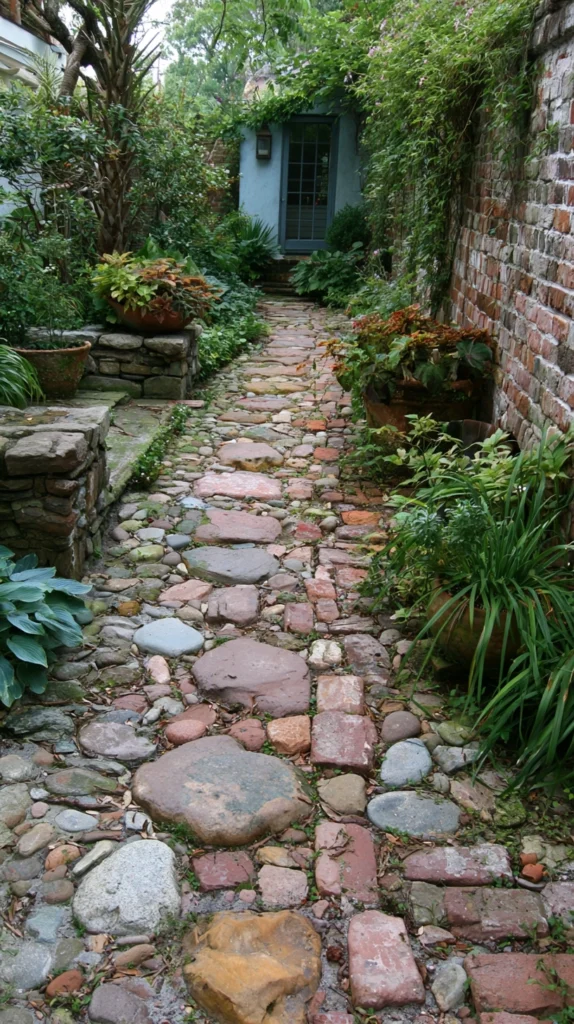
Reclaimed cobblestones and reclaimed bricks are the stepping stone materials that carry the most specific historical reference.
Cobblestones, the rounded river-worn stones that were set into historic street surfaces from the Roman period through the twentieth century, are reclaimed from street renovation projects and sold through architectural salvage dealers. Set as individual stepping stones in a garden soil or gravel surface, they bring centuries of street history into the domestic garden.
Reclaimed bricks from demolished buildings carry a different historical reference. The warmth of the brick’s terracotta tone. The weathered mortar that still clings to their faces. The variety in colour and condition across a collection of bricks from different periods and different buildings.
Both materials are best suited to gardens that reference history and tradition. The cobblestone path through a kitchen garden. The reclaimed brick path through a walled garden. These contexts suit the historical patina of the materials in a way that a contemporary minimal garden would not.
The uneven top surface of cobblestones makes them less comfortable to walk on in hard shoes than flat stone. In garden settings where walking is casual and shoes are typically soft outdoor footwear this is not a significant issue. In a main approach path where formal footwear is more likely, the comfort consideration is worth addressing.
10. Poured Concrete With Leaf or Texture Impressions
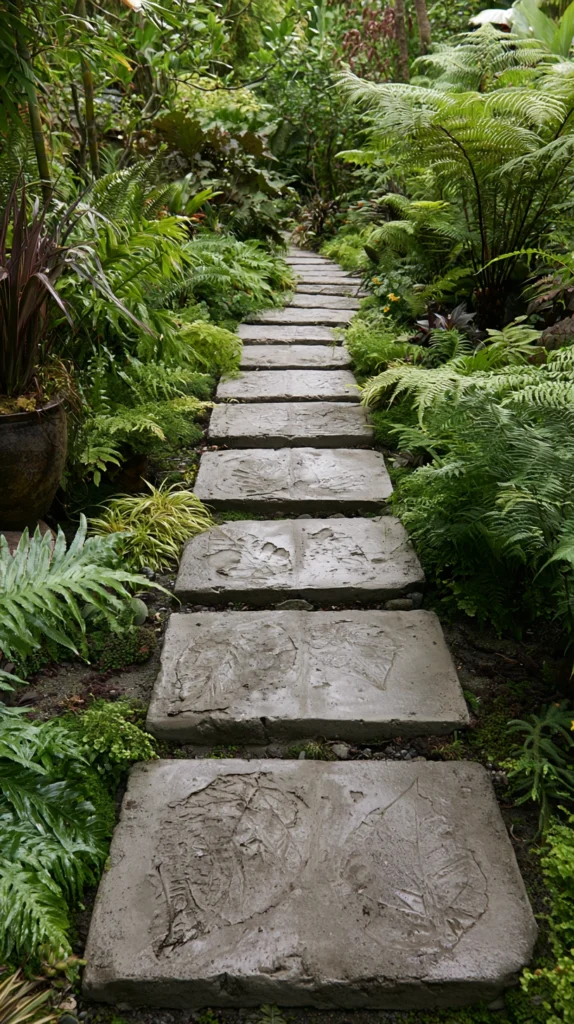
The personalised concrete stepping stone is the garden feature that can be made by anyone and finished in a way that is specific to the garden and the household that made it.
Fresh concrete poured into a simple mould can accept any impression made in its surface before it sets. Large leaves pressed into the wet concrete surface leave their veining and their outline as a permanent impression. Geometric tools pressed into the surface create repeating patterns. Collected stones, shells, and glass pressed into the surface become permanent embedded decoration.
The leaf impression stepping stone is the most popular version and the most reliably beautiful. The specific leaf used, a fern frond, a hosta leaf, a large fig leaf, creates an impression of remarkable detail that the concrete preserves perfectly as it sets.
These stepping stones can be made by children and adults together as a garden activity, creating personalised garden elements that record a specific season or a specific creative session. The stones made this way have the specific provenance quality that makes a garden feel genuinely inhabited by the people who use it.
Seal the finished stepping stones with a concrete sealant that protects the surface from frost damage and prevents the absorption of moisture that leads to cracking in severe winter conditions.
11. Glass Stepping Stones for an Unexpected Path
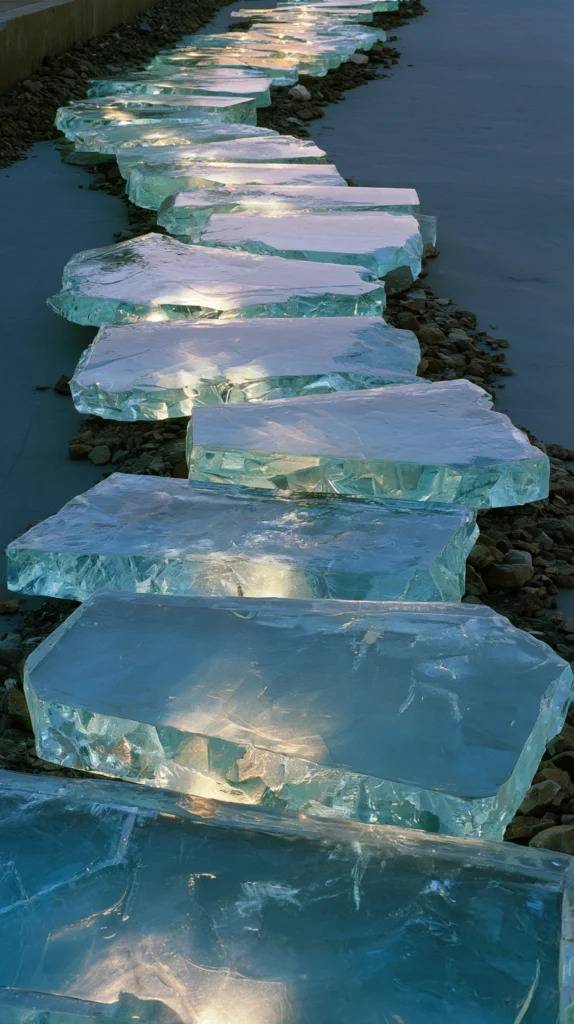
The glass stepping stone is the garden path element that most surprises and most delights.
Thick, tempered glass discs or squares, set into the ground at path level, create stepping stones of a completely different visual quality from any stone alternative. In daylight the glass is luminous, catching and refracting light in ways that stone cannot. From below, if there is a light source beneath the path, the glass transmits light upward through the path surface, creating a path that glows.
This glowing path effect is the most spectacular version of the glass stepping stone idea. A path over a ground-level lighting system, with glass stepping stones above the lights, creates a garden path that is dramatically beautiful at night.
The practical requirements of glass stepping stones are specific. The glass must be tempered to prevent shattering under foot traffic and under the stresses of freeze-thaw cycles. The glass must be thick enough, a minimum of fifteen millimetres, to handle the impact loads of walking without flex that would crack the glass. Anti-slip treatments on the upper surface are essential.
Glass stepping stones suit contemporary and minimalist gardens where the unexpected material choice reads as a deliberate design decision rather than an inappropriate material in the wrong context.
12. Natural Stone With Low-Light Uplighting
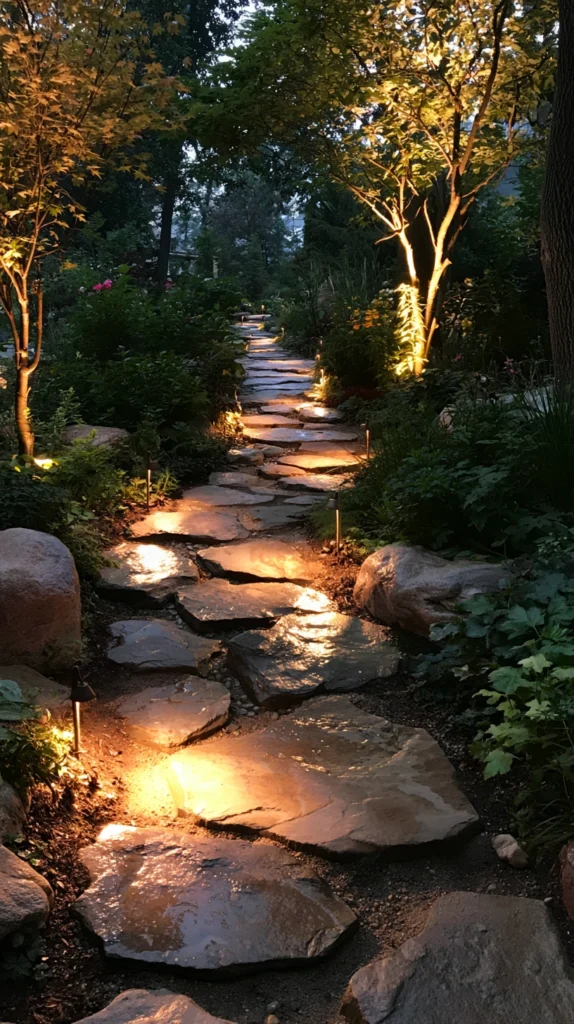
The stepping stone path at night, lit from below by carefully positioned uplights beside each stone, is a garden experience of extraordinary quality.
Small, low-wattage LED uplights positioned beside or beneath each stepping stone cast warm upward light that reveals the texture of the stone surface from below, illuminates the planted gaps, and creates a path of warm pools of light between which the darkness of the garden recedes.
The path that is merely pleasant in daylight becomes genuinely spectacular at night when the lighting is well-designed. The shadows on the stone’s surface created by raking upward light reveal grain and texture that flat daylight hides. The planted gaps, lit from below, show the plants in a way that overhead light never can.
This lighting approach requires a low-voltage garden lighting system with mains power supply and appropriately rated outdoor electrical fittings. The installation is a professional garden lighting project but the visual return on the investment is one of the most dramatic garden transformations possible.
The warm amber colour temperature of the lighting, around 2700K, suits stone and planted garden materials. Cool white lighting makes garden stone look cold and institutional.
13. A Curving Path That Reveals the Garden Gradually
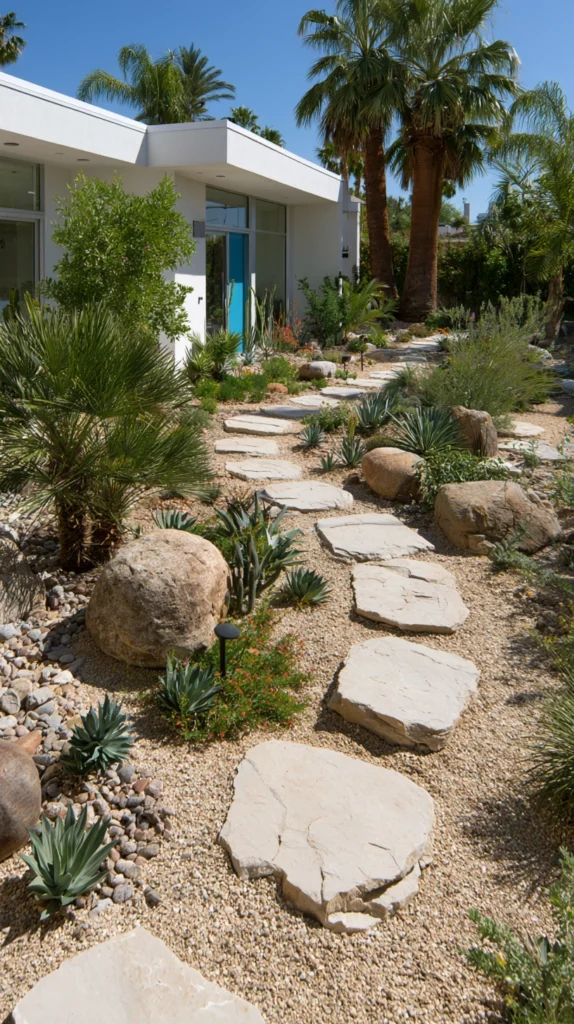
The path that curves and meanders through the garden creates a sequence of revelations.
A straight path shows the garden from one viewpoint simultaneously. The beginning, the middle, and the end are all visible from the start. Nothing is discovered. Everything is anticipated.
The curving stepping stone path shows the garden differently. A section of border. Then a turn. Then the focal point beyond the turn that was not visible from the beginning. Then another turn. Then the destination that has been approached gradually rather than directly.
This sequential revelation is one of the most fundamental pleasures of garden design and one of the most accessible to achieve. A path that curves simply by placing the stepping stones in a gradual arc through the garden creates a completely different spatial experience from the same route walked as a straight line.
The curve should be gentle enough to be natural and gradual enough to not feel contrived. A path that curves once, revealing a single change of view, is more effective and more satisfying than a path that turns multiple times in a small space.
The planting on either side of the curving path should emphasise rather than counteract the view-limiting quality of the curve. Taller planting on the outside of the curve and lower planting on the inside creates the partial concealment that makes the revelation beyond the curve more complete.
14. Stepping Stones Through a Water Feature or Pond Margin
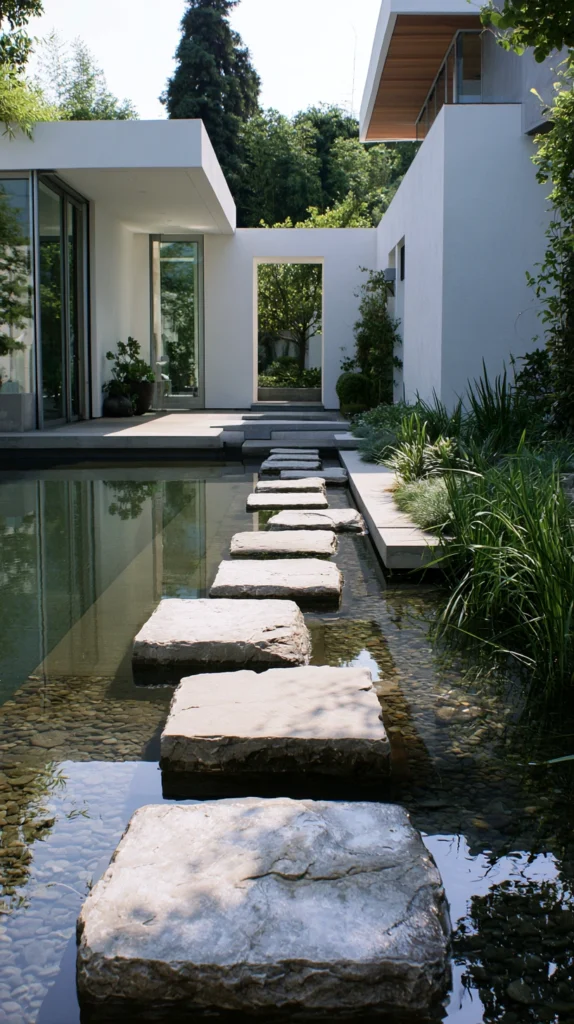
The stepping stones that cross water, or that cross a pond margin at the water’s edge, create a garden feature of extraordinary drama and practicality simultaneously.
Stepping stones that allow crossing a garden rill or a narrow water feature replace a bridge in a way that is more intimate and more physically engaging. The person crossing is closer to the water. The sound of the water beneath the steps is more present. The slight visual challenge of judging the next stone’s position over water is more concentrated than the same judgement over soil.
Stones set in the shallow margin of a wildlife pond, where they also function as drinking and bathing access points for birds and small mammals, are functional ecological additions as well as beautiful design elements.
The stones used in or beside water must be stable and non-slip. A slight texture on the upper surface prevents slipping when wet, which is the consistent condition of stones beside or over water. Flat, smooth stones beside water are a slipping hazard and should not be used in situations where the consequences of slipping are significant.
The height of the stepping stones above the water level determines the drama of the crossing. Stones set just above the water surface create the most intimate water-crossing experience. Stones set higher above the water create a safer crossing at the cost of the intimacy of being close to the surface.
15. A Path That Ends With a Destination
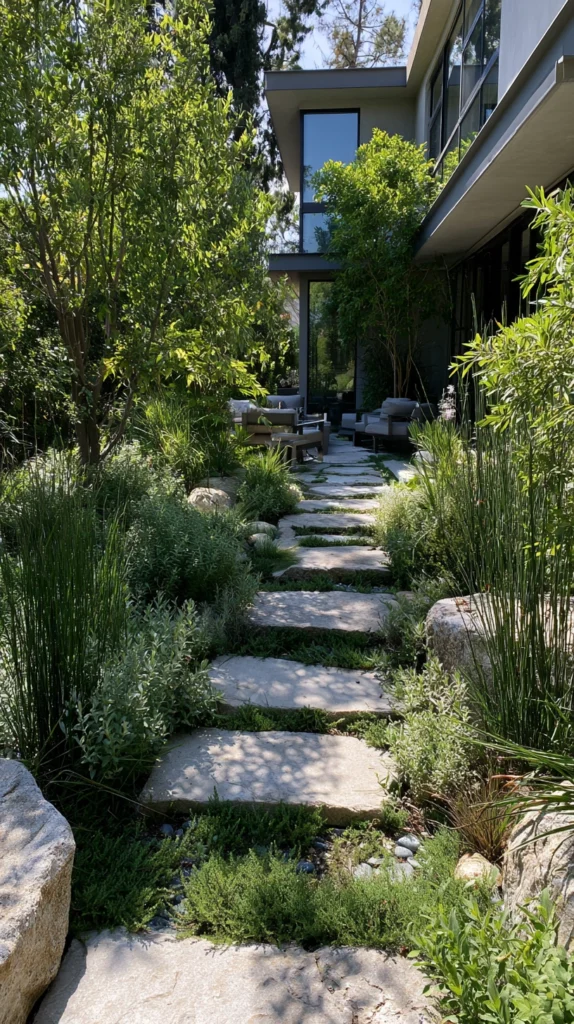
The stepping stone path is not complete without a destination.
A path that leads nowhere, that simply stops at the end of the lawn or at the back of the planting border without offering a specific place to be, is a path that makes the garden feel unfinished. The journey of the stepping stone path should lead somewhere worth arriving at.
A garden bench positioned at the end of the stepping stone path, oriented to face back toward the house or toward the garden’s best view. A specimen tree whose trunk marks the end of the path and whose canopy creates the sheltered space beneath it. A gate through a hedge that reveals the garden’s next zone. A focal point object, a sundial, a birdbath, a sculpture, that gives the walker something specific to approach.
The destination is what gives the journey meaning. Without it the stepping stone path is beautiful exercise. With it the stepping stone path is a narrative. A beginning and a middle and an end that the person walking the path enacts each time they walk it.
Design the destination with as much care as the path itself. The bench at the right angle for the view. The focal point visible from the path’s beginning so the destination is anticipated throughout the journey. The shade tree positioned specifically for the afternoon hours when the destination seat is most used.
How to Lay a Stepping Stone Path That Lasts
The longevity of a stepping stone path depends on the quality of the laying rather than the quality of the stone.
The most common cause of stepping stone failure is inadequate preparation of the stone bed. A stone that is not set on a stable, properly prepared base settles unevenly, tips under foot pressure, and eventually works loose.
Excavate the stone’s bed to a depth that places the stone’s top surface at the correct height relative to the surrounding ground. For lawn paths this means the stone’s top surface is flush with the lawn. For gravel or soil paths this means the stone’s top surface is at the walking surface level of the surrounding material.
Compact the base of the excavated area thoroughly. A tamped layer of compacted hardcore or sharp sand beneath the stone creates a stable base that prevents settling. A stone set directly on uncompacted soil settles at different rates across its base and becomes unstable within one to two winters.
Set the stone on a bed of dry mortar mix, sharp sand and cement in a four-to-one ratio, before compacting earth is used. The dry mix absorbs moisture from the surrounding soil and sets slowly, bonding the stone to its base without the need for wet mortar that is more difficult to use in the garden setting.
Check each stone for stability before moving to the next. A stone that rocks under foot pressure at installation will continue to rock and will eventually dislodge. Adjust the base until the stone is completely stable before accepting the position.
Common Mistakes in Stepping Stone Path Installation
Setting stones at the wrong height. Stones that project above the lawn surface cause trips and complicate mowing. Stones set too low collect water and are obscured by grass growth within one season. The correct flush-with-lawn height is the only acceptable height for lawn stepping stones.
Spacing stones for aesthetics rather than walking. A spacing that looks right when the path is viewed from above may not match the natural stride of the people who will use it. Walk the route before setting stones and place them where your feet actually fall.
Using stones that are too small. A stepping stone of less than thirty centimetres in its shortest dimension is too small for comfortable, confident placement of a foot. The minimum size for a stepping stone is thirty by forty centimetres for a standard adult stride.
Not considering drainage. Stones set in areas with poor drainage collect standing water in the gaps between them. Poor drainage beneath the stones undermines their base over time and causes uneven settling. Incorporate drainage consideration into the installation from the beginning.
Planting aggressive species in the gaps. Some ground cover plants suitable for stepping stone gaps are invasive and will spread beyond the path into the surrounding garden. Choose non-invasive species such as creeping thyme, Corsican mint, and baby’s tears for gap planting.
Skipping the base preparation. The step most often omitted in DIY stepping stone path installation is the most important. A properly compacted and level base prevents the settling and tipping that makes a stepping stone path uncomfortable and eventually dangerous to walk on.
Quick Summary
- Natural irregular flagstones in a lawn set flush with the grass create the most universally beautiful and enduring stepping stone path
- Reclaimed York stone with planted thyme or mint in the gaps is the classic English garden path with fragrance and history
- Circular stepping stones through a planting border create garden access that looks intentional and allows maintenance without soil compaction
- Timber cross sections through woodland or shaded areas reference the wooded environment in a path material that belongs there
- Large format slate creates a contemporary, architectural path character suited to minimal and modern garden designs
- Mosaic stepping stones are the most artistic and most individual garden surface treatment, requiring the most time and creating the most uniqueness
- Exposed aggregate concrete provides texture and colour variety within the concrete category that smooth concrete cannot match
- The alternating grass and stone grid is a path design and a garden statement simultaneously, suited to formal gardens
- Reclaimed cobblestones and bricks carry centuries of historical patina into the garden path’s surface
- Poured concrete with leaf impressions creates the most personal and most specifically handmade stepping stone path
- Glass stepping stones are the garden’s most surprising path material, spectacular in daylight and transformative when lit from below at night
- Low-wattage LED uplighting beside each stone creates a spectacular path experience at night that the best daytime path cannot match
- A curving path that reveals the garden gradually creates a sequential experience of discovery that a straight path cannot provide
- Stepping stones crossing water or set at a pond margin create the most dramatic and most ecologically valuable path setting
- A path without a destination is a journey without purpose, design the destination with as much care as the path itself
- Walk the route before setting any stones and place them at the positions where your feet actually fall naturally
A stepping stone path is not a route.
It is an invitation.
To slow down. To look at the ground and the plants growing between the stones. To notice the garden at the pace the garden requires to be noticed.
Every garden benefits from at least one path that asks this of the person walking it.
Lay the stones where the feet fall naturally.
The garden does the rest.