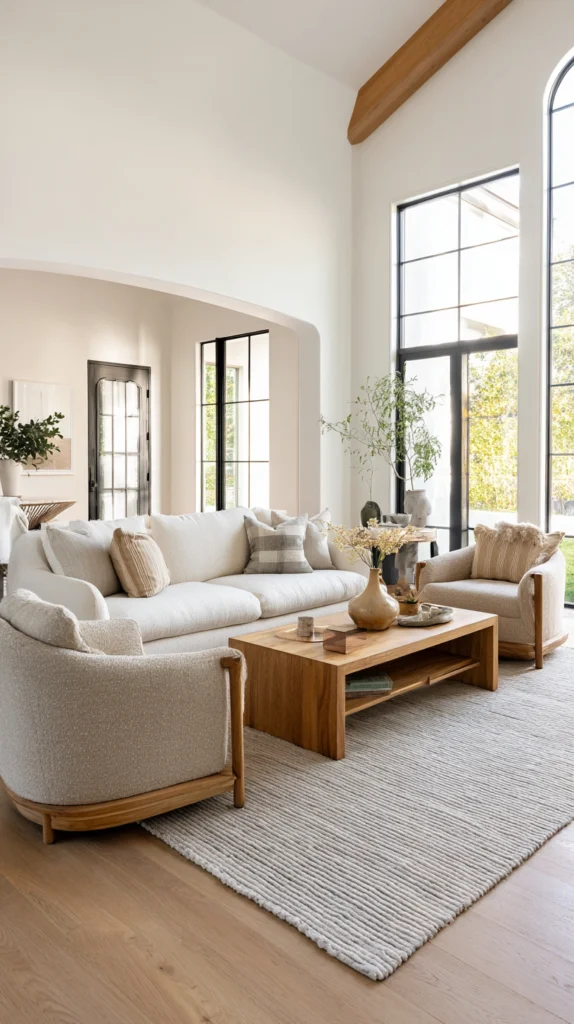
How to Choose the Right Rug Size for Every Room
The single most common rug mistake has nothing to do with color or pattern.
It’s size. A rug that’s too small makes an entire room feel disconnected, no matter how nice the rug itself actually is.
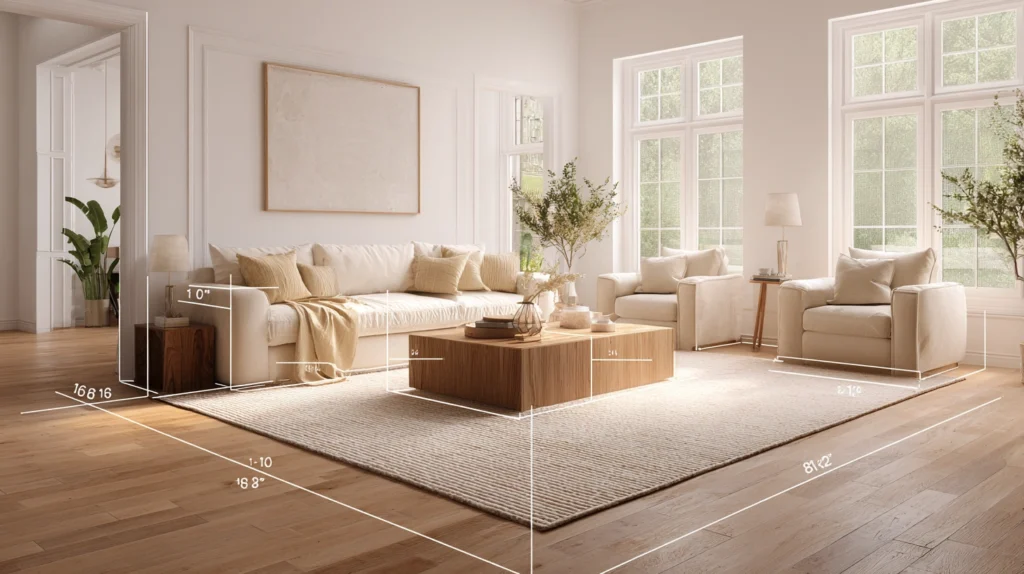
This mistake shows up constantly, in budget furniture setups and expensive designer rooms alike, since it has nothing to do with taste or spending power.
Most people size a rug the way they’d size a bath mat, just enough to cover a patch of floor.
Rooms don’t work that way. A rug needs to unify the furniture sitting on it, not just exist beneath it.
Here’s how to actually get rug size right, room by room, using real measurements instead of guesswork.
The One Rule That Applies Almost Everywhere
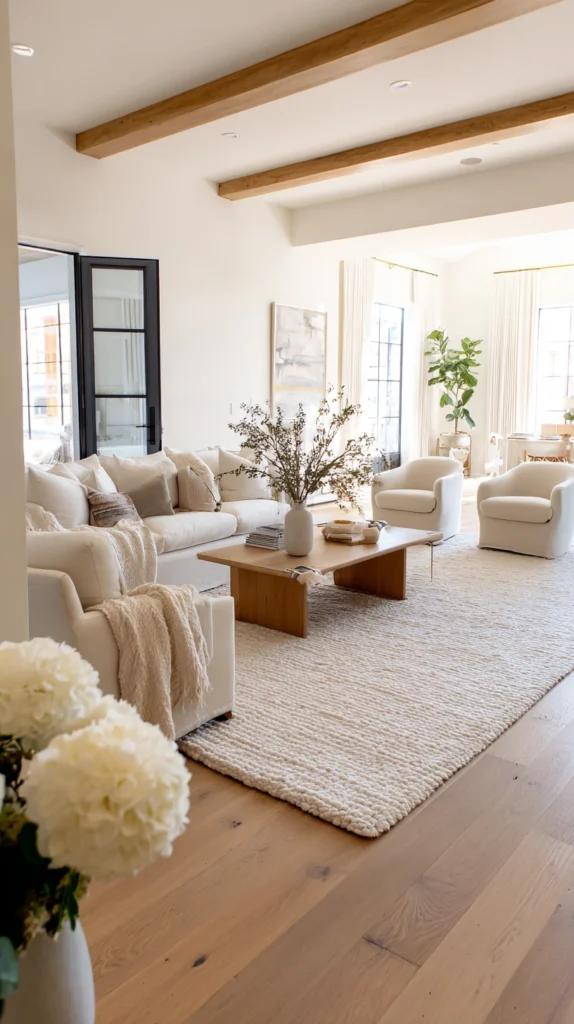
Furniture legs should relate to the rug in one of two consistent ways.
- All the way on: every leg of every major piece sits fully on the rug
- Front legs only: front legs on the rug, back legs off, for larger rooms where a bigger rug isn’t practical
What almost never works is a rug that touches no furniture at all, floating in the middle of the room with every piece sitting around its edges.
That “floating island” look is the single most common cause of a room feeling disconnected.
A small rug centered in a large room, with every sofa and chair pushed out to the walls around it, is the exact scenario worth avoiding.
The rug ends up reading as an accessory rather than the foundation the furniture actually sits on.
Living Room Rug Sizing
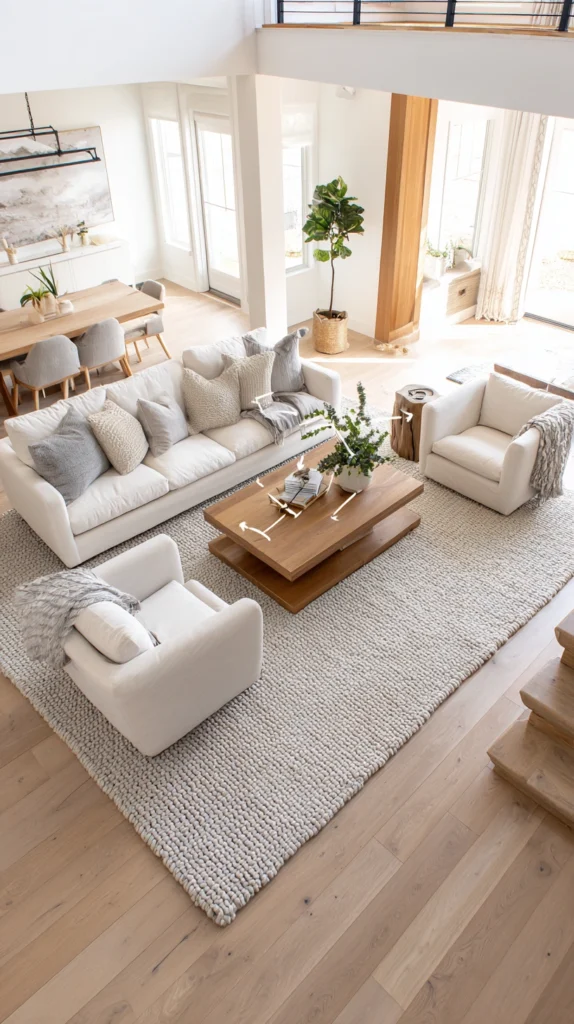
Living rooms need the largest rugs in the home, relative to the furniture sitting on them.
| Room Size | Recommended Rug Size | Furniture Rule |
| Small (under 120 sq ft) | 5×8 or 6×9 | Front legs only |
| Medium (120–200 sq ft) | 8×10 | All legs on, or front legs only for a large sectional |
| Large (200+ sq ft) | 9×12 or 10×14 | All legs on |
A rug this size should extend at least a few inches past the front edge of every sofa and chair in the seating group.
I sized my own living room rug to 9×12, and it now anchors my sofa, two chairs, and the coffee table all as one connected group.
Budget tip: Buying one size up from what feels necessary is almost always the better call, since an undersized rug is a far more common regret than an oversized one.
A few things worth knowing:
- Leave roughly 12 to 18 inches of bare floor visible between the rug’s edge and the walls
- Measure your actual seating arrangement, not just the room’s total square footage
- A rug that only fits under the coffee table alone is sized for a much smaller room than a full living room typically needs
Open-concept living rooms deserve extra attention here.
A rug sized for a clearly defined room often looks undersized once the space flows into an adjoining kitchen or dining area with no walls to contain it visually.
Dining Room Rug Sizing
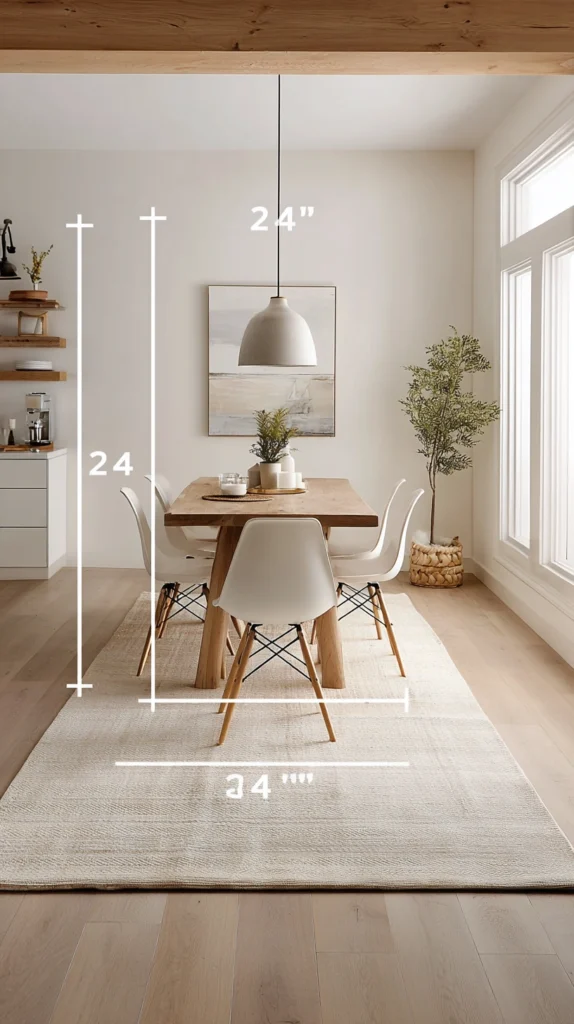
Dining room rugs need to account for chairs being pulled out, not just the table itself.
| Table Size | Recommended Rug Size | Extra Room for Chairs |
| Small (4 seats) | 6×9 | 24 inches beyond table edge |
| Medium (6 seats) | 8×10 | 24 inches beyond table edge |
| Large (8 seats) | 9×12 or larger | 24 inches beyond table edge |
Every chair leg needs to stay on the rug even when pulled back from the table to sit down.
I learned this the hard way with an undersized dining rug, where back chair legs kept catching the rug’s edge every time someone stood up.
Style tip: Measure your table with all leaves inserted if it’s an extendable design, sizing the rug for the table’s largest possible configuration.
A few things worth knowing:
- A rectangular table generally pairs with a rectangular or oval rug, rather than a round one
- Round tables work well with round rugs, but a rectangular rug can work too if sized generously
- Choose a low-pile rug specifically for a dining room, since chairs dragging across a plush pile becomes a real annoyance over time
Pendant or chandelier placement is worth checking alongside rug size too.
A properly sized rug and a properly centered light fixture should generally align over the same table, rather than pulling the eye in two different directions.
Bedroom Rug Sizing
Bedrooms have more flexibility than living or dining rooms, since there’s no single furniture grouping to fully contain.
| Bed Size | Recommended Rug Size | Placement Style |
| Twin or full | 5×8 | Runner at foot of bed, or rug extending past both sides |
| Queen | 8×10 | Rug extends past sides and foot of bed |
| King | 9×12 | Rug extends generously past sides and foot of bed |
A common approach places the rug so it extends about 24 inches beyond each side of the bed and at the foot.
I use an 8×10 rug under my queen bed, positioned so my nightstands sit on the rug’s edge rather than fully off it.
Budget tip: Two smaller runners, one on each side of the bed, cost less than one large rug and solve the cold-floor problem just as effectively.
A few things worth knowing:
- A rug that only peeks out from under the bed’s edges is too small for the room, not just the bed
- Centering the rug beneath the bed frame, rather than the whole room, keeps the focus on the actual furniture grouping
- A smaller accent rug at just the foot of the bed works fine as a secondary layer, but shouldn’t be the room’s only rug in a larger bedroom
Guest bedrooms are worth sizing a bit more conservatively than a primary bedroom.
A smaller footprint still solves the cold-floor problem without requiring the same investment as the room you use every day.
Home Office Rug Sizing
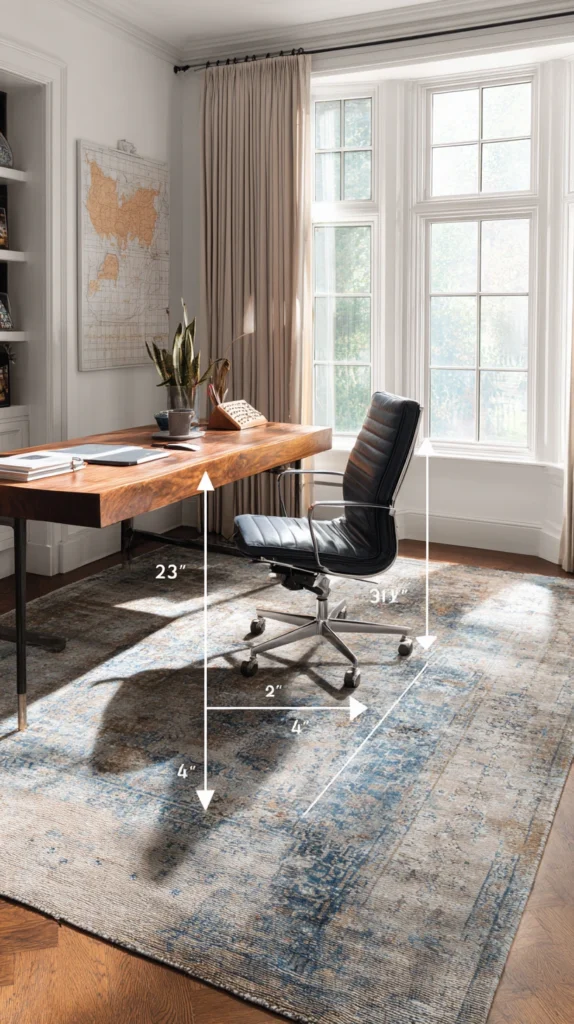
A home office rug needs to account for a rolling desk chair, which behaves differently than stationary furniture.
- Size the rug so the chair can roll fully around the desk without ever leaving the rug’s surface
- Add at least 24 to 30 inches of rug beyond the desk on the side where the chair rolls back
- Choose a low-pile, firm rug specifically, since a plush pile makes rolling a desk chair considerably harder
I sized my office rug generously beyond my desk’s rolling zone, and the chair no longer catches on the rug’s edge or drifts onto bare floor mid-task.
Style tip: A rug pad rated for rolling chair use protects both the rug and the floor underneath from the concentrated wear a desk chair creates.
A few things worth knowing:
- Standard living room sizing guidance doesn’t directly apply here, since chair movement matters more than furniture footprint
- A rug that’s too small in a home office becomes a genuine daily annoyance rather than just a style issue
- Consider a rectangular rug oriented to match your desk’s actual rolling path, rather than a room-centered placement
A built-in desk against a wall needs less rug depth than a freestanding desk positioned in the middle of a room.
Measure your specific setup rather than relying on a generic office rug size chart.
Entryway and Hallway Rug Sizing
Entryways and hallways call for a different sizing logic entirely, since there’s rarely a furniture grouping to work around.
- Entryway rugs should leave enough clearance on both sides for a door to swing open without catching the rug’s edge
- Hallway runners generally leave 4 to 6 inches of bare floor visible on each side of the runner’s width
- Runner length should stop a few inches short of any adjoining room’s doorway, rather than running flush into it
I sized my entry rug so it clears my front door’s full swing, which sounds obvious but is a genuinely common mistake.
Budget tip: Standard runner widths, typically 2.5 to 3 feet, fit most hallways without any custom sizing needed.
A few things worth knowing:
- Measure your door’s actual swing radius before finalizing entryway rug placement
- A runner that’s too wide for a narrow hallway can make the space feel more cramped rather than more finished
- Choose a low-pile, durable rug specifically for these high-traffic transitional spaces
A runner that stops short of an adjoining doorway, rather than running directly into it, creates a cleaner visual transition between connected spaces.
This small detail is easy to overlook when measuring only for length.
Kids’ Room and Playroom Rug Sizing
Kids’ spaces call for a slightly different sizing approach than adult rooms, since floor play matters as much as furniture placement.
- Size the rug generously enough to cover the room’s main open play area, not just the space beneath a bed or dresser
- Choose a rug large enough that toys and floor games stay contained within its edges rather than spilling onto bare floor
- Leave enough clearance around the rug’s perimeter for furniture like a bookshelf or toy bin to sit comfortably nearby
I sized my kids’ playroom rug to cover nearly the entire open floor area, since most of the actual use happens sitting or lying directly on it rather than on furniture.
Budget tip: A large, inexpensive flatweave rug suits a playroom better than an expensive plush one, since it will inevitably face more spills and wear than almost any other room in the house.
A few things worth knowing:
- Washable rugs are worth the investment in any room where kids spend significant floor time
- A rug that’s too small in a playroom gets outgrown almost immediately as kids get older and need more open space
- Round rugs work particularly well in playrooms, since there’s no furniture grouping dictating a rectangular shape
Layering Considerations That Affect Sizing
Layered rug arrangements follow slightly different sizing math than a single rug alone.
- The base layer should follow standard room sizing guidance, covering the full furniture grouping
- The top layer is typically sized considerably smaller, often half the base rug’s total area or less
- Leave a consistent, even border of the base layer visible on all sides of the smaller top rug
I size my top layer specifically to leave about 12 to 18 inches of the base rug showing around every edge, which keeps the pairing looking deliberate rather than accidental.
Style tip: A top layer sized too close to the base rug’s own dimensions loses the visual effect of layering entirely, since there’s no meaningful border left to actually see.
A few things worth knowing:
- Measure both rugs together on the actual floor before finalizing a layered purchase, rather than assuming standard sizes will pair well automatically
- A base layer that’s already appropriately sized for the room makes choosing the second layer’s size considerably easier
- Odd-shaped top layers, like round or hide rugs, don’t need to follow the same even-border rule as a rectangular one
How Rug Shape Should Relate to Room Shape
Shape matters alongside size, and mismatched shapes can undercut an otherwise correctly sized rug.
- A rectangular room generally suits a rectangular rug better than a round one, following the room’s own proportions
- A round or square room, less common but not rare, often pairs better with a round or square rug
- Furniture arrangement matters more than the room’s literal shape, since a round seating cluster in a rectangular room can still suit a round rug
I chose a rectangular rug for my rectangular living room specifically because a round rug would have left awkward triangular gaps of bare floor in every corner.
Style tip: When genuinely undecided on shape, match the rug to your largest single piece of furniture, like a sofa or dining table, rather than the room’s overall outline.
A few things worth knowing:
- Odd-shaped rooms, like an L-shaped living and dining combination, sometimes benefit from two separate rugs rather than one large, awkwardly shaped piece
- A rug shape that fights the room’s natural lines tends to look accidental rather than deliberate, however well-sized it is otherwise
- Custom-cut rugs are an option for a genuinely unusual room shape, though they cost considerably more than a standard size
A Few Sizing Mistakes Worth Avoiding
- Sizing a rug to the room’s total square footage rather than the actual furniture grouping sitting on it
- Choosing a size based on what’s in stock rather than measuring first
- Assuming a rug that looked right in a showroom will read the same in a room with different proportions
- Forgetting to account for chairs being pulled back from a dining or desk setup
How to Actually Measure Before Buying
Painter’s tape on the floor is the most reliable way to visualize a rug size before committing to a purchase.
- Tape out the exact rug dimensions you’re considering directly on the floor
- Walk around the taped outline for a day or two before deciding
- Move furniture temporarily onto the taped area to see how it actually reads with everything in place
This costs nothing beyond a roll of tape and a few minutes, and it catches sizing problems that measuring on paper alone often misses.
Photographing the taped outline from a doorway or across the room adds another useful check. A photo often reveals proportion issues that are harder to judge standing directly inside the taped area itself, since it’s closer to how the room will actually be seen day to day.
The Adjustment Worth Making When You’re Unsure
When genuinely stuck between two sizes, choose the larger one almost every time. An oversized rug still reads as a deliberate, grounding choice, while an undersized one almost always reads as a mistake, regardless of how nice the rug itself actually is.
This holds true across nearly every room covered here, from a living room seating group to a kid’s playroom floor. Rug size is one of the few design decisions where erring on the generous side rarely backfires, while erring small almost always does.