
14 Kitchen Corner Cabinet Ideas
Corner cabinets are some of the most awkward storage spaces in any kitchen, easily losing 30-40% of their usable space to deep, hard-to-reach corners. The right hardware or layout choice can turn that dead space into some of the most functional storage in the whole kitchen.
Below are 14 ways to solve the kitchen corner cabinet problem, from simple lazy susan upgrades to full custom pull-out systems, with real numbers on dimensions, cost, and installation so the solution actually fits your cabinet and budget.

Corner Cabinet Types
Diagonal corner cabinets:
- Single door at a 45-degree angle
- Deepest, hardest to reach without hardware
- Most common in older kitchens
- Best paired with a lazy susan or pull-out
Blind corner cabinets:
- L-shaped cabinet run meeting at a corner
- One section is fully hidden behind the other
- Common in modern kitchen layouts
- Best paired with a pull-out or swing-out system
Open corner solutions:
- No cabinet doors at all
- Best for display or frequently used items
- Works well with shelving or a corner rack
- Lowest cost option of the three types
1. Install a Lazy Susan Turntable
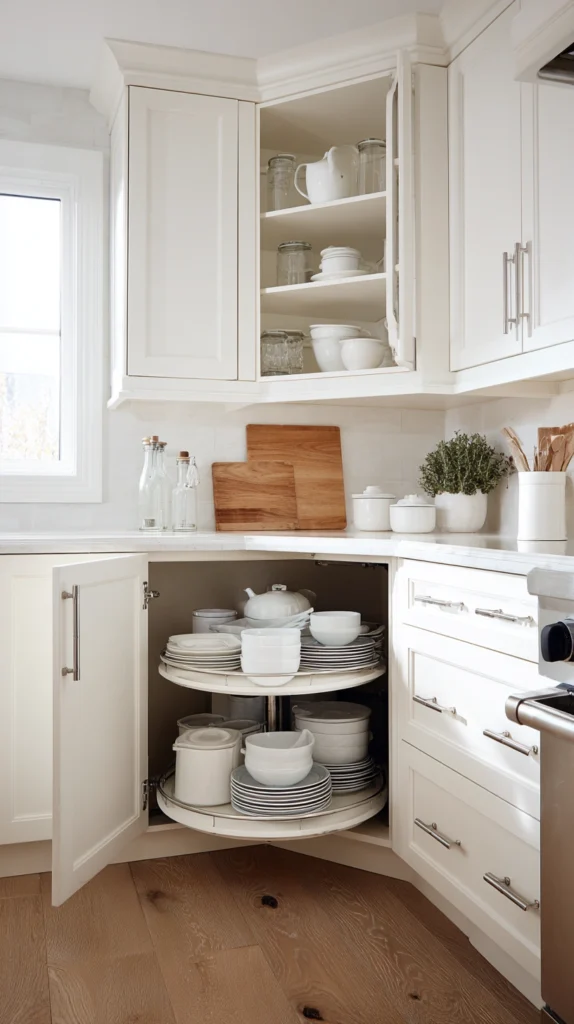
A lazy susan is the most common and affordable fix for a diagonal corner cabinet, using rotating shelves to bring items stored in the back within easy reach. Standard lazy susan units run 28-32 inches in diameter to fit most corner cabinet openings.
Budget: $40-120 for a basic two-tier lazy susan, or $150-300 for a heavier-duty, full-extension model. This is one of the least expensive corner cabinet upgrades available and often requires no professional installation.
Full-circle lazy susans rotate completely around, while D-shaped or kidney-shaped versions are designed to maximize storage in cabinets where a full circle would waste corner space. Measuring your cabinet’s interior width and depth before ordering is essential, since even a half-inch of miscalculation can prevent the unit from rotating freely.
Heavier-duty bearing systems are worth the extra cost if you plan to store heavier items like small appliances or large pots, since basic lazy susans can wobble or stick under excess weight over time.
2. Add a Blind Corner Pull-Out System
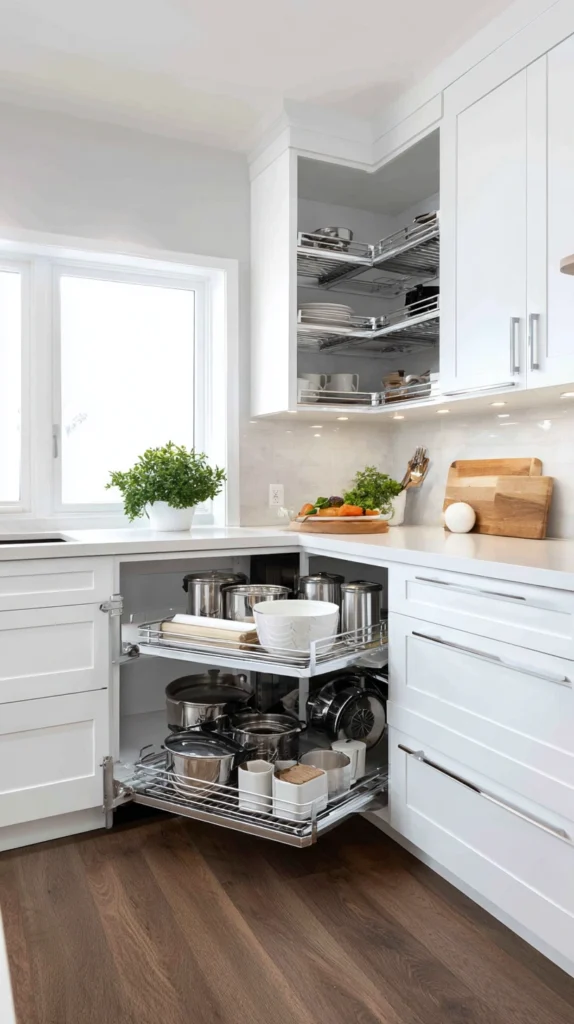
Blind corner cabinets hide a significant amount of unusable space behind the front-facing cabinet door, and a pull-out system solves this by bringing shelves out and around the corner as the door opens. Standard blind corner pull-out units are designed for cabinet openings 24-36 inches wide.
Budget: $200-500 for a quality blind corner pull-out system, plus installation if not doing it yourself. This is a bigger investment than a lazy susan but solves a type of corner that turntables can’t fully address.
These systems typically attach directly to the cabinet door, so opening the door pulls the entire shelving unit out and swings it into the accessible part of the cabinet in one motion. Measuring the exact blind corner depth and the width of the cabinet opening before ordering is critical, since these units are more precisely engineered than a standard lazy susan.
This upgrade delivers some of the biggest functional improvement on this list specifically because blind corners are otherwise nearly impossible to access without crawling partway into the cabinet.
3. Use Diagonal Corner Drawers
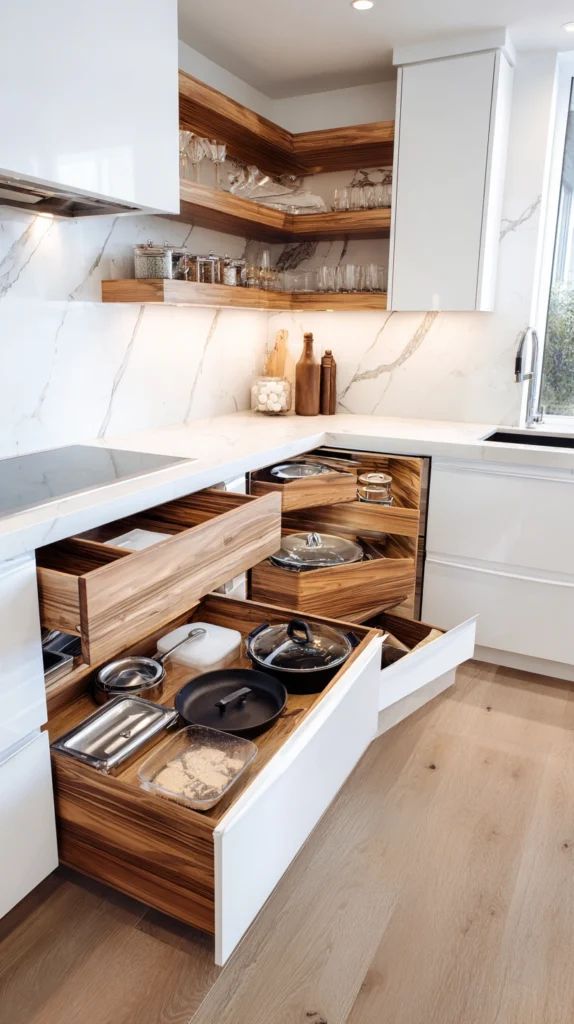
Diagonal corner drawers, custom-built to follow the cabinet’s angled shape, provide full-extension access without any rotating or swinging mechanism. Standard corner drawer boxes are built to match a 24-36 inch diagonal cabinet opening.
Budget: $600-1,500 for custom corner drawer boxes, typically installed during a kitchen renovation or cabinet refacing project. This is one of the more expensive options on this list since it usually requires custom cabinetry work rather than an add-on product.
Because these drawers extend in a straight line rather than rotating, every inch of the drawer is immediately visible and accessible once opened, which many homeowners find more intuitive than a lazy susan’s rotating motion. This solution works best when planned during new cabinet installation, since retrofitting existing cabinets for diagonal drawers is more complex than adding a pull-out system.
This is the premium option on this list, best suited to a full kitchen remodel rather than a standalone corner cabinet upgrade.
4. Add a Swing-Out Corner Shelf System
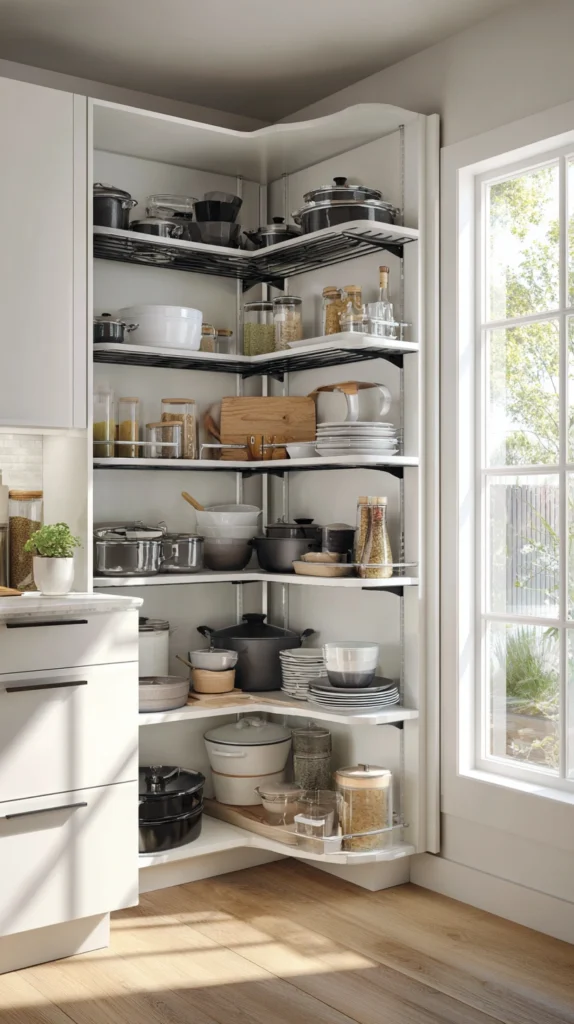
Swing-out shelving units pivot on a single hinge point, swinging the entire shelf assembly out of the cabinet and into the kitchen for full visibility and access. Standard swing-out units fit cabinet openings 24-33 inches wide.
Budget: $150-400 for a quality swing-out shelf system. This sits between a basic lazy susan and a full blind corner pull-out in both cost and functionality.
These systems work particularly well in diagonal corner cabinets where a full lazy susan isn’t practical due to the cabinet’s specific dimensions or door style. Because the entire unit swings out into the room, it requires enough clearance in front of the cabinet to fully open without hitting an island or opposite counter.
Checking the swing radius against your kitchen’s actual floor space before purchasing prevents a frustrating situation where the unit can’t fully open in a tighter kitchen layout.
5. Install a D-Shaped Lazy Susan
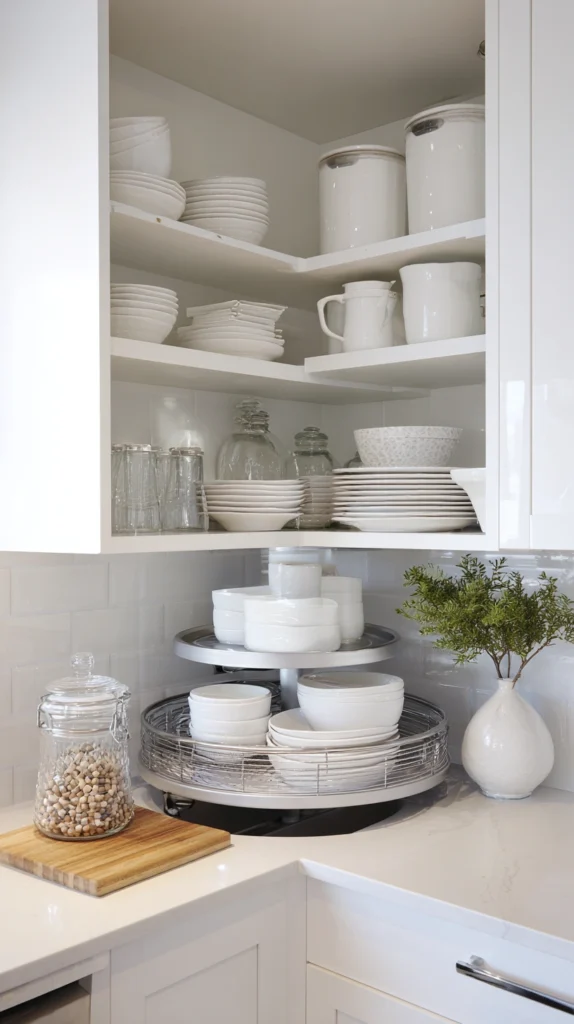
D-shaped (or kidney-shaped) lazy susans are designed specifically to maximize storage in corner cabinets where a full circular turntable would waste usable space along the straight cabinet walls. Standard D-shaped units are sized to match specific cabinet widths, commonly 24-36 inches.
Budget: $60-150 for a basic D-shaped lazy susan, or $150-250 for a heavier-duty version. This costs slightly more than a basic round lazy susan due to the more complex shape and mounting hardware.
Because D-shaped units use the cabinet’s straight walls more efficiently than a circular turntable, they typically offer 15-20% more usable shelf space in the same cabinet footprint. These units still rotate, just not through a complete 360-degree circle, since part of the shelf follows the cabinet’s straight back wall.
This is a strong middle-ground option for anyone who wants more storage capacity than a standard lazy susan without the cost of a full custom pull-out system.
6. Add Open Corner Shelving for Display
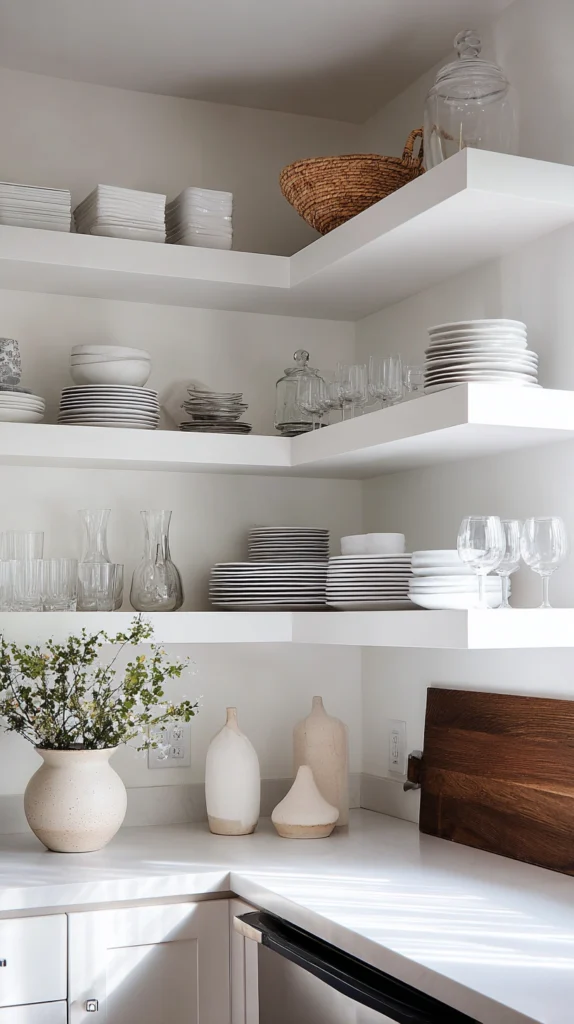
Removing cabinet doors entirely and adding open shelves is one of the lowest-cost corner solutions, particularly well suited to items used daily or displayed for style. Standard open corner shelves are cut to fit the same diagonal or L-shaped footprint as a closed cabinet.
Budget: $50-150 for shelf material and brackets if converting an existing cabinet, or built in as part of new custom cabinetry at a similar cost to standard open shelving. This is one of the most budget-friendly corner solutions on this list.
Open shelving works best for corner cabinets in a kitchen with already-organized, visually appealing dishware or cookware, since anything stored here is fully visible rather than hidden behind a door. Regular dusting and cleaning becomes part of the maintenance routine with any open shelf, which is worth considering before removing cabinet doors permanently.
This solution also works well as a temporary or rental-friendly fix, since shelves can be added without permanently altering the existing cabinet structure.
7. Build a Corner Pantry Cabinet
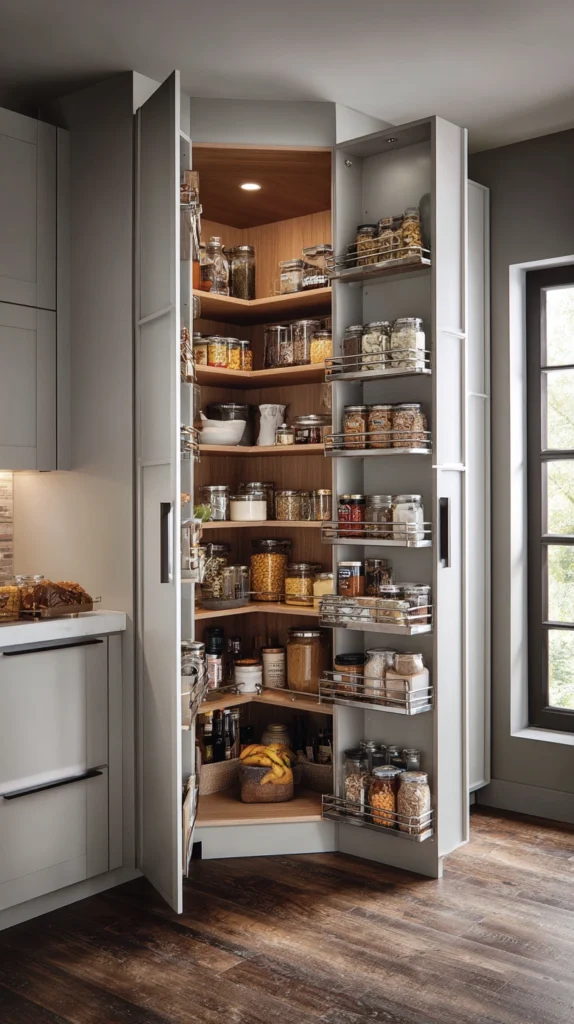
Converting a full corner into a tall, dedicated pantry cabinet maximizes vertical storage in a way that standard base cabinets can’t, particularly useful in smaller kitchens without room for a separate walk-in pantry. Standard corner pantry cabinets run 24-36 inches per side and extend to full cabinet height, typically 84-96 inches.
Budget: $800-2,000 for a custom-built corner pantry cabinet, depending on interior organization features like pull-out shelves or wire baskets. This is a bigger investment but often solves both the corner problem and general kitchen storage shortage at once.
Adding pull-out shelves or wire basket drawers inside the pantry cabinet improves accessibility significantly compared to fixed shelving, since reaching to the back of a tall, deep cabinet is otherwise difficult regardless of its corner placement. This solution works best when planned during a full kitchen renovation, since retrofitting a corner base cabinet into a full-height pantry usually isn’t structurally practical after the fact.
This is one of the higher-value options on this list for kitchens that need more overall storage, not just a fix for one hard-to-reach corner.
8. Add a Corner Sink to Eliminate the Problem Entirely
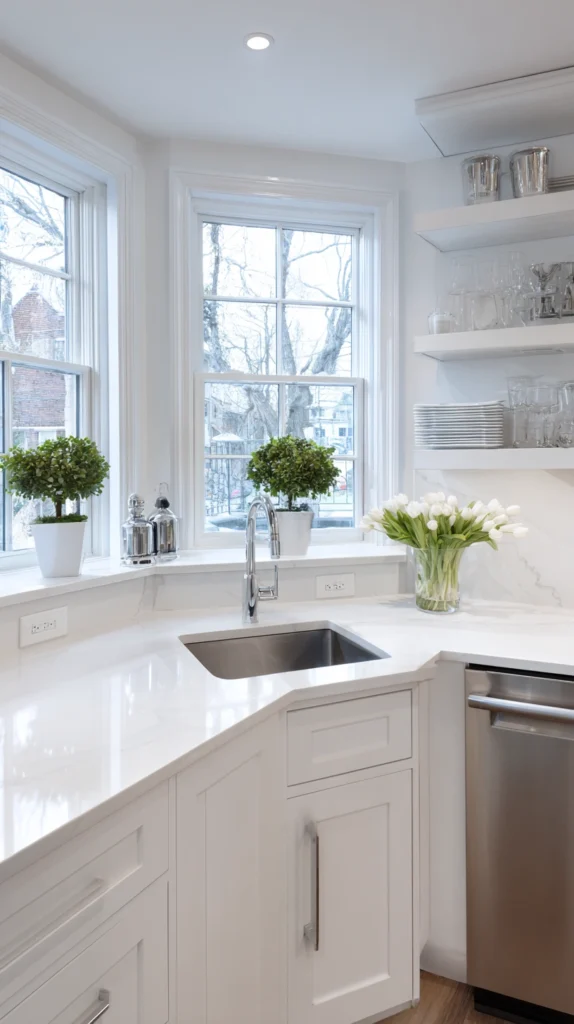
Rather than working around an awkward corner cabinet, placing the sink itself in the corner repurposes that space functionally instead of trying to maximize storage there. Standard corner sink cabinets run 36-42 inches per side to accommodate both the sink basin and plumbing.
Budget: $600-1,500 for a corner sink cabinet and basin, plus plumbing adjustments if the sink is being relocated from elsewhere in the kitchen. This is a bigger structural change, best suited to a full kitchen renovation.
This layout is especially popular in smaller or galley-style kitchens, since it uses an awkward corner productively while freeing up straight wall space elsewhere for additional counter or cabinet storage. Plumbing costs vary significantly depending on whether the existing water and drain lines are already near the corner or need to be rerouted.
This solution effectively eliminates the corner storage problem altogether by changing what the space is used for rather than trying to organize around its shape.
9. Use Wire Basket Pull-Outs for Budget Storage
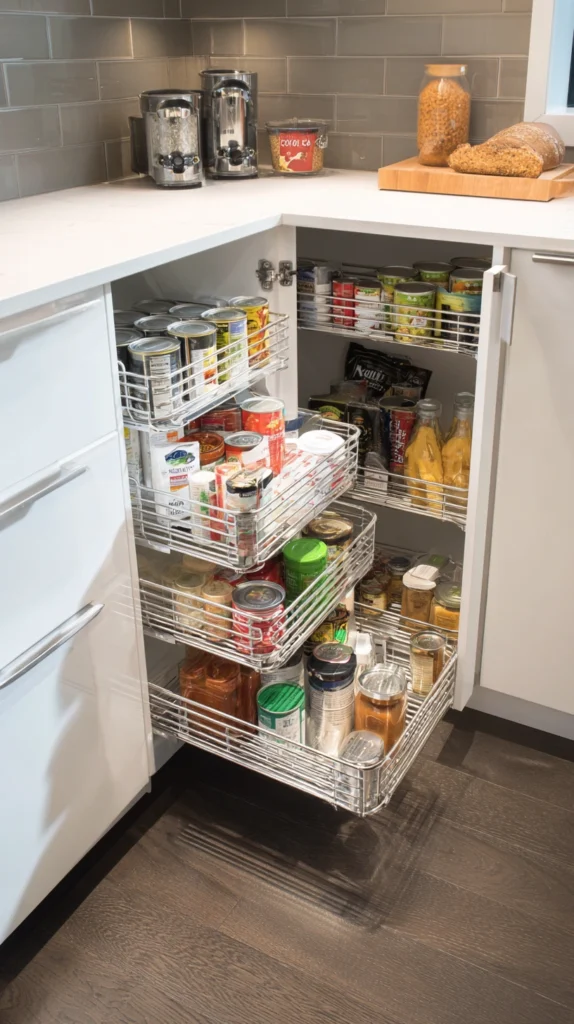
Wire basket pull-out systems offer a lower-cost alternative to full pull-out shelving, using simple sliding wire racks to bring corner items forward. Standard wire basket systems fit cabinet openings 15-36 inches wide depending on the configuration chosen.
Budget: $80-250 for a quality wire basket pull-out system. This is significantly cheaper than a custom blind corner or diagonal drawer system while still meaningfully improving accessibility.
Wire baskets are particularly well suited to storing produce, canned goods, or smaller kitchen items where visibility matters, since the open wire design lets you see contents at a glance rather than digging through a solid shelf. Many wire basket systems are designed as retrofit kits, meaning they can be installed into an existing cabinet without needing to replace the cabinet box itself.
This is a strong budget-conscious middle ground between doing nothing and investing in a full custom pull-out system.
10. Add a Corner Cabinet Appliance Garage
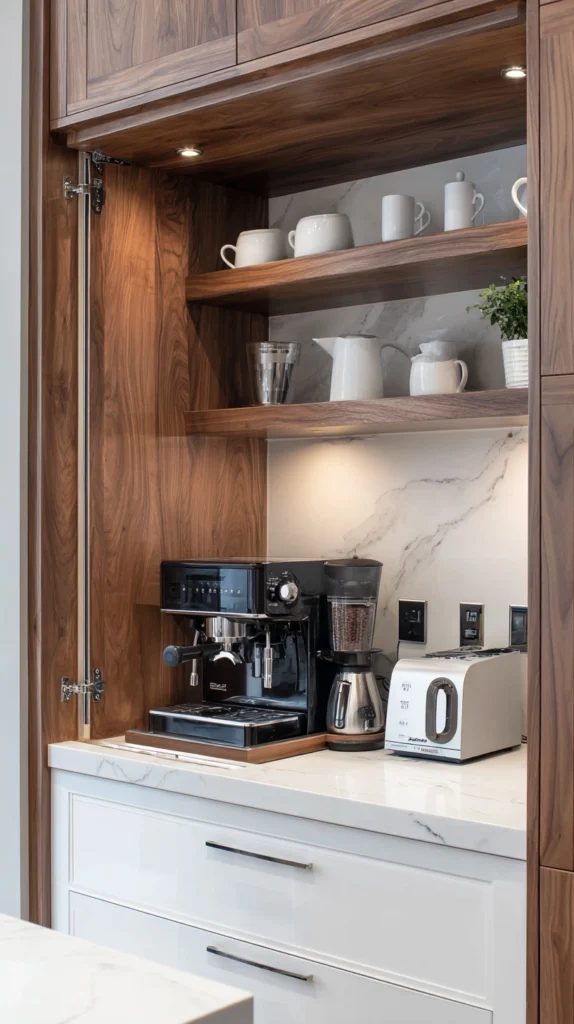
Rather than storage for dishes or food, a corner cabinet can be converted into a dedicated “appliance garage” for small countertop appliances like a coffee maker, toaster, or stand mixer, keeping counters clear. Standard appliance garage conversions fit within a standard 24-36 inch corner cabinet footprint.
Budget: $200-600 depending on whether pull-out shelving or a lift-up door mechanism is added to make appliances easier to access and use in place. This solves both a storage problem and a counter clutter problem at once.
Adding an outlet inside the cabinet allows appliances to be used directly from the garage without needing to be lifted out entirely, which is a popular upgrade for anyone using a coffee maker or toaster daily. A tambour (roll-up) door is a common style choice for appliance garages since it takes up less swing space than a standard hinged door.
This is a particularly useful option in a smaller kitchen where counter space is at a premium and corner cabinets would otherwise sit underused.
11. Install a Full-Extension Corner Drawer Kit
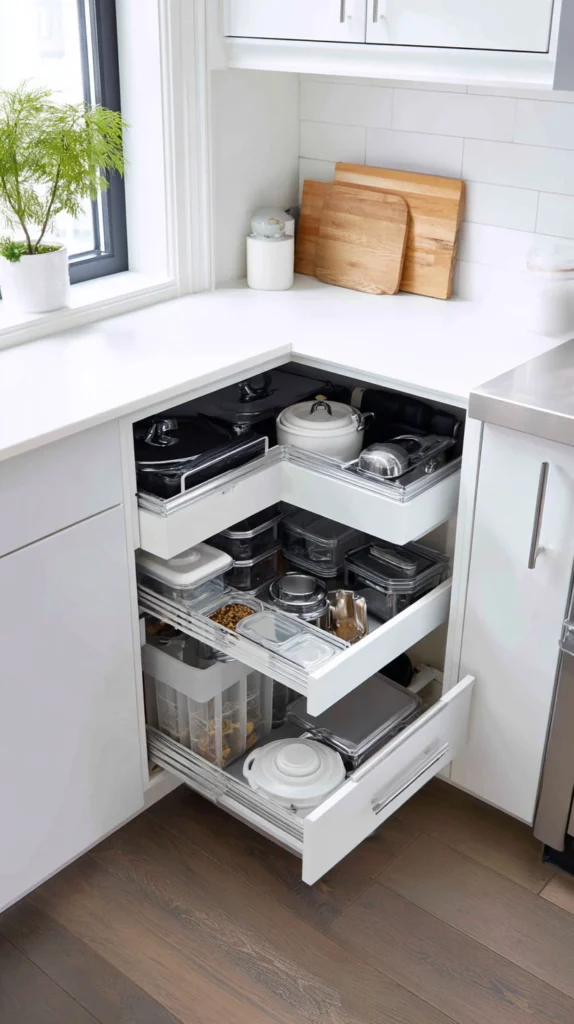
Full-extension corner drawer kits are retrofit products designed to convert an existing diagonal or blind corner cabinet into drawer-style storage without a full custom cabinetry replacement. Standard kits are designed for cabinet openings 24-36 inches wide.
Budget: $300-700 for a quality retrofit drawer kit, less than custom-built corner drawers but more than a basic lazy susan. This is a good middle-ground option for kitchens not undergoing a full renovation but still wanting drawer-style access.
These kits typically include the drawer boxes, slides, and any necessary corner-specific hardware, though installation may require some cabinet modification depending on the existing cabinet’s construction. Full-extension slides are worth prioritizing over partial-extension ones, since they allow the drawer to pull completely clear of the cabinet for full visibility and access.
This solution offers much of the functional benefit of custom corner drawers at a lower cost, since it works with the existing cabinet box rather than requiring full replacement.
12. Add a Corner Cabinet Wine or Bottle Rack
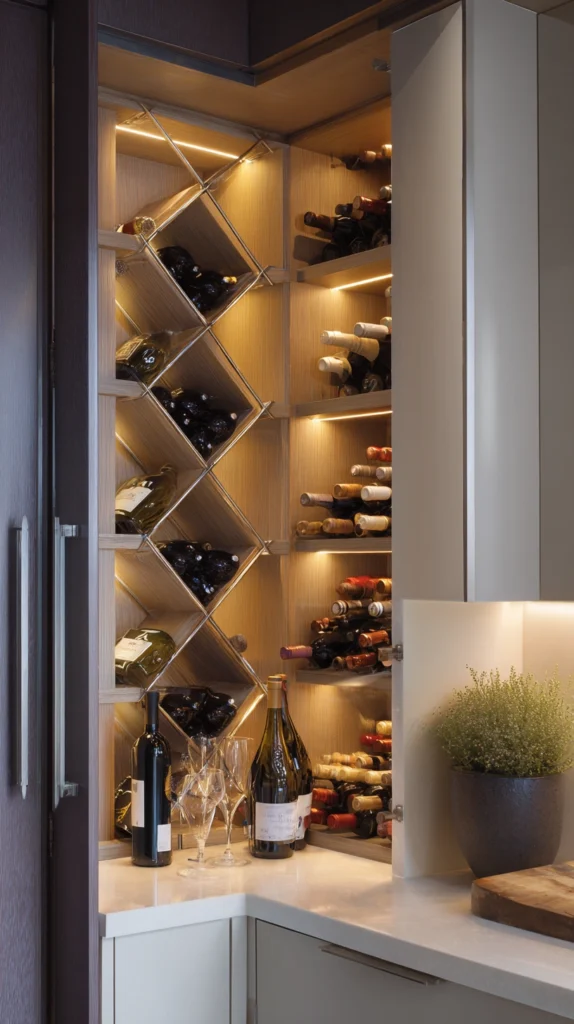
For kitchens that don’t need maximum food storage in every corner, converting a corner cabinet into a dedicated wine or bottle storage rack adds a functional, often visually appealing feature. Standard corner wine rack inserts fit cabinet openings 15-24 inches wide.
Budget: $80-250 for a quality wine rack insert designed for corner cabinet installation. This is one of the lower-cost specialty conversions on this list.
Diagonal or angled wine racks are specifically designed to make use of a corner’s shape rather than fighting against it, unlike standard rectangular wine racks that waste significant space in an angled cabinet. This conversion works particularly well in a corner cabinet with glass-front doors, turning what would otherwise be an awkward storage spot into an attractive display feature.
This option is best suited to households that entertain regularly or simply want a dedicated, visible spot for wine storage rather than tucking bottles into a pantry.
13. Use a Corner Cabinet for a Recycling and Trash Center
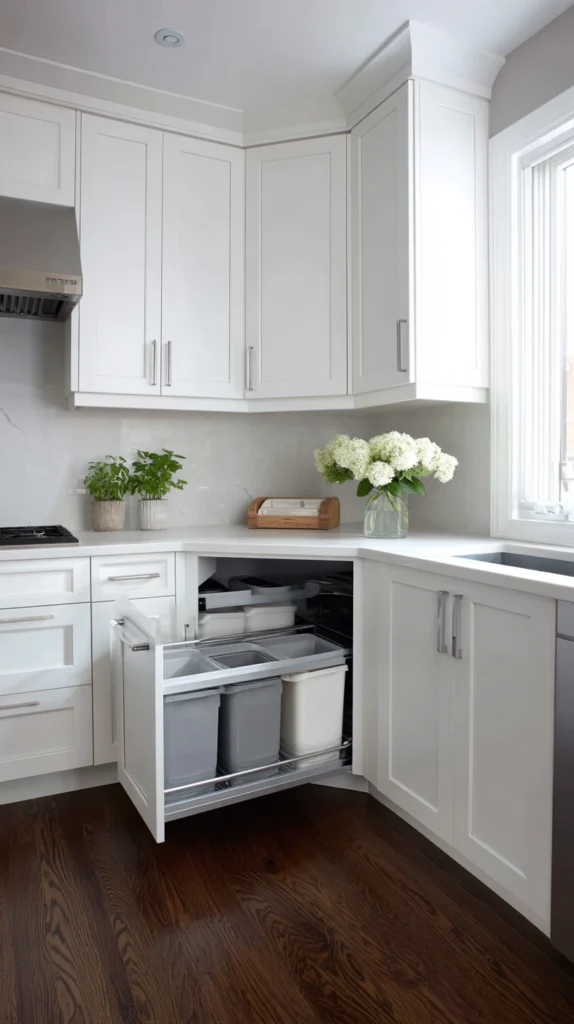
Dedicating a corner cabinet to pull-out recycling and trash bins keeps these less attractive necessities out of sight while making use of a space that’s otherwise hard to organize for regular kitchen items. Standard pull-out trash and recycling systems fit cabinet openings 18-36 inches wide.
Budget: $100-350 for a quality pull-out bin system with two or three separate bins for trash, recycling, and compost. This is a practical, moderate-cost solution that solves both the corner problem and a common kitchen organization challenge.
Choosing a system with removable bin liners makes ongoing cleaning significantly easier than a fixed bin setup, and this is worth prioritizing given how frequently this cabinet gets used compared to some of the more occasional-use options on this list. Positioning this system near the sink, if the corner cabinet is close enough, creates a more efficient workflow for meal prep cleanup.
This solution won’t maximize corner storage capacity the way a pull-out shelf system would, but it solves a genuinely useful organizational need most kitchens have.
14. Add Vertical Tray and Cutting Board Dividers
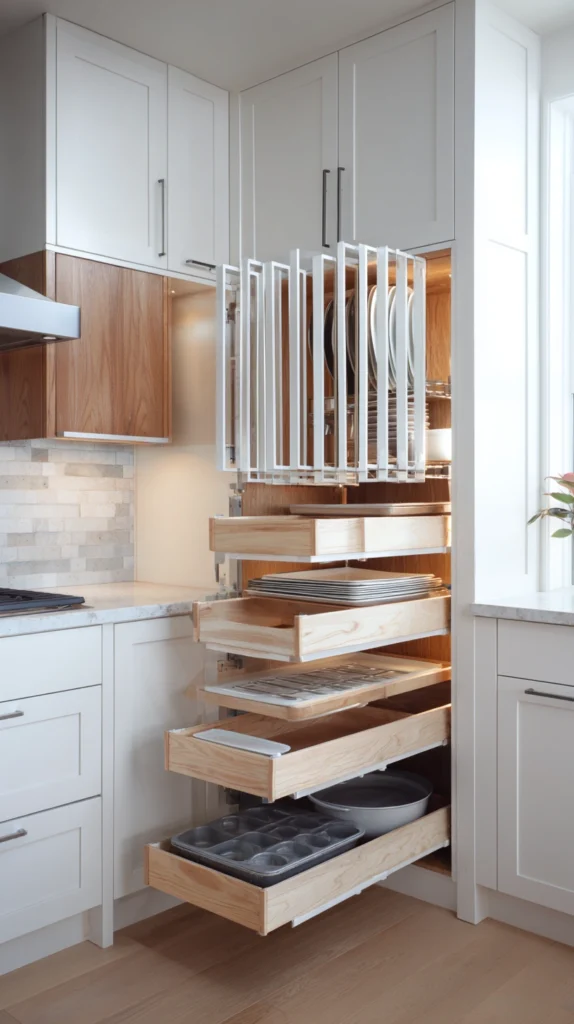
Vertical divider inserts, installed in a corner cabinet, create dedicated slots for baking sheets, cutting boards, and trays that are otherwise awkward to store flat in a stack. Standard vertical divider kits fit cabinet openings 12-24 inches wide, making them suitable for smaller corner sections.
Budget: $30-100 for a basic vertical divider insert kit. This is one of the least expensive options on this list, since it requires no motorized or rotating hardware.
This solution works particularly well in a corner cabinet section too narrow for a lazy susan or pull-out shelf system, making productive use of an oddly sized space rather than leaving it as wasted storage. Adjustable dividers, rather than fixed-width slots, allow the system to accommodate trays and boards of varying sizes as your kitchen tools change over time.
This is a good low-cost addition to pair with one of the larger corner solutions on this list, using a smaller adjacent cabinet section for flat-item storage while the main corner handles a pull-out or lazy susan system.
Quick Start Tool List
Before installing any corner cabinet system:
- Tape measure for precise cabinet dimensions
- Drill and screwdriver bits for mounting hardware
- Level to confirm even installation
- Cabinet hinges rated for the added weight of pull-out systems
Budget-Friendly Version
Lowest-cost corner solutions:
- Basic round lazy susan
- Open shelving instead of a closed cabinet
- Wire basket pull-out retrofit kits
- Vertical tray dividers for narrow sections
Success Indicators
- Items in the corner are reachable without kneeling or reaching blindly
- No wasted or “dead” space remains unused in the cabinet
- Hardware operates smoothly without sticking or wobbling
- The solution matches how the household actually uses the kitchen
- Corner storage no longer gets overlooked during regular cooking and cleanup
Remember
Measure the exact cabinet opening and depth before ordering any hardware, since corner systems are far less forgiving of size mismatches than standard shelving, match the solution to how the cabinet is actually used rather than choosing the most expensive option by default, prioritize full-extension hardware over partial-extension whenever the budget allows for meaningfully better access, and treat corner cabinet upgrades as one of the highest-value organization projects available in most kitchens given how much storage typically goes unused there.