
14 Black Home Office Ideas for a Modern Luxe Workspace
The home office default is beige.
Or white. Or the spare bedroom with some flat-pack furniture assembled without any particular conviction about what the room is supposed to feel like. A room that communicates function in the most basic and most uninspiring way possible.
This matters more than most people acknowledge. The space you work in every day shapes the quality of the work that happens there. A room that feels provisional and uninspired produces a working experience that echoes its environment.
A room that feels genuinely designed, that has been thought about and committed to, produces a different working experience. The work still happens. But the relationship between the worker and the work is different in a room that feels worth being in.
The black home office is the furthest possible design departure from the beige default.
It is serious. It is focused. It communicates that what happens in this room is important enough to deserve a considered environment. And when the black home office is done well, it is one of the most beautiful and most productive working environments available in any home.
Here are 14 ideas that build it.
Why the Black Home Office Works Better Than Intuition Suggests
The initial resistance to a black home office is usually the same everywhere.
Too dark. The room will feel oppressive. Concentration requires light. A dark room is a depressing room.
Each of these concerns is legitimate in a poorly designed dark room. Each of them is answered by a well-designed one.
Too dark. Not with the right lighting. The black home office requires better, more thoughtful, more layered lighting than a pale office, which is precisely why the resulting lighting environment is superior. Multiple warm light sources at different heights and positions produce a workspace that is illuminated exactly where illumination is needed, rather than flooded with the flat overhead light that most pale offices use.
Oppressive. Not when the room is large enough, and the furniture is well-chosen. The black room that feels oppressive is the small room with heavy furniture, no reflective surfaces, and inadequate lighting. The black room with warm materials, considered lighting, and strategic mirrors feels intimate rather than oppressive.
Concentration requires light. It requires the right light. The specific warm, layered light of a well-designed black office is significantly better for sustained concentration than the flat, cool, overhead fluorescent light of the standard office environment that most people are unconsciously comparing it to.
1. Matte Black Walls With a Single White Desk
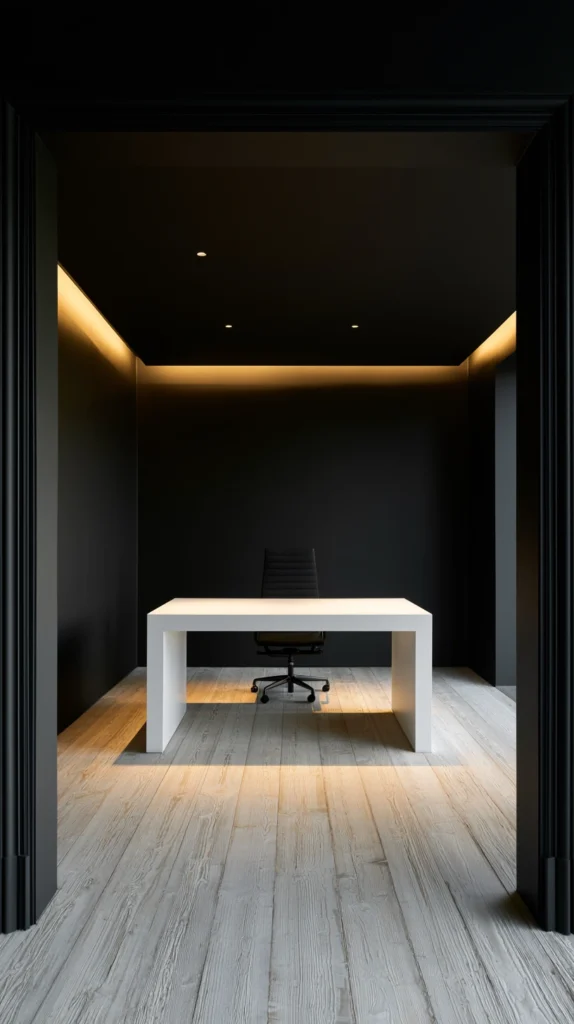
The simplest and most immediately effective black home office arrangement places a single white desk against matte black walls.
The contrast between the white desk surface and the dark walls creates a visual focus on exactly the right surface. The work surface. The place where things happen. The eye goes to the white desk in a dark room with the same immediacy that the eye goes to a lit screen in a dark cinema. The attention goes where the contrast directs it, which is exactly where it should go in a workspace.
The white desk does not need to be elaborate or expensive. A simple, clean-lined white desk in lacquered MDF, in white-painted solid wood, or in white laminate creates the essential contrast without requiring a significant investment. The black walls do the work of making the desk look considered regardless of the desk’s own design ambitions.
The monitor or laptop screen on the white desk against the dark walls creates the same focused contrast from a further distance. The workspace looks intentional, and the technology looks like it belongs rather than sitting on a surface in a room that was not designed with technology in mind.
Paint the walls, ceiling, and all the trim in the same matte black. The white desk should be the only pale element in the room for the contrast to work completely.
Why a white desk against matte black walls is the most effective minimal black office setup:
- The colour contrast focuses attention on the work surface automatically and without effort
- White against black creates the most complete contrast available in any two-colour palette
- The work surface appears to float in the dark room, elevating it above the surrounding environment
- The screen and any white paper or documents on the desk become visually prominent and easy to focus on
- The simplicity of the single contrast eliminates visual noise that a more complex colour scheme would create
- Works in any size of room, from a small home office to a dedicated study
2. Dark Wood and Black for a Warm, Serious Aesthetic
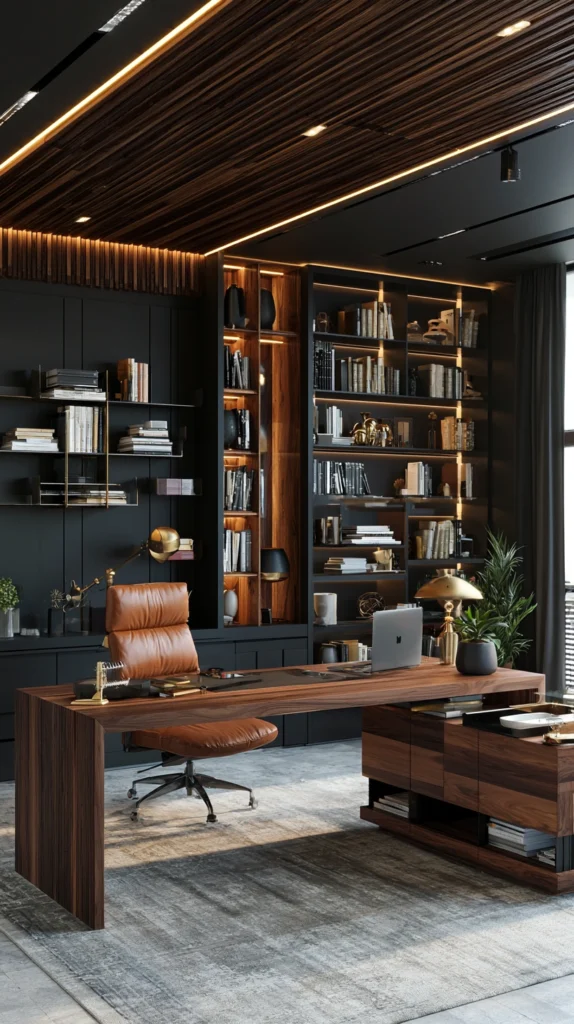
The black home office that leans cold and clinical is a failure of material selection rather than a failure of the dark colour palette.
Dark wood, specifically the warm-toned dark woods of walnut, dark oak, and ebonised timber, brings the warmth that pure black cannot supply. Against matte black walls, a walnut desk develops a richness and depth that the same desk in a pale room could never achieve. The dark warm wood and the dark cool walls create a tonal combination of extraordinary sophistication.
This is the black home office for the serious professional. The lawyer’s study. The writer’s room. The designer’s studio where the environment communicates craft and commitment rather than technology and efficiency.
A solid walnut desk with a surface of genuine depth and grain. Walnut bookshelf units on the walls. A leather desk chair in cognac or dark tan. The combination of dark wood, dark walls, and warm leather is one of the most classically beautiful professional interior arrangements available.
The warmth of the wood undertones prevents the room from feeling cold. The darkness of the overall palette provides the focus and seriousness that the work environment requires. The leather chair and the warm metal hardware add the finishing material notes that confirm the room’s identity as something deliberately and carefully designed.
3. A Gallery Wall of Black and White Photography
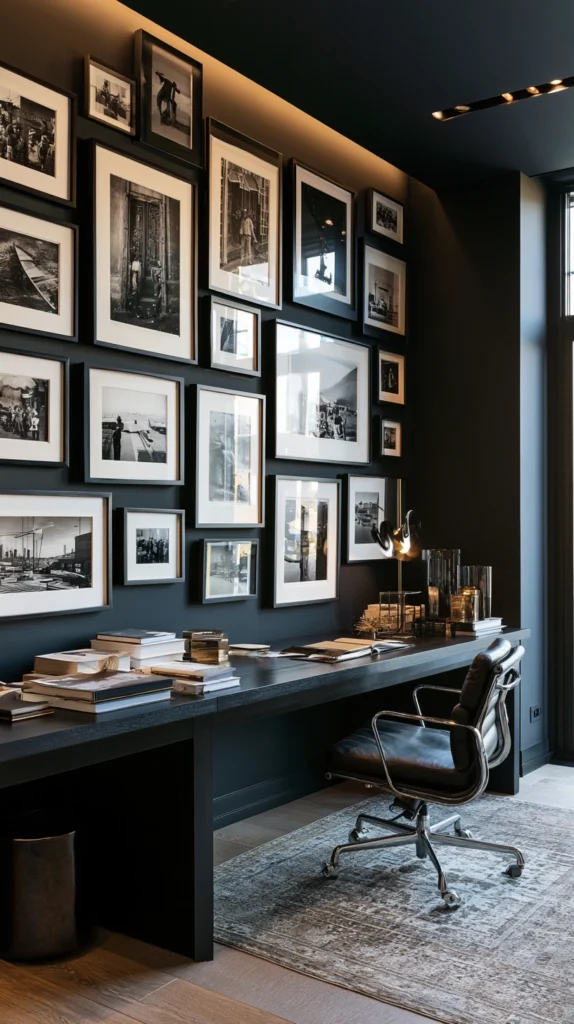
The black home office wall that carries artwork is a wall that needs art chosen specifically for the context.
Colourful art in a dark room draws the eye immediately away from the work surface and toward the wall. The colour contrast between bright artwork and dark walls is stronger than the contrast between the white desk and the dark walls. The art competes with the workspace for visual dominance.
Black and white photography or illustration on the wall of a black home office disappears into the room in exactly the right way. The frames, if they are dark, merge with the wall. The photographs, depending on their content and tonal values, sit in the dark room as tonal variations within the same palette rather than as competing colour elements.
The effect of a gallery wall of black and white photography in a black office is one of the most sophisticated and most specifically correct uses of artwork in any room. The images are visible and present. They provide visual interest and intellectual content. They do not demand attention when attention is elsewhere.
Choose photography with genuine content rather than generic editorial imagery. Work that you find genuinely interesting and would return to repeatedly. The office wall that contains images you actually want to look at during moments of reflection is an office wall that contributes to the quality of thinking that happens there.
4. A Statement Desk as the Room’s Primary Furniture
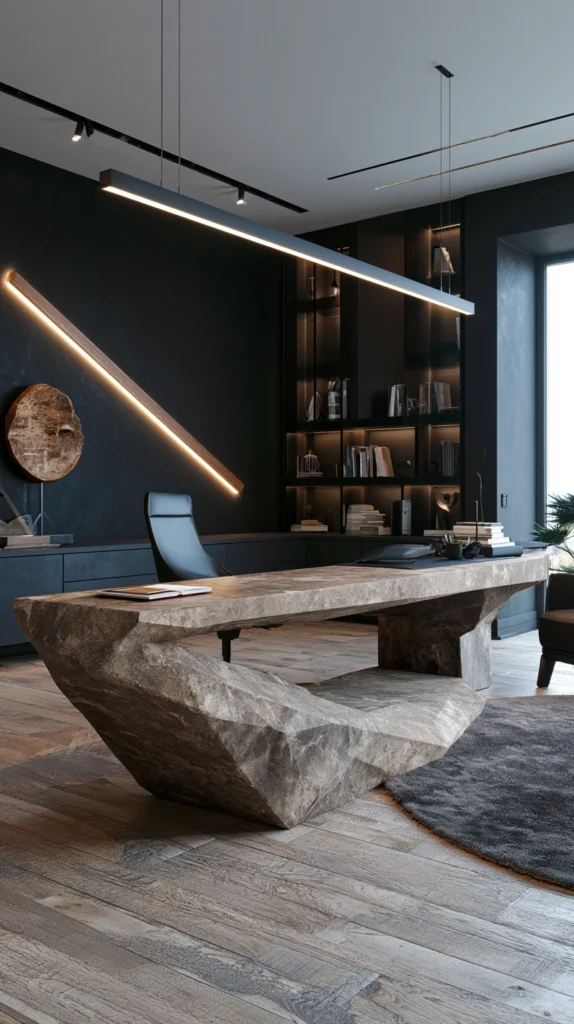
In a black home office the desk is the room’s primary visual object.
Not the art. Not the accessories. The desk. The surface on which the work happens. The centre of the room’s functional and visual gravity.
A statement desk in a black office communicates its importance by being genuinely beautiful in itself rather than merely adequate for the purpose. Not a flat-pack desk assembled from a box. A desk that is a piece of furniture in its own right.
The cantilever desk on a black metal trestle frame. The live-edge walnut desk on a single black steel leg. The deep, wide leather-topped partner’s desk with multiple drawers on each pedestal. The concrete-topped desk on a simple welded steel frame. Each of these desk forms is genuinely beautiful and each suits the serious, focused aesthetic of a black home office in a way that a standard flat-pack desk does not.
The desk should be sized generously. A work surface of one hundred and sixty centimetres wide minimum. One hundred and eighty centimetres is more comfortable for the combination of monitor, keyboard, documents, and the various equipment of a working desk. A desk that is too small for the work that happens on it creates the physical constraint that produces the psychological frustration that undermines the quality of the work environment.
5. Integrated Cable Management for a Clean Aesthetic
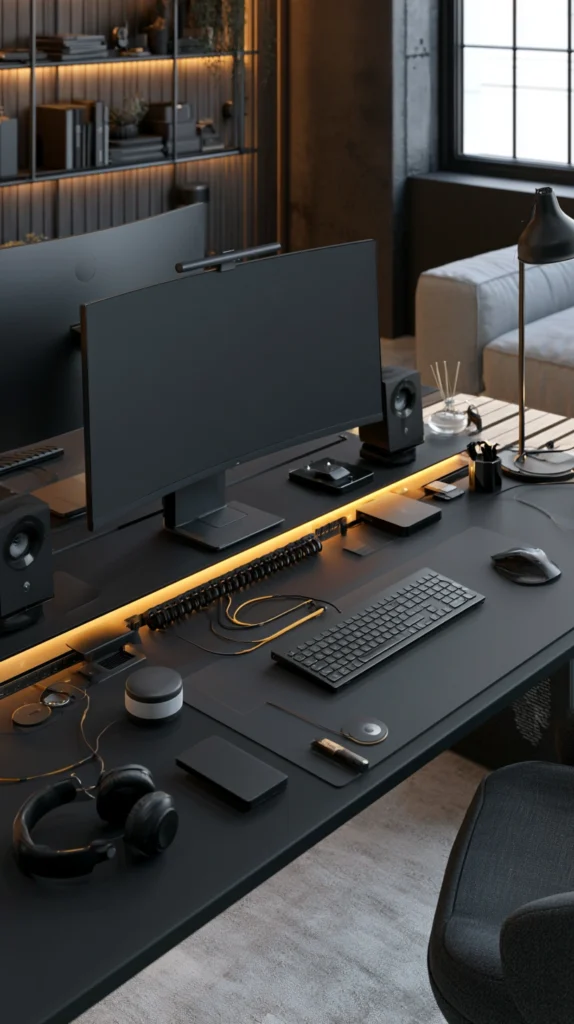
The black home office visual is destroyed by cables.
A cable from the monitor. A cable from the keyboard. A charging cable for the phone. The ethernet cable from the router. The power supply for the laptop. The cables from the desk lamp and the additional monitor. Each cable is individually modest. Together they create a nest of visual noise that makes the most carefully designed black desk look like an afterthought.
Cable management that hides every visible cable transforms the desk from a working surface with things plugged into it into an object of visual completeness.
A cable spine that runs the length of the desk edge holds the vertical cable drop from the desk surface to the floor in a single organised unit rather than multiple separate drops. A desk grommet at each end of the desk provides a managed entry point for cables from below rather than cables draped over the desk edge.
Under-desk cable management trays fixed to the underside of the desk surface hold the power strips, the charging bricks, and the cable runs out of sight below the work surface.
A hidden cable pass-through in a wall-mounted shelf above the desk allows the cable from a wall-mounted monitor arm to run directly through the wall to the power source rather than hanging visibly down the wall.
The investment in cable management is the investment that most improves the visual quality of a home office environment relative to its cost.
6. A Leather or Velvet Chair That Says You Take Comfort Seriously
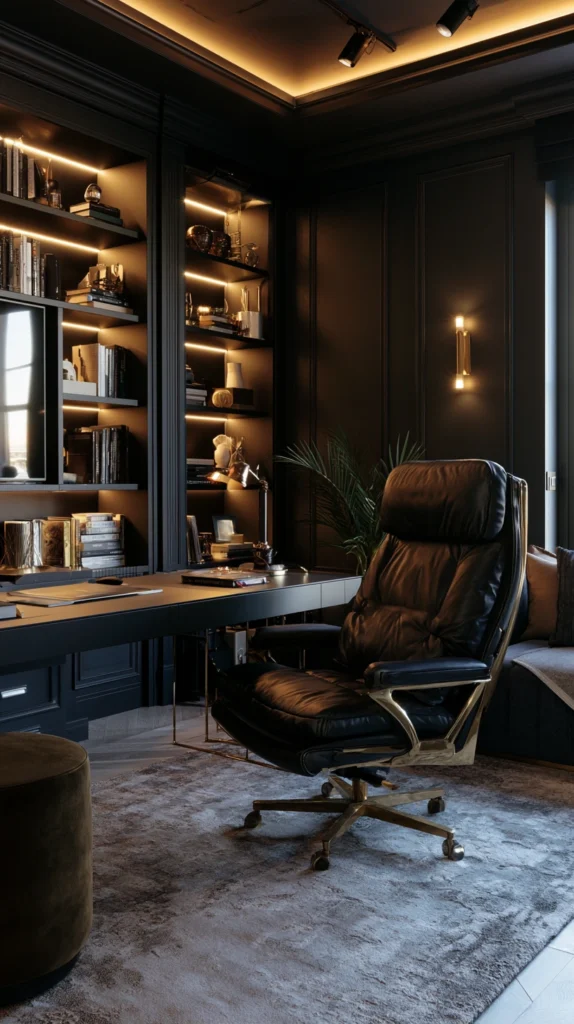
The office chair is the piece of furniture that most determines the daily physical experience of working at home.
Most home office chairs are either ergonomically correct and aesthetically negligible or aesthetically considered and ergonomically inadequate. The chair that looks good enough to photograph and the chair that is comfortable enough for an eight-hour day are, in most price categories, different chairs.
The black home office requires a chair that looks right and works right simultaneously. These chairs exist and they are not always as expensive as the assumption suggests.
A leather task chair in cognac, dark tan, or black leather with good lumbar support and adequate seat adjustment provides both the ergonomic function and the visual quality that a black home office requires. The warm leather against the dark walls is one of the best material combinations in any office environment.
A velvet upholstered chair in deep green, dusty blue, or warm burgundy provides a colour accent in the dark room that is warm and considered without being intrusive. The velvet surface catches and reflects light in the room in a way that matte materials do not.
Whatever chair is chosen, the height, lumbar support, and armrest position must be correct for the person using it. A chair that looks right but produces back pain after two hours has failed at its primary function regardless of how well it suits the room’s aesthetic.
7. Smart Shelving That Organises and Displays Simultaneously
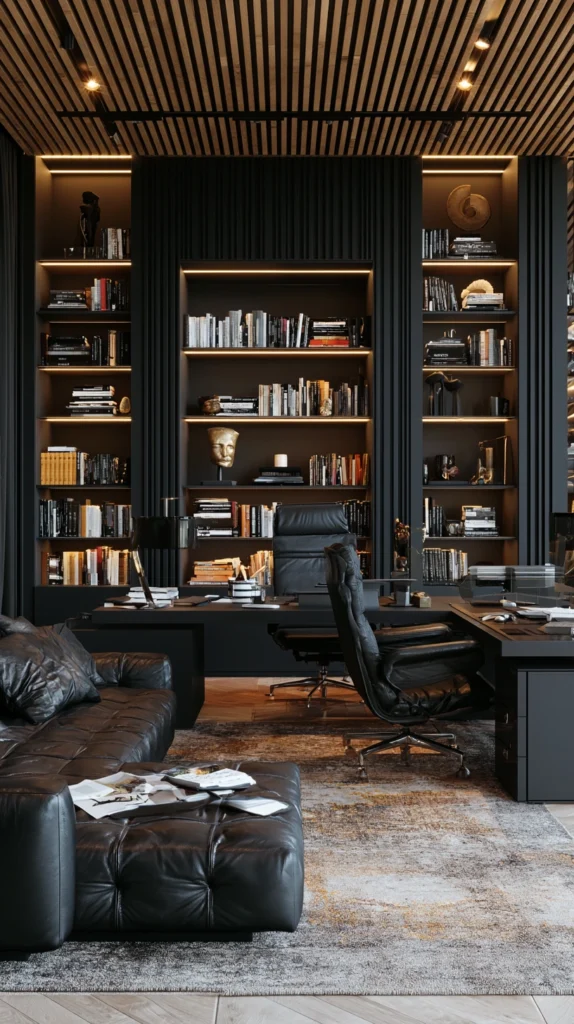
The shelving in a black home office serves two distinct functions that the shelving in most offices serves only one of.
Storage. That is the one function most office shelving addresses and the only function most office shelving designers think about.
Display. That is the second function that black home office shelving should also serve. The books and objects on the shelves of a black home office are visible in a way that the same books and objects on pale shelves in a pale room are not. The dark background makes everything placed against it more prominent and more considered.
This visibility is an invitation. The books on the shelf of a black home office are chosen rather than merely collected. The objects on the shelves are selected rather than accumulated. The books that are present are there because they belong and contribute. The objects are there because they are worth displaying against the dark backdrop.
Dark shelving that matches the wall colour creates shelves that appear as cavities in the wall, recessed planes of darkness where the objects on them float independently. This floating quality is one of the most beautiful shelving effects available and is specific to shelving whose colour matches the surrounding wall.
Pale shelving on a black wall creates the opposite effect. The shelf is visible and prominent. The objects on it are visible against the pale shelf surface rather than against the dark wall. This works when the shelving is itself a design element rather than a background for the objects it holds.
8. Layered Warm Lighting That Serves Every Task
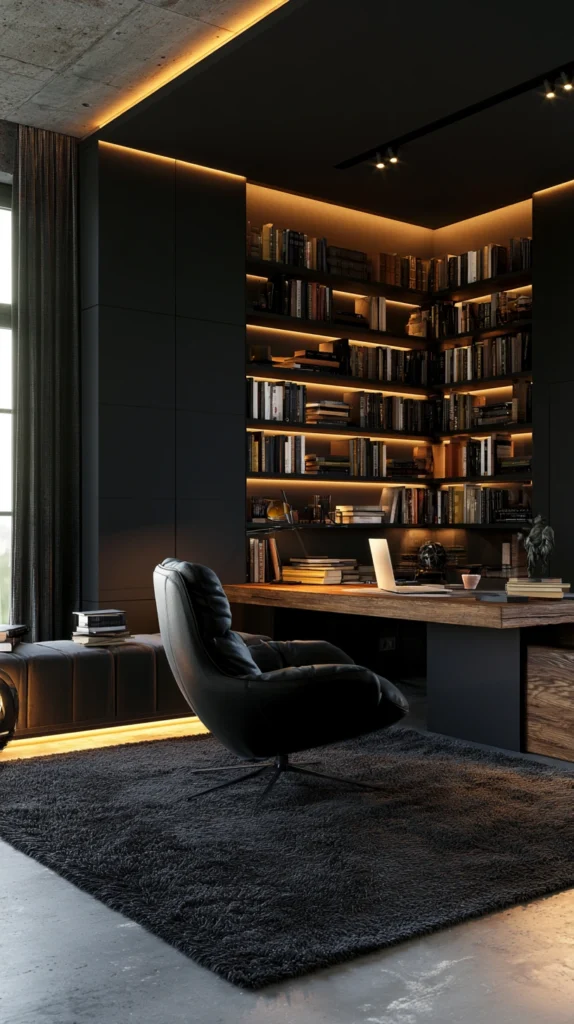
The lighting of a black home office is not one lighting decision. It is three.
Task lighting. The light that illuminates the work surface and the documents on it. This must be bright and correctly positioned to avoid shadows across the work. A quality desk lamp with a directional shade positioned to the left of a right-handed worker, or to the right of a left-handed worker, provides the shadow-free illumination that work requires without flooding the whole room with the harsh brightness that a ceiling fixture would produce.
Ambient lighting. The light that fills the room generally and prevents the contrast between the lit desk surface and the surrounding darkness from being so extreme that the eyes have to constantly adjust when moving focus between the desk and the room. A floor lamp in the corner of the room at a warm 2700K provides ambient light that reduces this extreme contrast without brightening the room to a level that undermines the atmosphere.
Accent lighting. The light that highlights specific elements of the room and creates the visual interest and warmth that makes the office environment feel genuinely designed rather than merely functional. LED strip lighting behind the monitor creating a bias light that reduces eye strain. Shelf lighting that illuminates the books and objects from below or from behind. A small lamp on the bookshelf that provides a warm point of interest in the visual field.
The combination of all three creates a workspace that is functional for every task and beautiful at every moment.
9. Matte Black Tech and Accessories for a Unified Palette
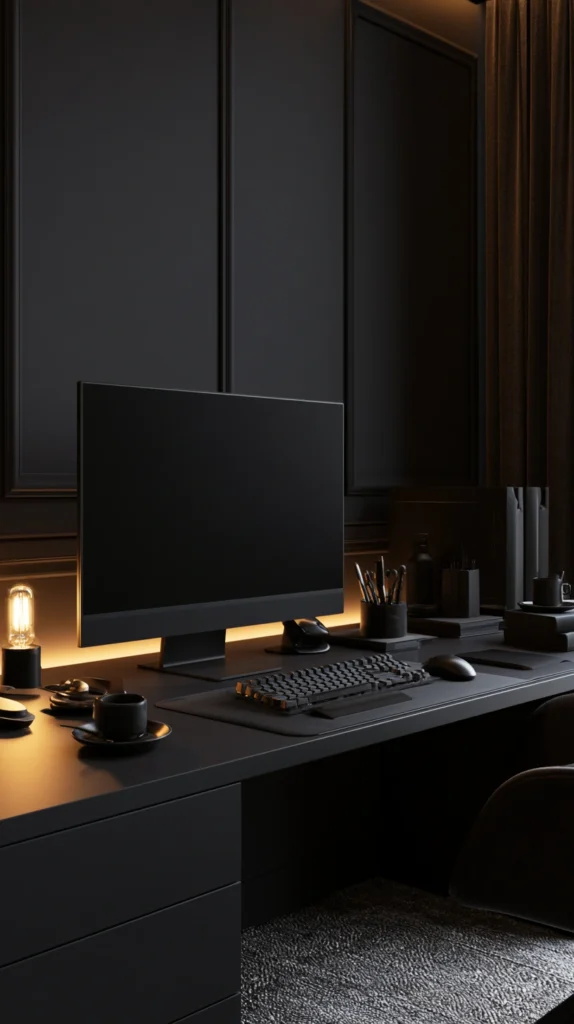
The technology and accessories on a desk in a pale office exist in whatever colours they arrived in from the manufacturer. Silver aluminium laptops. White USB hubs. Black and silver monitors. Grey keyboards.
In a black office, this mixture of manufactured colours creates visual noise that undermines the considered dark palette of the room.
Selecting technology and accessories in consistent dark tones creates a desk surface where the technology is part of the room’s palette rather than a departure from it.
Matte black monitors and displays from manufacturers that offer them. A matte black or dark aluminium laptop. A black keyboard and a black mouse. A dark monitor stand rather than a silver one. A matte black desk organiser rather than the standard silver mesh version.
These choices are available from most major technology and accessory manufacturers. The additional constraint of specifying matte black or dark aluminium rather than silver eliminates some options but rarely eliminates the option of genuine quality. The commitment to a consistent palette in the technology choices is the commitment that makes the desk surface read as designed rather than assembled.
Where specific technology in the preferred finish is not available, a skin or cover in matte black or dark grey applied to the existing silver device body is a more affordable alternative that achieves a similar visual consistency.
10. A Dramatic Pendant Light or Chandelier Above the Desk
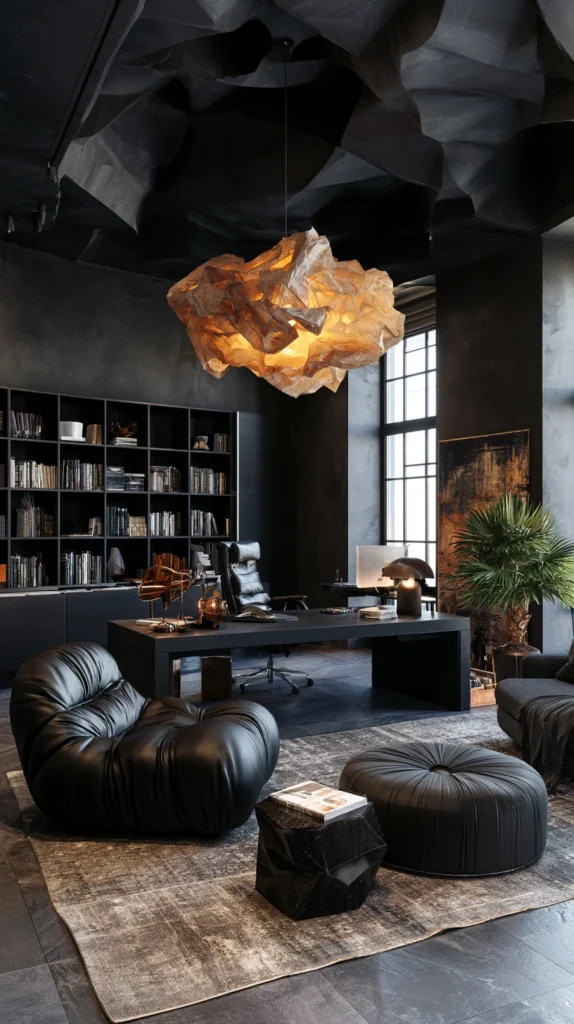
The ceiling fitting in most home offices is the least-considered element in the room.
A standard flush ceiling fitting. A basic pendant on a short drop. A bare bulb on an extension cord in rooms where the office is an afterthought.
In a black home office the ceiling fitting is an opportunity. The dark ceiling and the dark room create a context in which a dramatic pendant or chandelier reads as genuinely spectacular rather than merely attractive.
An oversized industrial pendant in black steel above the desk. A cluster of smoked glass pendants at different heights. A simple, heavy ceramic pendant in a matte black glaze. These fittings in a black office become dramatic design moments that define the room’s personality in the way that the same fittings in a pale room would be merely pleasant.
The pendant above the desk provides both the ambient lighting function and the visual focal point function simultaneously. It defines the desk as the primary location in the room by marking it with an overhead presence that no other position in the room has.
Install the pendant on a dimmer. The pendant at full brightness provides the ambient light level that supports intense daytime work. The same pendant at forty percent brightness provides the evening atmosphere that makes a late working session feel like a choice rather than an obligation.
11. A Dark Feature Wall Behind the Monitor for Eye Comfort
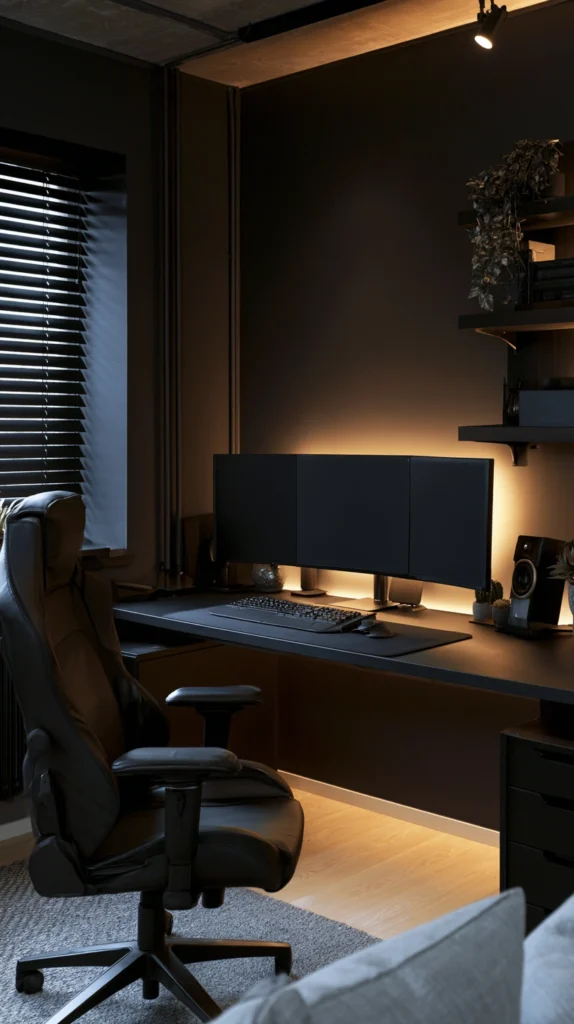
The monitor in a home office is the element that the worker looks at most consistently across the working day.
The wall behind the monitor is the element that the eyes see most consistently in the peripheral vision around the screen. The colour and brightness of this wall affects the experience of looking at the screen over an extended period.
A bright white or pale wall behind the monitor creates a high-contrast background that increases eye fatigue when working on dark content. The eye is constantly adjusting between the relative darkness of the screen and the relative brightness of the surrounding wall.
A dark wall behind the monitor reduces this contrast and reduces eye fatigue proportionally. This is the principle behind monitor bias lighting, the warm LED strip placed behind the monitor that reduces the extreme contrast between the lit screen and the dark wall. The dark wall behind the monitor is the full architectural application of the same principle.
In a black home office this eye comfort benefit is achieved automatically by the dark walls. The monitor sits against a dark background. The eye fatigue from contrast between screen and surrounding wall is minimised. The work sessions that are possible without discomfort are longer.
12. Natural Materials That Prevent the Room From Feeling Cold
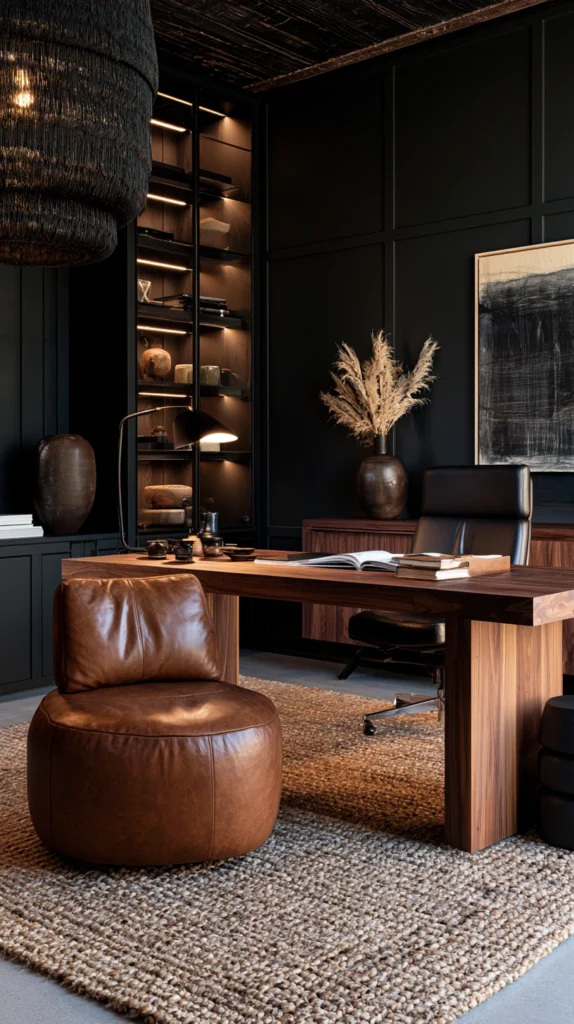
The black home office that uses only hard, manufactured materials, dark painted walls, black laminate desk, black metal shelving, black plastic accessories, feels cold and institutional regardless of how well-designed any individual element is.
Natural materials prevent this.
A wooden desk surface with visible grain. A leather chair that develops its character with use. A wool rug on the floor that provides warmth underfoot and visual warmth in the lower third of the room. A stone or concrete desk accessory. A ceramic lamp base. A plant in a terracotta pot.
These natural materials are warm in a way that manufactured materials are not. Their warmth is specific, textural, and organic. It cannot be replicated by applying a warm colour to a manufactured material. The warmth comes from the material being what it is rather than being finished to look like something warmer than it is.
In a black home office one or two significant natural material elements transform the room from an exercise in dark aesthetic to a room that feels genuinely good to spend extended periods in.
13. A Reading Chair and Lamp for Deep Work Away From the Desk
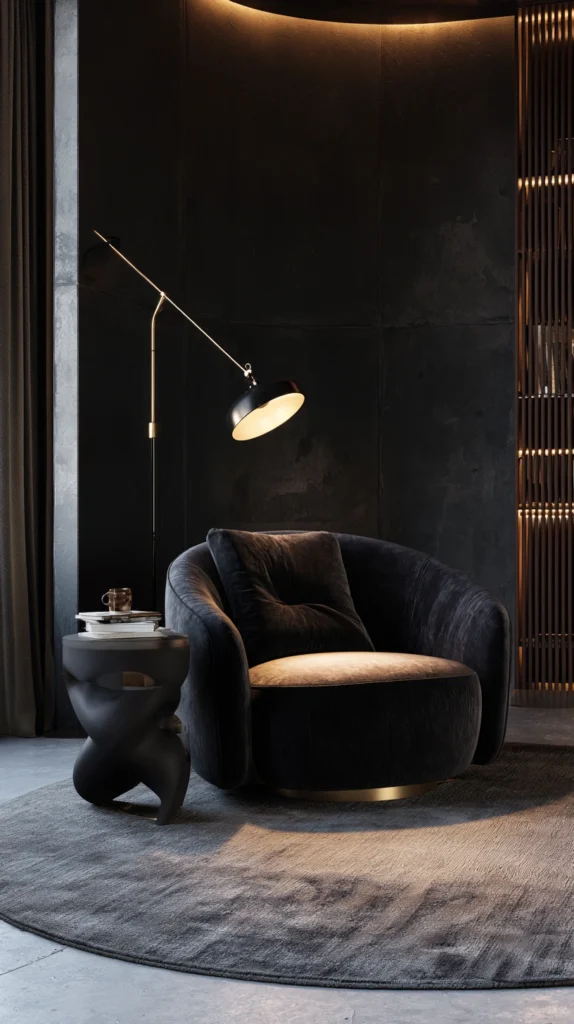
The desk chair is the working position. The reading chair is the thinking position.
The best knowledge work is not done entirely at the desk. The problem that requires a different angle of approach. The strategy session that benefits from removing the screen from the visual field. The chapter that needs to be read without the temptation to check email. These activities happen better in a chair without a desk in front of it.
A reading chair in the corner of a black home office, with a floor lamp behind and beside it and a small side table for a notebook and a drink, creates the second working position that the best home offices have always had.
The reading chair in a black office should be warm in its material and its form. A low, deep armchair in leather or velvet that encloses the sitter rather than presenting them. A chair from which getting up requires a small effort, which is the right quality for a chair you should stay in long enough to finish a train of thought.
The floor lamp beside the reading chair should provide warm, directional light that illuminates the book or paper in the reader’s hands without spilling light across the whole room. A pharmacy lamp in matte black with a warm LED. A classic adjustable floor lamp in dark bronze. The light that serves the reading position without becoming the ambient light of the whole room.
14. Plants That Live and Breathe in the Dark Office
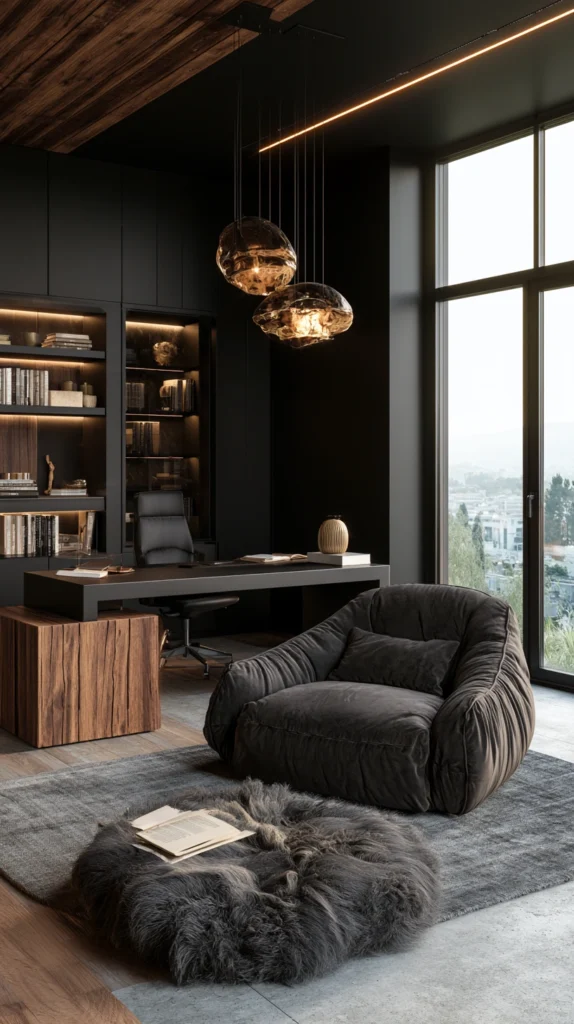
The black home office with living plants is the room that most successfully bridges the aesthetic seriousness of the dark palette with the human need for natural, living elements in the environments where extended work happens.
Plants in a dark room produce a specific visual effect. The green of the leaves against the dark walls is vivid and intense in a way that the same green against pale walls is not. The contrast between the organic, irregular form of the plant and the geometric precision of the dark office creates a productive visual tension.
The plants that work best in a home office are the ones that handle the conditions honestly. Low to moderate light. Regular but not excessive watering. The potential for extended periods without attention when the worker is travelling or the schedule becomes irregular.
Zanzibar Gem, the ZZ plant, is the most specifically office-suited plant available. It tolerates near darkness, irregular watering, and the general neglect that office plants are subject to with equanimity and returns looking healthy from every period of inattention.
Pothos in its dark-leaved varieties, N’joy and Marble Queen if there is sufficient light, Neon Pothos for its vivid yellow-green in low light, handles office conditions without complaint.
A snake plant in the corner of the office in a dark matte ceramic pot provides structure, height, and year-round presence without any of the maintenance requirements that more demanding plants impose on an owner whose attention is primarily directed elsewhere.
Position one significant plant rather than several small ones. The large specimen plant in a quality pot in the corner of a black home office has more visual impact than several small plants scattered across various surfaces.
How to Design a Black Home Office That Serves the Work
The black home office design that serves the work begins with the desk position rather than the paint colour.
The desk should face the light, not the light-blocking wall. A desk positioned with its back to the window puts the worker in shadow and the screen in reflected glare. A desk positioned to the side of the window, perpendicular to the main light source, puts the light where it can serve the work without creating glare or shadow.
Then the wall colour. The wall behind the monitor is the most visually important wall surface from the seated working position. Confirm that the dark colour chosen reads as warm rather than cold in the specific lighting conditions of the specific room. A colour that reads warm in a well-lit showroom may read cold in a north-facing home office with limited natural light. Always test in situ.
Then the lighting infrastructure. Before the furniture arrives and before any other decoration is decided, plan and install every light fitting. The position of the desk lamp. The position of the ambient floor lamp. The position and dimmer control for the ceiling pendant. The LED strips behind the monitor and behind the shelving. All of these require planning before the desk is placed and the room is arranged.
Common Mistakes in Black Home Office Design
Using cool white lighting throughout. The black room with cool white light is a room that feels like a data centre rather than a designed workspace. Every bulb must be warm. 2700K maximum. 2200K for the ambient sources. Cool white light makes the darkness feel industrial and unwelcoming.
Neglecting the floor. A dark room with a pale or institutional floor is a dark room that stops being dark at the floor level. A dark rug or dark wood flooring extends the dark palette to the ground and completes the envelope.
Over-decorating the surfaces. The black home office gets its character from restraint. Too many accessories, too many objects, too many things on the desk and the shelves, create visual noise in a room where the darkness amplifies visual noise rather than absorbing it.
Forgetting ergonomics in favour of aesthetics. The most beautiful black home office that is uncomfortable to work in for extended periods has failed at its primary purpose. The chair must be ergonomically correct. The monitor must be at the correct height and distance. The desk must be at the correct working height.
Choosing black without an undertone. Pure cool black without warm undertones can read as clinical and cold in a working environment. Black with brown or green undertones, warm charcoal rather than pure black, creates the dark palette with the warmth that a working environment requires.
No plants or natural materials. A black home office with only manufactured materials feels like an environment designed for machines rather than people. At least one natural material element and at least one living plant are non-negotiable for a workspace where human creativity and sustained concentration are the goals.
Quick Summary
- A white desk against matte black walls directs visual attention to the work surface automatically through complete colour contrast
- Dark wood furniture in walnut or ebonised oak brings the warmth that prevents the dark office from feeling cold
- Black and white photography in dark frames on dark walls adds visual content without competing with the work surface for attention
- A statement desk sized at minimum one hundred and sixty centimetres wide is the room’s primary furniture and should be beautiful in itself
- Integrated cable management that hides every visible cable is the single highest-impact visual improvement per pound spent in any home office
- A leather or velvet chair that is both ergonomically correct and aesthetically appropriate serves both function and form simultaneously
- Dark shelving whose colour matches the wall creates floating-object displays where books and accessories read as chosen rather than accumulated
- Task lighting at the desk, ambient lighting in the corners, and accent lighting on the shelves serve three distinct lighting functions no single source can provide
- Consistent matte black or dark aluminium technology and accessories prevent the desk surface from becoming a collection of mismatched manufactured colours
- A dramatic pendant above the desk marks the work position as the primary location in the room and provides ambient and focal lighting simultaneously
- A dark wall behind the monitor reduces the contrast between the lit screen and the surrounding environment and reduces eye fatigue over a full working day
- At least one significant natural material element prevents the room from feeling cold, clinical, and built for machines rather than people
- A reading chair with a directional floor lamp provides the second working position where thinking and reading happen away from the screen
- A single significant plant in a quality pot in a corner of the black office brings the living contrast that no designed element can replicate
- Position the desk perpendicular to the window, test the wall colour in the actual room’s light, and install all lighting before any furniture arrives
The black home office is not a dramatic statement made at the expense of the work.
It is an environment designed for the work.
The focus it creates. The warmth, when the materials are right. The specific quality of working in a room that was designed with as much thought as the work itself deserves.
The beige spare bedroom with assembled flat-pack furniture has never produced this quality.
The black home office can.
Design it properly and work differently.