
14 Black Dining Room Ideas for Moody Elegant Entertaining
The dining room is the room where candlelight is most correct.
And candlelight, which is warm and flickering and casts more shadow than it does light, is most beautiful against dark surfaces.
This is the fundamental case for the black dining room. Not that dark rooms are universally better than pale rooms. Not that drama is always the right note for a space. But that the specific activity that a dining room exists to contain, the gathering of people around food and drink in the evening hours, is an activity that dark rooms serve better than any other.

The pale dining room in the evening looks clinical when the overhead light is on and dim when it is off. The black dining room in the evening, lit by candles on the table and warm lamps in the corners and perhaps a pendant above the table at low setting on a dimmer, looks extraordinary. The room does something to the occasion. The occasion elevates.
This is the dining room that produces the dinners people talk about for years. Not because of the food, though the food matters. Because the room made everyone feel that being there was a specific and significant pleasure.
Here are 14 ideas for building that room.
Why the Black Dining Room Is the Best Version of the Dining Room
The argument is simple and specific to the function of the room.
Dining rooms are used in the evening. More than any other room in the house, the dining room’s primary use is in hours of low and artificial light. The decisions that govern a dining room should be calibrated for those hours, not for the afternoon when the room is empty and the light is full.
In low and artificial light, dark colours do something that pale colours do not. They make the light sources in the room more visible and more beautiful. Every candle on a dark table in a dark room is a specific point of warmth and life. The same candle on a pale table in a pale room is barely noticeable.
Dark rooms also create intimacy. The psychological effect of being in a dark, warm space with other people is one of gathering and closeness. The darkness beyond the table makes the table the world. The conversation that happens at a black dining room table by candlelight is conversation that happens with full attention, undistracted by the view through the window or the objects in the corners of the room.
The black dining room is not a difficult room. It is not an acquired taste. It is the most instinctively correct environment for what dining rooms are actually for.
1. Black Walls With White Architectural Details
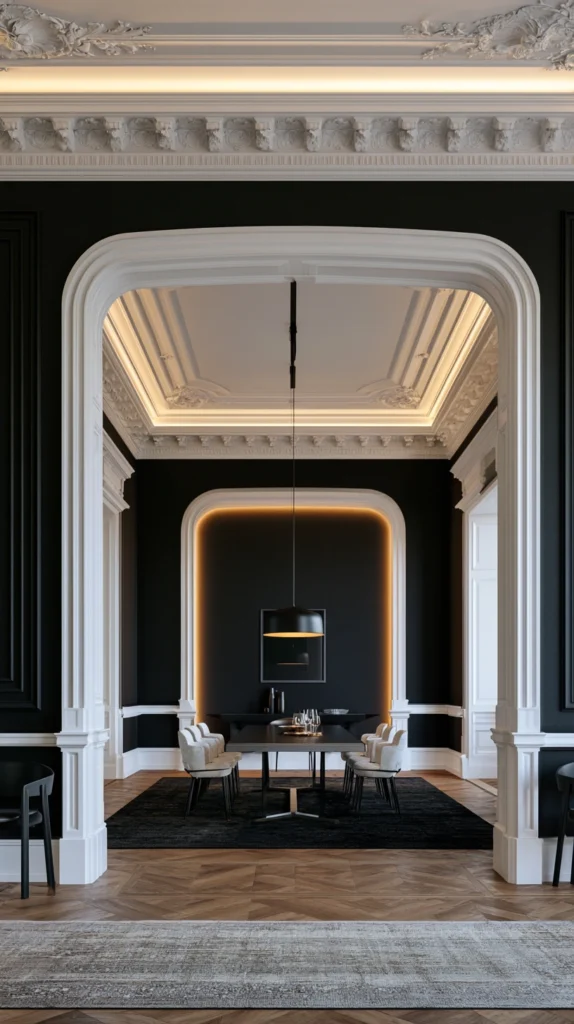
The black dining room in its most classical form pairs deep black walls with white or cream architectural details, mouldings, cornicing, and ceiling.
The white architectural elements define the room’s structure against the dark walls. The cornice catches the eye and directs it upward. The dado rail, if the room has one, creates a horizontal line at the mid-point of the wall that emphasises the room’s proportions. The door frame and window architraves read as graphic elements, white lines drawn on a dark ground.
This is the dining room treatment with the longest history. The dark-walled dining room with pale architectural detail appears in country houses, Georgian townhouses, and Victorian dining rooms of every period and every level of grandeur. It is not a contemporary trend. It is one of the oldest and most consistently successful room treatments in the history of domestic architecture.
The ceiling should be white or very pale rather than the same black as the walls. The pale ceiling in a dark room creates the impression of an open sky above a sheltered space. The same black on the ceiling creates a more enclosed cave-like quality that suits some rooms and overwhelms others.
Paint the walls in a matte or dead-flat finish. Gloss or satin black on a large wall surface creates unwanted reflections and feels more industrial than warm. The matte finish absorbs light and creates the warm, velvety quality that the black dining room requires.
Why black walls with white architectural details is the most enduring dining room treatment:
- The contrast between dark walls and white architectural elements emphasises the room’s structure and proportions
- The historical precedent for this treatment gives it a quality of correctness that more recent combinations lack
- White mouldings and cornicing provide the relief that prevents the dark room from feeling heavy
- The treatment suits period homes authentically while working equally well in contemporary spaces
- It is infinitely adjustable in its darkness by choosing a very deep charcoal rather than pure black for more restraint
- Every other furnishing choice, the table, the chairs, the lighting, the art, is framed and defined by the dark walls
2. A Black-Painted Table as the Room’s Centrepiece
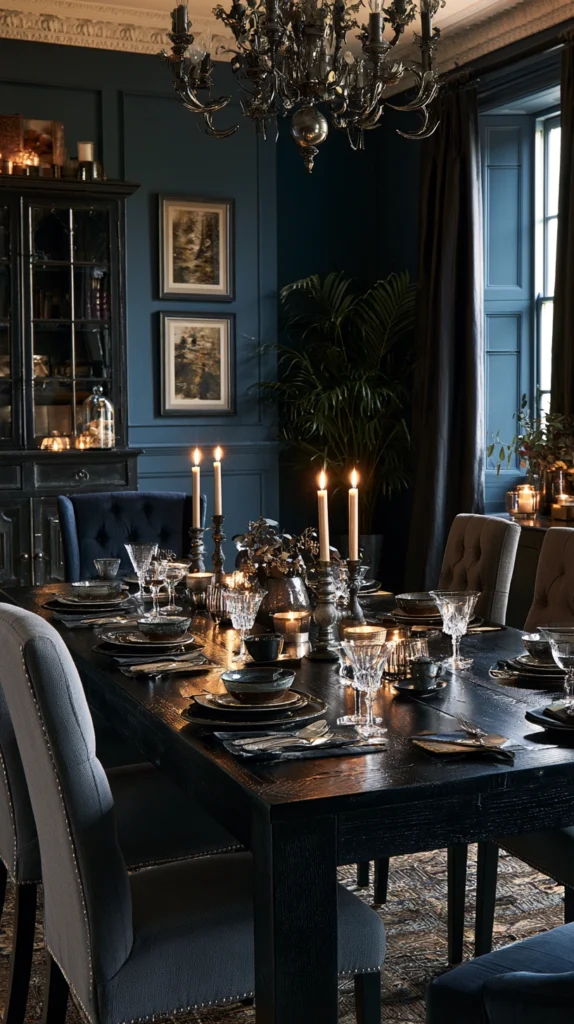
The dining table is the room’s most important piece of furniture and in a black dining room it has the opportunity to be beautiful in a way that a pale table in a pale room rarely achieves.
A black-painted dining table, whether an antique table refinished in gloss or matte black, a quality reproduction in lacquered black, or a contemporary table in black powder-coated metal and glass, is a piece of furniture with genuine presence and authority.
The surface of a black table by candlelight is one of the most beautiful table surfaces available. The reflections of the candles in the polished or semi-matte black surface, the way the food and the glassware are defined against the dark ground, the drama of a white cloth or pale linen napkins against the dark table. None of this is available on a pale table in a pale room.
The table should be sized for the room generously. A table that fills the room from four seats of clearance on each side creates a sense of abundance and purpose. A table too small for the room looks provisional.
The chair choice against a black table is a significant design decision. White upholstered chairs against a black table create maximum contrast and the most formal quality. Natural wood chairs against a black table create warmth and a more relaxed quality. Black chairs against a black table, upholstered in a contrasting fabric, create the most dramatic unity.
3. Dramatic Pendant Lighting Above the Table
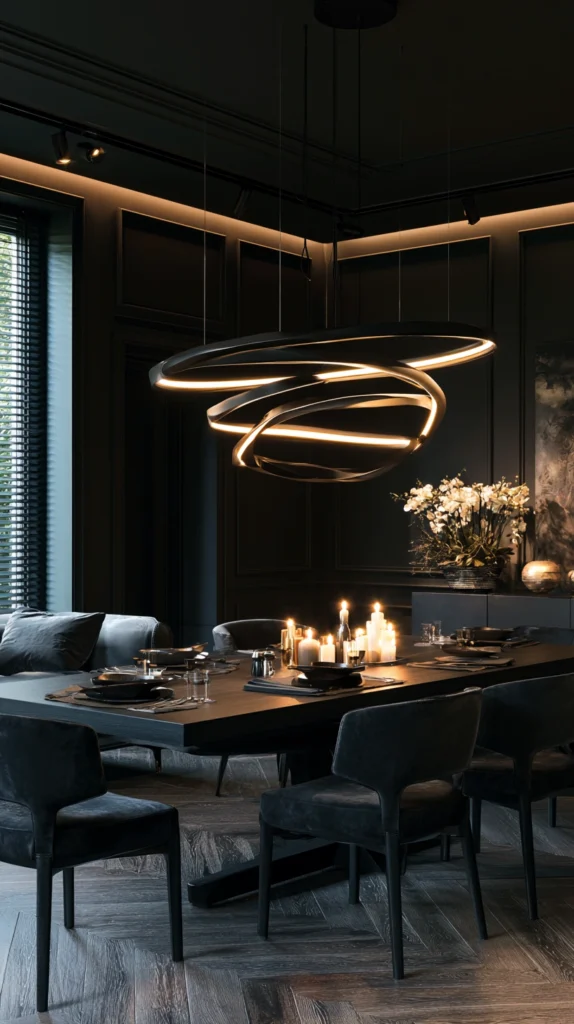
The pendant above the dining table is the room’s theatrical lighting moment.
Not the overall room lighting, which should be warm and low and supplemented by candles and table-level sources. The pendant is the lighting that defines the table as a stage, that creates the pool of warm light within which the meal and the gathering happen.
The black dining room requires a pendant that is confident enough to read against the dark walls and ceiling. A delicate fitting that might look beautiful in a pale room disappears into the darkness of a black one. The pendant must have presence.
An oversized industrial pendant in black steel with a large glass shade. A cluster of amber glass pendants at different heights. A rattan or woven pendant of significant diameter that creates a warm, diffuse glow. A sculptural pendant in blackened steel or aged brass that is beautiful as an object before it is switched on.
The height of the pendant above the table is critical. The conventional guidance is eighty to ninety centimetres above the table surface. This is low enough for the light to feel intimate and directed toward the table rather than toward the room generally. It is high enough that the pendant does not interfere with sightlines across the table.
Install the pendant on a dimmer without exception. A pendant that can only be operated at full brightness is a pendant that flattens the atmosphere of the room at exactly the moment the room should be at its best. At full brightness the pendant is functional. At thirty percent on a dimmer it is beautiful.
4. Candlelight as Primary Evening Illumination
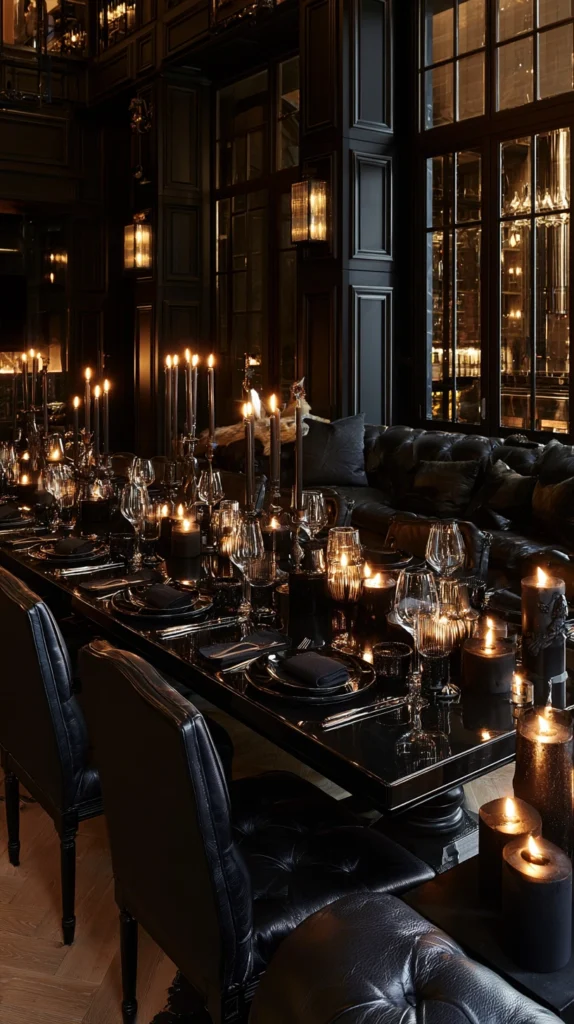
In a black dining room, candlelight is not supplementary to the room’s lighting. It is the primary illumination of the meal.
This is possible because the dark walls and dark surfaces of the black dining room absorb ambient light and make candles, which would be barely visible in a pale room, into the room’s defining light sources. The candle on a black table in a dark room is a point of genuine warmth and beauty. There is nothing casual or incidental about it.
Multiple candles at different heights on the table. Taper candles in tall candlesticks of different materials, iron, brass, silver, that suit the room’s overall character. Pillar candles in heavy holders that can burn for the full duration of a long evening dinner. Tea lights in small glass holders scattered among the table setting.
The quantity of candles should be generous rather than modest. A single pair of candles in matching candlesticks is the functional minimum. A table lit by eight or ten candles at different heights creates the full effect of a candlelit dining room and that effect is one of the most beautiful domestic lighting situations available.
The candles on the sideboard or the console table, the candles in the fireplace if the room has one, extend the warm candlelight beyond the immediate table and make the whole room glow rather than just the table surface.
Real candles only. LED candles in a black dining room look exactly like what they are and the effect is wrong. The flickering of real flame against dark walls creates movement and life that static LED light cannot replicate at any quality level.
5. A Statement Artwork on the Dark Wall
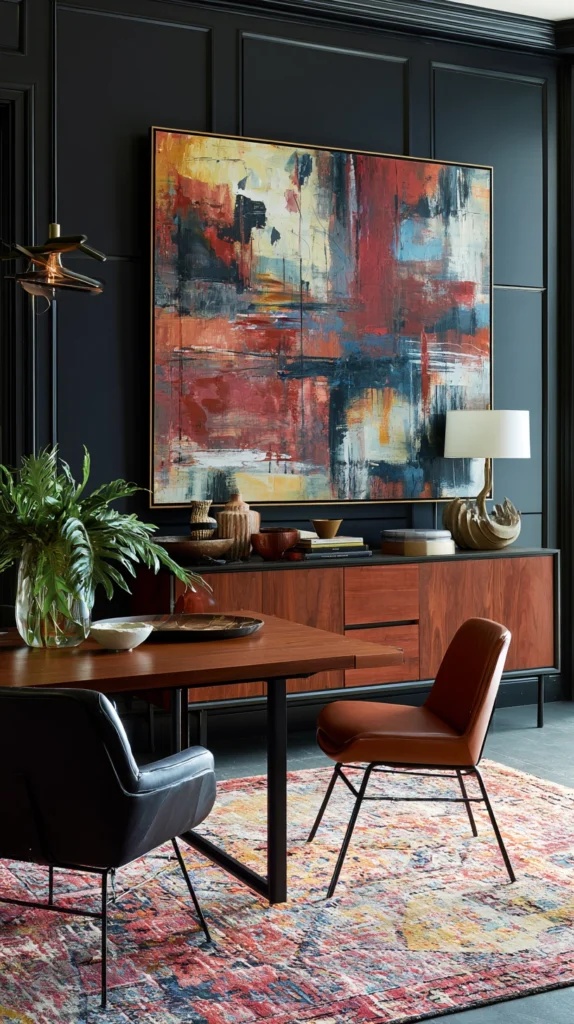
The black dining room wall is one of the best locations for significant art in any home.
The dark background makes colours in artwork vivid and present in a way that pale walls do not. A landscape with warm golds and deep greens against black walls is a different painting from the same landscape against white walls. The dark surround creates a frame effect that focuses attention on the art rather than distributing it across the room.
Choose art with confidence. The black dining room wall can carry a large, significant piece without the piece looking out of place or excessive. In a pale room the same piece might dominate the room uncomfortably. Against a dark wall it finds its correct context.
The art does not need to be dark in tone. A painting with rich, warm colours reads magnificently against black. So does a pale, luminous piece that has a glow quality in its surface. Both are enhanced by the dark surround.
A single large piece above the sideboard or on the wall facing the door creates the focal point that greets everyone who enters the room. Multiple pieces in a considered arrangement along the wall opposite the windows creates a gallery quality that suits a dining room with longer wall sections.
6. Black Velvet Curtains That Frame the Room
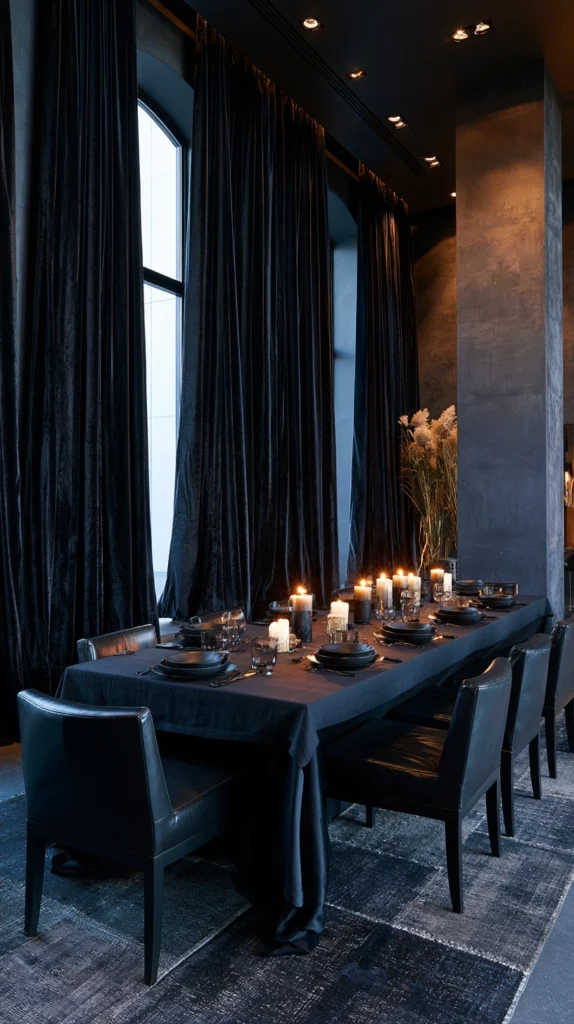
The curtains in a black dining room complete the envelope of the space in the evening hours.
Heavy, floor-to-ceiling curtains in black velvet drawn at dusk create a room that is entirely sealed from the exterior. The view through the windows, which might be a garden, a street, or a neighbouring building, is replaced by the dark velvet surface that reads as a continuous element of the room’s dark walls.
Velvet specifically is right for the black dining room for the same reasons it is right for a theatre. Its pile absorbs light and creates a surface of deep, velvety darkness rather than the reflective darkness of lacquer or glass. It moves when air moves in the room, which adds a quality of organic life to the room’s surfaces that hard materials cannot provide.
The curtains should be generously proportioned. Floor-to-ceiling height with additional length that pools slightly on the floor creates the theatrical generosity that the black dining room’s character requires. A curtain that ends at the sill or that hangs at standard window height looks undersized in a room of this ambition.
The lining of the curtain matters practically as well as aesthetically. A full blackout lining prevents any light penetration from the exterior in the evening and provides significant insulation that makes the room more comfortable in winter.
Curtains in a deep, warm colour rather than black, deep burgundy, forest green, or midnight navy, create contrast with the black walls while maintaining the dark palette. These coloured curtain alternatives add a jewel-box richness to the room that all-black curtains cannot.
7. A Mirror That Doubles the Candlelight
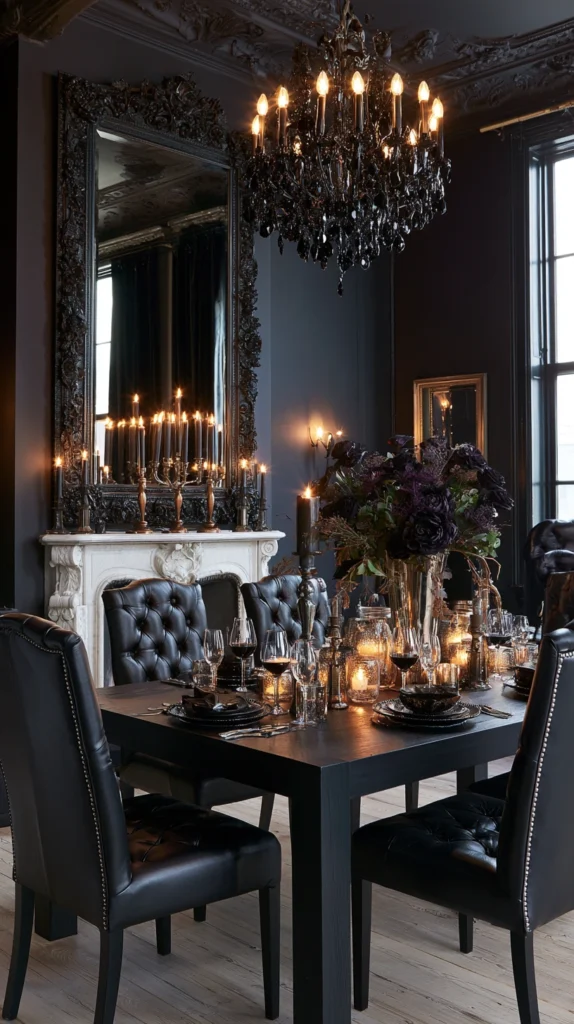
The strategic use of a large mirror in a black dining room is the most intelligent single addition to the room’s evening atmosphere.
A large mirror on the wall opposite the dining table, or on the wall adjacent to the main window, reflects the candlelight from the table and doubles the number of visible warm light points in the room. The mirror also reflects the table setting, the food, the people, the candles, creating a second version of the table that exists in the reflected space beyond the mirror’s surface.
The frame of the mirror should be as interesting as the mirror itself. In a black room, a very large frame in aged gold creates a warm contrast that reads as art as much as function. A black frame on a black wall creates a seamless integration where the mirror reads as a void in the wall rather than an object on it. A weathered timber frame with visible natural grain creates warmth against the dark wall.
An antique mirror with a slightly foxed or tarnished glass surface reflects light in a diffuse, atmospheric way rather than the sharp precision of a modern mirror. The slightly imperfect reflection of an antique mirror is specifically more beautiful in a dining room context than perfect modern mirror glass.
Position the mirror to reflect the most beautiful elements of the room. The table with its candles and its setting. The pendant above the table. The art on the opposite wall. A mirror positioned to reflect a blank wall or an unattractive view adds nothing. A mirror positioned to reflect the room’s best elements multiplies them.
8. Dark Wood Panelling for Warmth and Texture
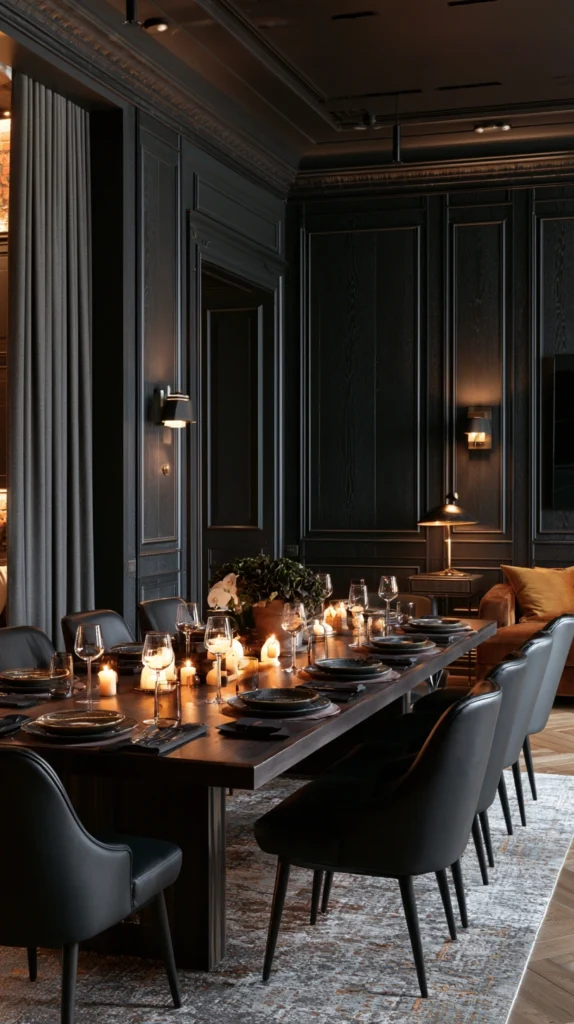
The black dining room that uses dark wood panelling, rather than or in addition to painted dark walls, adds a material warmth and textural richness that paint alone cannot provide.
Tongue-and-groove panelling in a dark stained timber below the dado rail, with painted dark walls above, creates a room of layered material quality. The wood of the lower section and the paint of the upper section are both dark in tone but different in surface and character. The combination adds depth to the room’s dark palette.
Full-height panelling in dark stained timber, ebonised oak or dark walnut, creates the richest possible material expression of the black dining room. The grain of the wood is visible within the darkness, creating a surface that changes as light moves across it in a way that painted walls do not.
Tongue-and-groove panelling, flat-set panelling with visible joins, or raised and fielded panel mouldings all create different visual characters within the same material and tonal approach. The raised and fielded panel has the most traditional quality and suits period rooms. Flat-set panelling has a more contemporary quality.
The ceiling above dark wood panelled walls should be pale. The contrast between the warm dark wood below and the pale ceiling above creates a sense of vertical space that both elements alone would not provide.
9. A Built-In Drinks Cabinet or Sideboard
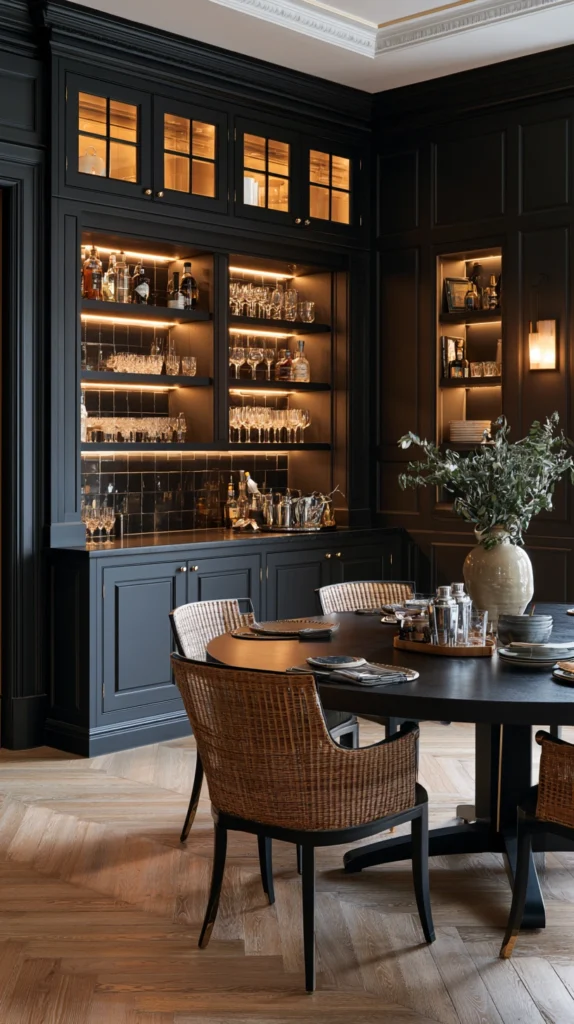
The black dining room at its most complete is the room that contains everything the evening requires.
A built-in drinks cabinet or a substantial sideboard is the dining room element that turns a beautiful room into a self-contained evening destination. The wine is here. The glasses are here. The decanters, the cocktail equipment, the spirits and the mixers. Everything needed for the full arc of a dinner party, from the arrival drinks to the digestif that concludes it, is in the room.
Built-in cabinetry in the same dark tone as the walls, with interior lighting that reveals the glassware and the bottles within when the doors are open, is the most seamless and the most visually spectacular version. The doors closed give the room a clean, architectural quality. The doors open reveal the warm interior of the cabinet with its lit arrangement of bottles and glasses.
A freestanding sideboard in a dark finish, ebonised wood, painted black, or in a dark lacquered surface, provides a surface for the serving of courses during the meal and storage for the tableware and the drinks below.
The sideboard provides the secondary flat surface that the dining room needs during a meal. The serving dishes that are not yet on the table. The bottle of wine not yet opened. The dessert that is waiting. These items on the sideboard, lit by a pair of warm table lamps or a pair of candles at either end of the sideboard, extend the warmth of the table’s lighting to the full room.
10. Upholstered Dining Chairs That Invite Lingering
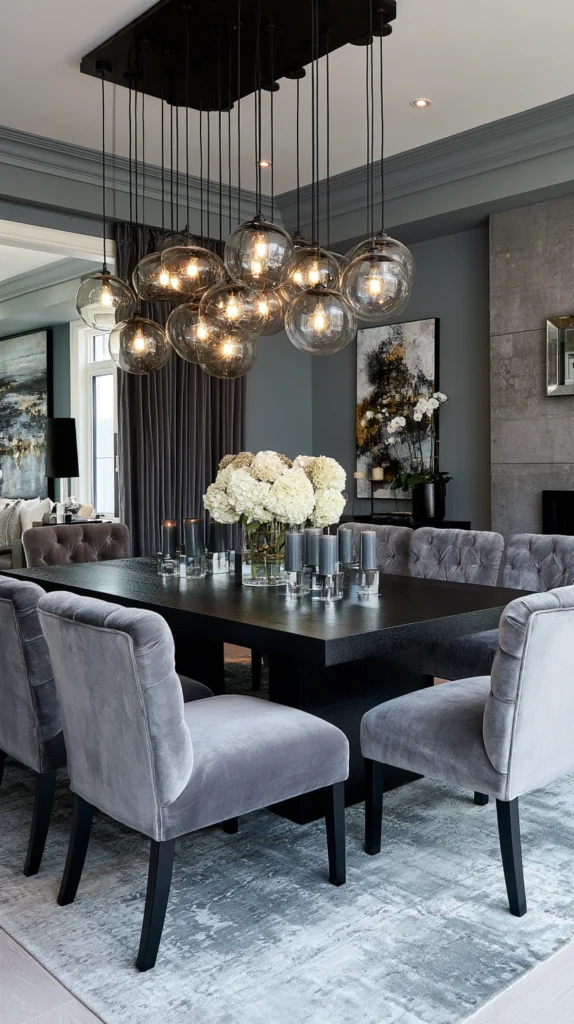
The black dining room is the room for long evenings.
Long evenings require comfortable seating that does not encourage departure after the dessert. The dining chair that is comfortable for two hours is the dining chair that makes a three-hour dinner possible.
Upholstered dining chairs in the black dining room serve both the comfort requirement and the room’s aesthetic simultaneously. A heavily upholstered dining chair in a warm velvet, a deep linen weave, or a soft bouclé provides the back and seat cushioning that makes extended sitting comfortable while adding the material warmth and texture that the dark room benefits from.
The colour of the upholstery determines the character of the room. Black velvet upholstery on dark chairs against dark walls creates total immersion in the dark palette. Cream or oatmeal linen upholstery on dark chairs creates a strong contrast that is warm and classic. Deep burgundy, forest green, or midnight blue velvet upholstery adds a jewel tone to the dark room that creates the most richly coloured version of the black dining room.
The chair arms are the detail that most determines long-term comfort. A dining chair with arms allows the sitter to rest their arms during the intervals between courses, which makes several hours at the table genuinely comfortable rather than increasingly strained.
11. A Fireplace as the Room’s Secondary Focus
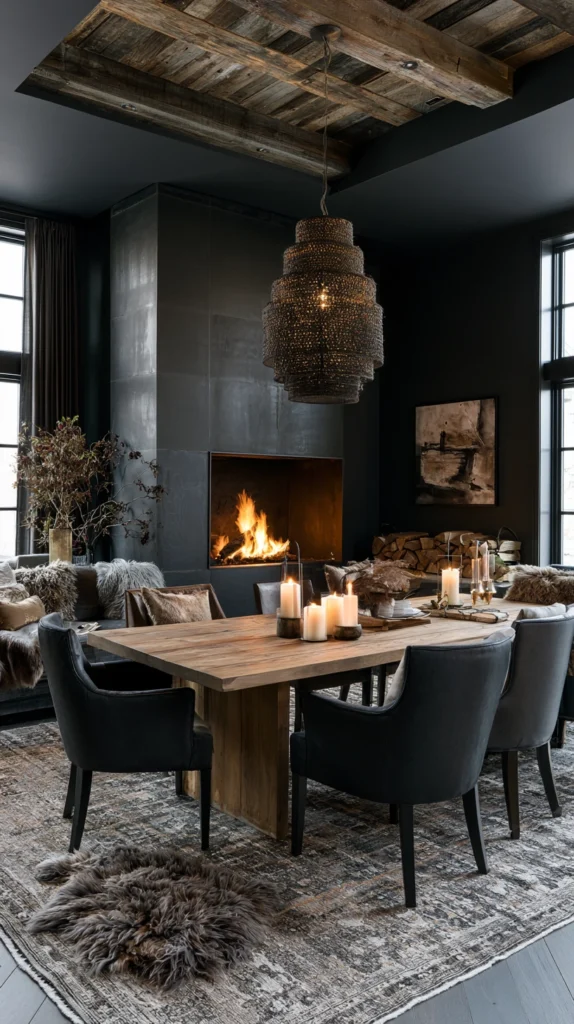
The dining room with a fireplace is the dining room with an additional source of warmth and light that makes winter entertaining specifically beautiful.
A lit fire in a dining room fireplace in December or January changes the character of the evening more dramatically than any other addition. The warmth, the sound, and the light of the fire add an element that no lamp or candle can replicate. The room is warmer in every sense. The gathering is more gathered.
The black dining room with a fireplace is one of the most perfect rooms available in any home for winter entertaining. The dark walls and the fire create an enveloping warmth and intimacy that is the dining room version of the feeling that makes people describe certain rooms as “cosy” despite their grandeur.
Position the dining table in relation to the fireplace thoughtfully. In a room where the fireplace is on one of the long walls, the table should be parallel to the fireplace so that the maximum number of seats have a view of the fire. In a room where the fireplace is on a short wall, the table should face it so that everyone seated has the fire in their field of view.
Even an unlit fireplace in summer adds to the character of a black dining room. The dark firebox within the architectural frame of the mantle is a strong compositional element. Fill it with candles for the summer months, when the fireplace is not functional, to maintain its role as the room’s secondary light source.
12. A Dark Rug That Anchors the Table
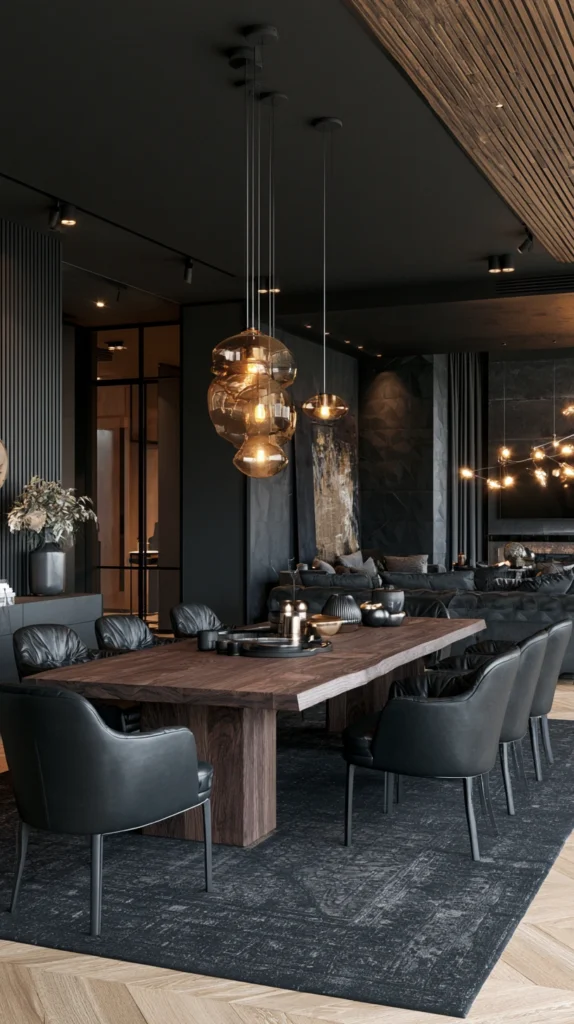
The dining room rug performs a specific function that is as practical as it is aesthetic.
It defines the dining zone within the room. It protects the floor beneath and around the table from the chair movement and the occasional dropped item that every meal generates. And it adds warmth, texture, and visual weight to the floor level of a room that is otherwise operating primarily at eye level with its dark walls and its candlelit table.
In a black dining room the rug should be dark. Not necessarily black, though a very deep navy or charcoal reads as effectively as pure black at floor level, but dark enough to maintain the room’s tonal commitment at the floor level rather than introducing a pale or bright element that breaks the envelope.
A deep patterned rug in jewel tones, the complex patterns of an antique Persian or Turkish rug in deep reds, blues, and ochres on a dark ground, adds colour to the room’s dark palette in a historical and richly textured form that suits the black dining room’s character precisely.
The rug must be large enough for the dining table and all chairs to sit within it even when the chairs are pulled back. This is the most consistently violated rug sizing principle in dining rooms. A rug that the chair legs fall off when pushed back for rising from the table is a rug that is too small.
13. Table Settings That Are Worthy of the Room
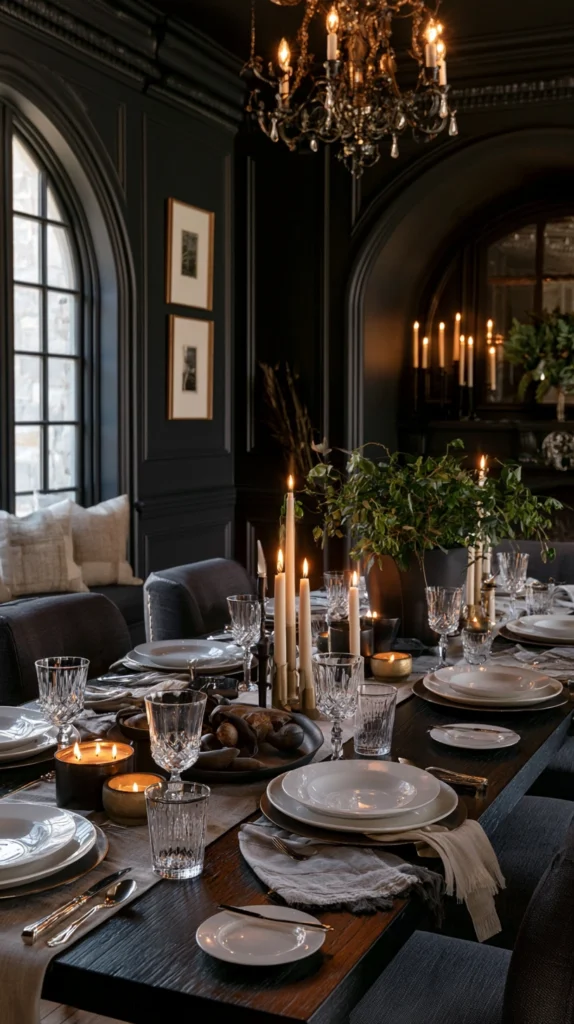
The black dining room sets a high standard for every element within it.
The table setting at a meal in a black dining room should meet that standard. The room communicates that this gathering matters. The table setting should confirm it.
White or cream china on the black table surface creates the maximum contrast that makes the setting as defined as the room. A single dark plate with a white border reads as designed and confident. Simple, good-quality glassware in clear crystal or warm amber catches the candlelight. Natural linen napkins, properly starched if the occasion warrants, or left loose and warm if it does not.
A single bloom per place setting, a ranunculus or a rose from the garden, placed at each setting rather than in a central arrangement, makes each seat a specific and considered position. The detail that says each person was expected and each seat was set for someone specific.
The centrepiece in a black dining room should be simple and dark. Branches of deep green foliage. A cluster of dark-coloured flowers, aubergine dahlias, deep burgundy roses, midnight blue delphiniums. Candles of black or deep burgundy wax. The centrepiece that competes with the room in its paleness or its brightness works against the room’s atmosphere.
14. The Black Dining Room by Season
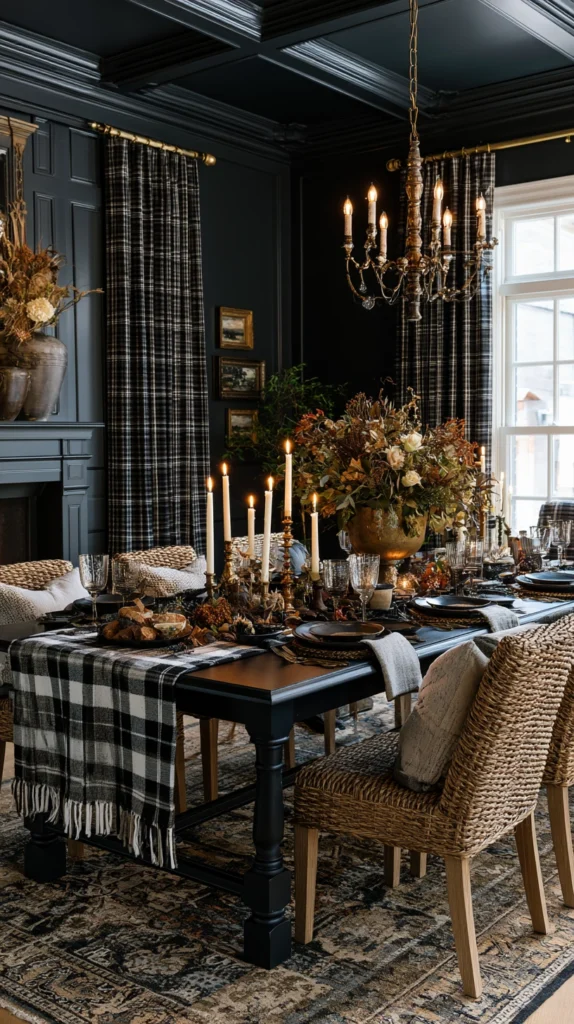
The black dining room changes with the seasons in a way that pale rooms do not.
In winter it is warmest and most complete. The firelight, the early darkness outside, the candles at their most necessary and their most beautiful, the heavy curtains drawn. The black dining room in December is the dining room at its absolute best.
In spring it lightens. The curtains left open to the longer evenings. Fresh flowers from the garden in pale tones against the dark walls. A bowl of pale eggs at Easter. The black room receives spring warmth differently from a pale room. The contrast between the dark interior and the new light outside is specifically beautiful.
In summer it accommodates the warmth with open windows and lighter table settings. White linen napkins. Clear glassware. Garden flowers in abundance against the dark walls. The black room in summer is not the room of deep winter intimacy but it is the room that makes white flowers more vivid and summer abundance more spectacularly visible than any pale room can.
In autumn it deepens again. The darkening evenings return the room to its most natural element. The candles return to being essential. The curtains close earlier. The richness of the room reasserts itself as the colour of the season outside, the deep reds and golds of autumn, enters the room in the flowers and the table setting.
The black dining room is a room for all seasons because the dark palette does not struggle with any seasonal change. It responds to each one differently and beautifully.
How to Commit to a Black Dining Room
The black dining room is not a gradual process.
The dining room that is half committed to the dark, one black wall, some dark accessories, a dark rug, without the full palette of dark walls and dark curtains and dark furniture, is not the black dining room. It is a pale dining room with dark elements. The effect is categorically different.
Commit fully or design differently. The black dining room works because of the totality of the dark environment. Every element of the colour decision reinforces every other. Candles look spectacular because every surface around them is dark. The table setting stands out because the floor and the walls recede. The art on the wall glows because it has the darkest possible background.
Partial commitment produces none of these effects. It produces a room that looks like someone started a bold project and lost confidence midway.
Choose the right black. A black with warm undertones, green, brown, or navy, rather than a pure cold black, creates a room that reads as warm and enveloping rather than cold and industrial.
And once the room is dark, maintain it. Touch up the paint regularly. The matte dark paint that gives the black dining room its warmth shows scuffs and marks more readily than pale paint. The room requires maintenance to look its best.
Common Mistakes in Black Dining Room Design
Using overhead lighting as the primary light source. A ceiling light at full brightness in a black dining room makes the room look like a theatre dressing room rather than a dining room. Overhead lighting in a black dining room should be on a dimmer and supplemented by the pendant above the table, the candles on the table, and the lamps on the sideboard.
Choosing a table that is too small. The formality of the black dining room requires a table of commensurate scale. A small table in a large dark room looks provisional.
Not using enough candles. One or two candles in a black dining room are insufficient. The dark room absorbs more light than a pale room. More candles are needed to create the same level of illumination.
Bright or pale centrepieces that fight the room. A very bright, pale flower arrangement in a black dining room competes with the room rather than complementing it. The centrepiece should work with the dark palette.
Cool white light from any source. Cool white lighting in a dark room creates an unwelcoming, clinical atmosphere. Every light source in the black dining room must be warm. 2700K maximum. Warmer is better.
Failing to maintain the paint. Dark matte paint shows marks. The black dining room that is not regularly maintained loses its quality rapidly.
Under-investing in the chairs. In a room of this intention, uncomfortable chairs are a significant design failure. The chairs must be beautiful and comfortable. They cannot be one without the other in a room designed for long evenings.
Quick Summary
- Black walls with white or cream architectural mouldings and cornicing is the most historically resonant dining room treatment
- A black-painted table reflects candlelight in a way that pale tables cannot and creates a stage for the meal
- An oversized pendant on a dimmer above the table is the theatrical lighting element that defines the dining space within the dark room
- Real candles at multiple heights on the table are the primary evening light in a black dining room and require generous quantity
- Large artwork is enhanced by dark walls which make colours vivid and create a natural frame effect
- Black velvet curtains drawn at dusk complete the room’s envelope and add material warmth that hard dark surfaces cannot
- A large mirror positioned to reflect the candlelit table doubles the warm light and multiplies the beauty of the setting
- Dark wood panelling adds material warmth and textural richness that paint alone cannot provide
- A built-in drinks cabinet or substantial sideboard makes the black dining room a self-contained evening destination
- Generously upholstered dining chairs with arms create the comfort that long evenings at the table require
- A fireplace in a black dining room is the most transformative element for winter entertaining
- A dark rug, sized to contain all chair legs even when pushed back, anchors the table and adds pattern and texture at floor level
- Table settings in white china and natural linen with dark floral centrepieces complement rather than compete with the room’s palette
- The black dining room responds beautifully to every season, at its most complete in winter and still beautiful in summer
- Commit fully to the dark or design differently because partial commitment achieves none of the effects of total commitment
- Every light source must be warm, the matte paint must be maintained, and the candles must be real and plentiful
The black dining room is the most considered and most rewarding dining room decision available.
Not the safest. Not the easiest to explain to someone who has not seen it done well.
But the room that produces the evenings people remember. The dinners where everyone stayed later than they meant to. The table that made the food taste better and the conversation feel more important.
The room that earns it.
Build it properly and the evenings justify it every time the candles are lit.