
15 Bedroom Feng Shui Layout Ideas for Better Energy
Creating a harmonious bedroom environment goes beyond aesthetic appeal. According to the ancient Chinese practice of feng shui, the arrangement and design of your sleeping space can significantly influence the quality of your rest, relationships, and overall well-being.
By implementing thoughtful feng shui principles, you can transform your bedroom into a sanctuary that promotes positive energy flow, restful sleep, and personal rejuvenation.
Feng shui, which literally translates to “wind and water,” is based on the concept of chi — the life force energy that flows through all living things and spaces. When chi flows smoothly and abundantly through your bedroom, it creates an environment conducive to rest, romance, and renewal.

Conversely, blocked or stagnant energy can lead to restless sleep, relationship discord, and feelings of unease.
The bedroom holds particular significance in feng shui practice because it’s where we spend approximately one-third of our lives in a vulnerable, unconscious state. During sleep, we’re most receptive to the energies surrounding us, making the bedroom layout and design critically important for our physical and emotional health.
Here are fifteen essential feng shui layout ideas to optimize the energy in your bedroom and create a space that truly supports your well-being.
1. Position Your Bed in the Commanding Position
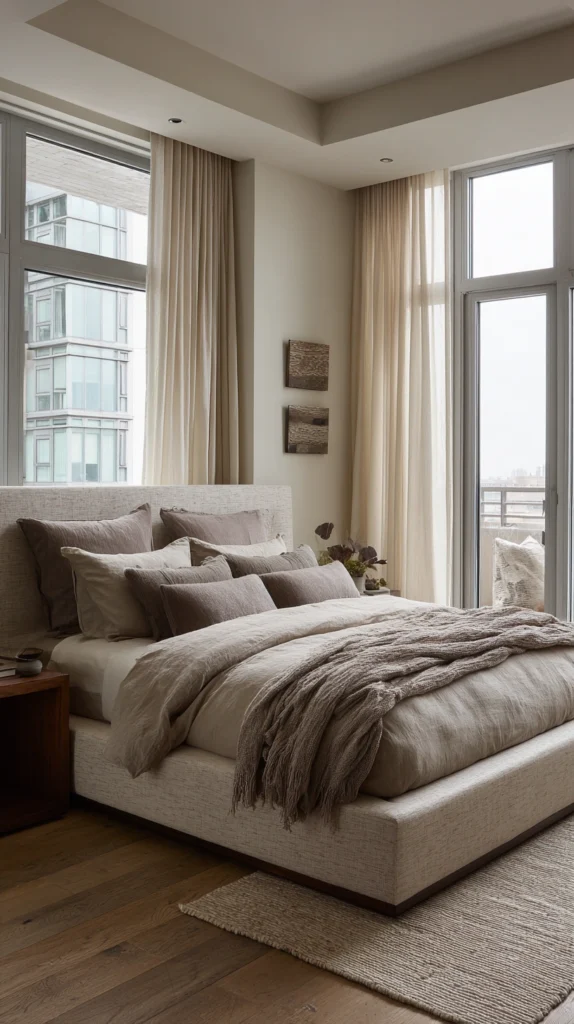
The commanding position is perhaps the most fundamental principle in bedroom feng shui. Your bed should be positioned diagonally from the door, allowing you to see the entrance while lying down, but not be directly in line with it.
The foot of the bed pointing directly at the door is called the “coffin position” in feng shui and is considered one of the most disruptive placements for rest. This diagonal placement creates a sense of security and control, as you can observe who enters your space without being in the direct path of energy rushing through the doorway.
The headboard must rest against a solid wall — not a window, not a shared wall with a bathroom, not a wall with a door in it. Both sides of the bed should be accessible with matching nightstands on each side; a bed pushed against one wall creates energetic imbalance that is particularly significant in shared bedrooms.
In small rooms where achieving the full command position is difficult, even a partial compliance — positioning the bed so the head can turn toward the entrance without the feet pointing directly at the door — delivers meaningful improvement over a fully misaligned placement.
2. Ensure Solid Support with a Headboard
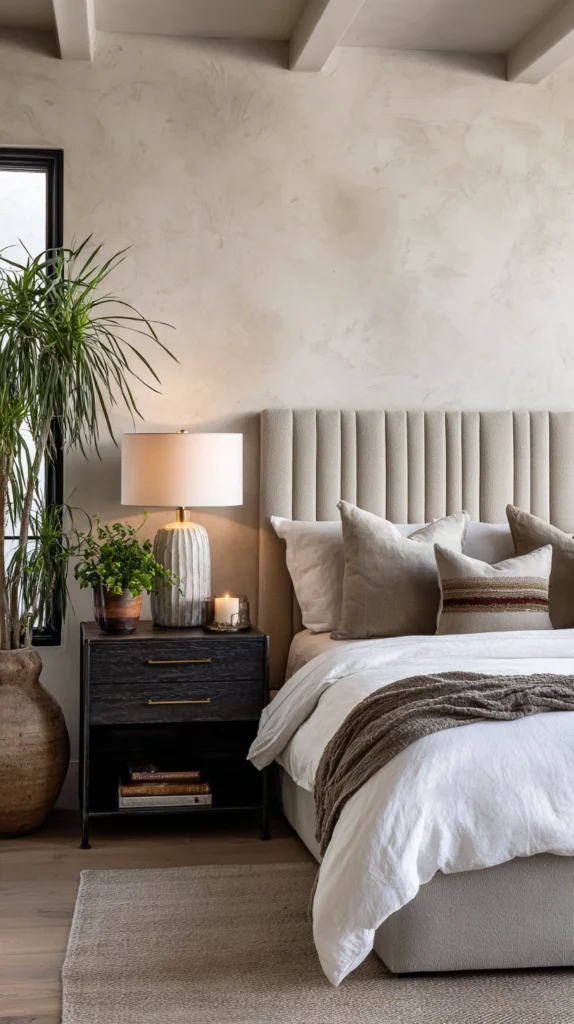
A sturdy, solid headboard represents stability and support in your life, particularly in your career and relationships. Choose headboards made from solid materials like wood or upholstered fabric rather than metal bars or open slats — slatted headboards allow energy to pass through without the sense of backing and support that a solid surface provides.
A headboard that reaches at least 24 inches above the mattress top — approximately 48–54 inches from the floor for a bed on a standard frame — provides adequate visual and energetic backing.
The headboard should be firmly attached to the bed frame and positioned flush against the wall, creating a sense of backing and protection while you sleep.
Avoid headboards with shelving or storage compartments directly above your head, as these create oppressive energy and subconscious unease about things hanging overhead. Also avoid headboards with sharp-edged geometric cutouts or pointed shapes, which create what feng shui calls “sha chi” — cutting energy directed at the sleeper — in favor of rounded or gently curved edges that allow energy to flow smoothly around the sleeping body.
3. Create Balance with Nightstands on Both Sides
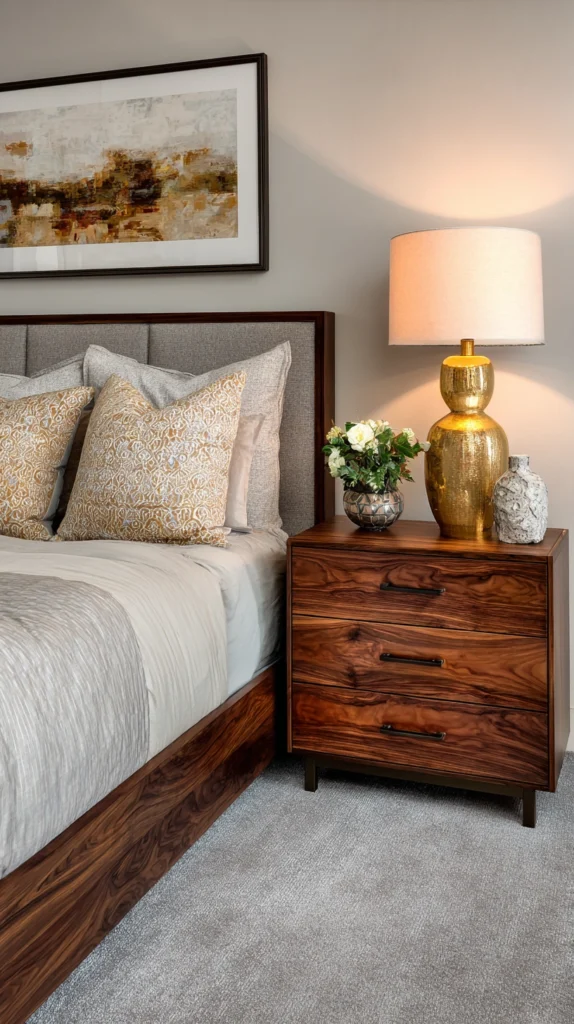
Symmetry in the bedroom promotes balance and equality, particularly important for couples. Place matching or complementary nightstands on both sides of the bed, each with its own lamp — nightstand height should sit level with or within 2 inches of the mattress top, which is both ergonomically correct and energetically balanced.
If space is tight on one side, a wall-mounted shelf as shallow as 8 inches achieves the same symmetry with a smaller footprint.
Even if you’re single, maintaining this balanced setup invites partnership energy into your life and prevents feelings of isolation or incompleteness. The nightstands should be in proportion to your bed — neither too large nor too small — and should ideally reach approximately the same height as your mattress.
Matching lamps on both nightstands complete the symmetry. They don’t need to be identical to the inch, but the same lamp in the same finish reads clearly as a deliberate pair rather than two unrelated pieces that happen to share a room.
4. Remove Electronics and Reduce EMF Exposure

Electronic devices emit electromagnetic fields that can disrupt sleep quality and interfere with the natural flow of chi. Remove televisions, computers, exercise equipment, and other technology from your bedroom wherever possible — the bedroom should be a sanctuary for rest and intimacy, not a workspace or entertainment center.
Every device that remains associates the room with alertness and activity rather than recovery and rest. If a television must stay, position it on a side wall rather than directly facing the bed, and store it in a cabinet with doors that close so the screen is out of sight during sleep.
If you must keep your phone in the bedroom, place it across the room rather than on your nightstand, and switch it to airplane mode during sleep hours.
This separation helps your mind associate the bedroom exclusively with relaxation and sleep, improving both sleep quality and relationship intimacy. Charge phones outside the bedroom where possible — a simple alarm clock placed on the nightstand replaces the phone’s alarm function and removes the temptation to check the screen during the night.
5. Clear the Space Under Your Bed

The area beneath your bed should remain clear to allow chi to circulate freely around your sleeping body. Storing items under the bed creates stagnant energy that can manifest as blocked energy in your life.
If storage is genuinely unavoidable due to space constraints, limit it strictly to soft items such as spare bedding, seasonal pillows, or out-of-season clothing in breathable cotton bags.
Never store items related to the past, broken objects, or anything that carries negative associations, as these energies will influence your subconscious mind throughout the night.
For beds with integrated drawer storage, keep the drawers organized and use them for soft items only — a drawer full of tangled cables, old paperwork, or gym equipment disrupts the energy of the space just as effectively as an open pile would.
The goal is a sleeping environment where nothing below the mattress introduces emotional or energetic weight into your rest.
6. Avoid Positioning Your Bed Under a Window
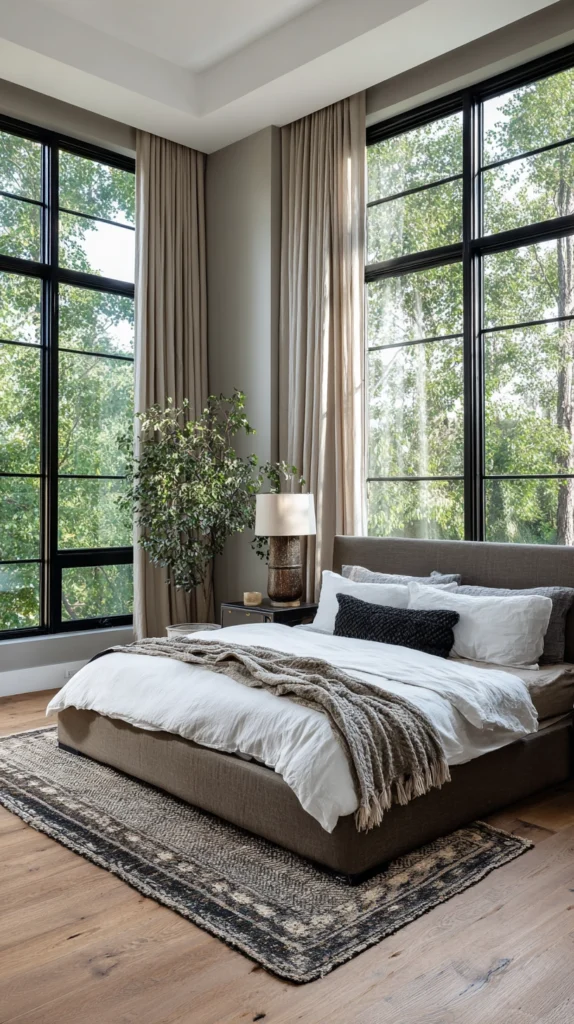
Windows represent openings where energy can escape, and sleeping directly under a window can leave you feeling unsupported and vulnerable throughout the night. The wall behind your headboard should be solid, providing stability and protection — a window behind the bed eliminates the sense of backing that is one of the most important qualities of a well-placed sleeping position.
If your only option is to place the bed under a window, install substantial window treatments that can be fully closed at night to create a sense of solidity.
Heavy curtains, Roman shades, or plantation shutters can help mitigate the unstable energy created by window placement behind the bed.
A solid, tall headboard that visually fills the window frame from the perspective of a person lying in bed also helps — if the headboard is high enough to obscure the window behind it when you are lying down, much of the vulnerability of the placement is neutralized.
Keeping the curtains fully closed every night, not just occasionally, is important for this remedy to be consistently effective.
7. Keep Mirrors Out of Direct View from Bed
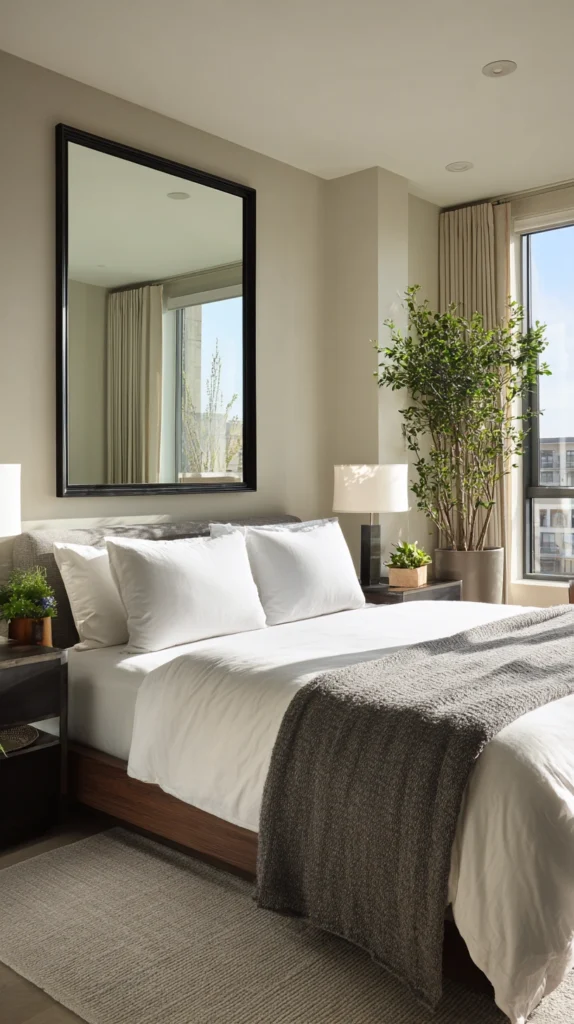
Mirrors are powerful feng shui tools that activate and redirect energy, but they can be too stimulating for the bedroom. Avoid positioning mirrors where they directly reflect the bed, as this creates restless energy, disturbs sleep, and according to feng shui tradition, invites third-party energy into relationships.
Round or oval mirrors are preferred in feng shui for their soft, uninterrupted energy — avoid mirrors with sharp or irregular cut edges, which generate cutting chi toward whoever is reflected.
If you must have a mirror in the bedroom, position it on a wall perpendicular to the bed where it reflects a window or a pleasant part of the room rather than the sleeping area.
Mirrored closet doors can be particularly problematic — consider replacing them with solid doors, or draping them with curtains during sleep hours as a practical remedy.
A mirror inside a wardrobe door that closes at night is fully neutralized, making this the most convenient placement for a bedroom mirror that needs to remain functional for dressing.
8. Choose Soothing, Balanced Colors
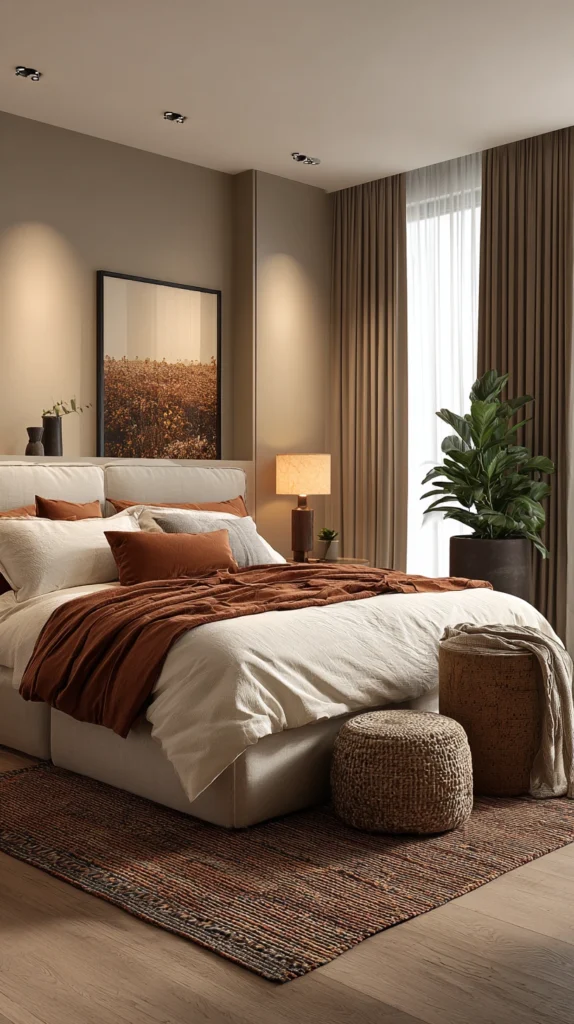
Color psychology plays a significant role in feng shui bedroom design. Opt for soft, skin-tone colors that promote relaxation and intimacy — warm beiges (Benjamin Moore Pale Oak OC-20, Farrow & Ball String), soft creams, gentle terracottas, dusty roses, and muted cocoas all create the cocooning quality that supports rest and romance.
These earth-tone and muted palettes carry yin energy, which is soft, receptive, and inward-facing — exactly the quality the bedroom needs to support genuine rest.
Avoid overly stimulating colors like bright red, intense orange, or vibrant purple in large amounts, as these carry strong yang energy that keeps the mind alert rather than settled.
Cool blues and greens should also be used sparingly, as they can create too much yin energy in their saturated forms, potentially leading to feelings of sadness or emotional flatness.
If you love these colors, incorporate them through artwork or accessories in muted, dusty versions — a sage green throw, a dusty blue cushion, a soft grey-blue accent wall — rather than saturated wall colors or dominant bedding.
9. Incorporate Pairs and Symmetry for Relationship Energy
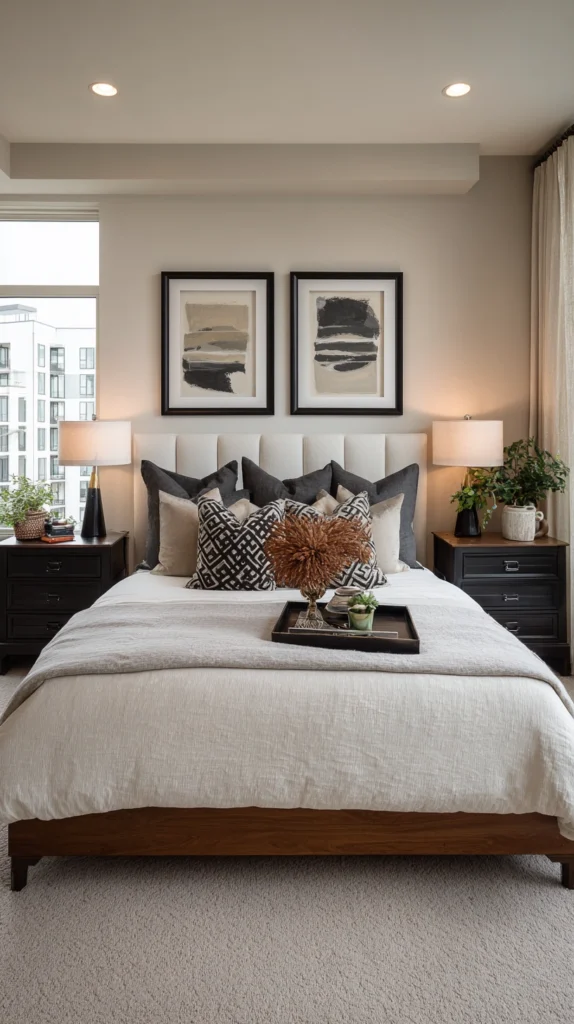
Feng shui emphasizes the importance of pairs in creating relationship harmony. Beyond the matching nightstands, incorporate pairs throughout the bedroom — two lamps, two decorative pillows, paired artwork, or matching decorative objects.
This doubling principle reinforces partnership energy and balance, and applies whether you are currently in a relationship or seeking one, as it programs the energy of the space to support connection rather than solitude.
Even imagery and artwork should reflect partnership — choose pieces depicting pairs of birds, couples, symmetrical landscapes, or balanced abstract compositions rather than solitary figures.
Family photos of parents and children are better placed in the living room; the bedroom’s relationship energy is specifically between the room’s two occupants, and family imagery introduces a different kind of connection that can dilute rather than strengthen it.
This principle of pairs extends to decorative objects on dressers and shelves — two candles rather than one, two small ceramics rather than a collection of three or five.
10. Eliminate Clutter and Maintain Organization
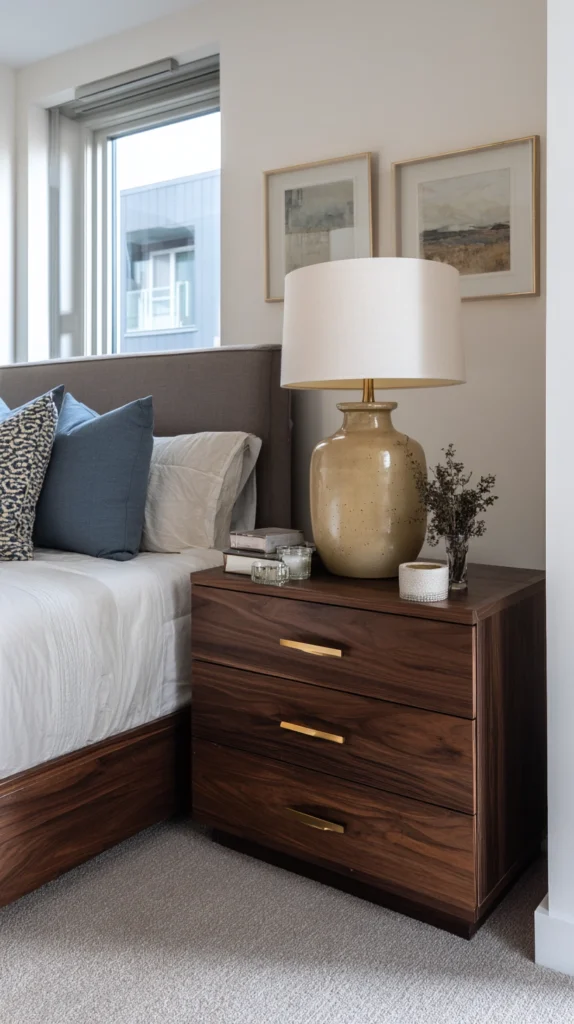
Clutter represents stagnant energy and creates chaos in both your physical space and your mind. A cluttered bedroom leads to disturbed sleep, increased stress, and blocked energy in corresponding life areas.
Keep surfaces clear, clothes put away, and belongings organized in closed storage rather than open shelving where objects accumulate and become visually noisy. The nightstand is the highest-priority surface to keep clear: it should hold only a lamp, a glass of water, a book or journal if reading at night is part of your routine, and nothing else permanently.
A small covered tray or box on the nightstand where the day’s items — watch, ring, phone — are placed and contained is a practical solution: the tray is the limit, and whatever doesn’t fit doesn’t stay on the surface.
Pay particular attention to the area around your bed, ensuring nightstands hold only essential items.
Implement the habit of tidying the bedroom before sleep each night, because the subconscious mind processes visual information even while sleeping, and a clear environment signals clearly that it is time to rest rather than to continue processing the day.
11. Avoid Exposed Beams or Sloped Ceilings Above the Bed
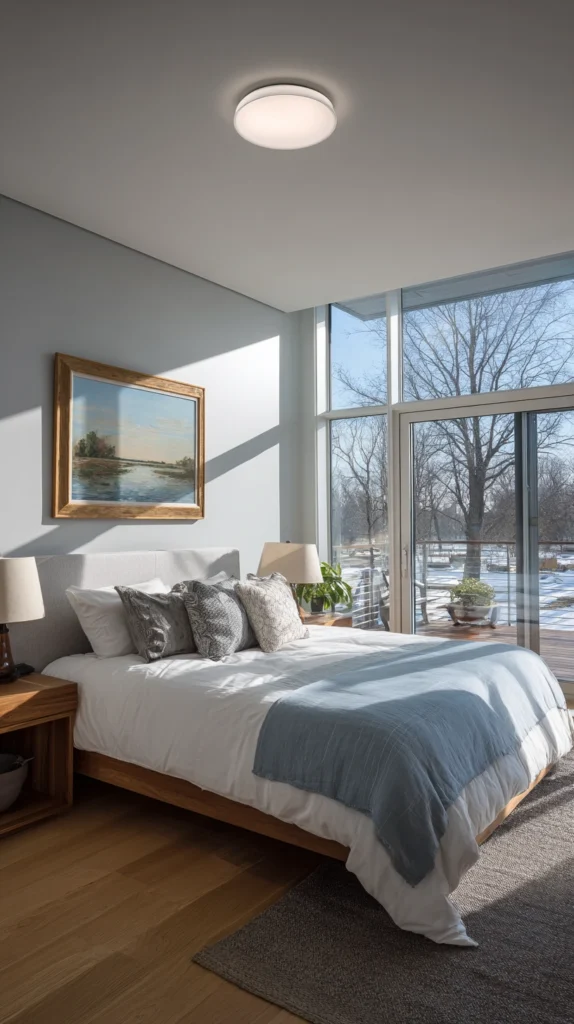
Structural elements like exposed beams, sloped ceilings, or heavy light fixtures directly above the bed create oppressive “cutting chi” that can manifest as pressure, health issues, or relationship tension in the areas of the body beneath them.
If possible, position your bed away from these architectural features — moving the bed even partially out from under a beam so only the foot of the bed lies beneath it significantly reduces the effect compared to sleeping with the beam crossing directly above the chest or head.
If relocation isn’t possible, remedies include draping fabric across the beam, painting it the same color as the ceiling to visually minimize it, or hanging two bamboo flutes at 45-degree angles on the beam to lift and redirect the energy.
Heavy chandeliers or ceiling fans should also be repositioned away from hanging directly over the bed — a ceiling fan directly above a sleeping body creates both a physical draft and a symbolic spinning energy that disrupts rather than supports rest.
Choose wall-mounted or bedside lighting over overhead fittings in the sleeping zone wherever the architecture allows.
12. Maintain Proper Distance from Walls

Your bed should have breathing room from the walls on all accessible sides, allowing chi to circulate completely around the sleeping area. Leave at least 24 inches on each accessible side of the bed — 30 inches is more comfortable for making the bed and for shared bedrooms.
Leave at least 36 inches at the foot of the bed if the door is on that wall. While the headboard should be against the wall, this solid backing is different from pushing all sides of the bed into corners.
This circulation principle applies to other bedroom furniture as well — avoid pushing all pieces flush against walls in a small bedroom. Even a few inches of space between a dresser and the wall creates a sense of flow and prevents the stagnant energy that comes from fully blocked pathways.
The goal is a sense of spaciousness and ease of movement, even in a compact room, because a bedroom that feels easy to navigate feels easier to rest in — the body’s sense of freedom of movement and its ability to genuinely relax are more closely connected than they might appear.
13. Choose Proper Bed Height and Avoid Platform Beds

The ideal bed height allows chi to flow underneath the sleeping body, which requires the bed to be raised off the floor with a proper frame and legs. Very low platform beds or mattresses placed directly on the floor restrict energy circulation and can contribute to feelings of being stuck or limited.
The optimal bed height allows you to sit on the edge with your feet flat on the floor and your knees at approximately a 90-degree angle — for most adults this means a mattress top height of 24–27 inches from the floor.
Storage beds with solid bases that block airflow beneath the mattress should be avoided where possible, as they trap stagnant energy beneath your sleeping body throughout the night.
If under-bed storage is genuinely necessary, a bed frame with legs and enclosed drawer units is preferable to a solid divan base — the legs maintain at least some airflow beneath the frame and prevent the completely sealed-off energy that a solid base creates.
The height of the bed also affects how the room feels on waking — stepping down from a well-proportioned bed height feels more grounded and settled than rolling up from floor level.
14. Incorporate Natural Elements and Living Energy
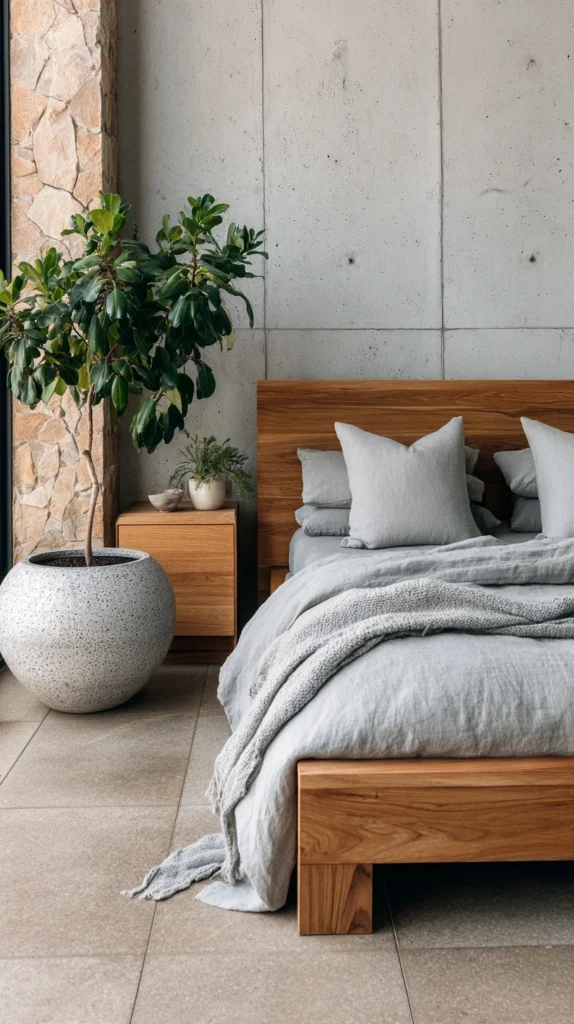
Bring nature into your bedroom through carefully selected plants, natural materials, and organic textures. Snake plants (Sansevieria) are one of the few plants that release oxygen at night rather than carbon dioxide, making them a genuinely beneficial addition to the sleep environment — position them on a high shelf or dresser rather than immediately at the bedside.
Peace lilies and pothos are also suitable for low-light bedroom conditions when kept away from the sleeping area, bringing wood element energy without introducing excessive yang activity.
Natural materials like solid timber furniture, cotton or linen bedding (look for a thread count of 200–400 for the best balance of softness and breathability), wool rugs, and stone or ceramic accessories ground the space and connect it to earth energy in ways that synthetic materials cannot replicate.
Fresh flowers introduce life force and beauty, particularly when displayed in pairs in a simple ceramic or glass vase on the dresser — avoid dried flower arrangements, which represent stagnant rather than living energy and belong outside the bedroom.
These elements together create an environment of authentic calm that supports the deep rest the bedroom is designed to provide.
15. Control and Layer Lighting for Flexibility

Lighting represents fire energy in feng shui and should be adjustable to support the different activities and energy states the bedroom needs to hold across the day. Avoid harsh overhead lighting as the primary source — a single ceiling fixture at full brightness creates flat, shadowless illumination that is energizing rather than restful and reads as institutional rather than domestic.
Install dimmer switches throughout the bedroom, or use lamps with three-way bulbs, so the room’s light level can shift meaningfully between morning energy and evening calm.
Create layers with bedside lamps, wall sconces, and perhaps accent lighting that can be dimmed in the evening — warm-toned bulbs at 2700K are the correct specification for bedroom lighting, as cool or daylight-toned bulbs above 4000K suppress melatonin production and make sleep harder to achieve.
Bright, yang lighting in the morning energizes you for the day; soft, warm lighting in the evening signals the body to prepare for rest.
This flexibility — the ability to modulate light levels to match the time of day and your current need — is one of the most practical and most impactful improvements available to any bedroom, regardless of whether feng shui is the guiding framework or simply good sleep hygiene.
Bringing It All Together
Implementing these feng shui bedroom layout principles creates a foundation for improved sleep, enhanced relationships, and greater overall well-being. Remember that feng shui is both an art and a practice — you don’t need to implement every principle perfectly or all at once.
Start with the changes that resonate most strongly with you and that address your primary concerns, whether that’s improving sleep quality, enhancing romance, or simply creating a more peaceful retreat.
The sequence that delivers the most impact first: confirm the bed is in the command position, remove any mirror that reflects the bed, clear the floor around the bed, add a solid headboard if one isn’t present, and move the phone charger out of arm’s reach. Each of these can be done in a single afternoon without cost, and the cumulative effect on how the room feels is immediate.
The most powerful aspect of feng shui is the intention you bring to your space. As you arrange and design your bedroom, do so mindfully, considering how each element supports your goals and well-being.
Your bedroom should ultimately feel like a personal sanctuary — a place where you can completely relax, rejuvenate, and connect with yourself or your partner. Trust your intuition as you apply these principles, and adjust accordingly where something doesn’t feel right despite following the guidelines. The ultimate goal is a space that supports your unique energy and lifestyle while honoring the timeless wisdom of balanced, harmonious design.