15 Privacy Hedge Landscaping Ideas
A privacy hedge is one of the most genuinely transformative and most completely valuable landscaping investments available to any garden, property, or outdoor space that requires the specific quality of natural, living enclosure that no fence, no wall, and no manufactured boundary structure can provide with the same combination of ecological richness, seasonal beauty, and the particular quality of warm, organic, living privacy that only a genuinely well-chosen and genuinely well-established hedge delivers.
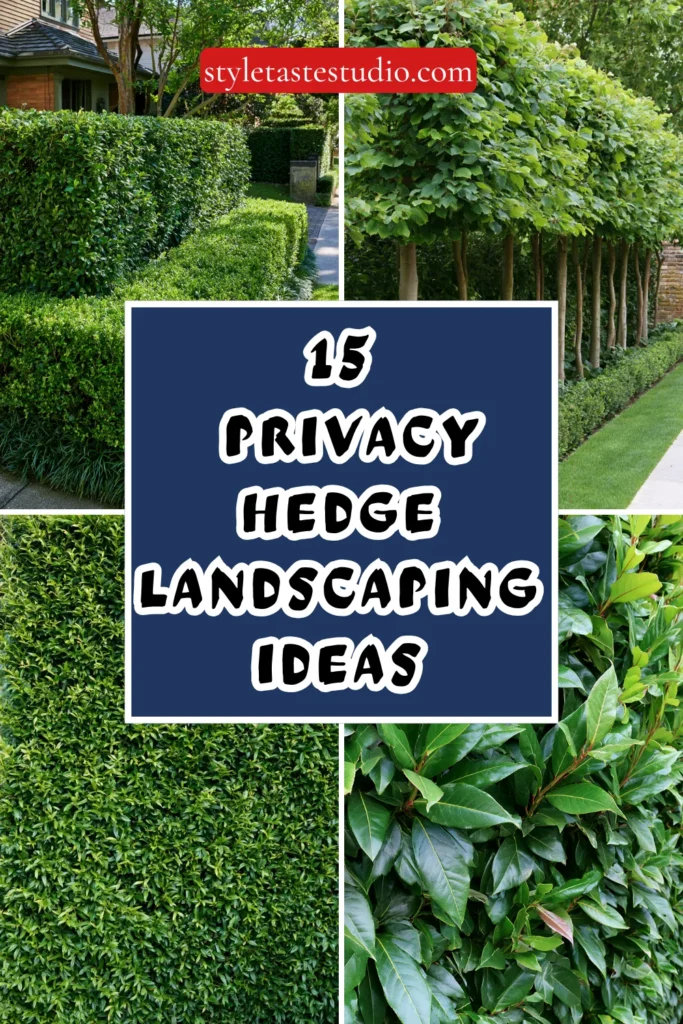
Here are 15 privacy hedge landscaping ideas that will transform every boundary in the garden into a living, growing, botanically extraordinary statement of a complete outdoor sanctuary.
1. Plant a Classic Yew Hedge for Timeless Formality
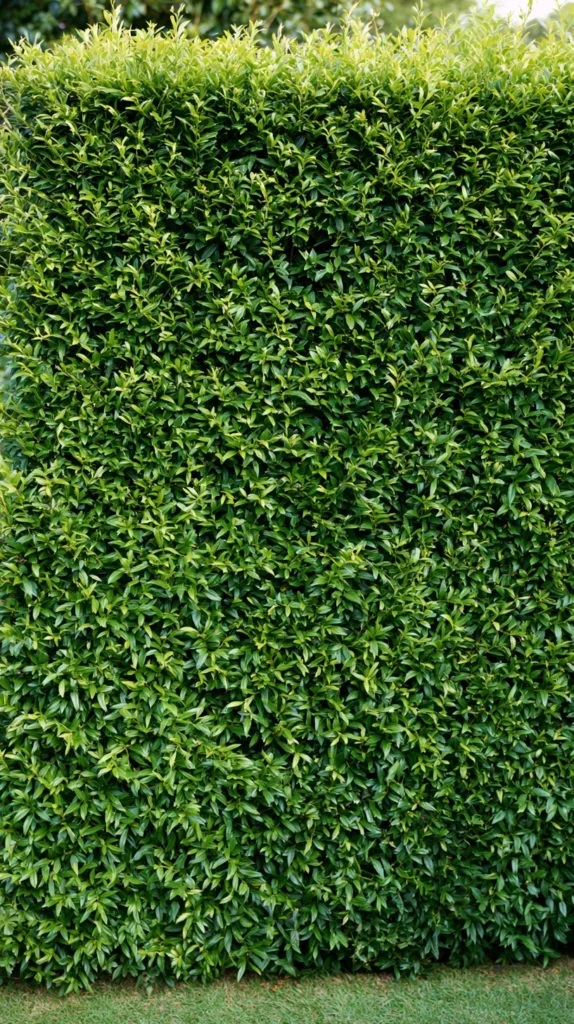
Yew — Taxus baccata — is the privacy hedge plant of most complete and most genuinely timeless formal authority in the temperate garden tradition, its dense, fine-textured, deep green evergreen foliage clipping to the most precise and the most architecturally perfect hedge forms available in any hedging species.
Yew grows considerably more quickly than its reputation for slowness suggests — establishing at a rate of thirty centimetres per year once its root system has settled into the garden soil, and reaching a substantial screening height of one and a half to two metres within five to seven years of planting from good nursery stock.
The yew hedge, once established, is virtually indestructible, tolerating renovation cutting of the most extreme severity, thriving in shade that eliminates most other hedging species from consideration, and improving in its formal precision and its visual authority with every passing decade of careful, twice-annual clipping.
2. Use Hornbeam for a Year-Round Formal Screen
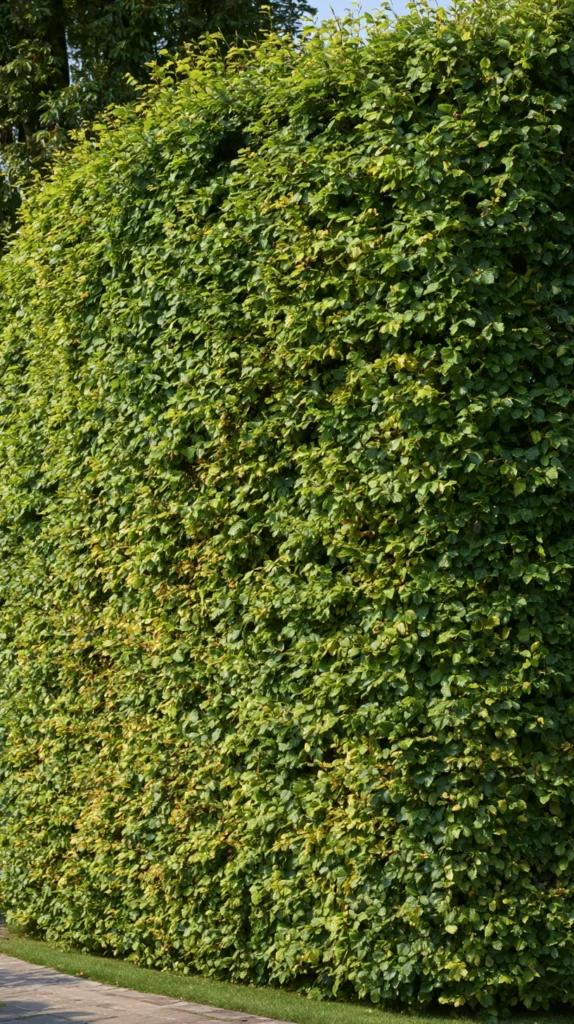
Hornbeam — Carpinus betulus — is the privacy hedge plant of most complete formal beauty and most genuinely valuable year-round screening performance for the deciduous hedging category, its specific quality of retaining its dead, russet-brown leaves throughout the autumn and winter months providing a level of year-round visual screening that most other deciduous hedging species completely fail to deliver during their leafless dormant period.
Plant hornbeam as a single or double staggered row of bare-root plants in the dormant season for the most economical and the most successful establishing hedge planting approach, at a spacing of forty to fifty centimetres between individual plants, in any soil condition, from the wettest and heaviest clay through the driest and most freely draining chalk that the garden presents.
The hornbeam hedge clips cleanly and precisely, responds to formal training with complete botanical compliance, and creates — in its mature, established form of dense, uniform, slightly ridged green summer foliage and warm, papery winter leaf retention — a garden boundary of extraordinary formal beauty and extraordinary year-round screening effectiveness.
3. Plant Photinia for Colourful Evergreen Privacy
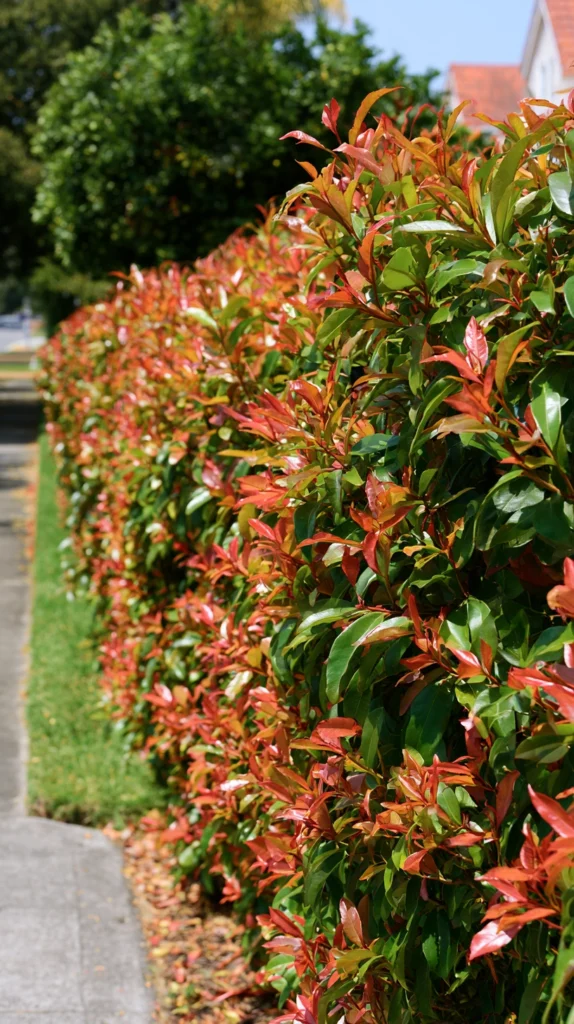
Photinia x fraseri Red Robin is the privacy hedge plant of most immediately striking and most genuinely colourful evergreen contribution — its brilliant scarlet new growth emerging with such vivid, such saturated, and such genuinely extraordinary intensity of color against the dark, glossy green of the mature foliage that a photinia hedge in active growth is one of the most ornamentally spectacular boundary plants available in any temperate garden.
Clip the photinia hedge two or three times during the growing season to stimulate the continuous production of the scarlet new growth whose specific ornamental quality is the plant’s most extraordinary decorative contribution — each clipping promoting a fresh flush of brilliant new shoots whose color intensity matches or exceeds that of the previous flush for the duration of the growing season.
The photinia hedge reaches a substantial screening height of two to three metres with considerable speed in a position of adequate sunlight and reasonable drainage, providing a privacy screen of complete effectiveness and complete year-round evergreen coverage with the additional, completely extraordinary ornamental bonus of the most vivid red coloring available in any commonly grown hedging plant.
4. Use Leylandii for Rapid Screening Results
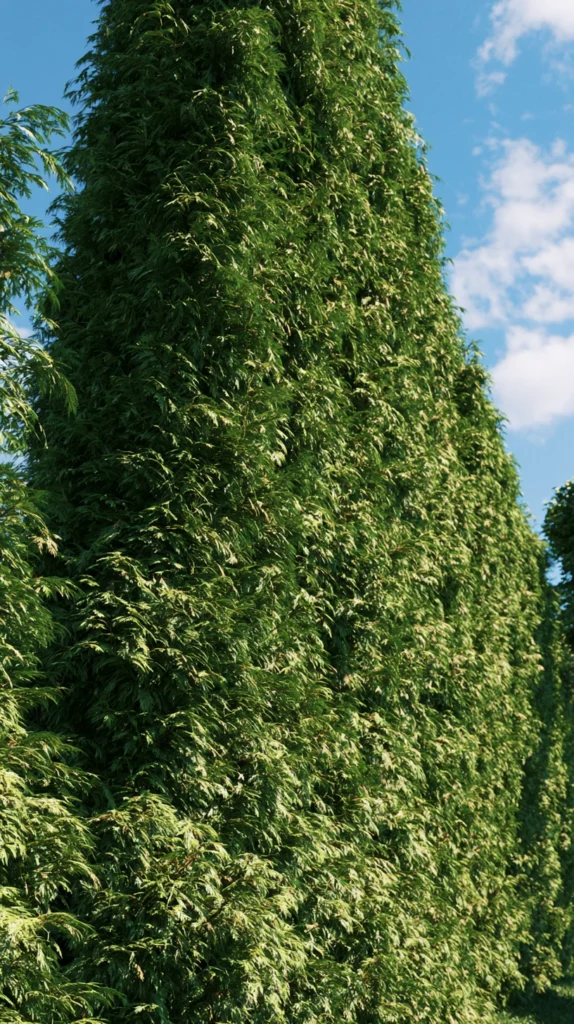
Leylandii — x Cuprocyparis leylandii — remains the privacy hedge plant of most rapid height gain and most immediately effective visual screening for the garden situation that requires the fastest possible establishment of a substantial, impenetrable evergreen barrier, regardless of the longer-term management commitment that the plant’s vigorous growth rate inevitably demands.
Plant Leylandii at sixty to seventy-five centimetre spacings in a single row for a hedge that will reach two metres of screening height within three to four years of planting — a speed of privacy establishment that no other commonly available hedging plant approaches with the same reliability or the same complete effectiveness across the full range of soil, aspect, and climatic conditions that different garden situations present.
Clip leylandii two or three times per year during the growing season and, crucially, never cut into the old brown wood beyond the green growing zone — the specific maintenance discipline that prevents the irreversible browning and the permanent screening gaps that the neglected and the incorrectly maintained leylandii hedge so commonly and so regrettably produces.
5. Plant a Native Mixed Hedge for Wildlife Value
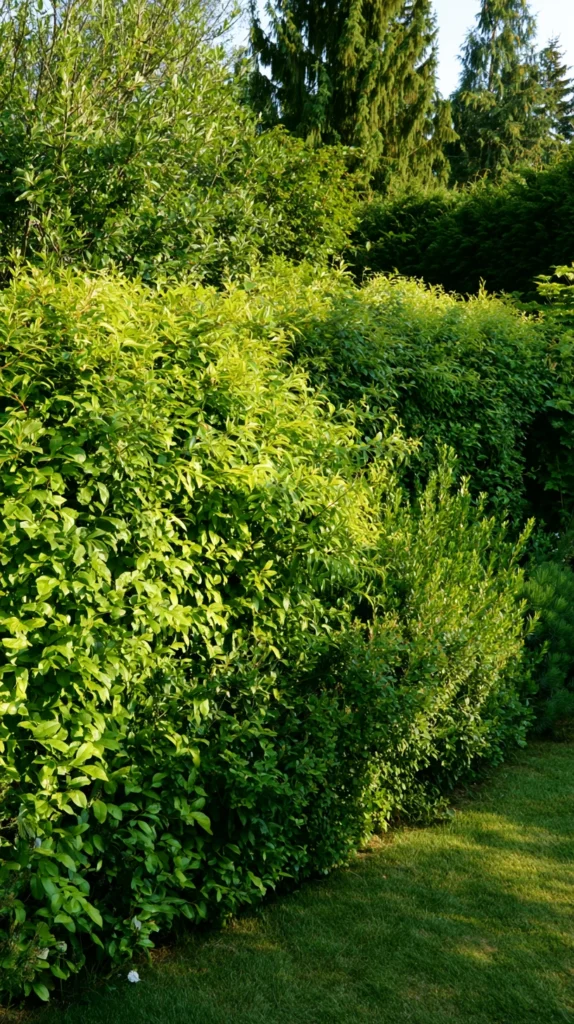
A mixed native hedgerow — hawthorn, blackthorn, field maple, dog rose, hazel, and spindle planted in a random, naturalistic mixture of appropriate species for the garden’s specific region and specific soil conditions — is the privacy hedge of most complete ecological value and most genuinely extraordinary combined ornamental and wildlife contribution, providing nesting habitat, foraging resources, and overwintering shelter for an extraordinary diversity of garden wildlife simultaneously with its boundary-defining and privacy-providing structural function.
Plant the mixed native hedge as bare-root whips in the dormant season at a spacing of three to five plants per metre in a staggered double row configuration, using a biodegradable spiral guard around each plant to protect it from rabbit and small mammal browsing during the vulnerable establishment period of the first two growing seasons.
Allow the mixed native hedge to develop a degree of natural informality in its growth habit rather than clipping it to the geometric precision of the formal evergreen hedge — the specific quality of natural, uneven, botanically varied growth that creates the most valuable and the most ecologically complete wildlife habitat while simultaneously creating the most genuinely characterful and the most botanically interesting informal privacy boundary available in any domestic garden.
6. Use Box for Low, Formal Boundary Hedging
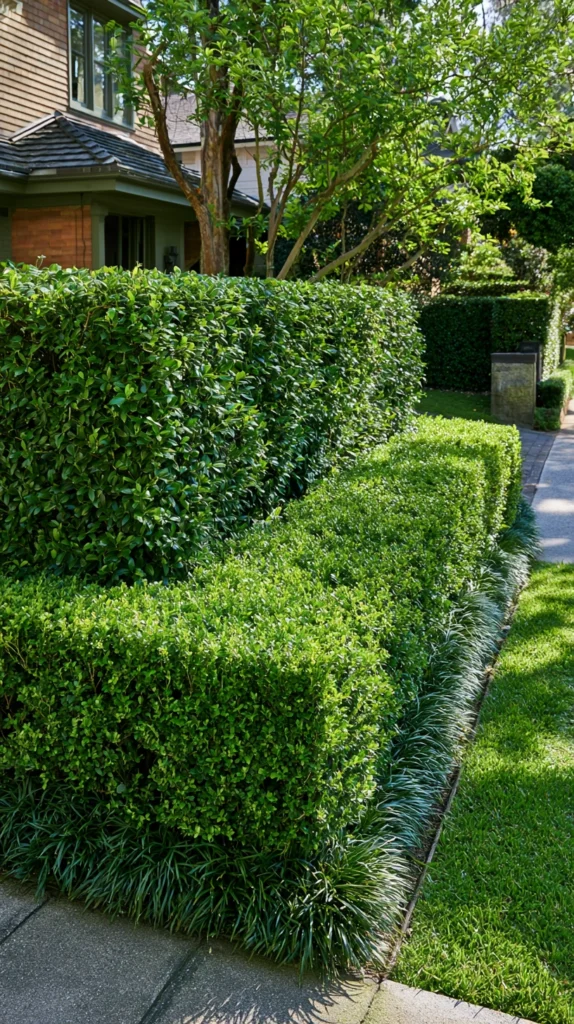
Box — Buxus sempervirens — is the privacy and boundary hedge plant of most complete formal garden design authority for the low and medium-height hedging applications where its specific combination of extremely dense, fine-textured evergreen foliage, complete tolerance of close and precise clipping, and the specific, warm, slightly aromatic quality of its small, dark green leaves creates a formal hedge of extraordinary architectural precision and extraordinary garden design versatility.
The box hedge’s specific susceptibility to box blight and box moth caterpillar in recent decades has prompted many gardeners to seek alternative hedging species of comparable formal clipping quality — Ilex crenata, Euonymus japonicus, and Pittosporum tobira providing the most horticulturally credible and the most ornamentally successful substitutes for the formal, low-clipped box hedge applications that these disease pressures have made increasingly difficult to maintain.
Plant box or its alternatives in enriched, well-drained soil at a spacing of twenty to thirty centimetres for the densest and the most rapidly complete formal hedge establishment, clip annually in late summer for the most precise and the most professionally finished formal hedge appearance, and feed generously with a balanced slow-release fertiliser each spring for the most vigorous and the most disease-resistant growth.
7. Plant Bamboo for a Contemporary Screen
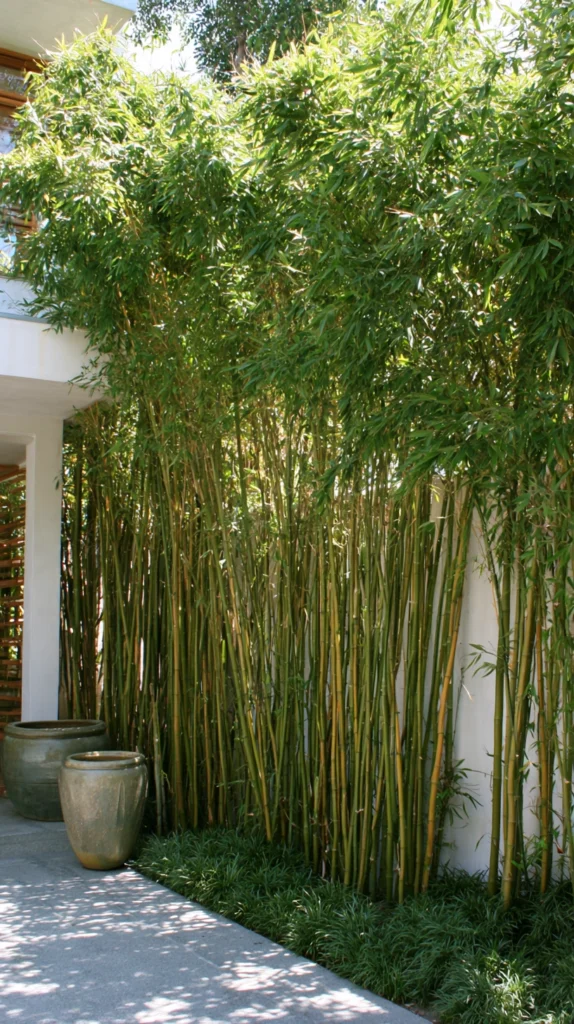
Clumping bamboo — the non-invasive, non-running varieties of the Fargesia genus and the Bambusa genus — creates the most immediately tropical, the most dramatically contemporary, and the most visually extraordinary privacy screen available in any garden whose soil, climate, and design aesthetic are compatible with the specific botanical character and the specific visual language of the bamboo screen planting.
Fargesia murielae and Fargesia robusta are the clumping bamboo species of most complete garden reliability and most genuine non-invasive growing behaviour for the privacy screen application — their contained, clumping growth habit expanding steadily outward from the planting position by a manageable increment of five to ten centimetres per year rather than the aggressive underground rhizome spread of the running bamboos that creates the specific, well-documented garden management problems of the invasive bamboo screen.
Plant clumping bamboo in generously sized groups of three to five specimens at one to one and a half metre spacing for the most rapidly complete and the most visually coherent privacy screen establishment, water generously during the first two growing seasons until the root system is fully established, and mulch heavily around the base of each plant to retain the consistent soil moisture that bamboo requires for its most vigorous and its most ornamentally spectacular growth.
8. Use Griselinia for Coastal Privacy
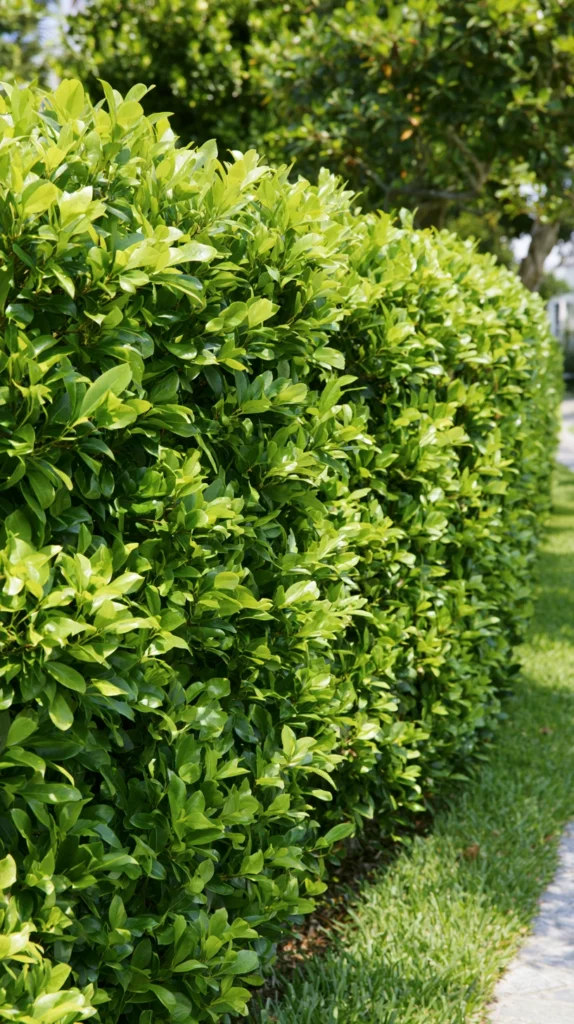
Griselinia littoralis is the privacy hedge plant of most complete and most genuinely reliable performance for the coastal and exposed garden position where the specific combination of salt-laden air, persistent strong winds, and the challenging soil conditions of the maritime environment eliminates the majority of commonly grown hedging species from practical consideration through simple failure of establishment or simple failure of ornamental performance under conditions of genuine coastal exposure.
The griselinia hedge’s apple-green, slightly leathery, oval leaves create a screen of pleasant, if relatively simple, evergreen appearance that responds well to formal clipping and reaches a substantial screening height of two to three metres with reasonable speed in the coastal environment whose specific combination of mild winter temperatures and salt air creates growing conditions that the griselinia inhabits with complete botanical equanimity.
Plant griselinia at fifty to sixty centimetre spacings in a single row for the coastal privacy hedge application, using a robust temporary windbreak netting behind which the hedge plants can establish in relative shelter during their first one to two growing seasons — the establishment shelter investment that most reliably and most effectively converts a challenging coastal planting position into a successful and ornamentally rewarding griselinia screen.
9. Plant Copper Beech for Dramatic Color
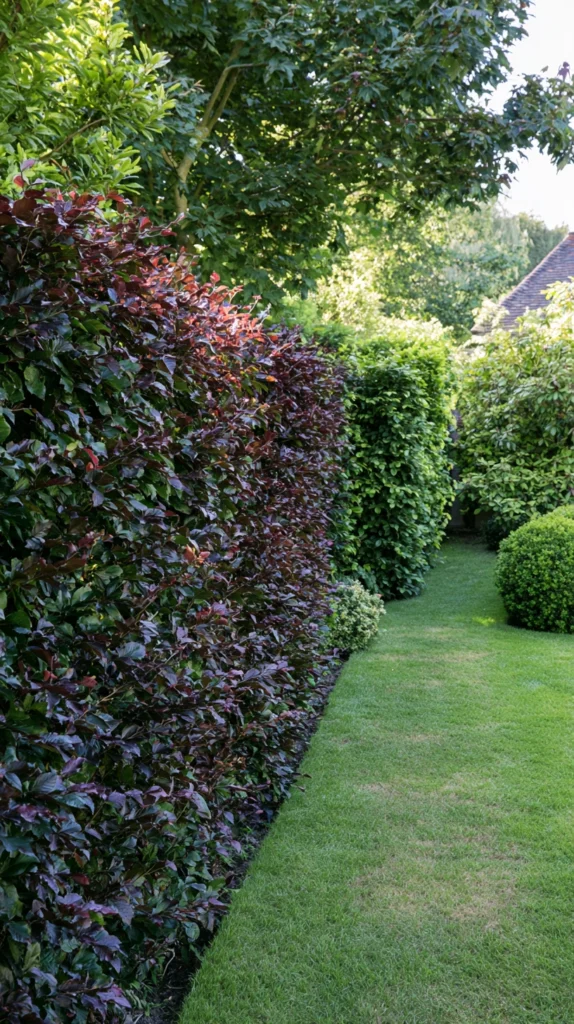
Copper beech — Fagus sylvatica Purpurea — is the privacy hedge plant of most dramatic, most visually commanding, and most genuinely extraordinary chromatic impact, its deep purple-bronze foliage creating a hedge of such completely unusual and such completely extraordinary color that it functions as simultaneously the garden’s most effective privacy screen and its most powerful and most eye-catching ornamental feature from the moment of its first significant establishment.
The copper beech hedge shares the deciduous species’ characteristic of retaining its dead leaves through the autumn and winter months — the specific, warm, copper-bronze color of the retained winter foliage creating a boundary of remarkable year-round visual interest and reasonable year-round visual screening that compensates substantially for the leafless transparency of the conventional deciduous hedge during its dormant period.
Plant copper beech at forty to fifty centimetre spacings as bare-root transplants in the dormant season for the most economical and the most reliably successful establishment approach, clip annually in late summer to maintain the desired hedge height and the precise, formal profile that displays the copper beech’s extraordinary foliage color to its most complete and its most dramatically beautiful ornamental advantage.
10. Use Portuguese Laurel for Elegant Evergreen Coverage
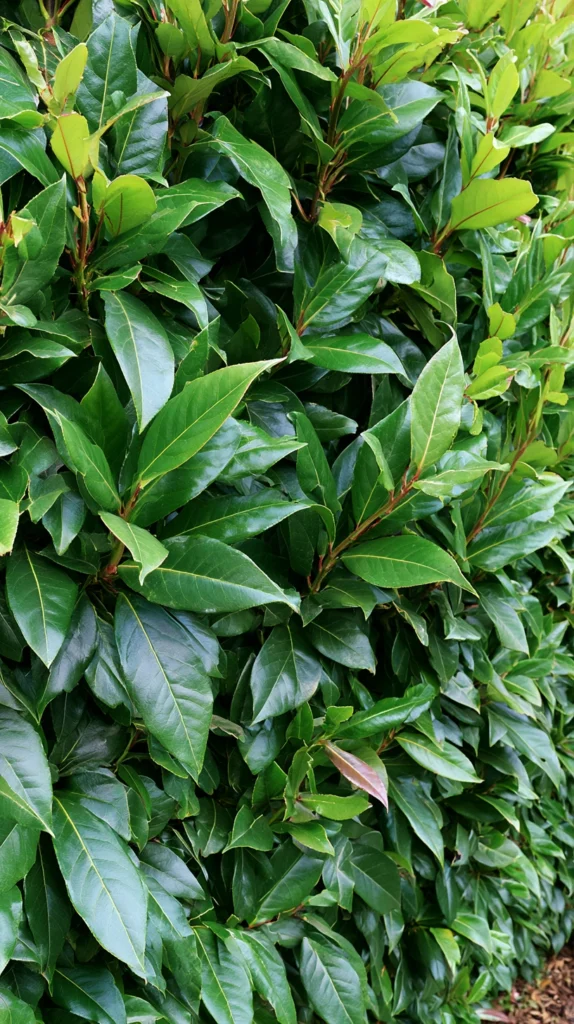
Portuguese laurel — Prunus lusitanica — is the privacy hedge plant of most complete, most genuinely elegant, and most underappreciated evergreen quality in the commonly available hedging species range — its dark, glossy, red-stalked leaves creating a hedge of considerably more refined and considerably more ornamentally distinguished appearance than the commonly grown cherry laurel whose coarser leaf texture and less elegant overall habit make it the more popular but the less beautiful of the two laurel hedging species in general garden use.
Portuguese laurel tolerates clipping to a precise, formal profile with complete botanical compliance, reaches a useful screening height of one and a half to two and a half metres within four to six years of planting from good nursery stock, and produces in early summer — when allowed to extend its growth slightly beyond the formal clipping regime — racemes of small, cream-white, almond-fragrant flowers of genuine ornamental beauty and genuine pollinator value.
Plant Portuguese laurel at sixty to seventy-five centimetre spacings in a position of full sun or partial shade on any well-drained garden soil, feed annually with a balanced granular fertiliser in spring for the most vigorous and the most ornamentally satisfying growth rate, and clip twice annually — once in spring and once in late summer — for the most consistently precise and the most formally beautiful hedge profile.
11. Plant Escallonia for Flowering Privacy
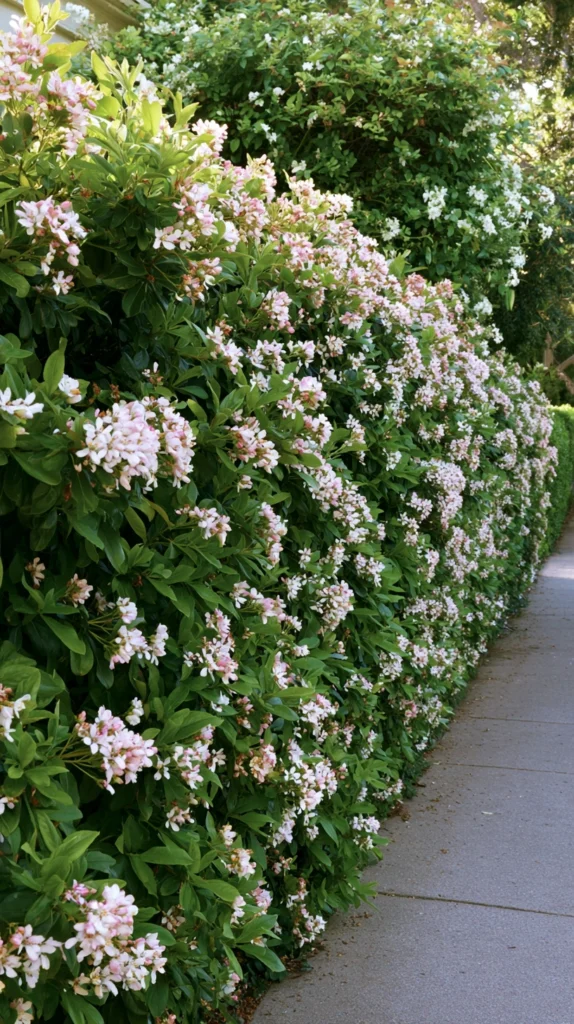
Escallonia is the privacy hedge plant of most generous, most continuously produced, and most ornamentally rewarding flowering contribution among the commonly grown hedging shrubs — its small, tubular flowers in pink, red, or white produced in such prolific abundance throughout the summer months that the established escallonia hedge creates a flowering boundary of extraordinary visual warmth and extraordinary pollinator attraction during the peak of the garden season.
The escallonia hedge’s specific combination of reasonable salt tolerance, reasonable wind tolerance, and genuine evergreen coverage makes it a particularly valuable hedging plant for the mild coastal garden where its tolerance of maritime exposure combined with its substantial ornamental flowering contribution creates a privacy screen of complete practical functionality and complete seasonal ornamental beauty.
Plant escallonia at sixty centimetre spacings in a well-drained, reasonably fertile garden soil in a position of full sun for the most prolific and the most ornamentally spectacular flowering display, clip after the main summer flowering flush has completed to maintain the desired hedge height and to stimulate the late-season secondary flowering that the established escallonia produces with remarkable botanical generosity following each trimming.
12. Use Holly for Impenetrable, Wildlife-Rich Privacy
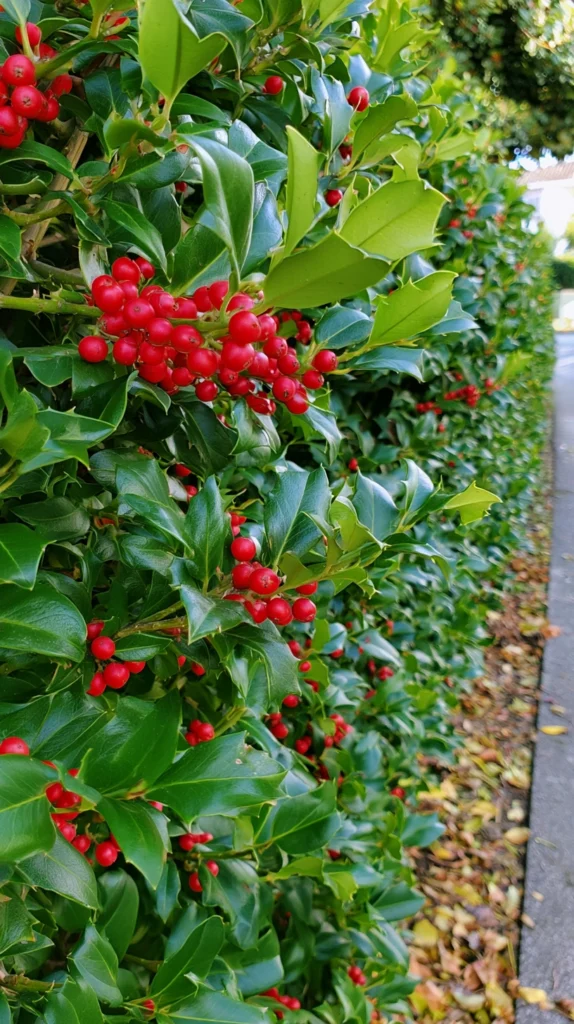
Holly — Ilex aquifolium — is the privacy hedge plant of most complete physical impenetrability, most genuinely valuable wildlife contribution, and most extraordinary combined ornamental and ecological achievement available in any commonly grown evergreen hedging species — its sharply spined leaves creating a hedge through which no person, no large mammal, and no intruder of any physical substance can pass without the most considerable personal discomfort and the most immediate botanical discouragement.
The holly hedge’s winter berry display — the specific, brilliant, completely extraordinary scarlet of the female holly’s berry production in the months of November through February — creates a garden boundary of such genuinely beautiful seasonal ornament and such genuinely valuable wildlife feeding resource that the holly hedge is simultaneously the garden’s most impenetrable physical barrier and its most visually magnificent and its most ecologically generous winter feature.
Plant holly at fifty to sixty centimetre spacings in a well-drained garden soil of any reasonable fertility, include at least one male holly specimen for every five to ten female plants to ensure the cross-pollination that berry production requires, and clip annually in late summer with sharp, clean cutting tools that minimise the leaf damage and the consequent browning that blunt or scissor-action hedge cutters produce on the large-leafed holly foliage.
13. Plant Pyracantha for Colorful Thorny Security
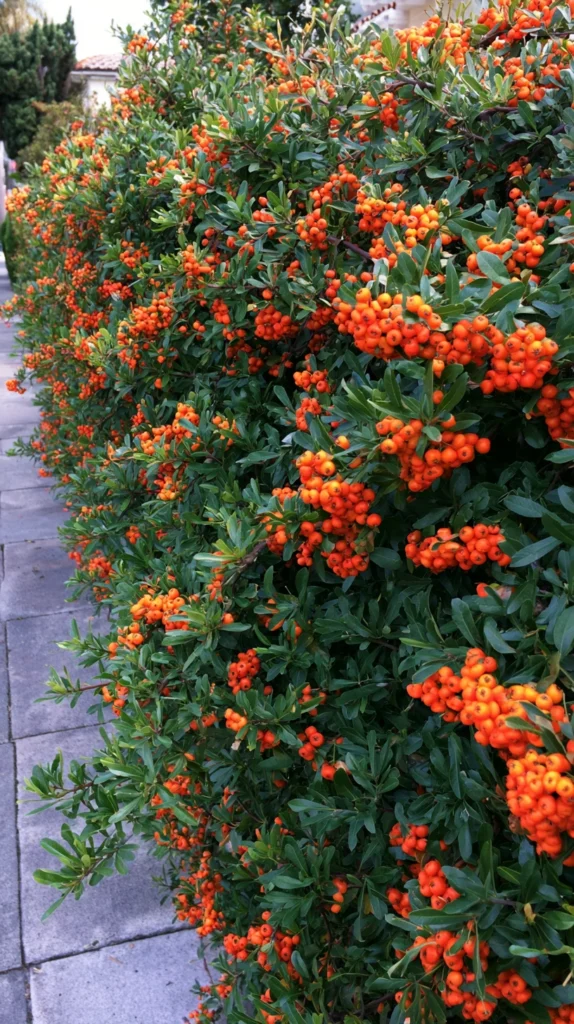
Pyracantha — the firethorn — is the privacy hedge plant of most dramatic combined flowering and fruiting ornamental display and most genuinely effective physical security screening, its dense, thorny structure creating an impenetrable boundary of complete intruder-deterrent capability while its prolific spring flower display and its subsequent spectacular autumn berry production in vivid shades of red, orange, and yellow create a seasonal ornamental boundary of extraordinary visual richness and extraordinary wildlife feeding value.
Train pyracantha along horizontal wires fixed to a post-and-wire fence framework for the most spatially efficient and the most ornamentally productive privacy screen configuration — the trained, wall-shrub method of pyracantha cultivation producing the most prolific berry crops from the most compact horizontal growing footprint of any pyracantha training system and creating the most genuinely spectacular and the most continuously ornamental privacy boundary of the available pyracantha cultivation approaches.
Plant pyracantha at one to one and a half metre spacings along the training wire framework for the wall-shrub privacy screen application, tie in the lateral growth branches to the horizontal wires in a fan or herringbone configuration as they develop, and prune immediately after the spring flowering — cutting back the flowered lateral shoots to within two or three buds of the main framework branches — to stimulate the maximum berry production on the short fruiting spurs that this specific pruning approach develops and maintains.
14. Use Pleached Trees for an Elevated Privacy Screen
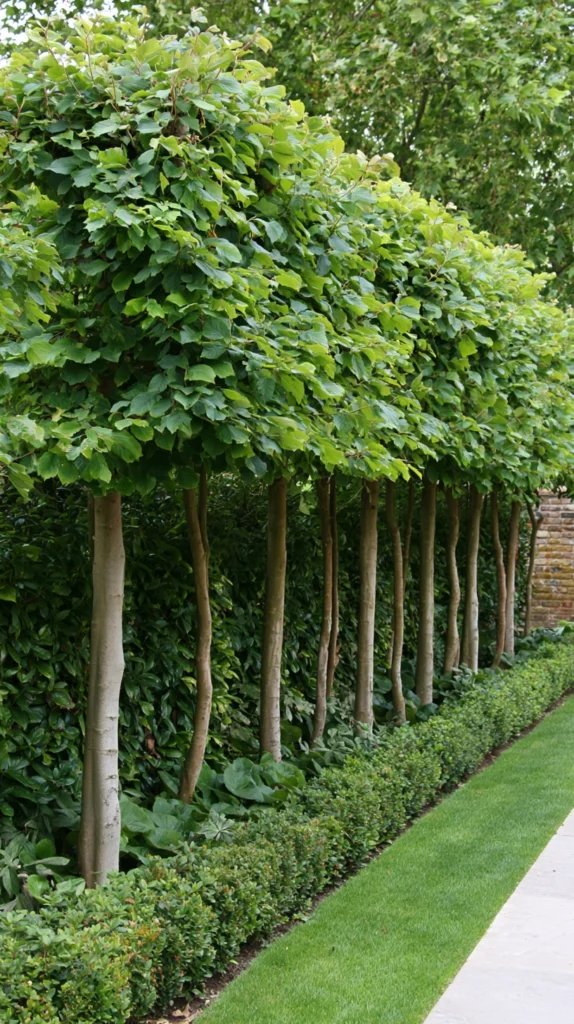
Pleached trees — lime, hornbeam, or plane trained into a flat, elevated, screen-like form on a permanent framework of canes and wires above a clear stem of one and a half to two metres.
It creates the most architecturally sophisticated and the most formally elegant privacy screen available in the garden boundary vocabulary, providing a raised, aerial screen of complete privacy effectiveness at the specific height above the garden where overlooking from adjacent windows, elevated viewpoints, or neighboring properties most commonly and most significantly compromises the outdoor space’s essential quality of private sanctuary.
The pleached tree screen’s specific combination of a completely clear, open stem zone below the training framework and a solid, formal, precisely clipped screen panel above it creates a garden boundary of extraordinary spatial sophistication.
Allowing the garden views, the borrowed landscape, and the broader outdoor environment to be enjoyed at and below eye level while creating complete privacy screening at the specific elevated positions where adjacent overlooking most significantly intrudes on the outdoor space’s quality of private enjoyment.
Plant pleached trees at two to two and a half metre spacings in the pleached screen configuration, installing the permanent support framework of upright posts and horizontal training wires before planting to ensure that the young tree stems can be immediately and correctly trained from the moment of planting, and clip the pleached panel twice annually — once in early summer and once in late summer — for the most precise and the most architecturally authoritative formal pleached screen appearance.
15. Design the Privacy Hedge as a Complete Garden Feature
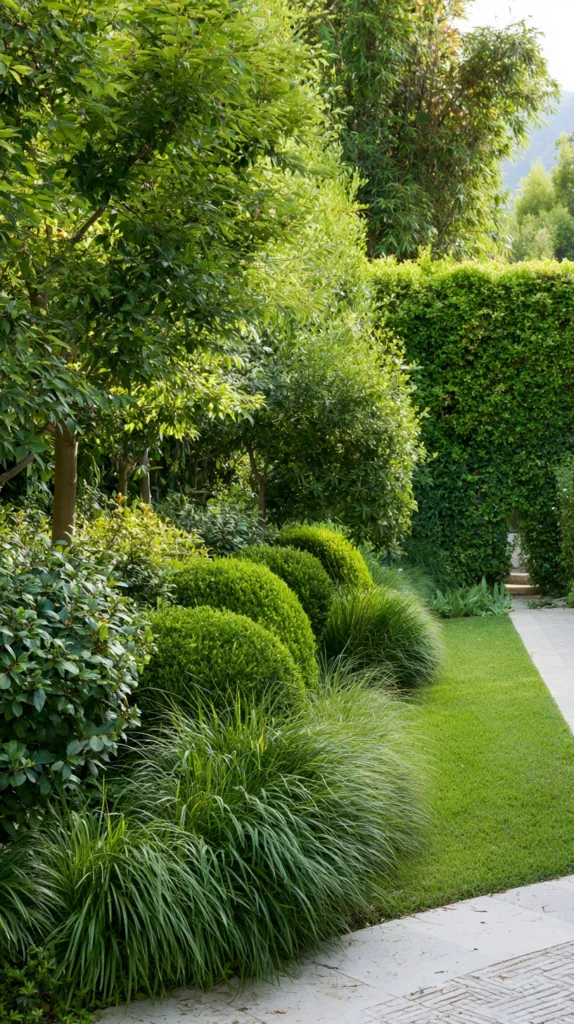
The final and most important privacy hedge landscaping idea is the one that transcends the purely functional boundary-marking purpose of the conventional privacy hedge and approaches the hedge as a complete, genuinely designed garden feature of botanical ambition, ecological generosity, seasonal interest, and personal aesthetic expression — the living boundary that is as beautiful and as botanically extraordinary as every other element of the garden it encloses.
Design the privacy hedge with genuine seasonal planning intelligence — choosing species whose combined flowering seasons, fruiting displays, foliage colors, and textural varieties create a boundary of continuous, evolving, seasonally rich botanical interest throughout the full twelve months of the garden year.
Supplement the primary hedging species with understorey planting at the hedge base — the shade-tolerant bulbs, the woodland ground covers, and the moisture-retaining mulch of decomposed leaf matter that creates the specific, layered, ecologically complete hedge habitat of most genuine biodiversity value and most complete botanical richness.
Make the privacy hedge completely and genuinely personal — the specific species chosen because they carry the specific botanical meaning, the specific seasonal beauty, and the specific ecological contribution that matters most to the household whose outdoor sanctuary they will enclose, protect, and make genuinely, beautifully, and completely private for as many growing seasons as the garden endures and the hedge is lovingly, knowledgeably, and completely maintained.
The privacy hedge designed with genuine botanical knowledge, genuine ecological intelligence, and genuine personal commitment to the specific, extraordinary quality of living, growing, seasonally beautiful natural enclosure that only a genuinely well-chosen and genuinely well-established hedge can provide is one of the most valuable, most enduring.
And most genuinely rewarding landscaping investments available to any garden, any property, and any outdoor space that deserves the specific quality of warm, organic, completely extraordinary natural privacy that no fence, wall, or manufactured boundary can ever genuinely replicate.