
13 Mediterranean Summer Home Ideas That Feel Effortlessly Luxe
The Mediterranean home in summer operates on a different set of principles from the rest of the decorating world. It is not about filling space — it is about editing it. Not about colour for its own sake — it is about the specific quality of whitewash against terracotta, of deep blue against pale stone, of a single olive tree in a clay pot against a rendered wall. The luxury is not in the cost of the materials but in the confidence of the choices, the unhurriedness of the arrangement, and the way the whole thing looks like it has always been exactly this way.
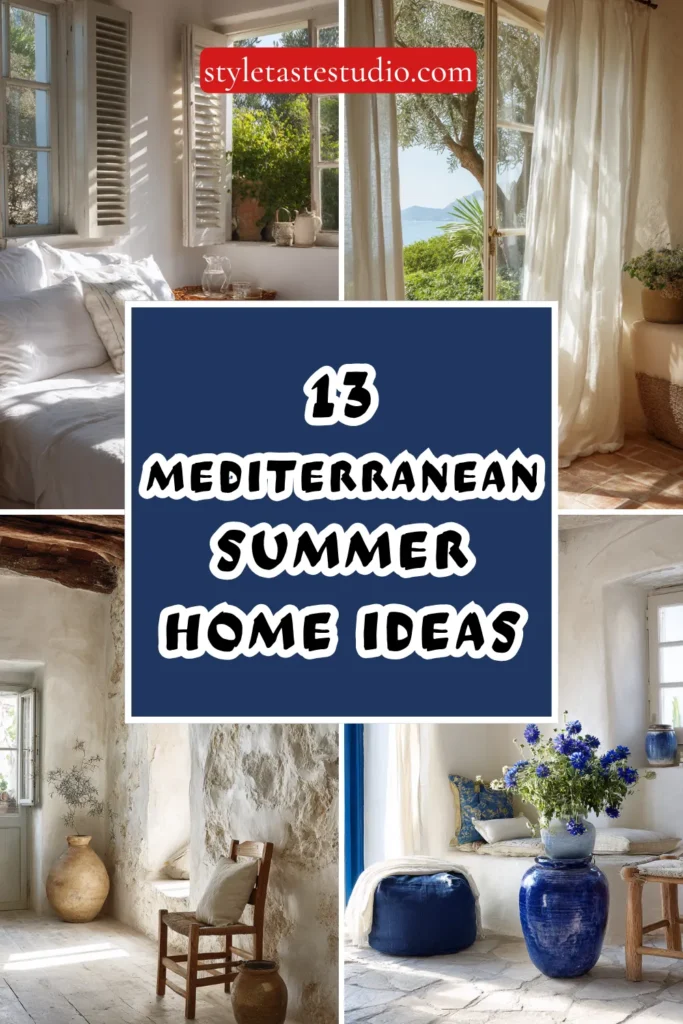
The thirteen ideas below translate that quality into specific, achievable home decor moves for anyone who wants to bring the feeling of a Mediterranean summer indoors and into the garden through the warmest months of the year. Each one works on its own as a seasonal update or as part of a broader scheme, and all of them prioritise the sensory and atmospheric qualities that make Mediterranean interiors so consistently appealing. Costs and a styling tip are included throughout.
1. Limewash or Whitewash Walls
Budget: $40 – $200
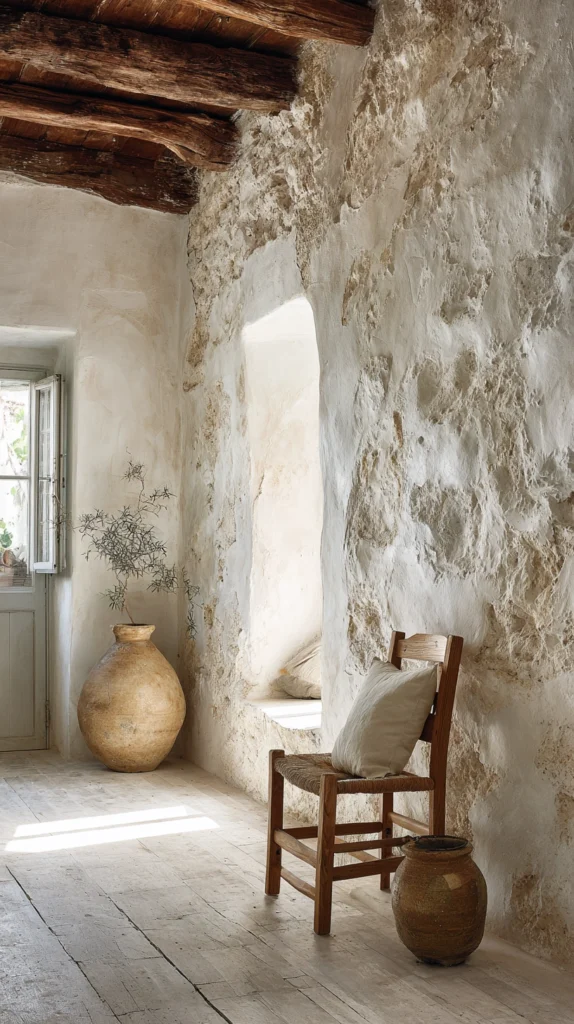
The particular white of a Mediterranean interior is not the bright, flat white of a freshly painted modern room. It is the softer, more complex white of limewash — slightly chalky in texture, uneven in depth of colour, and entirely different in quality from the uniform white that standard emulsion produces. Limewash absorbs and reflects light differently throughout the day, creating a wall that appears to shift in warmth and tone between morning and evening in a way that makes the room feel genuinely alive rather than statically decorated.
Limewash paint in warm white or off-white tones costs $30–$80 per litre and covers approximately 10–15 square metres per litre at the recommended coverage rate. A single feature wall in an average-sized room requires two to three litres for a single coat — most limewash effects require two coats applied with a wide natural bristle brush in irregular, slightly overlapping strokes. Ready-mixed limewash-effect paints from brands including Earthborn, Bauwerk, and Portola are available from specialist paint retailers and most deliver a convincing result without requiring the specialist preparation that traditional lime plaster demands.
Style tip: Apply limewash paint with a wide natural bristle brush in random, overlapping strokes rather than the systematic horizontal and vertical strokes used for standard emulsion. The deliberate irregularity of application is what creates the depth and variation that makes limewash look authentic — a limewash wall applied too evenly loses the textural quality that distinguishes it from ordinary white paint.
2. Terracotta Tiles or Terracotta-Effect Flooring
Budget: $80 – $600
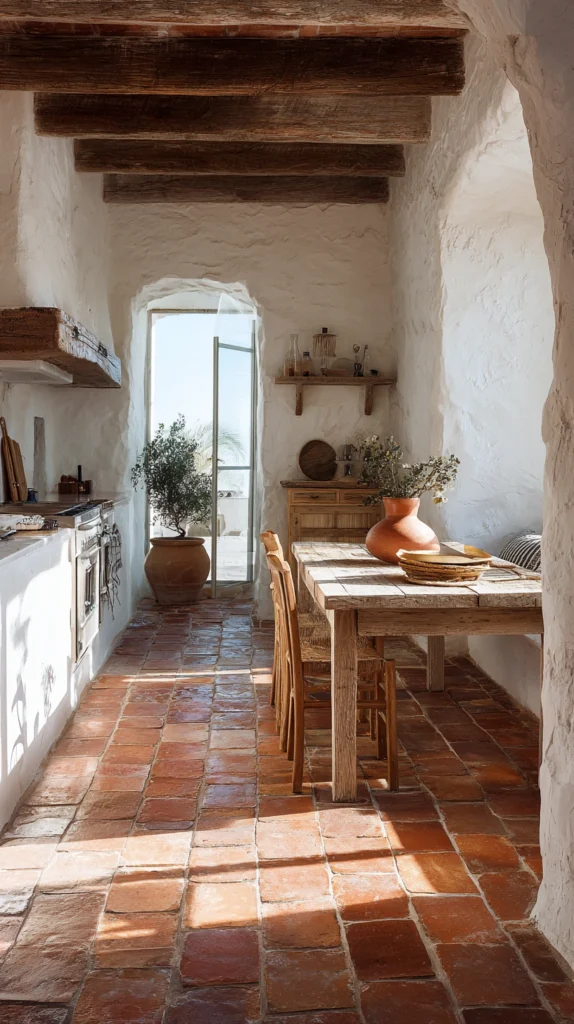
Terracotta floor tiles are the single most transformative flooring choice for a Mediterranean interior. The warm, earthy orange-red tone grounds every other element in the room — white walls, linen textiles, dark wood furniture, and clay pots all look precisely right against terracotta in a way they rarely achieve against the cool tones of grey stone or pale wood flooring. In summer, unsealed or lightly sealed terracotta stays naturally cool underfoot, which adds a sensory quality to the aesthetic appeal that no other floor material in this colour range provides.
Genuine terracotta floor tiles cost $3–$15 per square metre from specialist tile retailers, with handmade and reclaimed options at the higher end of this range. Installation by a tiler adds $20–$40 per square metre. Terracotta-effect porcelain tiles — more practical, more uniform, and significantly cheaper to install — cost $15–$40 per square metre and suit bathrooms, kitchens, and high-traffic areas where the porosity of genuine terracotta would require intensive maintenance. Terracotta vinyl or LVT flooring provides the look at $20–$50 per square metre installed and is the most accessible option for renters or those working to a tighter budget.
Style tip: Seal genuine terracotta tiles with a breathable natural oil or beeswax finish rather than a high-gloss sealant. A heavily sealed terracotta tile loses the matte, slightly absorbent surface quality that gives the material its warmth and character. The lightly sealed version develops a subtle patina with use that only improves over time — which is the quality that makes genuine terracotta worth the additional investment over a porcelain equivalent.
3. An Olive Tree in a Large Clay Pot
Budget: $40 – $200
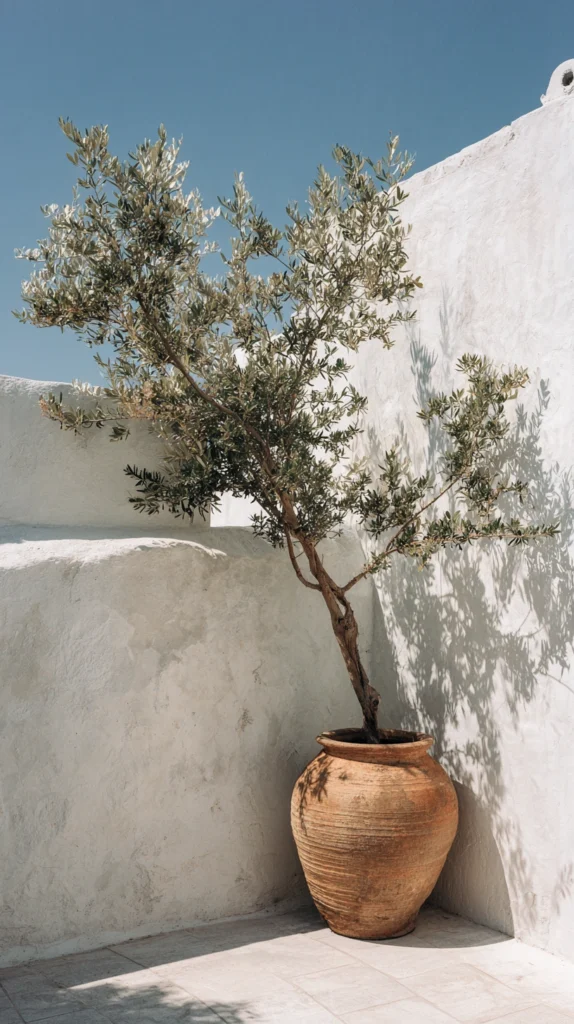
A single olive tree in a large, unglazed clay pot is perhaps the most complete expression of Mediterranean summer home decorating available in a single object. It requires almost nothing around it to look right — against a white wall, on a terrace, beside a doorway, or at the corner of a patio — and it carries the entire atmosphere of a sun-drenched southern European garden with it wherever it is placed. The silvery-green foliage, the gnarled trunk of an older specimen, and the clay pot itself together create a composition that no other plant-and-container combination quite replicates.
A young olive tree in a 5-litre nursery pot costs $20–$40 and will need transplanting into a larger decorative pot for display. A more established specimen in a 15–20 litre container runs $60–$150 and has the gnarled, characterful trunk that gives an olive its particular presence. A large unglazed clay or terracotta pot of 40–50 cm diameter costs $25–$80. Plant into a free-draining compost mixed with 30 percent horticultural grit and place in the sunniest available position — olive trees need six or more hours of direct sun to thrive and fruit reliably in containers.
Style tip: Resist underplanting the olive tree pot with other plants. The olive in a simple clay pot against a white wall is a complete composition that needs nothing added to it. Underplanting introduces a busyness that works against the clean, spare quality of the Mediterranean aesthetic — and the olive itself, given full access to the pot’s soil volume, grows more vigorously and looks better for it.
4. Deep Blue as an Accent Colour
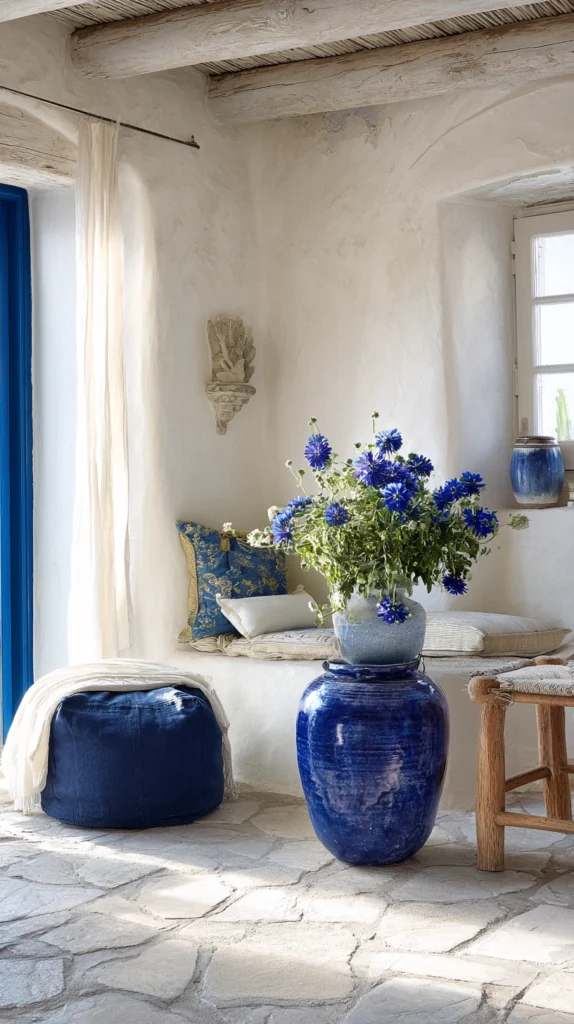
Budget: $20 – $150
The blue of a Mediterranean interior is not the bright, saturated blue of a nursery or the pale blue of a coastal cottage. It is deeper and more complex — the blue of deep water, of a Greek church dome, of hand-painted ceramic tiles seen from a distance. Used as an accent against white walls, natural stone, and warm wood tones, this deep blue creates the specific visual tension that makes Mediterranean interiors feel simultaneously calm and visually rich. It does not need to appear everywhere in the room — a few considered placements are enough to establish the palette.
Deep blue ceramic table lamps cost $40–$100. Hand-painted blue and white ceramic dishes for display cost $10–$30 each. Blue linen cushion covers run $15–$35 each. A painted blue door or window shutter — one of the most iconic Mediterranean exterior details — costs the price of a tin of exterior paint in the right tone, roughly $20–$40. Indigo, cobalt, and Prussian blue all work within the Mediterranean palette. Avoid turquoise or teal, which read as more Caribbean than Mediterranean and shift the colour story in a direction that does not suit the warm stone and terracotta tones of the wider scheme.
Style tip: Introduce the deep blue accent in three separate places within a room — a cushion, a ceramic object, and a textile — rather than concentrating it in one large piece. Three distributed accent points create a colour that reads as threaded through the room rather than applied to it, which is the quality that distinguishes a considered palette from an accent wall treatment.
5. Hand-Painted or Hand-Thrown Ceramics
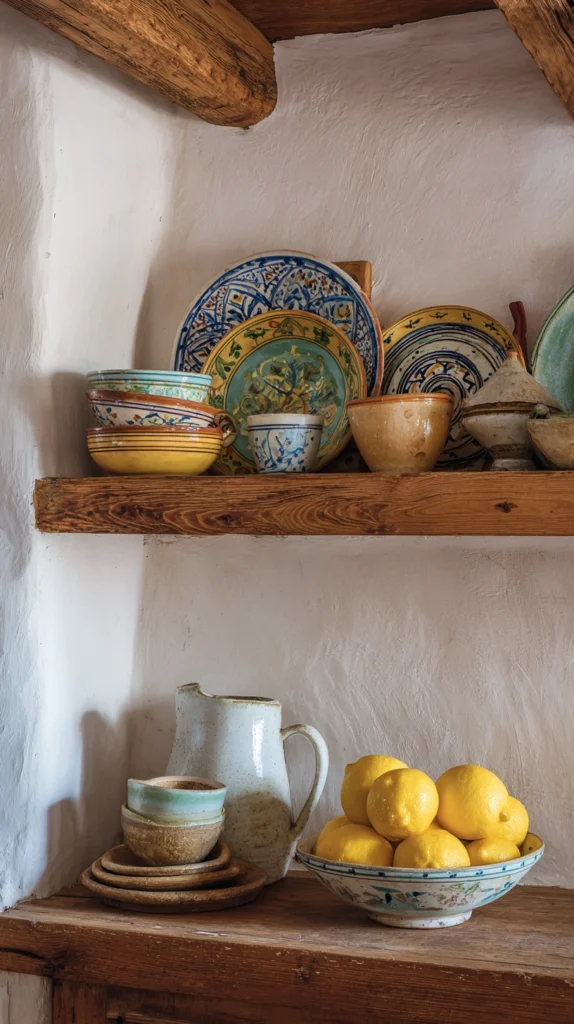
Budget: $20 – $200
Mediterranean ceramics — the hand-painted dishes of Deruta, the blue and white tiles of Portugal, the simple hand-thrown bowls of Provence — are the tableware and decorative objects of a culture that has never seen any contradiction between beautiful and functional. The plates are used for food and displayed when not in use. The bowls hold lemons during the week and olives at a gathering. The jugs are for water and for flowers on alternate days. Nothing is kept for special occasions in a Mediterranean home because every day qualifies.
Hand-painted Mediterranean-style ceramic dishes from independent makers on Etsy cost $15–$50 each. A set of four hand-thrown stoneware bowls runs $40–$120 from a studio potter. Hand-painted tile trivets cost $10–$30 each. A large hand-thrown ceramic jug suitable for flowers or water costs $30–$80. Prioritise quality over quantity — three genuinely well-made ceramic pieces displayed on a shelf or used at the dinner table create a stronger impression of Mediterranean abundance than ten mass-produced pieces arranged in the same space. The making is visible in the best ceramics and it is that quality of visible craft that the aesthetic depends on.
Style tip: Mix ceramic pieces from different makers and slightly different traditions rather than buying a coordinated set. A Moroccan bowl beside a Portuguese plate beside a hand-thrown Italian-style jug creates the gathered, well-travelled quality of a genuinely Mediterranean table. A matching set of ceramics, however beautiful individually, looks purchased rather than collected — which is the wrong quality for this aesthetic entirely.
6. A Shaded Outdoor Dining Area
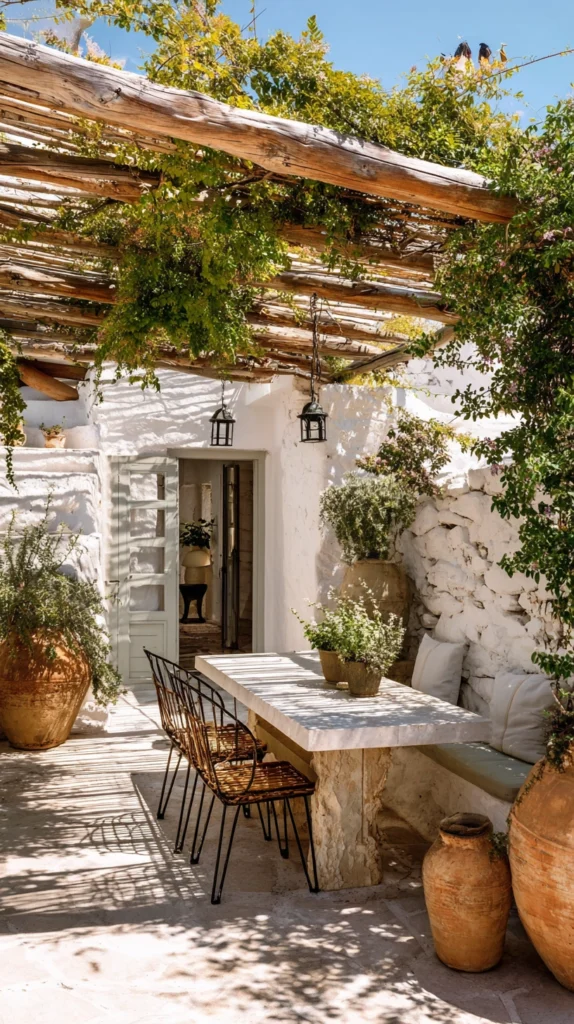
Budget: $200 – $1,500
The most important room in a Mediterranean home in summer is not inside the house. It is the shaded outdoor dining area — under a pergola draped in grapevine or wisteria, beside a wall of bougainvillea, or beneath a wide canvas awning stretched above a stone table. The meal taken outside in the shade of a long summer afternoon, at a table set without fuss and left at for hours, is the organising principle of Mediterranean summer living. The interior of the house is for sleeping. Everything else happens outside.
A timber pergola kit sized for a dining area costs $300–$800. A retractable awning over a terrace costs $400–$1,200 installed. A large stone or concrete outdoor dining table costs $300–$800 and lasts indefinitely without maintenance. A simple wrought iron or powder-coated aluminium table and six chairs costs $200–$500. The priority is the shade structure — the table and chairs are secondary to it. A beautiful outdoor dining set in full afternoon sun is used for thirty minutes. The same set in reliable shade is used for three hours. The shade is the investment that makes everything else worthwhile.
Style tip: Set the outdoor dining table simply and leave it set through the summer rather than clearing it after each use. A table with a simple linen cloth, a jug of water, and a small plant or candle at the centre — permanently available and always ready — is used more than a table that requires setting before every meal. The Mediterranean outdoor dining area is always in a state of gentle readiness, not ceremonial preparation.
7. Shutters on Every Window
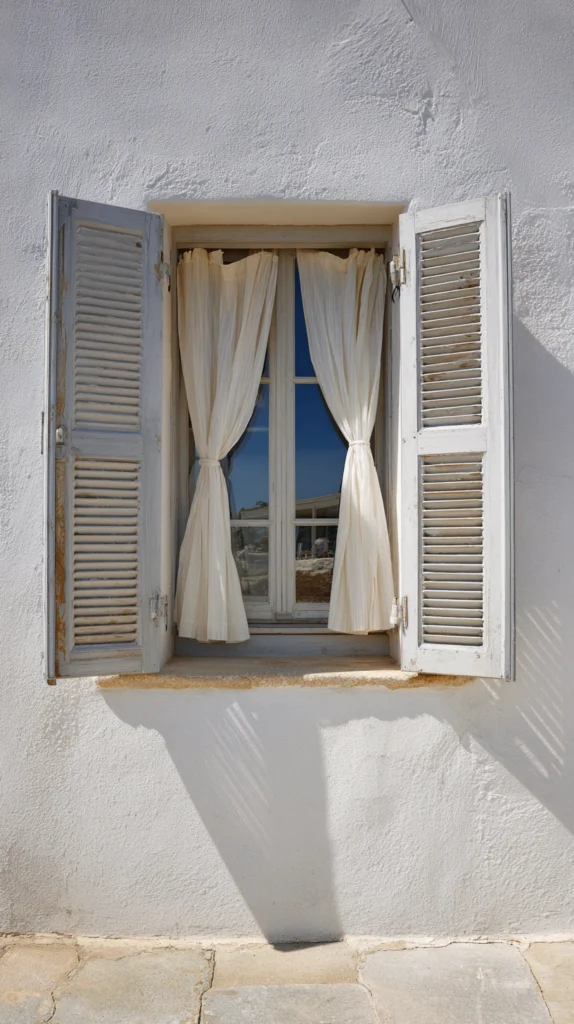
Budget: $100 – $600 per window
Interior or exterior shutters are the most functionally important architectural detail of a Mediterranean home and one of the most visually defining. They manage light and heat in a way that curtains alone cannot — fully closed against the afternoon sun they keep interior rooms significantly cooler than any window treatment that admits light, and partly open in the morning they create the specific quality of striped, filtered light that defines Mediterranean interior photography more than any other single element. They are also beautiful in their own right, which makes them one of the few architectural upgrades that justifies its cost entirely on aesthetic grounds.
Interior plantation shutters in painted MDF or timber cost $100–$300 per window professionally installed. Solid panel interior shutters in a more traditional Mediterranean style run $200–$400 per window. Exterior painted timber shutters — the most authentically Mediterranean option — cost $150–$600 per window depending on size and material. Paint shutters in white, off-white, or the deep sage green or warm grey that feature consistently in Mediterranean exterior colour schemes. The shutter colour against a limewashed or rendered white wall is a complete composition that needs no other exterior decoration around it.
Style tip: Operate shutters as they are intended — closing them against the afternoon sun rather than leaving them permanently open as a purely decorative element. A shutter that is never closed looks like a theatrical prop. A shutter that is used as a light and heat management tool looks like part of a home that has been intelligently adapted to its climate, which is the quality that makes Mediterranean architecture so widely admired and so consistently copied.
8. A Statement Hammam or Zellige Tile Detail
Budget: $80 – $500
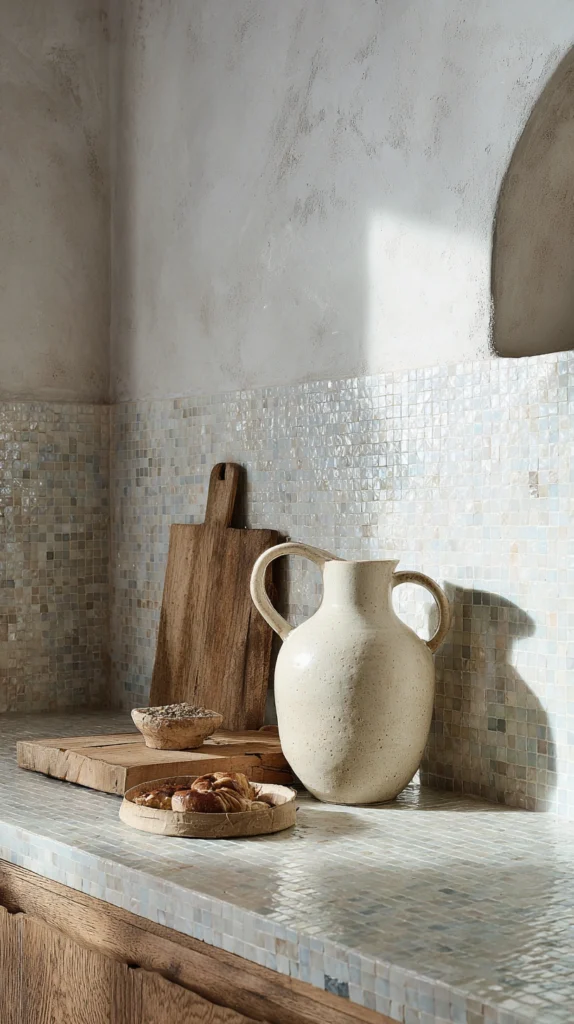
Zellige tiles — the small, handmade, slightly irregular Moroccan mosaic tiles in rich jewel tones — and hammam-style patterned encaustic tiles are among the most immediately luxurious-feeling surfaces available for a Mediterranean-influenced interior. Used as a splashback in a kitchen, a feature panel in a bathroom, or a tiled surface on an outdoor table, they bring a level of colour, craft, and visual complexity that transforms the character of the surface and the room around it in a way that no other material quite achieves at equivalent cost.
Zellige tiles cost $15–$40 per square metre from specialist tile retailers. A kitchen splashback of 0.5 square metres — enough to create a significant feature — costs $8–$20 in tiles plus installation. Encaustic patterned tiles in a Moroccan or Andalusian pattern cost $20–$60 per square metre. For a lower-commitment application, tile an outdoor coffee table surface with zellige or encaustic tiles using waterproof tile adhesive and grout — a project that costs $40–$100 in materials and takes an afternoon to complete. The finished piece looks as though it came from a Marrakech riad, which is precisely the effect the Mediterranean aesthetic is working toward.
Style tip: Use zellige or patterned tiles on one surface only within a room rather than on multiple surfaces simultaneously. The handmade richness and visual complexity of these tiles is most effective as a focal point against plainer surrounding surfaces. Two competing patterned tile surfaces in the same room cancel each other out — one strong tile detail in a room of simple materials is always more powerful than several competing ones.
9. Linen Curtains Left to Billow in the Breeze
Budget: $40 – $180
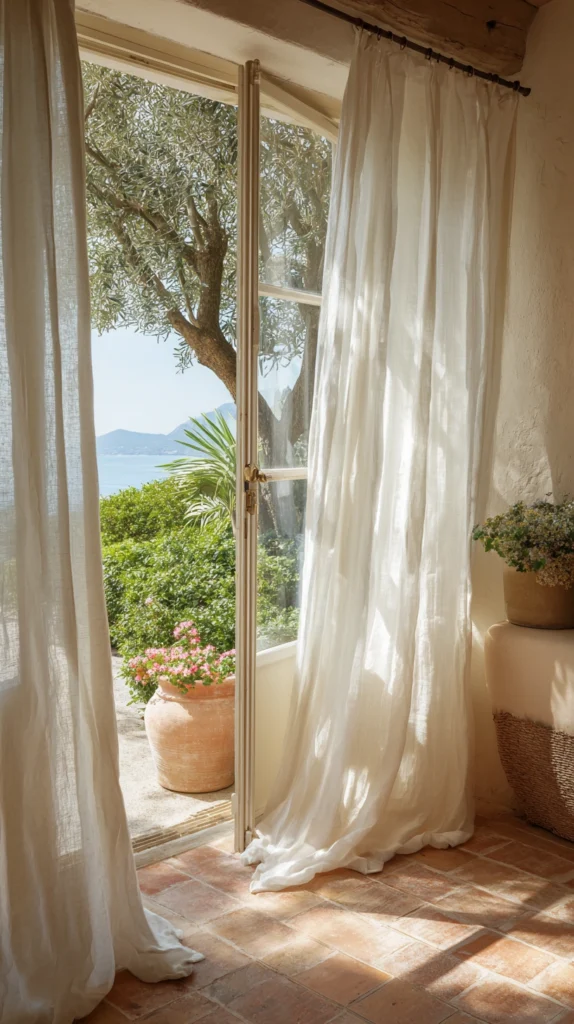
The image of white linen curtains billowing through a wide-open Mediterranean window is one of the most evocative and most copied in all of interior design — and it is copied so frequently because it works so completely. The movement of the fabric, the quality of the filtered light it produces, and the connection it creates between the interior and the summer air outside together make an ordinary window into one of the most atmospheric elements in the room. It requires nothing more than the right fabric, the right hanging height, and the decision to open the window.
Lightweight white or natural linen curtain panels cost $20–$60 each. Hang from ceiling height rather than from the top of the window frame — the floor-to-ceiling drop is essential to the Mediterranean effect and a curtain hung at window-frame height reads as an entirely different, considerably less atmospheric decorating decision. Use a simple iron or timber curtain pole at $15–$40 per window. Choose fabric light enough to move in a gentle air movement through the room — heavyweight linen or lined curtains do not billow and the still, heavy fabric removes the most essential quality of the arrangement.
Style tip: Allow linen curtains to puddle 5–10 cm on the floor rather than hanging them to an exact floor-grazing length. The pooled fabric at the base creates the generously proportioned, slightly undone quality of Mediterranean curtaining — the suggestion of abundance and ease rather than the precision of a tailored window treatment. It is a detail that takes ten seconds to arrange and defines the character of the whole window.
10. A Courtyard or Enclosed Garden Dining Space
Budget: $200 – $2,000
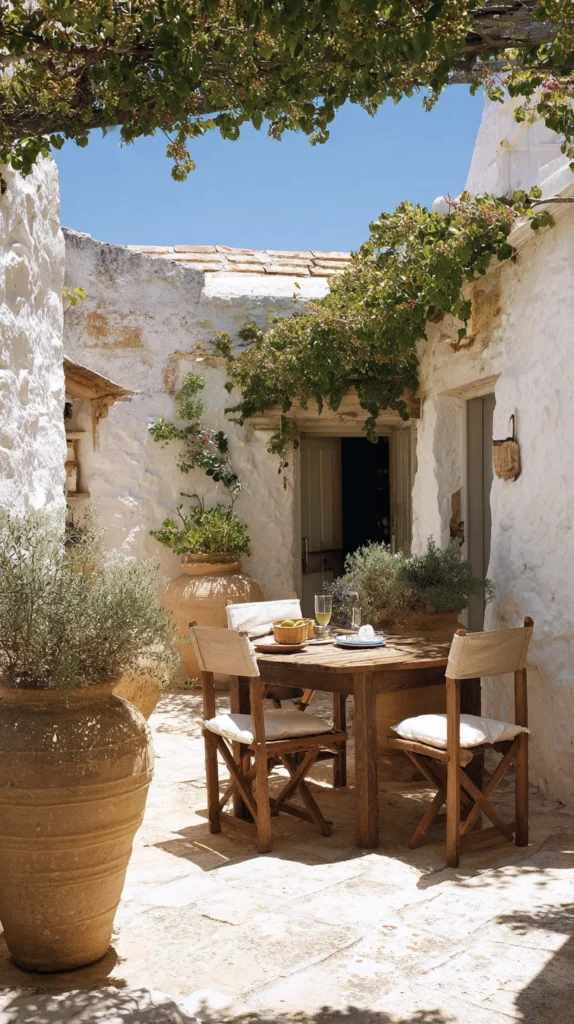
The enclosed courtyard — a small outdoor space surrounded on three or four sides by walls, hedges, or fencing — is the closest thing to a genuinely Mediterranean outdoor room that most home gardens can accommodate. The enclosure traps warmth, reduces wind, creates privacy, and gives the space a defined, room-like quality that an open garden never has. Furnished simply with a table, two or four chairs, a large clay pot, and some climbing plants, a small enclosed courtyard becomes the most used and most loved space in the home through summer.
Creating an enclosed courtyard from an existing garden space requires walls, close-boarded fencing, or tall hedging on the open sides. Close-boarded timber fencing costs $40–$80 per linear metre installed. A hornbeam or yew hedge planted to 1.5 metres from bare-root plants costs $5–$15 per plant and reaches the required height within three to four years. A rendered masonry wall costs $150–$300 per linear metre. Within the enclosed space, the furnishing cost is modest — a simple stone or timber table, two chairs, and one or two clay pots with Mediterranean plants complete the arrangement at $200–$500 in furniture and planting.
Style tip: Paint the interior walls of a small courtyard in warm white limewash rather than leaving them in their natural brick or render tone. A whitewashed courtyard wall reflects more light into the space, makes the area feel larger and more luminous, and creates the specific surface against which terracotta pots, climbing plants, and Mediterranean-palette furnishings look most completely right.
11. Fresh Citrus as Year-Round Decoration
Budget: $5 – $30
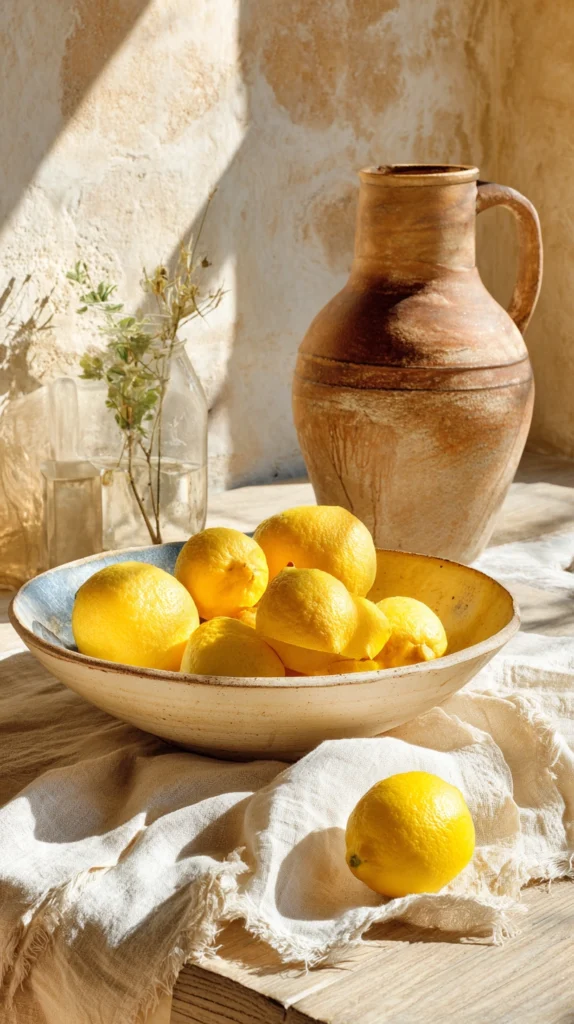
A bowl of lemons on the kitchen table, a cluster of limes beside the sink, a vase with a few stems of kumquat — fresh citrus used as a decorative object is one of the simplest and most effective Mediterranean home details available. The yellow and green tones of citrus fruit against white walls, terracotta surfaces, and natural linen textiles create a colour combination of remarkable warmth and freshness that no artificial decorating element achieves as effortlessly. The fruit is also used, replaced, and therefore always fresh — a self-renewing decoration that smells as good as it looks.
A kilogram of unwaxed lemons costs $2–$5 from a grocery or market. A wide, shallow ceramic fruit bowl costs $15–$30. A small citrus tree — lemon, lime, or kumquat — grown in a large container on a sunny terrace costs $25–$60 as a young plant and produces fruit in its second or third year. A container-grown citrus tree that produces fruit for cutting and display throughout the summer is the most Mediterranean of all possible kitchen garden plants and one of the most rewarding for a home that wants to bring this aesthetic into daily life rather than simply reference it decoratively.
Style tip: Use a wide, shallow bowl rather than a deep fruit bowl for a citrus display — the shallower vessel allows the fruit to be arranged in a single visible layer where every lemon or lime contributes to the composition rather than being buried beneath the ones on top. A shallow bowl of lemons on a table is a complete still life. A deep bowl with lemons tumbling out of the top is a fruit bowl that needs refilling.
12. Dark Wood Furniture Against White Walls
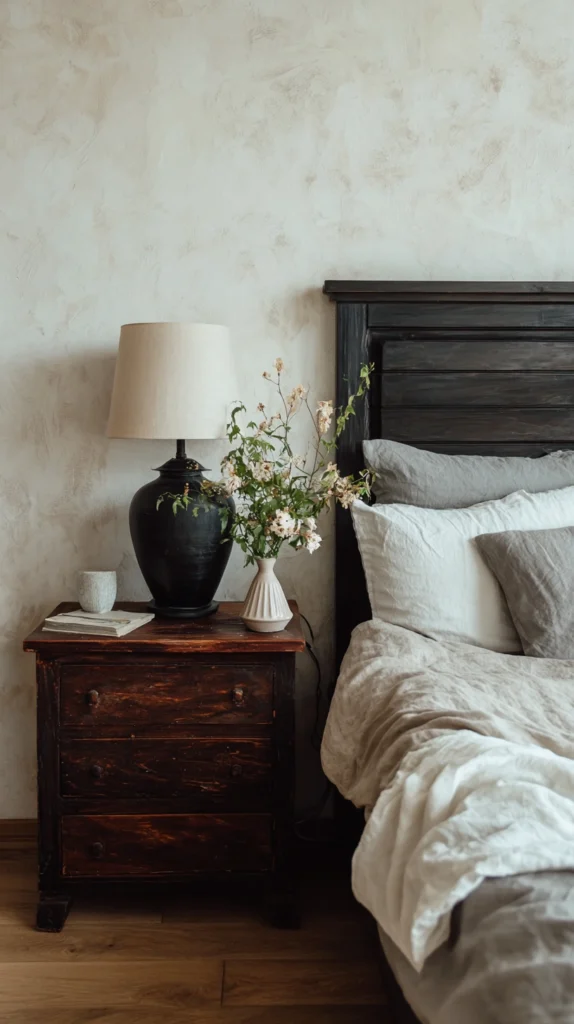
Budget: $100 – $800
The contrast between dark-stained or naturally dark wood furniture and white or off-white Mediterranean walls is one of the most visually satisfying combinations in all of interior design. The dark wood grounds the room, provides visual weight against the expansive whiteness of limewashed walls, and carries the warmth and solidity of a material that has been used in Mediterranean furniture for centuries. A dark wooden dining table, a carved side cabinet, a simple wooden bed frame — any one of these pieces placed against a white wall establishes the aesthetic immediately and without requiring anything else to support it.
Dark wood dining tables in solid walnut, oak, or mango wood cost $200–$600 for a table seating six. Vintage and second-hand dark wood furniture from markets and estate sales costs $50–$200 for pieces of equivalent quality to new furniture at two or three times the price. A dark wood bed frame runs $200–$500 new. The furniture does not need to be new or expensive — patina and age suit the Mediterranean aesthetic considerably better than factory-fresh uniformity, and a well-made piece that has been used for twenty years looks more appropriate against a limewashed wall than an identical piece that came out of a box last week.
Style tip: Leave dark wood furniture surfaces relatively clear — a single ceramic object, a candle, or a small plant rather than a styled arrangement of multiple decorative items. Dark wood furniture in a Mediterranean interior is most effective as a strong, simple statement against a white wall. Covering the surface with decoration reduces the visual impact of the furniture itself, which is the most important element in the composition.
13. The Afternoon Rest: Designing for the Siesta
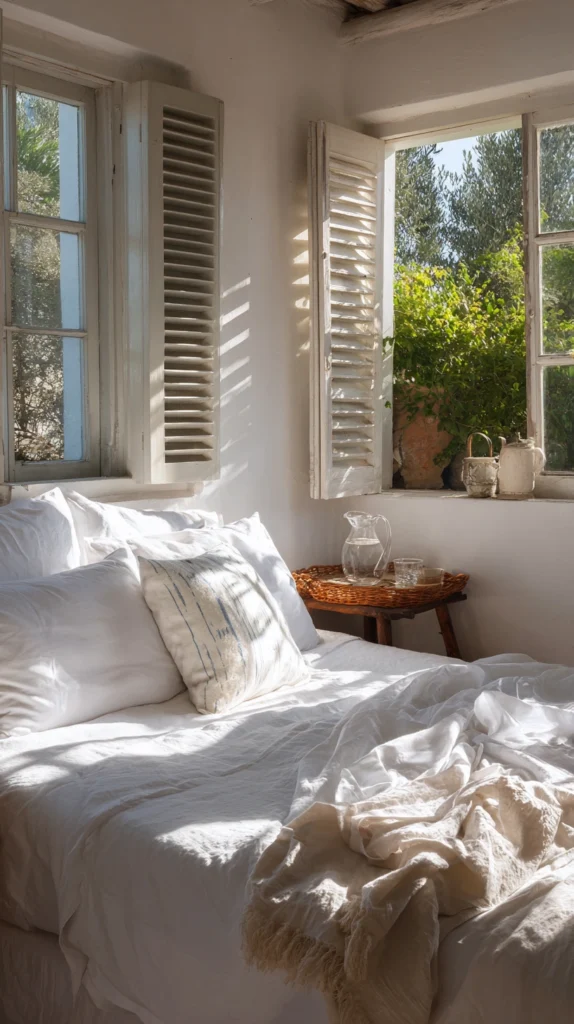
Budget: $100 – $500
The siesta is not simply an afternoon nap — it is a design principle. A home that accommodates the siesta has a bedroom with effective shutters or curtains that create genuine darkness in the afternoon, a bed with cool linen sheets and a single light blanket, and the quiet understanding that the hottest hours of the day are for rest rather than activity. Designing a bedroom around this principle produces one of the most sensory and most genuinely luxurious sleeping environments available — the Mediterranean bedroom at its best feels like the most considered, most comfortable room in any house it inhabits.
Effective light-blocking shutters or lined linen curtains cost $100–$400 depending on the window size and treatment chosen. A set of pure linen sheets in white or pale stone costs $80–$200. A lightweight cotton or linen blanket for the siesta hours runs $30–$80. A standing fan or ceiling fan for air movement without air conditioning costs $60–$200. A carafe of water on the bedside table costs the price of the carafe — $10–$30. The complete siesta bedroom setup costs $280–$830 assembled from these elements and delivers a quality of afternoon rest that the most expensive hotel room struggles to better when all the elements are in the right place.
Style tip: Make the siesta bedroom as cool and as dark as the climate and the window treatment allow. The Mediterranean siesta tradition exists because the midday heat makes it genuinely necessary — designing the bedroom for real darkness and real coolness rather than approximate versions of both produces a room that is used as intended and delivers the restorative quality of rest that makes the long Mediterranean summer evening possible. Function first, as always, in this aesthetic.
The Mediterranean summer home is built on principles that have been refined over centuries in climates that demand intelligent responses to heat, light, and the rhythms of the day. The luxury it offers is not the luxury of expensive materials or elaborate decoration — it is the luxury of a home that knows exactly what it is for and has been organised to deliver that purpose as completely as possible. Cool in the afternoon, beautiful at every hour, set for gathering in the evening, and entirely unhurried throughout.
Start with one idea from this list that addresses the most obvious gap between your current home and the Mediterranean quality you are working toward. White walls if the room is too dark and heavy. An olive tree if the terrace feels bare and unanchored. A shaded dining area if summer meals are being taken indoors because the garden is too exposed. One right change, made well, always reveals the next one clearly. The aesthetic builds itself once the first decision is the right one.