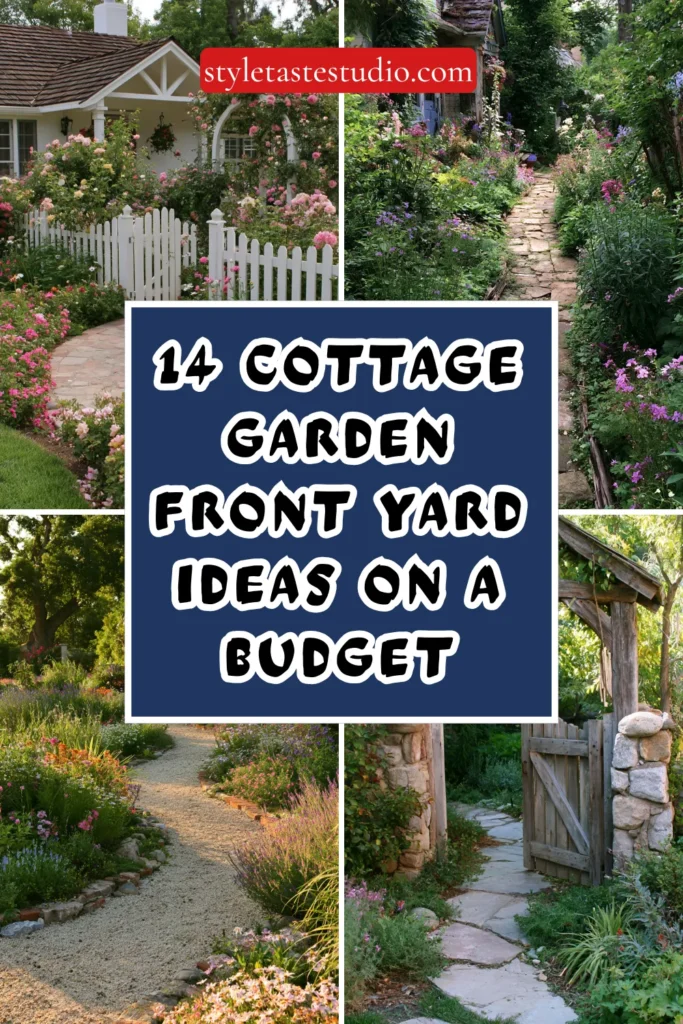
14 Cottage Garden Front Yard Ideas on a Budget That Look Like You Spent a Fortune
The cottage garden front yard has a reputation for being expensive.
It is undeserved.
The expensive front yard is the one with the immaculate box hedging clipped by a professional twice per year. The one with matching planters of architect-specified plants changed seasonally. The one where the design is controlled and precise and requires a budget and a contractor to maintain.
The cottage garden front yard is the opposite of all of that.
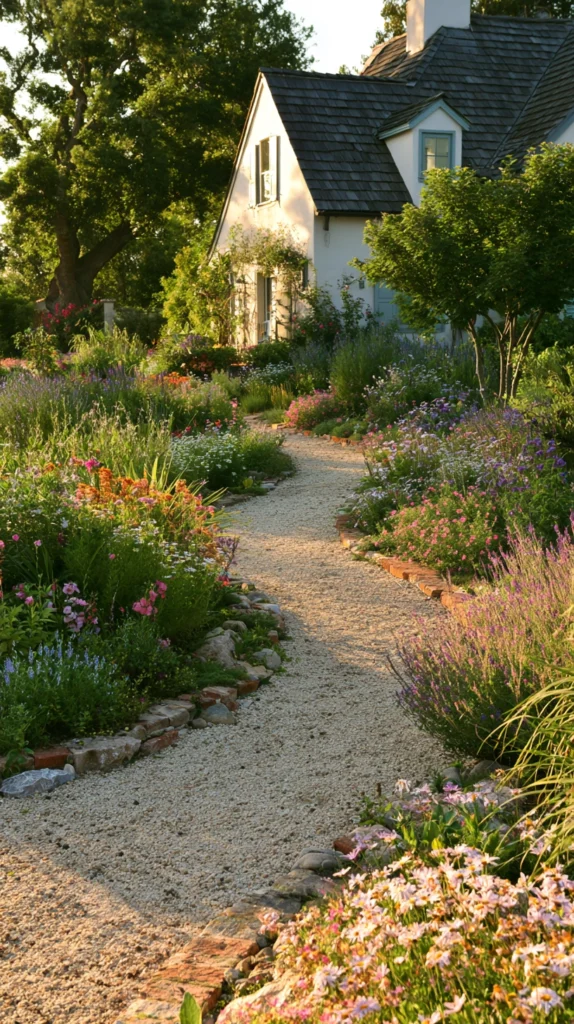
It is generous with what it costs the least. Space for self-seeding plants that cost nothing once established. Time for divisions from a neighbour’s overcrowded border. Patience for the slow beauty of a rose grown from a cutting. A willingness to let the planting be slightly out of control in the specific way that cottage gardens always have been, tumbling over the path edge, reaching toward the gate, going wherever there is sun and soil and space.
None of this costs money. Some of it saves it.
The cottage garden front yard that looks like it has been there for years, that stops people on the pavement to look and sometimes to ask what that pink rose is called, was almost always achieved on a modest budget over several years of gradual, patient planting.
Here are 14 ideas for creating that garden in your front yard.
Why Cottage Garden Is the Most Budget-Friendly Front Yard Style
The formal front yard requires control. Control costs money. Clipped hedges. Replaced seasonal planting. A mown lawn maintained at a specific height. Weed-suppressed gravel that requires re-dressing every two years.
The cottage garden front yard requires abandonment. Not the abandonment of a neglected garden. The deliberate abandonment of the formal impulse to control. Letting things seed where they will. Allowing plants to exceed their allotted space and to be cut back rather than prevented from growing. Choosing plants that multiply themselves rather than plants that remain exactly where they were placed.
This deliberate abundance is the character of the cottage garden and it is what makes the style intrinsically low-cost. The plants do the work. Self-seeding foxgloves appear year after year without any replanting cost. The hardy geraniums spread to fill the gaps left by bulbs that have finished flowering. The climbing rose sends new shoots up the fence every year without any investment beyond the initial planting.
The cottage garden improves with benign neglect in a way that formal garden styles do not. Every year it becomes more itself. Every year the self-seeded plants make it more spontaneous and more genuinely cottage in character.
1. Start With Self-Seeding Annuals and Biennials
The foundation of the budget cottage front yard is the self-seeding plant.
A plant that produces viable seed at the end of its season, drops that seed into the soil around it, and germinates reliably in the following spring, is a plant that you pay for once and that pays back in plants indefinitely.
Foxgloves are the quintessential self-seeding cottage garden plant. The biennial foxglove, Digitalis purpurea, produces its dramatic flower spikes in its second year, sets seed abundantly, and the seed germinates in late summer to produce the first-year rosettes that will flower the following year. Once you have foxgloves in a garden you continue to have them without any further purchase or planting.
Honesty, Lunaria annua, does the same. A biennial that self-seeds generously and fills the garden with purple flowers in spring and the luminous silver seed pods that give the plant its name in summer. One packet of seed in the first year provides all the honesty you will ever need.
Aquilegia, the columbine, is a perennial that self-seeds with the same enthusiasm as a biennial and produces a wildly varying mixture of forms and colours from the original plants’ crossing with each other. A garden with ten aquilegia plants in year one has twenty in year two and forty in year three. They need editing rather than purchasing.
Californian poppy, Eschscholzia californica, seeds into gravel and bare soil and cracks in paving with a freedom that makes it the most willing of all cottage garden self-seeders. Its vivid orange-gold flowers are among the brightest and most cheerful of all front yard plants and the plant itself costs virtually nothing to establish.
Why self-seeding plants are the most important budget cottage garden investment:
- One plant purchase produces multiple subsequent plants without further investment
- Self-seeded plants are specifically suited to the conditions where they germinate because they chose those conditions
- The random placement of self-seeded plants creates the spontaneous, undesigned quality that defines cottage style
- No replanting effort is required beyond the annual edit of seedlings appearing in wrong positions
- The plant range, foxgloves, honesty, aquilegia, californian poppy, covers spring through summer in the cottage garden calendar
- Self-seeded plants establish more vigorously than transplanted seedlings because they germinate in situ
2. Grow From Cuttings and Divisions
The cottage garden plant swap is one of the great traditions of the style and one of the greatest budget gardening strategies available.
A neighbour with an overcrowded geranium border who divides the plants in autumn and offers a handful of divisions to any taker provides you with established plants that would cost several pounds each at the garden centre. The friend with a climbing rose of extraordinary beauty who takes a cutting in late summer and pots it up for you provides a plant that would cost considerably more in the garden centre and that has the specific variety that you admired in their garden rather than the generic variety available on a tag at the nursery.
Seek out the opportunities for divisions and cuttings actively. Ask the gardeners you admire what they do with the overcrowded plants they must regularly divide. Offer to help with the division in exchange for a share of the plants. Attend plant sales at garden open days and National Garden Scheme gardens where quality divisions of unusual plants are sold for modest sums.
Many cottage garden plants divide with exceptional ease. Hardy geraniums separate into individual crowns that establish immediately. Hostas divide into pieces that produce full plants within a single season. Sedums pull apart into individual rosettes that root in any reasonable soil. Delphiniums and lupins produce basal cuttings in spring that root easily and flower in the same season.
These divisions and cuttings do not replace a core of properly purchased good-quality plants. But they supplement the core generously and at minimal cost.
3. A Climber on the Front Fence or Wall
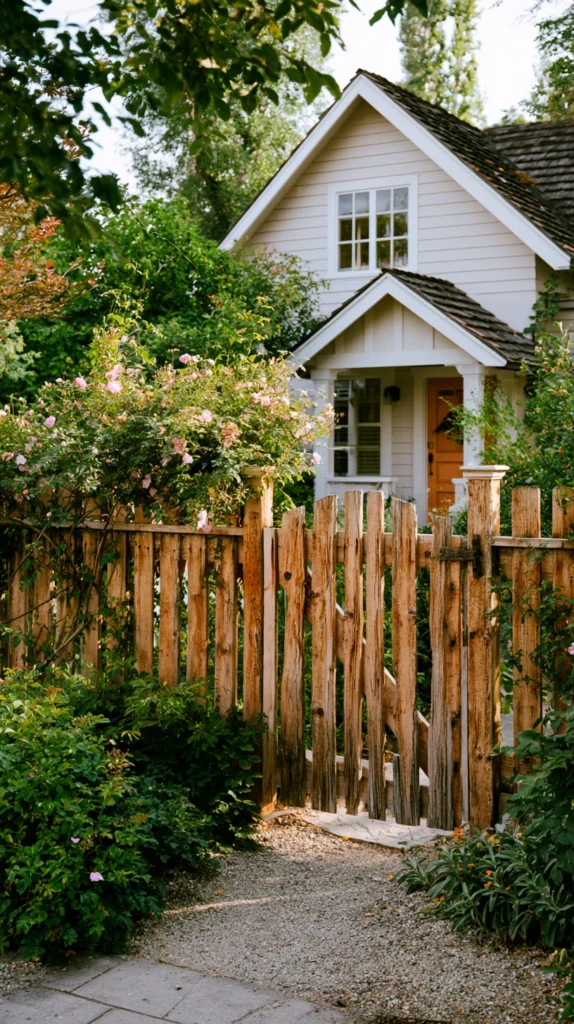
The climbing plant on the front fence or wall is the single highest-impact cottage garden addition for the area of ground it occupies.
A climbing rose trained across a garden fence, or a jasmine or clematis growing up a wall beside the front door, transforms the vertical plane of the front garden in a way that no ground-level planting can match.
The climbing rose on a cottage garden fence is one of the most enduring and most recognisable images of the English garden tradition. Rosa Zephirine Drouhin, the thornless climber, will reach three metres in two seasons and cover the fence in fragrant, deep pink blooms from June through September and into October. Rosa New Dawn, the pale pink rambler, covers an entire fence in a single season once established and flowers with extraordinary generosity.
Buy one quality bare-root climber in late autumn or early winter when bare-root roses are at their most affordable and most plentiful. A bare-root rose costs a fraction of the price of a container-grown equivalent and establishes faster and more strongly than a container-grown plant potted on from a small original.
Train the rose horizontally along the fence rather than allowing it to climb vertically. A rose trained horizontally produces significantly more lateral flowering shoots and therefore significantly more flowers than one allowed to grow straight upward.
4. A Path Edged With Low-Growing Cottage Plants
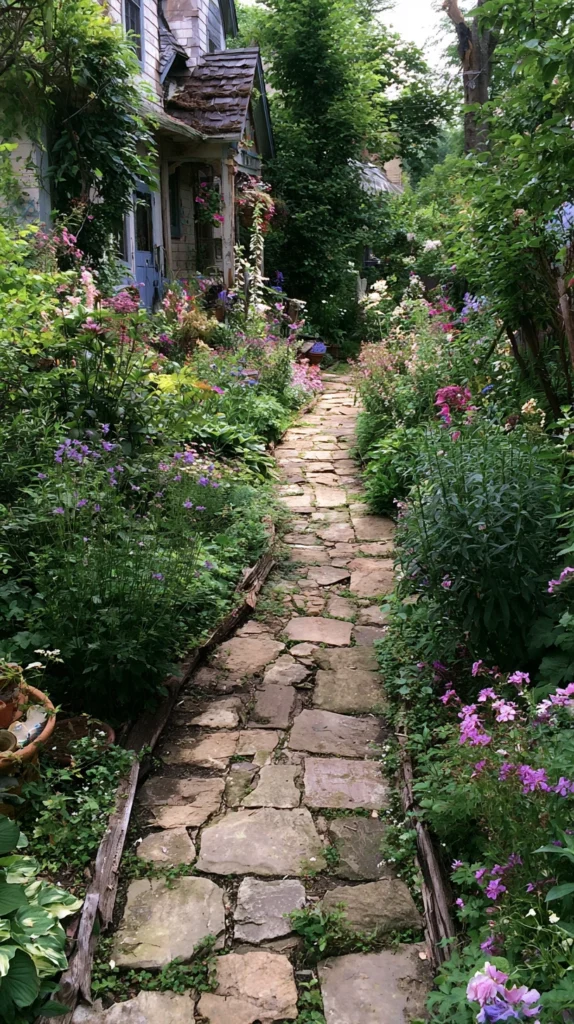
The path through the front garden, whether to the front door or to the side of the house, is the most visited part of the garden and the place where close-range planting is most appreciated.
Edge the path with the compact, floriferous cottage plants that reward this close-range observation. Lavender beside the path releases fragrance with every brushed contact. Catmint, Nepeta, tumbles softly over the path edge in a cloud of soft blue flower from June through August. Lady’s mantle, Alchemilla mollis, catches dew drops in its pleated leaves and produces frothy lime green flowers that suit every other plant it grows beside.
These path-edge plants are among the most affordable cottage garden plants available because they are among the most widely grown. Almost every cottage garden has one or more of them in surplus. A request for a division at a local garden club or an open day is almost certain to produce a response.
The path edge planting should be allowed to soften the path edge rather than being kept rigidly clear of the paving. A cottage garden path with clean, maintained edges is a well-maintained garden. The same path with catmint and alchemilla spilling slightly over the edge is a cottage garden.
5. Salvaged and Found Materials for Hard Landscaping
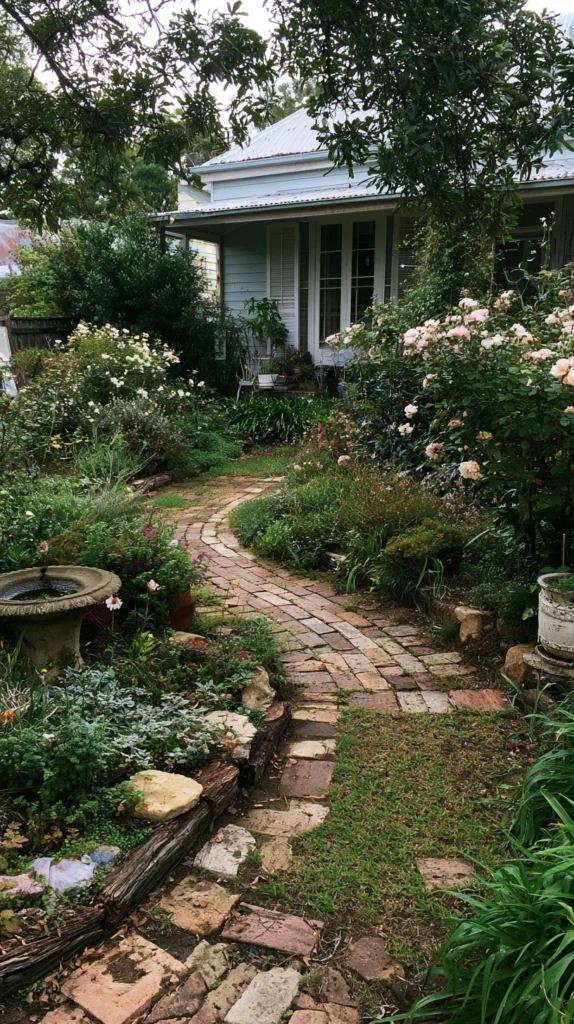
The cottage garden aesthetic is specifically tolerant of, and in fact enhanced by, materials that show their age and their history.
The salvaged brick path that is slightly uneven and has developed moss between its joints. The reclaimed timber sleeper raised bed that has weathered to silver. The terracotta pots of different ages, sizes, and degrees of weathering grouped at the front door. The old stone trough found at a demolition yard that now holds a seasonal planting.
These materials cost nothing or almost nothing. The salvage yard, the roadside skip during a neighbour’s renovation, the end of a local demolition. All of these are sources of materials that suit the cottage garden front yard precisely because of the history and weathering they carry.
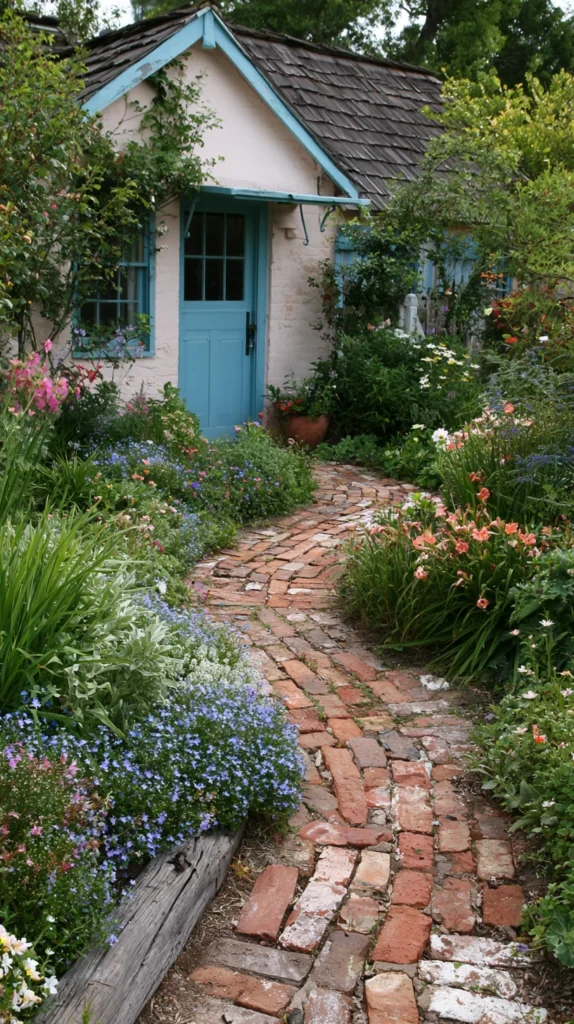
A path of reclaimed bricks laid in a simple pattern costs the labour and the sand for bedding. The bricks themselves, found at a salvage yard or from a local demolition, are a fraction of the cost of new materials and are more beautiful for their weathering and variation than new bricks would be.
Terracotta pots collected one by one from charity shops, car boot sales, and generous neighbours accumulate over time into a collection of varied sizes and ages that is more beautiful than a matching set of new pots from a garden centre and that costs a fraction of the price.
6. Roses for the Front Garden’s Primary Structure
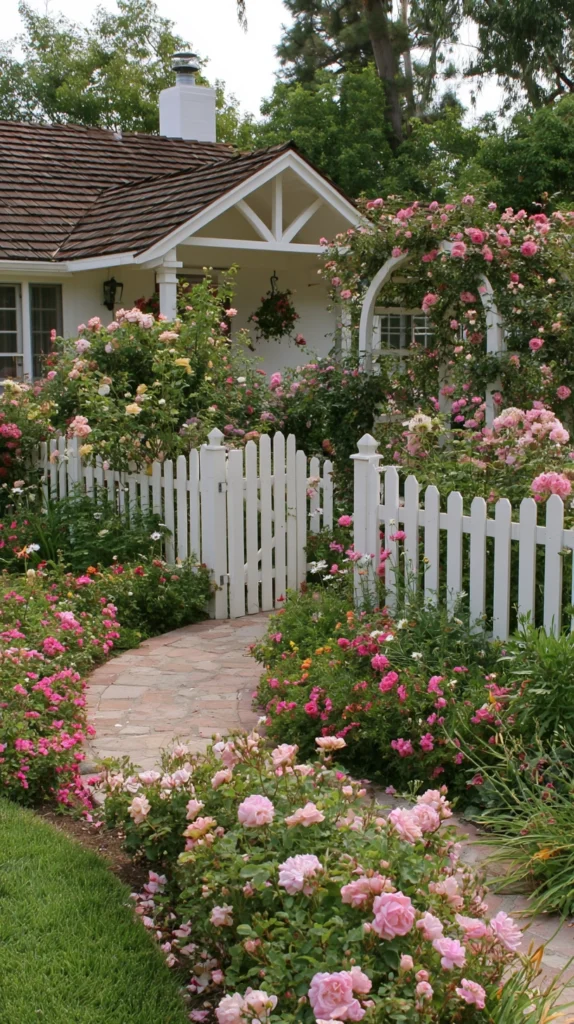
Roses are not the expensive choice in a cottage front yard. They are the investment that pays the longest and the most generous return.
A well-chosen rose planted in good soil in a sunny front garden position flowers from June through October for twenty, thirty, or fifty years with very little intervention beyond an annual prune and a spring feed. The cost per year of flower across the life of a good rose is negligible.
The initial cost of a bare-root rose in autumn is modest, particularly for the widely available varieties that are the cottage garden standards. Rosa Gertrude Jekyll, Rosa The Generous Gardener, Rosa Tottering-by-Gently. These David Austin English roses are the roses most associated with the contemporary cottage garden aesthetic and all are available as bare-root plants in the autumn for very reasonable prices.
Choose varieties for fragrance as well as flower. The front yard rose that can be smelled as people pass the garden is one of the most powerful neighbourhood impressions a cottage front yard can make. A rose without fragrance loses the sensory dimension that makes the cottage garden front yard experience complete.
Plant the roses where they will be seen from the street and the path as well as from the house. The front yard exists partly for the occupants’ pleasure and partly as a generous gift to the street it faces. A generous, fragrant rose in a cottage front yard is a gift to every person who walks past it.
7. Bulbs Planted Through the Borders for Spring Impact
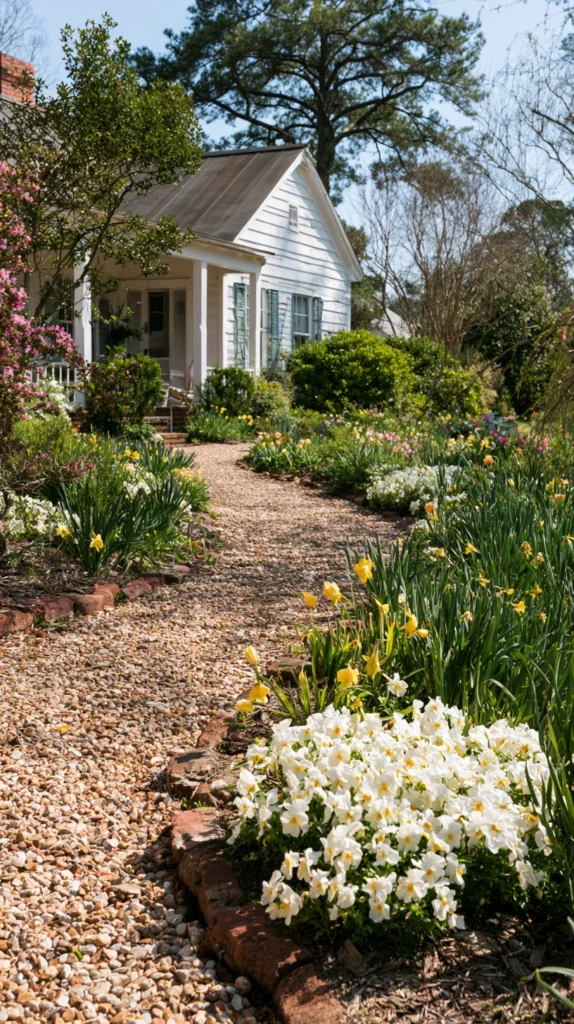
Spring bulbs planted through the cottage garden front yard borders deliver extraordinary colour at a time when very little else is flowering, at a cost that is among the lowest of any garden planting.
A bag of fifty mixed narcissi, planted through a herbaceous border in autumn at a depth of three times their diameter, costs very little and produces a display in March and April that would be impossible to achieve with any other planting at the same cost.
Tulips in the spring cottage front yard need annual replacement to maintain their flowering quality in most soils. But narcissi, alliums, and species tulips, the small, naturalising tulip varieties, persist and increase in the right conditions without any replanting.
Alliums, particularly the species alliums rather than the large-headed hybrid varieties, self-seed with the generosity of annual self-seeders and increase their colony year by year without any investment. Allium hollandicum Purple Sensation, Allium cristophii with its enormous starry sphere, and the dozens of species alliums all seed freely and increase the planting over time rather than diminishing.
Plant bulbs in naturalised drifts rather than in formal rows or circles. The naturalised drift, planted as if the bulbs fell from a height and were planted where they landed, creates the spontaneous, undesigned quality of the cottage garden.
8. A Homegrown Seed Sowing Programme
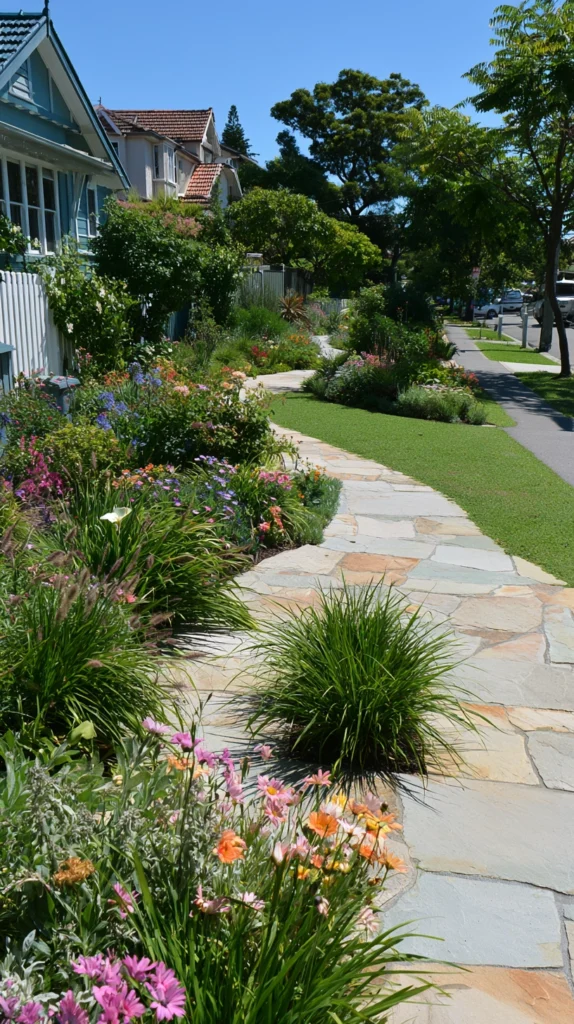
The most budget-conscious approach to cottage front yard planting is the direct sowing of seeds.
A seed packet of mixed cottage annuals, cosmos, cornflowers, love-in-a-mist, candytuft, sweet william, sown directly into prepared ground in spring after the last frost, produces a mixed cottage annual planting of extraordinary generosity for the price of the seed packet.
The direct-sown mixed cottage annual border is the fastest and least expensive way to create the illusion of an established cottage garden in a new or bare front yard. By July the border is full. By August it is spectacular. And the plants that are allowed to set seed at the end of the season provide the beginning of the self-seeding colony that gradually reduces the future need for seed purchase.
Sow in succession every three weeks from the last frost until midsummer. A late sowing in June produces late-season colour that fills the gap between the summer flush and the autumn border. The successive sowings ensure that the border is always at some stage of the flowering cycle rather than having all its colour at once and then nothing.
Collect seed from the best plants at the end of each season. Cornflowers, nigella, and sweet peas all produce seed that stores well over winter and provides next year’s sowing at no cost.
9. Cottage Garden Plants Available From Division at Plant Sales
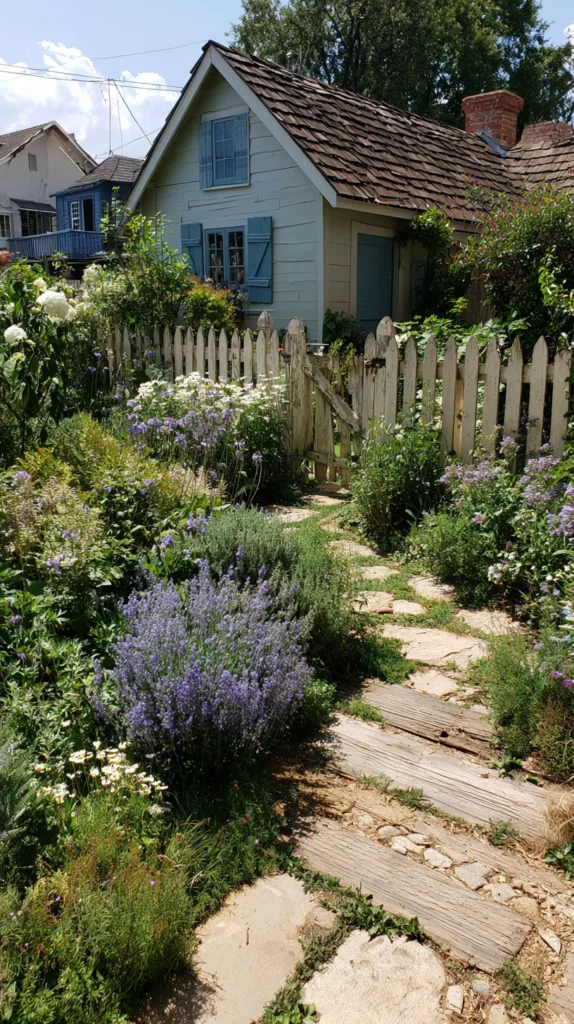
The National Garden Scheme, local horticultural society plant sales, and garden open days are the best budget sources for the specific cottage garden plants that the garden centre rarely stocks.
The named varieties of cottage garden plants, the specific geranium that a gardener has grown for twenty years and loves, the aquilegia cross that appeared spontaneously and has a colour unlike anything in the catalogue, the particularly good form of alchemilla that has the most perfectly pleated leaves, these plants are available only through the personal exchange between gardeners.
Plant sales at these events typically offer quality divisions of exactly these specific plants at prices that reflect the cost of the potting compost and the pot rather than any premium for the plant’s qualities.
Attend these sales early. The best plants sell first. Arrive at opening time with a box for carrying multiple plants, enough cash for a reasonable spend, and the specific knowledge of what you are looking for so the search is efficient.
Build relationships with the gardeners whose plants you admire. The person whose plant sale division produced the most beautiful foxglove you have ever grown is the person to ask about what else they are dividing this autumn.
10. Foxgloves for the Back of the Border
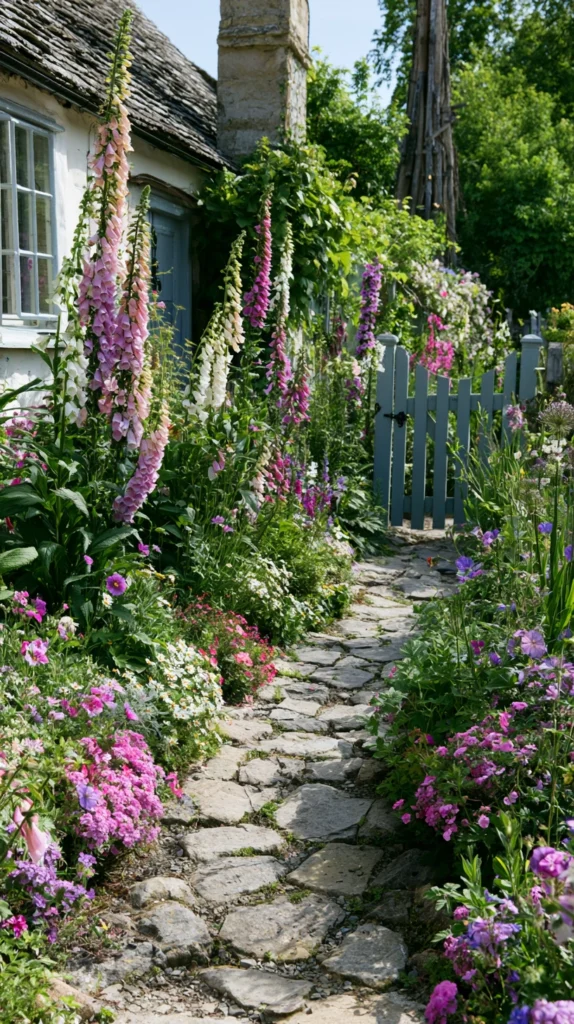
Foxgloves belong in the back of the cottage garden border and they earn their position there completely.
The tall flowering spike of Digitalis purpurea, reaching one and a half to two metres, provides the vertical element at the back of the border that defines the cottage garden silhouette from the street. The speckled tubes of the flower, white and cream and deep pink and purple, the bee-attracting intensity of the throat markings, the way the flower spike continues to produce flowers upward as the lower flowers set seed.
Plant once and let the self-seeding colony establish. After two years a foxglove planting manages itself. The spent plants are removed after seeding. The first-year rosettes that appeared from the previous year’s seed are left in place to flower next year. The cycle continues indefinitely without any further intervention or purchase.
The foxglove is the clearest expression of the self-sustaining cottage garden principle. It asks only that the gardener remove the spent plant rather than all its seed. The rest it does itself.
11. A Front Yard Palette of Three or Four Colours
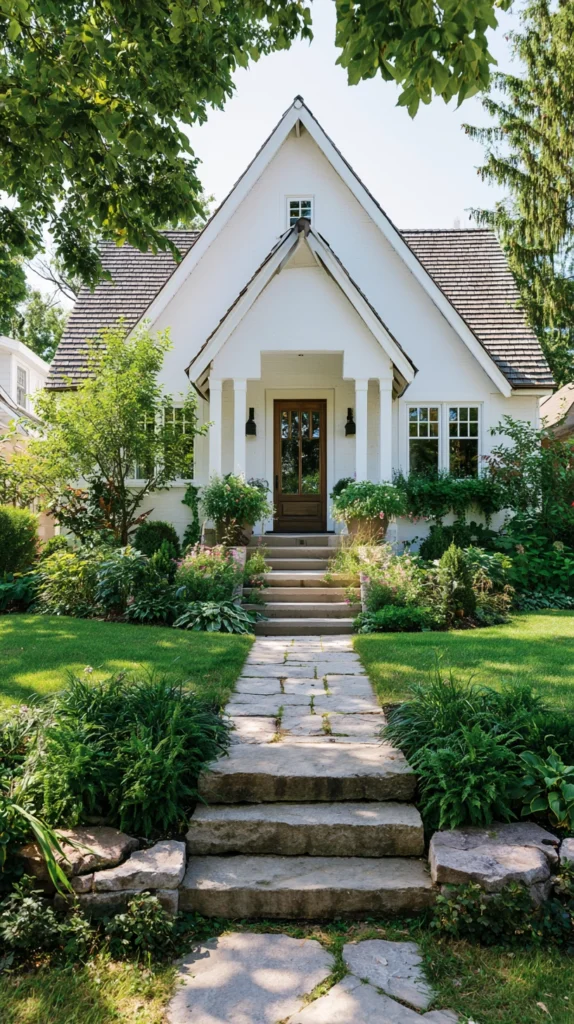
The cottage garden that uses three or four recurring colours throughout the planting reads as designed rather than random.
The recurring colours do not need to be the colours of a specific plant variety. They can be the result of choosing plants whose natural palette overlaps. The soft purples and blues of catmint, salvia, allium, and lavender. The warm pinks and deep reds of the rose, the geranium, and the sweet william. The white and cream that runs through the cosmos, the foxglove’s pale forms, and the honesty’s seed pods.
These colour families recur naturally in cottage garden planting because the plants that belong together in the style tend toward the same palette. Working with these natural colour affinities rather than introducing additional palette elements keeps the front yard planting coherent without any specific planning effort.
The colour palette also makes the plant selection process simpler and less expensive. Within the soft purple and blue palette, choose the plants that are most available at the best price from the sources available at the time of planting. The palette remains consistent regardless of which specific plants fulfil each part of it.
12. A Gate and Arch for Vertical Structure
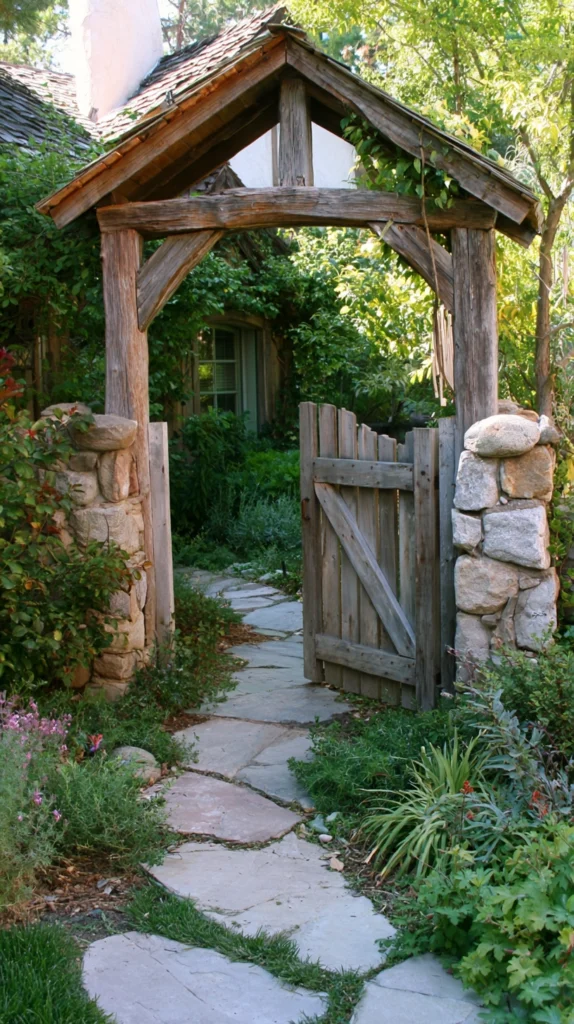
The garden arch over the gate or the front path is the structural element that most completely communicates the cottage garden aesthetic from the street.
The sight of a garden arch with a climbing rose in full flower above the gate is one of the most compelling garden images available in any front yard. It stops people. It communicates instantly the character of the garden beyond.
A garden arch does not need to be expensive. Galvanised steel arches are available at moderate prices and last for decades with minimal maintenance. A simple timber arch built from pressure-treated timber in an afternoon produces the same structural and visual function at a fraction of the cost of an ornate metalwork alternative.
The climbing plant on the arch should be chosen for the specific conditions at that position. Full sun for the full-flowering climbing roses. Partial shade for the clematis varieties that handle lower light. The right plant in the right position develops vigorously and produces the generous display that the arch’s visual promise requires.
The arch adds the vertical dimension to the front yard at the point where it is most needed. The transition from the public pavement to the private garden is defined by the arch. Passing through it is the gesture that marks the movement from the street to the garden, and a well-planted arch makes this transition feel like an occasion.
13. Cottage Garden Perennials That Spread and Share
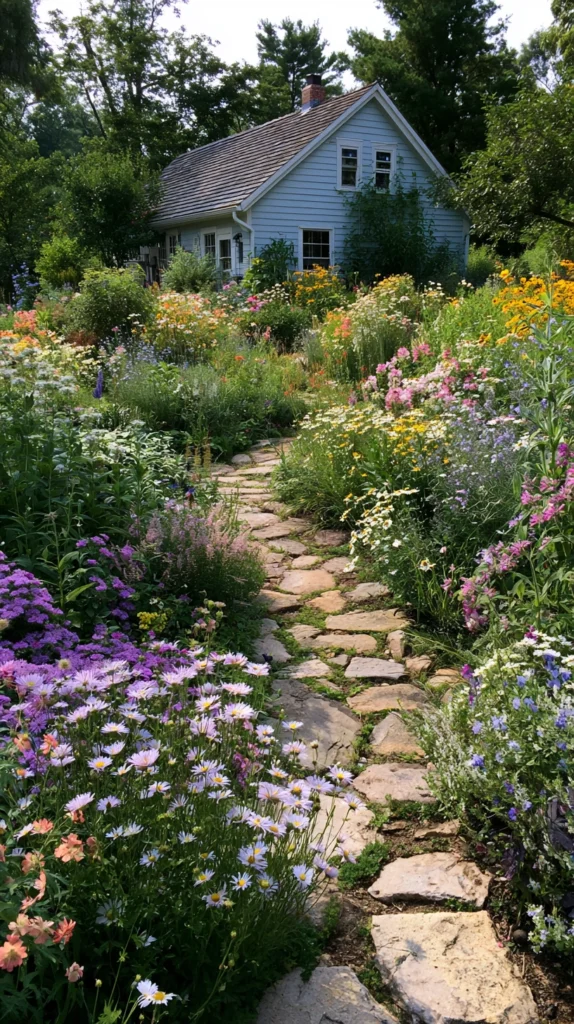
The best budget cottage garden perennials are the ones that spread themselves generously and that can be divided and shared with minimal effort.
Hardy geraniums, Geranium pratense and its varieties, Geranium psilostemon, Geranium endressii and its forms, all spread by both root division and by seed into steadily larger clumps and colonies. A single plant purchased in year one becomes a clump that can be divided into four or six plants in year three. Each division can fill a new area or be shared with another gardener.
Achillea, yarrow, spreads by underground runners and forms dense colonies that are easily divided. Its flat-topped flower heads in cream, yellow, and warm red suit the cottage garden palette and the dried seed heads persist through winter as architectural interest.
Phlox paniculata, the border phlox, produces fragrant flower heads in July and August in whites, pinks, and purples. It spreads by short runners and can be divided in early spring before the new growth reaches ten centimetres. One plant becomes five in two years.
These spreading perennials are the budget cottage gardener’s best friends because they self-supplement at a rate that reduces the need for new plant purchases while increasing the border’s density and colour.
14. The Patience to Let It Develop
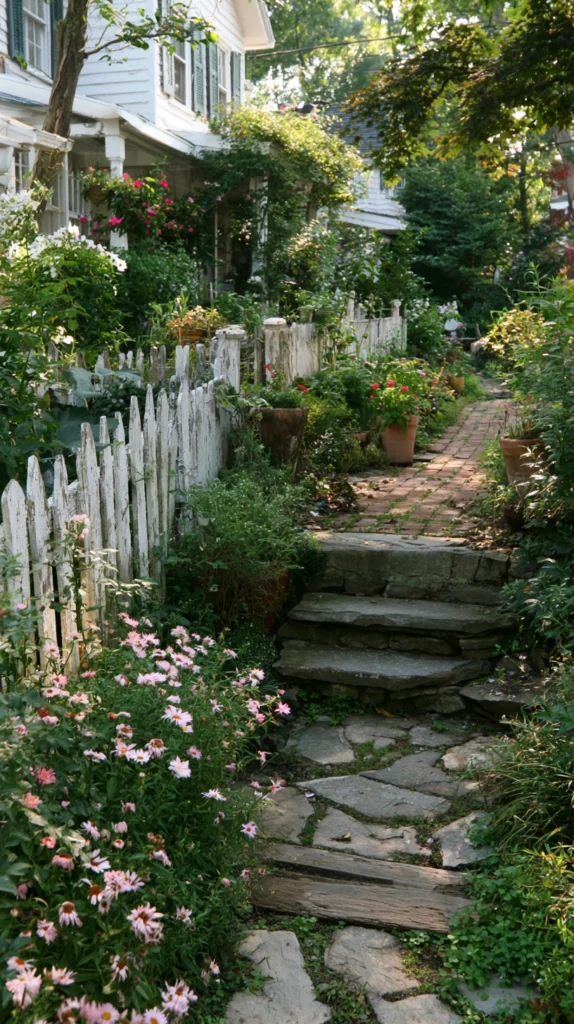
The final idea in a list of budget cottage garden ideas is the one that costs nothing.
Wait.
The cottage garden front yard that impresses on the first visit to a house was not created in a single season. It developed over years. The rose that covers the fence now was a bare stick in the first winter. The foxgloves that appear spontaneously in every bare patch of soil arrived from seed produced by the three foxgloves planted four years ago.
The cottage garden is a style that rewards patience more specifically than any other garden style. Each year brings more plants, more self-seeding, more division, more colour, more of the generous abundance that is the cottage garden’s defining quality.
Plant the initial core of plants in the first year. The climber on the fence. A few key perennials in the borders. The self-seeding annuals to cover the ground while the perennials establish. And then wait.
By year three the garden has a character that was not visible in year one. By year five it looks as if it has been there for much longer than it has. By year ten the cottage garden front yard has the specific quality of a garden that has found itself, that has selected its own plant combinations and its own balance through the process of natural growth, self-seeding, and the gradual dominance of what grows best in those specific conditions.
This is the cottage garden in its fullest expression. And it was achieved not by spending more but by planting right and waiting long enough.
How to Build a Budget Cottage Front Yard Over Three Years
Year one is the infrastructure year.
Plant the climber on the fence or wall. Install any structural hard landscaping with salvaged materials. Plant the rose. Scatter the self-seeding annuals to cover bare ground. Plant three or four key perennials that will form the planting’s backbone.
Year two is the filling year.
Divide the perennials that are ready to divide. Add the gaps that the first year revealed. Collect seed from last year’s best plants and sow it. Seek out the plant sale divisions that will supplement the backbone planting.
Year three is the beginning of abundance.
The self-seeding plants have established their first colonies. The perennials are filling their spaces. The rose is beginning to cover the fence. The garden is starting to look like a garden rather than a planting.
From year three onward the garden manages itself increasingly. The role of the gardener shifts from planting to editing. Which self-seeded plant to keep and which to remove. Which clump to divide and which to leave to fill further.
The budget cottage front yard is not an instant garden. It is a garden that accumulates its beauty over time. The investment is not money. It is attention and patience and the willingness to let the plants do what they do best.
Common Mistakes in Budget Cottage Front Yard Design
Trying to do everything in year one. A budget cottage front yard planted entirely in year one requires a budget that is not modest. Plant the structural elements and let the garden develop from there.
Buying expensive plants that are available cheaply from other sources. Many cottage garden plants are widely grown and widely available from divisions, seeds, and plant sales at a fraction of their garden centre price. Research the alternative sources before purchasing.
Planting in rows or formal patterns. The cottage garden’s informal quality comes from the irregular spacing and the naturalistic grouping of plants. Formal rows and circles look formal regardless of the plant species they contain.
Removing self-seeded plants without assessing their position. The self-seeded foxglove that appeared in the middle of the path needs moving. The self-seeded foxglove that appeared at the back of the border in a gap between two perennials is exactly where it should be. Assess each self-seeded plant on its specific position before removing it.
Neglecting the soil. Cottage garden plants perform significantly better in soil improved with organic matter than in poor, unimproved soil. A single investment in compost and well-rotted manure spread across the borders before the first planting pays back in dramatically better plant performance across every subsequent year.
Being too tidy. The cottage garden requires a specific tolerance for the slightly out-of-control. The catmint that has flopped over the path, the rose hip still on the plant in November, the dried seed head of the allium swaying in the autumn wind. These are the details that make a cottage garden look like a cottage garden rather than a managed border.
Quick Summary
- Self-seeding plants including foxgloves, honesty, aquilegia, and Californian poppy establish once and produce plants indefinitely at no further cost
- Divisions and cuttings from neighbours, garden open days, and local plant sales provide quality plants at a fraction of garden centre prices
- A single bare-root climbing rose planted on the front fence is the highest-impact cottage front yard addition per pound spent
- Path edging with lavender, catmint, and alchemilla creates the specific informality of cottage style at the most visible location
- Salvaged bricks, reclaimed timber, and found terracotta pots provide hard landscaping and container materials that suit the cottage aesthetic precisely
- A well-chosen David Austin bare-root rose planted in autumn provides decades of generous flowering for a modest initial investment
- Spring bulbs planted in naturalised drifts, particularly narcissi and alliums, provide spectacular spring colour at very low cost
- Direct-sown cottage annuals including cosmos, cornflowers, and sweet william cover bare ground generously from a single affordable seed packet
- National Garden Scheme and local horticultural society plant sales provide unusual named varieties at prices reflecting cost rather than quality
- Foxgloves planted once establish a self-sustaining colony that manages itself without any further planting investment
- A palette of three or four recurring colours creates coherence without planning effort because cottage garden plants naturally share colour families
- A garden arch over the gate, planted with a climbing rose, creates the defining cottage front yard architectural element from a moderate investment
- Spreading perennials including hardy geraniums, achillea, and phlox divide readily to provide free supplementary plants each year
- The most important budget cottage garden investment is patience, the garden’s quality increases with each passing year without additional expenditure
- Build in year one with the structural backbone, fill in year two with divisions and self-seedings, and let abundance develop from year three onward
The cottage garden front yard is not the result of money spent.
It is the result of time passed.
Time for the self-seeded foxgloves to establish their colony. Time for the climbing rose to cover the fence. Time for the borders to fill in from the edges of established clumps meeting each other in the middle. Time for the garden to become more itself each year than it was the year before.
Plant what you can afford in the first year.
Then wait.
The garden knows what to do.