15 Unique Red Kitchen Backsplash Designs for a Modern Look
Red is the kitchen’s most committed color choice and its most rewarding one for those willing to make the commitment fully.
There is no halfway with red in the kitchen — a timid application produces a result that reads as uncertain rather than daring, that captures the attention without satisfying it, that raises the question of whether the color was truly chosen or simply tolerated.

Red, chosen with genuine conviction and deployed with genuine intelligence, on the other hand, produces a kitchen of extraordinary energy and warmth that no other color can match.
The backsplash is the ideal canvas for red in the kitchen precisely because it is bounded — the backsplash has defined edges and a defined context, which allows red to make its full impact within a controlled field rather than overwhelming the entire room.
The kitchen with a red backsplash can be — and usually should be — otherwise restrained in its use of color, letting the backsplash carry the chromatic weight while the cabinets, countertops, and flooring provide the neutral ground that allows the red to sing at its full intensity.
The range of red available in backsplash materials is broader than most people realize, from the deep burgundy of aged terracotta to the high gloss of lacquered subway tile to the complex veining of quartzite with red mineral inclusions, and each version of red creates an entirely different kitchen character. Here are fifteen ideas for using this most powerful of kitchen colors with intelligence, confidence, and style.
1. Classic Red Subway Tile in a Modern Running Bond
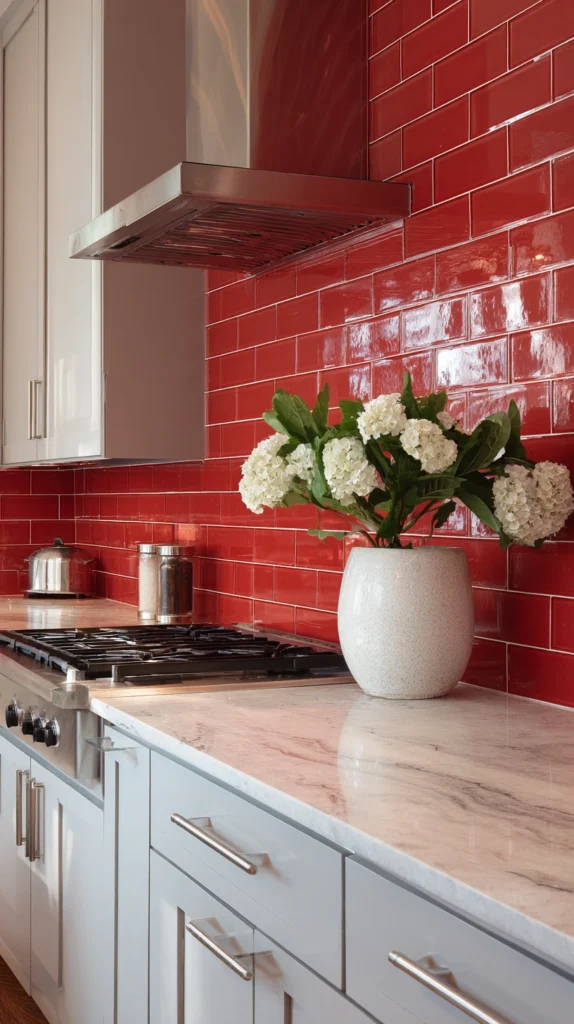
The red subway tile is perhaps the most immediately recognizable red backsplash option, and its longevity in the design canon reflects the fact that the combination of the tile’s simple rectangular form, its glazed reflective surface, and the particular quality of red that ceramic glazing produces creates a backsplash of reliable, transferable beauty.
The subway tile format — its horizontal orientation, its regular grout lines, the slight variation in glaze depth across the tile’s surface — is so resolved as a backsplash design that it requires almost no additional design support to succeed, and in red its energy and warmth transform the kitchen without requiring any other bold color decision in the room.
The modern application of the classic red subway tile is the running bond arrangement — staggered horizontal courses rather than a stacked pattern — which creates a dynamic horizontal rhythm that suits contemporary kitchen architecture while maintaining the familiar tile format.
Choose a grout color that complements rather than competes with the tile: a mid-gray grout creates a graphic contrast that emphasizes the tile grid; a terracotta grout creates a warmer, more unified surface; a white grout creates the maximum contrast and the cleanest contemporary result.
2. Handmade Terracotta Zellige for Artisanal Warmth
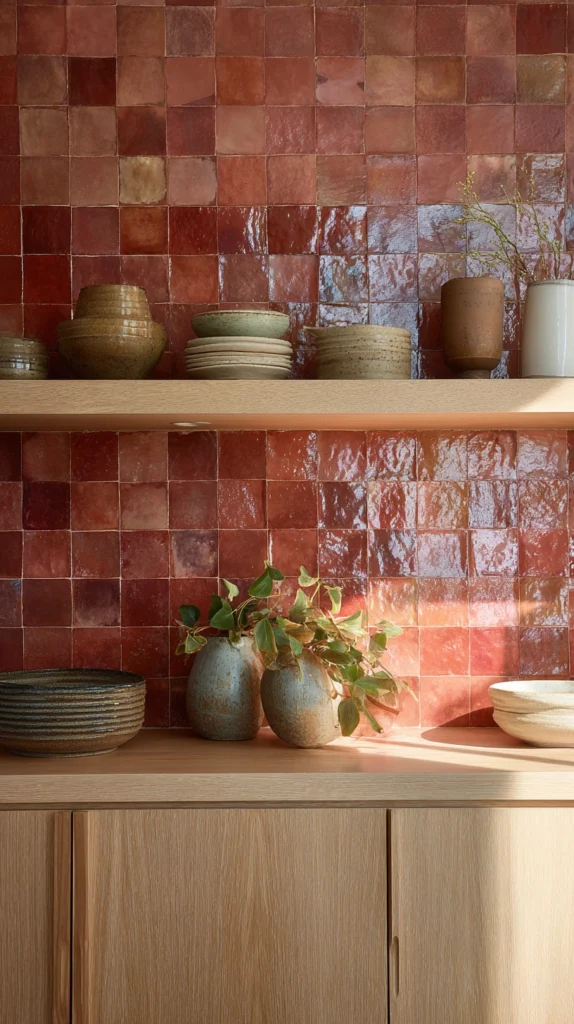
Zellige tile in a terracotta red — the Moroccan hand-cut ceramic whose irregular surface and multi-tonal glaze creates a shimmering mosaic effect rather than the uniform surface of machine-made tile — is the red backsplash option with the deepest material warmth and the most complex visual character available.
The zellige’s surface variation means that no two tiles are identical in color or reflectivity, and the assembled backsplash creates a red surface that appears to shift and shimmer as the light changes and as the viewer moves across the kitchen — an effect that flat, uniform tiles cannot replicate.
The warm, slightly brown-toned red of terracotta zellige suits the natural material kitchen — timber cabinetry, stone countertops, warm concrete floors — with extraordinary appropriateness, and the handmade quality of the tile relates to the material honesty that the natural interior values. Pair zellige in terracotta red with warm white cabinetry and a marble or limestone countertop for the most resolved and most classically beautiful result.
3. Full-Height Red Lacquered Glass Backsplash
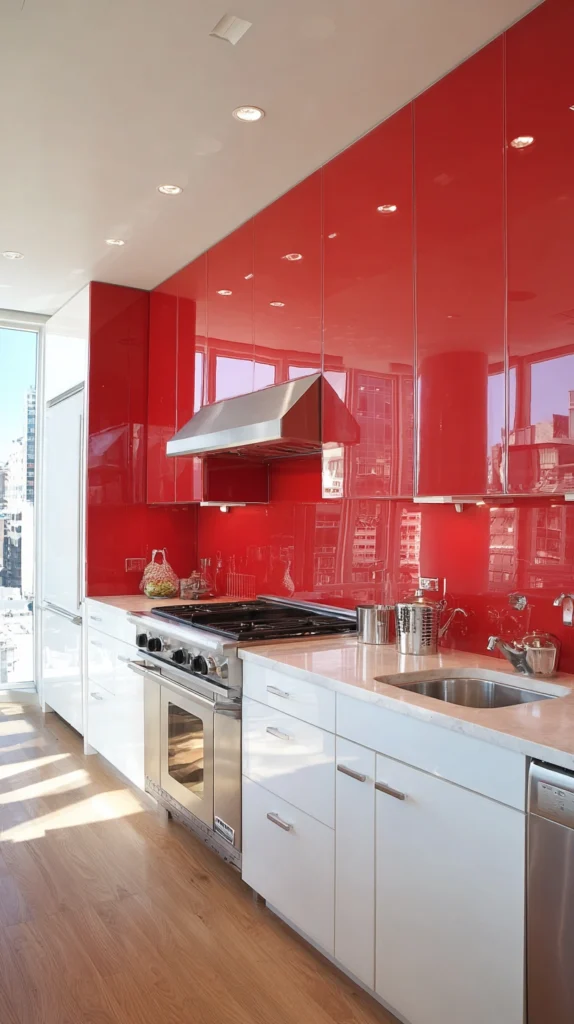
A full-height backsplash in lacquered glass — a single continuous pane of toughened glass with a red lacquer applied to its rear face, creating a seamless, joinless surface from countertop to cabinetry — is the red backsplash at its most contemporary, most minimal, and most dramatically impactful.
The glass’s mirror-like surface reflects the kitchen’s light, the movement within the space, and the colors of the surrounding surfaces, creating a red backdrop that is simultaneously a fixed element and a dynamic reflective field.
The lacquered glass backsplash has a practical advantage alongside its aesthetic one: the seamless surface has no grout lines, no tile joints, and no surface irregularities that collect grease and food residue, making it the most hygienic and the most easily cleaned backsplash option available.
The red of the lacquer can be specified precisely to a paint reference, allowing the backsplash color to be calibrated exactly to the surrounding palette — a quality that tile and stone backsplashes, whose colors are fixed by the material’s production process, cannot provide.
4. Burgundy Red Brick Slips for Industrial Character
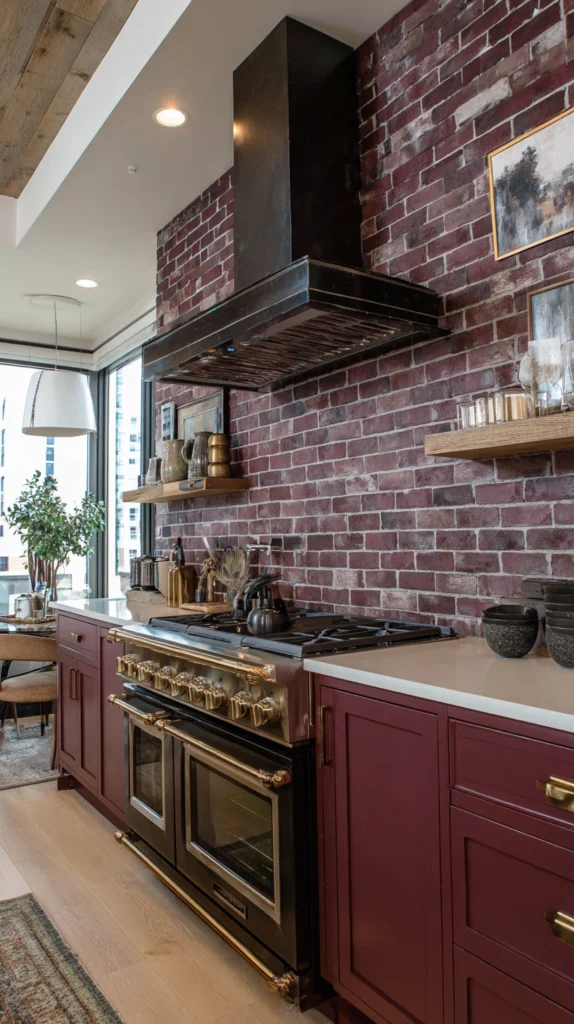
Brick slip tiles — thin sections of genuine brick face, or ceramic tiles manufactured in a convincing brick format — in a deep burgundy red create a backsplash with the weight and warmth of exposed brickwork without the structural implications of a genuine brick wall.
The brick format’s irregular surface texture and the natural color variation within a burgundy red brick — the slight shifts from deep wine red to warm brown to almost black at the corners and edges — creates a backsplash of considerable material depth that relates to the industrial and urban kitchen aesthetics where exposed brick is most commonly referenced.
Pair burgundy brick slip tiles with matte black cabinetry and industrial-style pendant lighting for the most resolved industrial kitchen result, or with natural timber cabinets and concrete countertops for a warmer, more organic interpretation of the same material reference.
5. Red Encaustic Patterned Cement Tiles
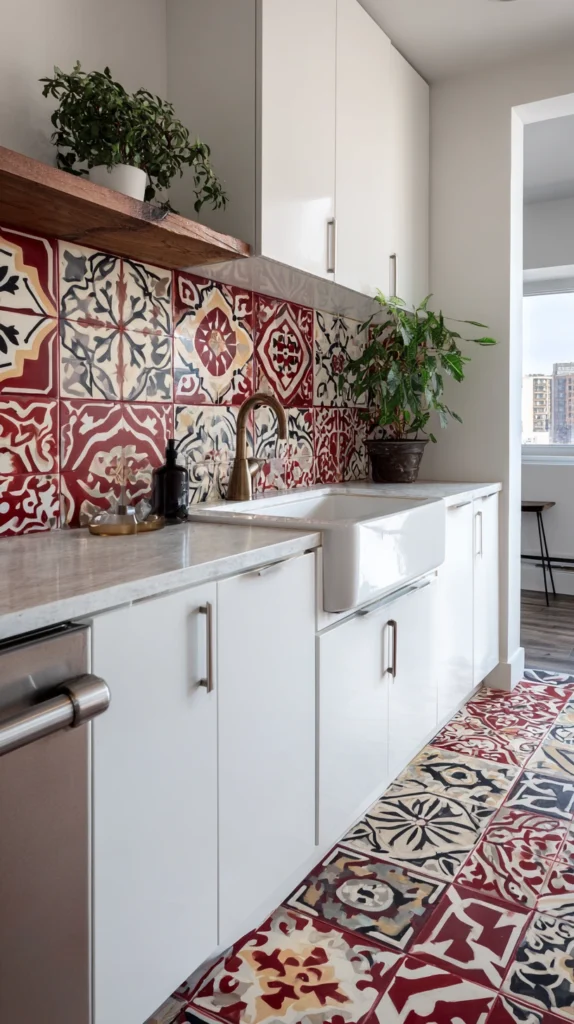
Encaustic cement tiles — hand-poured tiles in which pattern is created by colored cement layers rather than by surface decoration — are available in an extraordinary range of traditional and contemporary patterns, and the versions that incorporate red within a geometric or floral pattern create a backsplash of considerable decorative ambition and cultural richness.
The Moroccan and Spanish tile-making traditions in particular have produced patterns of extraordinary complexity and beauty that use red as one element within a multi-color geometric composition — stars, diamonds, arabesques, and organic floral motifs in which red appears alongside cream, black, navy, and terracotta.
A backsplash in patterned encaustic tile with red as the dominant note creates a kitchen focal wall of maximum decorative impact, and the rest of the kitchen should be calibrated to let the tile’s complexity read without competition — plain white cabinetry, simple stone countertops, minimal hardware.
6. Cherry Red Glossy Large-Format Ceramic Tiles
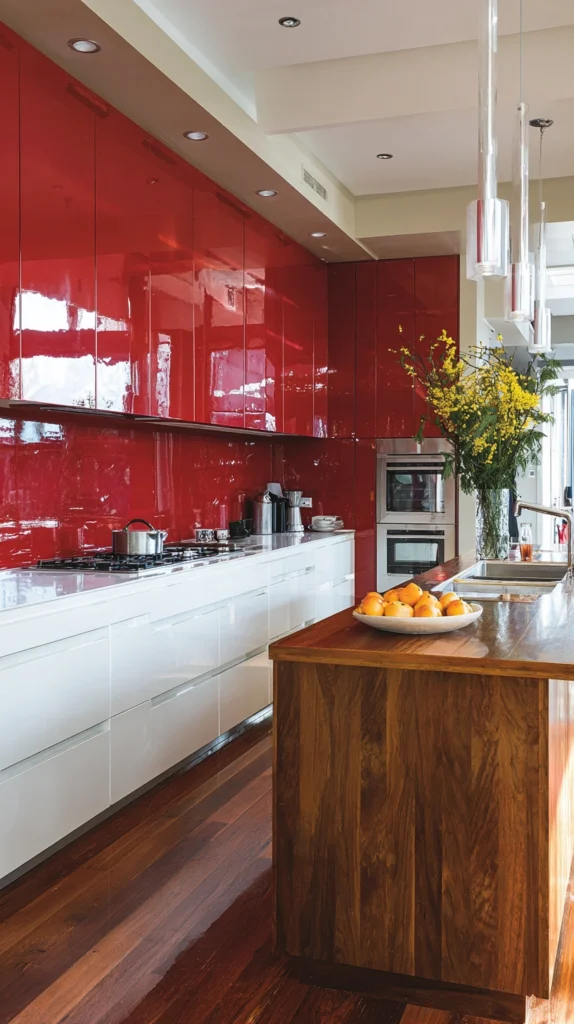
Large-format ceramic tiles — tiles of six hundred by twelve hundred millimeters or larger, installed with minimal grout joints — in a pure, saturated cherry red create a backsplash whose impact comes from the uninterrupted field of color rather than from the texture or pattern of the tile surface.
The large format reduces the grid of grout lines to a minimum, allowing the color to read as a continuous plane that approaches the seamlessness of painted or glass surfaces while maintaining the ceramic’s material warmth and the slight surface variation that differentiates the ceramic glaze from a purely flat lacquered surface.
The high gloss finish of cherry red large-format ceramic tiles creates a reflective quality that brightens the kitchen by bouncing light from the backsplash across the room, and the purity of the cherry red — neither the brown-tinged warmth of terracotta nor the blue-tinged cool of a true crimson — suits the contemporary kitchen with stainless steel appliances and flat-front cabinetry in a way that more complex red tones cannot match.
7. Red Quartzite or Marble with Natural Veining
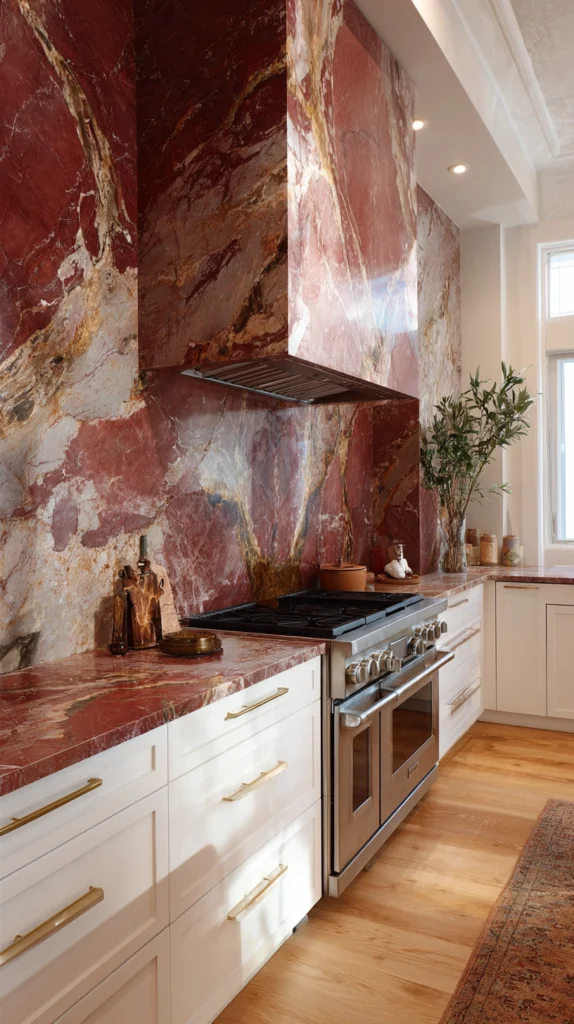
Natural stone in a red-toned quartzite or marble — the Rosso Levanto, the Red Dragon, the various quartzites with deep red mineral inclusions and dramatic white or gold veining — is the red backsplash for the kitchen where luxury material is the primary design priority.
The natural stone backsplash is not a flat color application but a geological composition — its red is the product of iron mineral content distributed through the stone over millions of years, and the veining that runs through it is the record of geological forces that no manufactured material can replicate.
A full-height natural stone backsplash in a red quartzite, installed in continuous slabs with minimal jointing, creates a kitchen feature of extraordinary material presence that justifies its significant cost through the sheer irreplaceable uniqueness of the material. Pair with simple, high-quality cabinetry in a natural timber or a deep painted tone that allows the stone to be the room’s primary material statement.
8. Red Spanish Talavera Tiles for Maximum Pattern
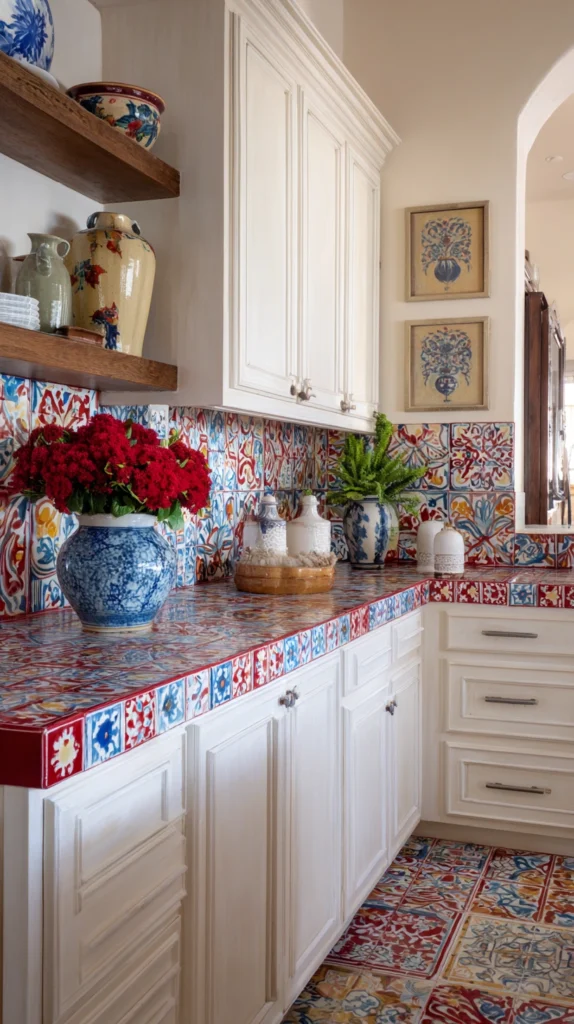
Talavera tiles — the hand-painted Mexican and Spanish ceramic tradition whose characteristic white tin glaze is decorated with bold patterns in cobalt, red, yellow, and green — create a backsplash of extraordinary folk art richness and cultural warmth that is entirely unlike any of the more restrained red backsplash options on this list.
The red in Talavera tiles is typically a warm, slightly orange-toned terracotta rather than a pure primary red, and it appears within patterns of considerable complexity and naivety — animals, flowers, geometric borders — that transform the backsplash from a background surface into the kitchen’s primary decorative feature.
This is a maximalist choice that requires the courage of its convictions and a surrounding kitchen designed with great restraint — plain white walls, simple cabinets, nothing competing with the tiles’ exuberant pattern — to be fully successful.
9. Red Penny Round Mosaic Tiles
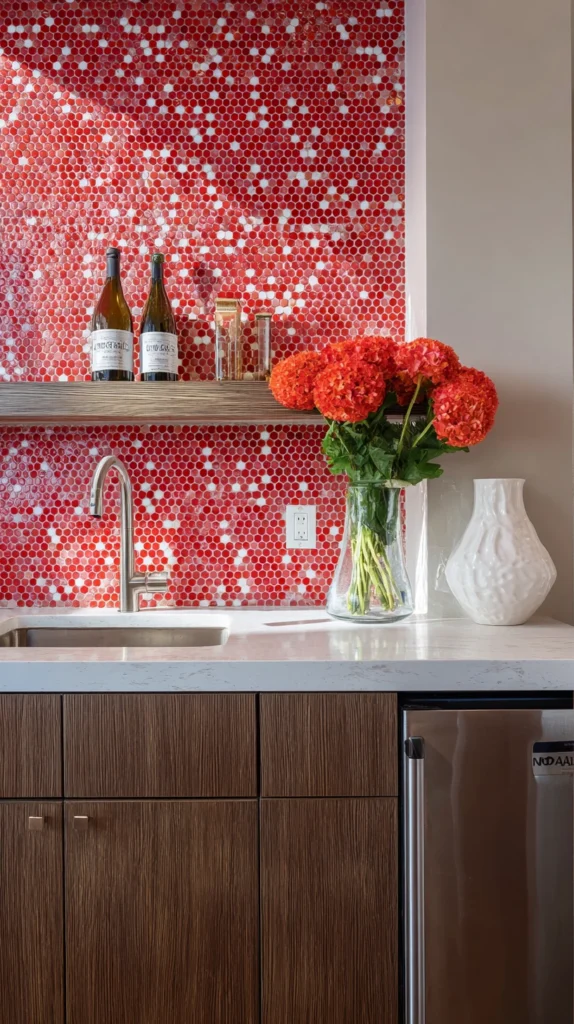
Penny round mosaic tiles — small circular ceramic or glass tiles arranged in a grid pattern on mesh backing sheets for installation — in a deep red or a range of red tones create a backsplash of fine, intricate pattern whose overall color reads as a rich, complex red that no single-color application can approach.
The penny round format creates a surface that is simultaneously regular — the circular tiles arranged in a consistent grid — and organically varied — the slight irregularity of hand-applied tile and the texture of the circular edges creating a surface whose visual character is closer to a fabric or mosaic artwork than to a conventional tiled surface.
The grout between the penny rounds is a significant design decision — white grout creates a graphic, almost polka-dot pattern within the red field; a red or terracotta grout creates a more unified surface where the tile circles are less visually distinct.
10. Matte Red Cement Effect Porcelain Tiles
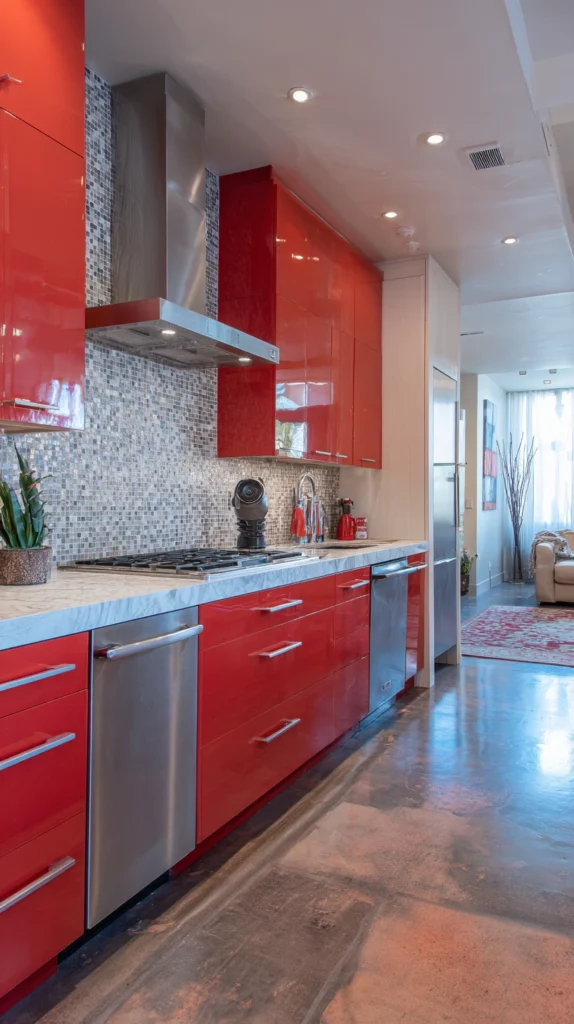
Porcelain tiles with a matte finish in a cement effect — their surface mimicking the texture and color variation of poured concrete rather than the smooth glaze of conventional ceramic — in a deep, complex red create a backsplash with an unusual combination of industrial material reference and warm, saturated color.
The matte cement effect surface does not reflect light in the way that glossy tiles do, which gives the red a different quality of presence — denser, more absorbing, more like the surface of a painted wall than the surface of a glazed tile.
This matte quality suits contemporary kitchens where a restrained, material-honest aesthetic is the organizing principle, and the cement effect texture adds surface interest without the pattern complexity of encaustic or printed tiles.
11. Red Glass Mosaic with Mirror Insert Tiles
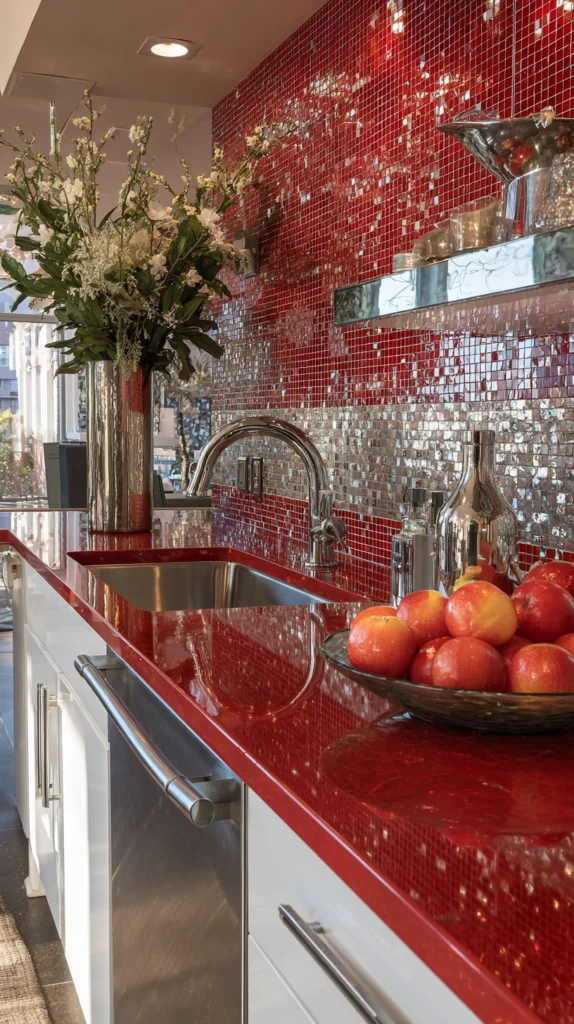
A red glass mosaic backsplash — small glass tiles in a saturated red, installed in a sheet mosaic pattern — supplemented with occasional mirror-finish insert tiles distributed through the mosaic at irregular intervals creates a backsplash whose surface sparkles and shifts as the kitchen’s light changes and as the viewer moves across the space.
The mirror inserts catch light from different angles than the surrounding glass tiles, creating points of intense reflection within the red field that add a festive, animated quality to the backsplash surface.
This is a kitchen backsplash that is most spectacular in the evening, when the kitchen’s artificial lighting creates the strongest reflective contrast between the red glass and the mirror inserts — a quality that makes the kitchen a genuinely beautiful evening space as well as a functional daytime one.
12. Deep Red Handmade Ceramic Tiles with Texture
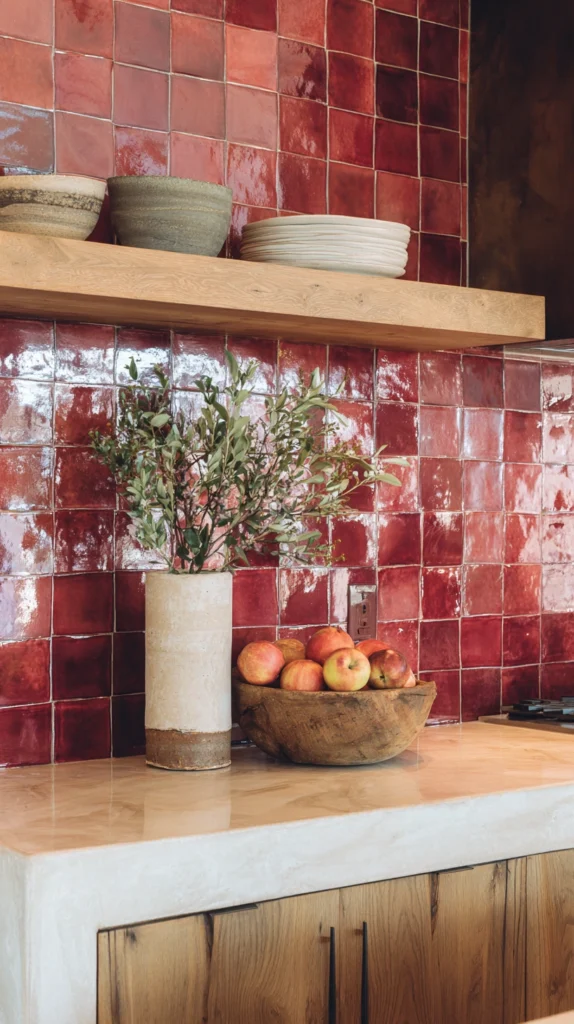
Handmade ceramic tiles in a deep red — tiles whose surface has been given a texture through the hand-throwing, pressing, or finishing process that machine-made tiles cannot replicate — create a backsplash of extraordinary artisanal quality that reflects a genuine craft tradition.
The texture of a hand-made tile surface — the slight undulation, the thumb marks preserved in the clay, the irregular glaze pooling in the tile’s lower areas — gives the assembled backsplash a quality of life and human presence that machine-perfection cannot approach.
These tiles suit the kitchen that values craft, material honesty, and the beauty of the imperfect, and they work best alongside natural materials — timber, stone, hand-beaten copper hardware — that share their commitment to the non-industrial aesthetic.
13. Red and White Geometric Pattern Tile
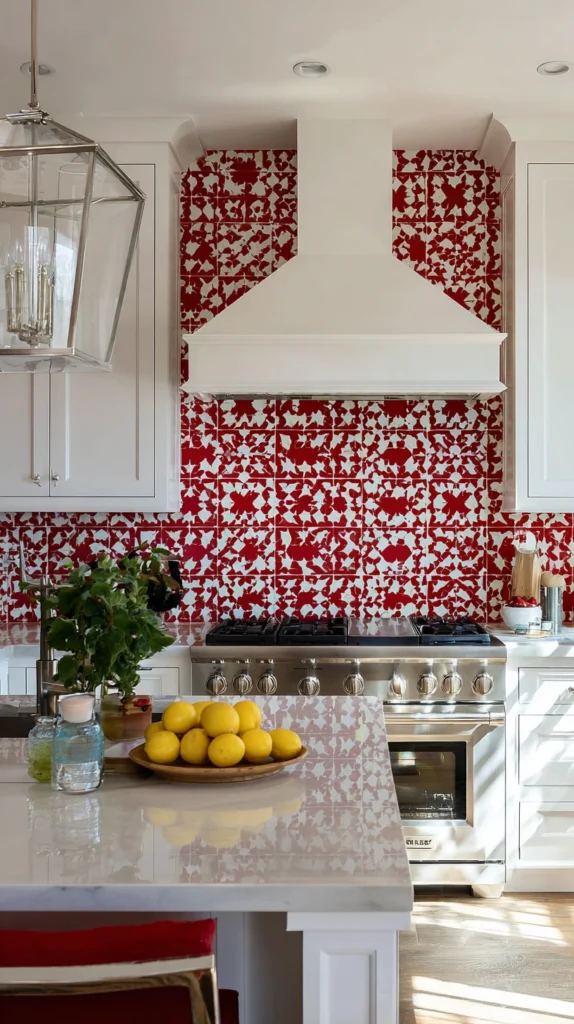
A geometric pattern tile in red and white — whether a traditional checkerboard, a Moroccan-influenced star-and-cross pattern, or a contemporary abstract geometric — creates a backsplash whose impact comes from the interaction between the two colors rather than from either alone.
The red and white combination is one of the most graphically powerful available in the tile-making palette, and the geometric pattern amplifies this power by creating a precise, rhythmic composition that rewards attention from across the kitchen as well as at close range.
The pattern’s scale relative to the backsplash area is a critical design decision: large-scale patterns in small kitchens create maximum impact per tile but may be cut awkwardly at the edges of the backsplash area; smaller-scale patterns accommodate edge cuts more gracefully and create a more refined, textile-like surface effect.
14. Red Arabesque or Lantern-Shaped Tiles
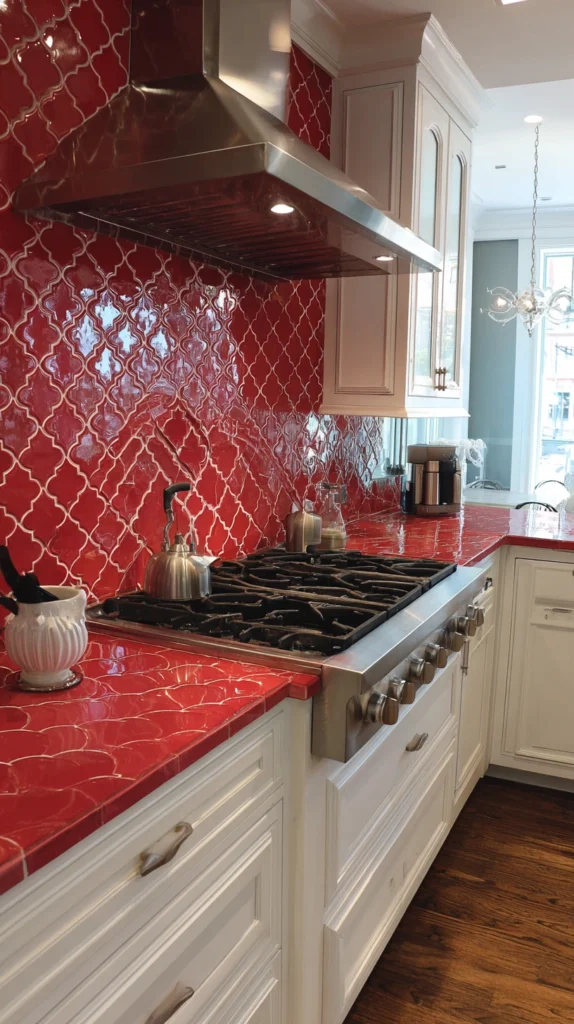
The arabesque or lantern-shaped tile — a tile cut in an elongated, curved form that interlinks with adjacent tiles to create a continuous geometric pattern across the assembled backsplash — is the format that most completely transforms the backsplash from a surface covered in tiles to a surface that is itself a designed pattern.
In a saturated red with a gloss or satin glaze finish, arabesque tiles create a backsplash of extraordinary decorative sophistication — the flowing curves of the individual tile shape creating an organic pattern rhythm that the strict geometry of rectangular and square tiles cannot produce.
The arabesque format’s curved edges also catch light differently from those of flat-edged tiles, creating a surface that seems to move and shift as the light changes direction, which gives the backsplash a dynamic quality unusual in a fixed surface.
15. A Mixed Red Tone Backsplash in a Gradient Composition
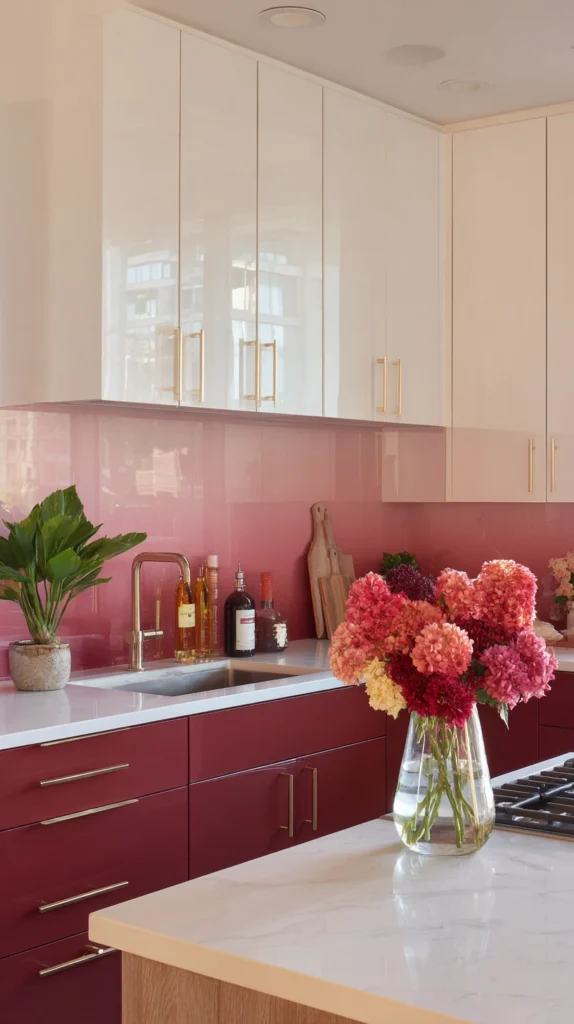
The final red backsplash idea is the most compositionally ambitious: a backsplash assembled from tiles in a range of related red tones — from a pale blush at one edge through warm terracotta to deep burgundy at the other — arranged in a deliberate gradient that creates a chromatic transition across the backsplash’s full width.
The gradient composition treats the backsplash as a single, unified design rather than a surface covered in a single tile choice, and the transition from light to dark — or from one red family to another — across the kitchen wall creates a visual depth and compositional interest that a single-tone backsplash, however beautiful its individual tile, cannot achieve.
This approach requires careful specification and sourcing to ensure that the gradient tones are compatible in material type and glaze character, and it is most successfully executed with a tile specialist who can advise on the specific tiles and transitions that will achieve the desired chromatic effect.