15 Stylish Corner Decor Ideas That Transform Blank Areas
Corners are the home’s great untapped resource. Every room has at least four of them, most rooms have more when you account for architectural features and furniture arrangements, and the vast majority of them in the vast majority of homes are doing absolutely nothing — standing empty, collecting dust in their crease, and representing an opportunity for both beauty and function that is simply not being taken.
The reason corners are so consistently neglected is partly practical and partly psychological.
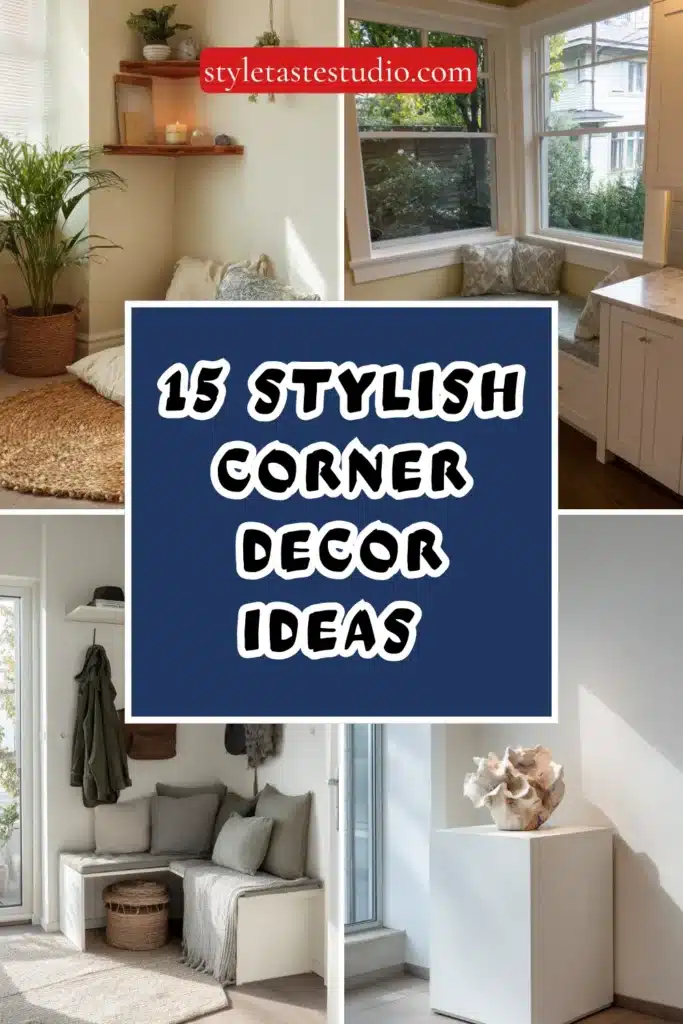
Practically, standard furniture is designed for walls and open floor areas, not for the specific geometry of a ninety-degree meeting of two planes. Psychologically, the corner sits at the periphery of the room’s visual field — it is not the focal wall, not the center of the arrangement, not the first thing the eye lands on — and so it tends to escape the decorating attention that more prominent surfaces receive.
This neglect is a mistake that is remarkably easy to correct once you start looking at corners not as the leftover space between walls but as defined areas with their own specific character and their own specific opportunities. Here are fifteen ideas for transforming them from blank areas into the room’s most interesting and most considered details.
1. The Tall Houseplant Statement
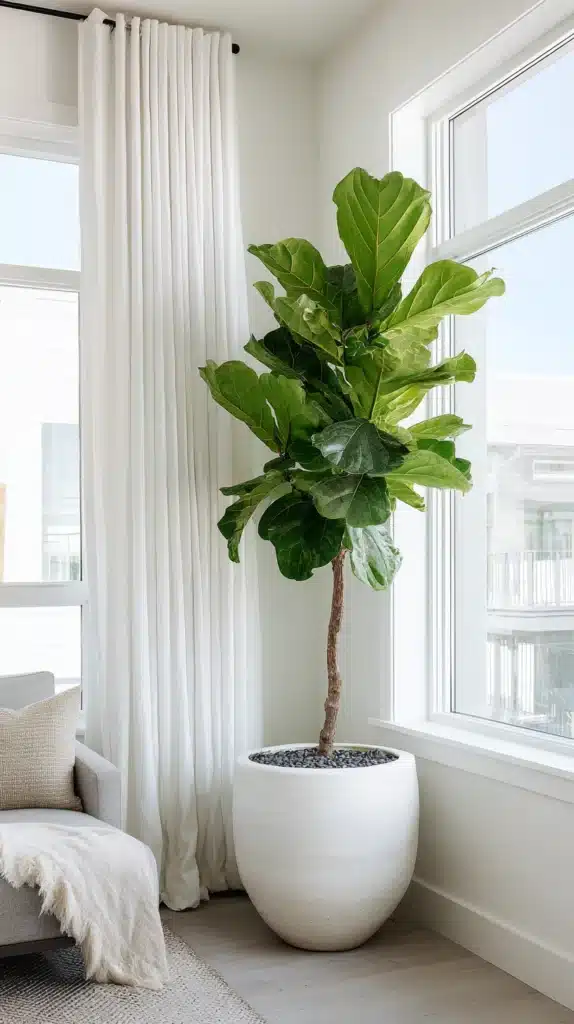
The tall indoor plant is the corner solution that requires the least effort and delivers among the highest returns of any option available, and yet it is consistently underutilized relative to its transformative potential.
A corner is structurally ideal for a large plant — it provides support on two sides for plants that grow tall and broad, it gives the plant’s silhouette a backdrop that allows its form to be read clearly, and it elevates the plant from a piece of furniture to an architectural element by filling a vertical space that furniture cannot occupy.
A fiddle-leaf fig, a bird of paradise, a tall Monstera deliciosa, a Strelitzia nicolai, or a large olive tree in a generous ceramic or terracotta pot positioned in a corner with good natural light creates a room feature of considerable presence and beauty.
The plant should be genuinely large — undersized plants in oversized corners look hesitant and lost — and the pot should be sized generously enough that the whole composition has visual weight. Add a simple saucer in a complementary material and a thin layer of decorative gravel on the soil surface for a finished, considered look.
2. A Floor Lamp and Reading Chair Arrangement
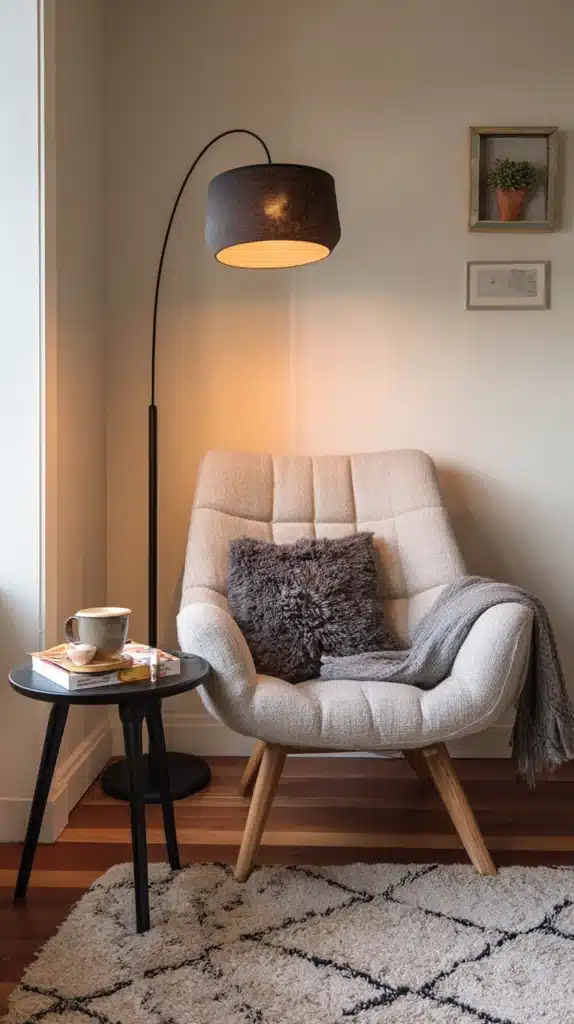
The reading corner — an armchair or small accent chair positioned in a corner with a floor lamp arching over it and a small side table beside it — is one of interior design’s most enduringly useful and most immediately welcoming arrangements, because it creates a destination within the room that has a clear and comfortable purpose. The psychological effect of a lit corner with a chair in it is powerful: the eye is drawn to it, the mind interprets it as an invitation, and guests and family members alike will gravitate toward it instinctively. The floor lamp is the organizing element — it should arch over the chair with enough clearance that reading is comfortable, and it should be at a height and wattage that provides genuinely useful task illumination rather than purely decorative ambient light.
Choose a chair whose scale suits the corner — a large, deeply cushioned armchair fills a generous corner with appropriate visual weight, while a smaller accent chair suits a tighter space. The side table should be low enough to place a drink on without reaching, and small enough not to dominate the arrangement.
3. A Corner Shelving Unit for Display and Storage
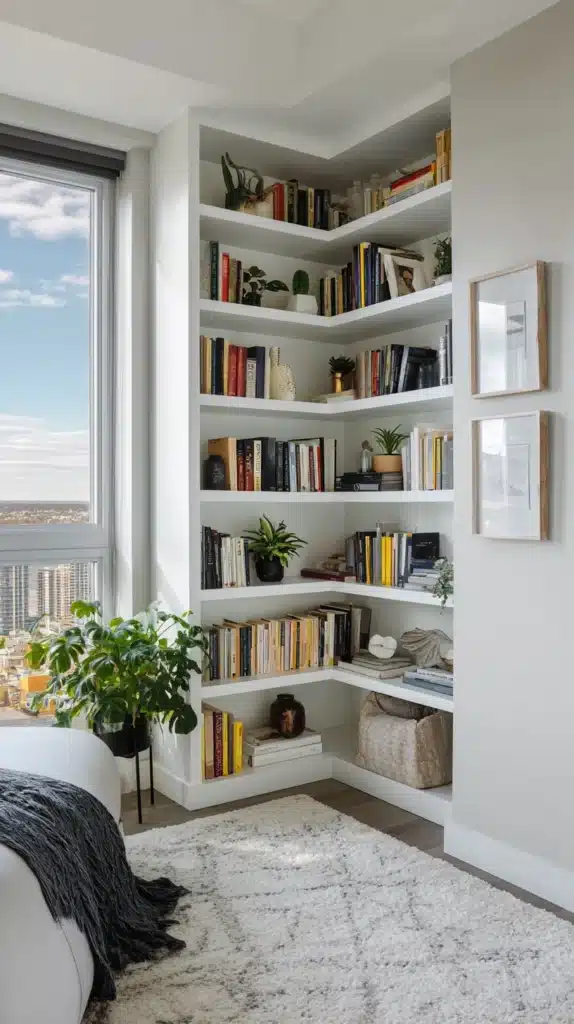
A shelving unit designed specifically for corners — the triangular or L-shaped shelf unit that fits precisely into a ninety-degree angle — makes use of space that standard rectangular shelving cannot occupy without projecting awkwardly into the room. Corner shelves can range from a simple set of floating triangular brackets in a staircase corner to a substantial floor-to-ceiling built-in unit that creates a library corner of real architectural presence.
The built-in corner bookcase is particularly effective in sitting rooms and studies, where the combination of the two walls’ surfaces creates a shelved area of considerable depth and the diagonal or curved front edge of the unit gives the room’s corner an architectural definition it would not otherwise possess.
Style the shelves with a mixture of books, plants, objects, and art rather than filling them uniformly with any single type of content, and vary the arrangement across different shelves to create the organic, accumulated quality that makes a shelf feel lived-in rather than dressed.
4. A Gallery Wall That Wraps the Corner
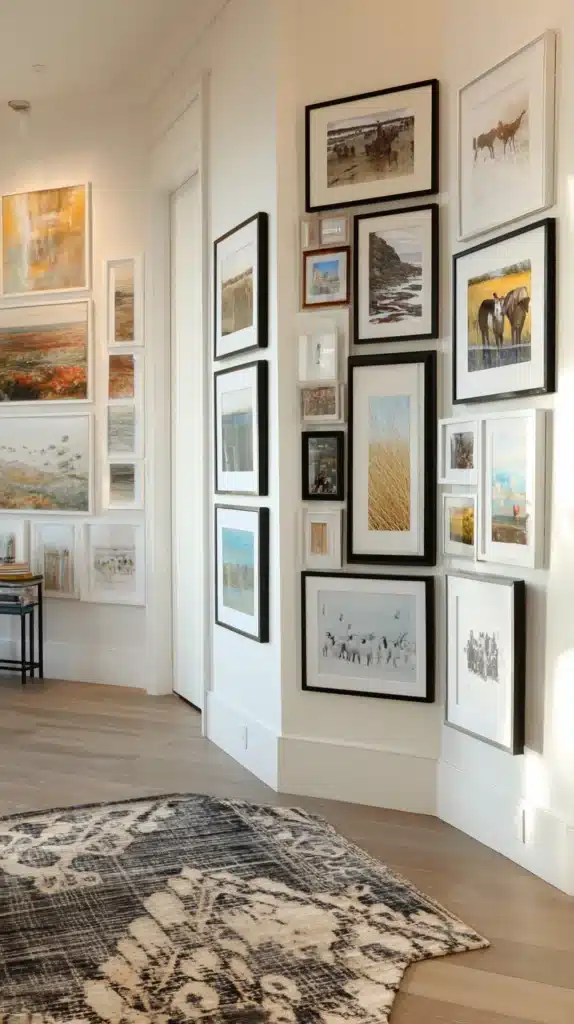
The conventional gallery wall runs along a single plane — one wall, one surface, a flat composition. The corner gallery wall breaks this convention by wrapping around the corner’s angle and continuing onto the adjacent wall, creating a composition that has depth and dimension as well as surface.
The effect of art that turns a corner is both unexpected and extremely satisfying — it gives the corner a sense of being fully inhabited by the gallery rather than simply bordered by it, and it creates a viewing experience that changes as you move around the room and see different angles of the composition from different positions.
The corner should be treated as the composition’s center — the most important or most striking piece positioned at the apex of the corner angle, with the arrangement radiating outward along both walls from that central point. Use consistent or complementary frames throughout the composition to maintain the visual coherence that a multi-surface gallery wall requires.
5. A Sculptural Object on a Plinth or Pedestal
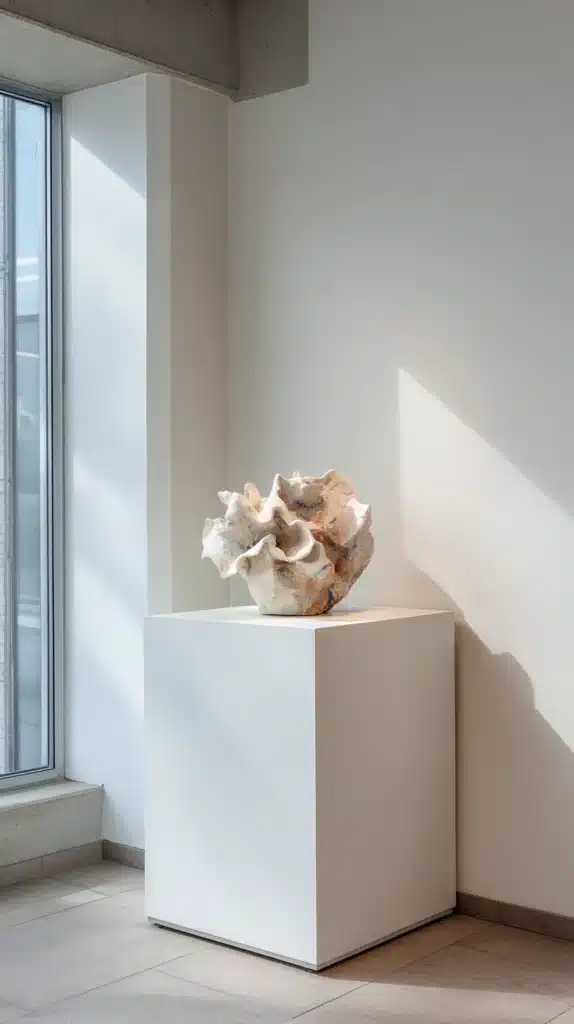
The plinth — a simple geometric form, typically a cylinder or rectangular solid, used to elevate an object to display height — is one of the designer’s most effective tools for transforming a corner from empty to intentional, and it works precisely because of its simplicity.
A white plinth or a natural stone or timber pedestal positioned in a corner, with a sculptural object placed on its top surface, creates a corner vignette that has the formal quality of a museum display without the stuffiness — it is simply a beautiful object given the elevation and space it deserves.
The object itself can be anything with genuine sculptural presence: a piece of ceramic art, an abstract sculpture, a large natural form like a piece of driftwood or a spectacular rock crystal, a found industrial object whose form you find compelling.
The plinth should be tall enough that the object it displays sits at eye level or slightly below when standing, and its diameter or width should be narrower than the object it supports so that the object reads as the focus rather than the base.
6. A Corner Fireplace or Bioethanol Burner
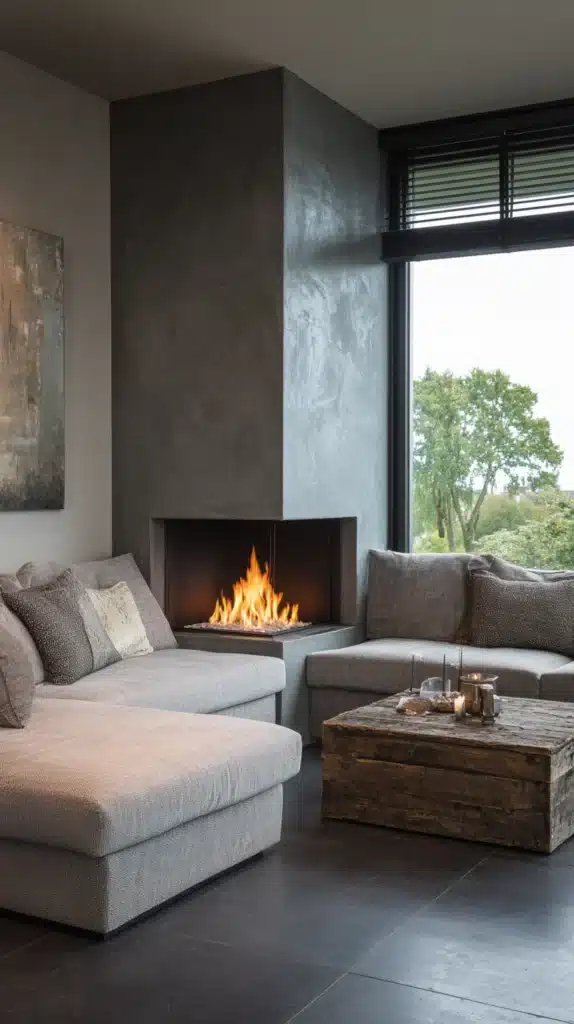
A corner-positioned fireplace or freestanding bioethanol burner transforms the room’s least significant spatial position into its most socially significant one — the place everyone orients toward, the point around which seating naturally arranges itself.
Corner fireplaces are available in a range of built-in configurations that fit precisely into the corner angle, and freestanding bioethanol burners designed for corner positioning bring the warmth, light, and social magnetism of fire to any corner without the infrastructure requirements of a conventional fireplace.
The seating arrangement around a corner fire should reflect the fire’s new role as the room’s focal point — chairs and sofas angled toward the corner rather than toward the more conventional wall-facing orientation that the room might otherwise suggest.
A simple hearth or tile treatment around the fire’s base and a minimal mantel or shelf above it complete the corner feature without requiring the architectural complexity of a traditional fireplace installation.
7. A Hanging Macramé or Textile Art Installation
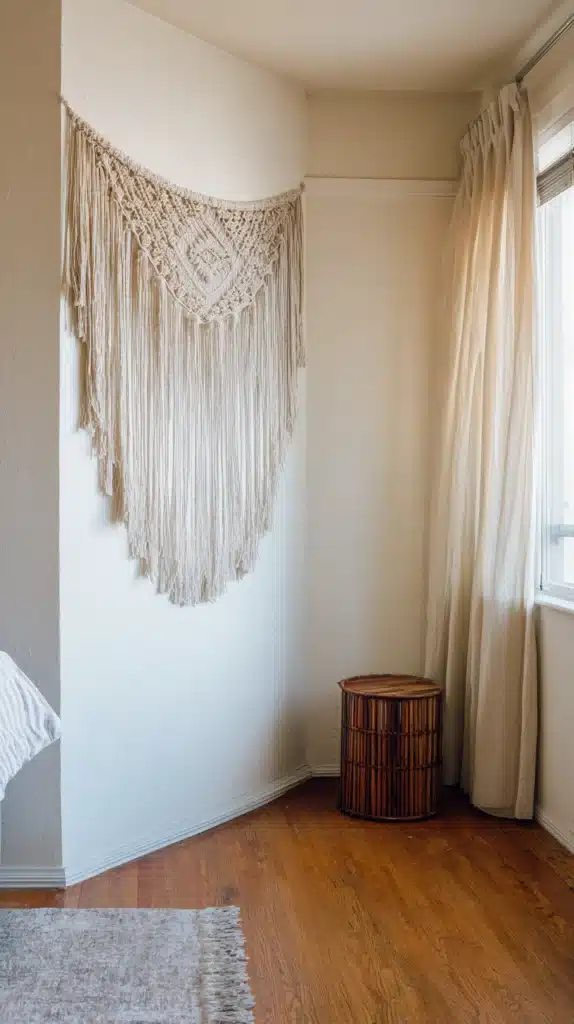
The corner of a room, where two walls meet at a vertical line, creates a natural anchor point for hanging textile art or macramé installations that use the corner’s three-dimensionality rather than simply treating it as a flat surface.
A large macramé wall hanging positioned across the corner angle — attached to both walls rather than hanging flat against one — creates a textile element with genuine spatial presence, a softness that fills the corner volume rather than simply decorating its surface.
Alternatively, a textile art piece hung from the ceiling at the corner’s apex and falling to near-floor length creates a vertical feature that uses the full height of the corner and introduces material warmth, texture, and movement into a space that hard architectural surfaces alone cannot provide.
Choose natural fiber macramé in undyed or earthy tones for the warmest, most organic result, and ensure the installation is large enough — in width and length — to fill the corner without appearing tentative.
8. A Corner Desk and Workspace
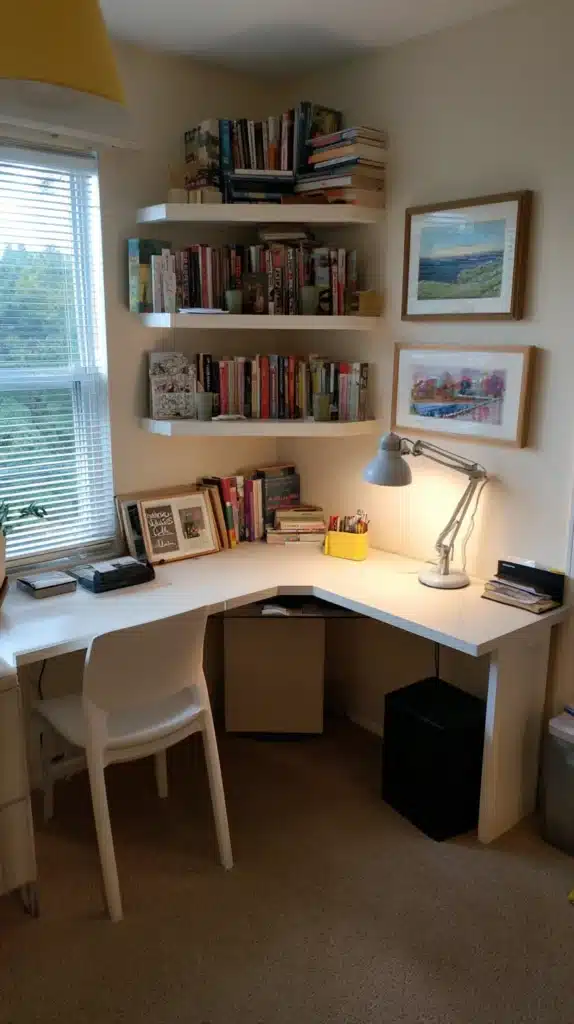
The corner desk — an L-shaped work surface that occupies both walls of a corner, positioning the user within the angle with work surfaces extending on both sides — is the most space-efficient home office configuration available in any room, because it converts a corner that would otherwise contribute nothing to the room’s function into a fully equipped workspace that leaves the main floor area uncompromised.
A well-designed corner desk setup should include proper task lighting — a desk lamp or wall-mounted lights on both sides to eliminate the uneven illumination that single-light setups create — organized cable management, and sufficient storage integrated into the desk’s surface or the shelving above it to contain the visual clutter that a workspace generates.
The styling of the corner above the desk — a small gallery wall, a floating shelf with plants and objects, a magnetic board for notes and inspiration — transforms the workspace from purely functional to genuinely pleasant to occupy for extended periods.
9. A Corner Coat and Bag Hook Arrangement
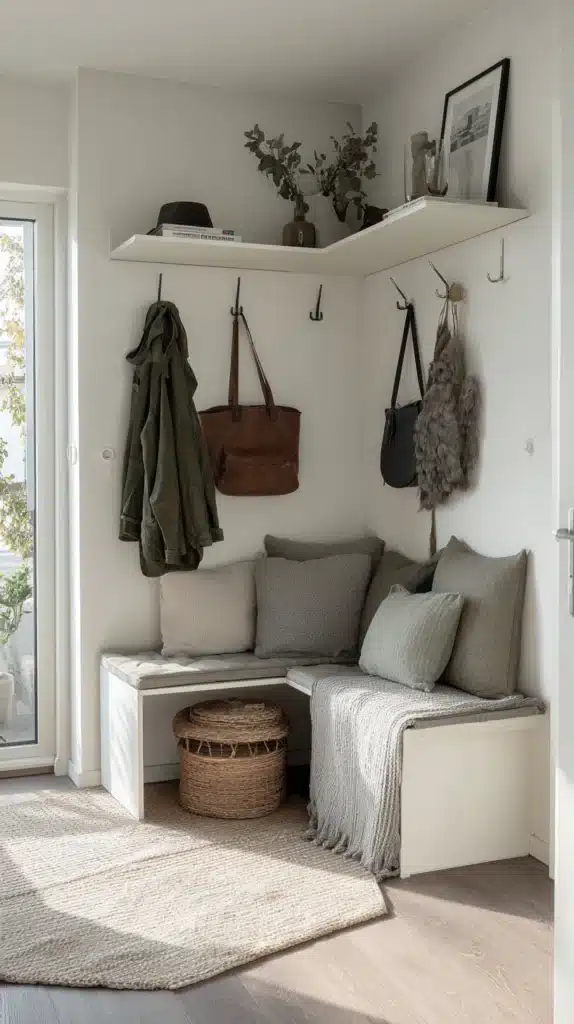
The entry corner — the corner nearest the front door or the transition point between entrance and main living space — is one of the most practically valuable corners in any home, and equipping it with a well-designed hook arrangement transforms it from a space where coats accumulate chaotically on a single hook to an organized and visually considered entry system.
A row of hooks installed across both walls of the corner at coat height, supplemented by a higher row for bags and a lower row for children’s items where relevant, creates a hook arrangement with considerably more capacity than a single-wall installation and a more interesting visual composition — the hooks wrapping around the corner rather than running in a single line.
Add a small shelf above the hooks for keys, mail, and small objects, and a shoe rack or basket below, and the corner becomes a complete entry system that is also a decorative element of genuine consideration.
10. A Corner Wet Bar or Drinks Station
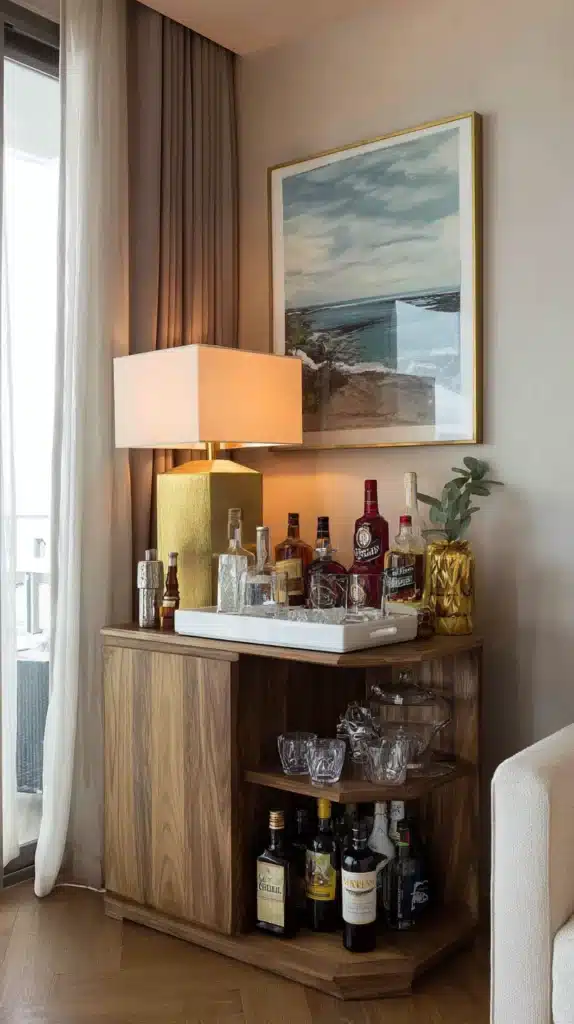
A corner dedicated to the drinks station — a small bar cart or a built-in cabinet configuration designed for the corner angle — creates an entertaining feature that uses the corner’s two-wall geometry to create a display of bottles, glassware, and bar accessories of considerable visual richness.
A corner drinks station benefits from being slightly illuminated — LED strip lighting inside a built-in cabinet, or a small lamp on the surface of a corner bar cart — because the warm light on glass and bottle creates an amber glow that draws the eye and gives the corner a distinctly festive, welcoming quality in the evening.
Position this corner in a living room, dining room, or open-plan kitchen area where it is visible and accessible during entertaining, and style it with the same attention you would give a well-dressed interior sideboard — a few carefully chosen objects alongside the functional items, a small plant or botanical detail, a candle or two.
11. A Corner Bench with Storage Below
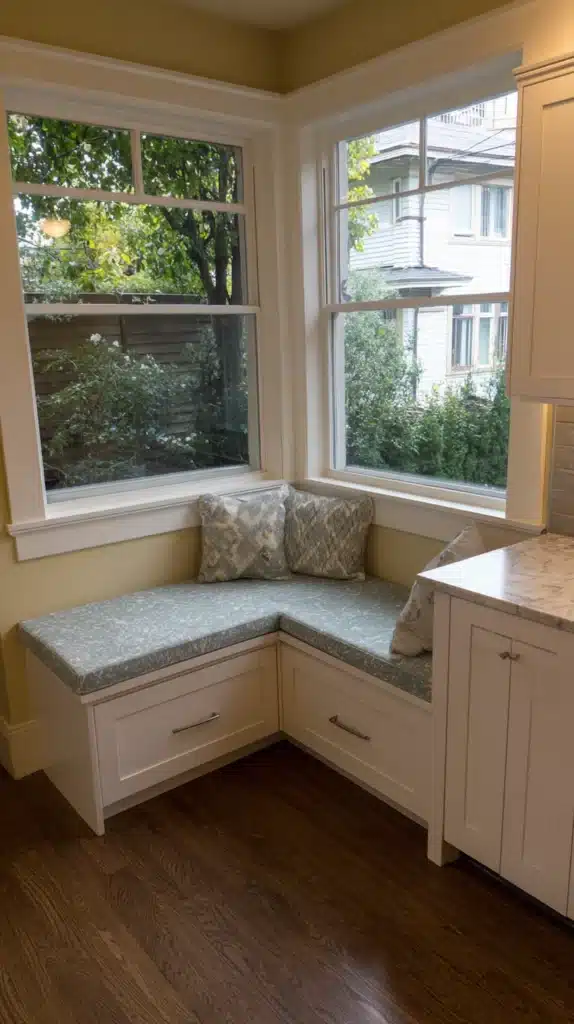
A corner bench — a built-in L-shaped seat fitted into a corner with storage drawers or cabinet doors below the seat surface — is the corner solution that combines the highest ratio of practical function with genuine visual appeal.
In a kitchen, bedroom, hallway, or children’s room, the corner bench occupies space that a rectangular bench cannot use, provides seating for multiple people in a compact footprint, and conceals a generous volume of storage within its base. The seat cushion should be fitted rather than simply placed — a fitted cushion with piped edges looks built rather than improvised, and its fabric choice is the corner bench’s primary aesthetic statement.
A velvet cushion in a deep jewel tone against painted white bench woodwork is a combination of considerable elegance. A durable woven outdoor-style fabric in a natural tone suits a practical family context. The corner bench’s visual simplicity makes it one of the most versatile corner solutions available across every interior style.
12. A Vertical Garden Wall in a Corner
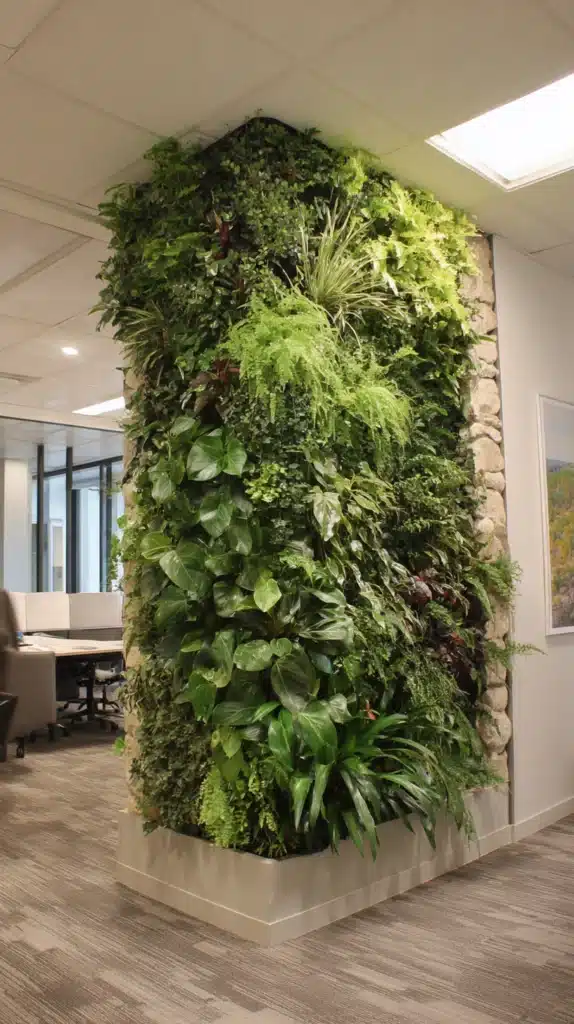
A vertical garden installation — modular planting panels mounted on both walls of a corner to create an L-shaped living wall that fills the corner volume with plant material — is the corner decor idea with the highest biophilic impact available at any price point. The corner configuration is particularly effective for vertical gardens because the two-wall arrangement creates a sense of being surrounded by greenery when standing near the corner, rather than simply facing a flat planted surface.
Choose plant species for their varied texture, form, and color — mixing trailing varieties, upright specimens, and rosette-forming plants creates a visual richness that a single species cannot achieve — and ensure the irrigation and drainage system is properly engineered before installation, as water management is the most common point of failure in interior vertical garden systems. A vertical corner garden in a living room, dining room, or office creates the single most dramatic biophilic feature available to the interior designer.
13. A Corner Meditation and Yoga Zone
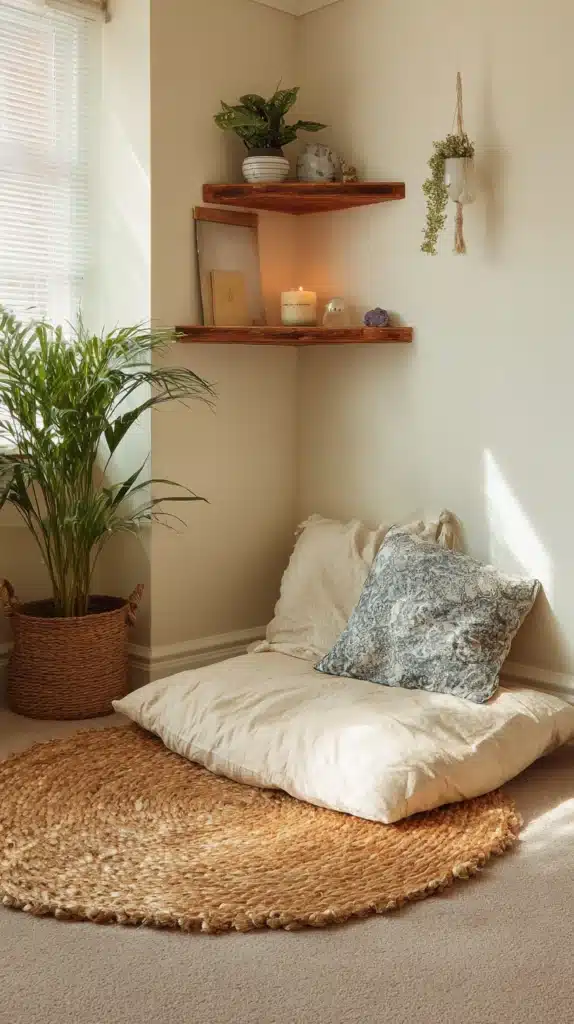
A corner of a bedroom or spare room converted into a dedicated meditation and mindfulness space — a floor cushion or zafu on a simple woven mat, a small shelf holding a candle, a plant, and perhaps a simple object of personal significance, and the two surrounding walls kept clear or hung with a simple piece of calming art — creates a spatial designation for stillness within the home that the absence of such a corner cannot provide.
The corner’s natural enclosure on two sides creates the sense of a sheltered, private space within the room, which is precisely what a meditation zone requires.
Keep the corner completely clear of the surrounding room’s clutter — its function depends on its separation from the visual and mental noise of the room around it — and treat the entry into this corner as a conscious threshold crossing, a deliberate transition from the active to the contemplative mode of being in the home.
14. A Corner Accent Table and Art Moment
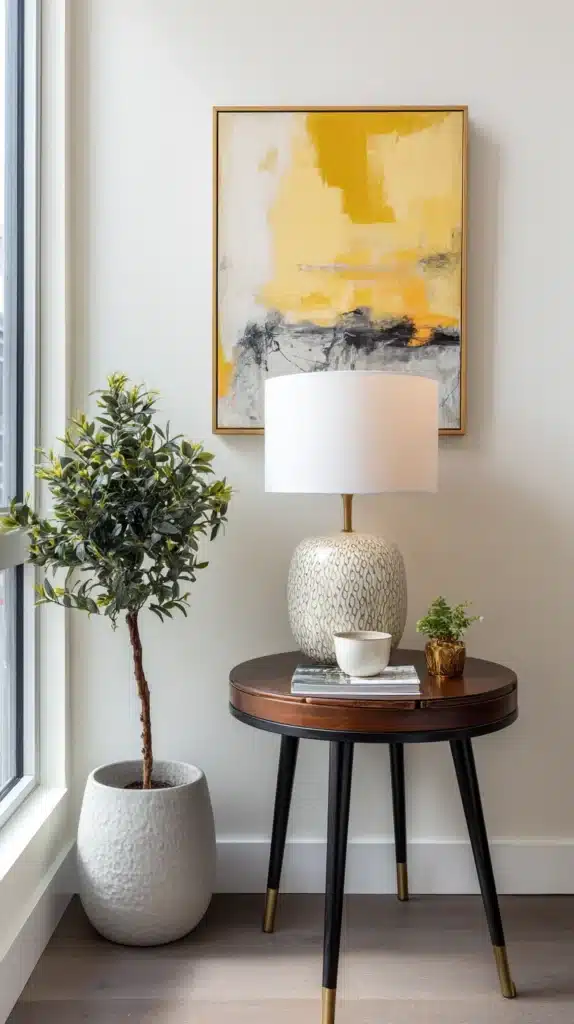
The simplest and most universally applicable corner solution is also, when executed with genuine care, one of the most beautiful: a small accent table positioned in the corner’s angle, styled with a lamp, a plant, and one or two objects of visual interest, with a piece of art hung above it on one or both of the adjoining walls.
This arrangement — table, lamp, art — is the corner equivalent of the interior designer’s classic vignette, and its appeal lies in its economy and its flexibility. The table can be round, square, or triangular; the lamp can be table-mounted or wall-mounted; the art can be a single significant piece or a small curated grouping.
The combination of upward light from the lamp, the presence of a living plant, and the visual interest of art above creates a corner that is warm, personal, and genuinely beautiful — one that the eye travels to with pleasure every time it sweeps the room, and that contributes more to the room’s overall character than any other intervention of comparable scale and cost.
15. A Corner Curtain or Canopy for Enclosure and Drama
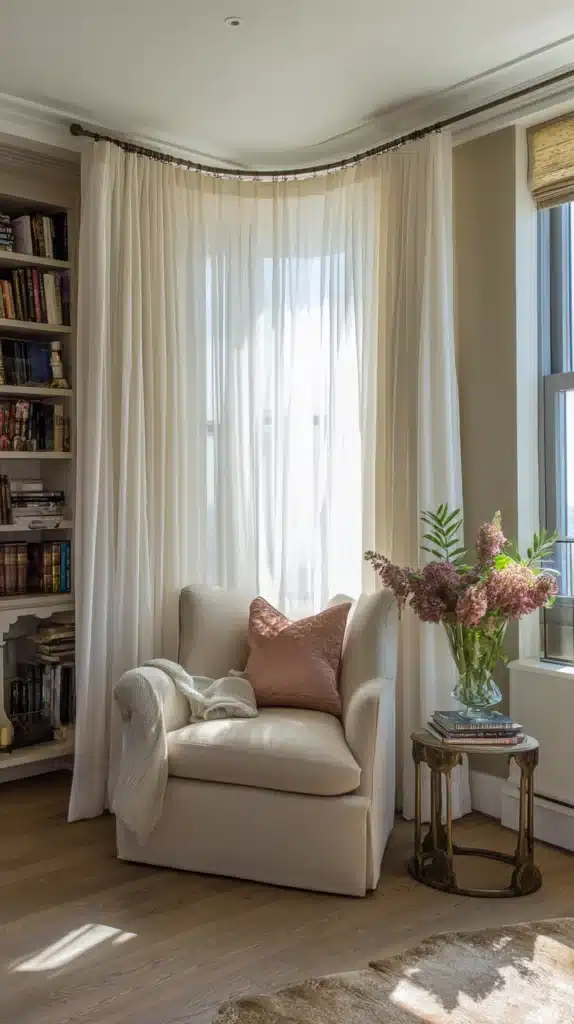
The final and most theatrically ambitious corner idea is the addition of a curtain or canopy treatment that uses the corner’s two-wall geometry to create an enclosed, draped space within the room — a corner canopy that frames the area beneath it with fabric and transforms it into a destination with genuine drama and intimacy.
A ceiling-mounted curtain track following an L-shaped path at the corner’s two walls, hung with floor-length curtains in a rich fabric — velvet, heavy linen, a patterned textile — creates when closed an enclosed alcove that reveals a bed nook, a reading chair, or a simple floor cushion arrangement.
When open, the curtains frame the corner and its contents in the way that theatre curtains frame a stage, giving whatever is within them the quality of a revealed tableau. This is the corner idea for the homeowner who wants their home to feel genuinely theatrical and who is willing to commit to the drama that the treatment requires.