15 Spring Terrace Decorating Ideas
A terrace occupies a particular position in the domestic imagination — more elevated than a backyard, more architectural than a balcony, more personal than any shared outdoor space. It sits at the intersection of inside and outside, private and exposed, structured and natural, and at its best it functions as an additional room that happens to be open to the sky.
In spring, when the light returns with new quality and warmth and the instinct to be outside reasserts itself after months of cold-weather retreat, the terrace becomes one of the most coveted spaces in any home.
The question of how to decorate it — how to make it beautiful, livable, and genuinely expressive of the season — is one that rewards careful thought and a willingness to treat the outdoor space with the same design seriousness you would bring to any interior room. A terrace decorated with intention becomes something you move toward rather than past, a destination rather than a transitional space, a room that happens to have the sky as its ceiling. Here are fifteen ideas for making yours extraordinary this spring.
1. Define Zones with an Outdoor Rug
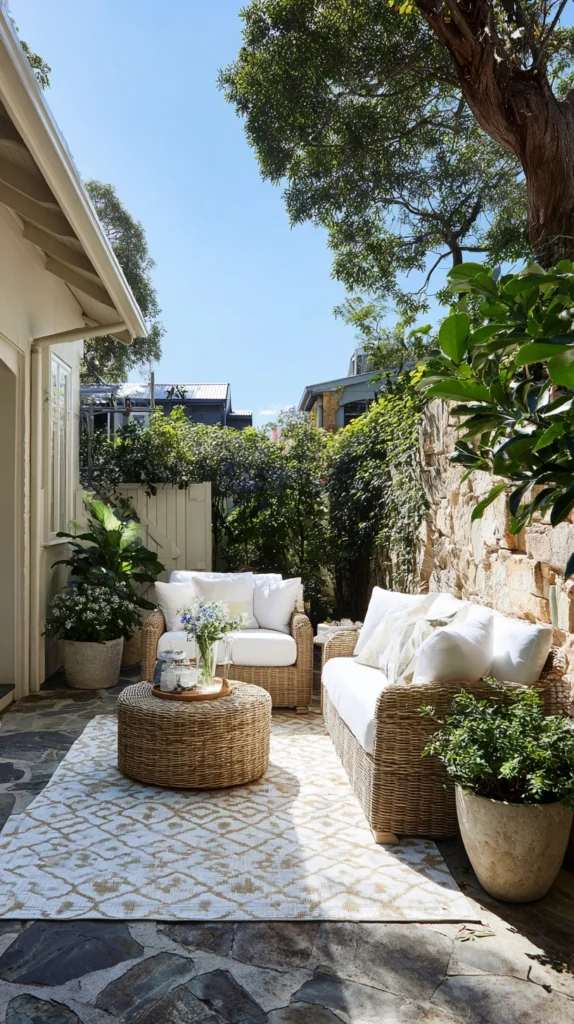
The outdoor rug is to the terrace what a foundation is to a building — the element that makes everything else possible by establishing a defined, grounded space within what might otherwise feel like an undifferentiated expanse of hard flooring. On a terrace, where the surface is typically stone, concrete, tile, or timber decking, an outdoor rug anchors a seating or dining arrangement and signals clearly that this is an area of specific purpose and intention.
For spring, choose a rug in a pattern or color that brings the season’s energy into the space — a botanical print, a fresh stripe in sage and white, a geometric in terracotta and cream, or a simple solid in a dusty blue or warm olive that complements the plantings around it. The rug should be generous enough that all furniture legs in the seating arrangement rest on it, even when chairs are pulled back from the table. This single rule — adequacy of scale — separates outdoor rugs that look designed from those that look like afterthoughts.
2. Build a Modular Seating Arrangement You Can Reconfigure
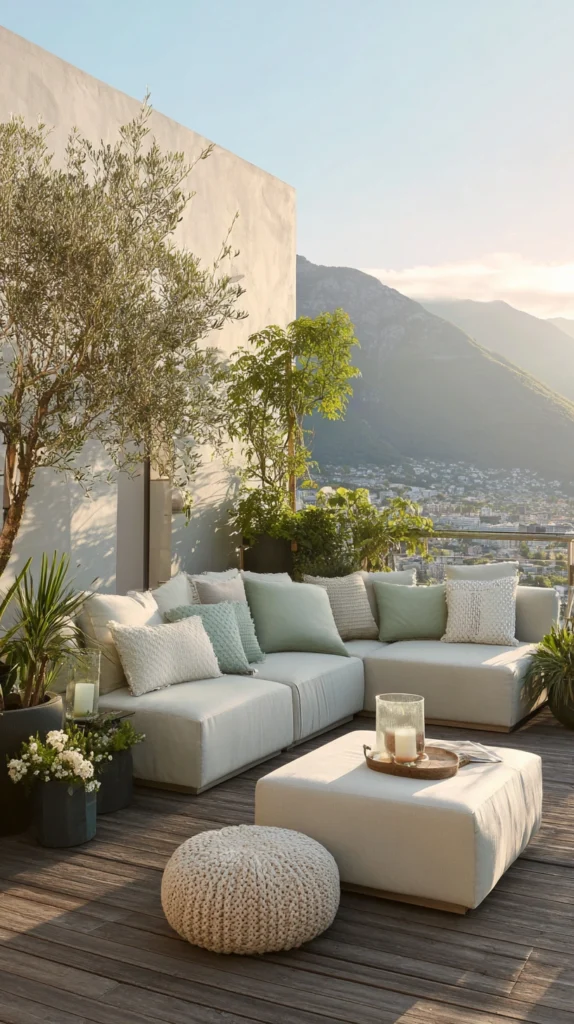
The modular outdoor sofa has transformed terrace living in the past decade, and its appeal lies precisely in the flexibility it offers a space whose function changes with the size of the gathering, the direction of the breeze, and the position of the afternoon sun.
A collection of modular pieces — corner units, middle sections, ottomans, and daybeds that can be combined and reconfigured in multiple arrangements — gives a single terrace the capacity to function as an intimate two-person reading space on a quiet weekday morning and a generous entertaining platform for a spring evening gathering of twelve.
Choose pieces in a performance fabric that resists fading and moisture with genuine effectiveness rather than merely theoretical durability, and select cushion covers that can be removed and washed. For spring, introduce color through the cushions rather than the frame — the frame can remain in a neutral aluminum or teak while seasonal cushion covers in soft greens, warm yellows, and botanical prints are swapped in and out as the mood demands.
3. Plant a Container Garden in a Cohesive Color Story
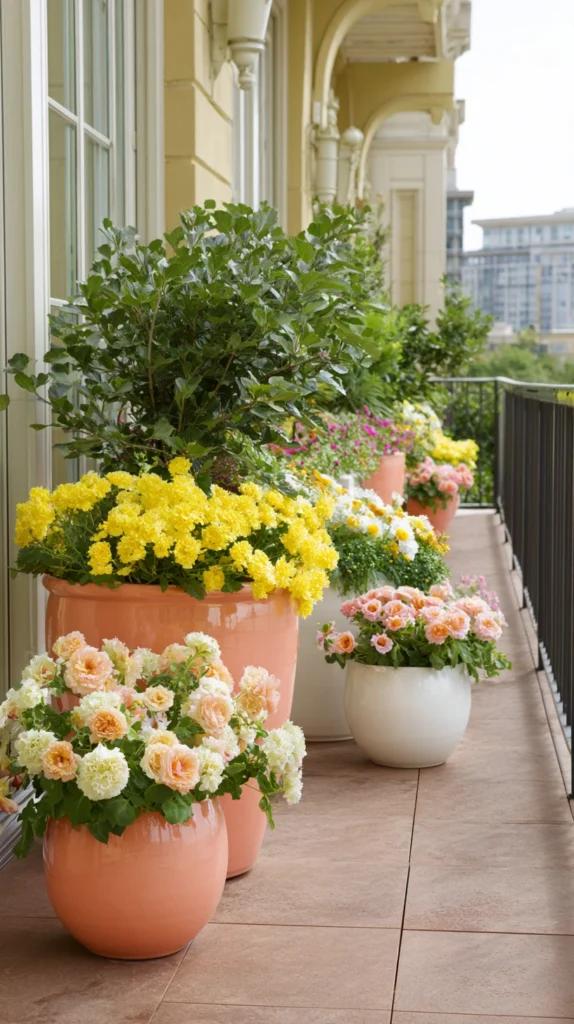
The terrace container garden is the spring decorator’s greatest single tool, combining color, texture, fragrance, and living material in a form that can be changed, moved, and refreshed throughout the season with a flexibility that fixed planting beds cannot match.
The key to a container garden that reads as designed rather than accumulated is the commitment to a color story — a palette of two or three colors that runs consistently through all the plantings, regardless of species, so that the collection reads as a unified composition rather than a series of individual choices.
A palette of soft apricot, cream, and pale yellow — achieved through tulips, trailing calibrachoa, and pale narcissus — creates a warm, early-spring arrangement with a cohesion that invites the eye to move through it with pleasure. As spring progresses, swap spent bulbs for summer bedding in the same palette, maintaining the color story across the seasonal transition.
4. Introduce a Dining Table That Suits the Scale
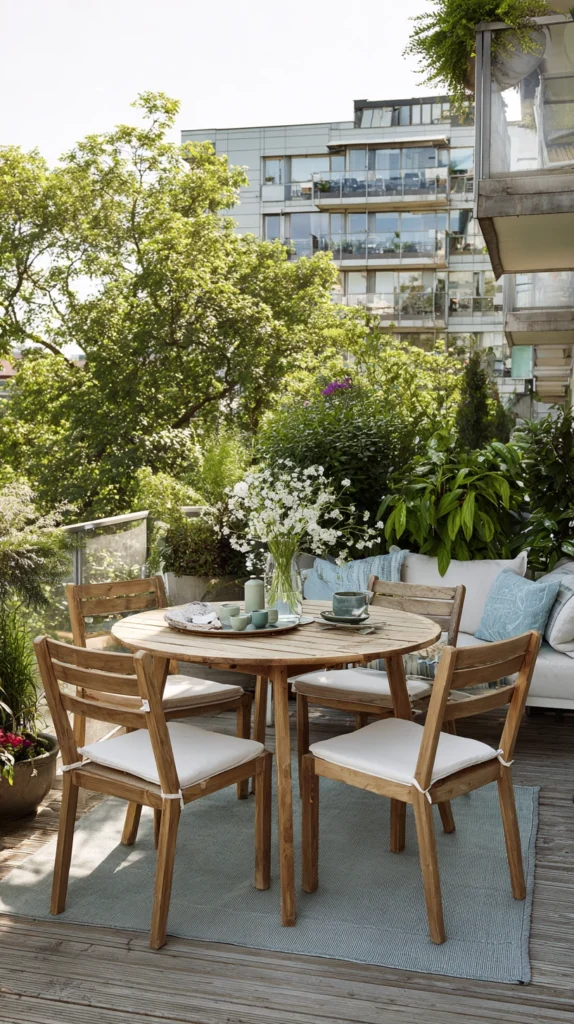
A terrace without a dining table is a terrace that is not being fully used, because eating outside in spring — even a simple breakfast, even a quick lunch with a book — is one of the season’s most reliable pleasures, and having a proper surface at which to do it makes the difference between something you do deliberately and something you do accidentally.
The table should suit the terrace’s scale with genuine accuracy — a table too small for the space looks tentative and lost, while one too large overwhelms the area and compromises circulation.
For spring entertaining, a round table seats guests in a configuration that facilitates conversation better than a rectangle, and in a terrace context it also moves through the space more gracefully, with no sharp corners to navigate. Choose materials that weather honestly — teak, powder-coated aluminum, stone, or concrete — and pair the table with chairs in a complementary weight and tone.
5. Hang Outdoor Curtains for Privacy and Softness
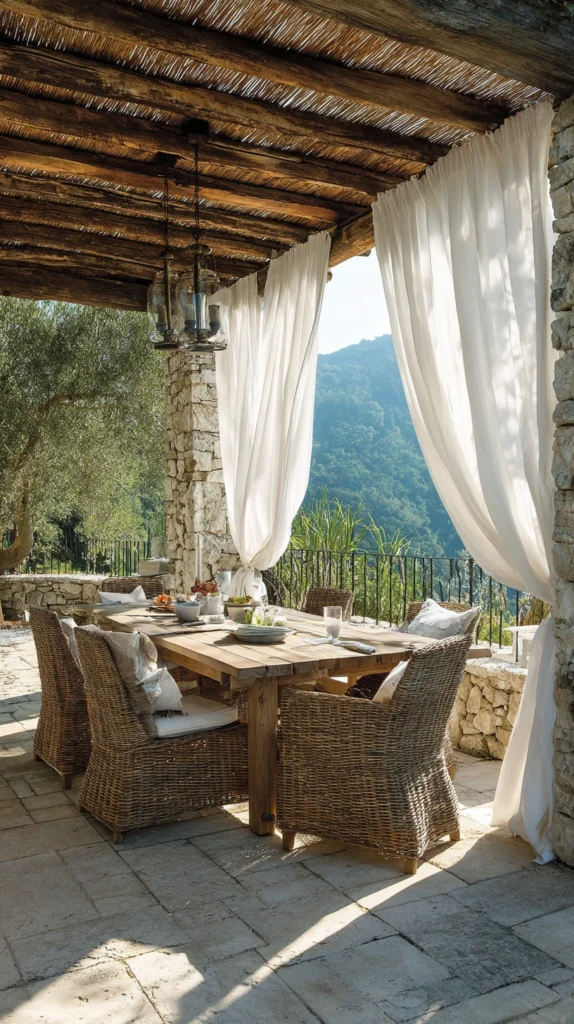
Outdoor curtains on a terrace serve multiple functions simultaneously and do all of them beautifully. They provide privacy from neighboring views without the visual hardness of a screen or barrier.
They soften the architectural edges of the space, introducing the kind of flowing, organic material presence that hard surfaces — stone floors, metal railings, concrete walls — categorically cannot provide. They create shade and filter light in a way that changes the quality of the space from a bright, exposed platform to something more sheltered and intimate. And in spring, when breezes are one of the season’s most pleasant characteristics, outdoor curtains that move in the wind add a kinetic, sensory dimension to the terrace that is deeply appealing. Choose fabrics in natural tones — unbleached linen, cotton canvas in soft white or stone — that will not dominate the planting palette and will weather gradually into an increasingly beautiful softness over successive seasons.
6. Create a Focal Point with a Statement Planter
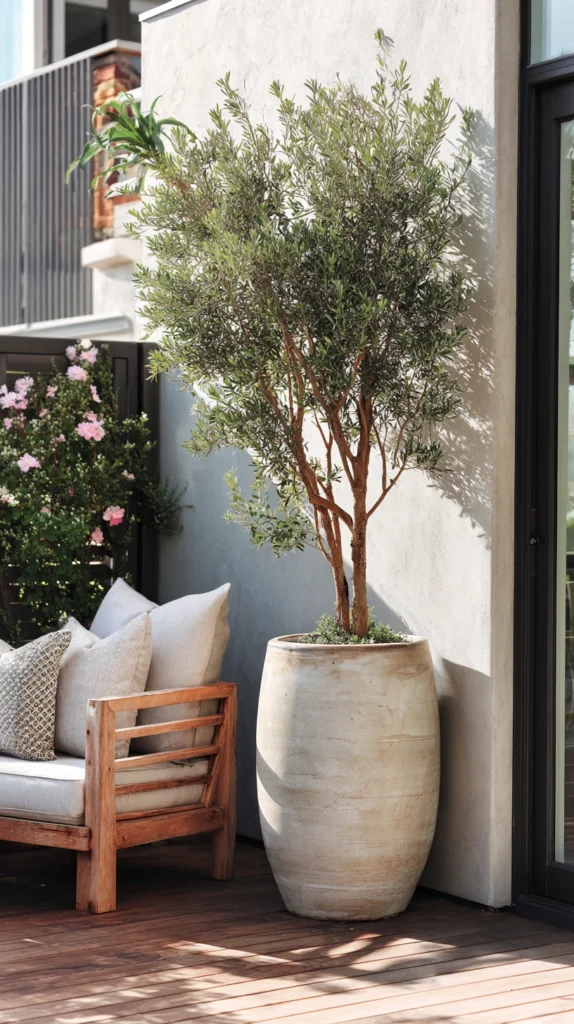
On a terrace where the architecture is regular and the furnishings are horizontal, a statement planter — tall, generous, architecturally significant, planted with something bold — creates the vertical focal point that the space needs to feel complete and three-dimensional. A large olive tree in a simple white or terracotta urn is perhaps the most elegantly versatile option available, adding Mediterranean gravitas and year-round evergreen structure with a silhouette that photographs beautifully in every season.
A tall Corten steel planter filled with ornamental grasses provides a more contemporary kind of drama, the grasses moving in any breeze and catching the spring light with a luminosity that is genuinely spectacular. Whatever the planting choice, the container itself should be scaled to make an impression — undersized statement planters achieve precisely the opposite of their intended effect.
7. Add a Pergola, Sail Shade, or Canopy Structure
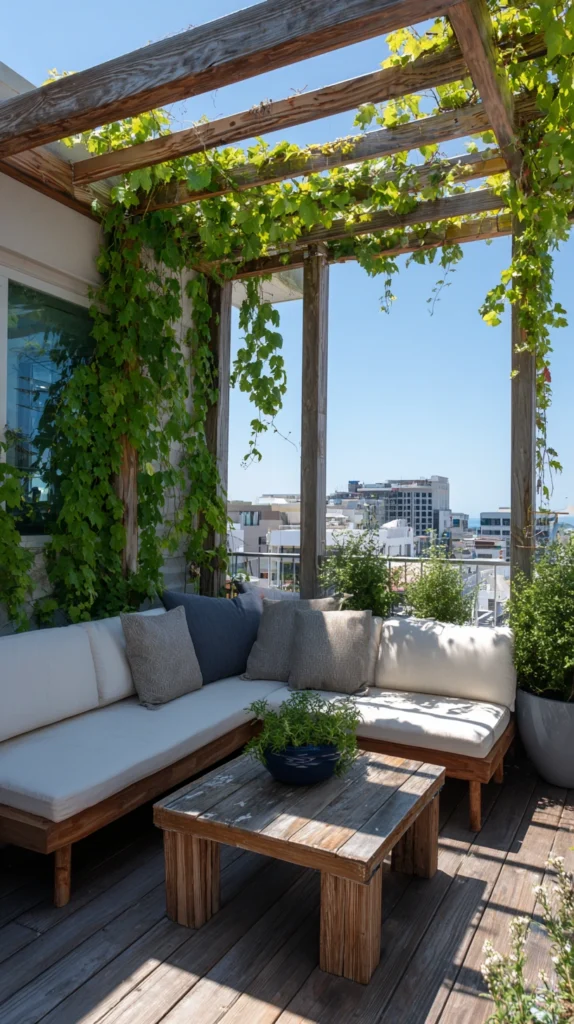
The fully exposed terrace is beautiful in principle but challenging in practice, because without some form of overhead cover the space is hostage to the full intensity of midday sun, the surprise of unexpected rain, and the slightly exposed feeling of being entirely visible from above.
A pergola — built from timber, steel, or aluminum — provides the structural framework from which shade fabric, climbing plants, string lights, and outdoor curtains can be suspended, transforming an open platform into a room with genuine architectural definition.
Where a permanent pergola structure is not possible, a quality sail shade tensioned between anchor points provides excellent coverage with a clean, contemporary aesthetic and the flexibility of seasonal installation and removal. Either solution fundamentally changes the terrace’s livability and the length of time you will willingly spend on it during the brightest and most unpredictable hours of the spring day.
8. Layer Lighting for Atmosphere After Dark
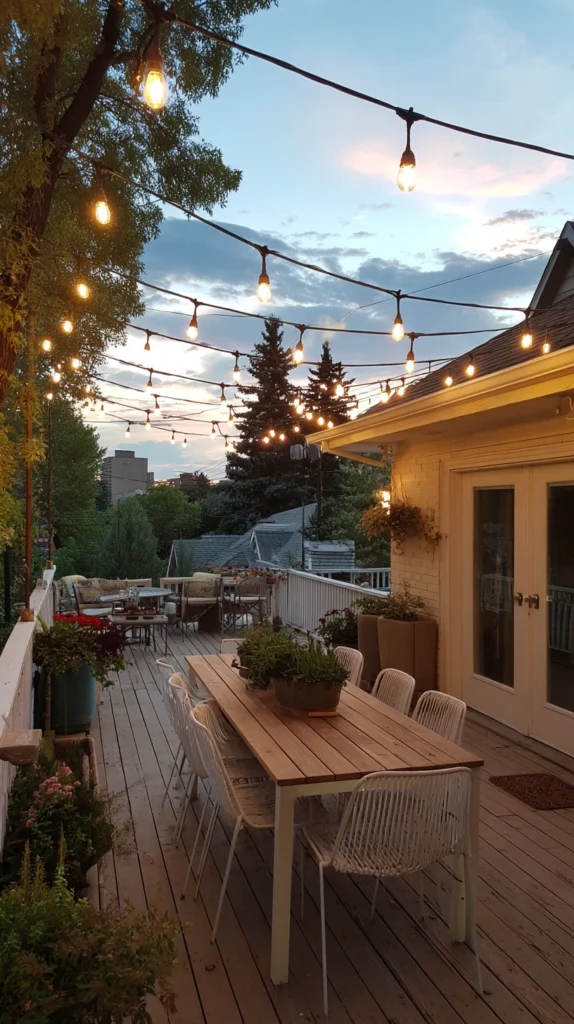
A terrace that is beautiful in daylight but dark and uninviting after sunset is a terrace that loses half its potential entertaining hours, and in spring — when evenings are mild enough to sit outside but not yet long enough to provide natural light through dinner — artificial lighting is not an optional enhancement but a functional necessity.
The best terrace lighting systems layer multiple sources at different levels: string lights overhead for ambient warmth and a sense of enclosure, lanterns at floor and table level for intimate pools of light, and uplighting through containers or into overhead plants for the dramatic effect of illuminated foliage after dark. Solar-powered options have improved dramatically and now provide genuine illumination rather than the decorative suggestion of it, and the absence of wiring requirements makes them enormously practical for terrace contexts where power access may be limited.
9. Incorporate a Fire Element for Evening Warmth
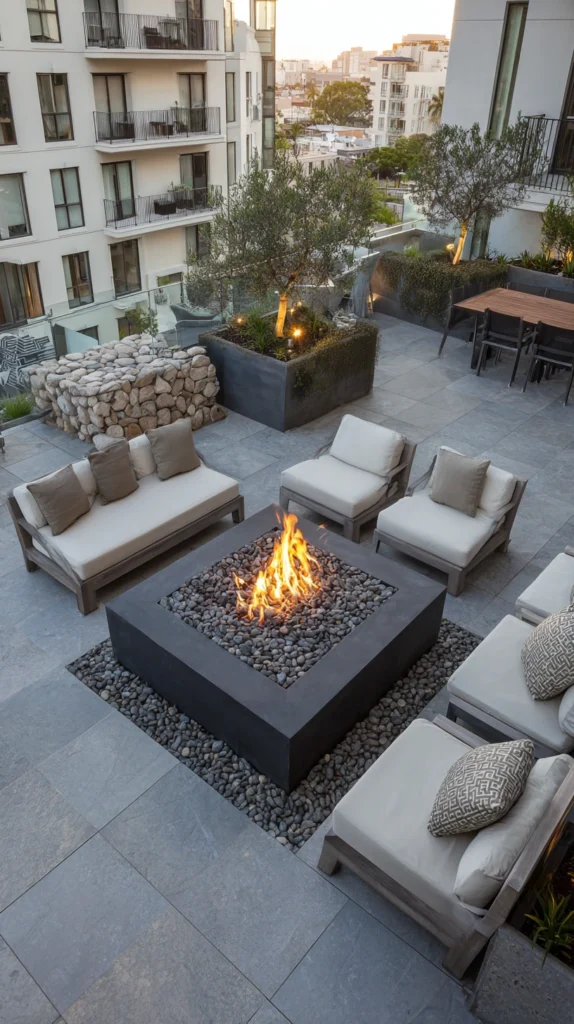
Spring evenings cool quickly, and the gap between a terrace that is comfortable until nine o’clock and one that sends everyone inside at seven is often nothing more than the presence or absence of a heat source.
A fire table — a coffee table or dining height table with an integrated gas fire element — combines the practical warmth of a fire pit with the functional surface area of a table, making it one of the most space-efficient heating solutions available for terrace use.
A freestanding patio heater provides coverage across a larger area. A simple chimenea or small wood-burning fire bowl adds the sensory dimension of a real fire — the crackle, the smell, the movement of flame — that gas and electric options approximate but never fully replicate. Pair any fire element with a supply of lightweight blankets stored in an outdoor basket nearby and the terrace becomes genuinely comfortable well into the cool spring evening.
10. Bring in a Beverage Station or Outdoor Bar Cart
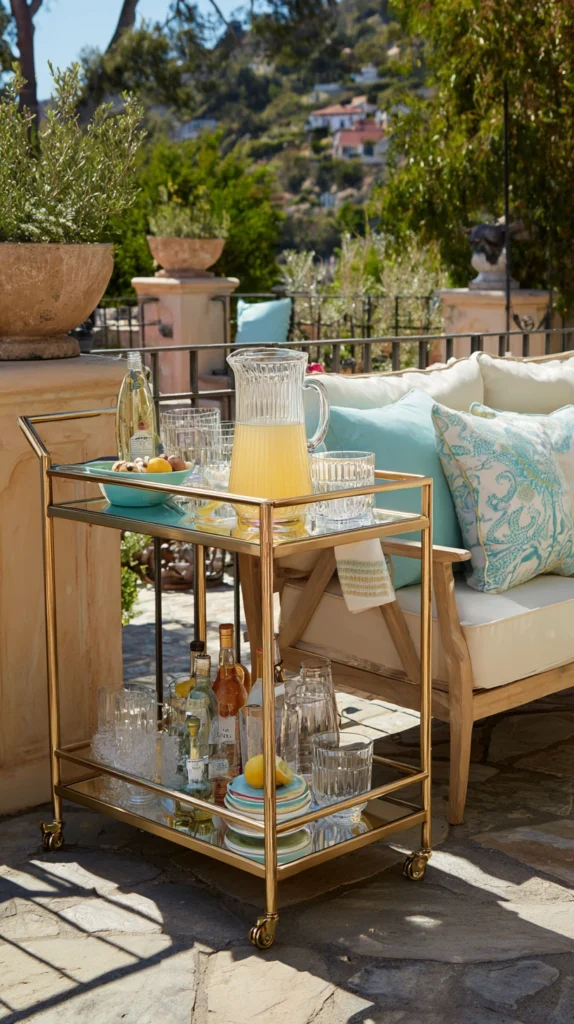
The outdoor bar cart is one of those terrace additions that has an effect on entertaining well beyond its practical function, because it signals clearly that this is a space equipped and ready for hospitality — that guests are expected and welcomed and that provisions have been thoughtfully made for their pleasure.
A well-stocked bar cart positioned at the terrace’s edge, holding a selection of drinks, glassware, a small ice bucket, and perhaps a vase of fresh spring flowers, transforms the host’s experience as much as the guest’s by eliminating the constant back-and-forth between terrace and kitchen that interrupts the flow of outdoor entertaining.
Choose a cart in a material that suits the terrace’s aesthetic — brass and glass for a more polished look, weathered wood for a relaxed organic feel, matte black metal for a contemporary edge — and treat its styling with the same attention you would give a well-arranged interior sideboard.
11. Plant Fragrant Species for Sensory Richness
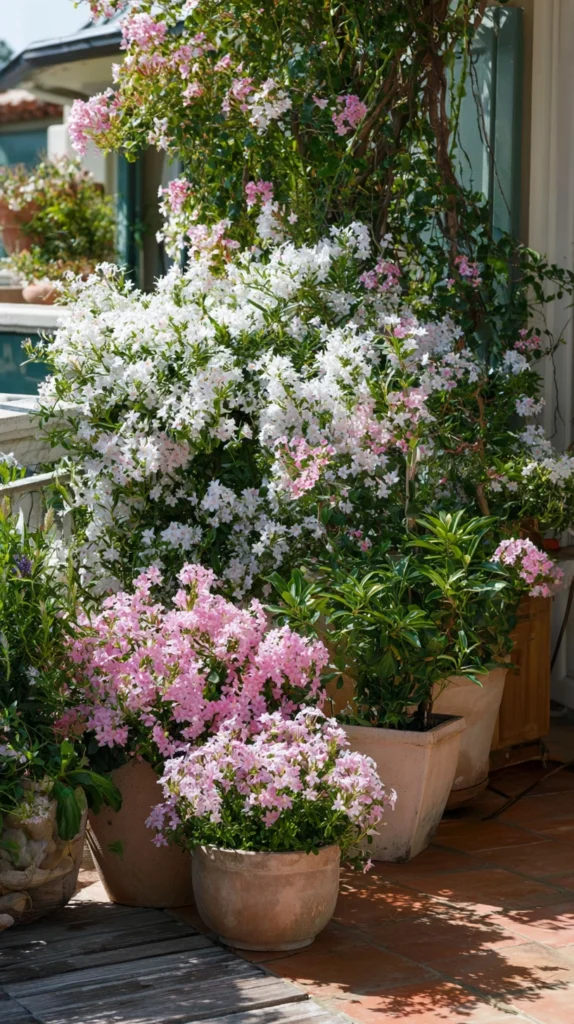
A spring terrace that smells extraordinary is a different and deeper experience than one that merely looks beautiful, and the deliberate planting of fragrant species is one of the most rewarding investments a terrace gardener can make.
Wisteria trained along a railing or pergola fills the surrounding air with its grape-sweet fragrance for several glorious weeks in spring. Gardenia, planted in containers that can be moved inside during winter in colder climates, produces a scent of almost scandalous intensity.
Jasmine on a trellis or trained up a post releases its fragrance most generously in the evening warmth, making it the perfect companion for a terrace used primarily for evening entertaining. Sweet peas in a container beside the seating area fill every quiet moment between conversations with a fragrance that is, arguably, the defining scent of spring itself.
12. Introduce Architectural Plants for Structure and Permanence
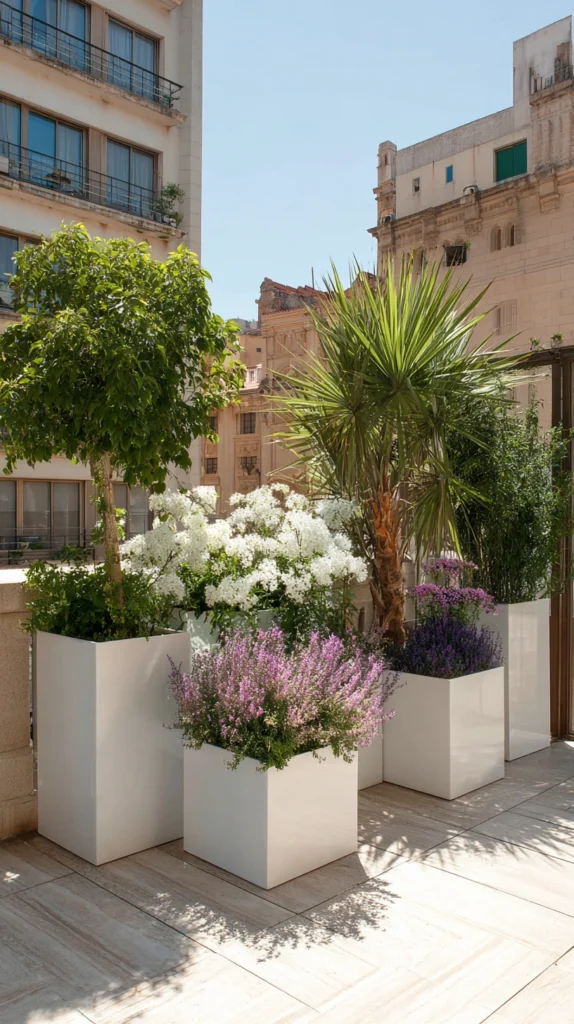
A spring terrace planted exclusively with seasonal flowers is one that requires constant replanting and offers little visual interest outside the flowering window. The solution is to build the planting scheme around a backbone of architectural plants — permanent or semi-permanent species that provide year-round structure and allow the seasonal plantings to perform against a stable and considered framework.
Clipped box spheres or topiary forms in containers provide formal architectural punctuation. Tall grasses like Pennisetum or Miscanthus add height and movement. A standard bay tree in each corner of the terrace creates symmetry and permanent green presence.
Evergreen climbers on walls and railings ensure that the terrace has a clothed, established quality even in the periods between seasonal planting rotations, and against this evergreen structure the spring additions of tulips, narcissus, and flowering annuals read with the clarity of decoration added to architecture rather than decoration fighting for attention in an empty space.
13. Add a Herb and Edible Garden Corner
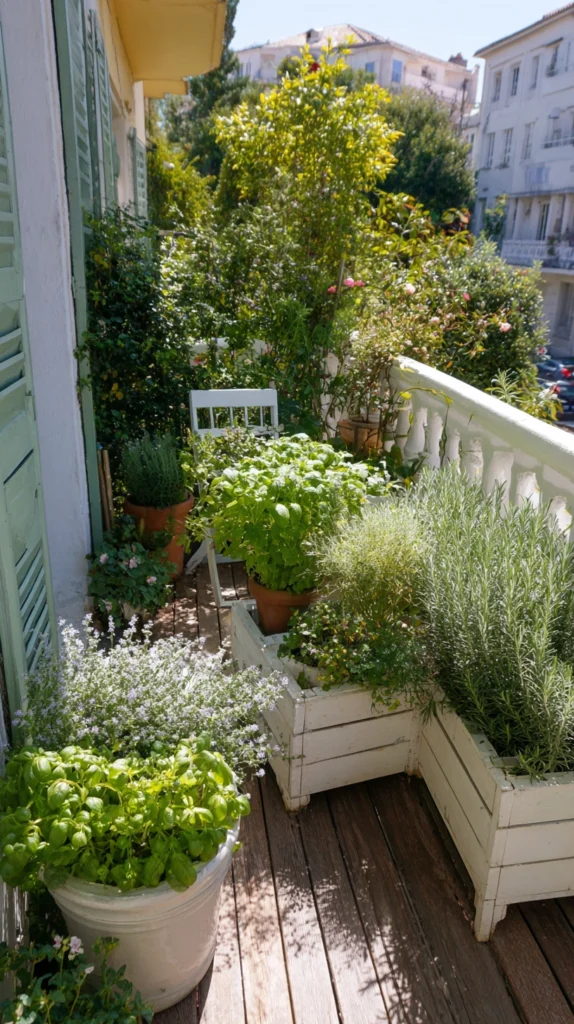
A terrace with a dedicated corner for edible growing connects the outdoor space to the kitchen in a way that adds daily purpose to the gardening activity and transforms a decorative space into something genuinely productive.
Grouped containers of herbs — rosemary, thyme, basil, chives, mint in its own pot to prevent spreading, lemon verbena for drinks and desserts — alongside a container or two of salad leaves, climbing beans on a small obelisk, and perhaps a compact fruiting plant such as a dwarf citrus or a strawberry tower create a kitchen garden in miniature that requires minimal space and provides maximum satisfaction.
The edible corner should be positioned close to the door for easy access and should be treated with as much aesthetic consideration as the purely ornamental areas of the terrace — terracotta containers, a small wooden potting tray, a vintage watering can nearby.
14. Use Mirrors to Expand the Visual Space
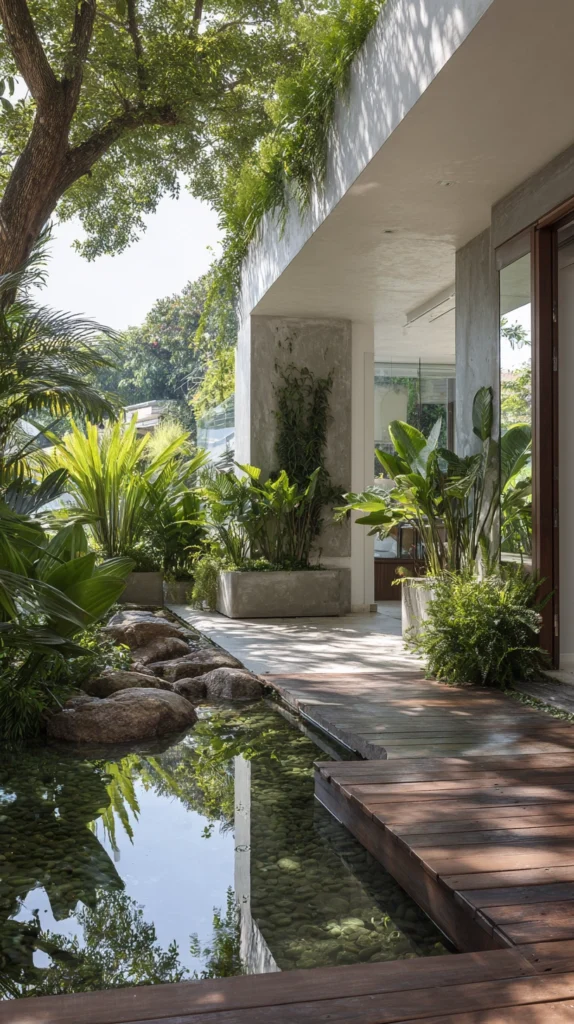
The interior designer’s trick of using mirrors to expand a room works with equal effectiveness on a terrace, and in the outdoor context it adds an additional dimension — the mirror reflects the planting, the sky, and the light in ways that make the garden feel like it extends beyond its actual boundaries.
An outdoor-rated mirror — framed in weatherproof materials such as teak, painted metal, or powder-coated aluminum — mounted on a terrace wall reflects the container garden opposite it and creates the impression of depth and planting density that a small terrace cannot otherwise achieve.
Position the mirror to reflect the most attractive aspect of the terrace — a beautiful planted corner, the sky at a particular time of day, the string lights at night — and it becomes both a functional space-expanding tool and a genuinely decorative element in its own right.
15. Finish with Personal Details That Make It Yours
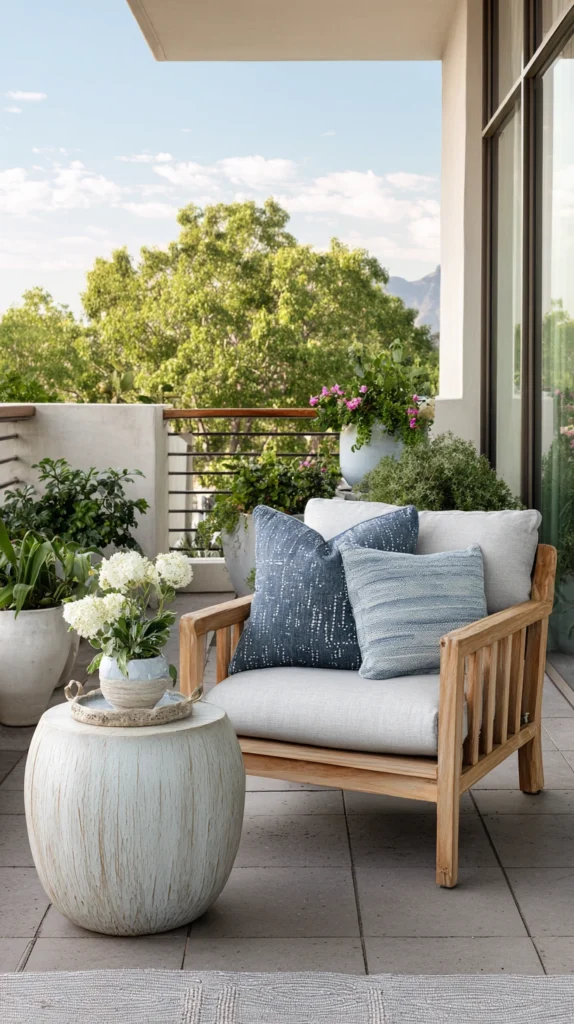
The terrace that has been decorated with intention but without personality is one that looks complete in photographs and feels slightly empty in person, and the difference between these two states is almost always the presence or absence of the small personal details that make a space genuinely inhabited rather than merely styled.
A stack of well-loved books on the outdoor table. A small ceramic object picked up on a trip abroad, weathering gracefully on a shelf beside the door. A hand-thrown pot from a local maker holding a simple planting. A lantern that was a gift, positioned where the light it casts is most beautiful.
These details cost very little in either money or effort, and they contribute more to the feeling of a space than any furniture purchase or structural intervention can. The terrace that feels like yours — that carries the evidence of your specific life, your particular loves, your personal version of beauty — is always, in the end, the most welcoming terrace of all.