14 Spring Mantel Decor Ideas for Bedrooms
The bedroom mantel is one of interior design’s most intimate and most underserved decorating opportunities. Unlike the living room mantel — that well-documented focal point that receives the full weight of seasonal decorating attention and the scrutiny of every guest who enters the space — the bedroom mantel exists in a more private, more personal context.

It is the surface you look at in the morning from the bed, the last thing you see before sleep, the area that frames the fireplace if the room has one or simply claims the wall above a decorative surround if it does not.
The bedroom mantel can therefore be styled with a slightly different set of priorities than its public-room counterpart — less concerned with impressing visitors, more concerned with creating a visual environment that is genuinely pleasurable to wake up to, that reflects the specific beauty of the season in an intimate and personal way, and that contributes to the bedroom’s fundamental purpose of providing a restorative environment for its occupant.
Spring, with its particular palette of soft colors, fresh botanicals, and the quality of light that belongs specifically to the weeks between winter and summer, offers a rich range of decorating possibilities for the bedroom mantel. Here are fourteen ideas for using them well.
1. A Simple Mirror Flanked by Bud Vases
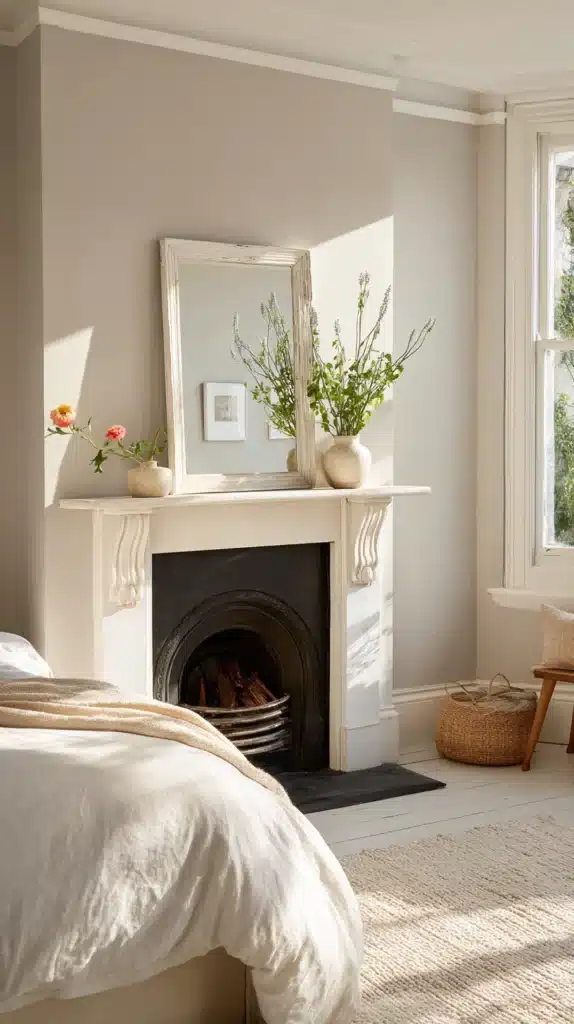
The bedroom mantel composition that is simultaneously the easiest to assemble and the most reliably beautiful is a simple mirror — leaning against the wall rather than hung, which creates an informal quality particularly suited to the bedroom — flanked by two bud vases or small vessels holding a single stem or small cluster of spring flowers.
The mirror’s reflective surface doubles the light in the room and doubles the visual presence of the flowers beside it, creating a composition of considerable beauty from the simplest possible arrangement of three objects. The bud vases should not match — the slight variation of two different vessels holding two different stems creates a more organic, gathered quality than identical vessels on identical sides of the mirror.
Choose vessels with genuine character — a small earthenware jug, a vintage medicine bottle, a simple ceramic cylinder — and the spring stems themselves should be whatever is currently beautiful: a single ranunculus, a stem of sweet pea, a few sprigs of muscari. Change them weekly as the blooms age and the garden or market offers something new.
2. A Botanical Print Gallery Above the Mantel
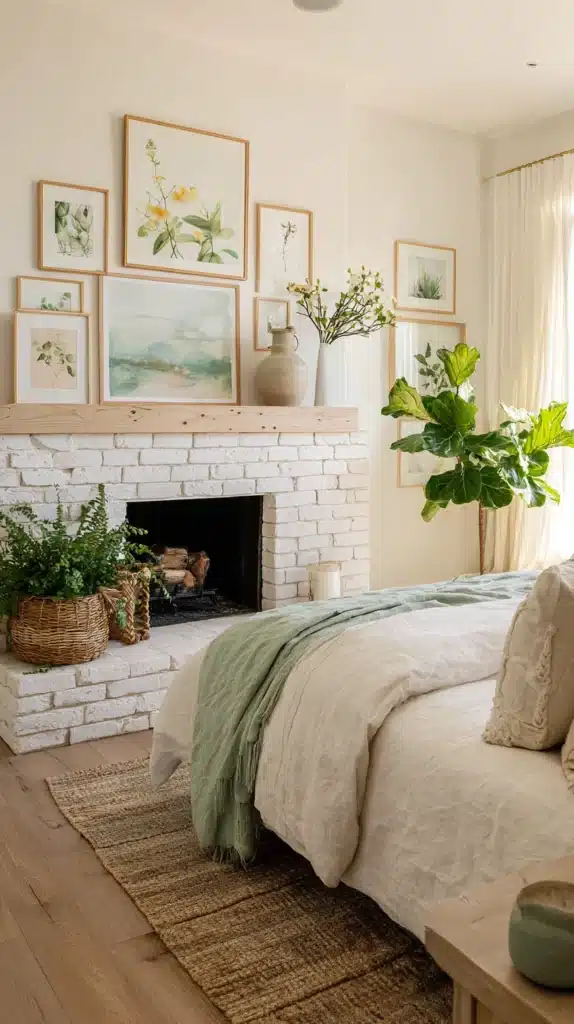
The mantel that serves as the base for a wall-mounted gallery of botanical prints — arranged in a loose, slightly asymmetric grouping on the wall above the mantel shelf — creates a spring bedroom focal point of considerable charm and lasting relevance.
Botanical prints have the specific quality of being simultaneously decorative and educational, beautiful and precise, and their subject matter — plants, flowers, the natural world rendered with scientific accuracy and artistic care — is perfectly aligned with spring’s visual language.
Choose prints in a cohesive palette — soft greens, pale yellows, the blush of petals rendered in watercolor or engraving — and frame them simply in thin timber or pale gold frames that let the artwork read clearly.
The arrangement above the mantel can include a mirror or a more significant piece of art at the composition’s center, with smaller botanical prints arranged around it in a grouping that feels gathered rather than geometrically planned.
3. Fresh Tulips in a Statement Vase
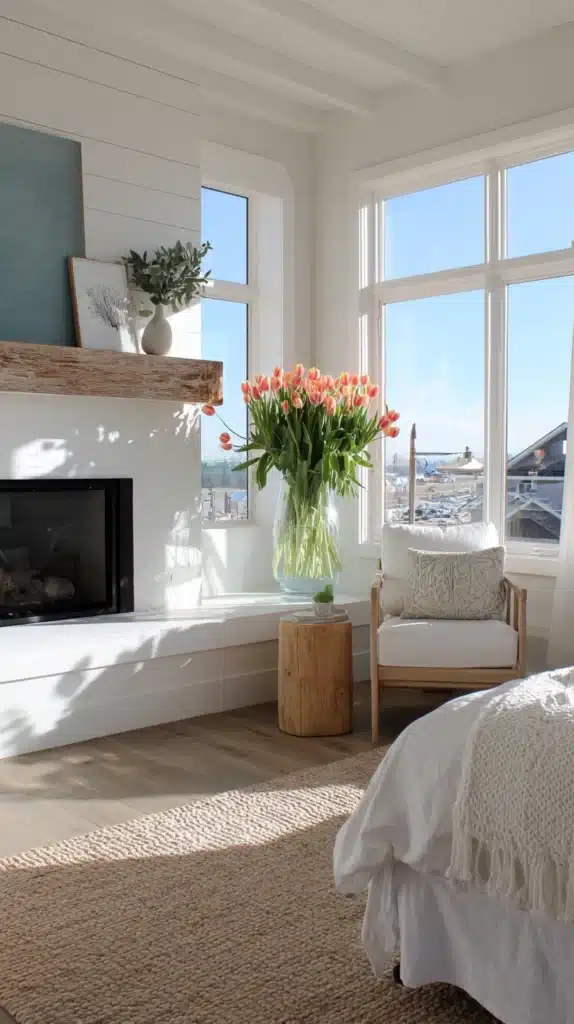
There are few spring decorating gestures more directly satisfying than a generous bunch of fresh tulips in a beautiful vase placed at the center of a bedroom mantel, and the simplicity of this arrangement is precisely what gives it its power.
The tulip is spring’s most immediately recognizable flower, carrying the season’s optimism and freshness in a form that requires no elaboration or supporting cast to read with full visual impact. The vase matters as much as the flowers — a generous ceramic vessel in a warm earthy tone, a clear glass cylinder that shows the tulips’ stems, or a simple terracotta pot create very different but equally beautiful results depending on the bedroom’s aesthetic.
Choose tulips in a color that relates to the bedroom’s palette: soft apricot tulips in a bedroom with warm neutral tones, white and cream tulips in a room with a cool, restrained palette, bright coral tulips as a deliberate seasonal accent against neutral walls and linen bedding.
Replace the water every two days and allow the tulips to open naturally rather than removing them when their petals begin to spread — the fully open tulip, its petals curved back and its center revealed, is often more beautiful than the tight bud.
4. A Layered Mantel with Varying Heights
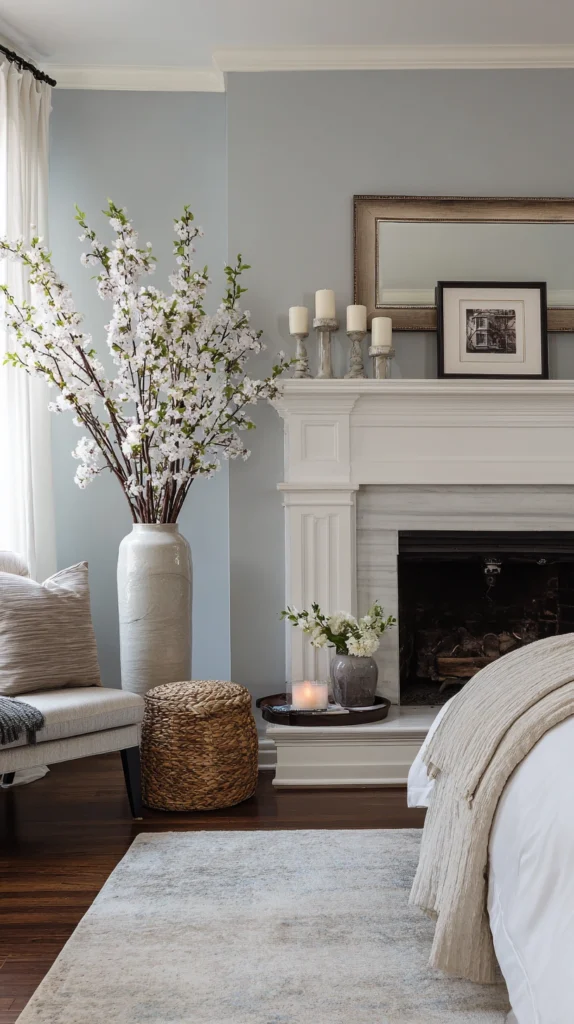
The bedroom mantel that works best compositionally is almost always one that achieves variety of height across its surface — a tall element at the back or center, medium-height elements in the mid-ground, and low flat elements at the front — creating a landscape of visual interest that the eye travels through with pleasure rather than registering in a single flat glance.
For spring, this layered approach might begin with a tall, slender ceramic vase holding branches of flowering quince or cherry blossom at the back of the mantel. In front of and beside it, medium-height candle holders, a small potted plant, or a framed photograph at a lower register.
At the front of the mantel shelf, flat items — a small ceramic dish holding a few smooth stones or a collection of spring seed packets, a low botanical illustration in a simple frame, a shallow tray holding a candle and a few spring flowers at their most horizontal. The layering creates depth and visual richness in a way that a flat row of objects of identical height can never achieve.
5. Dried Flower Arrangements for Lasting Spring Beauty
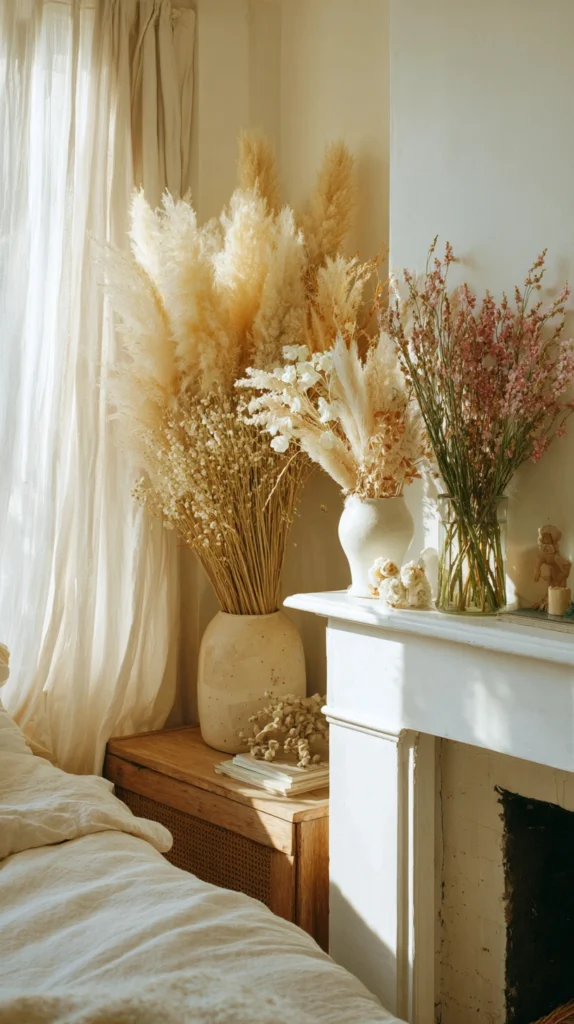
Dried flower arrangements bring the colors and forms of spring to the bedroom mantel without the maintenance demands of fresh flowers, and the palette available in quality dried botanicals — soft blush pampas grass, pale pink dried roses, bleached cotton pods, natural wheat and oat stems, dried lavender, soft orange amaranths — suits the bedroom’s typically muted, restful color palette more naturally than the saturated colors of fresh spring flowers.
A large dried arrangement in a ceramic or woven vase at one end of the mantel, with smaller dried botanical elements scattered through the composition on the other side, creates a spring mantel of considerable beauty that will look as good in three months as it does on the day it is arranged.
The dried arrangement can be supplemented with one or two fresh elements that are changed weekly — a small bud vase of fresh sweet peas, a single stem of ranunculus — to maintain the living quality of the composition while the dried arrangement provides its permanent structure.
6. A Candle Collection in Varying Heights and Tones
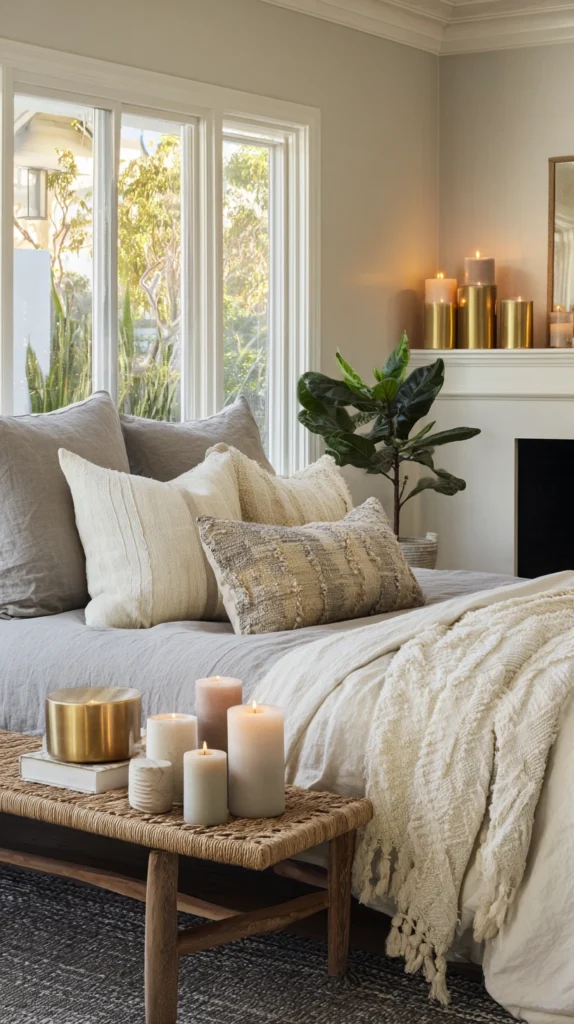
A collection of candles on a bedroom mantel creates an atmosphere of extraordinary warmth and calm at the end of the day, when the room’s main lights are dimmed and the mantel’s cluster of flames provides the specific quality of warm, moving light that promotes the relaxation that precedes sleep.
For spring, choose candles in tones that reflect the season — soft beeswax yellows, pale blush pinks, sage greens, and warm creams — in a variety of heights from tall tapers in simple holders to short pillar candles in ceramic or stone dishes. Vary the holder materials — a mix of brass, ceramic, timber, and stone gives the collection a gathered, accumulated quality — and position the candles asymmetrically rather than symmetrically across the mantel surface.
Safety is the practical requirement that must inform candle placement on a bedroom mantle: never leave candles unattended, ensure they are positioned safely away from any fabric or paper elements in the composition, and consider flameless LED candles in the same forms as wax alternatives for positions that cannot be safely monitored.
7. A Small Spring Terrarium as a Living Centerpiece
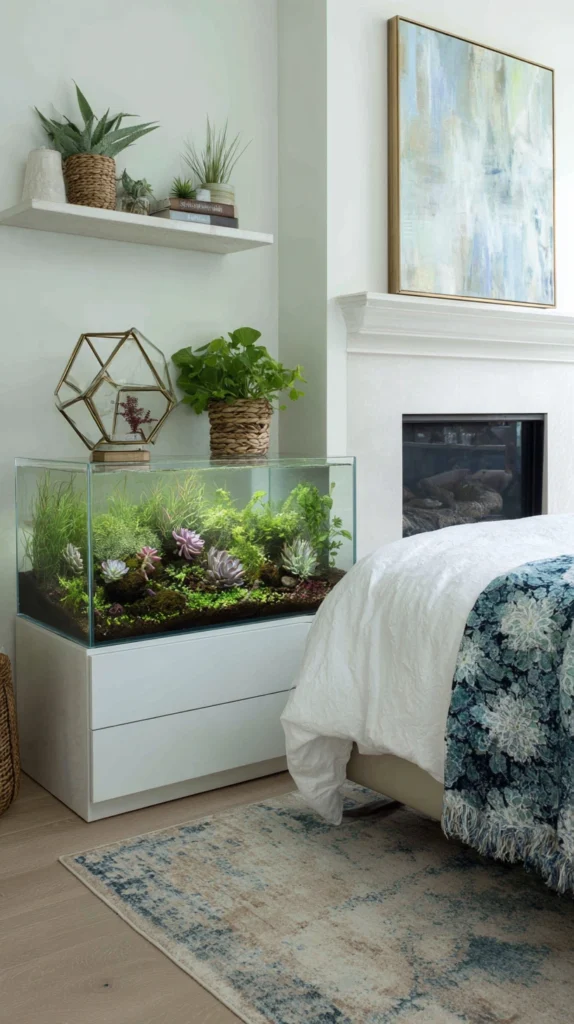
A terrarium — a glass vessel containing a small, self-contained planted landscape — placed at the center or to one side of the bedroom mantel introduces a living element of considerable beauty and very low maintenance into the spring bedroom’s decorating scheme.
An open terrarium in a geometric glass container, planted with small succulents in spring tones — soft green echeverias, pale purple sedums, small cacti — creates a miniature spring garden on the mantel surface that requires only occasional watering and benefits from the natural light of the bedroom window. A closed terrarium creates a more lush, tropical environment of ferns and mosses that suits bedrooms with a more maximalist or biophilic aesthetic.
The terrarium container should have sufficient visual weight — a generous geometric glass shape, a round bowl on a timber base, a simple cylinder of adequate diameter — that it reads as a centerpiece rather than disappearing among the other mantel elements.
8. Nature-Inspired Objects and Found Items
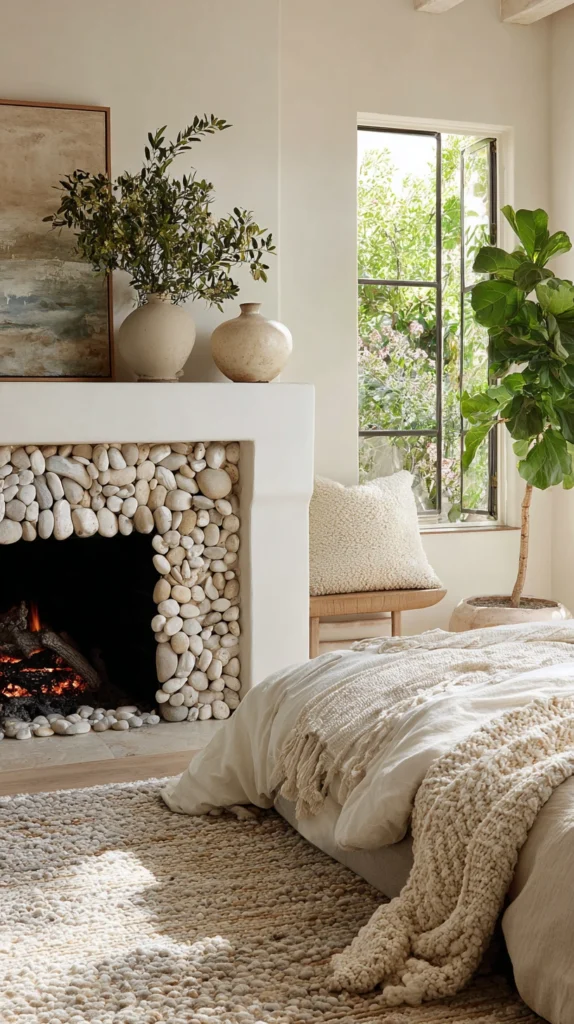
The spring mantel in a bedroom has a particular opportunity to tell a personal story through the display of objects gathered from the natural world — items collected on walks and garden visits during the spring season that carry specific memories and a quality of found beauty that purchased decorative objects rarely achieve. A piece of moss-covered bark from a walk through a spring woodland.
A few smooth river stones in graduating sizes. A bird’s nest discovered during the garden’s spring clearing. A collection of seed pods from last year’s garden, beautifully formed and naturally dried.
These found objects, displayed on the mantel alongside the more conventional elements of a spring composition — the candles, the flowers, the mirrors — give the arrangement a depth and personal specificity that makes it feel genuinely inhabited rather than styled. They cost nothing and cannot be replicated, which makes them among the most valuable things on the mantel.
9. A Framed Artwork Changed for the Season
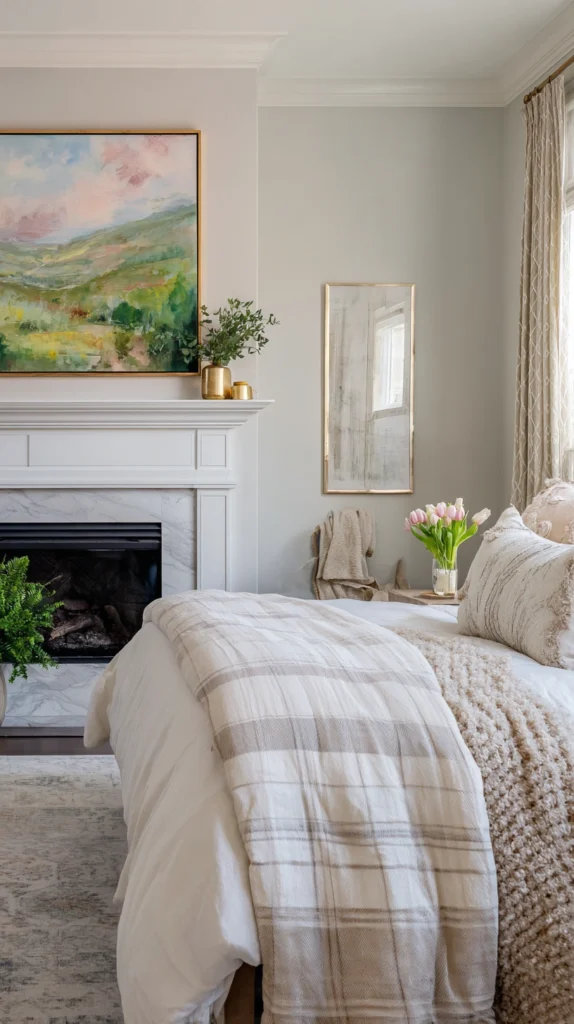
The bedroom mantel whose central position is occupied by a piece of art that is changed with the season — a spring landscape, a botanical watercolor, a simple abstract in the season’s palette — creates a different and considerably more engaged relationship between the room’s occupant and its decorating than the room with fixed art in a fixed position.
The act of selecting and installing a new work for each season is itself a pleasure, a small curatorial decision that connects the bedroom’s interior decoration to the specific qualities of the season outside the window.
For spring, choose a piece whose color is aligned with the season’s natural palette — the soft greens and blush pinks of the spring garden, the pale blues and warm creams of the spring sky — and whose subject matter, if representational, connects to the natural world. Lean the work against the wall on the mantel rather than hanging it, which allows it to be changed without filling the wall with additional fixings.
10. A Spring Color Palette Applied to the Mantel Composition
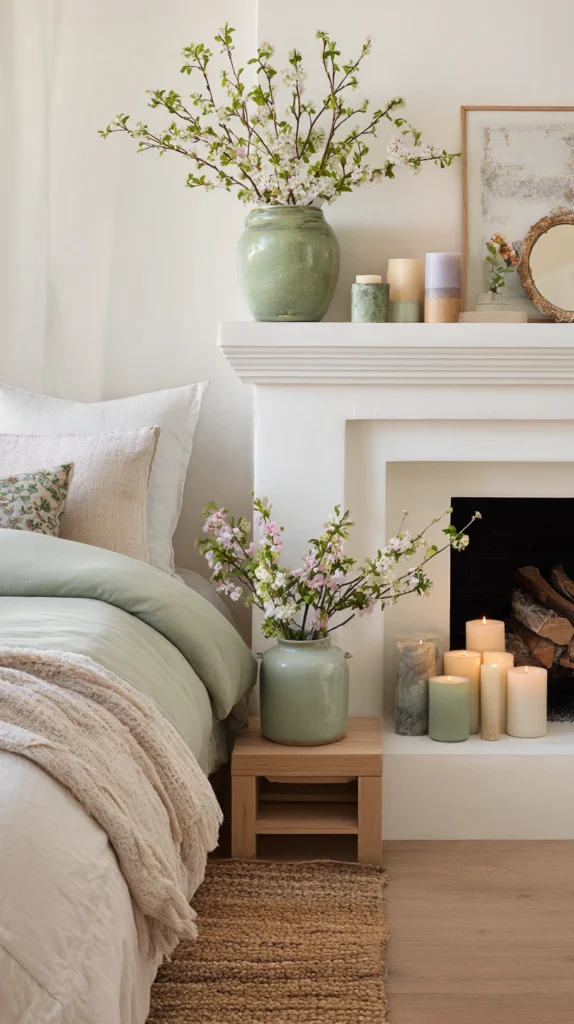
The bedroom mantel’s spring transformation does not require new objects if the room’s existing mantel accessories are rearranged and supplemented with color-specific additions that shift the overall composition toward the season’s natural palette.
Introduce spring’s characteristic tones — the soft sage green of new leaves, the warm blush of early blossom, the pale yellow of narcissus, the cool lavender of the season’s namesake flower — through small additions to an existing mantel composition: a spring-colored candle replacing a winter one, a fresh botanical print in a seasonal palette, a small vase of flowers in the season’s dominant tone.
The existing mantel elements — a mirror, a ceramic object, a candlestick — provide the composition’s structure while the color additions shift the seasonal register. This is the most economical and most accessible spring mantel approach available, requiring the minimum of new purchases while achieving a clear seasonal transformation.
11. Potted Plants and Forced Bulbs
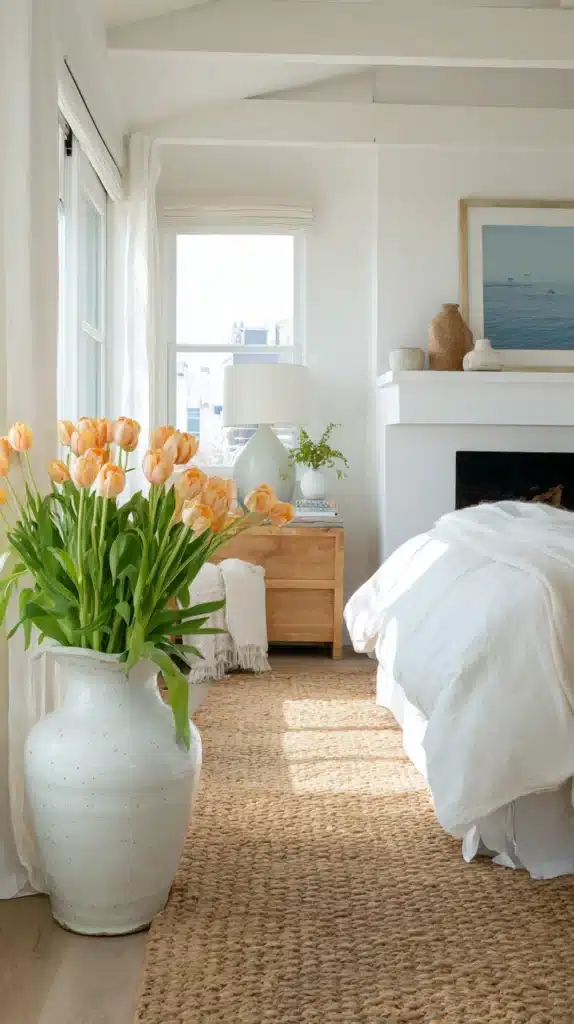
Potted plants and forced bulbs placed on or alongside the bedroom mantel introduce the living, growing quality of the garden into the bedroom space during the spring season when that quality is most abundantly available and most personally significant. A pot of forced narcissus whose fragrance fills the bedroom with the specific scent of spring mornings.
A small potted hyacinth in a ceramic cachepot that matches the bedroom’s palette. A delicate primrose in a terracotta pot, its quiet yellow flowers providing a note of color without competing with the room’s restful atmosphere.
These potted plants are inherently temporary — their flowering period is the most beautiful and briefest part of their domestic life — and their ephemerality is part of what makes them so appropriate to spring mantel decoration. Replace them as they finish with the next seasonal offering, maintaining the living quality of the mantel composition throughout the season’s progression from early spring through to the warmer weeks that follow.
12. A Spring Wreath Hung Above or Placed Against the Mantel
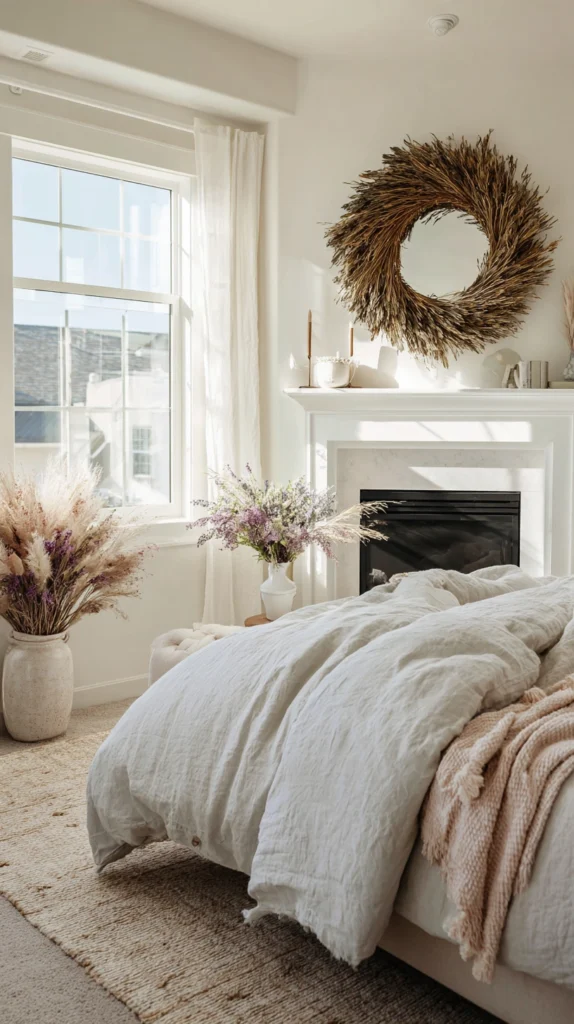
The wreath is conventionally associated with the front door, but its application above the bedroom mantel — hung on the wall above the mantel shelf, or leaned against the mirror or wall on the mantel itself — creates a spring decorating moment of genuine charm in the bedroom’s most private space.
A spring wreath for the bedroom mantel should be lighter and more delicate in its materials than a front door wreath designed to withstand outdoor conditions: dried pressed flowers and botanicals on a natural vine base, soft ribbon woven through a simple willow wreath, dried lavender and wheat stems on a circular frame, or fresh eucalyptus and seasonal flowers on a foam base that will last a week or two in the bedroom’s moderate conditions.
The wreath provides a circular form that creates a strong visual focal point above the mantel and that relates to the shape of a mirror, a clock, or a round vessel on the mantel shelf below it in a way that rectangular and linear objects cannot.
13. A Bedroom Mantel Dedicated to Personal Mementos
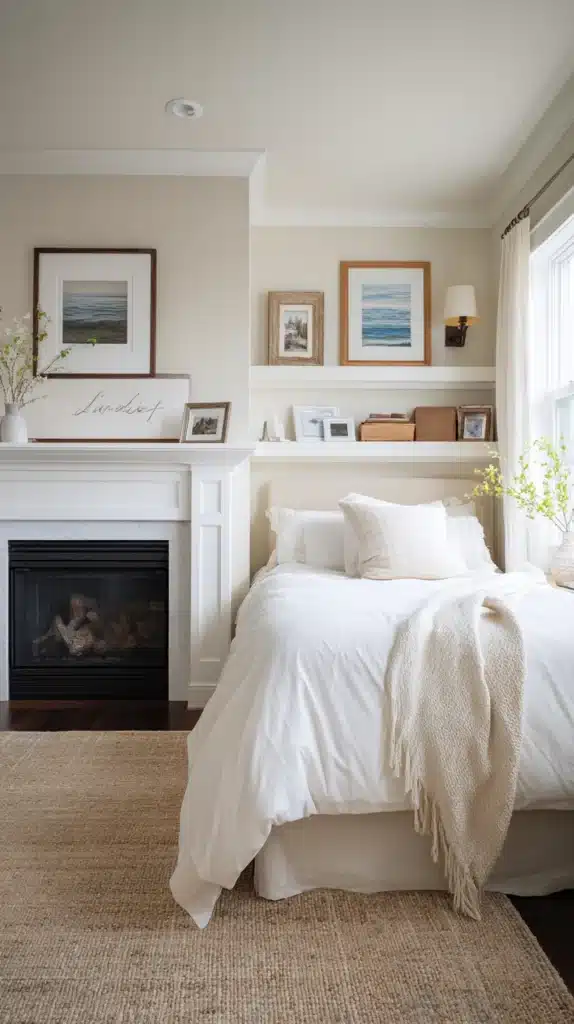
The bedroom mantel, unlike any other mantel in the home, has the specific privilege of being entirely personal — visible only to the room’s occupants and the intimates they invite into their private space, which means it can be decorated with objects of personal significance that would not be appropriate in more public rooms.
A collection of small framed photographs of people and places that matter most. A piece of jewelry displayed in a small ceramic dish. A collection of small objects gathered from meaningful journeys and experiences.
A handwritten note in a simple frame. These personal mementos, supplemented with spring flowers and seasonal botanicals, create a bedroom mantel of completely individual character — one that tells the story of a specific life in a way that no purely decorative scheme can replicate. The spring flowers change with the season; the personal objects remain, grounding the seasonal decoration in something permanent and deeply meaningful.
14. A Minimalist Spring Composition
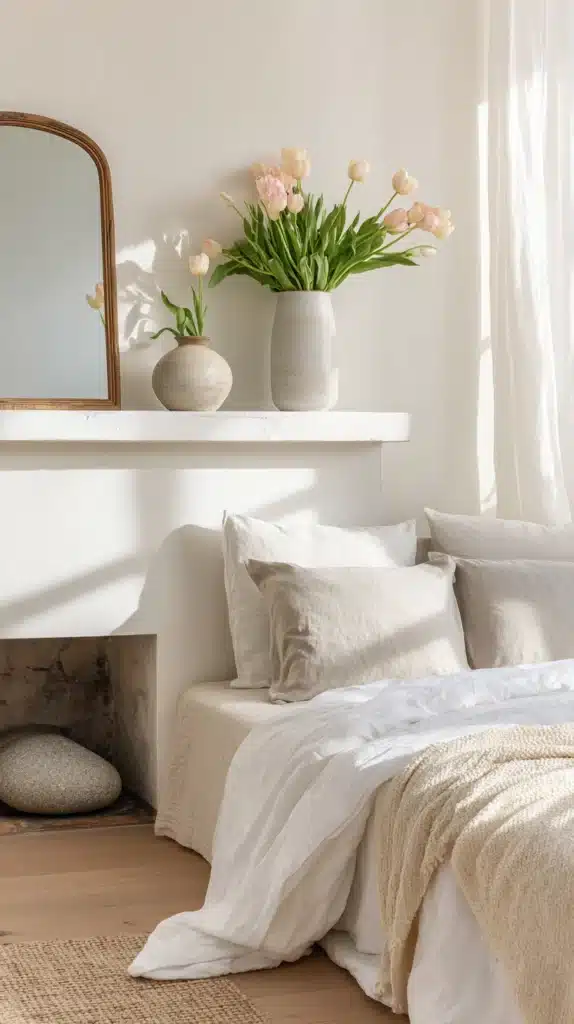
The final bedroom mantel idea is one of deliberate restraint — a spring composition that strips the arrangement to its absolute essentials and trusts those essentials to carry the full visual and emotional weight of the season.
Three objects at most: a simple mirror leaning against the wall, a single perfectly chosen vessel holding one or three stems of the spring’s most beautiful current offering, and one additional element of genuine visual quality — a smooth stone, a small sculpture, a candle in a beautiful holder.
The space around these three objects is as important as the objects themselves — the breathing room that allows each element to be seen and appreciated without competition from its neighbors is precisely what gives the minimalist composition its particular quality of calm and considered beauty.
In a bedroom, where the mantel’s role is to contribute to the room’s restorative atmosphere rather than to demonstrate decorating ambition, this restraint is not a limitation but an achievement — the most difficult thing in any art form is to know when to stop, and the minimalist spring bedroom mantel is the decorating expression of that knowledge applied with complete conviction.