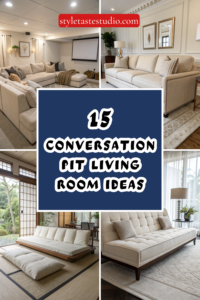
15 Cozy Small Sunken Seating Ideas for Modern Living
There is a particular quality of comfort that sunken seating produces that conventional furniture arrangements — however well chosen and carefully positioned — simply cannot replicate. It is the comfort of enclosure, of being held by the architecture rather than placed within it, of sitting in a space that has been specifically designed around the human body in repose rather than around the furniture that supports it.

The sunken conversation pit, which reached its cultural peak in the mid-century modern living rooms of the 1960s and 1970s, has returned to contemporary interior design with a confidence that reflects both a genuine nostalgia for that era’s commitment to spatial experimentation and a broader appetite for interiors that prioritize genuine comfort and social intimacy over the restrained, furniture-catalog perfectionism that dominated the preceding decades.
The misconception that sunken seating requires a large space has prevented many people from exploring the idea, but the truth is that a small, well-designed sunken seating area is in many ways more successful than a large one — the intimacy of scale reinforces the intimacy of the sunken form, and the result is a space that feels like a genuine sanctuary within the larger home. Here are fifteen ideas for bringing sunken seating into a modern living environment of any size.
1. The Classic Step-Down Conversation Pit

The conversation pit in its purest form is a recessed rectangular or square area set one or two steps below the surrounding floor level, lined on three or four sides with built-in upholstered seating, and designed specifically around the social act of conversation between a group of people who face each other at close range and at equal height.
This equality of positioning is one of the pit’s great social virtues — there is no head of the table, no hierarchical arrangement, no seat that is more prominent than any other. Everyone is held in the same gentle enclosure, at the same level, within easy conversational reach of everyone else.
For a modern small living space, a pit of just two by three meters can accommodate comfortable seating for six to eight people with a small central table, and the step-down depth of just twenty to thirty centimeters is sufficient to create the psychological sensation of enclosure without the engineering complexity of a deeper excavation.
The key design decision is the upholstery: choose a fabric with enough durability for daily use but enough quality to feel genuinely luxurious — a performance bouclé, a heavy linen, or a velvet in a color that anchors the room’s palette.
2. The Bay Window Sunken Nook

A bay window — that projecting architectural feature common in Victorian, Edwardian, and many contemporary homes — presents one of the most natural and most beautiful opportunities for sunken seating available in domestic architecture. The floor of a bay window can be excavated to create a sunken platform two or three steps below the main room level, with built-in seating fitted along the bay’s three sides and the floor of the surrounding room remaining at its original level.
The result is a reading or conversation nook that is simultaneously connected to the main room and architecturally distinct from it — a room within a room, lit from three sides by the bay’s windows, enclosed on three sides by the room’s walls and on the fourth by the step transition that marks the boundary between the sunken nook and the main space. This treatment transforms a feature that is typically treated as a simple window seat opportunity into something considerably more dramatic and more spatially rewarding.
3. A Sunken Media Zone Around a Central Screen

The challenge of positioning a television within a social seating arrangement is one of the most persistent frustrations of modern living room design, because the screen’s demands — it must be visible from every seat, it must be at approximately eye level when seated, it must not dominate the room when not in use — are frequently in tension with each other and with the other functional requirements of the space.
A sunken seating area designed around a wall-mounted or built-in screen addresses this conflict elegantly, because the screen is mounted at the main floor level of the room and viewed from the lowered seating below, which means that the eye-level viewing angle is achieved naturally by the geometry of the sunken arrangement rather than by mounting the screen uncomfortably high on the wall.
The sunken zone also creates an implicit enclosure around the media experience — a cinema-like sense of being gathered around and oriented toward the screen — that flat-floor seating arrangements can suggest but never quite achieve.
4. The Fireplace Pit Combination

The combination of a sunken seating area with a central or wall-adjacent fireplace is one of the most emotionally resonant interior design arrangements available, because it layers two of the home’s most primal comfort elements — fire and enclosure — into a single architectural gesture.
A small square pit with a central gas or bioethanol fire element at its heart, surrounded on all four sides by low built-in seating, creates a gathering space of intense warmth and intimacy that functions differently from any conventional seating arrangement around a fireplace.
The fire is below the surrounding floor level, which means it is at approximately the same height as the faces of the people sitting around it — an intimate rather than performative relationship with the flame that produces the ancient social pleasure of sitting around a fire in its most direct and undiluted form. The pit’s enclosure concentrates the warmth in a way that a conventional room arrangement disperses, making even a modest fire element feel genuinely heating rather than purely decorative.
5. The L-Shaped Sunken Corner Nook

For living spaces where a full pit is not possible but a partial sunken zone would transform the room’s spatial richness, an L-shaped sunken corner nook — recessed into one corner of the room, with two runs of built-in seating meeting at the corner — creates the essential qualities of sunken seating within a footprint that impacts only a fraction of the room’s total area.
The L-shaped configuration seats four to six people comfortably, leaves the remainder of the room at its original floor level and fully functional, and creates a defined corner destination that the room naturally organizes itself around.
The corner position provides two walls of the enclosure that sunken seating requires, with the step-down transition providing the third side and the open fourth side maintaining access and visual connection to the rest of the room. A small low table at the corner’s interior, and a pendant light hung from the ceiling above the nook, completes the sense of a defined zone within the larger space.
6. A Reading Pit with Floor-Level Bookshelves

A sunken reading nook flanked by floor-level bookshelves — the shelves positioned at the same level as the surrounding floor, their spines visible and accessible from the lowered seating within the pit — creates one of the most genuinely pleasurable domestic environments imaginable for anyone who loves books and the act of reading.
The reader sits below the level of the bookshelves, surrounded by books on two or three sides, enclosed and sheltered in a way that the most comfortable armchair in an open room can only approximate.
The ceiling feels lower from the pit’s floor, the surrounding room recedes, and the concentration required for reading becomes easier because the environment has been specifically designed to reduce distraction and increase the sensation of peaceful enclosure. Line the pit’s seating surface with deep cushions in a durable natural fabric, add a reading lamp on an adjustable arm mounted to the pit’s edge, and the nook becomes the most coveted space in the house.
7. A Sunken Dining Zone for Intimate Meals

Sunken dining — a step-down platform containing the dining table and chairs, set below the surrounding kitchen or living area floor level — creates an intimate dining environment with genuine architectural character and a sense of occasion that a conventionally positioned dining table rarely achieves.
The lowered floor level means that seated diners are slightly more enclosed than usual, which produces a restaurant booth-like quality of intimacy and privacy that makes conversation flow more naturally and meals feel more deliberate and pleasurable.
The sunken dining zone also allows the ceiling height above the table to be used more dramatically — a statement pendant light hung from the ceiling above the sunken zone appears at a lower and more intimate height from the diners’ perspective than it would from the surrounding floor level, creating a pool of warm light that defines the dining zone without any physical boundary.
8. The Outdoor-Indoor Sunken Transition Zone

A sunken seating area positioned at the boundary between an interior living space and an adjacent terrace or garden — its floor level below both the interior and exterior surfaces — creates a transitional zone that belongs fully to neither inside nor outside and is therefore uniquely suited to the kind of relaxed, seasonally extended living that modern home design increasingly prioritizes.
Glass walls or large sliding panels on the exterior side of the sunken zone, when open, dissolve the boundary between the lowered interior and the garden beyond, creating a continuous outdoor-indoor environment in which the sunken enclosure provides shelter and definition without closing the space off from the natural world. When the glass panels are closed for cooler weather, the zone functions as a fully interior sunken room that retains its visual connection to the garden through the glazing.
9. A Velvet-Lined Jewel Box Pit

For the homeowner who wants their sunken seating area to function as a deliberate design statement — a room within a room that announces its presence and its intention with complete confidence — the jewel box pit lined entirely in a single rich material is the approach that achieves this most effectively.
Upholstering every interior surface of the pit — the seat cushions, the back cushions, the side walls, and even the risers of the steps leading down — in a single fabric in a deep, saturated color creates an immersive material experience that is unlike anything that conventional furniture arrangement can produce.
Deep teal velvet, cognac leather, forest green bouclé, midnight blue performance fabric — the material choice should be bold enough to justify the commitment and luxurious enough in texture to reward the touch. The exterior edges of the pit, at main floor level, should be finished cleanly in a contrasting material — stone, timber, or metal edge trim — that frames the jewel box below with architectural precision.
10. A Modular Sunken Platform with Moveable Cushions

For renters and others who cannot undertake structural modifications to create a genuine sunken floor, a modular platform system achieves the visual and psychological effect of sunken seating by raising the surrounding floor area rather than lowering the seating area — the result, from the perspective of someone sitting in the central zone, is indistinguishable from a genuine step-down.
Low timber platforms laid around a central seating zone elevate the perimeter of the space by twenty to thirty centimeters, creating the surrounding raised floor that makes the seating area feel recessed.
Large floor cushions and low poufs in the central zone, combined with cushioned seating along the platform edges, complete the arrangement. The platforms can be built from simple timber construction and finished in the same material as the surrounding floor for visual continuity, or in a contrasting material that makes the raised perimeter a deliberate design element.
11. The Sunken Meditation and Yoga Space

Sunken seating does not need to serve the social and entertainment functions that the conversation pit traditionally has — it can equally serve solitary, contemplative purposes, and a small sunken zone designed specifically as a meditation, yoga, or quiet reflection space is one of the more interesting contemporary applications of the sunken form.
A shallow rectangular pit — deep enough to sit in cross-legged on a cushioned floor without the surrounding room feeling intrusive, but shallow enough to step in and out of with ease — lined with a simple natural material such as tatami matting, cork, or a dense wool felt, and kept completely clear of furniture and objects except for a single meditation cushion and perhaps a small shelf for a candle or plant, creates a designated space for stillness within the home that is spatially defined in a way that a mat placed on an open floor can never quite replicate.
12. A Children’s Play Pit That Grows Up

A sunken zone designed with children in mind — low, padded, enclosed, filled with cushions and the sensation of a safe, boundaried play space — has a secondary life as they grow, its fundamental qualities of enclosure and cushioned comfort remaining appealing long after the play function has been outgrown.
A small pit in a family living room, initially filled with floor cushions and soft toys, transitions naturally into a reading nook, a gaming zone, a homework space, and eventually a teenager’s preferred place for music listening and social media — always the most covetable spot in the room because its enclosure and its softness are things that human beings of all ages are drawn to instinctively.
13. An Alcove Sunken Seat Built Into a Thick Wall

In homes with walls of genuine thickness — older stone or brick buildings where wall reveals are substantial — the wall itself can be partially excavated to create an alcove sunken seat: a nook cut into the wall’s depth and lowered slightly below the room’s floor level to create a seat of remarkable intimacy and shelter.
This approach requires structural advice and careful construction but produces a spatial feature of extraordinary character — the sense of being literally within the wall, enclosed on three sides by the building’s own fabric, is one of the most atavistically comforting experiences that domestic architecture can offer. Line the alcove with cushions in a durable fabric, add a small reading light mounted to one side, and the niche becomes the house’s most beloved spot regardless of how many other seating options exist.
14. A Sunken Terrace Zone Brought Inside

Drawing on the vocabulary of the sunken outdoor terrace — the step-down entertainment zones that have been a feature of landscape architecture for decades — and bringing it inside as an interior design element creates a living space with a spatial richness that references both the formal garden tradition and the mid-century interior experiments of the conversation pit era.
A living room with one zone raised at the standard floor level and another lowered by two or three steps, the two levels connected by a broad shallow step that functions as additional informal seating, creates a room with genuine spatial variety — not two rooms, but one room with two distinct registers that suit different activities and different social configurations. The upper level suits standing, moving, and the active functions of the room; the lower level suits seated conversation, media viewing, and the more static, restful functions.
15. The Sunken Bed Platform for Studio Living

In a studio apartment where the sleeping zone must coexist with the living zone in the same open-plan space, a sunken platform for the bed — a shallow rectangular recess set into the floor at the sleeping area’s location, framed at its perimeter by the surrounding floor level and perhaps by low built-in storage units — creates a spatial definition for the sleeping zone that is achieved through floor level change rather than through walls or partitions, maintaining the studio’s openness and light while giving the bed a defined architectural home that feels genuinely separate from the surrounding living space.
The recess needs to be only deep enough — fifteen to twenty centimeters — to create the perceptible threshold that signals a change of zone, and the frame of the recess at floor level can incorporate lighting that illuminates the sleeping area softly from below its perimeter, creating a warm, floating quality to the bed platform that is both beautiful and deeply restful to sleep within.