15 Rustic DIY Farmhouse Table Ideas
The farmhouse table is one of the most enduring and most universally loved furniture forms in the domestic interior, and its appeal is not difficult to understand. It is a table that looks as though it was made to be used, that carries within its solid timber surface the specific quality of a piece of furniture that expects to host meals, homework, craft projects, and the accumulated daily activity of a household without complaint and without deterioration.
The farmhouse table’s visual character, its thick solid top, its sturdy legs, its honest joinery, and its unpretentious finish, communicates a set of values about the domestic interior that the sleek, manufactured dining table cannot approach. It says that this home is a place of genuine activity, genuine warmth, and genuine welcome.
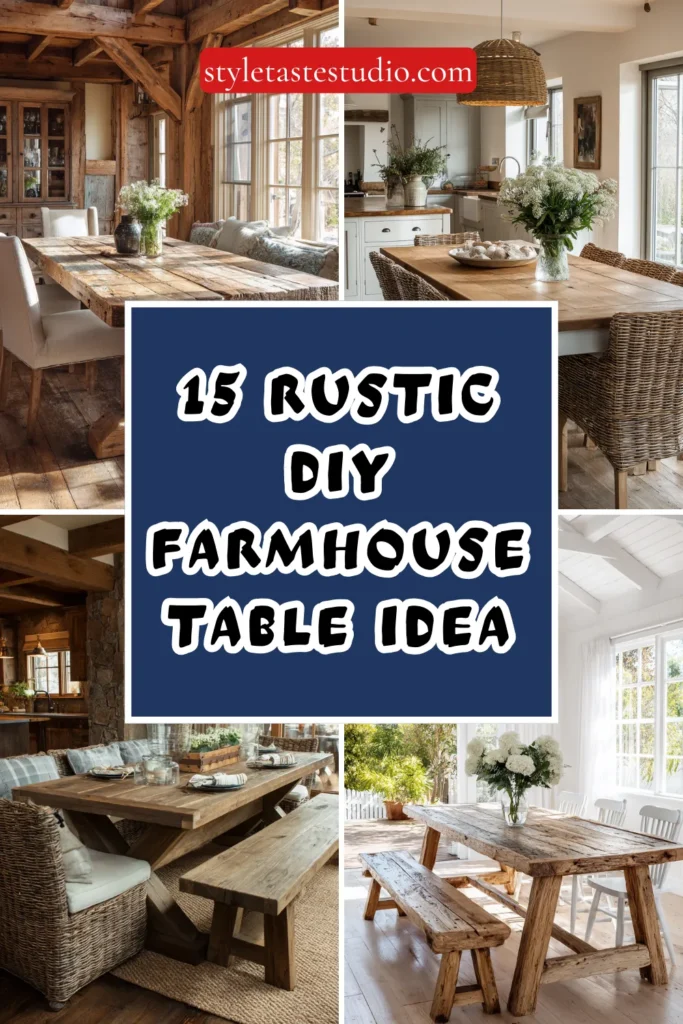
The good news for the homeowner who wants one is that the farmhouse table is also one of the most achievable DIY furniture projects available. Its construction is fundamentally simple.
A flat top of adequate thickness supported on a frame of four legs and two or four rails, joined with straightforward woodworking connections that require no specialist skills and no specialist tools beyond what most households either already own or can borrow for a weekend project.
The projects collected here range from the genuinely simple, achievable in a single day with basic tools and a modest timber budget, to the more ambitious constructions that reward additional time and skill with a finished piece of genuine heirloom quality.
All of them share the farmhouse table’s fundamental character. Here are fifteen rustic DIY farmhouse table ideas that bring this most welcoming of furniture forms into the home by the most satisfying means available, which is building it yourself.
1. The Classic Plank Top Trestle Table
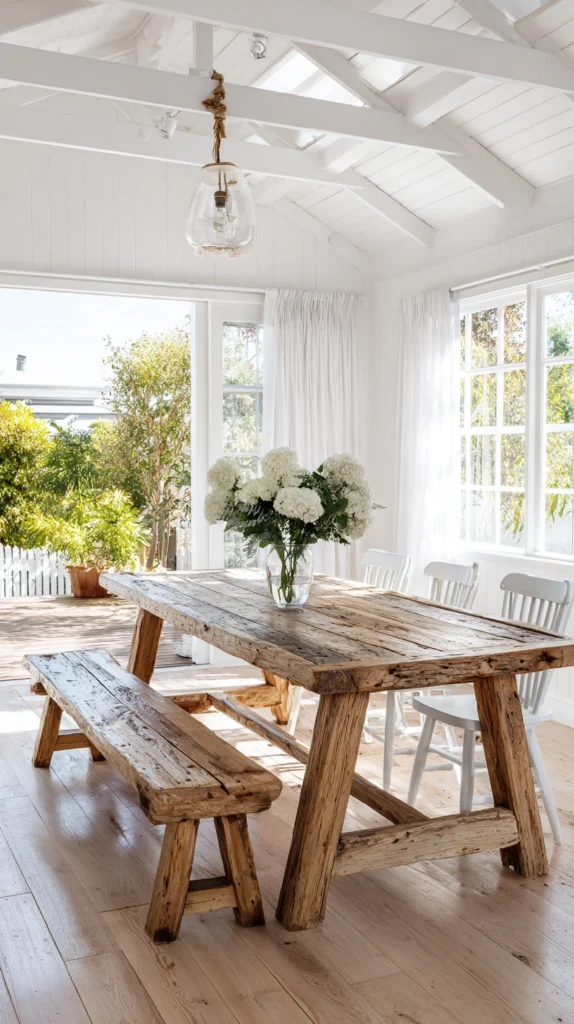
The trestle table is the farmhouse table in its most historically authentic form, a solid plank top of generous dimensions supported on two A-frame trestle legs connected by a central stretcher rail running between them. It is among the most straightforward farmhouse table constructions available and produces a finished piece of considerable visual presence.
The top is constructed from three or four planks of solid timber in a width of twenty to twenty-five centimeters, glued and clamped edge to edge to create the full table width. Douglas fir, pine, and oak are the most appropriate species for the classic trestle table, with oak producing the most durable and most visually characterful result at a higher material cost.
The trestle legs are each constructed from two angled leg boards joined at their apex and braced by a horizontal foot board at their base. The angle of the leg boards determines the trestle’s stability. An angle of fifteen degrees from vertical on each leg creates the splayed form that the classic trestle requires for stable support of the top.
The central stretcher connecting the two trestles should be of adequate section to resist the longitudinal racking forces that the table experiences during use. A stretcher of seventy-five by seventy-five millimeters, fixed to the inner face of each trestle with a substantial bolt connection that can be tightened if the joint loosens over time, creates the rigid spine that the trestle table’s construction requires.
2. The Reclaimed Timber Table with Steel Legs
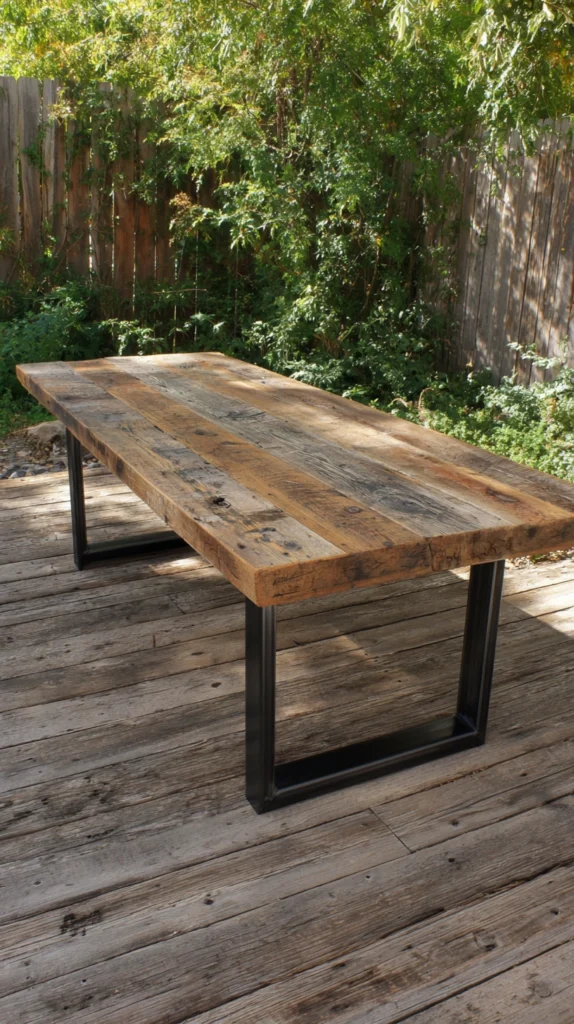
A tabletop constructed from reclaimed timber, old floorboards, scaffolding planks, or barn timber salvaged from a demolition or salvage yard, combined with legs fabricated from steel box section in a simple four-leg configuration, creates a farmhouse table of complete industrial character and absolute material authenticity.
The reclaimed timber top’s preparation is the project’s most time-consuming element. Old floorboards and scaffolding planks carry the surface imperfections, nail holes, paint residues, and the accumulated marks of previous use that give the reclaimed top its specific character. The preparation process preserves rather than removes these marks while creating a surface that is flat, splinter-free, and food-safe for the dining table application.
Sand the reclaimed surface progressively through increasing grits, starting at eighty grit to level any significant unevenness and ending at one hundred and eighty grit for the final surface before finishing. Fill any cracks or significant voids with a tinted epoxy resin in a color matched to the timber tone, creating the smooth, character-rich surface that the reclaimed farmhouse table most beautifully achieves.
The steel legs should be fabricated from a box section of adequate wall thickness for the table’s scale, typically fifty by fifty millimeters by three millimeters for a standard dining table.
A local steel fabricator can cut and weld the leg assembly to the specified dimensions, and the finished steel should be treated with a rust-inhibiting primer and a matte black or raw steel topcoat before fixing to the timber top.
3. The Simple Four-By-Four Leg Table
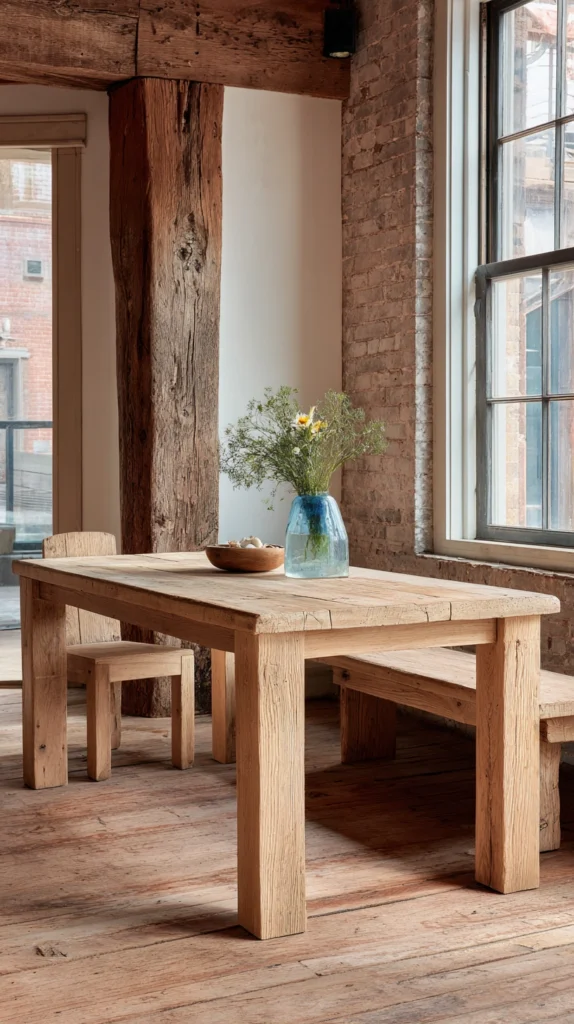
The simplest possible farmhouse table construction uses four standard timber posts of one hundred by one hundred millimeters section as the legs, connected by a simple rectangular apron frame of seventy-five by fifty millimeter timber, with a solid plank top fixed to the apron’s upper face. It can be built in a single day with basic hand tools and requires no specialist woodworking skills.
The leg-to-apron connection is the construction’s critical joint. A pocket screw connection, created with a pocket hole jig that is available from any hardware store for a modest cost, creates a strong, concealed fixing that is both simple to execute and reliable in service. Two pocket screws at each leg-to-apron connection and two at each apron-to-top connection create the full structural assembly.
The tabletop for this construction is most simply created from standard dressed pine boards of one hundred and forty millimeters width, laid side by side across the apron frame and fixed with screws from below through the apron’s top face. The gaps between the boards can be left as a deliberate design feature of the rustic aesthetic or filled with timber filler for a more refined surface.
Finish the table with a penetrating oil in a tone appropriate to the desired aesthetic. A raw linseed oil finish darkens the pine slightly and creates the warm, honey-toned surface of the classic farmhouse table. A whitewash or liming treatment creates the bleached, weathered surface of the coastal farmhouse aesthetic. Both finishes are achievable with basic application equipment and minimal experience.
4. The Herringbone Top Farmhouse Table
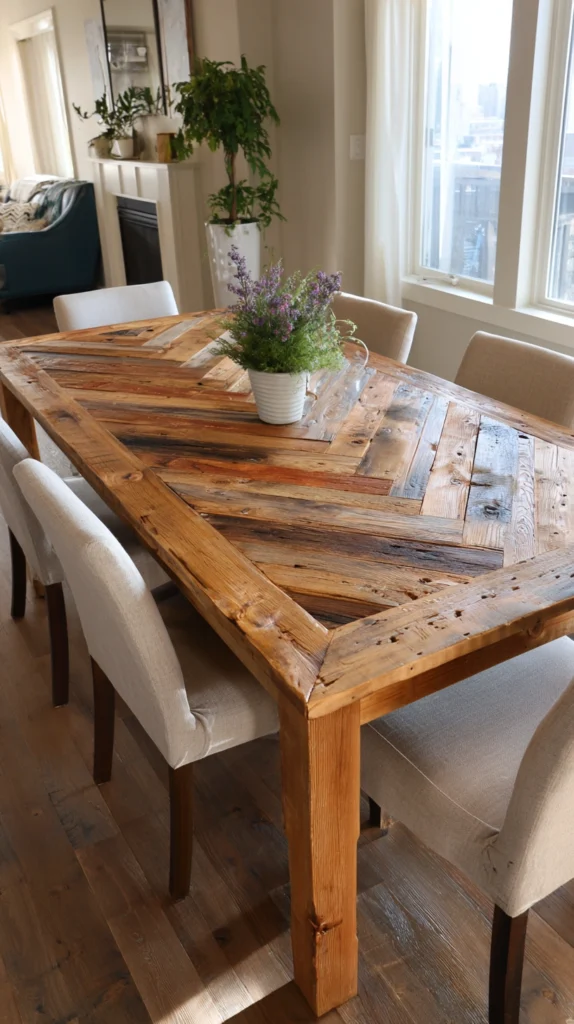
A farmhouse table whose top is constructed in a herringbone pattern, individual timber boards cut at forty-five degrees and laid in the alternating diagonal pattern of the classic herringbone, creates a table of considerably greater visual complexity and decorative ambition than the standard parallel-plank top while using the same basic construction techniques.
The herringbone top requires more precise cutting than the parallel plank top. Each board must be cut at an accurate forty-five degrees on both ends to create the tight joints that the pattern requires. A miter saw set to forty-five degrees and a stop block clamped to the fence to ensure consistent board lengths are the two tools that make the accurate cutting of the herringbone pattern achievable without specialist skills.
The boards for the herringbone top should be narrower than those used for a standard parallel plank top. A board width of fifty to seventy-five millimeters creates the tight, detailed herringbone pattern that reads most elegantly at dining table scale. Wider boards create a coarser pattern that reads as clumsy rather than refined against the scale of a standard dining table.
Glue and nail the herringbone boards to a plywood substrate of eighteen millimeters thickness that provides the flat, stable base that the herringbone pattern’s multiple short boards cannot provide independently. The plywood substrate also eliminates the wood movement that solid timber tops experience with seasonal humidity changes, which is particularly significant in a top constructed from multiple short-grain pieces.
5. The Bread Board End Table
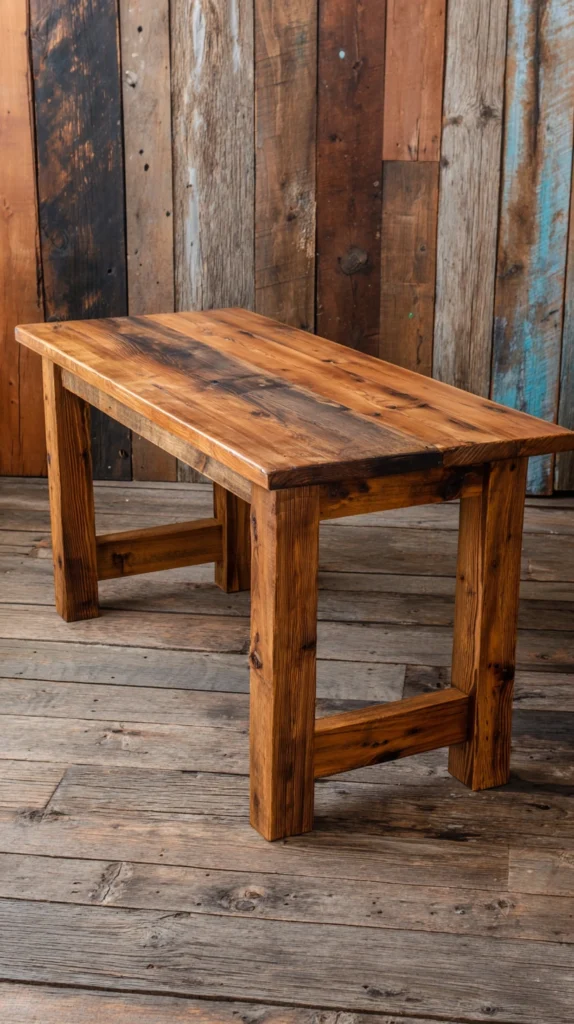
The bread board end table adds a perpendicular board at each short end of the plank top, running across the full width of the top’s grain direction and fixed with a system of elongated slots and central fixed connections that allows the top to expand and contract with seasonal humidity changes while the bread board ends remain flush and stable.
The bread board end’s primary function is to prevent the plank top from cupping. A solid timber top of significant width will cup across its grain direction as the timber’s moisture content changes with the seasons, and the bread board end’s cross-grain construction resists this cupping tendency with its own structural resistance. The elongated slot fixing system accommodates the top’s longitudinal expansion without restricting it.
Cut the elongated slots in the top’s end grain using a router or a drill and chisel, with the central fixing hole as a fixed round hole and the outer fixing holes as slots of adequate length for the anticipated seasonal movement. A rule of thumb for slot length is one millimeter per twenty-five millimeters of top width, calculated from the central fixed point outward in each direction.
The bread board ends should be of a thickness matching the top’s thickness and a width of one hundred to one hundred and fifty millimeters for a standard dining table top. They should be finished in the same treatment as the top, with particular attention to the end grain faces which absorb finish more rapidly than face grain and require an additional application to achieve the consistent finish appearance.
6. The Painted Farmhouse Table with Natural Top
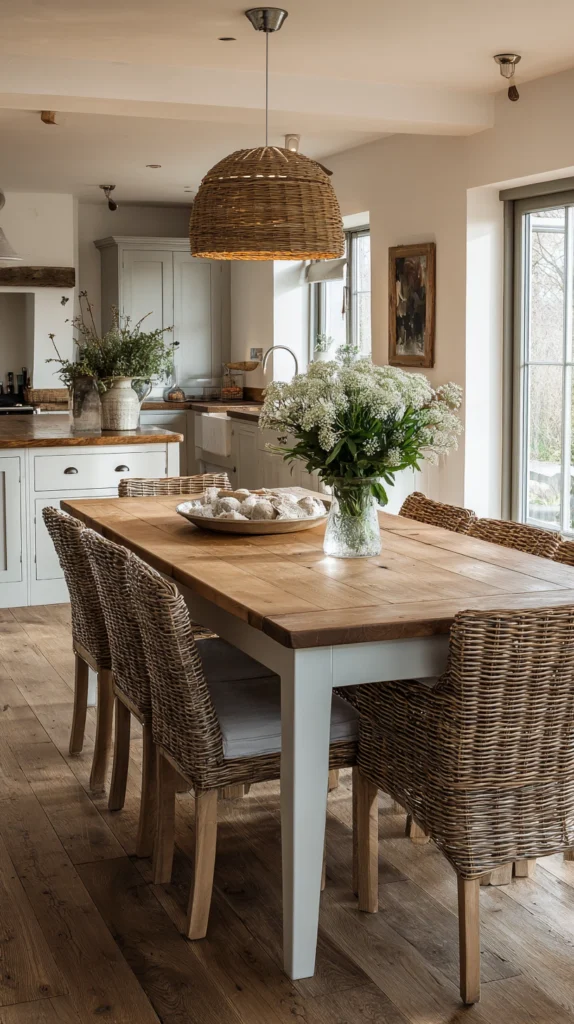
A farmhouse table whose legs, apron, and stretchers are painted in a deep, matte color while the top remains in a natural, oiled timber finish creates a two-material aesthetic of considerable visual interest and practical intelligence. The painted base creates the farmhouse character and the muted color, while the natural timber top provides the warmth and the material authenticity of the genuine wood surface.
The base color should be chosen to relate to the surrounding interior rather than simply defaulting to white, which is the most common painted farmhouse table base color but not always the most interesting or the most contextually appropriate. A deep forest green, a soft charcoal, a warm navy, or a muted terracotta each create a painted farmhouse table base of considerably greater visual interest than the standard white.
The paint for the farmhouse table base should be a floor or furniture-grade enamel of adequate hardness for the knocks and scuffs that table legs and aprons routinely receive. Standard wall paint, applied to furniture without the appropriate primer and topcoat, chips and wears within months of use. A properly prepared and properly painted furniture finish maintains its appearance for years of daily household use.
The natural timber top should be finished with a hardwearing penetrating oil or a furniture-specific hardwax oil that provides the daily wear resistance that the dining surface requires. The oil finish should be renewed annually with a light sanding and a fresh application to maintain its protective quality and its visual warmth throughout the table’s working life.
7. The Chunky Butcher Block Table
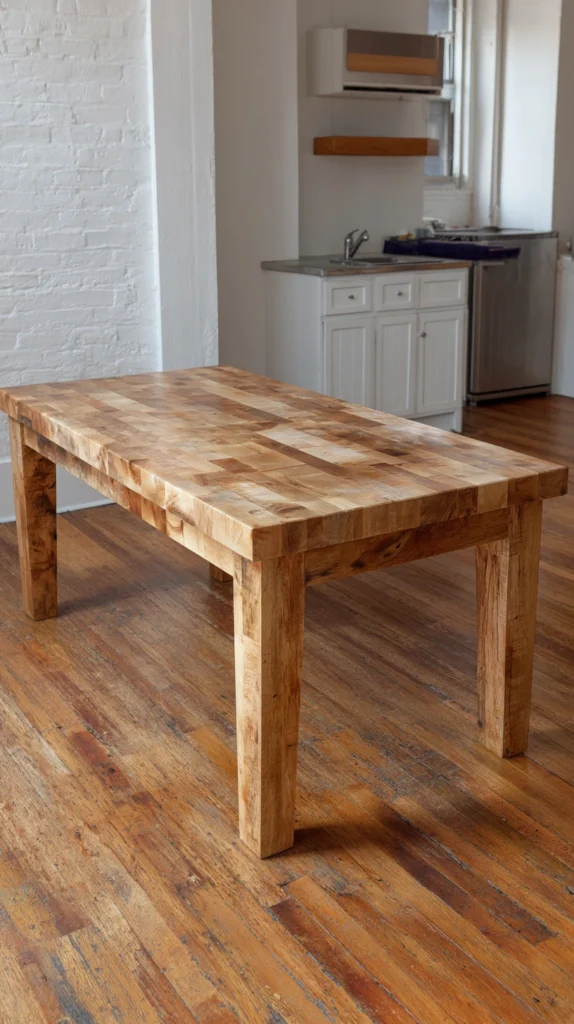
A farmhouse table whose top is constructed in the butcher block format, individual strips of timber glued together with their end grain facing upward to create a surface of extraordinary hardness and warmth, creates a kitchen or dining table of complete culinary character and the specific visual richness of the end grain timber surface.
The butcher block top is constructed by gluing together strips of hardwood, typically maple, oak, or walnut, of a consistent thickness in the range of thirty to forty millimeters, with the strips oriented so their end grain faces upward. The glued assembly is clamped until the adhesive cures and then planed or sanded flat on both faces to create the smooth, even surface that the finished top requires.
The end grain surface of the butcher block top requires more thorough sealing than the face grain surface of a standard plank top. End grain is significantly more absorbent than face grain, and an unsealed or inadequately sealed end grain surface will absorb liquids, food residues, and cleaning products at a rate that creates hygiene and appearance problems within a short period of regular use.
Apply a generous initial sealing coat of food-safe mineral oil to the new butcher block top, allowing it to soak in completely before applying a second coat and repeating the process until the surface no longer absorbs the oil rapidly. A final coat of a beeswax and oil combination product creates the warm, slightly sheen surface that the butcher block top at its most beautiful possesses.
8. The Turned Leg Farmhouse Table
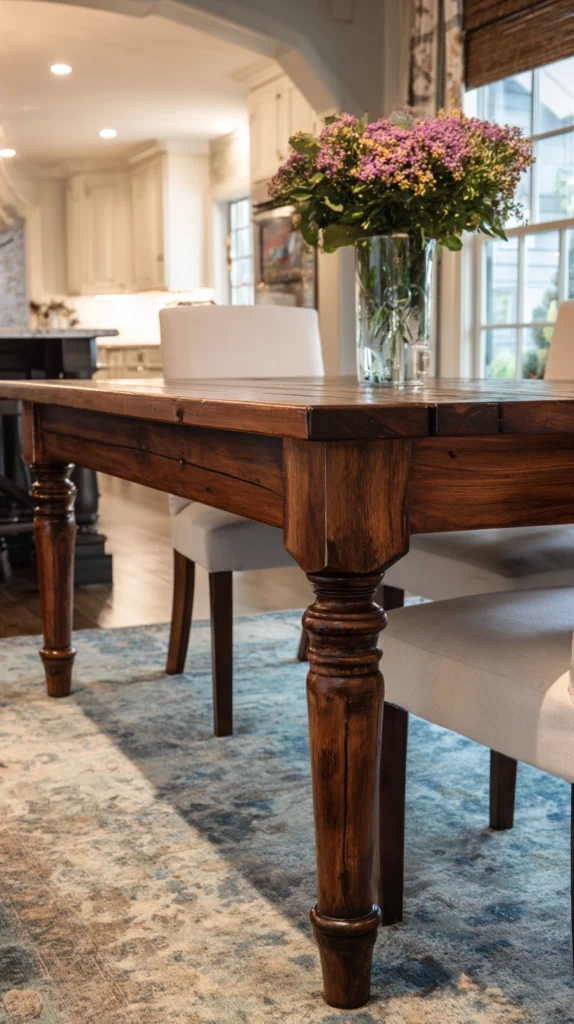
A farmhouse table with turned legs, the cylindrical timber legs shaped on a lathe with the decorative profiles of the traditional furniture turning tradition, creates a piece of considerably greater decorative refinement than the square-section leg table while maintaining the farmhouse character through the solid timber top and the honest construction of the supporting frame.
Turned legs for the farmhouse table can be purchased ready-made from timber suppliers and specialist furniture component suppliers in a range of profiles and sizes, making the turned leg farmhouse table accessible to the builder who does not have access to a lathe. The purchased turned leg eliminates the most technically demanding element of the construction and allows the builder to focus on the top and frame assembly.
The turned leg’s connection to the apron frame requires a mortise-and-tenon connection for maximum strength and traditional authenticity, or a metal corner bracket of adequate size for the construction speed and the simpler tooling requirements that the pocket screw connection cannot provide at this joint.
The mortise-and-tenon is the stronger and more traditional joint but requires a mortise chisel and the skill to use it accurately.
Choose a turned leg profile that relates to the table’s intended aesthetic. A simple, understated turning with minimal decoration suits the contemporary farmhouse interior.
A more elaborate turning with multiple coves, beads, and tapers suits the more traditional or more overtly rustic farmhouse interior. The leg profile communicates the table’s period reference more clearly than any other single design element.
9. The Double Trestle Sawhorse Table
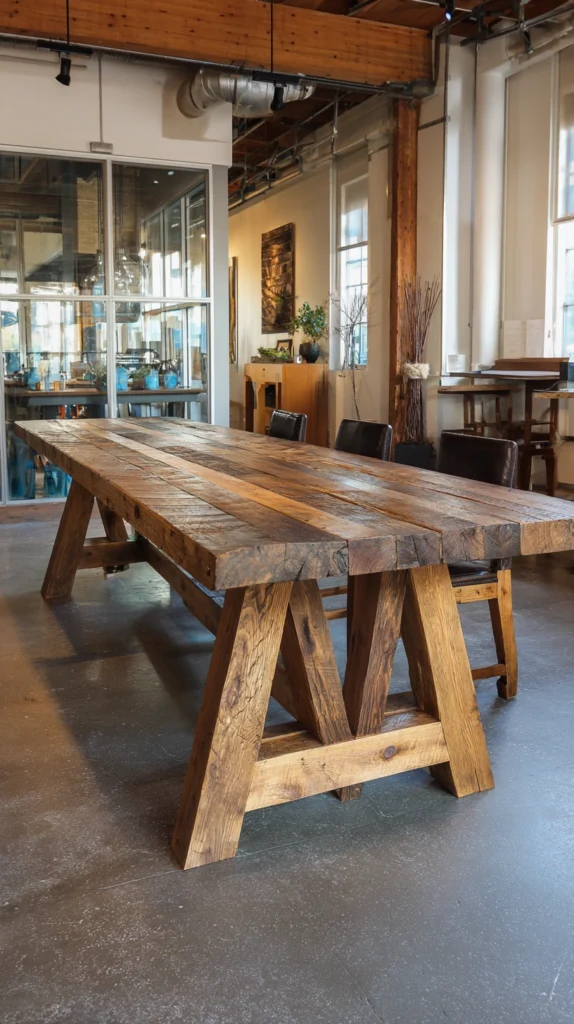
A farmhouse table constructed from two pairs of sawhorse-style trestles, each pair connected by a horizontal stretcher at their base and supporting the tabletop at their apex, creates the most visually dynamic and most structurally expressive of the farmhouse table forms. The crossed leg sawhorse creates a strong diagonal visual rhythm that the parallel-leg table entirely lacks.
The sawhorse trestles can be constructed from standard dimensional timber in a simple halved joint where the two crossed legs meet at their midpoint. A half-lap joint at the crossing point, where each leg is notched to half its thickness so the two legs interlock flush, creates the clean, traditional sawhorse crossing that is both structurally sound and visually precise.
The connection between the sawhorse trestle pair and the tabletop should allow for disassembly, a traditional feature of the trestle table that makes the piece easy to transport and store when not in use.
A simple bolt and nut connection through the top of each trestle into the underside of the tabletop, with a wing nut for tool-free tightening, creates the demountable connection without sacrificing structural rigidity during use.
The sawhorse table’s visual energy is best complemented by a top of simple, restrained character. A wide-plank top in a single timber species, finished with a single penetrating oil, provides the calm horizontal surface that the dynamic crossed-leg base requires as its visual counterpart for a well-balanced overall composition.
10. The Farmhouse Table with Bench Set
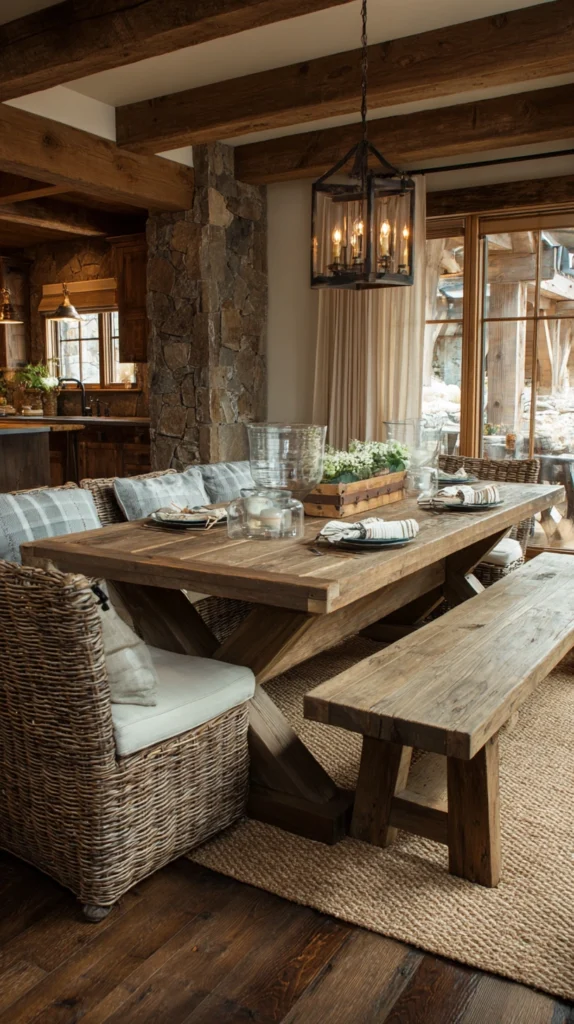
A farmhouse table designed and built as a set with matching benches rather than individual chairs creates the most authentically farmhouse of all the table configurations and the one that most directly references the communal dining tradition of the working farmhouse from which the table type takes its name and its character.
The bench construction follows the same structural logic as the table construction, with a narrower top of thirty-five to forty centimeters width supported on a simple leg and apron frame of proportions scaled to the bench’s narrower and lower format. The bench height should be calibrated to the table height so that seated bench users have an appropriate clearance between the bench seat and the table’s underside apron.
The visual relationship between the table and bench top surfaces should be consistent in material, finish, and character. If the table top is in reclaimed oak with a raw oil finish, the bench tops should be in the same timber and the same finish. The visual consistency of the matched set creates the farmhouse table and bench combination’s specific quality of intentional completeness that mismatched seating cannot provide.
Build the benches slightly longer than the table’s width dimension to create the overhang at each end that the farmhouse bench traditionally possesses. This overhang is both practical, providing easy entry and exit from the bench’s end positions, and visually characteristic, giving the bench set the generous, overscaled quality of farmhouse furniture at its most authentic.
11. The Pallet Wood Farmhouse Table
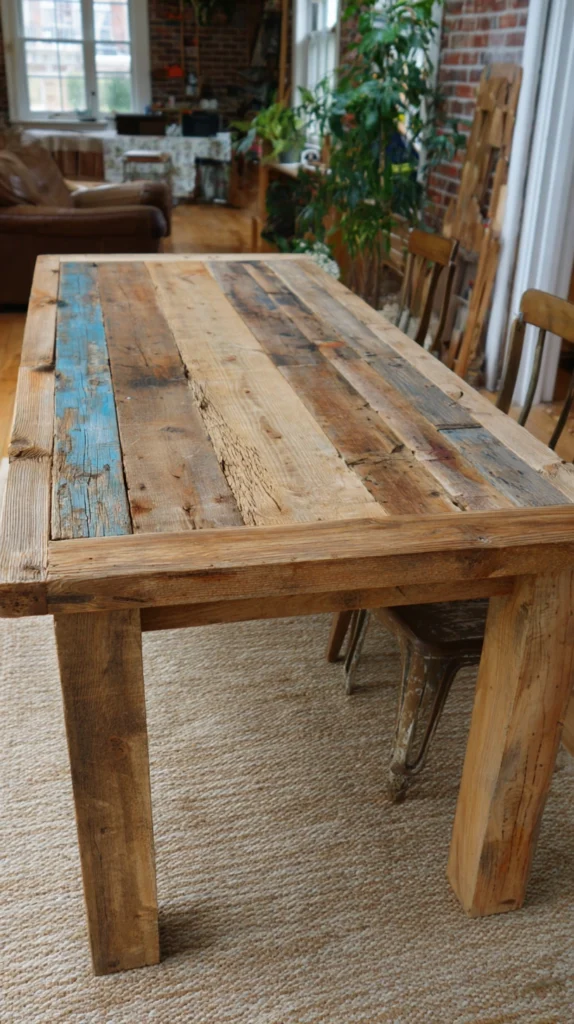
A farmhouse table constructed entirely from reclaimed pallet timber creates a piece of complete material economy at a material cost that approaches zero for most builders, while the pallet timber’s characteristic rough surface, nail holes, and paint residues create a rustic surface character that no new timber can replicate regardless of the finishing treatments applied to it.
The pallet timber’s preparation is the project’s most labor-intensive element. Each pallet board must be deconstructed from the pallet carefully to avoid splitting, inspected for protruding nails and metal fasteners that are removed completely, and sorted by thickness and width to identify the boards of sufficient consistency for the tabletop application. Inconsistent pallet boards should be reserved for the less critical apron and leg construction.
The pallet wood tabletop requires more thorough surface preparation than standard dimensional timber because of the variation in the boards’ surfaces and the presence of the rough, weathered texture that gives the material its character but must be rendered safe for a dining surface. Sand progressively to a final grit of one hundred and eighty, and apply a penetrating oil sealer of sufficient body to fill the surface texture to a smooth, hygienic finish.
The pallet wood farmhouse table’s specific appeal is the complete transparency of its material origins. Every mark on the surface, every stenciled shipping code, every nail hole and bolt hole, tells the story of the timber’s previous life in the supply chain. This material biography is the pallet wood table’s most distinctive quality and the one that makes every example completely unique.
12. The Live Edge Farmhouse Table
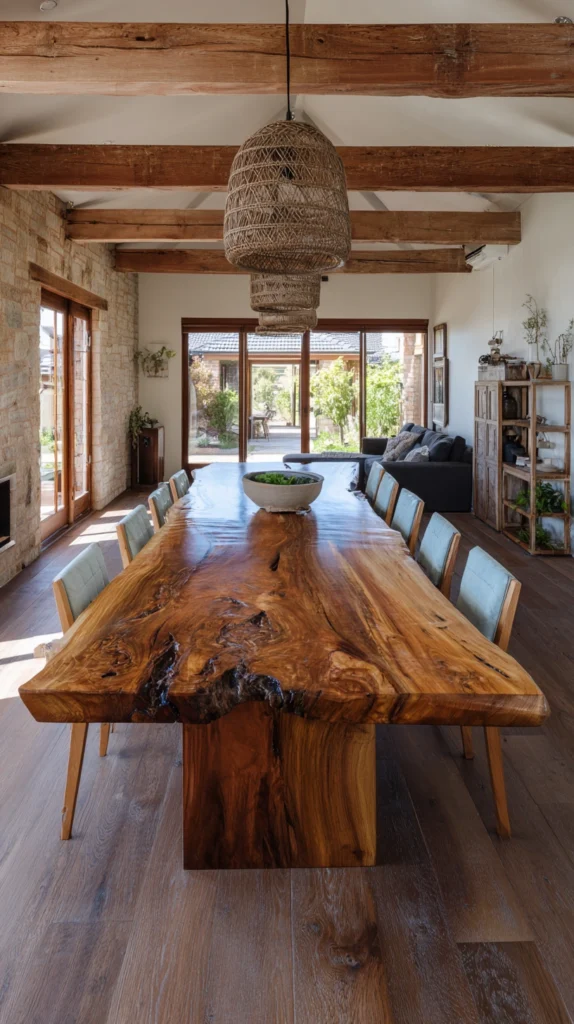
A farmhouse table whose top incorporates a live edge, the natural, uncut edge of the timber slab that retains the tree’s original bark line with all its organic irregularity, creates a piece at the intersection of the rustic farmhouse aesthetic and the contemporary natural material design movement. The live edge top brings the specific beauty of the unprocessed natural material into the dining table’s daily use.
The live edge slab requires sourcing from a specialist timber merchant or a sawmill that processes whole-tree slabs rather than standard dimensional lumber. The slab selection should consider the edge’s specific form, the width variation along the table’s length, and the consistency of the timber’s figure and color across the full surface. A slab with dramatic figuring and a strong edge form creates the most visually compelling live edge table.
Preparation of the live edge requires the removal of any remaining bark from the edge, as bark separates from the timber over time and creates a maintenance issue on a finished dining table. The bark removal exposes the cambium layer beneath, which should be sanded smooth and treated with the same finish as the table’s face surface to create a consistent, durable edge finish.
The live edge top is best supported on a base of simple, industrial character that does not compete with the organic drama of the top’s natural edge. Steel tube legs in a matte black finish, or a simple timber trestle in a single dark-stained species, create the base restraint that allows the live edge slab to be the table’s complete visual statement without competition from an elaborate supporting structure.
13. The Extension Farmhouse Table
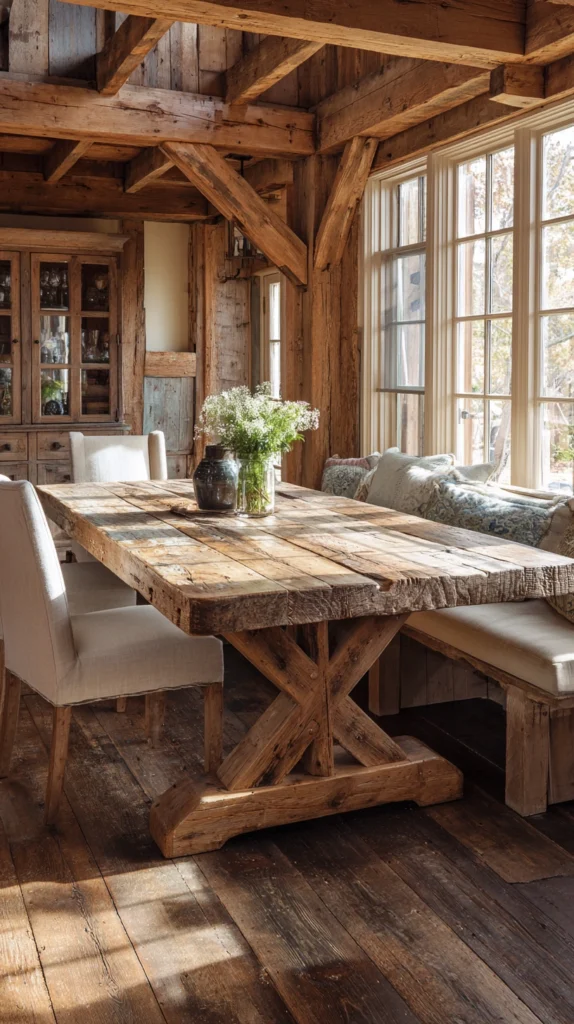
A farmhouse table built with an extension leaf mechanism, a central section that separates on sliding runners to accept one or two additional timber leaves that increase the table’s seating capacity for larger gatherings, creates the most practically useful of all the farmhouse table configurations for a household whose dining numbers vary significantly between everyday meals and entertaining occasions.
The extension mechanism requires the most precise construction of any farmhouse table project. The sliding runner system must be perfectly aligned so that the two table halves separate and reconnect smoothly and level, without the misalignment that a poorly fitted extension mechanism creates.
Commercial extension table hardware of adequate quality, available from specialist woodworking suppliers, provides the precision that the hand-made alternative rarely achieves.
The extension leaves should be stored flat in a cool, dry location that maintains their dimensional stability between uses. A leaf stored in a garage or an outdoor shed experiences humidity and temperature variations that cause the timber to move, creating the dimensional changes that prevent the leaf from fitting the table’s extension gap accurately when it is needed for use.
Finish the extension leaves in the same material and the same process as the main table surface, applying the same number of coats of the same product in the same sequence, so that the leaf surface matches the table surface in sheen and color when deployed.
A leaf whose finish does not match the main surface creates a visible discontinuity at the extension joint that undermines the quality of the completed extended table.
14. The Farmhouse Coffee Table
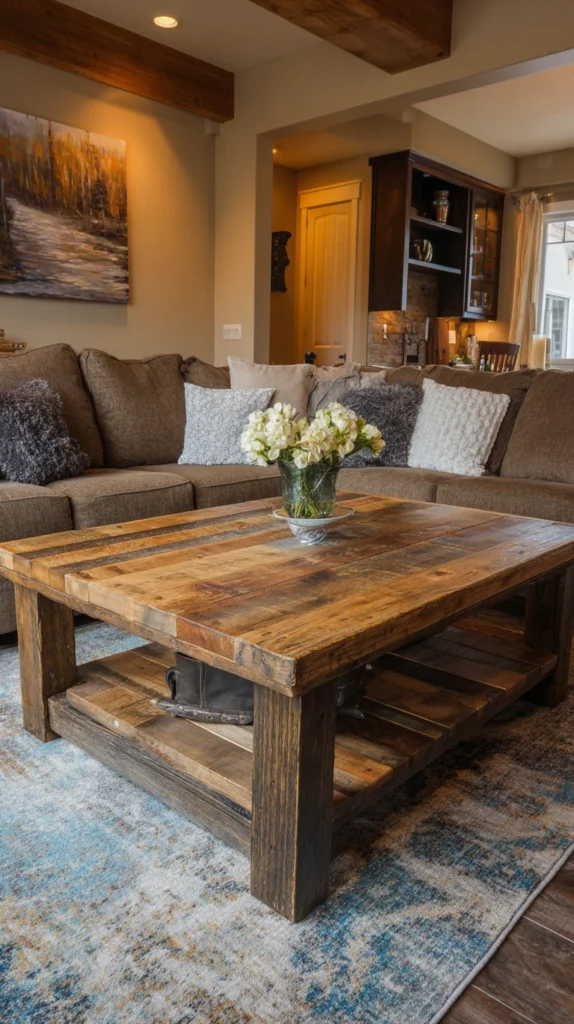
The farmhouse aesthetic applied to the coffee table scale creates a living room centrepiece of rustic character and generous proportions that the standard glass and chrome coffee table entirely lacks. The farmhouse coffee table’s solid timber top, its chunky legs, and its honest construction bring the dining table’s material warmth to the living room’s central furniture piece.
The coffee table construction follows the same structural principles as the dining table but with dimensions appropriate to the living room application. A height of forty-five centimeters suits the standard sofa seat height.
A top area of approximately sixty by one hundred and twenty centimeters provides adequate surface area for the coffee table’s functional requirements of drinks, books, and the various objects of the living room’s daily use.
A lower shelf between the stretchers that connect the table’s legs at their base creates additional storage for the living room’s books, remote controls, candles, and the accumulated objects of daily living room use.
The lower shelf is one of the farmhouse coffee table’s most practically valuable elements and one of the simplest to incorporate into the construction, requiring only a shelf board cut to fit between the stretchers and fixed at an appropriate height.
Finish the farmhouse coffee table with a hardwearing surface treatment appropriate to the intensive daily use that the coffee table receives. A hardwax oil of furniture grade, applied in two to three coats with a light denib sand between each coat, creates a surface of adequate wear resistance for daily coffee table use while maintaining the warm, natural appearance of the timber beneath.
15. Build the Farmhouse Table for the Life You Will Live at It
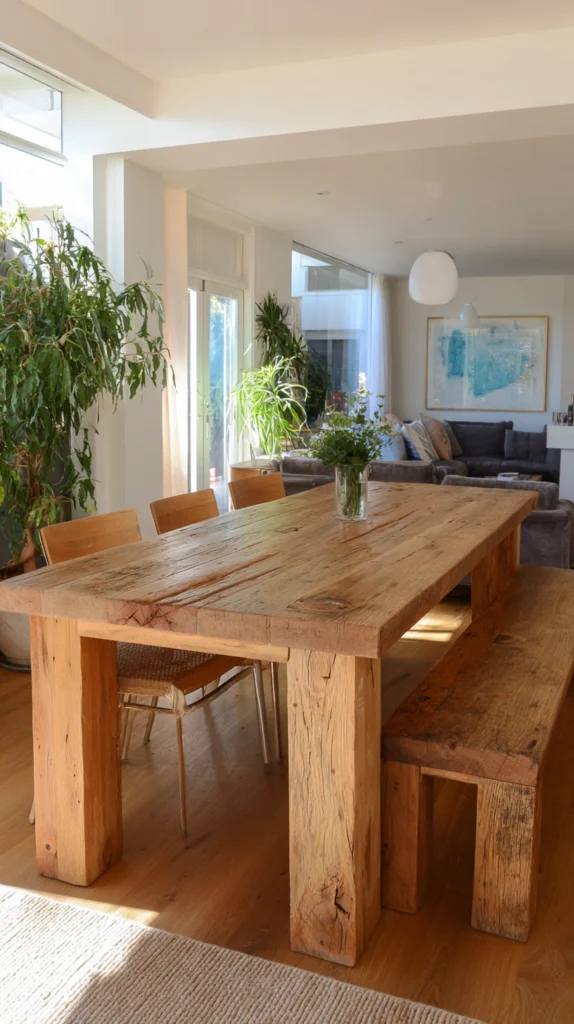
The final farmhouse table idea is the most important design principle of the entire building project. It is the commitment to building a table whose dimensions, whose material, whose finish, and whose construction are all calibrated to the specific life that the household will actually live at it rather than the ideal farmhouse table of the inspiration image.
A household with young children needs a table whose surface can be wiped clean without damage, whose finish is robust enough to resist the marks and impacts of daily family use, and whose dimensions create the communal dining experience of the farmhouse table at its most socially generous. A couple needs a table whose scale suits two people at everyday meals while expanding to accommodate guests.
The build process itself is one of the farmhouse table project’s most significant pleasures and one of its most lasting values. A table that has been built by the hands of the household carries a specific warmth and a specific meaning that no purchased table, however beautiful and however expensive, can possess. Every mark on its surface is a record of the life lived at it.
Build the farmhouse table with the intention of keeping it for a very long time. Choose the timber with care, prepare and finish the surfaces with thoroughness, and construct the joints with the precision that a piece of furniture intended for decades of daily use genuinely requires. The farmhouse table built well and built for permanence becomes, in time, exactly the piece of furniture that its name has always promised. A table that belongs completely to the home and the family it serves.