15 Boho Summer Decor Ideas That Feel Relaxed and Stylish
Boho style at its best is not about buying a collection of things that look eclectic — it is about layering textures, materials, and found objects in a way that feels genuinely lived in and personal.

The summer version of this aesthetic leans into warmth, natural materials, and a certain ease that makes a space feel like it has always looked that way rather than been arranged for effect. Rattan beside linen beside a hand-thrown pot beside a trailing plant — nothing matches exactly and everything works together.
The fifteen ideas below are the boho summer decor moves that deliver the most visual impact for the effort and budget involved. Each one works as a standalone upgrade or as part of a broader scheme, and none of them require a complete room overhaul to make their presence felt. Costs and a practical styling tip are included with each to help you get the look right from the first piece you add.
1. A Macramé Wall Hanging as a Statement Piece
Budget: $30 – $150
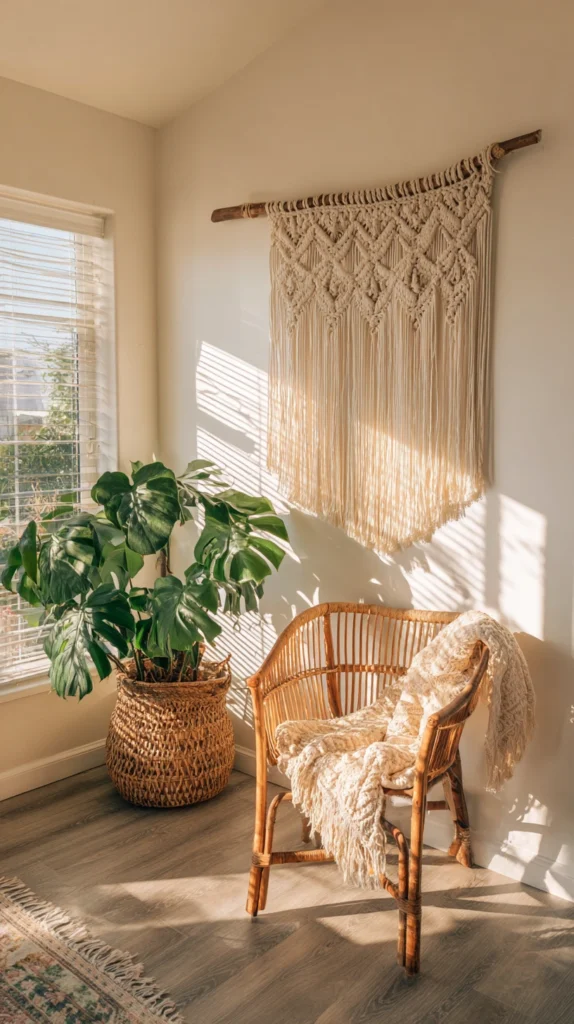
A large macramé wall hanging is one of the most effective single pieces of boho decor available — it adds texture, warmth, and a handcrafted quality to a wall that paint, prints, and mirrors cannot replicate. The knotted cotton or jute creates depth through shadow, which changes through the day as the light moves, and the fringing at the base adds movement to a surface that would otherwise be static. One generous piece hung on a prominent wall does more for a boho room than several smaller decorative items scattered across the same space.
Handmade macramé wall hangings from independent makers on Etsy cost $30–$80 for a medium piece and $80–$150 for a large statement version suitable for a living room or bedroom focal wall. Mass-produced versions from homewares retailers are available for less but lack the irregularity and craft quality that makes a handmade piece genuinely interesting to look at up close. Hang on a dowel or a piece of driftwood at a height where the base of the fringing sits just above eye level when standing — this is the proportion that reads best on a standard ceiling-height wall.
Style tip: Hang the macramé on a wall that receives natural light from one side rather than directly opposite a window. Side lighting creates shadows within the knotted texture that bring the piece to life — direct front lighting flattens it and reduces the three-dimensional quality that makes macramé visually interesting from across the room.
2. Rattan and Wicker Furniture
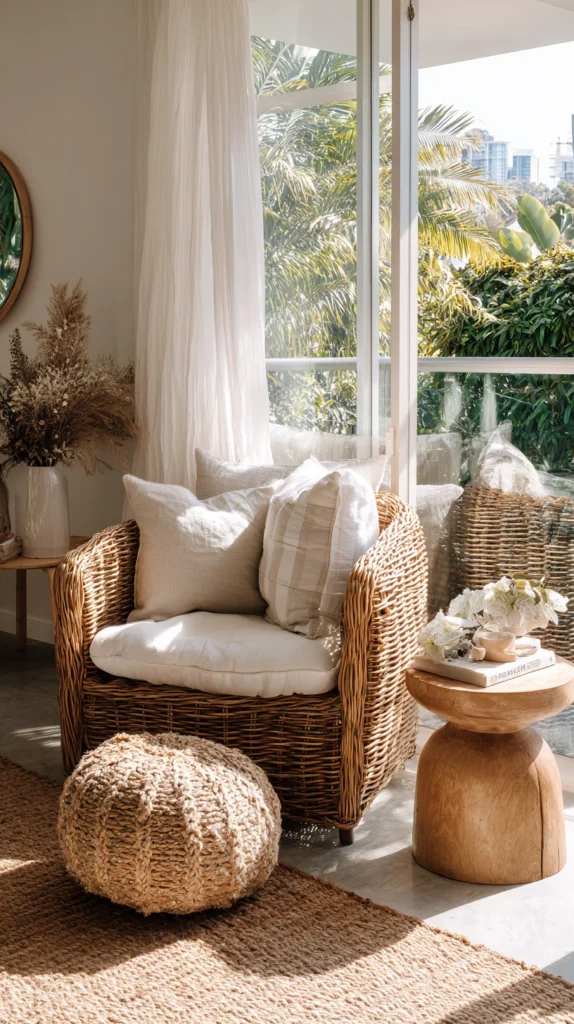
Budget: $80 – $600
Rattan furniture is the structural foundation of a boho summer interior. The woven natural material brings warmth, texture, and an organic quality to a room that upholstered furniture rarely matches, and it suits the light, airy feeling of a summer interior better than most other furniture materials. A rattan armchair, a wicker side table, or a cane-backed dining chair used alongside other natural materials establishes the boho palette immediately without requiring any other significant decorating commitment.
A rattan accent chair costs $80–$200 from most homewares retailers and online marketplaces. A full rattan sofa or daybed runs $200–$600. Vintage and second-hand rattan pieces found at markets, charity shops, and online resale platforms often have the best patina and the most character at a fraction of new retail prices. A single coat of natural rattan oil ($8–$15) refreshes older pieces and prevents the material from drying out and becoming brittle in warm summer conditions or in air-conditioned interiors.
Style tip: Mix rattan with at least two other natural materials in the same space — linen cushions, a jute rug, a wooden tray, or a terracotta pot. Rattan in a room full of synthetic or upholstered furniture looks like a themed piece. Rattan alongside other natural textures looks like a considered design palette that holds together coherently.
3. Layered Rugs on Natural Flooring
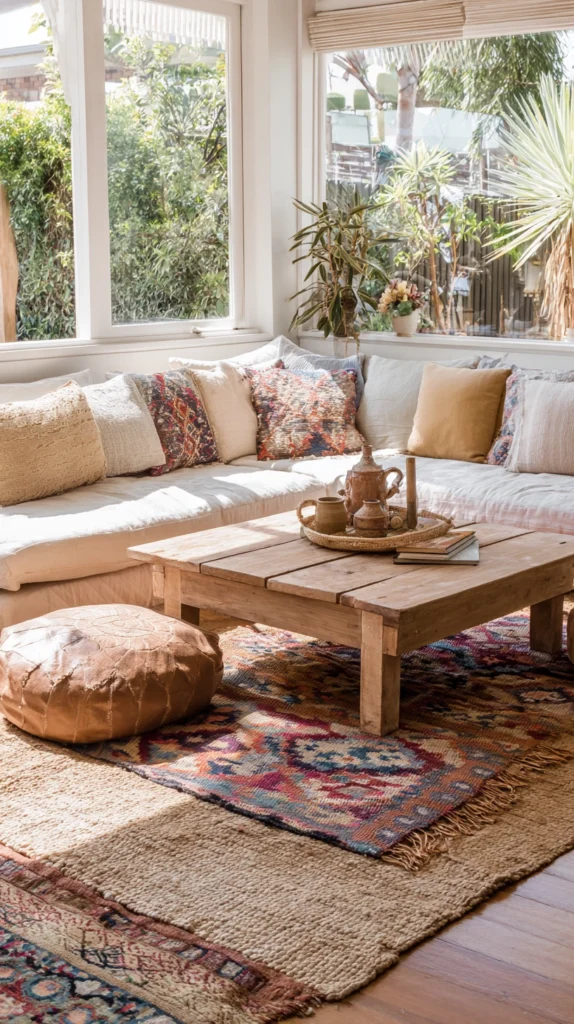
Budget: $40 – $300
Layering rugs — placing a smaller, more decorative rug on top of a larger, neutral base rug — is one of the most characteristically boho decorating moves and one of the most effective ways to add warmth and visual interest to a summer room without changing the furniture or wall colour. A large jute or sisal base rug grounded under a smaller patterned kilim or Moroccan Beni Ourain rug creates a layered, textural arrangement that makes any seating area feel more intentional and more comfortable than a single rug or bare floor.
A large jute or sisal base rug in 160×230 cm costs $40–$100. A smaller patterned kilim or vintage-style rug at 90×150 cm runs $30–$150 depending on source and quality. Second-hand kilims and Moroccan rugs from online resale platforms and market stalls are often the most characterful options at the best prices — the slight irregularity and fading of a used rug suits the boho aesthetic far better than the uniformity of a new one. Offset the smaller rug at a slight angle rather than aligning it perfectly parallel to the larger one beneath — the angle is the detail that makes the layering look deliberate rather than accidental.
Style tip: Choose a base rug in a natural, undyed material — jute, sisal, or natural wool — and let the layered rug carry all the pattern and colour. Two patterned rugs layered together compete rather than complement. A neutral base and a patterned top rug is the combination that consistently reads as intentional rather than busy.
4. Trailing and Hanging Plants Everywhere
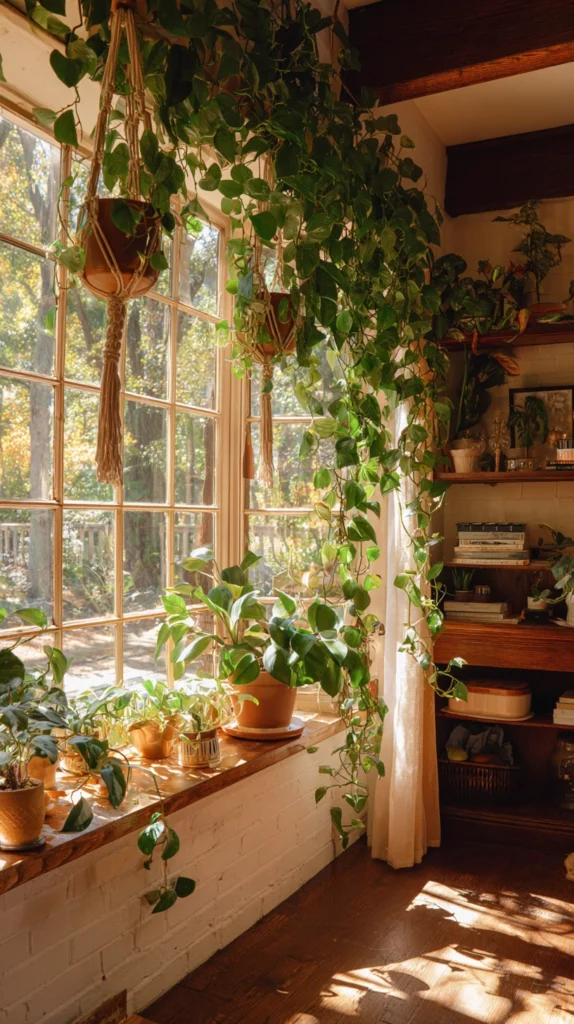
Budget: $30 – $150
Plants are the most essential element of boho summer decor — not as occasional accents but as a consistent, abundant presence throughout the space. Trailing pothos and string of pearls hanging from shelves, large monstera leaves reaching into a corner, a cluster of small succulents on a windowsill, and a fiddle leaf fig standing beside a sofa together create the layered, living quality that distinguishes genuinely boho interiors from those that merely reference the aesthetic through furniture and textiles. The plants are not decoration — they are the environment.
Pothos plants in hanging pots cost $8–$20 and are among the most forgiving and fastest-growing trailing plants available for indoor use. String of pearls in a small hanging pot costs $6–$15. A monstera deliciosa in a 14–17 cm pot runs $15–$35. A fiddle leaf fig in a 19–21 cm pot costs $20–$50. Macramé plant hangers cost $10–$25 each and are available from most homewares and craft retailers. Cluster pots at different heights — on the floor, on shelves, hanging from the ceiling — to create the layered, jungle-like density that boho plant styling requires.
Style tip: Use terracotta, ceramic, and woven basket pot covers rather than plastic nursery pots as the visible outer container. The material of the pot is as important as the plant inside it in a boho interior — a beautiful trailing pothos in a plastic pot looks like a houseplant. The same plant in a hand-thrown terracotta pot or a woven seagrass basket looks like a considered design element.
5. A Floor Cushion and Pouf Seating Corner
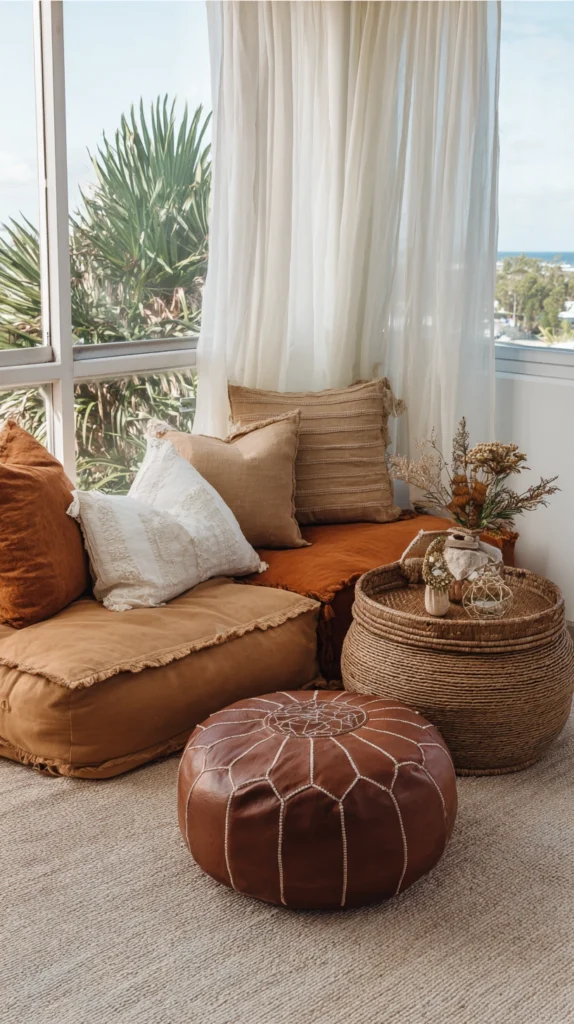
Budget: $50 – $200
A low seating corner assembled from floor cushions, a Moroccan leather pouf, and a low rattan tray as a coffee surface is one of the most distinctly boho interior setups available and one that transforms even a small or awkward corner of a room into somewhere people genuinely want to sit. The floor-level seating creates an intimacy and informality that standard sofa-and-coffee-table arrangements rarely achieve, and it requires very little floor space to establish a functional, comfortable, and visually strong arrangement.
Large floor cushions in linen, cotton, or woven fabric cost $20–$60 each. A Moroccan leather pouf costs $40–$100 and doubles as extra seating, a footrest, or a low side table with a wooden tray balanced on top. A low rattan tray for a surface costs $15–$35. Choose cushion covers in a mix of solid, striped, and embroidered fabrics in warm earthy tones — terracotta, ochre, rust, dusty pink, and warm cream — for a palette that reads as boho without the visual confusion of too many conflicting colours. All fabric selections should be washable given the frequency with which floor cushions are used.
Style tip: Position the floor cushion corner at an angle to the room rather than parallel to the walls. A diagonal arrangement within a square or rectangular room creates the relaxed, non-institutional feeling that boho seating setups require. Furniture arranged at strict right angles to the walls always reads as more formal than the same pieces shifted slightly off the grid.
6. Woven Baskets as Storage and Display
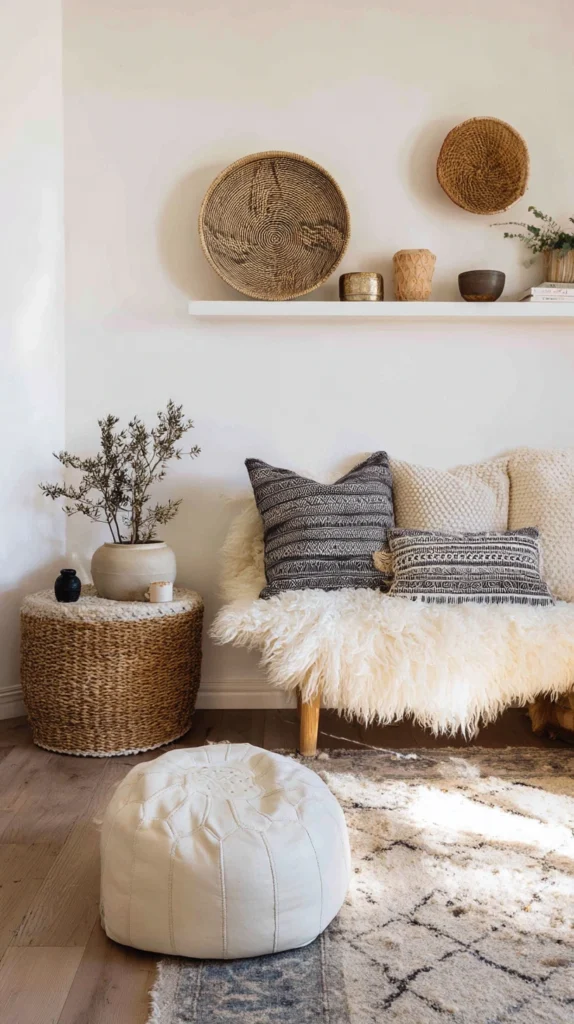
Budget: $20 – $120
Woven baskets are one of the most versatile and cost-effective boho decor elements available. They function as plant pot covers, magazine storage, blanket holders, fruit bowls, wall art, and display trays simultaneously — their usefulness is matched only by their visual warmth, which is considerable. A grouping of different-sized woven baskets in the same corner of a room, or a row of matching baskets on an open shelf, creates an organised, textural display that looks intentional and handcrafted without requiring any additional styling effort around it.
Seagrass, rattan, and water hyacinth baskets cost $8–$30 each depending on size. A set of three nesting baskets in graduated sizes runs $20–$50. Large floor baskets suitable for blankets or laundry cost $25–$60. Hang small shallow baskets on a wall in a loose cluster — wall-mounted basket arrangements have become one of the most recognisable boho decorating signatures and cost considerably less than conventional wall art of equivalent visual impact. Group an odd number — three, five, or seven — at slightly varied heights for the most natural-looking arrangement.
Style tip: Mix basket materials within the same arrangement — seagrass beside rattan beside woven cotton — rather than using a single material throughout. The variation in texture and weave pattern within a consistent warm natural colour palette creates visual interest that a uniformly matched set of baskets never achieves, while the consistent palette keeps the arrangement from looking eclectic to the point of incoherence.
7. Linen and Muslin Curtains
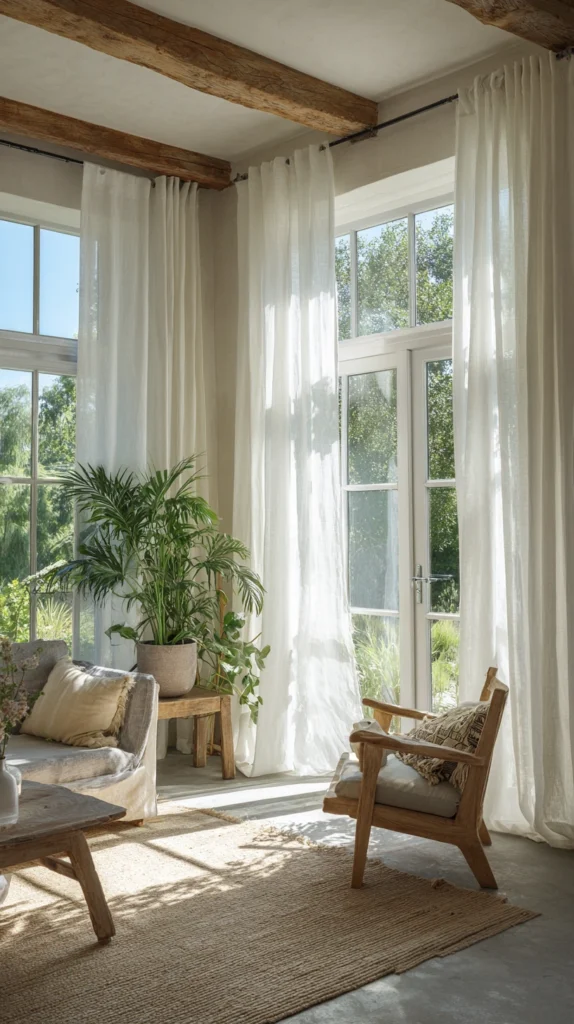
Budget: $40 – $200
Lightweight linen or muslin curtains that billow gently in a summer breeze are one of the most atmospherically effective elements in a boho summer interior. They filter rather than block natural light, allowing the room to feel bright and open while softening the harsh quality of direct midday sun. The natural movement of the fabric in any air movement through the window adds life and animation to a room that static furnishings cannot provide, and the undyed or lightly bleached natural tones of good linen complement every other natural material in the boho palette.
Linen curtain panels in natural, undyed, or stone-washed finishes cost $20–$60 per panel from homewares retailers. Muslin panels — lighter and more affordable — cost $10–$30 per panel. Hang from a simple iron or wooden curtain pole at ceiling height rather than at window-frame height — a curtain hung from the ceiling makes the window and the room feel taller than they are, which suits the airy, open quality of a boho summer interior. Use enough fabric width — at least twice the window width per window — for the gathered, generous drape that makes linen curtains look luxurious rather than skimpy.
Style tip: Allow linen curtains to puddle slightly on the floor rather than hanging them to an exact length. A small amount of pooled fabric at the base — 3–5 cm — creates the relaxed, unstudied quality that is central to the boho aesthetic. Curtains hemmed to precise floor-grazing length look tailored. Curtains that puddle slightly look lived in, which is always the right direction for boho summer decor.
8. A Gallery Wall of Mixed Prints and Textiles
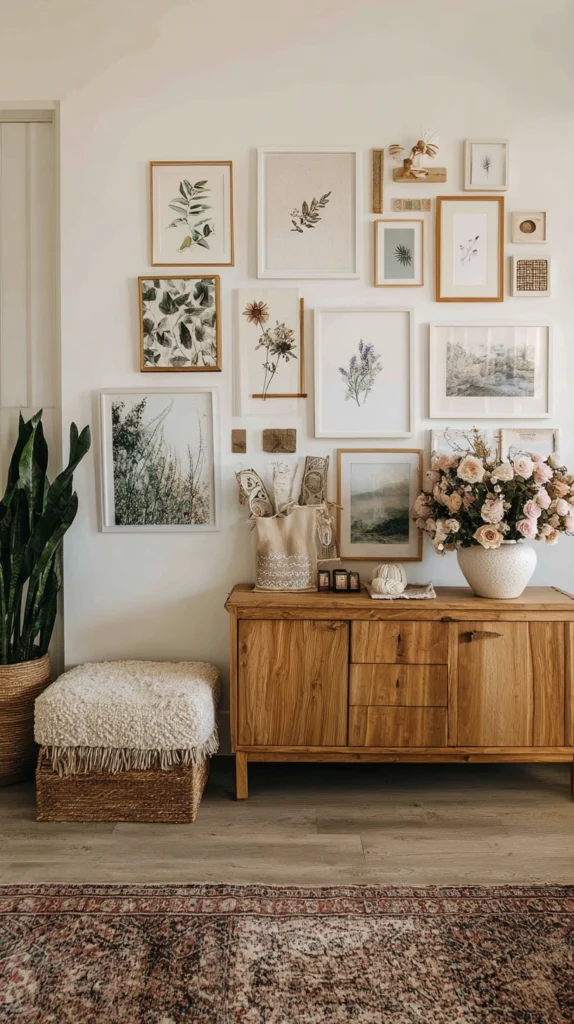
Budget: $50 – $250
A boho gallery wall differs from a conventional art arrangement in one key way — it mixes framed prints with unframed textiles, woven wall pieces, dried botanicals, and found objects rather than presenting a uniform collection of framed artwork at matching heights. The mixture of materials, frames, and sizes creates a layered, collected quality that suits the boho aesthetic far better than the clean geometry of a conventional gallery wall, and it allows the arrangement to grow and change over time as new pieces are added and others moved.
Botanical prints from independent artists cost $5–$25 each unframed. Vintage frames from charity shops run $2–$10 each and add more character than new frames from a homewares chain. Small woven wall textiles cost $15–$40 each and can be hung without a frame using a dowel or a nail. Dried pampas grass in a small vase or dried botanicals mounted on card add organic texture to the arrangement. A wall of fifteen to twenty mixed elements assembled over several months costs $80–$200 in total and becomes increasingly personal and characterful as each new piece finds its place.
Style tip: Establish the largest or most visually dominant piece first — a large print, a textile, or a macramé piece — and build the rest of the arrangement around it rather than starting with the smaller pieces and trying to make them cohere afterward. The anchor piece sets the scale and tone of the whole arrangement, and every subsequent addition either supports or undermines the decisions already made around it.
9. Dried Pampas Grass and Botanical Displays
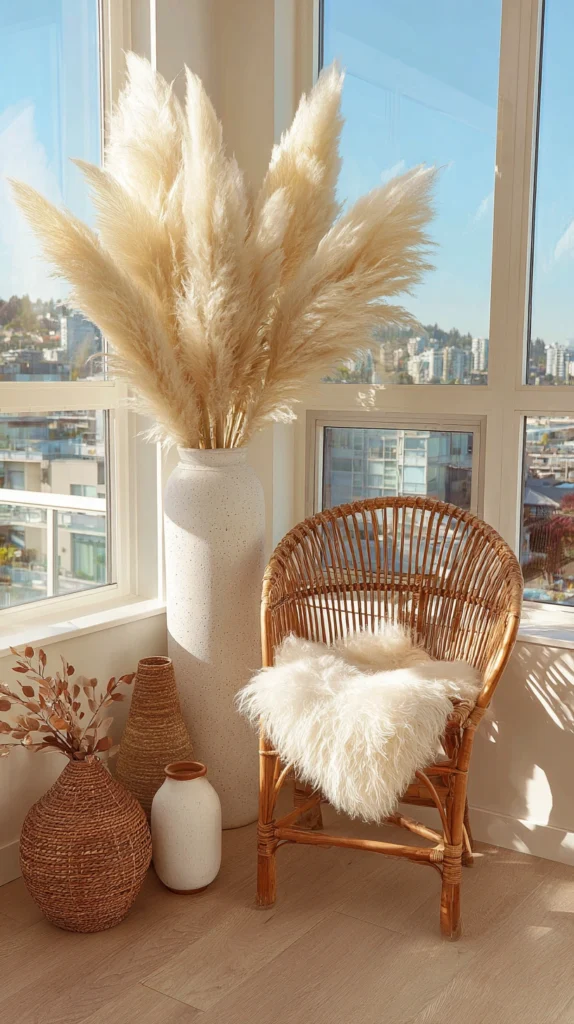
Budget: $15 – $80
Dried pampas grass became the most recognisable boho decor signature of the past few years and has remained one because it works — the soft, feathery plumes add movement and warmth to a corner or shelf in a way that artificial flowers never achieve, they require no maintenance beyond an occasional gentle shake to remove dust, and the warm cream and blush tones of the dried stems suit the earthy, natural boho palette better than almost any fresh flower arrangement. Combined with dried eucalyptus, bunny tail grass, and dried lavender, it creates a botanical display that lasts an entire season without water or replacement.
Dried pampas grass stems cost $3–$8 each from florists, garden centres, and online suppliers, or can be harvested from mature garden plants in autumn at no cost. A generous arrangement of five to seven stems in a tall ceramic or wicker vase costs $20–$50 in materials. Dried eucalyptus bunches cost $8–$20. Bunny tail grass comes in packets of twenty to thirty stems for $5–$15. Arrange in a tall vessel — at least 50–60 cm high — for proportions that read correctly in a room-scale setting. Small vases of pampas grass look decorative. Tall, generous arrangements look architectural.
Style tip: Shake dried pampas stems gently before arranging them indoors to release any loose seed before it settles on surrounding surfaces. Pampas grass sheds its fine seed over time, particularly in warm, dry indoor conditions, and the shedding is considerably less disruptive when managed at the point of bringing the stems inside rather than discovered across furniture surfaces several weeks later.
10. Warm Ambient Lighting With Rattan Shades
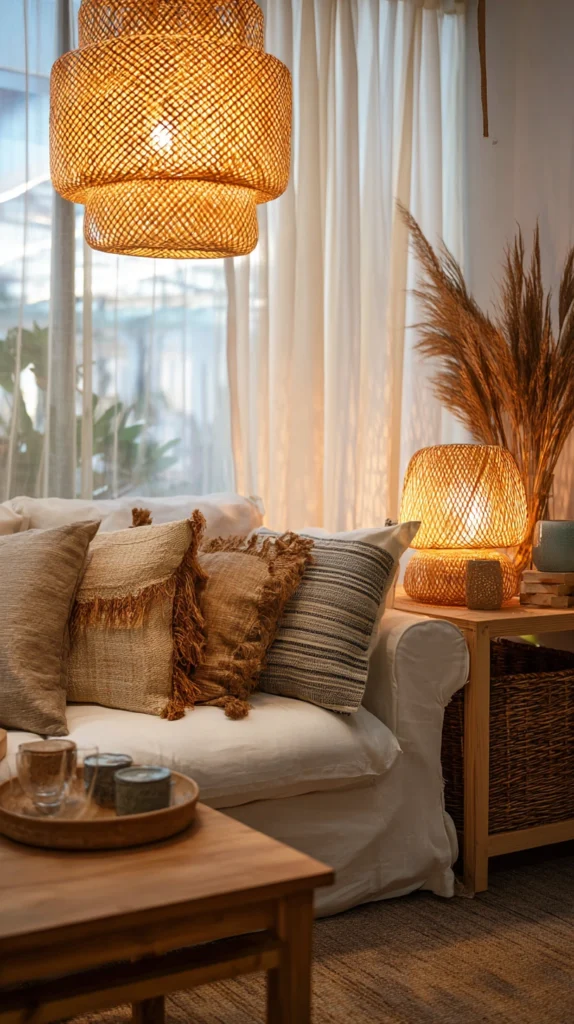
Budget: $40 – $200
Lighting in a boho summer interior should be warm, layered, and as far from overhead fluorescent as possible. Rattan and woven pendant shades cast a dappled, patterned light through their weave that adds visual texture to walls and ceilings that solid shades cannot produce. A rattan pendant over a dining table, a wicker table lamp on a sideboard, and a string of warm fairy lights draped over a shelf together create a light environment that suits long summer evenings and the relaxed, unhurried quality that boho decor is built on.
A rattan pendant lampshade in 30–40 cm diameter costs $30–$80 from most homewares retailers and can be fitted to an existing ceiling rose with a standard pendant fitting. Wicker table lamps with a fabric or paper shade run $40–$100. Warm white fairy lights on a 5-metre reel cost $10–$25 and can be draped over a headboard, wound around a mirror, or arranged along a shelf without any fixed installation. Use warm white bulbs throughout — 2700K or below — and avoid cool white light in any form, which immediately undermines the warm, organic quality that boho decor depends on.
Style tip: Never rely on a single overhead light source in a boho room. Layer at least three light sources at different heights — a ceiling pendant, a table or floor lamp, and either candles or fairy lights — and use dimmers where possible. Boho interiors at their most atmospheric are always lit from multiple low points rather than from a single central overhead source that flattens the textures and warmth that the rest of the decor is working to create.
11. Terracotta Pots in Every Size
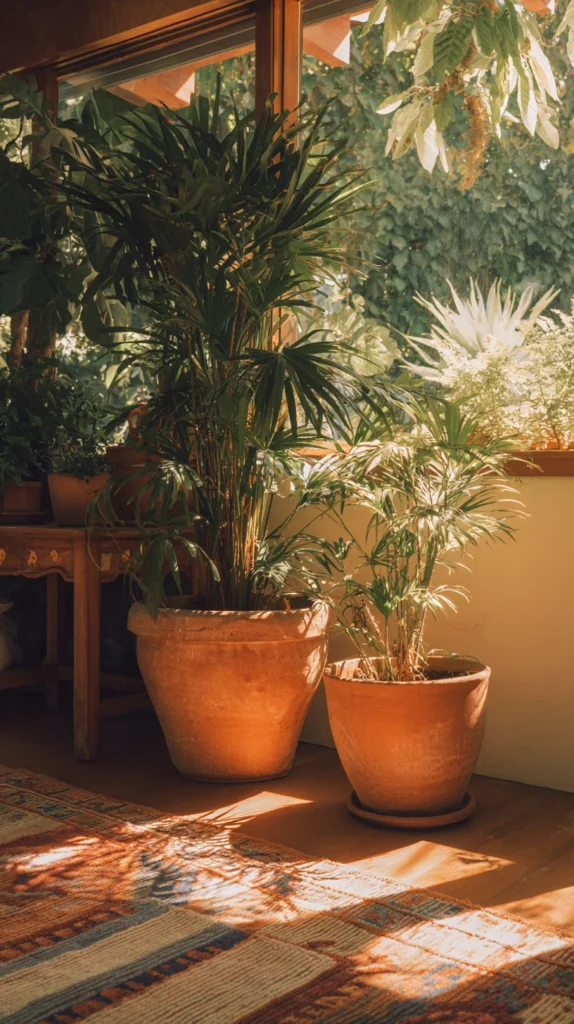
Budget: $15 – $80
Terracotta is the most reliably boho pot material available and one of the most affordable. The warm, earthy orange-red tone of unglazed terracotta suits natural light, linen textiles, and wooden surfaces in the way that no glazed or synthetic pot material does, and the way terracotta ages — developing a white mineral bloom and slight weathering over time — only makes it more beautiful in the context of a boho interior where patina and imperfection are valued over pristine uniformity. A collection of terracotta pots in varying sizes, grouped together or distributed across a room, costs very little and contributes enormously to the warmth of the space.
Terracotta pots in standard sizes cost $2–$15 each from garden centres and homewares retailers. Large decorative terracotta jars and amphora-style vessels run $20–$60. Aged or painted terracotta — whitewashed, colour-dipped, or wrapped in jute twine — can be found at vintage markets for $5–$25 each. Group pots in threes or fives on a windowsill, shelf, or floor corner, mixing sizes and heights. A pot without a plant — used as a sculptural object or a small vase for a single dried stem — is as valid in a boho arrangement as one planted with a trailing succulent or a compact herb.
Style tip: Soak new terracotta pots in water for an hour before using them for the first time. New terracotta is porous and draws moisture away from the compost and plant roots rapidly until the material is saturated. A pre-soaked pot maintains more even moisture around the plant’s root system and reduces the frequency of watering needed through the first few weeks after planting.
12. A Hammock or Hanging Chair Indoors
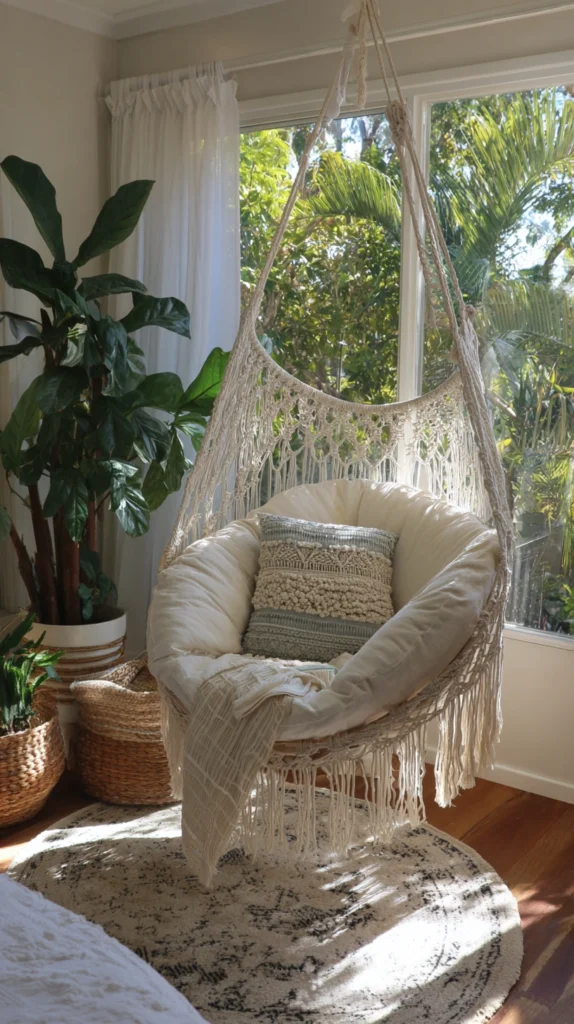
Budget: $80 – $350
Bringing a hammock or hanging chair indoors is one of the most genuinely boho things a summer interior can include. It is unexpected, it is supremely comfortable, and it signals a commitment to leisure and relaxation that conventional seating arrangements, however good, can never quite convey in the same way. A macramé hanging chair suspended from a ceiling hook in a bedroom corner or beside a large window is simultaneously a piece of furniture and the most characterful element in the room — the focal point around which everything else is arranged.
A macramé hanging chair in natural cotton cord costs $80–$200. A woven rattan egg chair with its own stand costs $150–$350 and requires no ceiling fixing, making it the practical choice for rented properties or rooms without a suitable ceiling joist. Ensure any ceiling-mounted chair is fixed into a structural joist using a rated hook and hardware — the dynamic load of a person in a swinging chair is considerably greater than the static weight it appears to exert, and fixing into plasterboard alone without a joist behind it is not safe for this application. A local handyman or hardware retailer can advise on the correct installation approach for any specific ceiling type.
Style tip: Dress the hanging chair with a single oversized linen or cotton cushion and a lightweight throw rather than multiple small pillows. The large single cushion and throw creates the relaxed, inviting quality that makes a hanging chair look lived in immediately. Multiple small cushions arranged formally make it look like a display rather than somewhere to actually spend time.
13. Vintage and Collected Objects on Open Shelving
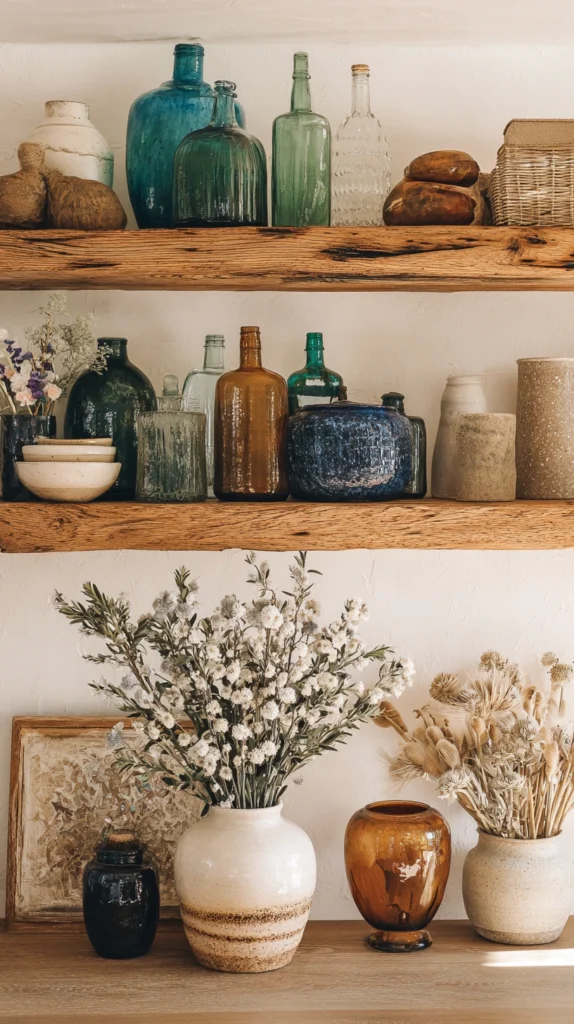
Budget: $20 – $150
Open shelving styled with a mix of vintage finds, travel objects, books, plants, and candles is one of the most distinctly boho decorating approaches and one of the most personal. The collection is never finished, never symmetrical, and never perfectly curated — which is exactly what makes it interesting. A shell from a beach, a small woven basket from a market, a vintage glass bottle, a hand-thrown mug used as a vase — each object carries a story and the shelf as a whole tells a version of the person who assembled it in a way that matching sets of decorative objects from a chain store never can.
Open wooden shelves cost $15–$40 each and can be installed easily on a single afternoon. Floating shelves in natural timber or painted white suit most boho interiors. The objects that populate them are accumulated rather than purchased as a set — vintage markets, charity shops, car boot sales, and holiday souvenirs are the primary sources, and the budget is whatever each individual piece costs at the point of acquisition. The total investment in a genuinely personal shelf arrangement built over one summer season is typically $20–$80 in objects, with the shelving itself as the main fixed cost.
Style tip: Edit the shelf arrangement once a season rather than adding continuously without removing. A shelf that grows without editing becomes cluttered — the objects stop being individually visible and start competing as an undifferentiated mass. Removing two or three pieces each time you add a new one keeps the arrangement breathing and ensures that each object on the shelf is there because it earns its place rather than simply because it has not been moved.
14. Embroidered and Block-Printed Textiles
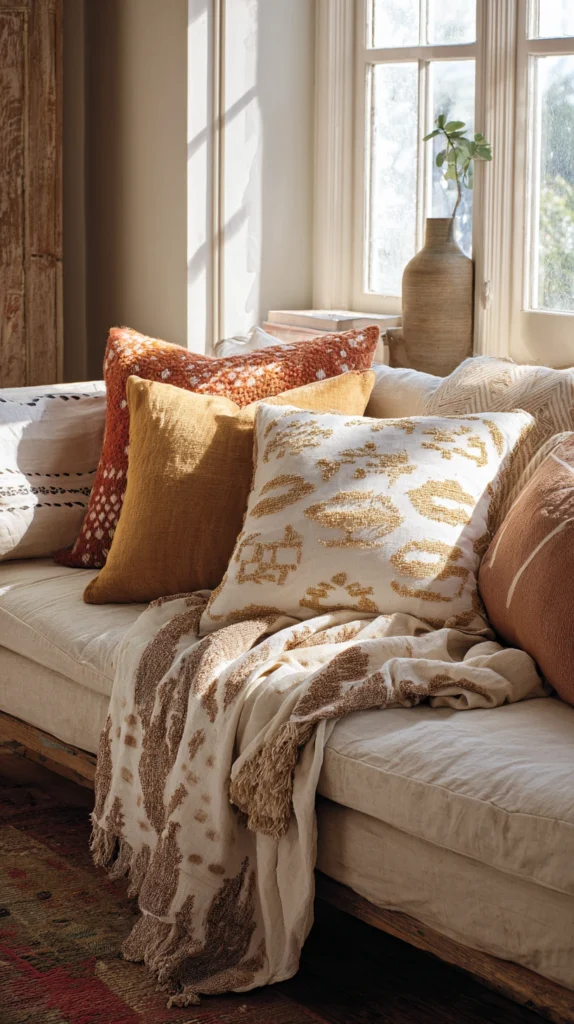
Budget: $30 – $200
Embroidered cushion covers, block-printed tablecloths, hand-stitched wall hangings, and printed cotton throws bring a handcrafted quality to a boho summer interior that machine-made textiles cannot replicate regardless of their design. The slight imperfection in a hand-blocked print or a hand-stitched embroidered detail is what makes these pieces interesting at close range — the evidence of human making that distinguishes them from the uniform precision of a mass-produced equivalent. In a boho interior, the making is as important as the object itself.
Indian block-printed cotton cushion covers cost $10–$25 each. Hand-embroidered cushions from artisan makers run $20–$60. A block-printed tablecloth or throw costs $30–$80 depending on size and source. Embroidered wall hangings from independent makers cost $25–$100. Look for pieces from independent makers on Etsy, at craft markets, and from fair trade retailers rather than from high-street chains where similar-looking products are often machine-produced rather than genuinely handcrafted. The provenance and the making matter in this context as much as the appearance.
Style tip: Mix embroidered and block-printed textiles with plain linen and cotton rather than using exclusively patterned pieces throughout. Patterned textiles need plain surfaces around them to be read clearly and to have their pattern appreciated individually — a room of exclusively patterned textiles becomes visually exhausting. The plain pieces are not background noise: they are the breathing space that makes the decorated pieces visible.
15. An Outdoor-Inspired Indoor Space

Budget: $80 – $400
The most complete expression of boho summer decor is a room that blurs the boundary between inside and outside — large windows open to the garden, potted plants at every level, natural materials throughout, the smell of something growing, and the light quality of a room that is not insulated from the season happening beyond it. This is not a single decorating decision but the cumulative effect of most of the ideas on this list working together: the plants, the natural textiles, the rattan, the terracotta, the warm light, and the openness to whatever summer is doing on the other side of the window.
The investment in a fully realised boho summer interior built across a season of considered additions — a rattan chair, a macramé piece, a set of linen curtains, an abundance of plants, a layered rug arrangement, and a collection of terracotta pots — sits between $300 and $800 for a living room or bedroom space, spread across multiple purchases rather than a single outlay. Each element contributes to the whole, but the whole is always greater than the sum of its parts — which is the characteristic that distinguishes boho decor done well from the same elements assembled without the underlying logic of warmth, texture, and natural materiality that makes the style work.
Style tip: Step back from the room once a month and look at it as a whole rather than as a collection of individual elements. Boho decor is about the overall feeling the space creates — the warmth, the life, the texture — more than about any single piece within it. Monthly reassessment tells you whether the room is moving toward that feeling or accumulating pieces without building toward it, which is the most useful and most honest editing process available for any evolving interior.
Boho summer decor at its best feels like it happened gradually and genuinely — like the room has been lived in and added to over time rather than decorated in a single weekend from a single retailer. That quality takes a little patience and a willingness to let the space evolve rather than trying to complete it all at once. The ideas on this list are best approached one or two at a time, allowing each addition to settle and show you what the space needs next rather than filling every surface simultaneously.
Start with whatever feels most absent from the room you have right now — texture if it feels flat, plants if it feels lifeless, warmth if it feels too cool and minimal. Build from that first right decision and let the rest follow in its own time. The best boho interiors are never finished, and that is precisely what makes them so interesting to spend time in.