15 Organized and Beautiful Pantry Styling Ideas
The pantry is having a cultural moment that shows no signs of abating. Scroll through any interior design platform for longer than five minutes and you will encounter image after image of perfectly organized pantry shelves — matching glass jars in descending order of size, color-coded labels in a consistent typeface, a palette of natural linen and warm timber and matte white ceramics that makes the storage of pasta and flour look like the work of a professional stylist.
There is something in this phenomenon worth examining rather than simply dismissing as aesthetic excess: the organized pantry genuinely improves daily life in ways that go beyond its visual appeal.
A pantry where you can see everything, find anything in seconds, and assess your supplies at a glance reduces the friction of daily cooking, eliminates the frustration of reaching past six things to find a seventh, and creates the pleasant sensation of a kitchen that is under control — a sensation that has downstream effects on the stress levels of everyone who cooks in it.
The aspiration to the beautiful pantry is also an aspiration to a more organized domestic life, which is a worthwhile aspiration however it is packaged. The good news is that a genuinely useful and genuinely beautiful pantry does not require a dedicated room, a significant budget, or professional installation — it requires a system, some investment in containers, and the willingness to maintain it. Here are fifteen ideas for building yours.
1. Decant Into Matching Containers for Visual Cohesion
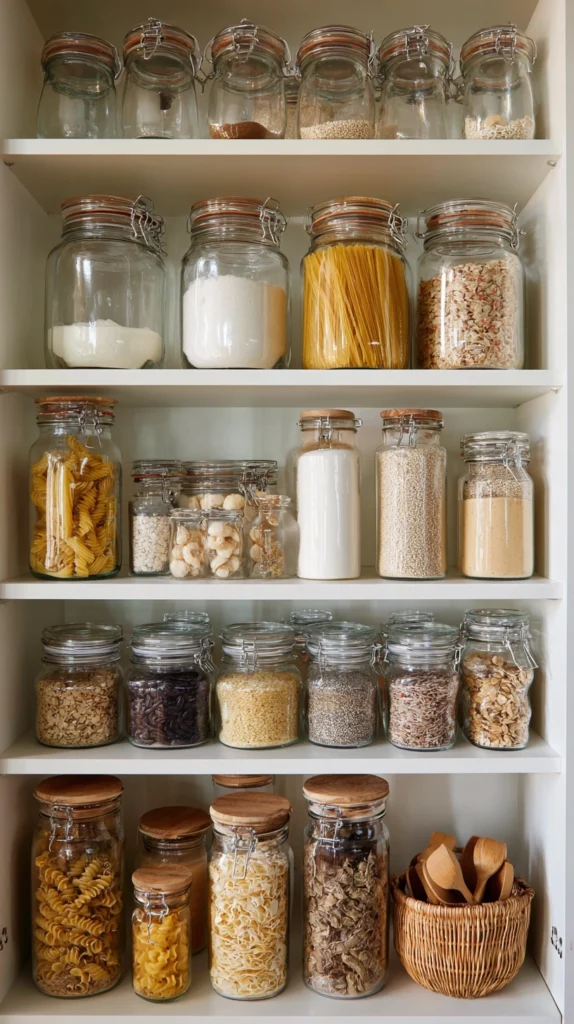
The single most transformative pantry organization decision available — the one that converts a pantry from a collection of competing commercial packaging into something that looks genuinely designed — is the transfer of dry goods from their original packaging into matching containers.
Flour, sugar, rice, pasta, oats, lentils, nuts, seeds, cereals, and the full range of dry staples that most households store in their original bags and boxes, when decanted into matching glass or ceramic containers, immediately create the visual coherence that is the foundation of a beautiful pantry.
The container choice matters enormously: wide-mouth glass jars with airtight lids in a consistent style allow the contents to be seen from the front, which is both beautiful and functionally essential; ceramic canisters in a coordinated palette create a warmer, more tactile visual effect; clear acrylic containers maximize visibility while providing a more contemporary aesthetic.
Whatever the container style, the consistency is the point — the elimination of the visual noise of competing commercial packaging, replaced by a unified system whose visual logic is immediately apparent, is the pantry’s most significant upgrade available at any budget level.
2. Label Everything with a Consistent System
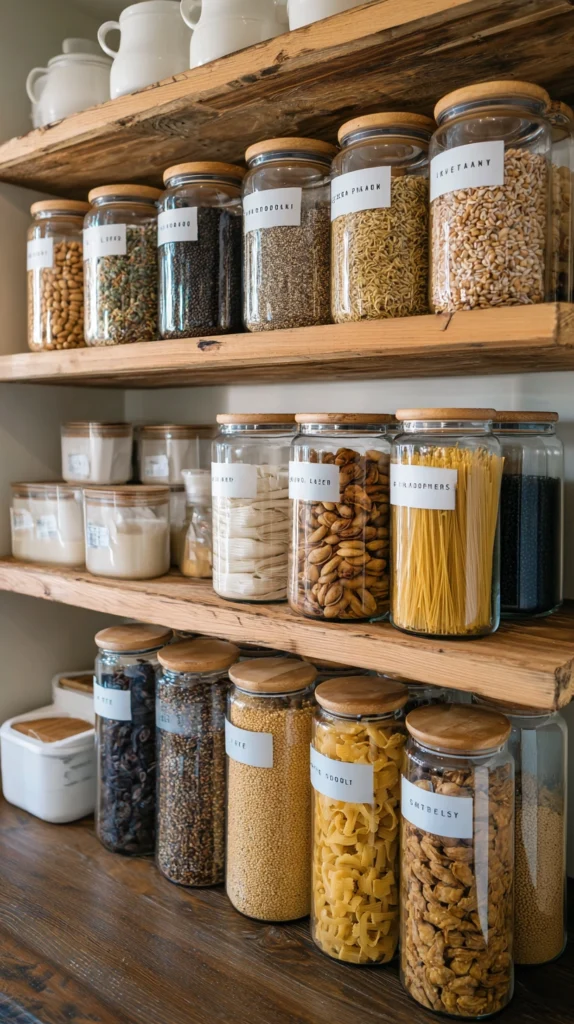
The labeled pantry is not merely a more beautiful version of the unlabeled pantry — it is a more functional one, because labels communicate not only what a container holds but where it belongs, ensuring that the organizational system is maintained consistently by everyone in the household rather than degraded by well-intentioned but disorganized restocking.
The labeling system should be consistent in typeface, in label material, and in the information it communicates — at minimum, the contents and where relevant the date of decanting for items with significant shelf life considerations. A label maker producing clean, consistent text on a matte white label is the most practically efficient labeling system for most households.
Hand-lettered labels in a consistent hand on kraft paper or cream card create a warmer, more craft-like effect that suits pantries with a natural, organic aesthetic. Whatever the labeling method, apply it to every container without exception — the partially labeled pantry where some containers are identified and others are not defeats the system’s organizational purpose entirely.
3. Organize by Zone and Category
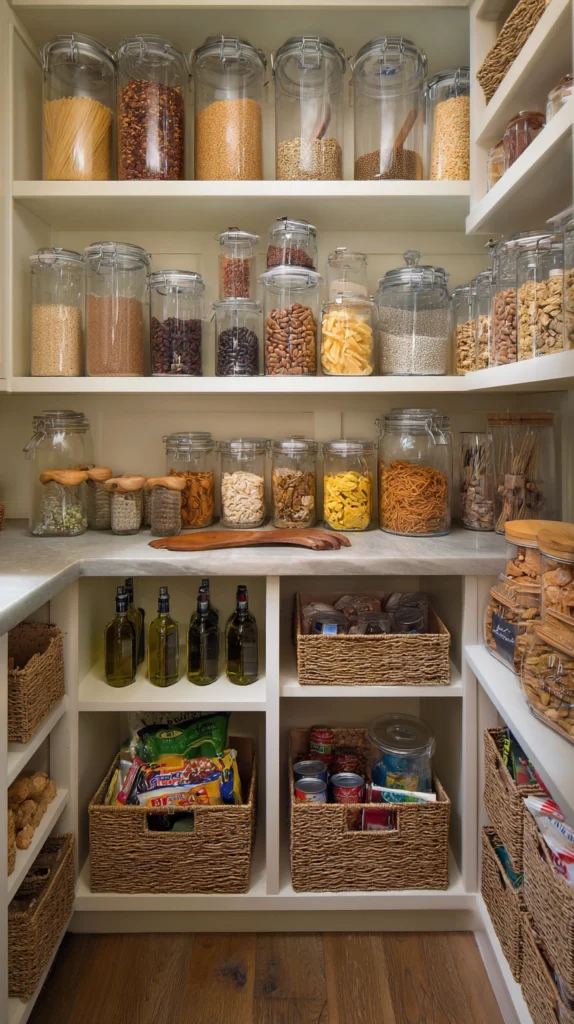
The pantry that is organized by zone — a clearly defined area for baking ingredients, a separate area for grains and pulses, a zone for snacks, a zone for canned and preserved goods, a zone for breakfast items, a zone for oils, vinegars, and condiments — is significantly more functional than one where items are stored wherever space permits without reference to category or frequency of use.
The zoning principle works on a simple psychological basis: when the baking zone is in a consistent place, the brain develops an automatic association between the need for a baking ingredient and the specific shelf or section where it will be found, which eliminates the low-level cognitive effort of searching that an unzoned pantry requires every time a specific item is needed.
Position the most frequently used zones at eye level and within easy reach — the daily staples of cooking deserve the best access — and reserve the higher shelves for items used occasionally and the lower shelves for bulk storage and heavy items.
4. Use Tiered Shelf Risers for Depth Management
The deep pantry shelf is one of the domestic kitchen’s most persistent organizational challenges, because the items stored at the back of a deep shelf are invisible and inaccessible — out of sight, out of mind, out of rotation — until they are discovered months past their best by date during a pantry clear-out that the depth of the shelf made necessary in the first place.
A tiered shelf riser — a stepped platform that positions items at the back of the shelf at a higher level than those at the front, making every item visible from the front of the shelf regardless of its position — solves the deep shelf problem with remarkable simplicity and effectiveness.
Tiered risers are available in timber, bamboo, and acrylic in a range of widths that suit different shelf depths, and they can be used for spice jars, canned goods, small bottles, and any item that benefits from being raised above the items in front of it. The investment is modest and the organizational improvement is immediate and permanent.
5. Create a Dedicated Snack Zone for Family Accessibility
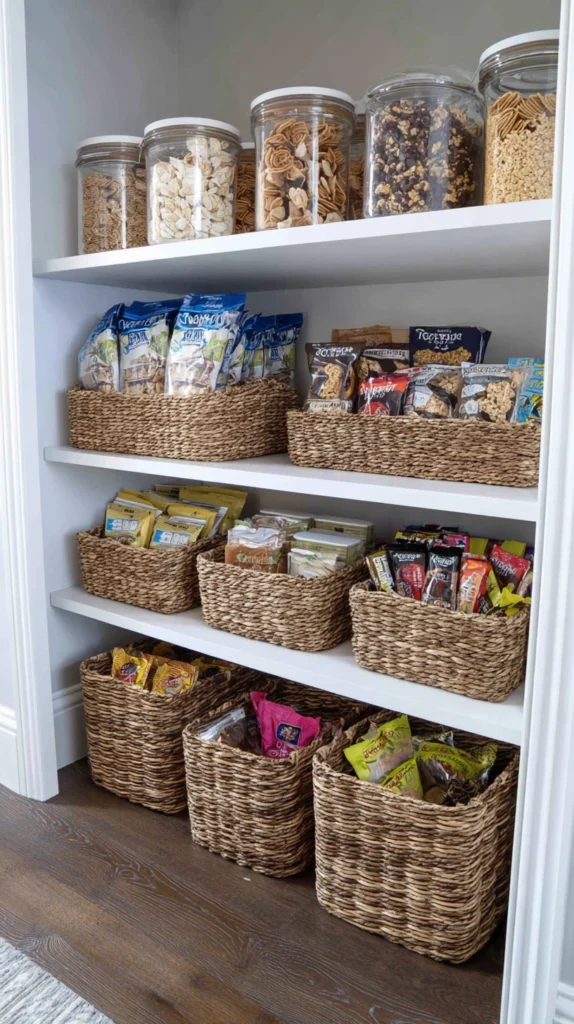
The snack zone — a specific, defined section of the pantry stocked with approved snacks and positioned at a height accessible to every family member who is expected to help themselves independently — is one of those pantry organizational decisions whose daily quality-of-life impact is immediately and consistently felt.
When snacks are dispersed throughout the pantry rather than consolidated in a designated zone, the decision of what to eat requires a survey of the entire pantry, which is both inefficient and likely to result in less healthy choices made on the basis of what was most visually prominent rather than what was most appropriate.
A dedicated snack zone — a single basket or a specific shelf section holding all the household’s approved snacks in a visible, accessible arrangement — makes the healthy choice the easy choice by design, which is the most sustainable behavior modification available without requiring any willpower from anyone.
6. Invest in a Lazy Susan for Corner and Deep Shelves
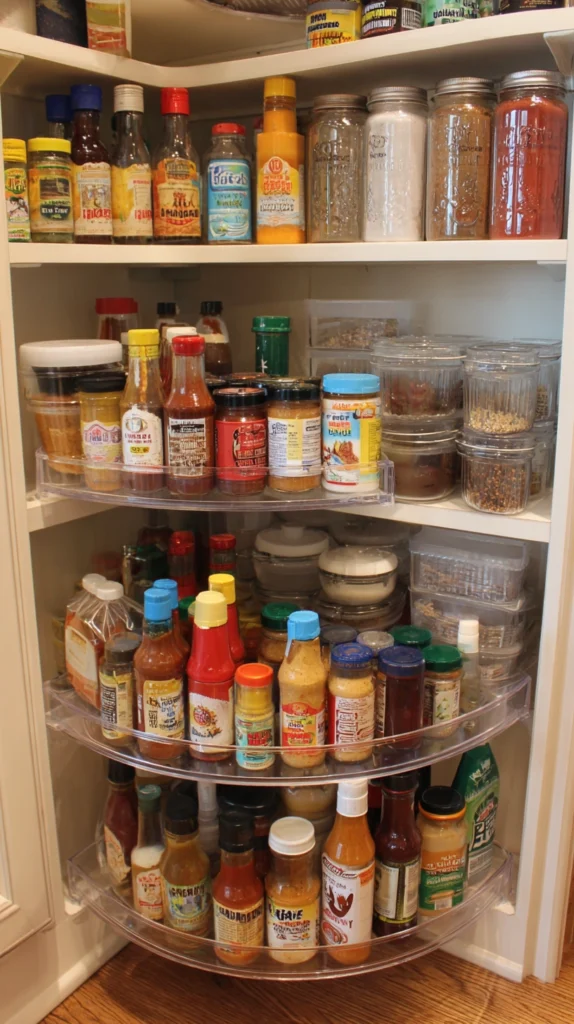
The lazy Susan — a rotating turntable that allows every item on a circular platform to be brought to the front of the shelf with a simple rotation — is the single most useful piece of organizing hardware available for pantry shelves, and it is most valuable in the two locations where access is most problematic: deep shelves where items at the rear are inaccessible, and corner shelves where the geometry of the corner makes the inner sections of the shelf difficult to reach.
A set of stacking lazy Susans of different diameters, positioned at the points of maximum access difficulty in the pantry’s shelf layout, transforms the usability of those areas more completely than any other single organizational intervention.
Use them for spices and small bottles where the rotating mechanism allows every item to be quickly and clearly presented; for canned goods where the rotation allows a complete inventory to be visible in a single turn; and for condiment bottles whose varied heights make them difficult to organize efficiently in a static arrangement.
7. Maintain a Visible Inventory System
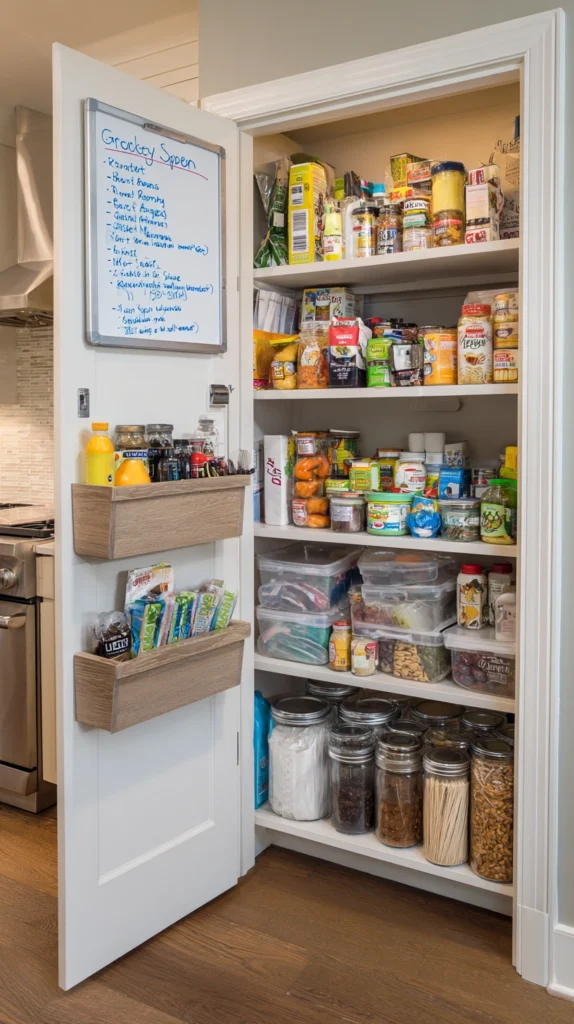
The pantry that maintains a visible inventory — a list of current stock levels displayed on the inside of the pantry door, on a small chalkboard or whiteboard mounted nearby, or in a simple digital note accessible on a phone while shopping — eliminates two of the most common and most frustrating pantry failures: the duplicate purchase of items already in stock, discovered only when attempting to store the new purchase, and the absence of an essential ingredient discovered mid-recipe.
A physical list on a chalkboard or magnetic whiteboard, updated by whoever finishes or restocks any item, requires the least technology and the most consistent discipline.
A shared digital list that all household members can update from anywhere — including from the supermarket when they notice that something is running low — requires more technology but less discipline in the moment of updating, since the update can be made immediately from wherever the discovery of low stock occurs. Either system works; the choice depends on the household’s habits and preferences.
8. Use the Pantry Door for Additional Storage
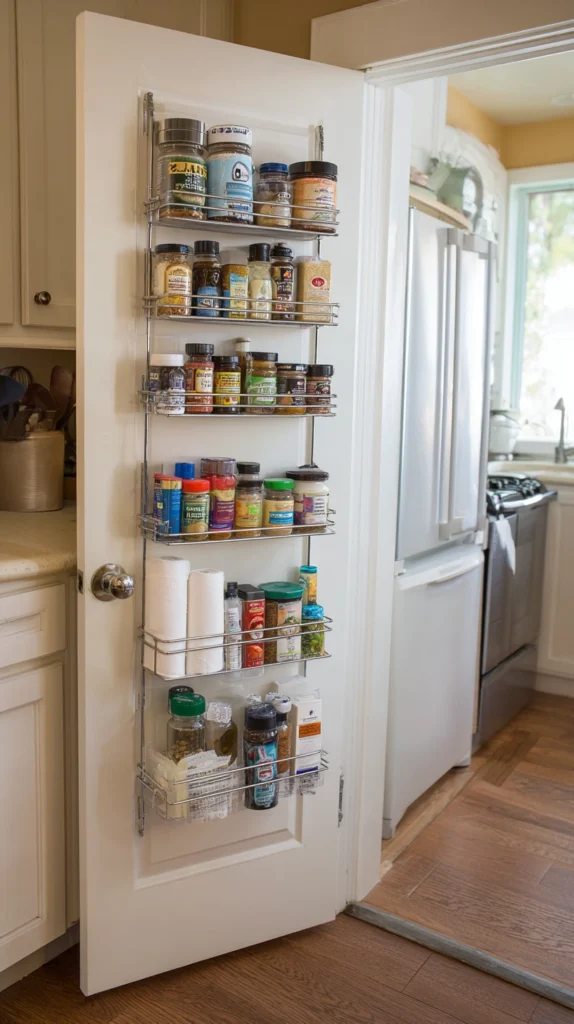
The inside face of the pantry door is a vertical storage surface that most pantry organizational systems ignore entirely, and equipping it with a properly installed over-door rack or a series of wall-mounted shelving strips converts it from a wasted surface into a useful additional storage zone that can accommodate spices, small bottles, foil and cling film rolls, snack bags, and the miscellaneous small items that otherwise clutter the main shelves without adding enough organizational value to justify their shelf space.
Over-door racks designed specifically for pantry use are available in metal wire and powder-coated steel in a range of sizes and configurations, some with adjustable shelf heights that allow the rack to be customized to the specific items it will store.
Ensure that the rack’s depth when loaded does not exceed the clearance between the door and the nearest shelf when the door is closed — measure this carefully before purchasing, as the depth of a loaded door rack frequently causes the door to catch on adjacent shelving if the clearance has not been properly accounted for.
9. Standardize Your Tin and Can Storage
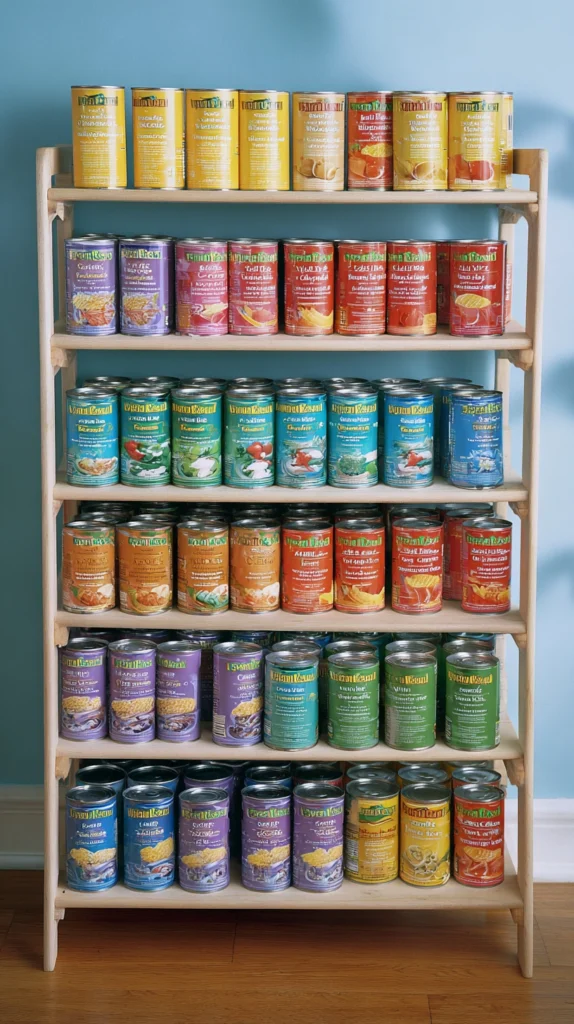
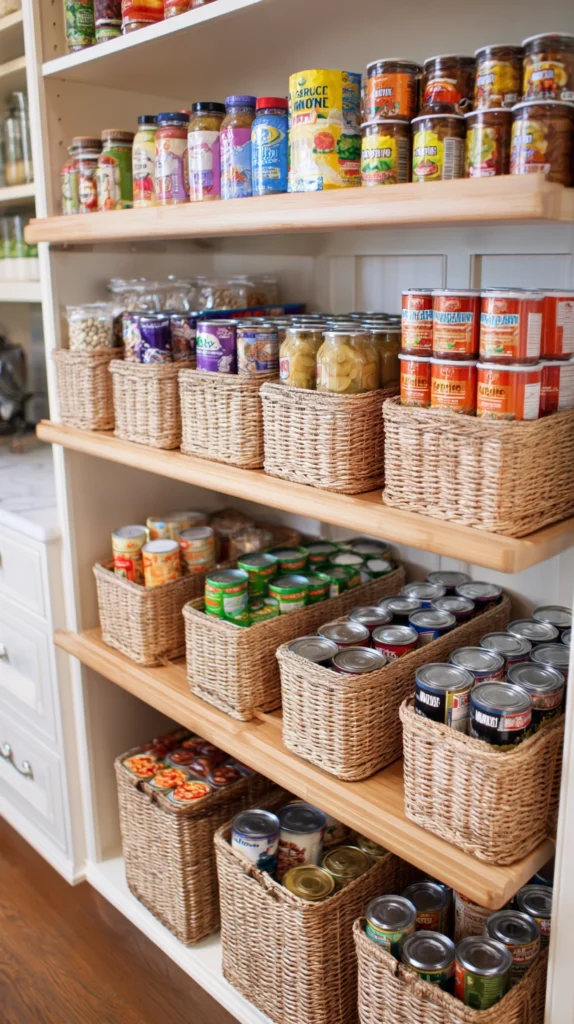
Canned goods are among the most challenging pantry items to organize effectively — they are heavy, they cannot be decanted into transparent containers for visual display, their labels are designed for commercial shelf display rather than domestic pantry organization, and they accumulate quickly into unstable stacks that collapse when any item is removed from anywhere other than the top.
A can dispenser — a tiered rack that holds cans in a gravity-fed column so that new cans added at the back roll forward to replace cans removed from the front — creates a first-in-first-out rotation system that is both organizationally correct from a food freshness perspective and spatially efficient.
Alternatively, organizing cans in a single layer on a shelf riser, facing forward, with a clear label system indicating the category of each section, creates a visible and accessible can storage system that works for most household can inventories without the dedicated infrastructure of a can dispenser.
10. Decant Oils and Vinegars into Beautiful Dispensers
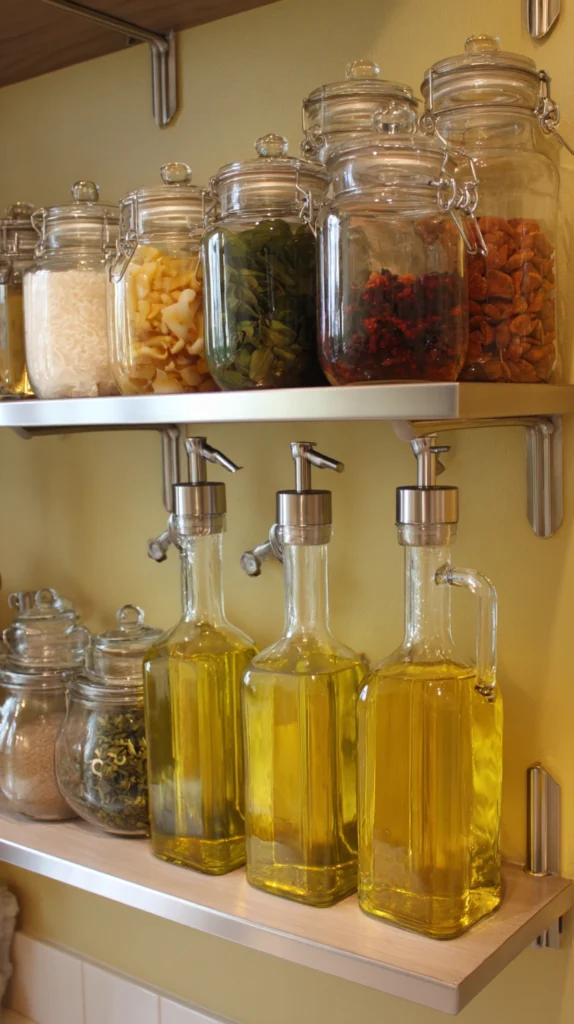
The oils and vinegars section of the pantry is the area most consistently undermined by the commercial packaging of the products it contains — the variety of bottle shapes, label designs, and cap styles creating a visual chaos that clashes with the organizational coherence achieved in the rest of the pantry.
Decanting frequently used oils and vinegars into matching dispensers — simple glass bottles with pouring spouts, matching ceramic decanters, or a set of coordinated glass bottles in a consistent shape and style — creates an oils and vinegars display of genuine beauty that suits both pantry storage and counter display.
The decanted dispensers can be stored in the pantry and brought to the counter during cooking, or stored on the counter permanently as a kitchen display if the kitchen’s aesthetic suits open-container storage. Label each dispenser clearly with its contents and replace the product when the dispenser is empty, maintaining the rotation that ensures the product quality remains high.
11. Create a Breakfast Station Within the Pantry
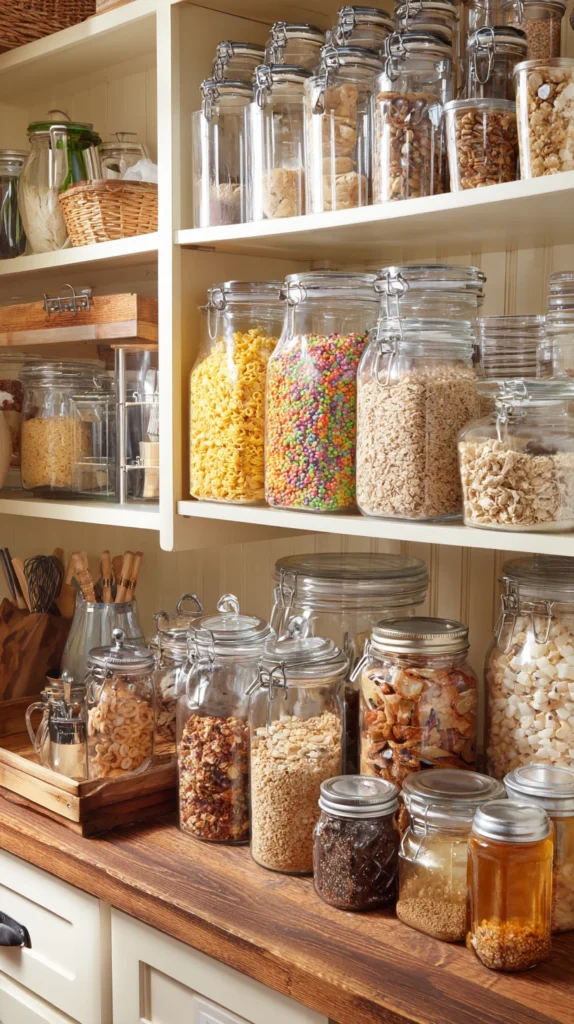
A dedicated breakfast station within the pantry — a shelf or section that holds everything needed for the household’s breakfast routine in a single, accessible location — converts the morning kitchen experience from a search through multiple sections of the pantry into a single interaction with a defined zone.
Cereals, oats, granola, nut butters, honey, jams, and whatever other breakfast items the household regularly consumes, organized together on a specific shelf or in a dedicated basket that can be brought out to the counter as a single unit, create a morning routine of remarkable efficiency and clarity.
The breakfast station can be made even more functional by including the non-perishable elements of the coffee and tea setup within its zone — coffee beans or ground coffee, tea bags or loose leaf tea, sugar — so that the first interaction with the kitchen each morning is a single, satisfying engagement with a well-organized, beautiful section of the pantry rather than a dispersed search through multiple cupboards.
12. Use Baskets for Irregular and Difficult Items
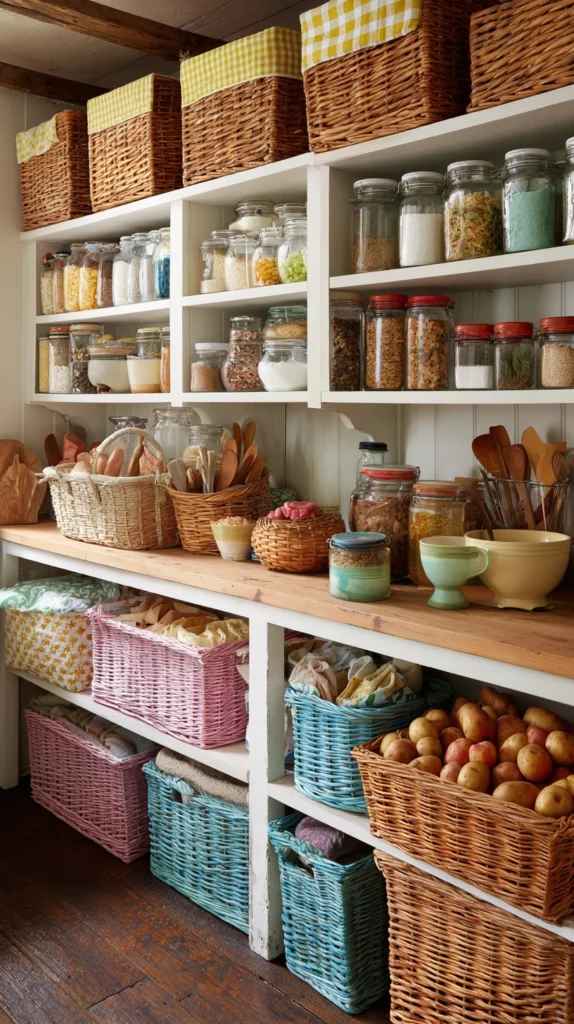
Not everything in a pantry can be decanted into a glass jar or organized into a neat row on a shelf — the irregular shapes of root vegetables, the awkward dimensions of baking tools and equipment, the miscellaneous nature of specialty ingredients used occasionally — and for these items the basket is the most practical and most visually appropriate storage solution available.
A lined wicker or seagrass basket on a lower shelf, holding potatoes and onions in a breathable environment that suits their storage requirements.
A fabric-lined basket on an upper shelf containing specialty baking tools — pastry brushes, cookie cutters, a rolling pin — that are used occasionally and need to be accessible without being displayed.
A small wire basket in the snack zone holding fruit or individually packaged snacks in a contained but accessible arrangement. Baskets create defined zones for difficult items within the pantry’s overall organizational system while adding a warmth and texture that hard-edged containers alone cannot provide.
13. Illuminate Your Pantry with Proper Lighting
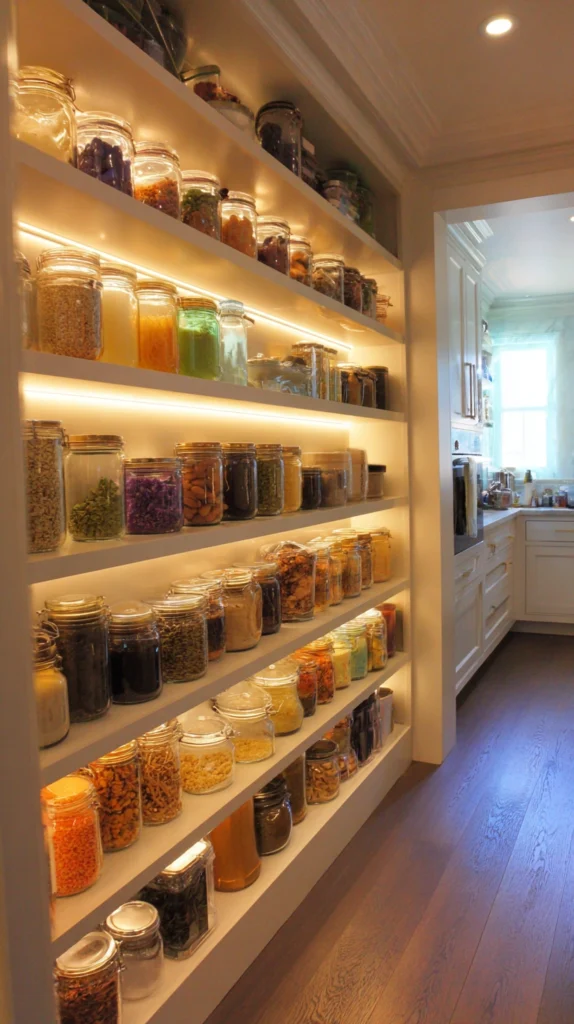
The pantry that relies on the spillover of ambient kitchen lighting to illuminate its interior — the common situation in a walk-in pantry without a dedicated light, or a deep cupboard pantry whose interior is in perpetual shadow — is a pantry that fails at its most fundamental organizational purpose regardless of how well its contents are organized, because items that cannot be clearly seen cannot be efficiently located.
A dedicated light source within the pantry — an LED strip light mounted under each shelf to illuminate the shelf below it, a single ceiling-mounted light on a switch just inside the pantry door, or a battery-powered motion-activated light that turns on when the pantry is opened — converts the pantry from a dark storage space where items are found by memory and touch into a well-lit working environment where every item is clearly visible.
The warmth of the light matters — a warm white LED strip at 2700K to 3000K maintains the pantry’s welcoming quality; a cool white light at 4000K or above creates a clinical environment that undermines the aesthetic investment made in containers, labels, and organization.
14. Perform a Quarterly Pantry Reset
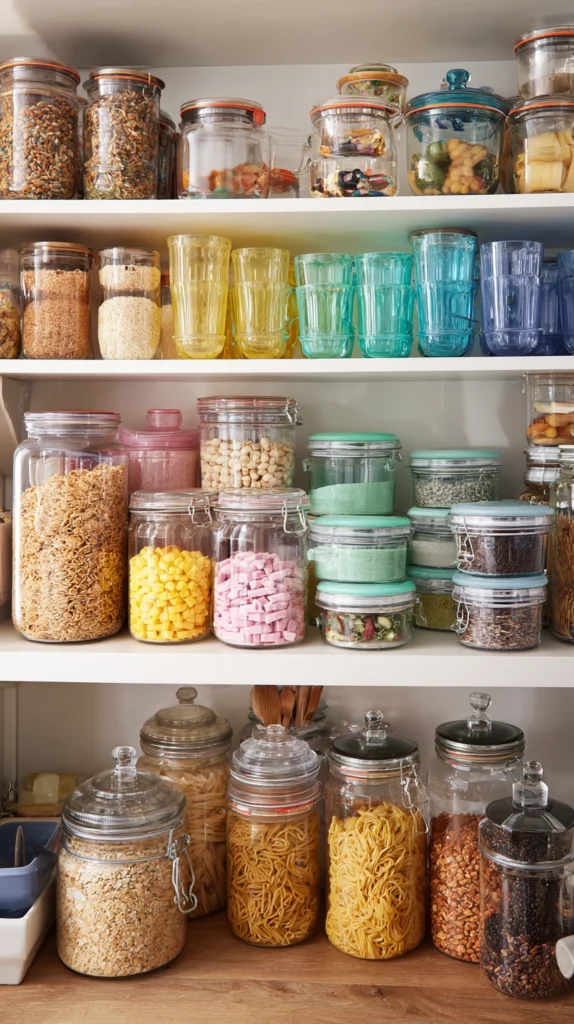
The most visually beautiful and most practically functional pantry in the world will degrade within a few months without a systematic approach to its maintenance, because the accumulation of new purchases, the consumption of existing stock, and the natural drift of items from their designated zones creates an entropy that undermines the organizational system continuously and incrementally.
A quarterly pantry reset — a complete removal of all contents, cleaning of the shelves, disposal of expired items, and systematic replacement of everything in its designated zone — reverses this entropy and restores the pantry to its ideal state four times per year.
The reset should take no more than two hours for a well-organized pantry whose system is already established, and it should be paired with a stock-taking process that generates a shopping list for items that have been consumed and need to be replaced.
This ritual maintenance is what separates the pantry that remains beautiful and functional for years from the pantry that achieves its ideal state for a few weeks after organization and then gradually reverts to its previous disorder.
15. Style the Pantry with a Few Beautiful Objects
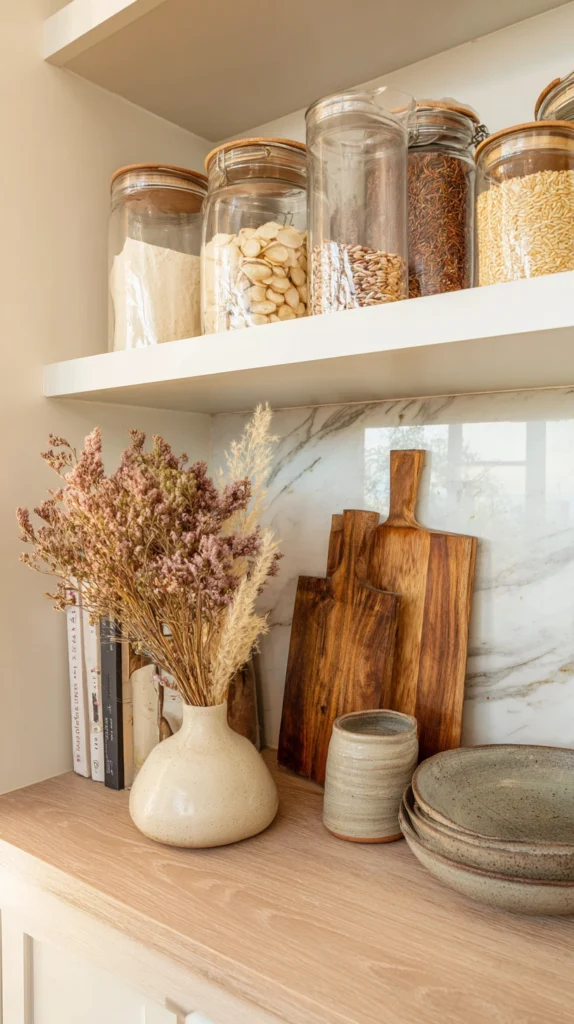
The pantry that contains nothing but food and organizational hardware is a pantry that is functional but not beautiful, and the final idea for a pantry that genuinely achieves both qualities is the addition of a small number of carefully chosen non-functional objects that give the space character and warmth without interfering with its organizational purpose.
A small ceramic vase holding a few dried stems from the garden. A beautiful cutting board leaning against the back wall of a shelf, its timber grain visible behind the containers in front of it. A small framed botanical print on the pantry wall.
A vintage measuring jug in an interesting glaze positioned as a display object at the end of a shelf. These objects do not need to be many or expensive — they need only to be genuinely beautiful, placed with genuine intention, and consistent with the pantry’s overall aesthetic language.
Their presence transforms the pantry from a storage system into a room — a space with visual intelligence and personal character that reflects the specific sensibility of the person who created it, which is always the highest aspiration of any interior space regardless of its scale or its function.